Category: News

  • Bodycam captures police team falling when deck collapses in Missouri

    Bodycam captures police team falling when deck collapses in Missouri

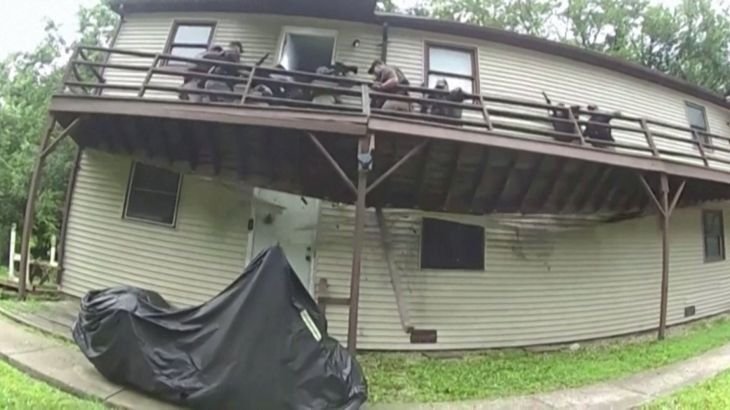
    Recently released body camera footage shows a deck collapsing during a warrant operation in Huntsville, Missouri, injuring multiple law enforcement officers. The raid involved the Moberly Area SWAT Team, US Marshals, and supporting personnel.

  • Trump, Trump, Trump: Kennedy Center Board Voted To Return POTUS’s Name To Three Different Spots On Complex’s Grounds

    Trump, Trump, Trump: Kennedy Center Board Voted To Return POTUS’s Name To Three Different Spots On Complex’s Grounds

    When the board of the Kennedy Center met last week to decide on the future of the complex, they took up a resolution to restore Donald Trump‘s name to the front facade of the complex.

    The vote by the Trump-controlled board was not just one designation for the president, but three.

    According to a copy of the resolution filed in federal court late on Tuesday, Trump’s name would be returned to the front facade, just below its official name, “The John F. Kennedy Memorial Center for the Performing Arts.” Below that lettering, a new one would be added to read, “Restored and Renovated by President Donald J. Trump.”

    That’s not all. The resolution also provides for another Trump designation, just below “Restored and Renovated by President Donald J. Trump.” Once a $100 million threshold is met for an endowment the board set up for the center, per the resolution, a line would be added to read, “Endowed by the Trump Kennedy Center Fund.”

    So the facade of the Kennedy Center would read:

    The John F. Kennedy Memorial Center for the Performing Arts

    Restored and Renovated by President Donald J. Trump

    Endowed by the Trump Kennedy Center Fund

    There’s more. The board resolution also designated “the physical site and grounds upon which the center sits” as the “President Donald J. Trump Plaza.”

    The resolution said that the purpose in recognizing Trump was that he “has successfully engaged in raising hundreds of millions of dollars for the Center, both in appropriated funds and private funds, and brought it back from the brink of disaster.” In a prior legal document, the center’s attorneys acknowledged that ticket sales fell last year, when Trump took control of the institution, while artists canceled performances.

    The board is chaired by Trump and includes administration figures like Sergio Gor and Dan Scavino and Fox News personalities Maria Bartiromo and Laura Ingraham. In December, they voted to add Trump’s name to the center and, the next day, the facade was changed to read “The Donald J. Trump and The John F. Kennedy Memorial Center for the Performing Arts.”

    Rep. Joyce Beatty (D-OH), an ex officio member of the board, sued, and in May U.S. District Judge Christopher Cooper ruled that only Congress could make such a change to the center’s name.

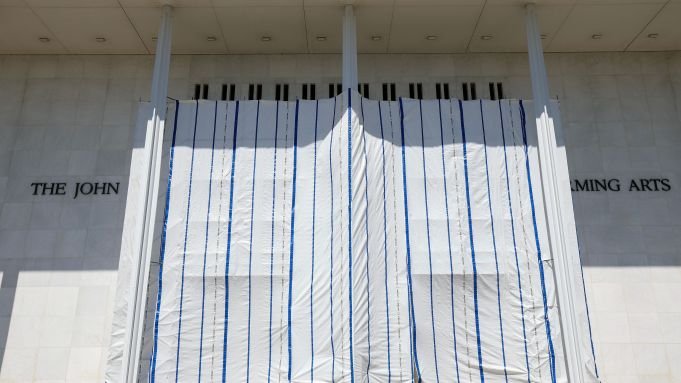
    That forced the center to remove references of the “Trump Kennedy Center” from its website and other materials, and, most prominently, from the front facade. On the night of the deadline to remove Trump’s name from the facade, a crowd gathered and watched as workers installed scaffolding and, in the middle of the night, a tarp. That concealed the actual removal of the lettering for POTUS. The tarp has remained there ever since.

    In response to the latest effort to return Trump’s name multiple times to the front of the building, Beatty’s attorneys argued that the board seems intent “on defying the court’s decision.”

    Her attorneys, Nathaniel Zelinsky and Norm Eisen, wrote, “Adding the words ‘Restored and Renovated by,’ or ‘Endowed by,’ before President Trump’s name, and renaming the ground on which the building sits, provides no lawful basis to ignore this Court’s decision and impose Donald Trump’s name on a memorial dedicated by the Congress exclusively to a different President.”

    They cited a statute that “no additional memorials or plaques in the nature of memorials shall be designated or installed in the public areas of the John F. Kennedy Center for the Performing Arts.” The board’s resolution seemed to suggest that renaming the plaza would fall outside of the statute.

    The center has committed to forego attempts to install the Trump designations until September 8. Beatty’s attorneys want the judge to rule by then.

    A Kennedy Center spokesperson did not return a request for comment.

    As for the tarp, the center’s attorneys cited a declaration from executive director Matthew Floca and wrote that the covering “was and is a necessary element of the ongoing construction activities at the Center—during the removal of the name, it served as a safety barrier for ongoing construction activities and helped safeguard the marble facade of the building in light of reported panel damage.” They added that the center will use the existing scaffolding to “assess, investigate and engineer structural repairs to the overhead soffit.”

    “Final removal of the scaffolding and its barrier is contingent upon the scope of any repairs required at present to the marble facade, as well as any other necessary repairs,” the center’s attorneys wrote.

    Beatty’s attorneys called the explanation a “pretextual justification.” “Defendants state they intend to use the scaffolding to examine the roof overhang,” the wrote. “But the soffits are some twenty feet or more above the scaffolding. Defendants imply that they will erect more scaffolding around the rest of the Center, presumably to examine other portions of the roof. But Defendants tellingly have not done so for months, leaving only the Center’s iconic name obscured—a strong indication that this structure has nothing to do with the roof and is, instead, meant to defy a return to the status quo.”

    Beatty’s team also wrote that they were concerned that the center “may have damaged the historic marble that lines the facade” when they attached Trump’s name in December. “Adding another inscription or inscriptions, in naked defiance of this court’s ruling, obviously would do further damage,” the wrote.

    Congress last year passed $257 million in public funds to renovate the Kennedy Center, as part of the One Big Beautiful Bill Act.

    In his May ruling, the judge also halted plans to close the center for two years for the renovations, concluding that the board had been “derelict” in moving to shutter the complex because they “neglected to consider the full range of its statutory obligations and potential adverse consequences of closure on programming and memorial functions.” He noted that the board could still move to close the complex, but only after there was a fuller consideration of impacts.

    Last week, the board again voted for a two-year closure plan, while keeping limited programming at The Reach, an extension that opened in 2019.

    In the latest filing, the center’s legal team argued that it had conducted an independent analysis, with Delta Consulting Group presenting two options: the closure plan that was ultimately approved, and another plan for a partial closure. The analysis concluded that the partial closure would take longer — four years — and would mean that the center “would suffer a reduction in both revenue and fundraising ability” and “reputational damage that would result from the proximity of construction activities to performance venues.”

    Beatty’s team, though, argued that the board “fell short by a country mile” in its analysis.

    “The only materials that purport to examine the costs and benefits of the closure was a 5-slide PowerPoint presentation prepared by the Delta Consulting Group, which was subsequently displayed at the Board meeting,” they wrote. “Excluding two cover slides and one slide describing the lead consultant’s biography, the substance of the presentation deck is just two slides long.”

    Beatty’s team is calling for a discovery process rather than an expedited briefing on a motion to grant summary judgment, which the center wants. The center also is appealing Cooper’s May ruling.

  • MS NOW To Launch Direct-To-Consumer Subscription Offering In September

    MS NOW To Launch Direct-To-Consumer Subscription Offering In September

    MS NOW said that it would launch its direct-to-consumer offering on Sept. 9, a service that will include access to 24/7 live streams, original creative content and engagement options with the network’s journalists.

    MS NOW’s Membership, as it is called, will cost $7.99 per month or $79.99 annually. An introductory offering will be available through Sept. 30 for $39.99 for a full year.

    The network has said that the subscription service will be different than other offerings, emphasizing community features and interactivity, as well as a new roster of contributors and experts. The network announced in December that the service would include 24/7 access to the linear network.

    MS NOW President Rebecca Kutler said in a statement, “Our Membership is the first step in a long-term strategy to deepen our relationship with audiences in ways that build on what they already value about MS NOW, while addressing what consumers told us was missing from the news experience. We will continue to research, test, and refine this experience because we want it to be something that our loyal MS NOW fans genuinely love, as well as something that future fans genuinely need.”

    When the network was part of Comcast, certain MSNBC programming was available on Peacock. But that offering ended with the split from the parent company and sister network NBC News. As part of the split, MSNBC rebranded to MS NOW.

    Fox News launched a subscription service, Fox Nation, in 2018, and it has grown through the years as a companion to the news network. It features on demand access to shows like Jesse Watters Primetime and Hannity, but also an extensive slate of lifestyle and entertainment programming. It’s priced at $8.99 a month, or $71.49 for one year.

    CNN debuted an All Access plan last year, including live coverage streams, on demand original series and documentaries and CNN.com access. It’s priced at $6.99 per month, and $69.99 annually.

  • Decision On Paramount’s $1.88B WBD Merger Bond Pushed Close To Ticking Fee Start Date; L.A. County Report Again Predicts Big Job Losses If Deal Goes Through

    Decision On Paramount’s $1.88B WBD Merger Bond Pushed Close To Ticking Fee Start Date; L.A. County Report Again Predicts Big Job Losses If Deal Goes Through

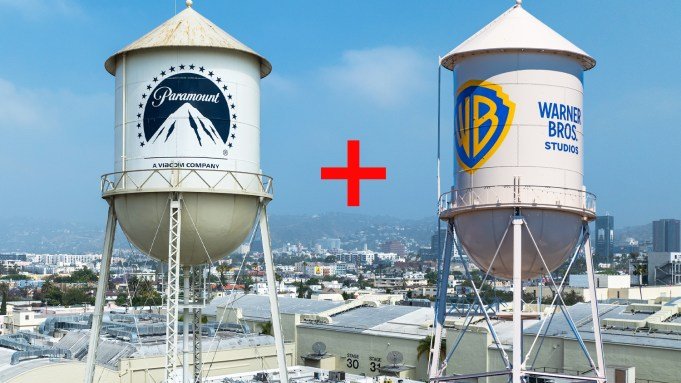
    The results of a court hearing in Oakland on Wednesday might be a little to close for comfort for Paramount and David Ellison. Additionally, the findings of a report submitted to the Los Angeles County Board of Supervisors might prove very scary in terms of potential job losses and more if the $111 billion merger with Warner Bros Discovery goes through.

    As fellow billionaire Mark Zuckerberg’s Meta faces 29 states down the street in California court over potentially trillions in penalties and allegations that his social media platforms violated child privacy laws and are constructed to be addictive, lawyers for CEO Ellison were in federal court Monday hoping to get their recent $1.88 billion bond request addressed ASAP.

    With a trial in the 12-state antitrust case against the melding Paramount and Warner Bros Discovery already set for March 2027, it all turned out to be a session of hurry up and wait.

    Judge Araceli Martinez-Olguin decided this morning that nothing is going to happen in that big flex by Paramount until September 24.

    That’s just days before the $7 million a day ticking fee to WBD shareholders kicks in on October 1. A stipulation of the agreement from earlier this year between Team Ellison and the David Zaslav-run WBD that could rack up close to $1.3 billion in payouts (if the deal goes south or is pushed back) for the still Melrose lot based company. Fees that, along with some regulatory hoops Paramount will have to rejump through in February, that make up a significant portion of Para’s request August 17 motion for the big money to offset the  “extraordinary losses” the state’s July 13 filed case could cause the company.

    There’s also a June 4 deadline for the expiration of a deal, with Paramount obliged to pay a $7 billion termination fee. Not cheap, even for the scion of one time world’s richest man Larry Ellison (who has committed some very big bucks to guaranteing the debt heavy WBD deal).

    The Oracle founder was nowhere to be seen or heard today, but plaintiffs’ lead attorney California’s Ashley Kaplan, plus fellow lawyers James Weingarten, Bren Nakamura, Richard Parker, Kellie Lerner, Julia May, Nicole Gordon, Divya Rao, Joseph Alioto, and Christina Black were onboard virtually for CA AG Rob Bonta, NY AG Letitia  James, 10 other blue states and the Writers Guild of America in the hearing. Beth Wilkinson (maybe the busiest lawyer in Tinseltown this summer), Rakesh Kilaru, Jeffrey Kessler, Marguerite Sullivan, Dan Petrocelli, Pete Herrick, Julia Schiller, Maggie Sullivan and Jennifer Parsigian were there for Paramount and WBD.

    The bond may be a long overdue grown up move by Paramount in the bitter battle in court and the court of public opinion. However, it could also ultimately prove an empty gesture too. In a TRO ruling last month, the Joe Biden-appointed judge cast aside the need for a bond, $1.88 billion or otherwise. “Plaintiffs have demonstrated that Plaintiff States bring suit to enforce important public interests,” she said in a pretty heavily implied rejection of the security requirement.

    Still, courts like casinos are full of wild card moments, so that could all shift by late September, or not.

    The Ronald V. Dellums Federal Building complex in downtown Oakland, CA

    Jane Tyska/Digital First Media/East Bay Times via Getty Images

    With all that playing out in Northern California, the L.A. County Department of Economic Opportunity to today built on its already ominous June 18 report to the board of supervisors on a Para-WBD merger with even harsher data.

    If the $82 billion debt carrying ParaBros was to be real, David Ellison’s dream will be a nightmare for Paramount and WBD staff, the “Assessing the Effects of the Proposed Paramount Skydance Acquisition of Warner Bros. Discovery on the Los Angeles County Economy and Workforce” entitled dense document predicts.

    There will be “a potential loss of 15,567 corporate roles that overlap across both companies, with 6,099 shared, and 2,495 jobs specifically in Los Angeles County,” today’s report says.

    Read the L.A. County Department of Economic Opportunity report on possible consequences of a Paramount-WBD merger here.

    Getting very specific in the realm of some of the worst fears of both critics and boasters of the merger, the DEO document goes on to cite:

    • If the merger goes through, about 4,500 film and TV jobs in Los Angeles County could be lost
    over the three-year period when the companies combine operations

    • In total, 10,360 job years could be at risk, including:
    — 2,661 indirect jobs at small businesses that support production — such as prop houses, printers, transportation companies, and other vendors.
    — 3,204 induced jobs that exist because film and TV workers spend money in the local economy including restaurants, retailers, and service providers.

    • The economic impact of losing these jobs is significant. At stake:
    — $1.26 billion in wages
    — $2.78 billion in economic value
    — $4.06 billion in total business output
    — $547 million in tax revenue, including $78.6 million in local taxes — most of which (63%) comes from property taxes.

    With initial details from two months ago in mind, the report notes:

    These estimates measure employment capacity at risk, not a forecast of layoffs. One job
    sustained for one year equals one job-year, so the impact may be distributed across different
    workers, projects, and positions over the three-year integration period.

    • The impact extends beyond direct film and television employment. An estimated 2,661 indirect job-years are at risk among businesses that support production, including independent artists, agents and promoters, sound recording, employment services, and equipment rental. A further 3,204 induced job-years reflect reduced household spending across the County economy.

    • The economic impact extends well beyond employment. The modeled losses correspond to approximately $1.26 billion in labor income, $2.79 billion in value added, and $4.06 billion in economic output over the modeled period.

    • The fiscal impact extends across federal, state, and local government. The modeled losses correspond to approximately $547 million in tax revenue, including $78.6 million in local tax revenue.

    • Impacts would emerge over time, not at closing. Evidence from six completed media mergers shows workforce actions unfolding over several years following a transaction, supporting continued monitoring of employment and production activity rather than a single point-in-time assessment.

    To put this into perspective, the direct jobs at risk account for nearly 9% of the 52,016 film and TV
    jobs California has already lost since 2022 — and almost all those losses (99.6%) occurred in Los
    Angeles County.

    Do the math, all of it.

    Paramount had their own POV on the DEO report.

    “LA County’s own economic report underscores what we have been saying all along: our industry is in decline, production is down and jobs are being lost — and lost for good if we don’t act,” a company spokesperson told Deadline Wednesday. “Our plan to invest $30 billion annually in production and release at least 30 films a year is how we regain that ground: more production that supports more jobs over time, and ultimately, a stronger, more durable entertainment industry for generations to come.”

    In a posting on X, Bonta said of the latest L.A. County report: “As I have said repeatedly, the proposed unlawful Paramount-Warner Brothers merger will lead to significant job loss and massive damage to the economy.”

    Meanwhile, back in Oakland, as various exhibitors, guilds and pundits opine on the pros and cons of one big ParaBros, and Team Ellison leaks threats to adiós California and jump to a friendlier Red jurisdiction, today’s 21-minute case management conference before Martinez-Olguin had some other topics on the agenda too.

    For one thing, all sides said in an August 13 filing they “are having constructive discussions regarding the identification of two alternative magistrate judges to preside over a settlement conference for the Actions and will provide a further update to the Court as soon as possible.” Now, this is standard operating procedure in matters such as this, and leans not much at all to the desires of the DGA, the suddenly corporately compliant IATSE and others for a deal to avoid a trial. To that, Magistrate Judge Ajay Krishnan, who took on his role in January,  has been named to oversee discovery.

    No judge has been picked “for mediation,” but filings (AKA suggestions) from the AGs/WGA and Para/WBD are due on August 26.

    Neither Paramount nor Golden State AG Bonta’s office responded to Deadline’s request for comment on today’s hearing.

    California Attorney General Rob Bonta left, Paramount CEO David Ellison

    California Attorney General Rob Bonta left, Paramount CEO David Ellison

    Getty Images

    Paramount shares closed down a hair Wednesday at $10.60, off more than 20% year to date (despite gaining over the past few weeks) and half of where they were trading at their 52-week high of over $20.


    Overall, the $31-a-share cash deal is funded by mix of equity and debt. Larry Ellison is personally guaranteeing $45.7 billion in equity commitments (with much of that syndicated out to Middle East investors); the debt package of about $49 billion is run through a group of banks led by Citibank, Bank of America and Apollo. Para would assume WBD’s debt, reported at about $30 billion net as of June 30.

    Jill Goldsmith contributed to this report

  • US pilot lands jet without front wheels after landing gear failure

    US pilot lands jet without front wheels after landing gear failure

    Video shows how a US pilot managed to land a private jet safely without front wheels at an airport in Ohio, after the plane’s front landing gear failed to deploy.

  • Anti-Muslim protesters call for ‘Christian Crusade’ in Dearborn, US

    Anti-Muslim protesters call for ‘Christian Crusade’ in Dearborn, US

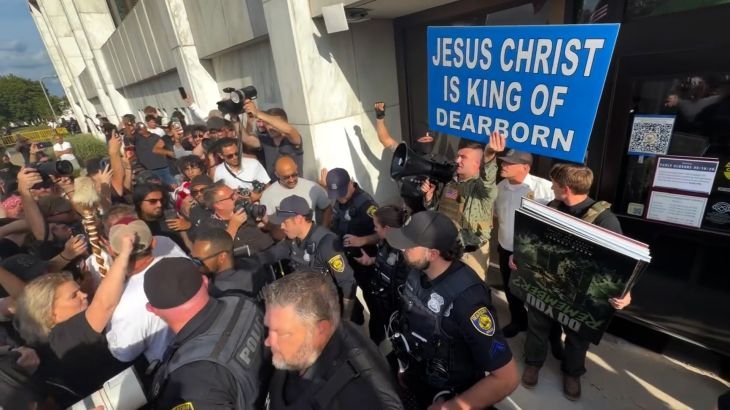
    Far-right protesters clashed with police at an anti-Muslim rally in the US city of Dearborn, billed by organisers as a ‘Christian Crusader march’. Hundreds gathered outside a city council meeting, with several arrests reported.

  • Five Standout Claims In ABC’s First Amendment Lawsuit Against The FCC

    Five Standout Claims In ABC’s First Amendment Lawsuit Against The FCC

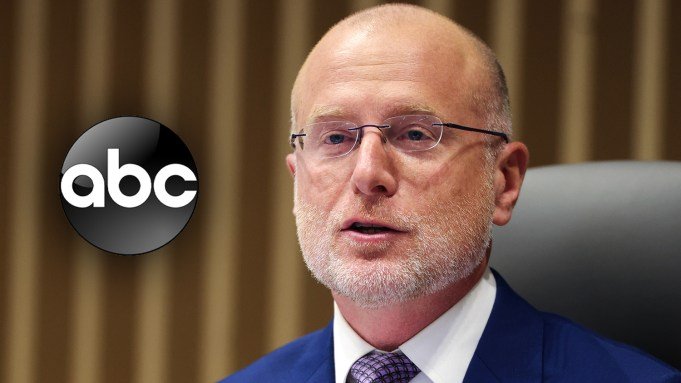
    ABC has been pushing back on FCC for several months now, but on Tuesday, it filed a First Amendment lawsuit, claiming that the agency’s regulatory actions and investigations were part of a Trump administration effort to punish it for its speech.

    The lawsuit goes through a narrative of Donald Trump‘s attacks on the network, including his calls for the revocation of FCC licenses. In fact, the third paragraph of the ABC complaint features a screenshot of a Trump Truth Social post in which he calls for licenses to be terminated because of “100% negative” coverage on newscasts and late-night shows.

    The central part of the lawsuit is the FCC’s order that ABC’s eight owned broadcast stations file for early license renewal, a very unusual regulatory demand, given that the first of the licenses wasn’t set to expire until 2028. While the FCC tied its order to an ongoing investigation of the network’s diversity, equity and inclusion practices, ABC lawyers noted that it came just after Trump blasted Jimmy Kimmel over jokes on his show.

    The FCC issued a statement on the ABC lawsuit. with a spokesperson saying, “All broadcasters have a legal obligation to operate in the public interest—even Disney.  The FCC has been examining claims that Disney engaged in illegal DEI discrimination for over a year.  Disney is obviously very concerned about the FCC’s proceeding, as evidenced by their ongoing campaign of disinformation as well as their decision to ask a court to stop the FCC from further pursuing matters.”

    ABC, however, contended that the consequences of the Trump administration’s actions go beyond ABC. The network stated in the lawsuit, “If the Administration gets its way, the message to every media company in the country will be unmistakable: tell only the stories the Administration deems favorable, or face the coercive machinery of the federal government. In such a world, the press could in no way be described as free.”

    Here are five of the standout claims that ABC made in its lawsuit to try to bolster its point:

    FCC “confirmed the connection” to Trump’s threats: A challenge to ABC’s First Amendment claim will be in proving that there is a causal link to the president’s remarks and FCC action.

    Among other things, the network noted the timing of the FCC’s order for early license renewals, coming a day after Trump called on ABC to fire Kimmel over a comment he made about First Lady Melania Trump.

    But the network also cited a more recent example they claimed “confirmed the connection” between the White House and the FCC. In July, Trump gave a primetime address, but ABC and NBC decided not to broadcast it, amid concerns that the president would use the platform to make unfounded claims about election rigging.

    The network’s legal team wrote, “ABC was aware that the President wanted the address to be broadcast live, and considered the risk of resulting Administration retaliation. ABC ultimately decided to livestream the speech on ABC News Live, which it ordinarily would not have done.”

    Trump was aware of the decisions to bypass the address, and during the speech called for ABC and NBC to lose their licenses. ABC noted in the lawsuit that after the Trump threat, the FCC “promptly confirmed the connection: following the President’s demand, the Chairman stated that the Commission would consider ABC’s decision not to broadcast the July 16 address as part of its review of the Stations’ renewal applications.”

    Returning Kimmel to the air invited “further reprisal from the administration”: Few incidents involving the FCC drew the level of attention than what happened last September, when ABC put Kimmel on suspension amid furor among one of his jokes about the reaction to the assassination of Charlie Kirk.

    As noted in the ABC lawsuit, FCC Chairman Brendan Carr warned the network’s stations that “we can do this the easy way or the hard way.” “These companies can find ways to take action on Kimmel, or there is going to be additional work for the FCC ahead,” he said on Benny Johnson’s podcast.

    Hours later, ABC suspended Kimmel. In the lawsuit, its legal team said that the network was exercising its editorial judgment in suspending the late-night host, but they also noted that the president “celebrated” the decision, writing on Truth Social, “Congratulations to ABC for finally having the courage to do what had to be done.” The lawsuit also noted Carr’s comment to a reporter about the Kimmel suspension: an animated image of two characters from The Office celebrating.

    Then, the network’s legal team wrote, ABC made the decision to return Mr. Kimmel to the air “with full awareness that doing so was likely to invite further reprisal from the Administration.”

    They added, “The reprisal was swift to manifest: the following day, the President posted on Truth Social: ‘I can’t believe ABC Fake News gave Jimmy Kimmel his job back. . . . I think we’re going to test ABC out on this. Let’s see how we do.’”

    Carr later insisted that his comments were not a threat. “What I’ve been clear about is that if you look at the full context, not only what I said, but what the companies themselves have said about their decision. It was a business decision,” he told reporters after the incident.

    Brendan Carr takes Trump’s social media posts “as his directives”: While the lawsuit runs through a gallery of Trump’s attacks on ABC and other networks, it also cites numerous comments made by the FCC chairman.

    The ABC lawsuit cites this as further evidence that Carr is taking cues from Trump. The network claimed that Carr “takes the president’s social media posts as his directives.”

    The network’s legal team wrote, “First, replying to a post by the President expressing frustration at news coverage of the Iran conflict, the Chairman warned that stations airing ‘fake news’ had ‘a chance now to correct course before their license renewals come up,’ explaining that ‘they will lose their licenses if they do not.’”

    “Similarly, when the President called for NBC to fire late-night television host Seth Meyers, the Chairman reposted the President’s post to his official X account, thereby throwing the weight of NBC’s chief regulator in support of the President’s attempt to influence NBC’s editorial discretion.”

    Carr has defended his comments, often citing the obligation of broadcasters to uphold a public interest standard. But Anna Gomez, the sole Democrat on the commission, has said that the FCC has been using an “undefined” concept as a “roving mandate to police speech.”

    The FCC demanded records of political donations from The View hosts and ABC News personnel. According to the lawsuit, as part of the FCC’s investigation into The View, the agency’s Media Bureau made an extensive list of demands last month for information from the network’s Houston station. The investigation is into whether The View much comply with the FCC’s equal time rule, which requires that broadcasters who feature political candidates as guests must offer comparable time to rivals, if requested.

    Per the lawsuit, the FCC issued a letter of inquiry last month directing the station to “produce all internal communications among The View’s booking staff, its segment producers, its Executive Producer, and its on-air co-hosts discussing any candidate over a two-year period, together with the messages that two named co- hosts had sent to the program’s Executive Producer about a single booking decision.” The FCC also demanded the disclosure of political donations of employees and co-hosts, including a list of every donation over the past four years and the date of each, according to the suit.

    According to ABC, the Media Bureau issued another inquiry two weeks later that “demanded the standards and policies in place across all ABC programs relating to ‘journalistic integrity, newsworthiness, fairness, impartiality, objectivity, partisanship, [and] bias,’ as well as the political donations of on-air talent and producers, naming Good Morning America, This Week with George Stephanopoulos, and ABC World News Tonight with David Muir.”

    The network’s legal team argued that that Communications Act’s equal time provisions do not include a provision that “permits the government to demand a journalist’s or on-air anchor’s messages to her producer, to inventory her political contributions, or to audit the editorial standards of an entire news division.”

    The targeting of The View already has forced the show to avoid political candidate guests. ABC is asking for immediate action from the court, including a temporary restraining order to prohibit the FCC from taking any further moves in its early license renewal proceedings.

    The network’s legal team emphasized the urgency of the situation by citing instances where editorial decisions are being impacted. They noted that The View has not booked a political candidate since February, when U.S. Senate candidate James Talarico’s appearance triggered the agency’s investigation. The show also has passed on clips to air during the Hot Topics segment on The View and the cold open of the program, out of concern of triggering the equal time requirement, per the lawsuit.

    Carr has denied that he is censoring the program, and merely enforcing a rule on the books that doesn’t prevent the show from featuring candidates, albeit they would be on the hook to offer equal time. ABC, however, argued that The View falls under an exemption for bonafide news programming, and that the FCC affirmed as much in 2002.

    The network’s legal team argued, “Since the Bureau’s inquiry began, Plaintiffs must now evaluate any invitation to a political candidate for its potential consequences, including whether it might later be cited by the Commission as a basis for non-renewal in the Stations’ impending license renewal process.”
  • Why is the US ramping up Tomahawk production?

    The Pentagon has contracted a defence manufacturer to increase the output of cruise missiles.

    It’s a multibillion-dollar deal that some military analysts say confirms suspicions that the United States is running out of critical munitions.

    The Pentagon has contracted defence company Raytheon to significantly increase its output of Tomahawk missiles.

    Recommended Stories

    list of 3 itemsend of list

    Raytheon has supplied the US with weapons for decades, but this time is different.

    The company is set to deliver the Tomahawks at an unprecedented scale and speed.

    How important are these missiles to US defence strategy?

    And could this ignite a global arms race – and lead to more conflict?

    Presenter: Anna Burns-Francis

    Guests:

    David Des Roches – professor at the Thayer Marshall Institute and former Pentagon director for Arabian Peninsula affairs

    Patrick Bury – defence and security specialist at the University of Bath and a former NATO analyst

    Dan Grazier – senior fellow and director of the National Security Reform Program at the Stimson Center

  • Tropical Storm Lala leaves Hawaii flooded and without power

    Tropical Storm Lala leaves Hawaii flooded and without power

    Tropical Storm Lala has left parts of Hawaii facing severe flooding, widespread power outages and blocked roads after brushing the islands. Nearly 104,000 customers remained without electricity on Monday, while around 100 homes were swept away or damaged on the Big Island.

  • ABC Files First Amendment Lawsuit Against FCC, Claiming Trump Administration “Retaliatory Campaign” Against Its Free Speech

    ABC Files First Amendment Lawsuit Against FCC, Claiming Trump Administration “Retaliatory Campaign” Against Its Free Speech

    UPDATED: ABC filed an unprecedented First Amendment lawsuit against the FCC on Tuesday, claiming that its investigations and regulatory actions are part of a Trump administration “retaliatory campaign” to curb the network’s free speech.

    The lawsuit, filed in federal court in Washington, D.C., also seeks to halt a proceeding in which the agency and its chairman, Brendan Carr, demanded that it put its eight stations up for early license renewal. That followed Donald Trump‘s attacks on the network, including its late night host, Jimmy Kimmel.

    “Acting through the Federal Communications Commission, the Administration has waged a retaliatory campaign against ABC for a single reason: it disapproves of what ABC broadcasts,” the lawsuit stated.

    The lawsuit is heavy in references to Trump’s attacks on the network and calls for it to lose its licenses, including his complaints over the way that ABC News moderated the 2024 presidential debate, during an attack on a news reporter who asked about releasing the Jeffrey Epstein files, and in a Truth Social post in which the president complained about late-night shows being “100% negative” to him.

    The lawsuit also cited Carr’s warning to ABC last September, after Kimmel made a joke tied to the investigation into the assassination of Charlie Kirk. On a podcast, Carr said that “we can do this the easy way or the hard way,” adding that companies could take action “or there is going to be additional work for the FCC ahead.” Two major station groups with network affiliates said that they would not air the show, and ABC pulled Kimmel from the air for several days before restoring him to the air.

    In the lawsuit, the network said that it anticipated the FCC taking action soon following a public comment proceeding on whether to renew the stations licenses. Bloomberg reported that the FCC may issue a hearing designation order this month, a regulatory move that would kick off an agency adjudication process to determine the fate of the licenses.

    ABC stated in the lawsuit, “Any FCC adjudication would be a charade. The Commission cannot lawfully grant renewal this early in the license terms—the only outcomes on the table are adverse to Plaintiffs. At one extreme, the Commission may intentionally prolong the adjudicative process, miring ABC in years of costly litigation, with the threat of adverse action ever present and with every editorial judgment shadowed by the prospect of provoking the Administration into further retaliation.”

    The network’s legal team added, “At another extreme, the Commission may use the hearing to deny license renewal or immediately revoke the Stations’ licenses, forcing Plaintiffs off the air entirely, as the President has repeatedly demanded. In either scenario, the Administration accomplishes its goal of eliminating a perceived media critic: either it gets Plaintiffs to fall in line, or it silences them if they refuse.”

    An FCC spokesperson did not immediately return a request for comment. In ordering the early renewal of broadcast licenses, the agency and Carr cited an ongoing investigation of The Walt Disney Co.’s diversity, equity and inclusion policies. The network called the investigation “pretextual,” arguing that it has cooperated but that “simply begat increasingly aggressive demands.”

    ABC also cited more recent comments from Carr, including that the network’s decision not to air a primetime address from Trump last month would be part of the review of the broadcast licenses.

    “The Commission’s true target is not the Stations’ employment practices or their carriage of a single presidential address; it is the content of Plaintiffs’ programming—and thus their speech,” the lawsuit stated.  “Because the Commission cannot regulate that content directly, it has used its review of the Stations’ licenses as an instrument to the same end.”

    The FCC under Carr has launched a series of investigations against the networks, including Comcast and NBCUniversal over its DEI practices, and CBS over the way that 60 Minutes edited an interview with Kamala Harris.

    Up to now, no network had directly challenged the FCC via litigation, amid warnings that the agency under Trump was overstepping its authority by delving into content and editorial choices. The lawsuit cited the recent warning from Sen. John Kennedy (R-LA), who told an FCC official that the agency “scares me right now” and is “getting into the foothills of violating the First Amendment.”

    ABC’s legal team wrote that the network was the “the visible target and suffers the most immediate harm, but the message is addressed to every broadcaster in the country, and the ultimate cost is borne by the press as a whole.” The lawsuit warned that “news organizations throughout the country are also watching and waiting to see the extent to which ABC and the Stations will be punished, as promised, for coverage that the Administration has deemed unfavorable—because if it happens to ABC, they could be next.”

    After the suit was filed, Gigi Sohn, former counselor to FCC Chairman Tom Wheeler, wrote on X, “People need to understand what a big deal this is. Disney is doing what many of us had urged for many months – taking on the FCC’s weaponization of its regulatory power.”

    The lawsuit names the FCC, Carr and its two commissioners, Olivia Trusty and Anna Gomez. The inclusion of Gomez, the sole Democrat, appears to be for litigation reasons, as the complaint also cites her criticisms of the Republican-controlled agency as waging a “sustained, coordinated campaign of censorship and control.”

    The network is seeking a temporary restraining order and preliminary injunction to halt further action on the early license renewals, as well as an order that the FCC be prohibited from taking actions “to coerce or threaten” the network “with sanctions in an effort to alter their exercise of editorial discretion.”

    Its lead attorney on the complaint is Beth Wilkinson, who is also representing Paramount in its defense against an antitrust lawsuit brought by state attorneys general challenging its proposed merger with Warner Bros. Discovery.

    Also cited by the network is a separate FCC investigation into The View. The agency is reviewing whether the show should be exempt from equal time rules, which require that broadcasters who feature presidential candidates provide comparable time to rivals, if requested. The network has argued that the FCC signaled back in 2002 that it fell under an exemption for news programming, only to have Carr threaten to reverse course earlier this year.

    The first of the eight ABC stations were not set to face license renewal until 2028. As Carr opened proceedings in which the public could comment on The View investigation and the station licenses, the network launched an on-air campaign to elicit filings. More than 78,000 have commented so far on The View and more than 153,000 in the license renewal proceeding. The network said an analysis showed that the comments overwhelming supported its side.