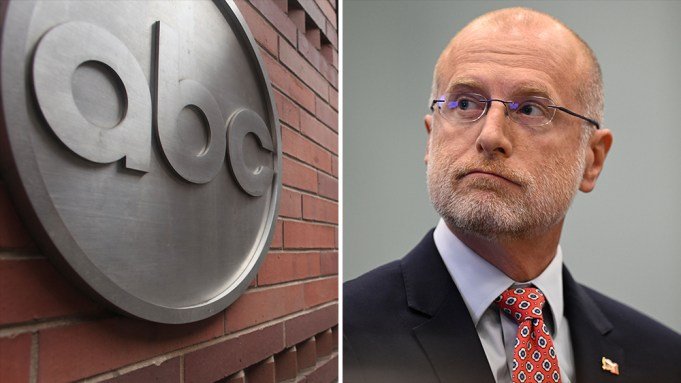
UPDATED: ABC filed an unprecedented First Amendment lawsuit against the FCC on Tuesday, claiming that its investigations and regulatory actions are part of a Trump administration “retaliatory campaign” to curb the network’s free speech.
The lawsuit, filed in federal court in Washington, D.C., also seeks to halt a proceeding in which the agency and its chairman, Brendan Carr, demanded that it put its eight stations up for early license renewal. That followed Donald Trump‘s attacks on the network, including its late night host, Jimmy Kimmel.
“Acting through the Federal Communications Commission, the Administration has waged a retaliatory campaign against ABC for a single reason: it disapproves of what ABC broadcasts,” the lawsuit stated.
The lawsuit is heavy in references to Trump’s attacks on the network and calls for it to lose its licenses, including his complaints over the way that ABC News moderated the 2024 presidential debate, during an attack on a news reporter who asked about releasing the Jeffrey Epstein files, and in a Truth Social post in which the president complained about late-night shows being “100% negative” to him.
The lawsuit also cited Carr’s warning to ABC last September, after Kimmel made a joke tied to the investigation into the assassination of Charlie Kirk. On a podcast, Carr said that “we can do this the easy way or the hard way,” adding that companies could take action “or there is going to be additional work for the FCC ahead.” Two major station groups with network affiliates said that they would not air the show, and ABC pulled Kimmel from the air for several days before restoring him to the air.
In the lawsuit, the network said that it anticipated the FCC taking action soon following a public comment proceeding on whether to renew the stations licenses. Bloomberg reported that the FCC may issue a hearing designation order this month, a regulatory move that would kick off an agency adjudication process to determine the fate of the licenses.
ABC stated in the lawsuit, “Any FCC adjudication would be a charade. The Commission cannot lawfully grant renewal this early in the license terms—the only outcomes on the table are adverse to Plaintiffs. At one extreme, the Commission may intentionally prolong the adjudicative process, miring ABC in years of costly litigation, with the threat of adverse action ever present and with every editorial judgment shadowed by the prospect of provoking the Administration into further retaliation.”
The network’s legal team added, “At another extreme, the Commission may use the hearing to deny license renewal or immediately revoke the Stations’ licenses, forcing Plaintiffs off the air entirely, as the President has repeatedly demanded. In either scenario, the Administration accomplishes its goal of eliminating a perceived media critic: either it gets Plaintiffs to fall in line, or it silences them if they refuse.”
An FCC spokesperson did not immediately return a request for comment. In ordering the early renewal of broadcast licenses, the agency and Carr cited an ongoing investigation of The Walt Disney Co.’s diversity, equity and inclusion policies. The network called the investigation “pretextual,” arguing that it has cooperated but that “simply begat increasingly aggressive demands.”
ABC also cited more recent comments from Carr, including that the network’s decision not to air a primetime address from Trump last month would be part of the review of the broadcast licenses.
“The Commission’s true target is not the Stations’ employment practices or their carriage of a single presidential address; it is the content of Plaintiffs’ programming—and thus their speech,” the lawsuit stated. “Because the Commission cannot regulate that content directly, it has used its review of the Stations’ licenses as an instrument to the same end.”
The FCC under Carr has launched a series of investigations against the networks, including Comcast and NBCUniversal over its DEI practices, and CBS over the way that 60 Minutes edited an interview with Kamala Harris.
Up to now, no network had directly challenged the FCC via litigation, amid warnings that the agency under Trump was overstepping its authority by delving into content and editorial choices. The lawsuit cited the recent warning from Sen. John Kennedy (R-LA), who told an FCC official that the agency “scares me right now” and is “getting into the foothills of violating the First Amendment.”
ABC’s legal team wrote that the network was the “the visible target and suffers the most immediate harm, but the message is addressed to every broadcaster in the country, and the ultimate cost is borne by the press as a whole.” The lawsuit warned that “news organizations throughout the country are also watching and waiting to see the extent to which ABC and the Stations will be punished, as promised, for coverage that the Administration has deemed unfavorable—because if it happens to ABC, they could be next.”
After the suit was filed, Gigi Sohn, former counselor to FCC Chairman Tom Wheeler, wrote on X, “People need to understand what a big deal this is. Disney is doing what many of us had urged for many months – taking on the FCC’s weaponization of its regulatory power.”
The lawsuit names the FCC, Carr and its two commissioners, Olivia Trusty and Anna Gomez. The inclusion of Gomez, the sole Democrat, appears to be for litigation reasons, as the complaint also cites her criticisms of the Republican-controlled agency as waging a “sustained, coordinated campaign of censorship and control.”
The network is seeking a temporary restraining order and preliminary injunction to halt further action on the early license renewals, as well as an order that the FCC be prohibited from taking actions “to coerce or threaten” the network “with sanctions in an effort to alter their exercise of editorial discretion.”
Its lead attorney on the complaint is Beth Wilkinson, who is also representing Paramount in its defense against an antitrust lawsuit brought by state attorneys general challenging its proposed merger with Warner Bros. Discovery.
Also cited by the network is a separate FCC investigation into The View. The agency is reviewing whether the show should be exempt from equal time rules, which require that broadcasters who feature presidential candidates provide comparable time to rivals, if requested. The network has argued that the FCC signaled back in 2002 that it fell under an exemption for news programming, only to have Carr threaten to reverse course earlier this year.
The first of the eight ABC stations were not set to face license renewal until 2028. As Carr opened proceedings in which the public could comment on The View investigation and the station licenses, the network launched an on-air campaign to elicit filings. More than 78,000 have commented so far on The View and more than 153,000 in the license renewal proceeding. The network said an analysis showed that the comments overwhelming supported its side.
Leave a Reply