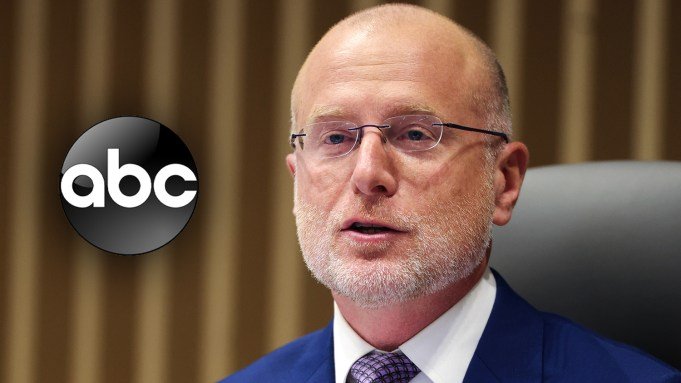
ABC has been pushing back on FCC for several months now, but on Tuesday, it filed a First Amendment lawsuit, claiming that the agency’s regulatory actions and investigations were part of a Trump administration effort to punish it for its speech.
The lawsuit goes through a narrative of Donald Trump‘s attacks on the network, including his calls for the revocation of FCC licenses. In fact, the third paragraph of the ABC complaint features a screenshot of a Trump Truth Social post in which he calls for licenses to be terminated because of “100% negative” coverage on newscasts and late-night shows.
The central part of the lawsuit is the FCC’s order that ABC’s eight owned broadcast stations file for early license renewal, a very unusual regulatory demand, given that the first of the licenses wasn’t set to expire until 2028. While the FCC tied its order to an ongoing investigation of the network’s diversity, equity and inclusion practices, ABC lawyers noted that it came just after Trump blasted Jimmy Kimmel over jokes on his show.
The FCC issued a statement on the ABC lawsuit. with a spokesperson saying, “All broadcasters have a legal obligation to operate in the public interest—even Disney. The FCC has been examining claims that Disney engaged in illegal DEI discrimination for over a year. Disney is obviously very concerned about the FCC’s proceeding, as evidenced by their ongoing campaign of disinformation as well as their decision to ask a court to stop the FCC from further pursuing matters.”
ABC, however, contended that the consequences of the Trump administration’s actions go beyond ABC. The network stated in the lawsuit, “If the Administration gets its way, the message to every media company in the country will be unmistakable: tell only the stories the Administration deems favorable, or face the coercive machinery of the federal government. In such a world, the press could in no way be described as free.”
Here are five of the standout claims that ABC made in its lawsuit to try to bolster its point:
FCC “confirmed the connection” to Trump’s threats: A challenge to ABC’s First Amendment claim will be in proving that there is a causal link to the president’s remarks and FCC action.
Among other things, the network noted the timing of the FCC’s order for early license renewals, coming a day after Trump called on ABC to fire Kimmel over a comment he made about First Lady Melania Trump.
But the network also cited a more recent example they claimed “confirmed the connection” between the White House and the FCC. In July, Trump gave a primetime address, but ABC and NBC decided not to broadcast it, amid concerns that the president would use the platform to make unfounded claims about election rigging.
The network’s legal team wrote, “ABC was aware that the President wanted the address to be broadcast live, and considered the risk of resulting Administration retaliation. ABC ultimately decided to livestream the speech on ABC News Live, which it ordinarily would not have done.”
Trump was aware of the decisions to bypass the address, and during the speech called for ABC and NBC to lose their licenses. ABC noted in the lawsuit that after the Trump threat, the FCC “promptly confirmed the connection: following the President’s demand, the Chairman stated that the Commission would consider ABC’s decision not to broadcast the July 16 address as part of its review of the Stations’ renewal applications.”
Returning Kimmel to the air invited “further reprisal from the administration”: Few incidents involving the FCC drew the level of attention than what happened last September, when ABC put Kimmel on suspension amid furor among one of his jokes about the reaction to the assassination of Charlie Kirk.
As noted in the ABC lawsuit, FCC Chairman Brendan Carr warned the network’s stations that “we can do this the easy way or the hard way.” “These companies can find ways to take action on Kimmel, or there is going to be additional work for the FCC ahead,” he said on Benny Johnson’s podcast.
Hours later, ABC suspended Kimmel. In the lawsuit, its legal team said that the network was exercising its editorial judgment in suspending the late-night host, but they also noted that the president “celebrated” the decision, writing on Truth Social, “Congratulations to ABC for finally having the courage to do what had to be done.” The lawsuit also noted Carr’s comment to a reporter about the Kimmel suspension: an animated image of two characters from The Office celebrating.
Then, the network’s legal team wrote, ABC made the decision to return Mr. Kimmel to the air “with full awareness that doing so was likely to invite further reprisal from the Administration.”
They added, “The reprisal was swift to manifest: the following day, the President posted on Truth Social: ‘I can’t believe ABC Fake News gave Jimmy Kimmel his job back. . . . I think we’re going to test ABC out on this. Let’s see how we do.’”
Carr later insisted that his comments were not a threat. “What I’ve been clear about is that if you look at the full context, not only what I said, but what the companies themselves have said about their decision. It was a business decision,” he told reporters after the incident.
Brendan Carr takes Trump’s social media posts “as his directives”: While the lawsuit runs through a gallery of Trump’s attacks on ABC and other networks, it also cites numerous comments made by the FCC chairman.
The ABC lawsuit cites this as further evidence that Carr is taking cues from Trump. The network claimed that Carr “takes the president’s social media posts as his directives.”
The network’s legal team wrote, “First, replying to a post by the President expressing frustration at news coverage of the Iran conflict, the Chairman warned that stations airing ‘fake news’ had ‘a chance now to correct course before their license renewals come up,’ explaining that ‘they will lose their licenses if they do not.’”
“Similarly, when the President called for NBC to fire late-night television host Seth Meyers, the Chairman reposted the President’s post to his official X account, thereby throwing the weight of NBC’s chief regulator in support of the President’s attempt to influence NBC’s editorial discretion.”
Carr has defended his comments, often citing the obligation of broadcasters to uphold a public interest standard. But Anna Gomez, the sole Democrat on the commission, has said that the FCC has been using an “undefined” concept as a “roving mandate to police speech.”
The FCC demanded records of political donations from The View hosts and ABC News personnel. According to the lawsuit, as part of the FCC’s investigation into The View, the agency’s Media Bureau made an extensive list of demands last month for information from the network’s Houston station. The investigation is into whether The View much comply with the FCC’s equal time rule, which requires that broadcasters who feature political candidates as guests must offer comparable time to rivals, if requested.
Per the lawsuit, the FCC issued a letter of inquiry last month directing the station to “produce all internal communications among The View’s booking staff, its segment producers, its Executive Producer, and its on-air co-hosts discussing any candidate over a two-year period, together with the messages that two named co- hosts had sent to the program’s Executive Producer about a single booking decision.” The FCC also demanded the disclosure of political donations of employees and co-hosts, including a list of every donation over the past four years and the date of each, according to the suit.
According to ABC, the Media Bureau issued another inquiry two weeks later that “demanded the standards and policies in place across all ABC programs relating to ‘journalistic integrity, newsworthiness, fairness, impartiality, objectivity, partisanship, [and] bias,’ as well as the political donations of on-air talent and producers, naming Good Morning America, This Week with George Stephanopoulos, and ABC World News Tonight with David Muir.”
The network’s legal team argued that that Communications Act’s equal time provisions do not include a provision that “permits the government to demand a journalist’s or on-air anchor’s messages to her producer, to inventory her political contributions, or to audit the editorial standards of an entire news division.”
The targeting of The View already has forced the show to avoid political candidate guests. ABC is asking for immediate action from the court, including a temporary restraining order to prohibit the FCC from taking any further moves in its early license renewal proceedings.
The network’s legal team emphasized the urgency of the situation by citing instances where editorial decisions are being impacted. They noted that The View has not booked a political candidate since February, when U.S. Senate candidate James Talarico’s appearance triggered the agency’s investigation. The show also has passed on clips to air during the Hot Topics segment on The View and the cold open of the program, out of concern of triggering the equal time requirement, per the lawsuit.
Carr has denied that he is censoring the program, and merely enforcing a rule on the books that doesn’t prevent the show from featuring candidates, albeit they would be on the hook to offer equal time. ABC, however, argued that The View falls under an exemption for bonafide news programming, and that the FCC affirmed as much in 2002.
The network’s legal team argued, “Since the Bureau’s inquiry began, Plaintiffs must now evaluate any invitation to a political candidate for its potential consequences, including whether it might later be cited by the Commission as a basis for non-renewal in the Stations’ impending license renewal process.”
Leave a Reply