If you purchase an independently reviewed product or service through a link on our website, Variety may receive an affiliate commission.
Ever wondered what would happen if Darth Vader joined the Avengers? Or if the Millennium Falcon got a Tony Stark-approved upgrade? Lego is giving fans the chance to find out.
The toy company announced a first-of-its-kind Lego Ideas challenge at New York Comic Con on Saturday, inviting builders to combine the worlds of Marvel and “Star Wars” for a chance to have their creations turned into an official Lego set. The competition marks the first time the two Disney-owned franchises have been brought together in a Lego Ideas challenge, allowing fans to dream up their own cross-universe creations.
The announcement was made by filmmaker, actor and Marvel Comics writer Kevin Smith, who is also working on the upcoming “Star Wars/Marvel: Hope Assembles” comic series. Set to launch in January, the series will mark the first official crossover between the two comic book universes, arriving as “Star Wars” prepares to celebrate its 50th anniversary in 2027.
“Working on the upcoming Star Wars/Marvel: Hope Assembles comic series has been incredibly exciting, and this Lego Ideas challenge reflects the same spirit of creativity inspired by these two iconic universes,” Smith said in a statement. “This challenge gives fans a chance to be part of something never done before and I can’t wait to see all of the creative Marvel and Star Wars mash ups it inspires!”
The competition invites fans to submit original builds across three categories: vehicles, characters and scenes. That could mean reimagining familiar spacecraft with superhero technology, bringing characters from the two franchises face-to-face or creating entirely new settings that unite their respective worlds.
Submissions are now open through the Lego Ideas platform, with fan voting set to begin Dec. 8. Grand prize selections will be announced in 2027, with winning designs eligible to be developed into official Lego products.
The challenge builds on Lego’s longstanding relationships with both franchises, which have produced some of the company’s most elaborate and collectible sets. Lego’s “Star Wars” partnership dates back to 1999, while its Marvel lineup has brought characters including Spider-Man, Iron Man and the Avengers into brick form through everything from smaller character sets to large-scale collector’s builds.
“This challenge is a milestone for Lego Ideas and our fan community,” said Fede Begher, senior vice president and head of product group at the Lego Group. “For the first time ever, fans can build with both Marvel and Star Wars in a single LEGO Ideas challenge, unlocking entirely new possibilities for creativity and storytelling.”
The Philippines has revamped its International Co-Production Fund (ICOF) around two tracks, with the amount of cash on offer tied to the size of the Filipino stake in a project.
The Film Philippines Office (FPO) unveiled the new framework at the Busan International Film Festival‘s Asian Contents & Film Market.
The Majority Track covers projects led by Filipino producers working with foreign partners. Features and series on this track can receive up to PHP13 million ($210,000), and documentaries and shorts up to PHP5 million ($80,000).
To qualify, the Filipino side must own at least 20% of the project and hold the largest share among the co-producers. Two Filipinos must fill above-the-line roles – director, writer or actor – and five more must work in key creative or technical crew positions. Applicants need a release strategy for both the home market and abroad. Foreign partners must take a minority stake and make a matching creative or technical contribution.
The Minority Track is for international productions in which a Filipino producer is the junior partner. Features and series can draw up to PHP7 million ($113,000), with documentaries and shorts capped at PHP3 million ($48,000).
The bar is lower here. Filipino producers need a stake of 10% or more, and the production must hire either two Filipino above-the-line talents or three Filipino crew members in key creative or technical roles. Applicants must also show how the film will reach audiences outside the Philippines.
Both tracks offer the same top-ups. Qualifying ASEAN co-productions earn an extra PHP1 million ($16,000), and projects that clear a cultural test can collect up to PHP2 million ($32,000) more. The FPO noted that the dollar figures may vary with exchange rates.
The FPO sits within the Film Development Council of the Philippines (FDCP), the national film agency that reports to the Office of the President. It runs the country’s incentives for international co-productions and for line and post-production work. It also provides endorsements for government permits and makes location referrals.
Several ICOF-backed films have won festival prizes. Tommy Ng Ka Chung’s “Another World” was co-produced by Filipino company Overmind Corp with partners in Hong Kong and Singapore, and won best animated feature at the 62nd Golden Horse Awards in November 2025. Janus Victoria’s “Diamonds in the Sand,” which has Japanese and Malaysian co-producers, took the Mulberry Award for best debut film at Udine’s Far East Film Festival.
Marianne Métivier’s “Elsewhere at Night” won best screenplay at the Torino Film Festival. James J. Robinson picked up best Australian director at the Melbourne International Film Festival for “First Light.” Mouly Surya’s “This City Is a Battlefield” won best cinematography at the Bandung Film Festival.
The FPO’s separate Film Location Incentive Program has backed two prizewinners. Rafael Manuel’s “Filipiñana” won a special jury award for creative vision in Sundance’s World Cinema Dramatic competition, and Morgan Knibbe’s “The Garden of Earthly Delights” won best film at Torino.
The most moving scene in “The First Taste of Loneliness” is not, in fact, its most tear-streaked. Gu You‘s heartfelt family portrait opens on an extended, anguished scene of three women — a mother, her daughter and her granddaughter — keeping vigil at the bedside of their beloved husband, father and grandfather as his longtime battle with pancreatic cancer comes to a close. Emotions run high and loud; the camera peers closely into their grief. But it’s a quieter, more composed moment a little later that really jabs at the heart. A short time after her father’s death, Yue (Zhou Xun) opens the final jar of his famous homemade pickles, tastes them, and with the bittersweet knowledge that she’ll never get to do so again, declares it a good batch.
“The First Taste of Loneliness” is best when focused on such small but important everyday details. Its portrayal of the immediate, intense pain of mourning can be overwrought, but the bulk of this admittedly overlong film is given over to a more patient, restrained and gracefully observed study of how life reshapes itself around an absence — as Yue, her mother Luna (Xi Meijuan) and her teenage daughter Moon (Wang Shengdi) deal with the sadness, the relief and the faint sense of betrayal that comes from carrying on, while keeping space for the dead man’s spirit in their respective lives.
Shot and structured with grand-scale elegance to counter the intimacy of the storytelling, this is a stirring final entry in Gu’s “Landscape” trilogy, which began with his Cannes-premiered 2019 debut “Dwelling in the Fuchun Mountains” and continued with 2023’s “Dwelling by the West Lake” — the three films connected not directly by characters or narratives but a shared style of melancholic family portraiture. Premiering in the main competition at the Busan Film Festival, “Loneliness” again demonstrates the filmmaker’s formal prowess, with its preponderance of ambitiously floating pans and heavily populated setpieces. It has a broader, more populist streak than its predecessors, which could net it greater global distribution, but has its artistic downsides: An overreliance on stickily emotive ballads to unnecessarily articulate the characters’ feelings is a particular debit.
Somewhat heavily expository dialogue informs us that Yue, formerly a fashion director in Beijing, has recently returned with Moon to the family apartment in the city of Hangzhou in southeast China. Home to Luna and her late husband for decades, it’s a roomy, rambling space with spectacular views of the Qiantang River and, in Zhou Xingyu’s excellent production design, a storied buildup of clutter. Mikiya Takimoto’s camera lingers affectionately on stacked bookshelves — not even old cassette tapes have been thrown away — and desktops heavy with ornaments, notes and photographs that reveal in shorthand a life rich in love. Even in death, the man maintains a palpable presence in the home.
But it may be time for at least some remnants of the past to make way for the present. Luna implores Yue, recently divorced, not to get stuck in a holding pattern, either in her career or her relationships — but Luna, too, needs to make some changes. She tentatively accepts the romantic advances of another man, Xu (Xu Chaoying), opening herself to a kind of happiness she’d largely forgotten how to feel. Moon, meanwhile, is struggling at school but on the precipice of adulthood; as the young woman begins to make her own decisions in life, Yue must relinquish a degree of maternal responsibility.
Written by Gu with Yang Yikun, the screenplay, delicately braids these three arcs in such a way that each woman’s new freedoms complement the others’, while Takimoto’s bravura camerawork — painting in watercolor shades of misty gray and mossy green — often physically connects their stories in languid, widely swooping movements. And while the three leads’ performances are sensitively synched, Xi Meijuan is especially poignant as a widow trying to maintain a level of grieving decorum while embracing fresh experiences and sources of joy: A lovely scene of her and Xu dancing with other couples in a public square hits just the right note of romantic sentimentality tempered with elegiac sorrow. If “The First Taste of Loneliness” hits overly maudlin notes elsewhere — literally so, in the case of Sylvian Wang’s plaintive, piano-heavy score — it never feels cynical or manufactured in its emotions. Its moments of overstatement are entirely human, en route to a lighter, softer state of serenity.
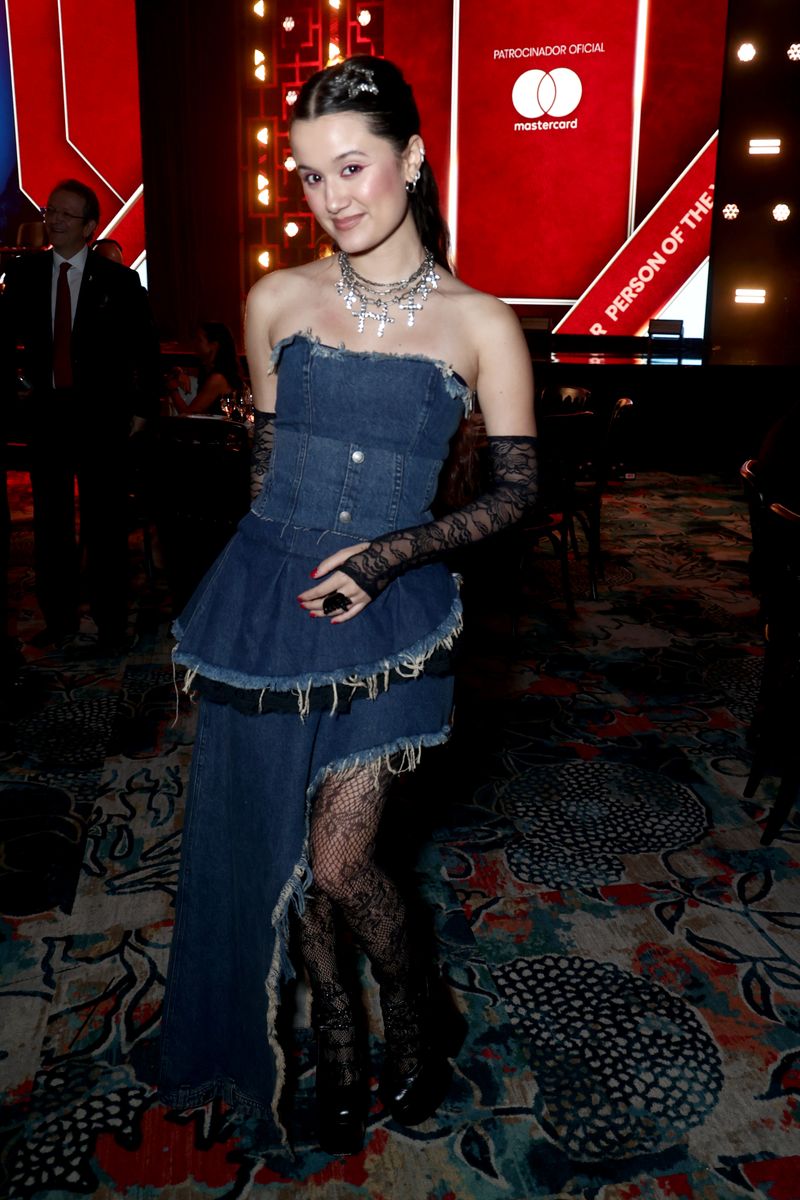
Joaquina, the youngest-ever winner of the Latin Grammy Award for Best New Artist, may be known for her emotional songwriting and signature red cat-eye, but the Venezuelan singer-songwriter says both came from a very personal place.
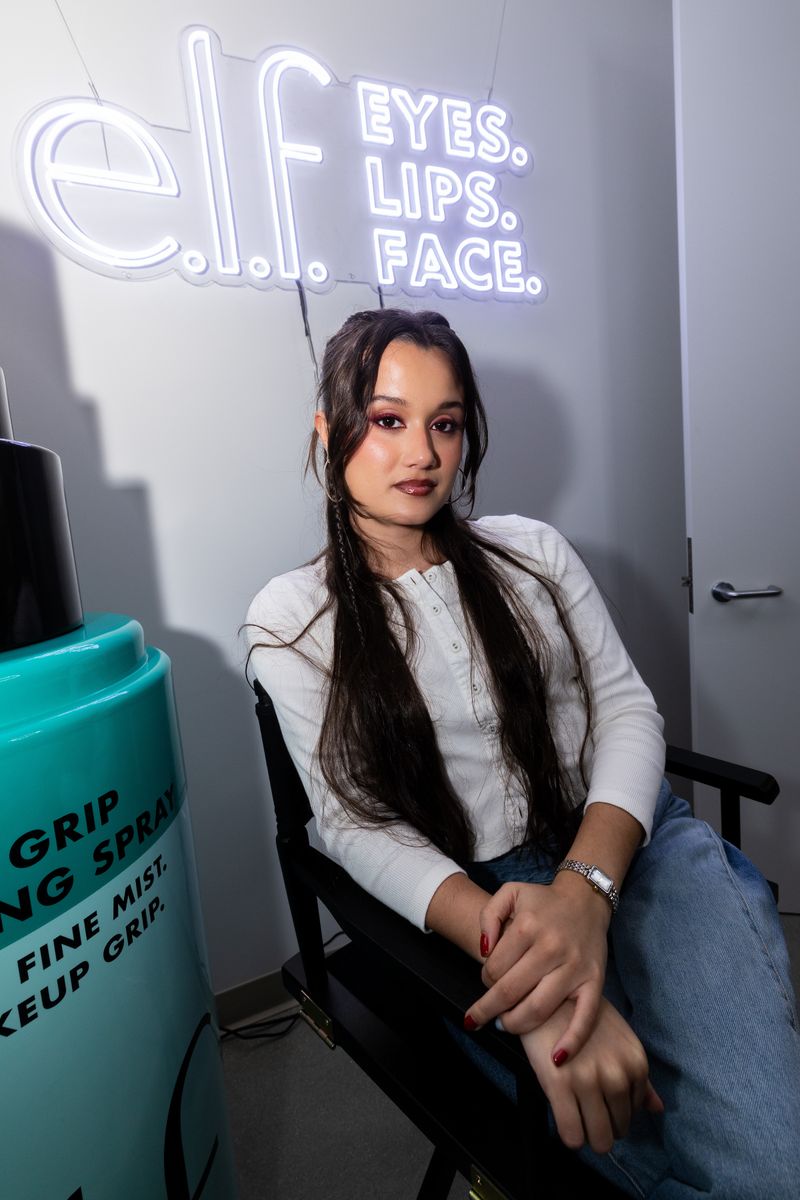
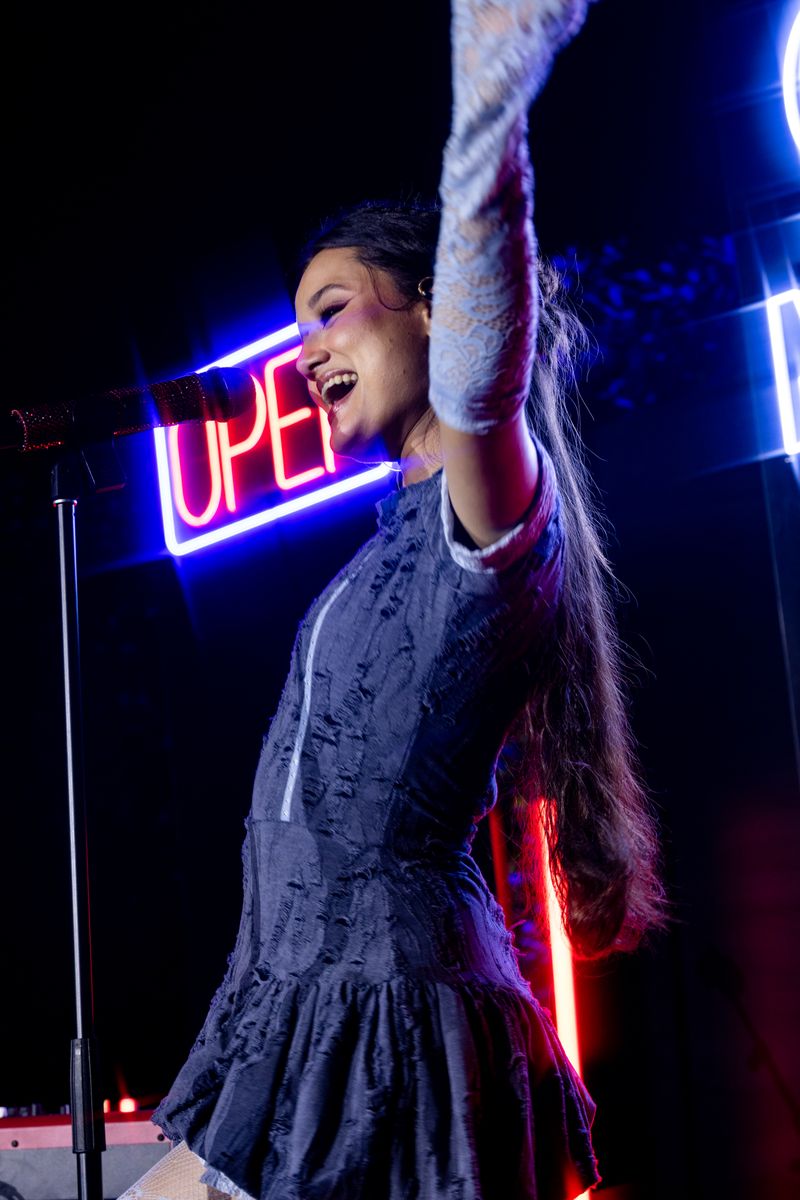
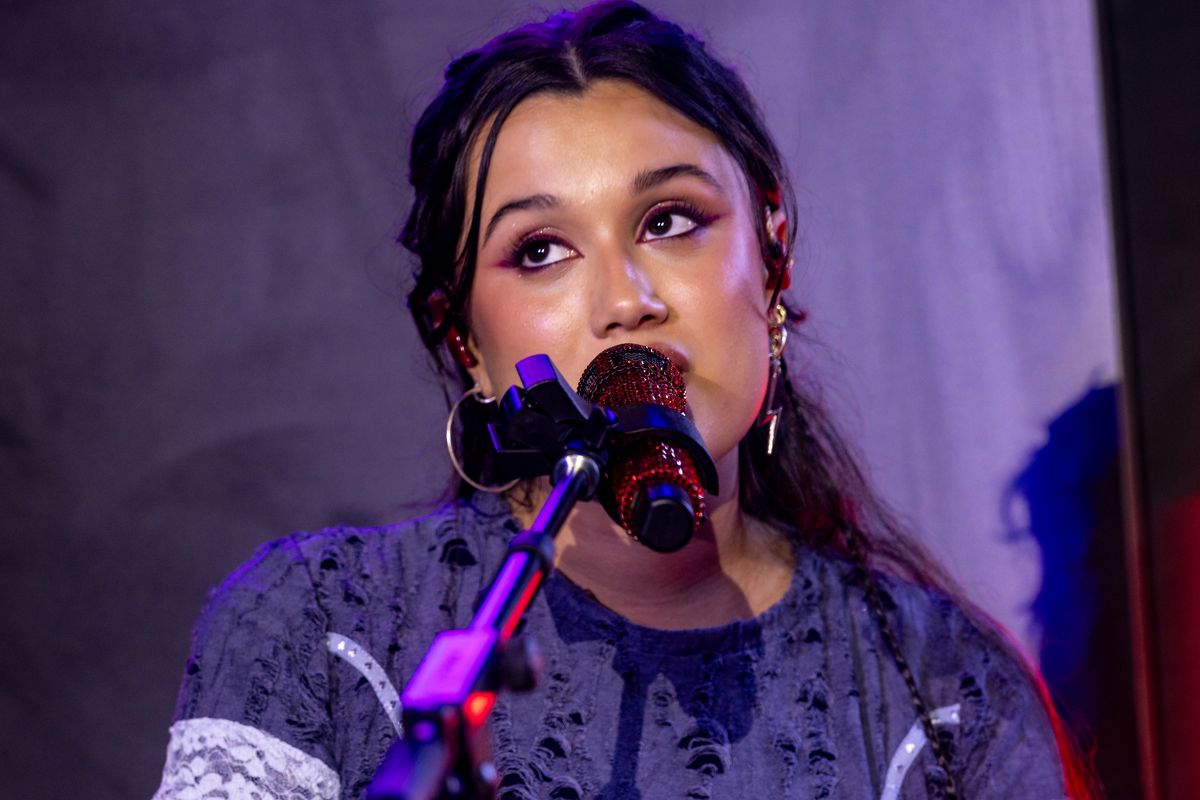
Joaquina performs “Ya no estoy” for the first time at the e.l.f. Mirror Mix event
With the help of CROING Creative and Digital Agency, the 22-year-old artist is entering a new chapter with “Ya no estoy,” her collaboration with e.l.f. Cosmetics for the brand’s Mirror Mix album, while also taking on a new role as one of the brand’s ambassadors.
For Joaquina, the partnership makes sense because music and makeup have been intertwined in her life for years. “I’ve always dreamt of working with a makeup brand,” she said during an interview with HOLA! at the Genius and e.l.f. event in Los Angeles.
She explained that she started making music around 13 or 14, which was also when she began discovering how much she loved makeup. “When it comes to expression, those two things go hand in hand for me.”
And while Mirror Mix is a brand project, Joaquina said she never felt like she was simply recording a song for a campaign, and the brand gave her creative freedom to write about whatever she was experiencing, and “Ya no estoy” was actually a song she had already started for the album she is currently making.
“I finished it, and I recorded it, and they loved it,” she said. “It just feels crazy, and I feel like the luckiest girl on the planet to be able to have an opportunity.”
The song ultimately became something much more personal than a typical brand collaboration. On “Ya no estoy,” Joaquina sings about choosing herself after losing herself in a relationship, with the song exploring independence, self-love, and learning to be comfortable alone.
Joaquina had to learn that love isn’t supposed to be everything
“Ya no estoy” feels personal because Joaquina wasn’t writing about some abstract idea of independence; she was writing from experience.
The singer said one of the biggest lessons she’s taken from a past relationship is that building your entire life around another person can ultimately hurt both people involved.
“I feel like something that I’ve learned through that process is that sometimes when you build your life around the idea of love or the idea of someone, it just ends up hurting you and the other person more than anything,” she said.
While she thought the phrase “you have to love yourself before you can fully love someone else” sounded cliché, she realized it had some weight.
“I never thought that it was true until I felt so unhappy and felt like everything around me was crumbling just because this relationship was over,” she said. “I think that love should be an addition to your life and not the sole purpose of it,” she said.
Now, Joaquina is learning how to be her own company and work through her insecurities before she gives that part of herself to someone else again. Which is something most women probably can’t say they figured out by 22 years old.
If there’s one thing Joaquina won’t separate from her music and identity- it’s Venezuela. She was born into a Venezuelan family and has lived in Miami since she was 6.
Growing up, she said her home remained deeply Venezuelan even as she built a life in the United States. Her parents played Venezuelan music, cooked Venezuelan food, and insisted that Joaquina and her sister speak Spanish so they wouldn’t lose their accents.
“Now that I look back, I’m really grateful that they did that,” she said. “I just feel so lucky that I’m bilingual,” she said, calling it “such a privilege” that has opened doors for her.
That upbringing left her with a complicated relationship with belonging. Joaquina said that as she’s gotten older, she’s sometimes felt “not American enough” and other times “not Venezuelan enough.”
Instead of choosing one side, however, she’s learned to let both exist. “These two loves, they don’t – they coexist in my heart,” she said. “They don’t have to compete.”
That bicultural identity is also intentionally present in “Ya no estoy.” The song incorporates the Venezuelan cuatro, while the lyrics and story reflect her experience of figuring out who she is and what she wants on her own terms.
Before Joaquina had a signature beauty look, she had a teenage girl’s free time, her mother’s makeup, and YouTube.
Her relationship with makeup started at home. Joaquina said her mother is “a makeup freak just like me,” and she grew up watching her get ready and seeing how much she enjoyed the process.
Then the pandemic happened, and Joaquina was 15, stuck at home, attending school online and, as she described it, going through an insecure period where she felt like she didn’t quite fit in.
So she started experimenting. “I was literally like scavenging my mom’s makeup, like old makeup, you know, stealing stuff,” she joked.
She spent hours watching YouTube makeup tutorials and practicing on herself. That is essentially how she taught herself to do makeup, and eventually how she landed on the look that would become almost synonymous with her.
Joaquina remembered finding a colorful palette in her mom’s bathroom with red, orange, and blue shadows. Because she has large eyelids and wanted to emphasize her eyes, she started playing around with cat-eye shapes. After trying black and purple, she landed on red. “I just really liked it,” she said. “So I’ve just kept doing it since then.”
The look has since become part of her identity, with fans recreating the red cat-eye and even wearing it to her shows.
She still considers herself an “up-and-coming” artist
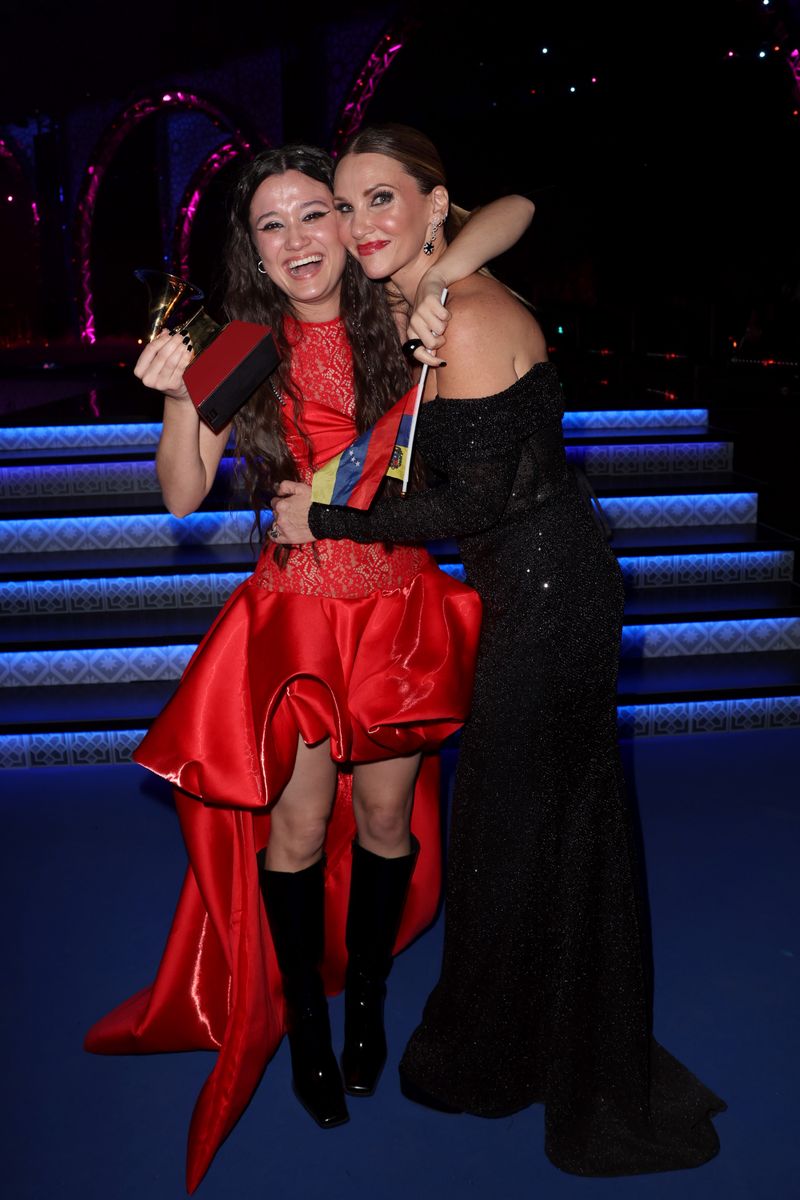
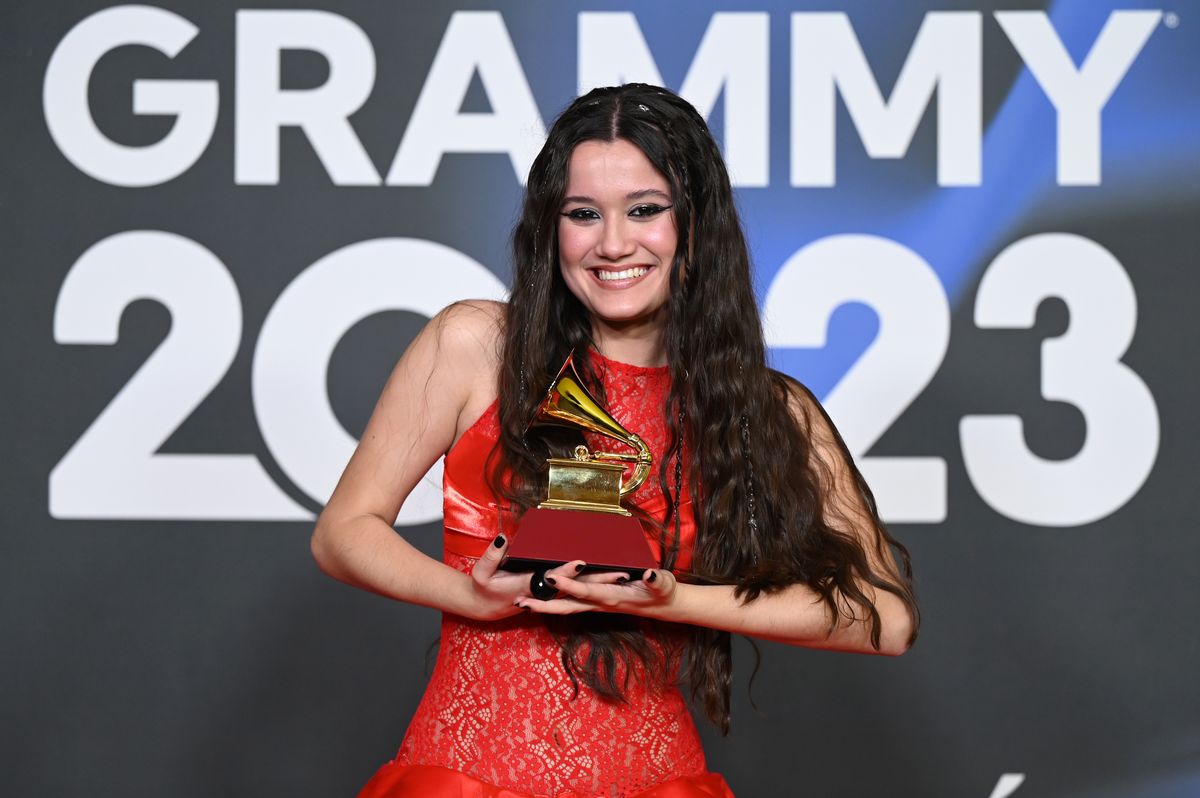
Joaquina became the youngest-ever winner of the Latin Grammy Award for Best New Artist in 2023 when she was 19
Joaquina is a Latin GRAMMY winner and eight-time nominee, has performed with Gustavo Dudamel and the New York Philharmonic at Radio City Music Hall, and has built a growing international fan base. However, she still describes herself as someone just getting started.
When asked when the world might stop calling her an “up-and-coming” artist, she basically shrugged. “Girl, I don’t know,” she said.
She knows she’s accomplished a lot, and she’s proud of her accomplishments, but none of those things, she explained, guarantee that you’ve reached the moment you’ve been waiting for. “You can have all the accolades in the world, but it really just takes like a shift, and sometimes it’s longer, sometimes it might be a song,” she said.
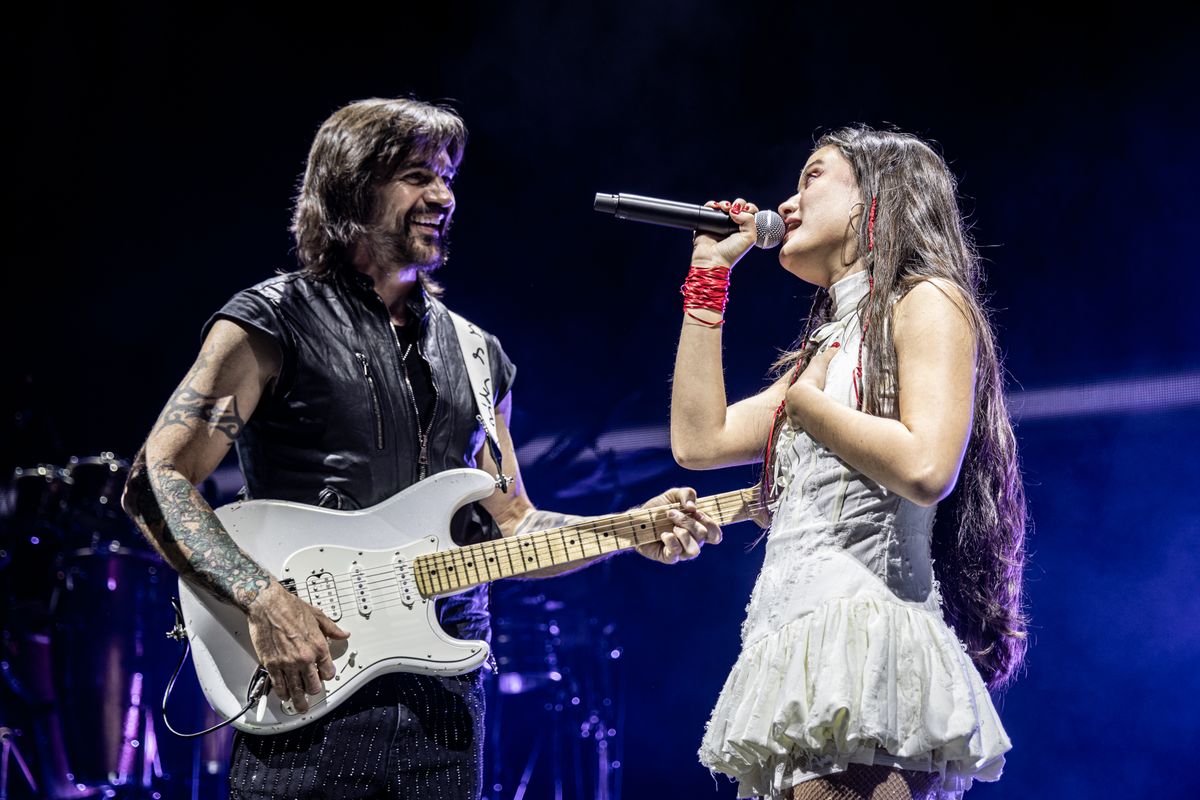
Juanes and Joaquina perform during Juanes North America Tour in January 2026
That’s why she’s focused less on collecting achievements and more on making music that actually sticks. “I think that my focus is to just like make really good albums,” she said.
She wants to build a community around her music so that when the bigger spotlight eventually arrives, she’ll have something meaningful to show for it. “I know my potential, and I know the music that I’m making,” she said. “I feel like people literally have not seen not even like 1/5 of what I know I can offer.”
Shakira may have left Barcelona behind, but one part of her life in Catalonia has followed her all the way to Miami. The Colombian superstar surprised Spanish television viewers during her October 8 appearance on La Revuelta when she effortlessly switched between Spanish and Catalan while chatting with host David Broncano.
What started as a casual conversation quickly turned into one of the interview’s funniest moments. Shakira revealed that she still speaks Catalan with her two sons, Milan and Sasha, whom she shares with former FC Barcelona footballer Gerard Piqué.
The Colombian artist has arrived in Madrid to begin a stay of almost a month, with 12 concerts scheduled at the Shakira Stadium.
She admitted that she uses the language more frequently in Miami than she did while living in Catalonia. “I speak more Catalan in Miami than when I lived in Catalonia,” Shakira confessed, explaining that the language has become something of a secret communication tool in her household.
Shakira speaks Catalan on La Revuelta and surprises David Broncano
The unexpected language lesson began when Shakira casually used a popular Catalan expression during her interview. “De puta mare, como dicen en Catalunya,” she said, using a colloquial phrase that roughly translates to “freaking awesome.”
Broncano immediately noticed. “Do you speak Catalan?” he asked.
Shakira confirmed that she does, explaining that her connection to the language remains strong because of her children. “I speak Catalan with my children. Yes, they are Catalan,” the singer explained.
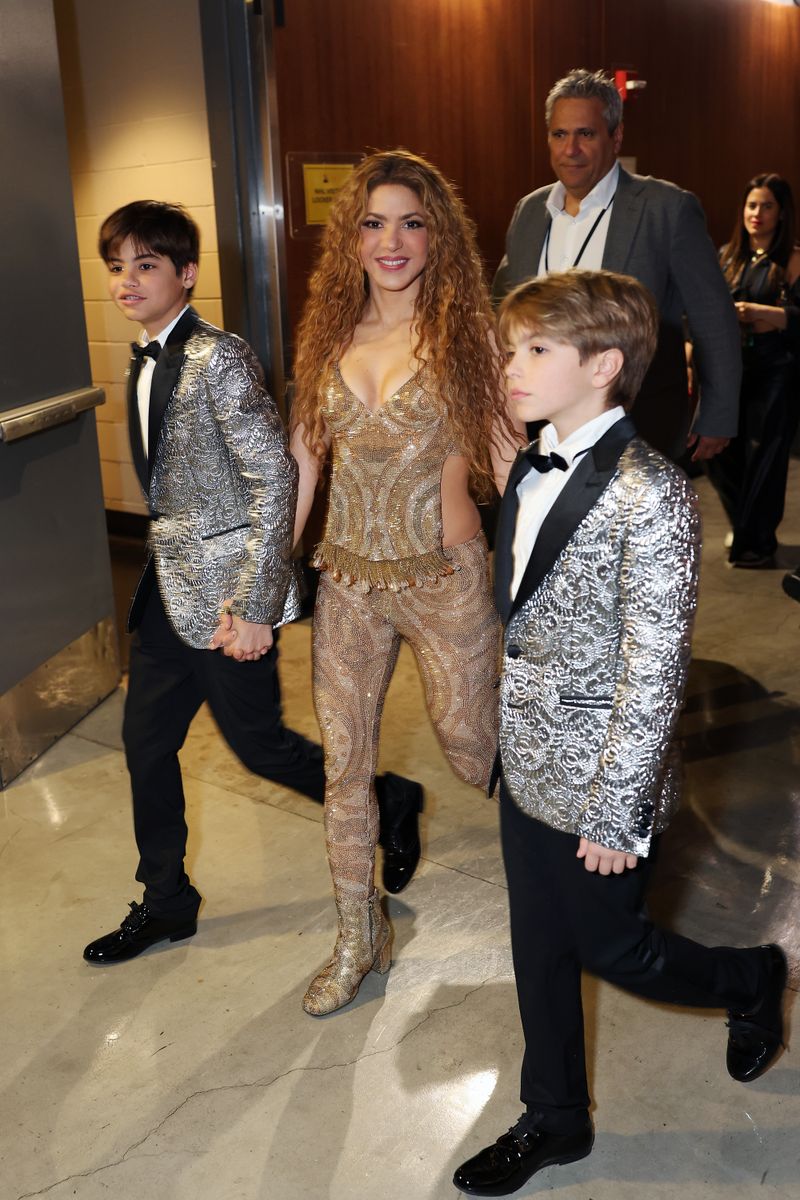
Shakira with her sons Milan and Sasha at the 67th edition of the Grammys
Why Shakira speaks Catalan with Milan and Sasha in Miami
For Shakira, Catalan is more than a reminder of her years in Barcelona. It also serves a surprisingly practical purpose. The singer revealed that her children sometimes switch to Catalan when they want to communicate without their friends understanding the conversation. “I speak Catalan with them in Miami. When they don’t want their friends to understand them, they speak Catalan to me,” she explained.
Although Milan and Sasha have grown up surrounded by multiple languages, Shakira clarified that English is their primary language when speaking to each other. “They speak a lot of English with each other. I try to speak in Spanish with them and in Catalan when I don’t want other people to understand me,” she said.
Sasha Pique Mebarak, Shakira, and Milan Pique Mebarak
Shakira shows off her Catalan with several expressions
Shakira didn’t stop at explaining how she uses the language. She also demonstrated her Catalan skills by sharing a few familiar expressions. Among the phrases she used were “Però què fas, tio!” which means “But what are you doing, dude?”
“Milan, parlem després,” which means “Milan, let’s talk later,” and “Hem de parlar d’això,” which means “We need to talk about this.”
And while she is internationally recognized for performing in Spanish and English, her ability to converse in Catalan reflects another aspect of her multilingual life.
David Broncano jokes about Gerard Piqué during the Catalan conversation
Just when the conversation seemed to be turning into an informal Catalan lesson, Broncano introduced an unexpected twist.
Shakira appeared surprised when the television host responded to her in Catalan. Curious about how someone from Jaén had learned the language, she asked whether he had once dated a Catalan woman.
Broncano confirmed that he had and immediately turned the coincidence into a joke. “In fact, the same thing has happened to both of us,” he replied, apparently alluding to their past relationships with Catalan partners.
The exchange was particularly amusing given Shakira’s highly publicized breakup with Piqué, which inspired some of her most talked-about music.
Shakira’s Barcelona years continue to influence her family life
Shakira’s relationship with Catalonia extends well beyond her former romance with Gerard Piqué. The singer spent years living in Barcelona, where her sons Milan and Sasha were raised during their early childhood. Both children began their education in Catalonia before the family relocated to Miami in 2023.
Their move marked a significant new chapter for Shakira, who has since balanced motherhood with her international music career. Still, the singer’s comments on La Revuelta suggest that the language and cultural influences from those years remain part of her children’s lives.
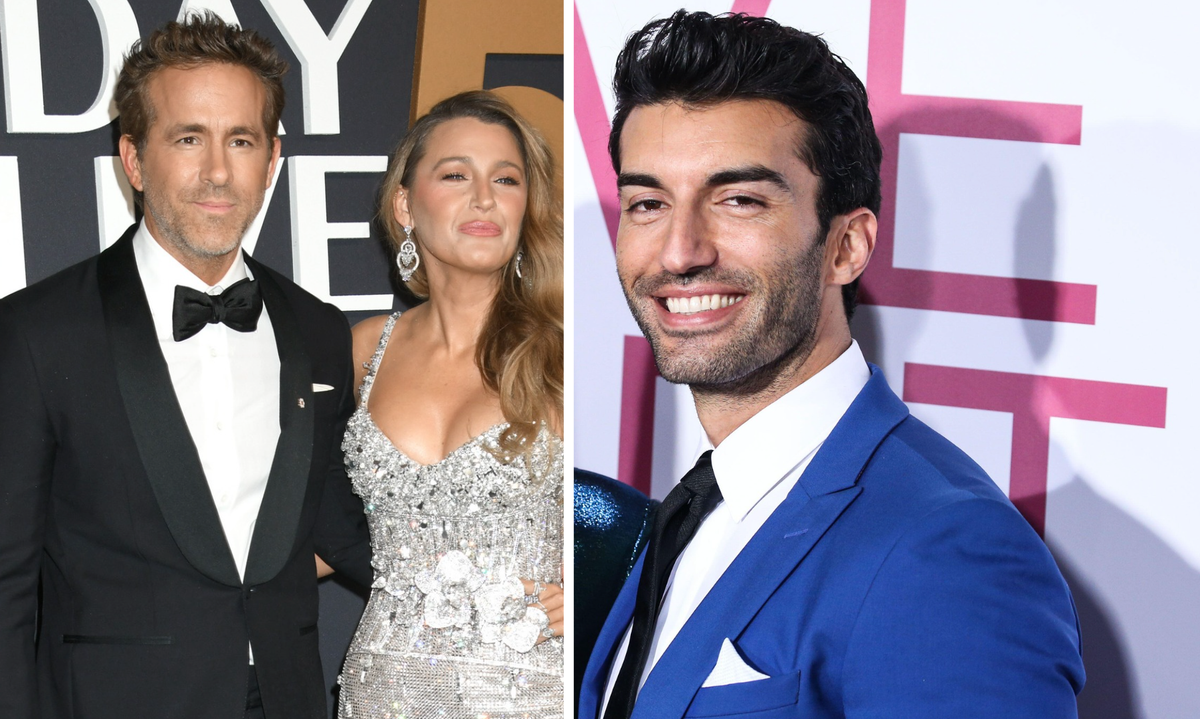
Ryan Reynolds did not hold back when discussing Justin Baldoni behind closed doors. Newly unsealed text messages from Blake Lively‘s legal battle with her It Ends With Us co-star and director reveal just how strongly the Deadpool actor felt about Baldoni as his wife faced intense public criticism during the film’s August 2024 release.
In messages exchanged with It Ends With Us author Colleen Hoover, Reynolds called Baldoni a “predator and sociopath” while criticizing the public narrative surrounding Lively.
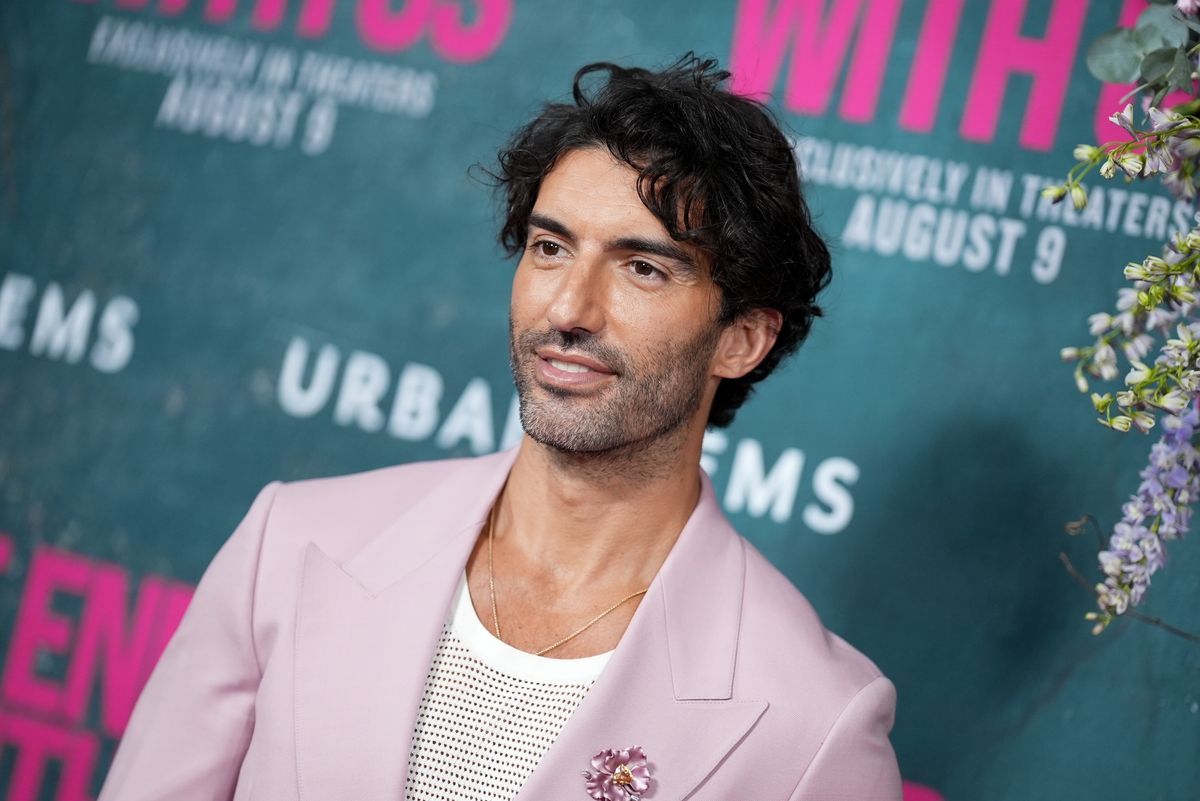
Justin Baldoni arrives at New York Federal Courthouse for his trial against Blake Lively
The private conversations, reported by Page Six on October 9, 2026, offer another revealing look at the Hollywood dispute that dominated entertainment headlines before Lively and Baldoni reached a settlement in May 2026.
You may also like
Continue reading
And Reynolds’ comments about Baldoni were only part of the story.
Ryan Reynolds Calls Justin Baldoni a ‘Predator and Sociopath’ in Private Texts
According to the newly disclosed court documents, Reynolds exchanged messages with Hoover on August 10, 2024, as speculation about tension behind the scenes of It Ends With Us intensified.
In one particularly pointed message, Reynolds expressed disbelief that Lively was facing public criticism while Baldoni was attracting less scrutiny.
He described Baldoni as a “predator and sociopath” and questioned why the narrative had focused on blaming a woman. The actor also expressed confidence that more information about the production would eventually become public. “It’s amazing to me how low people still go,” Reynolds wrote, adding that he believed people would eventually speak on the record.
The messages show that Reynolds was already deeply frustrated by the situation months before Lively formally accused Baldoni of sexual harassment and retaliation in December 2024.
Ryan Reynolds Mocks Justin Baldoni’s Crisis PR Team
One of the more striking revelations involves Reynolds’ sarcastic interpretation of Baldoni’s public relations strategy.
In his conversation with Hoover, Reynolds suggested that Baldoni’s crisis communications advisers were encouraging the director to maintain a carefully crafted public image while handling negative attention behind the scenes.
Judge dismisses Justin Baldoni’s $400M countersuit against Blake Lively and Ryan Reynolds
Reynolds imagined a conversation in which the team instructed Baldoni to continue discussing domestic violence, praising Lively and presenting himself as a thoughtful advocate.
He then wrote an imaginary response from Baldoni: “Justin: Namaste. Let’s get this bitch.” According to the court documents cited by Page Six, Hoover reacted with laughter.
The exchange reflected Reynolds’ belief that Baldoni’s public messaging did not align with what Reynolds believed was happening behind the scenes. Baldoni disputed the allegations against him.
Colleen Hoover Responds to Ryan Reynolds’ Messages About Justin Baldoni
Hoover, whose bestselling novel inspired the film, also shared her frustration with the online reaction. In the newly revealed conversation, the author suggested that some of the loudest critics were young social media users who might eventually regret their comments.
She also expressed relief that public attention appeared to be shifting away from Lively and toward Baldoni. Reynolds responded that he was surprised by the number of girls participating in the criticism, although he believed some observers already understood the situation.
Their exchange came during a particularly complicated promotional period for It Ends With Us.
Judge Dismisses Justin Baldoni’s $400M Countersuit Against Blake Lively and Ryan Reynolds
The film performed strongly at the box office, but its publicity campaign attracted controversy over how its subject matter was being discussed.
Lively faced criticism for encouraging moviegoers to wear floral outfits to screenings and for promoting her business ventures during interviews connected to a film centered on domestic abuse. At the same time, speculation grew about why Baldoni appeared separately from several cast members during promotional events.
The newly disclosed texts suggest that Reynolds and Hoover viewed the backlash through a very different lens from many of the film’s online critics.
Ryan Reynolds Also Pressured Sony Pictures to Defend Blake Lively
The messages to Hoover were not the only private communications involving Reynolds that have attracted attention.
Additional court documents reported by Page Six reveal that Reynolds contacted talent agent Warren Zavala on August 17, 2024, urging Sony Pictures to publicly support Lively. Reynolds reportedly believed the studio was failing to adequately defend his wife against damaging publicity.
He described Sony’s response as “unforgivable” and argued that the company needed to take stronger action. “Sony needs to step up for real,” Reynolds wrote. “ENOUGH IS ENOUGH.”
According to the messages, Reynolds had even drafted a proposed statement for the studio, although Sony did not release his version.
Justin Baldoni gains the support of Joe Rogan — says ‘everyone is scared’ of Blake Lively and Ryan Reynolds
He wanted the company to acknowledge what he believed was a coordinated reputational attack on Lively.
Sony eventually issued a public statement supporting the actress in December 2024, after her allegations against Baldoni became public.
What Happened in Blake Lively and Justin Baldoni’s Lawsuit?
The dispute began publicly in December 2024, when Lively accused Baldoni of sexual harassment and retaliation related to their work on It Ends With Us.
Baldoni denied the allegations and subsequently pursued a $400 million lawsuit against Lively, Reynolds, and others, accusing them of defamation and other wrongdoing. That lawsuit was dismissed in June 2025.
In April 2026, a federal judge dismissed much of Lively’s case, including her sexual harassment claims, while allowing certain retaliation-related claims to proceed.
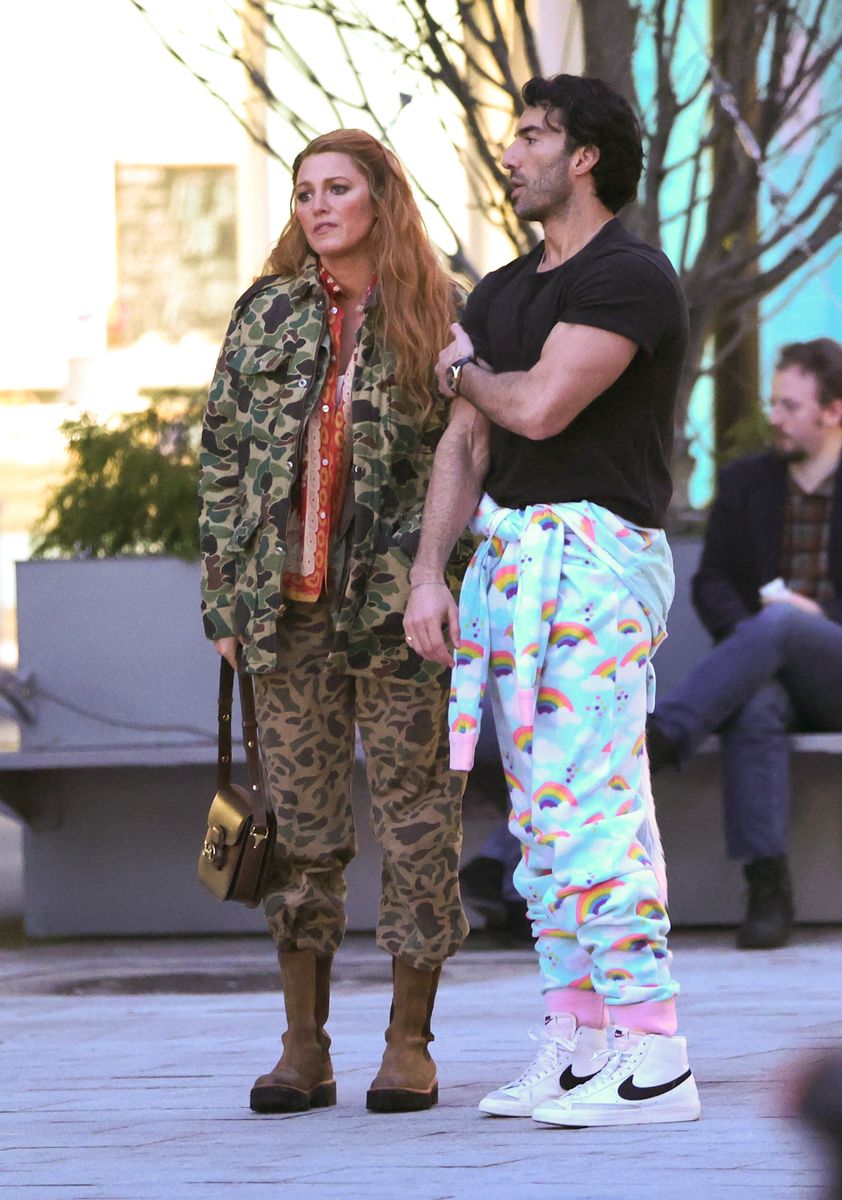
Blake Lively and Justin Baldoni are seen on the set of “It Ends with Us”
The ruling did not establish that all of the alleged conduct had or had not occurred. Some claims were dismissed because of the legal requirements governing Lively’s working relationship and the claims she brought.
The parties ultimately reached a confidential settlement in May 2026, shortly before the scheduled trial.
A joint statement from the parties acknowledged concerns about the production and emphasized the importance of workplaces free from misconduct.
The agreement ended the litigation without a trial determining the remaining disputed allegations.
How Has Justin Baldoni Responded Since the Settlement?
Baldoni has also addressed the emotional toll of the legal dispute.
In July 2026, he and his wife, Emily Baldoni, shared a video discussing the difficult period their family had experienced. The director said they had deliberately avoided speaking publicly for an extended period while allowing the legal process to unfold.
“Welcome to the future,” we hear several times in “Ray Gunn” — not that the brave new world it presents is all that welcoming. Or, for that matter, particularly brave or new. The good news is we finally have flying cars and superpowered jetpacks; in other respects, though, we haven’t come a long way at all. Co-existence with extraterrestrials has seen humans revert to old habits of prejudice and apartheid; crime and corruption are rampant as ever; pop-up ads now irksomely manifest as holograms in your personal space. Still, at least the future looks good. The fifth animated feature from Brad Bird is a handsome return to the retro-futurism he previously practiced in “The Incredibles” and his live-action oddity “Tomorrowland”: in this case, a vision of an impossible 21st-century metropolis as might have been dreamed in 1939.
The world-building — indeed, even just the building-building — is the principal ongoing thrill of “Ray Gun,” as it zips restlessly between gorgeous Art Deco skyscrapers, smokily lit Old Hollywood nightclubs and vividly kitsch rent-a-rooms, all rendered in chic, clashing scarlets and lilacs and burgundies, in vehicles that may be futuristically engineered, but have the luxurious, elongated curves of pre-WWII automobiles. Like “Blade Runner,” Bird’s film sits in the genre-melding realm of sci-fi noir; unlike “Blade Runner,” with its seamy, rain-sodden transformation of Los Angeles, this lighter, brighter detective story is not willing to sacrifice much gleam.
And fair enough: “Ray Gunn” is a caper first and foremost, with all its gumshoe antics safely in the PG-rated zone, though one suspects many of today’s kids may be entirely bewildered by it. (After all, Robert Zemeckis’ peerless “Who Framed Roger Rabbit?” — the original and best repurposing of noir tropes for family entertainment, and a clear creative touchstone here — is now very nearly as old as the 1940s classics it was spoofing.) Bird’s mystery zigs and zags breathlessly as it probes multiple murders connected to a femme fatale-styled starlet in the imaginary city of Metropia; it’s consistently nifty, even when it feels less than original.
But it it’s never quite as funny as it should be, while its characters — in particular the eponymous hero, a smooth-talking P.I. voiced by Sam Rockwell — want for texture and soul. Audiences should happily speed along with them on their adventures, but after a fairly long two hours in their company, we don’t feel terribly attached to them. These aren’t fatal shortfalls: There are more than enough visual and sonic delights here to compensate. But they are surprising ones from Bird, whose animated work has been marked by zingy, non-snarky but adult-favoring wit and carefully seeded personal stakes.
In “Ray Gunn,” the titular pun — the protagonist’s name, but also his preferred weapon — is typical of the script’s quippery, getting more nods and smiles than outright giggles. The only character dynamic worth a damn, meanwhile, is that between Ray and his weary partner Eye-Ra (Tom Waits, the film’s most inspired casting coup, yielding its most affecting voice performance), who run a down-at-heel “discreet investigations” business from a creaky office being gradually stripped bare by repo men. Business is bad for Ray, in part because Eye-Ra is an alien cyclops, and human-alien collaboration is frowned upon in this world. (We never learn how the two species came to occupy the same planet, but the law regarding their separation is entrenched: Eye-Ra is barred from human hospitals, while aliens can only enter certain clubs as serving staff.)
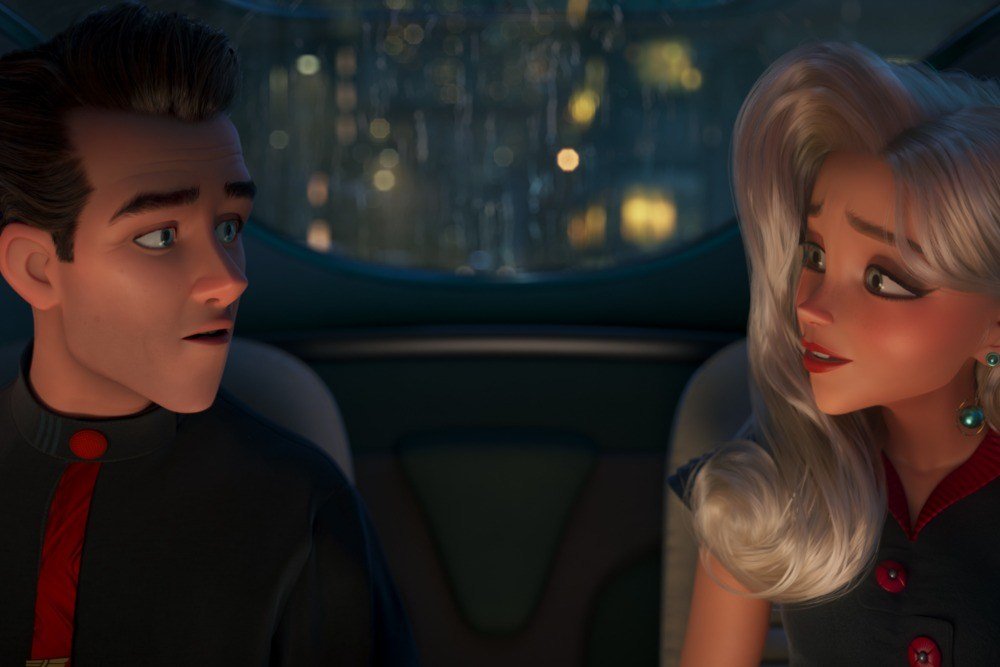
It’s a heavy racial allegory to throw into an otherwise breezy enterprise, and the tone hiccups here and there as a result. With more than a nod to the identity politics that underpinned last year’s “KPop Demon Hunters,” however, it does eventually figure into the principal storyline — which, after a couple too many introductory false starts, kicks off when Ray is hired by Arnold (Bobby Cannavale), the lunkhead fourth husband of tempestuous pop megastar Venus Nova (Scarlett Johansson) — to spy on her, though his motivations, of course, aren’t entirely what they seem. When people start showing up inconveniently dead and she’s thrust into scandal on the eve of her new album launch, Ray finds himself effectively babysitting her whilst carrying out his own snooping. But she’s a hard woman to pin down, in multiple senses; the more he knows about her, the less he knows about her, and naturally something sparks between them.
It’s an odd, perhaps youth-pandering detail that Venus, with her wasp-waisted silhouette and Veronica Lake hairdo, isn’t a Hollywood siren but a Dua Lipa-style electropop artist. (Her original songs are in fact written by Grammy winner Kimbra, of “Somebody That I Used to Know” fame, and they aren’t much in dialogue with Michael Giacchino’s wonderfully busy, brassy score, which makes no secret of its preferred era.) Nova’s particular brand of celebrity doesn’t really fit the film’s 2039-by-way-of-1939 mission statement, though it does allow Johansson a standout torch number in a more anti-period-appropriate vein — when Venus shows her true colors. Turns out she, like Bird, wants everything old to be new again, or everything new to be old again, or whatever the case may be.
She has a suitable partner on that front in the analog-inclined, trenchcoat-sporting Ray, but his image, too, doesn’t entirely add up: Rockwell voices him with jaded slyness, but he has the unlined face and swooshy hair of a Disney prince, rather than any stubbly Bogart gruffness. It’s just one reason why we can’t altogether warm to him — and why he doesn’t light up the center of Bird’s beautifully rendered dark-pastel dystopia. Rather like the man himself, “Ray Gunn” has slick, boundless energy and resourcefulness to spare, but that doesn’t quite amount to charm.
At MIPJunior, it’s not often that a little creeper gets put out on center-stage. But on Oct. 10, as “Migali” makes its world premiere in front of buyers from all across the globe, a tiny spider princess seems to be set on weaving webs of laughter and fun at the unmissable Cannes children’s TV market.
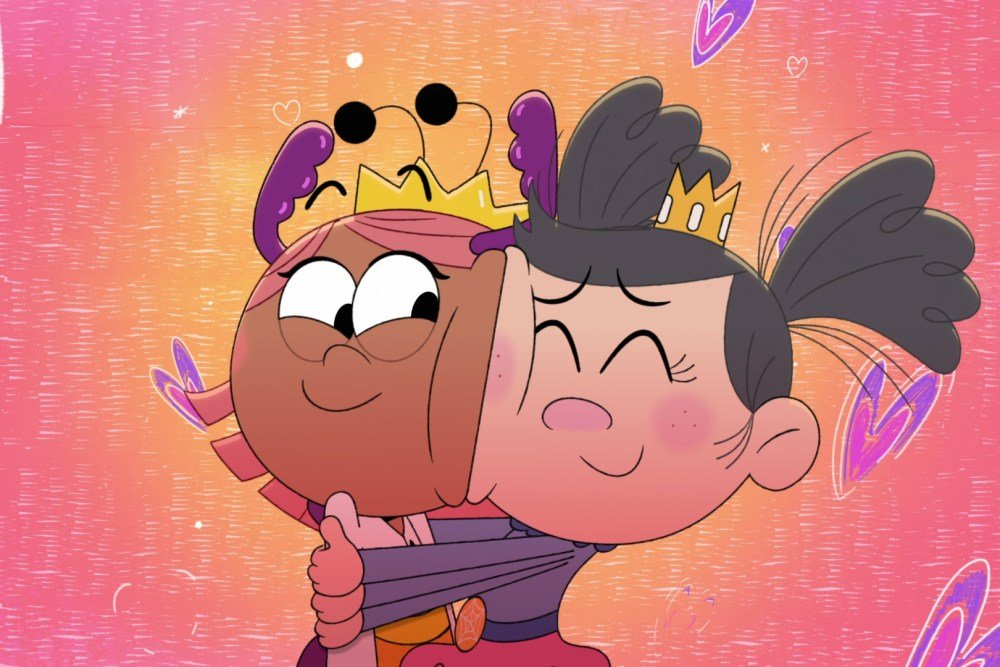
Produced by Adelaïde Terme (Easy Peasy Entertainment, the production/licensing arm of French Auzou Publishing Group) along with Bardaf! Productions in co-production with RTBF, Ketnet, RTS and TF1, “Migali” is a 52x11minute series centered on six-year-old Migali, a spider princess determined to become queen.
As she heads to the Royal Academy, where princes and princesses of all kingdoms learn to control their abilities, Migali brings her boundless energy and extraodinary web-weaving skills to the school, meeting a gallery of other quirky characters from all size and shapes. Facing (and, more often than not, provoking) chaos in her daily life, Migali stays happy, merry and positive, meeting each challenge as a new, fun adventure.
An adaptation of the eponymous comic book series by Alexandre Arlène and Fabien Ockö Lambert, “Migali” is directed by Cédric Frémeaux (“50/50 Heroes”). Ahead of the premiere, Frémeaux spoke with Variety about the smooth journey that has been bringing this loveable, quirky spider princess from page to screen.
“I’ve always loved animated series,” recalls the storyboard artist-turned director. “As a kid, I woke every morning eager to discover ‘Dexter’s Laboratory,’ ‘Dragonball,’ and many others. I was captivated by these worlds. Growing up, it quickly became clear to me that I wanted to work in that industry someday.”
During high school, Frémeaux found his way as an intern at Ankama, the French multimedia giant behind videogame hit “Dofus,” subsequent animated series “Wakfu” and manga hit “Radiant.” After studying animation at LISAA in Paris, he started his career as a storyboard artist, dabbling with editing and directing on trailers and teasers. “Migali” is his second series, a match made possible by Terme, who reached out to Frémeaux for this adaptation.
“She presented me Auzou’s line-up, and I immediately connected with ‘Migali,’ which turned out to be her own pick for our collaboration. What struck me with this character is how radiant and fun she was, as a heroin. With our target audience [kids 5-8], it’s very important to connect with a protagonist. And with Migali, they definitely can as she faces the sames challenges that they do.”
Migali, who Frémeaux frames as “Spiderman’s young cousin living in a world of unicorns, dragons and potions,” was brought to screen in close connection with the author duo and Terme, who saw the potential for an animated series even before the first comic was published.
Since then, Migali’s books have sold more than 150,000 copies in France, and boasts nine volumes already. This success fueled Frémeaux’s enthusiasm even more, as he prepared himself for the challenge of bringing this character to the screen.
“What I also love about ‘Migali’ is its humor, which doesn’t shy away from deeper topics that really connect with kids. Children from this age are much smart than we think, and if you’re lazy in your writing, they will see it instantly. Today, they have access to so much content. They know these narratives, and they know how it works. Instead of fighting for their attention span with fast-paced, frantic content, we chose to craft something that both takes them seriously and makes them laugh. And I think that’s key to succeeding in retaining kids’ attention today.”
Yet, as Frémeaux continued, the challenge of producing 52 episodes of 11 minutes (or as he put it, a nine-hour movie) was a huge undertaking. “Once storyboard was locked, we had to deliver a full episode’s animatic every week. And to do that, there’s only way I know: surrounding yourself with talented people who understand the project.”
Frémeaux goes even further: “My role as a director is to find people who are better than me at they own field of expertise. Once I managed to achieve that, every piece fell right into place, and the production was very smooth.” A production that was split between Caribara studios in Annecy, Paris, and Caribara Belgian subsidiary Waoooh.
“The key is these large European co-productions is to communicate constantly, and maintain overall cohesiveness throughout the whole pipeline. Animation is, at its heart, a collaborative art, and I strongly believe ‘Migali’ benefits from this collective effort. It would be a far less interesting product if I had created it alone with AI tools.”
“Migali” is AI-free, as the teams received strict instructions during this creative process. While aknowledging its uses, Frémeaux views AI technology as a tool that can’t be part of creating something. “Technology has always been part of the animation industry, which faced similar issues with the introduction of 3D, and other tools that revolutionized the medium over and over. But creativity has to remain at the center of this process, and tools can’t replace artists. Our show is made by people who asked themselves a lot of questions, who made choices in framing, staging, and poured their craft and soul in this series. And that is something that AI can’t do.”
As “Migali” premieres this afternoon, Frémeaux is eager to present this colorful, quirky character to the world. “Much like in our show, Migali is about to discover a whole new world, and I can’t wait to introduce her to global audiences. The series has a lot of potential, and we’ve only scratched the surface of Migali’s universe. There are many more paths and characters we can explore, to build beyond the Royal Academy and introduce children to this loveable IP.”
“Migali” premieres today at MipJunior, subsequently airing on TF1 and other partner broadcasters in the following months. The series is distributed internationally by Moon-Keys International Content.
On a balmy April afternoon at Abbey Road Studios in London, a 74-piece orchestra comprised of violinists, cellists, flautists and even an organ-payer, is packed into Studio One. The iconic room, which has hosted musical legends from Edward Elgar to Harry Styles, is painted “Toy Story” blue, a fitting color given the reason everyone is here today is to record the score for “Ray Gunn,” a new feature animation from Pixar legend Brad Bird, the brains behind “Ratatouille” and “The Incredibles.”
The film, which has been gestating inside Bird’s mind for three decades, is not a Pixar or Disney project, however (more on which later), but a Skydance Animation production which will hit Netflix on Dec. 18 (it premieres at the BFI London Film Festival on Oct. 10).
Directing the orchestra at Abbey Road is Bird’s longtime collaborator, composer Michael Giacchino. “Ray Gunn” is the duo’s sixth project together since first teaming up for “The Incredibles” in 2004 and it’s one Giacchino (who won an Oscar for Pixar’s “Up” in 2010) has had more than two decades to prepare for. “We talked about this movie during ‘The Incredibles,’” the composer reveals, when we speak a few months later. “I’ve known about this for a very long time.”
Fittingly, given the key role of music in the film, Bird first conceived the idea for “Ray Gunn” – a noir detective caper set in a “Jetsons”-style retro future – after hearing The B-52s’ song “Planet Claire.” To Bird, the tune sounded like a mash-up between the theme song to 1960s detective series “Peter Gunn” and “a ’50s monster sci-fi movie,” Bird says in an interview a day before the film’s premiere. “I went, ‘This is not “Peter Gunn.” What is this?’ And then I went, ‘It’s Ray-Gun.’ And then I went, ‘Ray Gunn: It’s a guy’s name. He’s a detective, but it’s in the future.’”
Michael Giacchino and Brad Bird (courtesy of Netflix)
Courtesy of Netflix
But the idea got shelved as other projects got in the way: there was his sophomore Pixar project “Ratatouille” followed by “The Incredibles 2” and, in between, live action fare “Mission: Impossible – Ghost Protocol” and “Tomorrowland” as well as an abandoned attempt to adapt Will Eisner’s comic “The Spirit.” Bird, who describes his mind as a “big shop floor,” would come back and “tinker” with “Ray Gunn” every now and again, biding his time until he could bring it to life (the film fell through at other studios including Warner Bros.)
It was “Mission: Impossible” that finally paved the way for what had effectively become Bird’s real-life mission: impossible. “It was [Skydance’s] second film and everybody was happy with how it turned out,” Bird says of his turn at the helm of the Tom Cruise franchise. So when the opportunity arose to pitch the studio on another idea, “Ray Gunn” was the obvious choice. (The move also reunited Bird with Pixar co-founder John Lasseter, now the head of Skydance Animation.)
“I never pitched it at Pixar because I felt like it wasn’t in Pixar’s wheelhouse exactly,” Bird explains, referring to the studio’s reputation for catering to younger audiences than the one he’s aiming at with “Ray Gunn.” “If you put a Pixar label on it people would go, ‘Oh well, it’s meant for the same audience that these other films were meant for,’ and inevitably some of them would go, ‘Well, my little Jimmy would be unhappy at this.’”
Bird expands on the theme, pointing out there are “10 billion animated films” for children and far fewer for teenagers and adults, despite them comprising the majority of the movie-going audience. Making animated films for them “shouldn’t be a controversial decision,” Bird says, “and yet it was always treated that way by the ministers of resource allocation [at Pixar].” (He is returning to Pixar for his next project, a third “Incredibles” movie.)
Skydance had a different take. “My thought when [they] got involved was that that they’ll go with me on this slightly different audience tangent,” Bird says. “And here it is.” Skydance CEO David Ellison is a producer on “Ray Gunn”: was that in name only or was he fairly hands-on? “Well, he was more involved in the earlier days,” Bird says. “But he got — you know, his plate became very full.” The director is obliquely referring to Ellison’s recent battle to acquire Warner Bros. Discovery. Bird won’t be drawn on whether he thinks Ellison will stick to his promise, made as part of his bid, that Skydance will produce at least 30 theatrical films a year. “All that stuff is beyond my pay grade,” he says, sidestepping the question.
While Skydance may have become the latest lightning rod in an increasingly polarised and under pressure Hollywood, Bird is a pragmatist. Later in our conversation, he notes that after making “The Iron Giant” he took his nascent idea for “The Incredibles” to Pixar. “The crew from ‘Iron Giant,’ a lot of them were mad at me initially because they felt like I was leaving hand-drawn [animation] and going to the sexy new CG,” Bird recalls. “And I said I don’t really care about the technology part. I’m going up to Pixar because they protect storytelling.”
“Ray Gunn”
Netflix
As it happens, protecting — versus exploiting — art is one of the themes of “Ray Gunn,” which follows the eponymous private detective (voiced by Sam Rockwell) as he uncovers a dastardly plot involving Venus Nova (Scarlett Johansson), a superstar singer with a huge secret.
For Giacchino, the trick to scoring a film filled with so much intrigue is keeping the viewer guessing. “Probably the second toughest thing was just making sure everything was always in alignment thematically, so that I didn’t give the audience something that they shouldn’t be thinking about,” he notes. (The actual toughest, he says, was an intimate scene between Gunn and Nova when they’re first opening up to each other. “It needed to really hit every single emotional beat in this perfect way,” he explains.)
Bird may have written “Ray Gunn” almost three decades ago but it’s themes of art, technology and corporate greed resonate now as much as they did in the late 1990s. He says the screenplay changed “less than you’d think” between that first draft and the finished movie.
“A lot of the things that people are saying that [the film] is dealing with that are contemporary right now in the headlines were in there 30 years ago,” Bird notes. “People are people and greed is greed and the flaws of people make good subject material for films. If that’s what’s driving the story, then the story’s not going to age because it’s about eternal things rather than things that were in the news last week.”
Hollywood’s appetite for Asian stories has broadened, but for Lionsgate’s Helen Lee-Kim, “every movie is still a fight.”
Lee-Kim, the studio’s president of international, made the remark at the Busan International Film Festival‘s Asian Contents & Film Market during the panel “UTA × Gold House: Hollywood & The Asian Diaspora,” moderated by Variety‘s Asia Editor Naman Ramachandran.
The discussion brought together representatives from Lionsgate, UTA, Gold House Studios, Hybe America Studios and East West Bank to examine how Asian stories can reach wider audiences without sacrificing their cultural identity.
Lee-Kim said pandemic viewing, despite the disruption COVID brought to the industry, exposed audiences to films across languages and helped make language less of a barrier. Asian content can attract viewers beyond Asia, she said, with a compelling concept remaining central to its commercial appeal.
She pointed to “Karoshi,” the action thriller starring Teo Yoo and directed by Takashi Doscher, as an example of bringing Asian talent into Hollywood filmmaking. Such projects still require studios and distributors to take individual creative bets, she said.
UTA’s David Park cited “Parasite” and “Squid Game” as breakthroughs that demonstrated possibilities once difficult to imagine. Their success has expanded the routes available to Asian filmmakers beyond moving to Hollywood and working in English, he said.
Discussing Na Hong-Jin’s Korean project “Hope,” Park highlighted its ambition, original concept and global genre appeal, with Asian actors in the leading roles alongside international stars.
Park also pointed to “Past Lives” and “Tokyo Vice” as examples of multicultural storytelling grounded in particular experiences. He expressed a desire for more such collaborations to develop organically, cautioning against allowing calculations about global audiences to dictate the work.
Christine Yi, president of Gold House Studios, said the company was looking across genres, without a prescribed category. What mattered was originality and a human, subjective perspective, she said. Its interest in new voices did not require creators to compromise or deliberately internationalize their material.
Hybe America Studios president James Shin emphasized collaboration with artists and Korean creative teams as the company builds its film and television business. Discussing “K-Pop: The Debut,” he stressed the importance of working across cultures through creative partnerships.
East West Bank executive vice president Bennett Pozil, who financed “Crouching Tiger, Hidden Dragon,” pointed to growing investment activity across Southeast Asia. He cited the Taiwan Creative Content Agency (TAICCA) as an example of funding being channeled directly into the industry, alongside co-production investments in Singapore and Thailand.
His view on cross-border storytelling was shared across the panel as multilingual and multicultural filmmaking opens more paths to audiences.
“Don’t force anything,” Pozil said. “It has to be authentic.”