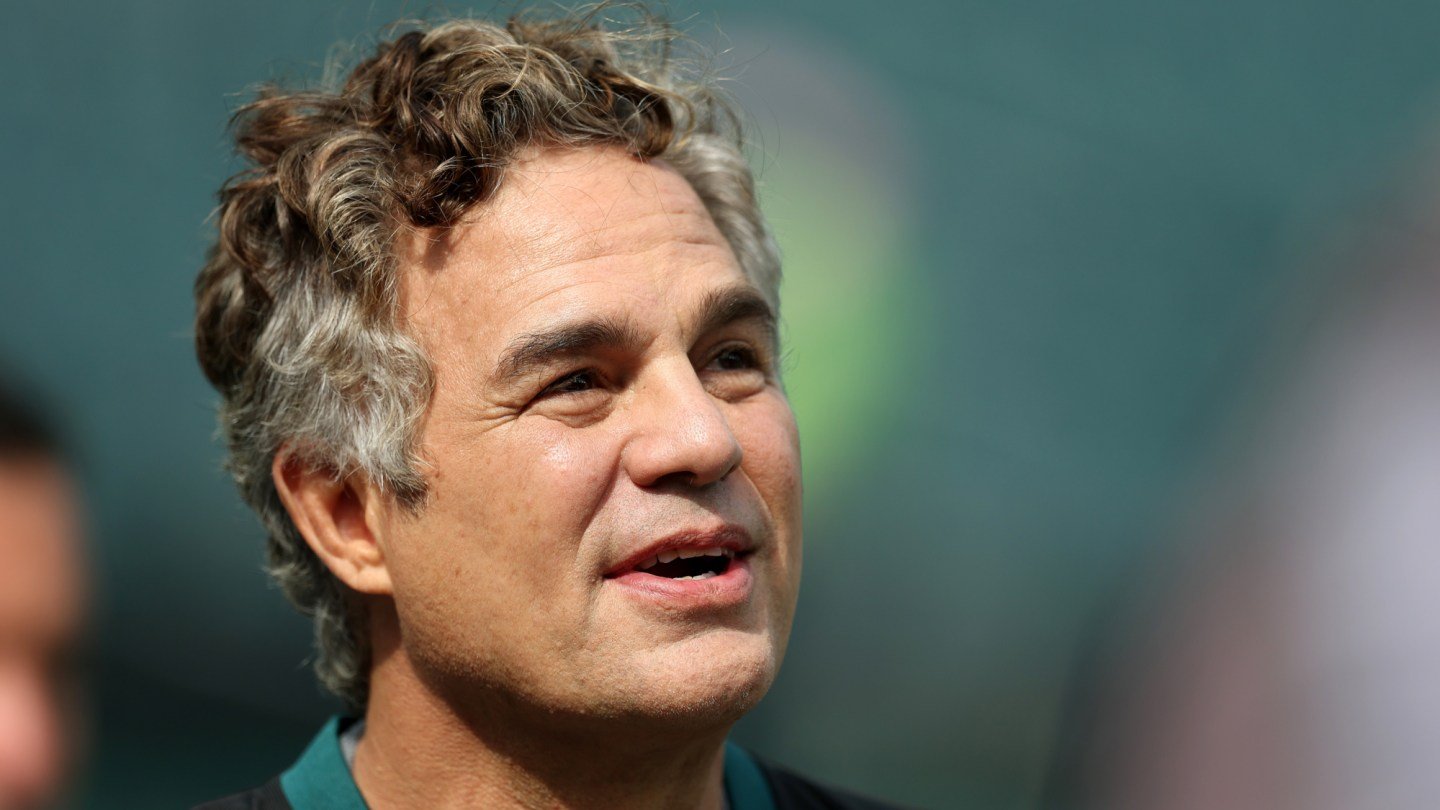
Mark Ruffalo has been a consistent opponent of Paramount’s $111 billion deal for Warner Bros., testifying against the merger to a Senate hearing, signing an open letter along with hundreds of actors opposing the buy and amplifying his message on social media consistently.
His latest missive took aim at Larry Ellison, the Oracle founder worth about $200 billion who’s the father of Paramount CEO David Ellison. Larry’s billions are a key backstop to help his son’s merger of the two historic Hollywood studios cross the finish line.
Ruffalo’s post on Instagram highlighted Oracle’s ties to the Israeli military, circulating a clip of former Oracle chief Safra Catz talking up Oracle’s tech at the Israeli-American Council National Summit in 2024 as it related to Israel’s war effort in Gaza. The executive spoke about “profoundly scary technologies” the company had built that could be deployed. The Marvel actor described the war as a “genocide” that “was built on an apartheid system of oppression powered by Oracle.”
Ruffalo’s implication to his audience was to link Oracle, the Ellisons and their media empire all together, saying that the moguls “are crushing workers and consolidating the wealth of the world for their own power and concentrated dominance.”
A spokesperson at Paramount took the normally unusual step of issuing a lengthy reply to Ruffalo’s comments, both calling for the temperature of the debate to be lowered while also deeming that actors’ remarks “antisemitic.”
“We are, as always, troubled when antisemitic tropes are invoked in purported service of a business dispute,” the Paramount rep stated. “Words like ‘genocide’ and ‘apartheid,’ applied to a corporate transaction, aren’t just wrong — they’re a bridge too far, and they cheapen the very real suffering those words are meant to describe. This doesn’t deserve a response in kind — and to be clear, we don’t tolerate prejudice of any kind, against anyone.”
The studio rep added, “This brings us to a moment to lower the temperature, not raise it. We’d rather build than further engage in such rhetoric. This simply exposes the true motivation of some who have advocated opposition to this transaction. On the other hand, our commitment to great content is matched by our commitment to acceptance – to every story, every storyteller, and no blacklists, no exceptions, for anyone.
The rep added, “We understand people feel strongly about this merger and are hopeful and expect that it will be judged based on the legal merits, not underlying bias. We’re asking for the same good faith we’re extending: less rhetoric, more understanding. Paramount’s future is being written for everyone who wants to make and watch great stories.”
Oracle, the Austin-based tech conglomerate, increasingly has become an AI power player as well as a stakeholder in TikTok’s U.S. operations. The far-reaching applications for its technology have come under increasing criticism from opponents of the Israel war in Gaza, as well as the Boycott, Divestment and Sanctions movement that has lobbied against companies doing business with Israel.
Mark Ruffalo’s caption referencing Oracle’s ties to the Israeli military.
Paramount has come out swinging against a Friday screed from Mark Ruffalo, in which the award-winning actor accused moguls David and Larry Ellison of “powering some of the most destructive and inhuman forces in the world.”
A spokesperson for the David Ellison-run enterprise said the company is “troubled when antisemitic tropes are invoked in purported service of a business dispute. Words like ‘genocide’ and ‘apartheid,’ applied to a corporate transaction, aren’t just wrong — they’re a bridge too far, and they cheapen the very real suffering those words are meant to describe. This doesn’t deserve a response in kind — and to be clear, we don’t tolerate prejudice of any kind, against anyone.”
Ruffalo took to Instagram with a years-old clip of Paramount board member Safra Catz discussing “really profoundly scary technologies” that Oracle used to assist the Israeli military following the Oct. 7 terror attacks. That 2023 event saw Hamas and other Palestinian militant groups kill 1,195 Israelis and foreign nationals and abduct 251 people. Ruffalo referred to Larry Ellison as a “classic Oligarch,” and warned of the danger of his son’s bid to combine Paramount with Warner Bros. Discovery. Referencing the Catz clip, Ruffalo encouraged his followers to “look how she revels in what we now have come to see as a genocide, which was built on an apartheid system of oppression powered by Oracle.”
Ruffalo was one of the earliest Hollywood figures to decry the proposed Warner Bros. Discovery and Paramount merger. Numerous industry sources have expressed concern over Ruffalo’s conflating the merger with anti-Israel sentiments.
Paramount said Ruffalo’s post “brings us to a moment to lower the temperature, not raise it. We’d rather build than further engage in such rhetoric. This simply exposes the true motivation of some who have advocated opposition to this transaction. On the other hand, our commitment to great content is matched by our commitment to acceptance – to every story, every storyteller, and no blacklists, no exceptions, for anyone.”
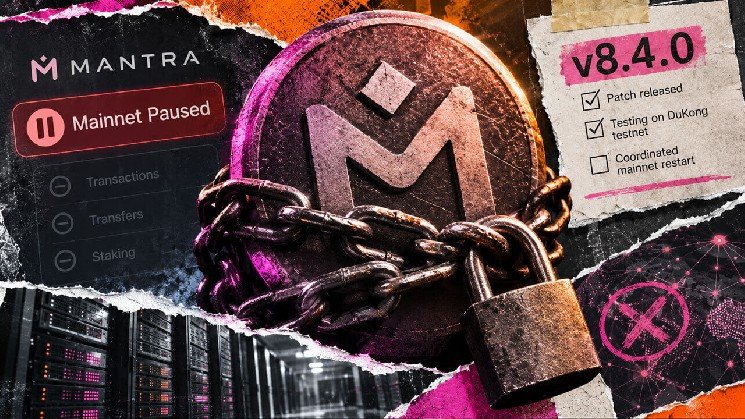
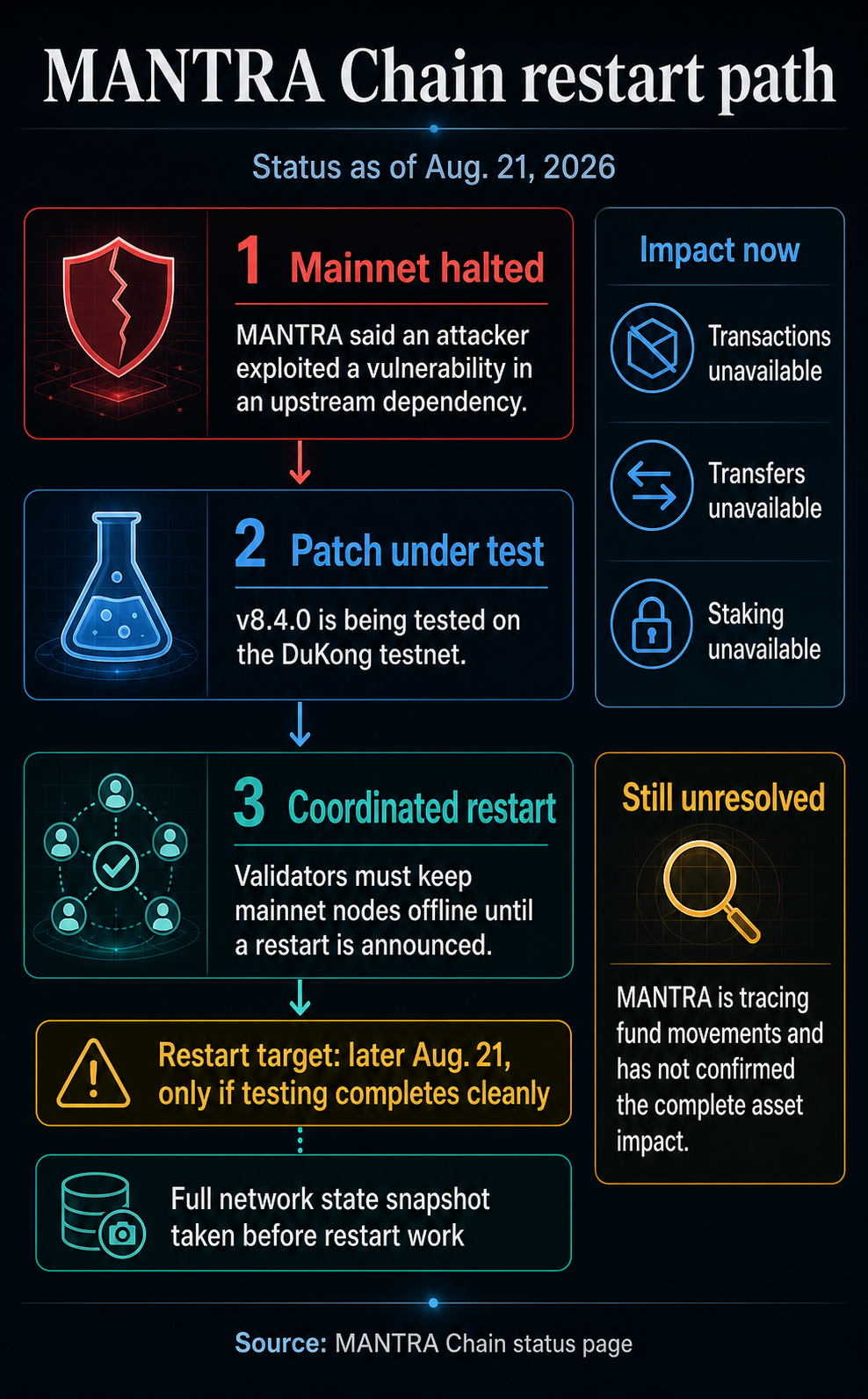
MANTRA Chain remained halted on Aug. 21 after the team said an attacker exploited a vulnerability in an upstream dependency. Transactions, transfers, and staking are unavailable while the mainnet is paused.
MANTRA identified the vulnerable software only as an upstream dependency. In its official incident record, the team said it was tracing fund movements, working with exchange partners, and continuing to assess the complete scope.
The incident record shows MANTRA first froze endpoints and transactions while reviewing the root cause and impact. It later attributed the precautionary halt to an attacker exploiting the upstream dependency, then announced the patched release and testnet testing, with the mainnet remaining offline throughout those updates.
The project’s latest update said user funds were unaffected by the halt itself and that a full network state snapshot was taken before the restart process began. That assurance is limited to the network pause, which prevents transactions from being processed. The asset impact of the attacker’s activity remains unconfirmed.
Patch testing controls the restart
MANTRA said patched release v8.4.0 addresses the underlying vulnerability and is undergoing testing and due diligence on the DuKong testnet. The project’s GitHub release confirms the version and includes a mainnet upgrade handler.
Testing on DuKong is the gate before rolling out the same software to mainnet. MANTRA said it was prioritizing a careful, verified rollout and instructed validators to keep their mainnet nodes offline until it announces a coordinated restart.
The coordination requirement prevents individual node operators from bringing mainnet service back independently. Validators have to wait for MANTRA’s restart announcement so the patched network can return through the wider validator set together.
The team was targeting a restart later on Aug. 21, subject to testing completing cleanly. Mainnet can return only after the patch clears testing and the wider validator set is ready for the coordinated upgrade.
MANTRA outlined a three-step restart plan after halting mainnet, with a patch under test and validator coordination still underway.
For users, the halt means ordinary onchain activity cannot proceed. Assets cannot move on MANTRA Chain, staking operations are unavailable, and deposits and withdrawals for the token remained paused on affected venues, according to earlier incident updates. MANTRA said users didn’t need to take action while the chain remained offline.
A restart announcement would resolve the immediate operational freeze, while MANTRA’s assessment of fund movements and the incident’s complete asset impact remains a separate issue to watch.
Paramount Skydance representatives are expected to meet on Monday with the California Attorney General’s office to discuss a potential settlement of the states’ antitrust case, according to two sources familiar with the situation.
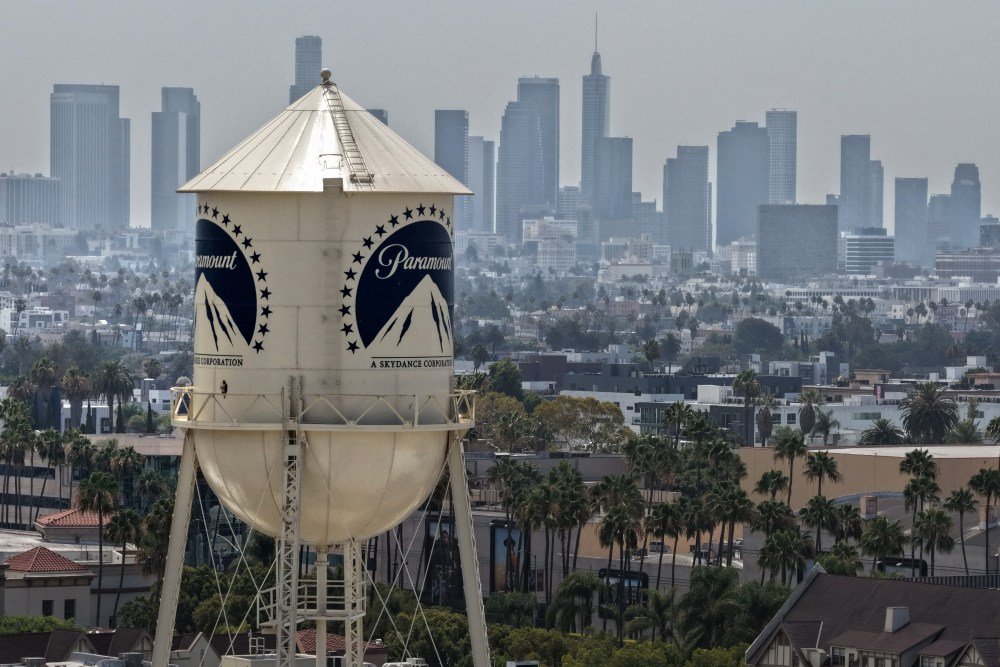
Paramount has been pushing hard for a deal to allow its $111 billion merger with Warner Bros. Discovery to close. The deal is currently on hold pending a March trial in federal court in Oakland.
Attorney General Rob Bonta has said he is open to settlement negotiations, but has also said that Paramount has thus far been unwilling to offer the kind of structural remedies that would be needed to satisfy the states’ concerns.
A Paramount spokesperson declined to comment.
Bonta led a 12-state coalition to challenge the merger in July, arguing that it would illegally contract the marketplace for theatrical distribution and basic cable. The merger would consolidate two of Hollywood’s five legacy studios and two of the top three cable programmers.
Under federal rules, the two sides will have to at least try to settle the case in front of a magistrate judge at some point. At a hearing this week, Judge Araceli Martinez-Olguin asked the parties to identify two potential magistrates who could oversee mediation by next Wednesday.
A parade of interested parties has recently come out in favor of a settlement, including the Directors Guild of America, IATSE, Los Angeles Mayor Karen Bass and Cinema United, the trade group representing theater chains.
“Earlier this week, you heard the attorney general himself say he’d prefer this settle in the boardroom, not the courtroom,” Gov. Gavin Newsom said Friday. “I think there’s some universal sentiment there, if that’s possible. The question is is that possible. And what’s the best deal? That has to be worked through. That’s a process that’s unfolding, I assure you, in real time.”
Paramount has pledged various commitments to try to get a deal done, including a promise to make 30 films a year for the next three years, and to keep them exclusively in theaters for at least 45 days. Bonta’s office, however, has argued that such behavioral remedies have proven impossible to enforce in the past.
The Writers Guild of America has filed its own lawsuit, which is set to be tried along with the states’ case next March. The WGA is also a party to the stipulation that puts the merger on hold until the trial, and would have be involved the parties are aiming to reach a global resolution. A WGA spokesperson did not respond to a request for comment.
Stellar has emerged as the leading public blockchain network for tokenizing non-US government debt, currently hosting approximately $490 million in such assets, according to the latest on-chain data. Since February, the Stellar network has outpaced competitors in this sector, signaling a significant shift for real-world asset (RWA) tokenization beyond the traditional US government debt and US dollar stablecoins.
Surge in tokenized global debt
Institutional custodians and fund management platforms have increasingly used Stellar to issue and store debt securities denominated in euros, pounds, and a range of other local currencies. This trend underscores a growing global move toward blockchain-based finance, as most governments and businesses outside the US do not operate primarily in dollars but are nonetheless issuing debt onchain.
Since February, Stellar has led the market, holding roughly $490 million in tokenized non-US government debt and surpassing any other public blockchain in this specific area.
The growth rate for tokenized non-US government debt on Stellar has remained robust, with new issuances significantly exceeding those of competing Layer-1 blockchains specializing in similar financial instruments.
Benefits for issuers, asset managers, and developers
Bringing sovereign debt onto the blockchain removes US-foreign correspondence hurdles, provides 24/7 settlement opportunities, and leverages programmable, compliant infrastructure. Asset managers can access instant atomic settlement in stablecoins, while issuers benefit from reduced costs to bring new instruments to market.
Exchanges and custodians are expanding services to accommodate funds originating from Europe, Latin America, and Asia. For developers, Stellar’s combination of low transaction fees and built-in compliance features has made it a preferred option for companies seeking to offer regulated financial products.
Mini dictionary: Real-world asset (RWA) tokenization refers to the process of issuing digital tokens that represent ownership of tangible or financial assets, such as government debt, directly on a blockchain. This enables transparent, efficient, and programmable asset management across borders.
Global regulatory shift and future challenges
Efforts to diversify reserve and settlement systems away from dollar dominance are driving further adoption of blockchain-based solutions. Recent regulatory progress in the EU and UK regarding distributed ledger technology (DLT) securities is expected to encourage greater issuance of tokenized financial instruments.
While Ethereum and Polygon are courting RWA issuers, Stellar’s early momentum has helped it retain a leadership position in this emerging sector. The network’s ongoing development focuses on key priorities, including the verification of reserves, expanding liquidity on secondary markets, and establishing cross-chain interoperability standards to support broader enterprise adoption.
Important steps for the sector include reserve verification, improving secondary market liquidity, and developing robust cross-chain standards, which are considered vital for the future growth of tokenized government debt.
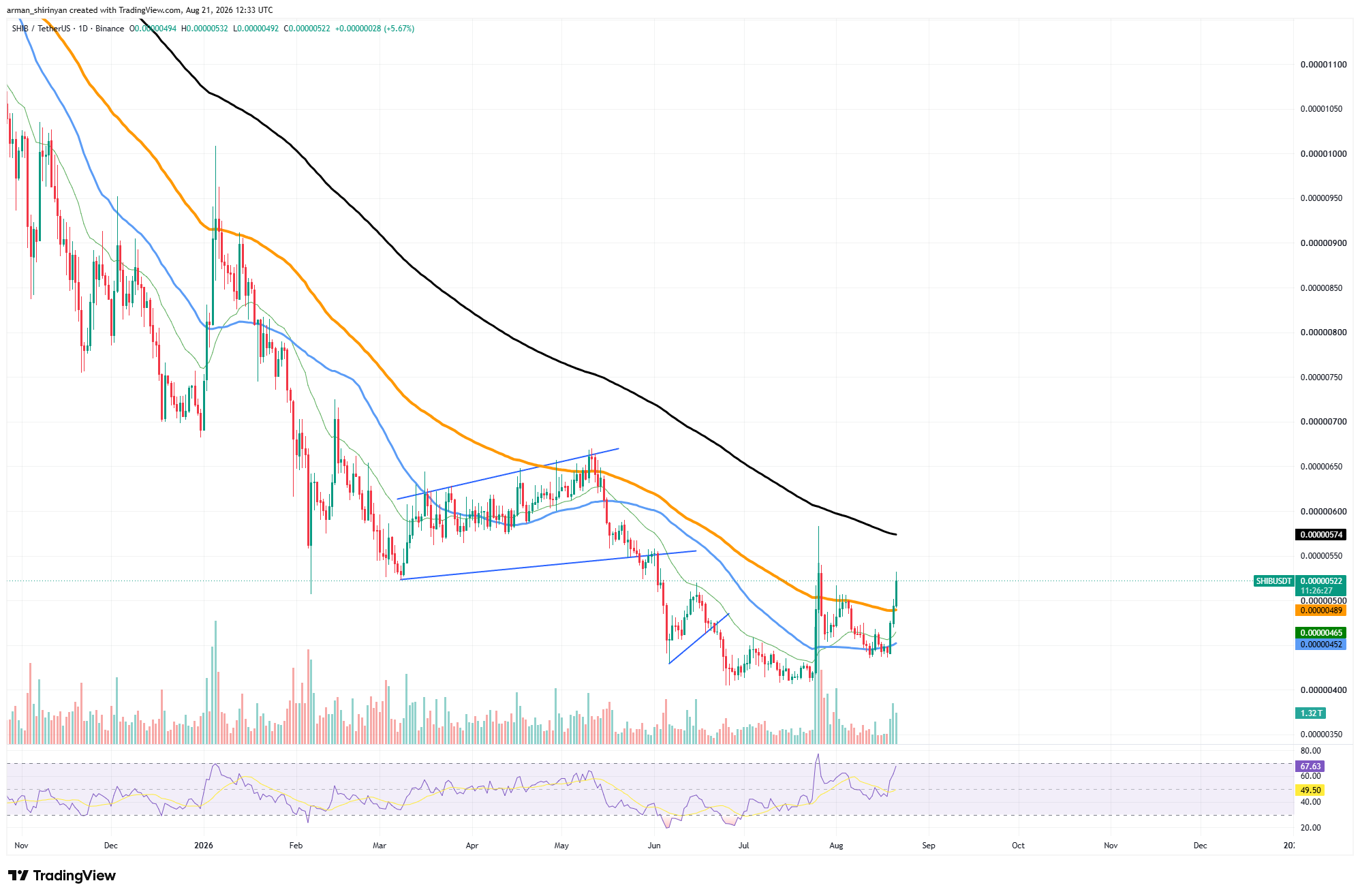
As $SHIB works to establish a more convincing recovery, Shiba Inu is going through another significant change in exchange flows. While a number of other exchange metrics are increasing, exchange netflow has decreased by about 811 billion $SHIB from the prior reading.
$SHIB back at bullish range
The combination does not always imply simple profit-taking, but it does suggest that investors are repositioning aggressively in response to the most recent price increase. After gaining roughly 5.5% on the daily candle, $SHIB is currently trading at about $0.00000521.
$SHIB/USDT Chart by TradingView
More significantly, the token is getting close to levels that haven’t been consistently maintained since June and has surpassed its orange moving average near $0.00000489. Exchange data shows conflicting results. The approximate 811 billion contraction was caused by the total exchange netflow, which is currently at about 212.3 billion $SHIB, down from levels above one trillion $SHIB.
This decline indicates a significant drop in the net amount of $SHIB moving onto exchanges because netflow measures inflows minus outflows. This casts doubt on a purely profit-taking interpretation. Sustained growth in positive netflows would typically provide stronger evidence if holders were all rushing to exchanges to realize gains. There are still indications that exchange activity has increased.
While total inflows rose by 1.85 percent to approximately 1.007 trillion $SHIB, the seven-day moving average of mean inflows increased by 26.36 percent to 1.286 billion $SHIB. At 87.39 trillion $SHIB, exchange reserves increased by 0.24 percent as well. It is evident that some holders are moving tokens to trading venues.
Buyers lead the way
However, active addresses and receiving addresses have grown by 1.15% and 1.12%, respectively, while outflows are still massive at roughly 748 billion $SHIB. Instead of a one-sided withdrawal from $SHIB, this suggests more extensive activity. In a technical sense, buyers are currently in the lead.
The breakout above $0.000005 creates space toward roughly $0.0000055–$0.0000057, while the RSI has surged to about 67.4, putting $SHIB near overbought territory. The 811 billion netflow decline does not indicate that investors are giving up on the rally, even though profit-taking risk is rising as $SHIB appreciates.
For the time being, it indicates that significant withdrawals are offsetting exchange-bound supply at the exact moment that $SHIB is attempting its most robust recovery in weeks.
Pakistan’s former Prime Minister Imran Khan was sent back to prison after being transferred for a medical evaluation. The Supreme Court had ordered the hospital visit. The government says the evaluation did not find any issue requiring immediate care.
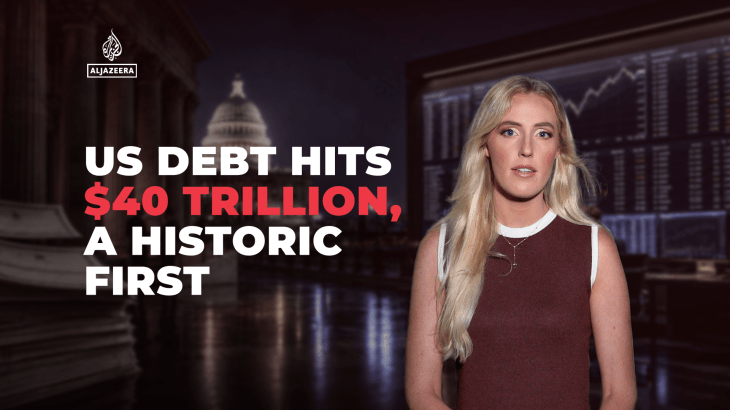
The US national debt has officially surpassed $40 trillion for the first time in history, and it’s growing fast. Al Jazeera’s @EmmaWithrow explains how we got here, who America owes that money to, and why it matters.
Chris Aronson, former domestic distribution chief at Paramount Pictures, has sued the studio, alleging he’s owed millions of dollars in compensation after being let go last September as part of a round of layoffs shortly after its merger with Skydance Media.
Aronson’s attorney, Barry Kaufman, tells The Hollywood Reporter he filed the complaint with Superior Court of Los Angeles County on Aug. 20 but it hasn’t yet been formally processed yet before the document leaked online. “I have not even received back a conformed copy of the Complaint and the associated documents from the court confirming that it was accepted for filing,” Kaufman added. Aronson did not reply for comment.
In the complaint, Aronson claims that on Sept. 29 of last year — months into a new contract agreement inked in July that would have kept him at Paramount until Dec. 1, 2028 — he was summoned to a meeting with new Paramount co-chairs Dana Goldberg and Josh Greenstein.
The duo informed him that he was terminated “without cause,” the complaint states, and that Greenstein assured him that Paramount would “pay you everything you’re owed under your contract” and “added words to the effect that ‘you’re worth every penny.’” Aronson claims that he was also informed that Paramount intended to “downgrade the position” he was occupying.
As to that pay, “the remaining salary and incentive compensation under the agreement had an estimate value approaching $3.9 million,” Aronson’s complaint states, per the unprocessed court document confirmed by Kaufman to THR that leaked without a case number to Deadline. “When the value of lost employment benefits and related compensation components is included, Aronson’s projected economic damages exceed $4 million.”
Shortly after the timeline Aronson outlines, Paramount announced in November that it hired Shaun Barber, who spent 18 years at Lionsgate and Summit Entertainment handling such blockbuster franchises like John Wick, The Hunger Games and Twilight, as its new domestic distribution chief. Aronson stayed on until Dec. 1, when Barber took over that role.
At the time of his layoff, Aronson was 69 years old. The executive’s complaint states that as part of his termination process, he received disclosure data related to broader layoffs at the company and his own independently commissioned analysis found a statistical pattern of age discrimination. That included layoffs of 62 employees aged 40 years or older and 30 staffers under the age of 40. Aronson claims that Paramount’s HR department was aware of age-related impacts of its employment moves made for business strategy reasons.
Aronson, who had overseen the theatrical distribution efforts on titles like Top Gun: Maverick, as well as multiple Mission: Impossible, Sonic the Hedgehog and A Quiet Place installments, stayed with the studio through December of last year. He joined Paramount in 2019 after running distribution at 20th Century Fox prior to the Disney acquisition of Fox studio assets. His contract was renewed in 2022 by Paramount and again in 2025, months before he was terminated.
At the time of the September meeting, Paramount execs had “suggested and dangled the prospect of a future consulting relationship” that never materialized. Aronson had subsequently taken on a consulting role to Rentrak Theatrical, the box office data platform formerly known as Comscore Movies, a division that he once founded.
Aronson’s complaint says that Paramount not only terminated the role but “abruptly ended what reasonably appeared to be the final chapter of a distinguished career in theatrical distribution.” Paramount declined comment on the suit.
It’s been nearly 20 years since Keeping Up With the Kardashians premiered on E! and helped shift the reality TV genre. Now, after years of having her own life and family filmed, Khloé Kardashian is stepping behind the camera to put the spotlight on her closest group of friends with her new unscripted series, The Girls: A Khloé Kardashian Project.
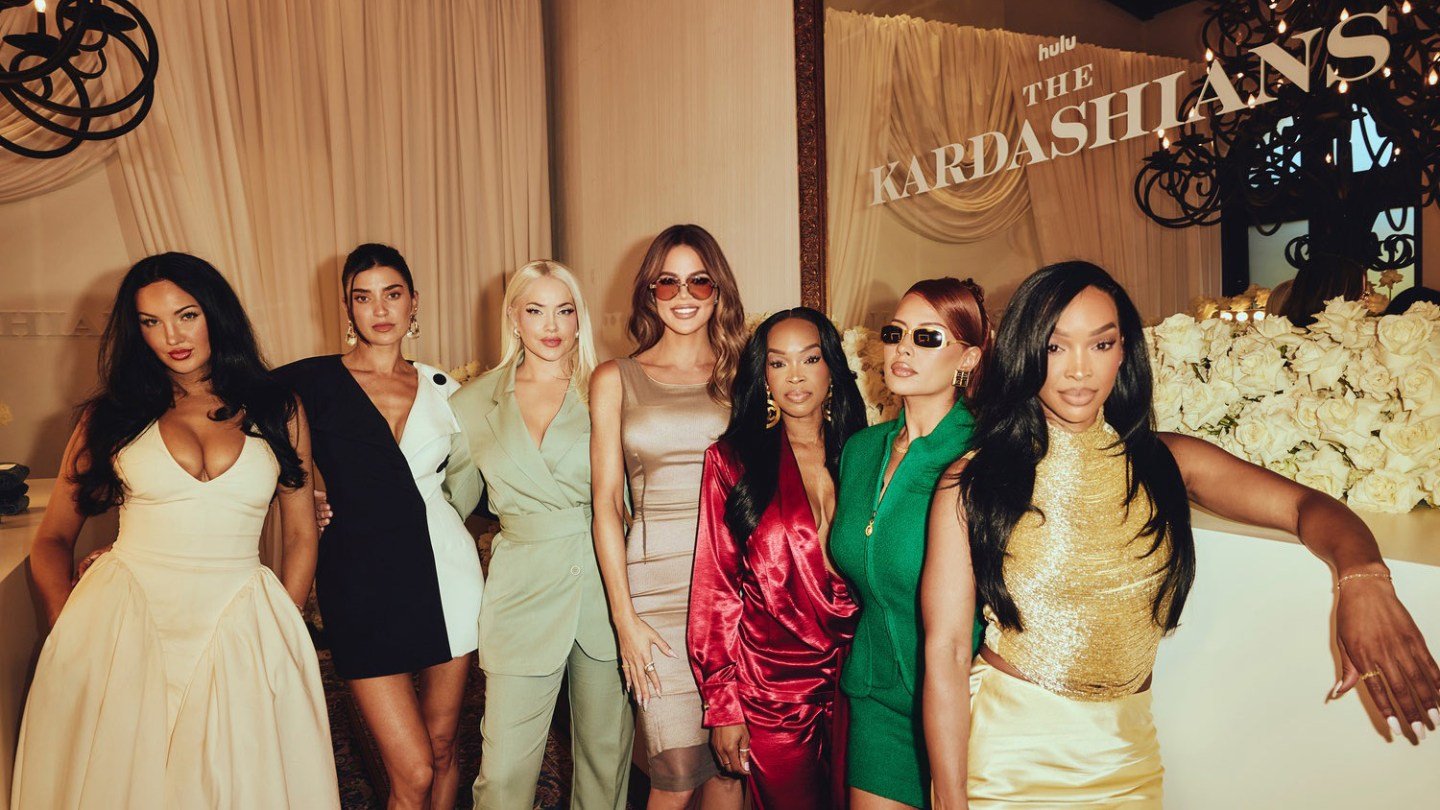
The cast includes six women: Nicole Williams English, Olivia Pierson, Khadijah Haqq-McCray, Natalie Halcro, Malika Haqq and Yris Palmer. While all have experience in front of the camera except Palmer, they bring different histories and relationships to the group. Malika and Khadijah are longtime friends of Kardashian’s, while Williams English, Pierson and Halcro previously starred together on WAGS, another E! reality series.
The show, which premiered Friday on Hulu and Disney+, follows the women as they navigate motherhood, marriage, dating, business and their friendships with one another. Kardashian serves as an executive producer and narrator and appears onscreen at times,= but intentionally doesn’t position herself as a main castmember.
Speaking with The Hollywood Reporter, Kardashian opens up about the drama that surprised her, balancing being a boss and a friend as an EP and why she doesn’t want The Girls to feel like another Kardashian spinoff. She also praises her sisters Kim Kardashian and Kylie Jenner’s acting era and what’s ahead for the third season of her podcast, Khloé in Wonder Land. The Hollywood Reporter can also exclusively reveal that season eight of The Kardashians will premiere in October.
***
What made you feel like this group of women deserved their own show and spotlight?
I knew they were comfortable in front of the camera. I also know that they genuinely like each other. At least some more than others, as I realized later. (Laughs.) So how we’ve all hung out, and what I didn’t really realize until we started filming was that there are definitely more little cliquey groups, or some hang out more one on one than others, and not all six have ever really hung out in depth this way. So if I’m having a birthday party or a kid’s birthday party, they’re always there.
Also, them being in my family, meaning all these girls are friends with different sisters in different ways, and they’ve all been around for so many years — at least a decade. I felt like this would be a great show. It’s an extension of us. They really are friends. They know where all the bodies are buried. They’re all really good girls. They all get along really well, so I thought. (Laughs.) How they have their own dynamics within each of the six of them is also really fascinating. Whenever I post them, people always have questions, so I’m like, OK, let’s let people see who they are because they’re such great, phenomenal women who have so much to offer and so much to show. People should know who they are.
You’ve spent so much of your life being filmed. What was it like to be on the other side of the camera and deciding what parts of your friends’ lives audiences get to see?
I left what parts of their lives up to them. But I did say, “When you do a reality show, the best thing to do is to be as open and transparent as possible.” Although they’re friends or acquaintances, when you’re doing a show with other people that aren’t family, those other people will probably want to expose you. (Laughs.) No matter how friendly you guys are. Because if someone feels like they are carrying more weight than the other, other people can get resentful.
I film with my sisters and family, and when we go through that where we feel like we’re doing more work than someone else, we get resentful, we’re frustrated and say our piece on camera. And the grace that family gives one another is also very different. So I made that very clear from the start: Be open. Some girls took that advice. Some girls didn’t. And you will see that unfold on camera.
These women are all been your close friends for years but not necessarily friends with each other. Some of them we’ve seen on reality TV beforewhile others are being introduced for the first time. Did you feel responsibility for putting them back into the spotlight?
I had moments in this where I sort of regretted doing any of this because of the fighting and drama and me being in the middle because I put them all together. I’m now the EP. I didn’t think I would be involved as much as I was trying to navigate them through certain things. I thought, Most of them are used to TV. They’re fine on camera. Some of them took so many years off that it was like they were starting over again. And the insecurities of when you watch, like, “Is this going to sound right?” Because they don’t get to watch the show before it airs, so everyone’s spiraling and freaking out.
Also, because I am friends with them, they do feel like they can call me and be like, “So and so said this about me, and I didn’t like that and to get these cameras back up.” It was so fucking middle school. I was so shocked that these girls acted like that. Some of them are more cliquey than others, which is totally fine, but they never spent this much time with one another, and that didn’t go well for a few of them. I felt bad, like, did I ruin some friendships with one another? I don’t know. I thought it would be a much more seamless process, and it wasn’t. But with all that being said, I think that would make for great TV.
Was there any particular friendship that had drama and surprised you?
I didn’t think Natalie and Yris would not get along the way they did, and there’s some contention between those two, which surprised me. They would butt heads a lot throughout the season, and it would be more continuous. I wasn’t expecting that to happen. (Laughs.)
Nicole Williams English, Olivia Pierson, Khadijah Haqq-Mccray, Natalie Halcro, Malika Haqq and Yris Palmer of The Girls.
Cristian Lopez/Disney
Were there any arguments or storylines that unfolded after cameras wrapped?
Oh my gosh, there’s a trip to Vegas that they take on camera, and there’s moments of that, and I should have known that maybe there’s some tension with them taking them to Vegas, where they’re partying. I just should have known that probably wasn’t going to go well. I just thought it was going to go really well, and there was definitely fighting there. We got a lot of it on camera, but we missed some. But they do make up for it, and there’s a lot of them. You still know exactly what happened. But even after the fact, I think everyone’s in their own heads.
I get it. Maybe the anxiety of not knowing what’s going to come out exactly, because you film so much and not knowing what’s going to make it air versus what won’t, that anxiety will probably eat away at anyone. So there’s a lot of phone calls, often like, “Are you sure I’m gonna look good, or did I say something like this? Did I do that?” I could never do that. So I empathize, but I really think everyone’s gonna love it.
With you appearing on the show and being an EP, there’s obviously a huge draw to it and a Kardashian connection. But you aren’t a main castmember, so was it important to you to make sure this felt like their show rather than another Kardashian spinoff?
Correct, and that’s exactly right. I’m in a certain amount of episodes, but I pop in and out because, in real life, I would be at those lunches, I would be doing those things. So I made sure to do what I would normally be doing with them, but I didn’t want to feel like a main character. I didn’t want it to feel like a Kardashian spinoff, like you said. I want them to have their own legs and to run with it. They’re that great of girls, and they can definitely carry the weight of the show. But I am also the narrator of the show, so it’s an extension of me for sure or my family.
I don’t want people to get confused and think it’s another Kardashian spinoff — it’s definitely not. This is all them. But in reality I am their friend, so I would be spending time with them. I think we did a really good job of me being around but not dominating.
Do any of your sisters or anyone in the family make an appearance on the show, or was it,like you said, that you wanted to keep it separate for this project?
Yeah, they do. Kylie does because Kylie and Yris are really great friends, so it’s literally just our organic relationships. And Kim does, because Kim, Natalie and Olivia are really great friends. If I remember correctly, my mom does, too.
I think it would be weird if they didn’t, because this is just how we interact with these girls. It could be as little as FaceTimes, but these are really people in our close circle that we speak to. I speak to some of them every single day. It’s not us dominating. We are very much in the background. It’s not like it’s going to be a Kylie episode. It’s more like her having a conversation with Yris — just a very natural type of thing.
You’ve been doing reality TV for almost 20 years. What did you learn from being on the other side of the camera that you maybe wish you had known when you first started?
I’ll be honest with you: I loved how green I was. In hindsight, I loved that we were told, You guys might not get a second season, so go big or go home. This probably won’t go anywhere. Kourtney and I specifically did not think about it. We just were like, “Fuck it, we’re gonna film whatever we want to do.”
We were just goofs. We weren’t overthinking. We never thought we were gonna be famous or be a star — nothing like that. And that’s what made everything work the way it did because you could smell that stuff. You know when someone’s putting on. You know when someone’s contrived. We were just who we were. I was 22 years old. And to be green, naive and not overthink anything. What a blessing.
I remember watching in season three of Keeping Up With the Kardashians that you took an acting class, and Kourtney went with you for support. With your sisters Kim and Kylie breaking into the acting world over the last couple of years, with American Horror Story, All’s Fair and The Moment, is acting something that still interests you? Is that something you still ever think about?
I’m literally traumatized from that whole experience. (Laughs.) We can blame season three for why I am so traumatized when it comes to acting. But I get asked to act all the time and to do these roles. I’m never gonna say never, but currently it’s not something I feel like makes my heart happy. It’s not like where my passion is with anything.
But, oh my God, do I remember that scene and that acting class and having to say the word “hat” in so many different tones. It was horrible! But I love Kim and Kylie’s acting era.
Are there any projects you can say you were approached for?
I don’t know anything specific, but I get asked all the time: “Would you ever do a movie?” People will say someone wants you for a movie, and I’m like, no, no, no. I have taken meetings with people who wanted to do a scripted series with me, and I just don’t know if it’s my thing.
I’m so honored and so flattered. But I also don’t want to do something that I don’t feel like I could give 100 percent with. I don’t think it’s fair to any production, any people that are working their butts off. It would have to be something I take classes in, really study and try to be the best I can be at it. It’s not something I would ever do, like, OK, acting sounds cool today. That’s just not who I am. I would have to take it seriously, and right now, I don’t know if I have the bandwidth to do all that extra stuff to give another workplace what they deserve out of me.
Do you see yourself producing more reality shows centered on outside your family? Is building a slate of shows something that you want to do?
I do. I mean, again, I want to be very passionate and intentional with everything that I do. But I do see that. I really do enjoy it. I think with your friends, it’s a different level of work involved because it does get very personal. But I still really enjoy it.
I like being a therapist in a way to people. (Laughs.) But businessly, I find it really cool, really creative. I like the ins and out of it all. So yeah, I could see myself doing more.
Kardashian on her Khloé In Wonder Land podcast with guest Dolly Parton.
Khloe Kardashian/YouTube/Screenshot
Season three of Khloé in Wonder Land is releasing later this year. What are you excited about with that? And do you have any more dream guests to appear? You’ve had some really great ones.
I’ve had some fabulous guests. I’m excited for this new season because it’s going to be longer, which means I have more room to diversify a bit and see what has stuck with my audience versus what has not. The biggest thing that I want to do is branch out a little bit more. Last season, I did a lot of family [episodes], which I still love doing. I think people love that with us. It may be nostalgic for them. But I want to branch out into a ton of different genres.
I do love conspiracies. I love all that crazy stuff. I still love self-help-type things. Other doctors that know how to break down whatever issues are so fascinating. I did something with Dr. Amen, and the amount of people that got all this positive knowledge from him made me feel so good because it’s almost like I was giving back to people that couldn’t afford to see him themselves or didn’t have access to his clinics. So that makes me feel good when I’m able to provide real information to people where they have a takeaway. Those obviously aren’t in every podcast episode, but I love when I’m able to do things like that.
I could go from a celebrity to a doctor to a conspiracy theorist, and I have more room to play. I love how all over the place it is, but that’s why it’s Khloé in Wonder Land because my brain is fascinated by anything and everything.