Zach Hickerson wrote to TMZ on Friday, giving the outlet a detailed account of what he experienced the day that the Heroes and Nashville actor was found unresponsive in the Airbnb in Greenville, South Carolina, where the on-off couple had just arrived. Brian Hickerson dated Panettiere on and off since 2018; he was arrested several times in the subsequent years for domestic abuse and, at one point, pleaded no contest to two felony charges related to an assault against Panettiere.
A heavily redacted incident report from the Greenville Police Department released this week reveals details of the brothers’ reaction to Panettiere’s death. After first responders attempted but failed to revive Panettiere, Brian Hickerson became very emotional, according to the report; he also showed authorities a bag containing medication he said she was taking.
Zach Hickerson reached out to TMZ to clarify the public record on what he experienced on Sunday so that he can now “mourn without additional noise, chaos, and misinformation being created and propagated by the media as well as the public.”
“There are a lot of assumptions, speculations and accusations currently swirling,” he said in his statement, which TMZ published on Friday. “The truth will come out as the authorities complete and release additional details from the investigation. And that is important because the people who loved and adored Hayden deserve the truth.”
Zach said that on Sunday morning he attended a church service and, on his way, exchanged messages with Brian; they planned to get lunch and play indoor golf together after the service. When he left church, he called and texted both Panettiere and his brother. He said he assumed they had fallen back asleep, so he drove to the Airbnb where the two were staying in Greenville, where the brothers’ grandmother also lives. He said he did not have the door code and was unable to enter.
A loud knock on the door woke his brother, he said; both Brian and Panettiere had been asleep on the fold-out couch in the townhouse’s living room.
“When we went in and tried to wake Hayden up for lunch, we realized she was unconscious,” he recalled. “I immediately called 911 and Brian gave her Narcan. We then jointly performed CPR while 911 was on speaker until Fire and EMS arrived. At that point we watched as they tried every measure possible to save her life.”
A Narcan bottle was reported to have been at the scene of the actor’s death, and reports emerged that first responders had discussed an “overdose.” The account from the younger brother of Panettiere’s boyfriend and longtime abuser confirms that Panettiere was potentially the victim of a drug overdose.
Zach Hickerson expressed his deep sense of loss over Panettiere’s death.
“I am beyond heartbroken and devastated by this tragic and traumatic loss,” he told TMZ. “Hayden was one of my dearest and closest friends that I loved and cared about for the last 8 years.”
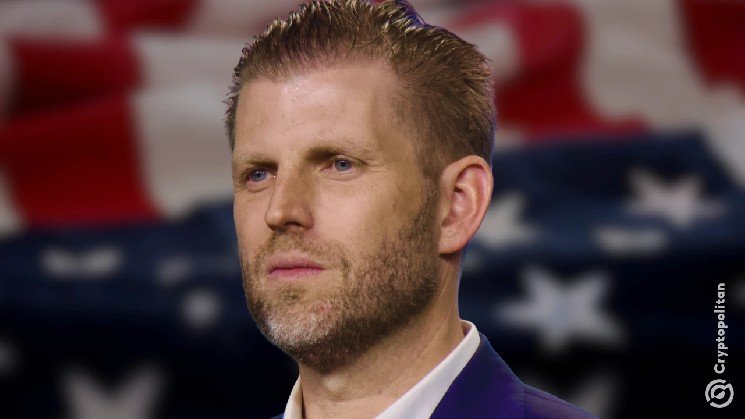
Eric Trump has agreed to pull back from decision-making at World Liberty Financial’s proposed national trust bank while the crypto business works through the federal approval process.
Eric, World Liberty co-founder Zak Folkman, and Emirati investor Hamad Khalfan Ali Matar Alshamsi each signed separate commitments through companies connected to them. The agreements keep all three investors away from bank management decisions.
The commitments became public when World Liberty won preliminary approval late last week. They deal with the company’s ties to Trump’s family and overseas money as its affiliate pursues a federal bank charter.
Such deals have been termed passivity commitments. According to World Liberty, the reason behind making such arrangements is to ensure that particular investors do not control the trust bank.
The lawyers said the reason why the case would be considered different is that, apart from a foreign investor, who has some connections with the royal family of Abu Dhabi, it is the son of the country’s president, which makes the situation different from others. This is also true for other aspects of financial business.
World Liberty keeps major investors away from management while regulators review the bank
World Liberty spokesman David Wachsman said the company expects to remain under federal oversight for years.
“World Liberty is intentionally running towards regulation and permanent supervision, not away from it. Before full approval and for many years afterward, the World Liberty Trust Company will fully cooperate with the OCC, a federal regulator, and will adhere to all other applicable laws and regulations,” Wachsman said.
More scrutiny has been directed at the proposed crypto bank compared to other such proposals in view of the ownership associations of World Liberty. World Liberty had just made an agreement prior to Donald Trump taking the helm as president of the country to sell 49% ownership to a business that is associated with Sheikh Tahnoon bin Zayed, brother to the UAE president.
Trump and his family also hold financial interests in World Liberty. The company says none of them work there as officers, directors, or employees. The White House rejects claims that Trump’s business interests amount to a conflict or that he uses presidential power to make himself richer.
Federal reviews for bank charters involve detailed checks on the finances of organizers and directors. World Liberty’s filing lists Zach Witkoff, son of presidential envoy Steve Witkoff. It also names Scott Alper, an executive at the Witkoff Group, along with Robert Witkoff, Steve’s brother.
A federal charter would move $USD1 issuance and nearly $4 billion of reserves inside World Liberty
The charter would let World Liberty directly hold the assets supporting $USD1, its dollar-backed stablecoin.
That setup would allow the company to keep issuance and reserve management within the same organization rather than depend on outside arrangements. $USD1 is worth nearly $4 billion by market value, according to CoinGecko, making it one of the world’s largest stablecoins.
The filing also lands during a wider shift in federal policy toward crypto banking. Jonathan Gould, the U.S. Comptroller of the Currency, said after taking office that approving new bank charters would be one of his priorities.
That differed from the Biden administration, which had been far less welcoming toward charter requests from digital-asset firms.
World Liberty is part of that group. Ripple, Paxos, and Fidelity Digital Assets all won conditional trust bank approvals in 2025. Coinbase (NASDAQ: COIN) received comparable conditional approval earlier this year. Those decisions give the companies a route toward running regulated trust banks, but each still has federal requirements to meet before getting full authorization.
Trump’s administration has also moved deeper into digital-asset policy. On Wednesday, Trump met top executives from crypto companies at the White House. The meeting happened as the Securities and Exchange Commission works on finishing a broader regulatory structure for the industry.
World Liberty now faces the remaining steps in that process. Regulators still have to decide whether the company can bring $USD1’s reserve setup inside a federally supervised banking business.
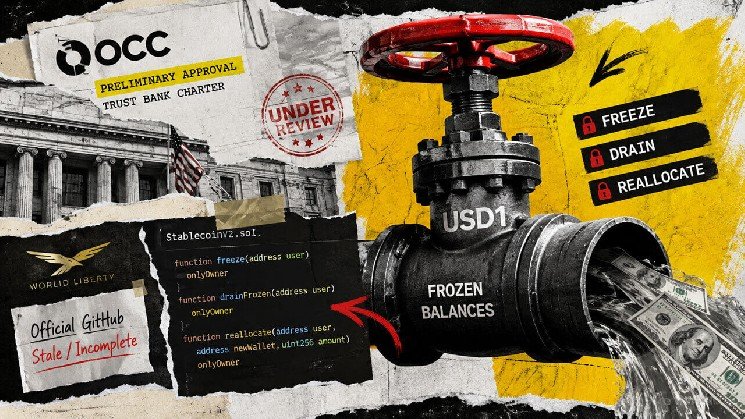
Justin Sun escalated his public fight with Donald Trump-backed World Liberty Financial on Friday, accusing its $USD1 stablecoin of carrying administrative powers that allow privileged operators to move funds from frozen wallets without holder consent.
On Aug. 21, the Tron founder alleged that World Liberty’s published source code does not match the contract currently running on-chain, arguing that the discrepancy amounts to evidence of deceptive deployment and comparing it with techniques used in rug pulls.
Sun said the live $USD1 implementation can drain or reallocate balances after an address has been frozen, meaning cold storage or multisignature custody would not prevent intervention at the token-contract level. He also claimed similar privileged functions were added to the $WLFI token after the fact.
According to him:
“$USD1‘s highest-level permissions allow the issuer to move $USD1 out of YOUR account into its own wallet — or anyone else’s — without your consent. Cold wallet? Multisig? Doesn’t matter. The authority operates at the token contract level. Nothing you do can stop it.”
What $USD1’s live code actually allows
$USD1 operates through an upgradeable proxy that moved to its current StablecoinV2 implementation on April 5.
That version contains drain and reallocate functions that apply to frozen accounts. A technical review of the contract found that drain transfers a frozen address’s full balance to the contract owner, while reallocate can move a specified amount from a frozen address to another address.
Neither action requires approval from the affected holder.
That means Sun is correct that a user’s own custody setup cannot override contract-level controls once an address has been frozen.
The functions do not, however, give arbitrary users access to someone else’s $USD1 or allow unrestricted transfers from any wallet at any time. They sit behind privileged permissions and operate on frozen balances.
The more difficult issue is the gap between the deployed contract and World Liberty’s own published repository.
The project’s GitHub code includes minting, burning, freezing, and pausing functions, but does not show the drain, reallocate or V2 initializer functions present in the live implementation. The deployed code itself is publicly visible through verified blockchain explorers, so the functions are not hidden from anyone inspecting the active contract directly.
Still, a developer or investor relying on World Liberty’s own repository would not see the full set of administrative powers governing $USD1 today.
That distinction is significant because centralized stablecoins routinely retain intervention rights. USDT and USDC issuers can freeze or blacklist addresses, while BitGo, $USD1’s current issuer and technical provider, says in its terms that it may freeze or upgrade $USD1 and, in some legal or compliance circumstances, render assets permanently unusable.
Those disclosures make the existence of centralized controls less unusual. However, they do not explain why World Liberty’s public repository has not kept pace with its deployed contract.
Sun escalates attack as World Liberty awaits final bank approval
The allegations deepen a dispute between Sun and World Liberty that has been building for months.
Sun was one of the project’s early investors, committing $45 million to $WLFI. Their relationship later deteriorated after World Liberty restricted his access to the tokens, accused him of improperly moving assets and participating in activity intended to pressure $WLFI’s price, and sued him for defamation. Sun denies the allegations.
The legal fight intensified again on Aug. 20, when Sun claimed he had won a procedural victory that would keep his personal claims against World Liberty in federal court.
A day later, he broadened the dispute to $USD1, arguing that the mismatch between World Liberty’s published code and the live contract amounted to evidence of fraudulent deployment.
“Anyone in crypto knows exactly what that pattern is,” Sun said, comparing the discrepancy with techniques used in rug pulls and alleging that World Liberty had previously taken a similar approach with $WLFI.
The available evidence does not establish that World Liberty deliberately kept its repository outdated to mislead users or auditors. Nor does the code discrepancy indicate a reserve shortfall, impaired backing, or unauthorized movement of $USD1 from holder accounts.
The timing nevertheless raises the stakes for World Liberty.
Sun’s attack came seven days after the Office of the Comptroller of the Currency (OCC) granted preliminary conditional approval to World Liberty Trust Company, a proposed national trust bank that plans to assume $USD1 issuance, redemption, and reserve management from BitGo.
The approval remains subject to pre-opening requirements and does not yet authorize the bank to begin operations.
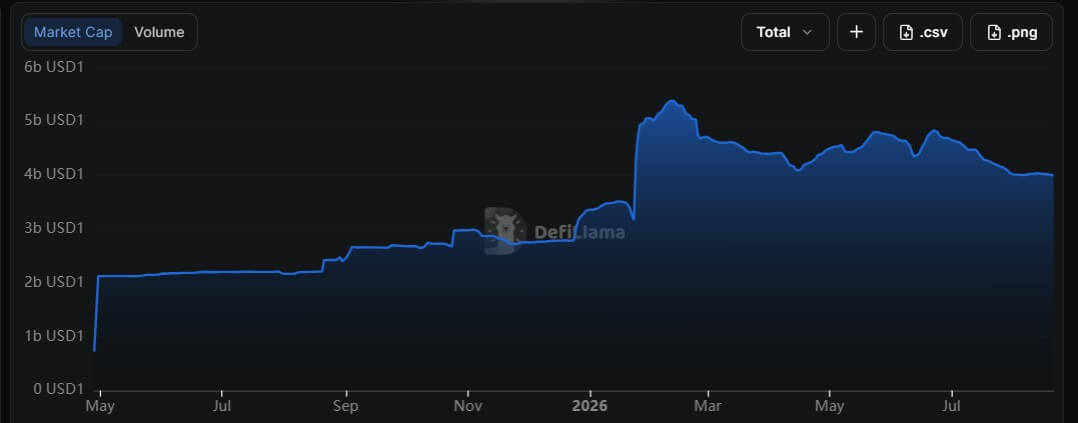
$USD1 is also approaching that transition with a smaller supply base. Circulating supply has fallen by more than $1.3 billion from a February peak above $5.3 billion to $4 billion, according to DeFiLlama data.
$USD1 Stablecoin Supply (Source: DeFiLlama)
The decline began before Sun’s latest allegations and does not show that holders are redeeming because of the contract dispute. It does, however, leave World Liberty pursuing final bank approval while its flagship stablecoin is below its recent peak.
World Liberty has also challenged Sun’s description of the court fight. Chief Executive Officer Zach Witkoff said Sun’s account of the recent arbitration hearing was “riddled with falsehoods,” arguing that the court had made no ruling and that some claims brought by Sun’s companies belong in arbitration. World Liberty is separately seeking dismissal of Sun’s personal claims.
Why has Trump’s World Liberty Finance ($WLFI) now filed a lawsuit against Tron’s Justin Sun?
The dispute therefore leaves a narrower technical issue than Sun’s rhetoric suggests. He has not established that $USD1 is a rug pull or that it added its administrative controls for fraudulent purposes.
What remains harder to dismiss is the disclosure gap: $USD1’s live contract contains powers that World Liberty’s own public repository does not fully reflect, just as the company seeks final approval for a regulated trust bank that would eventually oversee the stablecoin.
Disclaimer: This is not investment advice. The information provided is for general purposes only. No information, materials, services and other content provided on this page constitute a solicitation, recommendation, endorsement, or any financial, investment, or other advice. Seek independent professional consultation in the form of legal, financial, and fiscal advice before making any investment decision.
SPX6900 is up 15.63% today against the US Dollar
$SPX/$BTC increased by 6.87% today
$SPX/ETH increased by 5.77% today
SPX6900 is currently trading 34.24% above our prediction on Aug 26, 2026
SPX6900 gained 26.21% in the last month and is down -64.05% since 1 year ago
$SPX price is expected to drop by -23.34% in the next 5 days according to our SPX6900 price prediction
SPX6900 price today is trading at $ 0.457549 after gaining 15.63% in the last 24 hours. The coin outperformed the cryptocurrency market, as the total crypto market cap increased by 20.21% in the same time period. $SPX performed well against $BTC today and recorded a 6.87% gain against the world’s largest cryptocurrency.
According to our SPX6900 price prediction, $SPX is expected to reach a price of $ 0.340842 by Aug 26, 2026. This would represent a -23.34% price decrease for $SPX in the next 5 days.
$SPX Price Prediction Chart
Buy/Sell SPX6900
What has been going on with SPX6900 in the last 30 days
SPX6900 has been displaying a positive trend recently, as the coin gained 26.21% in the last 30-days. The medium-term trend for SPX6900 has been bullish, with $SPX increasing by 25.52% in the last 3 months. The long-term picture for SPX6900 has been negative, as $SPX is currently displaying a -64.05% 1-year price change. On this day last year, $SPX was trading at $ 1.27.
SPX6900 reached its all-time high price on Jul 28, 2025, when the price of $SPX peaked at $ 2.27. The current $SPX cycle high is $ 0.489603, while the cycle low is at $ 0.229854. $SPX has been displaying low volatility recently – the 1-month volatility of the coin is at 4.42. SPX6900 recorded 16 green days in the last 30 days.
SPX6900 technical analysis for today – Aug 21, 2026
The sentiment in the SPX6900 markets is currently Neutral, and the Fear & Greed index is reading Greed. The most important support levels to watch are $ 0.371642, $ 0.347484 and $ 0.334604, while $ 0.408681, $ 0.421560 and $ 0.445719 are the key resistance levels.
Neutral sentiment for SPX6900
23 indicators are currently signaling a bullish prediction for SPX6900, while 9 indicators are showing a bearish forecast. With 72% of indicators favoring a positive prediction. This results in an overall Neutral sentiment for SPX6900.
Crypto market is currently experiencing Greed
Currently, the Fear & Greed index is at 72 (Greed), which signals that investors have a positive outlook on the market. The Fear & Greed index is a measure of sentiment among cryptocurrency investors. A “Greed” reading suggests that investors are currently optimistic about the cryptocurrency market, but can also be an indication that the market is overvalued. A “Fear” reading, on the other hand, signals that investors are currently hesitant about the cryptocurrency market, which potentially represents a buying opportunity.
SPX6900 moving averages & oscillators
Let’s take a look at what some of the most important technical indicators are signaling. We’ll be going through key moving averages and oscillators that will allow us to get a better idea of how SPX6900 is positioned in the market right now.
The Relative Strength Index (RSI 14) is a widely used indicator that helps inform investors whether an asset is currently overbought or oversold. The RSI 14 for SPX6900 is at 71.06, suggesting that $SPX is currently overbought.
The 50-day Simple Moving Average (SMA 50) takes into account the closing price of SPX6900 over the last 50 days. Currently, SPX6900 is trading below the SMA 50 trendline, which is a bearish signal.
Meanwhile, the 200-day Simple Moving Average (SMA 200) is a long-term trendline that’s calculated by taking an average of the $SPX closing price for the last 200 days. $SPX is now trading below the SMA 200, signaling that the market is currently bearish.
The bottom line about this SPX6900 prediction
After considering the above factors, we can conclude that the current forecast for SPX6900 price prediction is Neutral. $SPX would have to decrease by -23.34% to hit our $ 0.340842 target within the next five days. Moving forward, it will be important to monitor the $SPX market sentiment, the key support and resistance levels, and other metrics. However, we have to keep in mind that the cryptocurrency markets are unpredictable, and even the largest crypto assets display a lot of price volatility. For long-term SPX6900 price predictions click here.
Disclaimer: This is not investment advice. The information provided is for general purposes only. No information, materials, services and other content provided on this page constitute a solicitation, recommendation, endorsement, or any financial, investment, or other advice. Seek independent professional consultation in the form of legal, financial, and fiscal advice before making any investment decision.
TL;DR: Get four Claude AI courses with 100+ lectures, eight-plus hours of video, five projects, and quizzes for just $19.99 (MSRP $159).
The Claude AI Professional eDegree teaches practical ways to use Claude for prompting, coding, integrations, and workflow automation. It includes four courses, more than 100 lectures, eight-plus hours of video, quizzes, five projects, and a professional certificate.
The prompting module covers context management and techniques for producing more accurate, relevant responses. Claude Code lessons focus on AI-assisted code generation, debugging, agentic workflows, and VS Code integrations.
Automation training covers Claude CoWork, plug-ins, sub-agents, and workflow systems. Students also learn to connect Claude with Gmail, Google Drive, Calendar, Chrome, MCP connectors, and other productivity tools.
Five projects apply these skills to marketing workflows, AI websites, automation systems, educational content, virtual assistants, and AI-powered applications.
The program is designed for developers, entrepreneurs, freelancers, creators, and professionals who want to reduce repetitive work and build more efficient workflows.
Prices subject to change. PCMag editors select and review products independently. If you buy through StackSocial affiliate links, we may earn commissions, which help support our testing.
About Our Expert
StackCommerce Team (Sponsored)
Experience
Products featured in these stories are selected by our partners at StackCommerce. If you buy something through links on our site, PCMag may earn an affiliate commission.
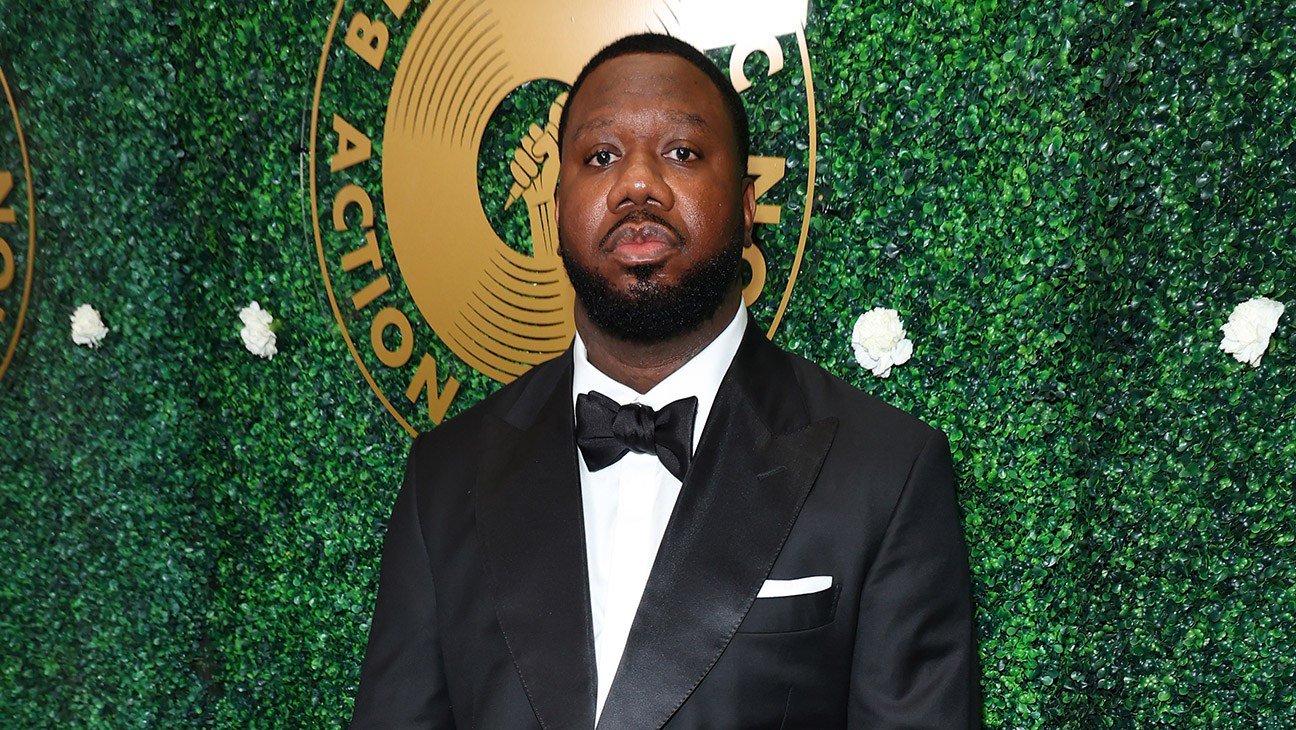
Quality Control co-founder Pierre “P” Thomas has been hospitalized after suffering a heart attack, the company said on social media on Friday.
“We want to clarify that Pierre “P” Thomas is alive and currently hospitalized receiving medical care,” Quality Control said in an Instagram post. “We ask that everyone keep P and his family in their thoughts and prayers and respectfully give them the privacy and space they need during this time. We deeply appreciate everyone’s concern, support, prayers, and loving energy right now.”
TMZ reported earlier Friday that Thomas is being treated in the ICU at a hospital in Las Vegas, with members of his family beside him.
Quality Control is a power-player in the hip-hop world, with Thomas co-founding the record label and artist management company with Kevin “Coach K” Lee in 2013. Quality Control’s roster has included the likes of Migos, Cardi B, City Girls, Lil Baby and Lil Yachty among others.
The company sold to the then-Scooter Braun-led Hybe America back in 2023 for about $300 million. “P and I are ecstatic about this partnership with Scooter and HYBE and are confident they can get us to our global ambitions we’ve had in our scope since the beginning of the company as nothing means more than our artists impacting worldwide,” Lee said in a statement at the time. “Over many years, Scooter and I have cultivated real trust and a common way of looking at the world and culture.”
Working in the deals department is surprisingly satisfying, because I treat every day sort of like a role-playing game. I venture into the dungeons of Amazon, Best Buy, and all the other top retailers and manufacturers, encountering products and dispatching them with my price-comparison tools and the spellbook of PCMag expert reviews that let me determine whether an offer is worth your time and money. The five deals that follow are some of the best treasure I looted, top-rated items from Samsung, Lenovo, and other top brands at discounts as high as 50% off.
A price drop of 27% on Lenovo’s excellent all-purpose Idea Tab is a great way to start us off. Lenovo makes some of the most reliable Android tablets on the market, with crisp screens, solid builds, and speedy performance. This one is an entry-level model but still impresses, with a 2.5K display that boasts a speedy 90Hz refresh rate for smooth scrolling and gaming. Battery life is also a strong point, with up to 12 hours of video playback on a single charge. Not only do you get a discount, but it also ships with a folio case and a Lenovo Tab Pen stylus for faster note-taking and AI features like Circle to Search. It definitely dominates on our list of the best cheap tablets.
More Tablet Deals
*Deals are selected by our commerce team
TCL S5 75-Inch 4K Smart TV Deal
TCL S5 75-Inch 4K Smart TV
75-inch screen, HDR 10, HDR 10+, HLG, Dolby Vision, 60Hz refresh rate, Google TV
If you don’t need the absolute latest model, there are some spectacular bargains to be found in Best Buy’s TV offerings. This TCL S5 hit stores two years ago, but seeing it discounted by 39% is a surprise. The S5 is one of the absolute best 75-inch displays you can get at this price, with support for a wide variety of picture modes including Dolby Vision, HDR 10, HDR 10+, and HLG (Hybrid Log Gamma). The high-brightness LED backlight makes it useable in lots of different environments, and a trio of HDMI Inputs, including one with eARC, let you hook up multiple consoles, streaming boxes, and other input sources. We have a review of an older S5 model where we marveled over how great the color range and accuracy was for the price.
More TV Deals
*Deals are selected by our commerce team
SteelSeries Arctis Nova 3P Wireless Gaming Headset Deal
SteelSeries Arctis Nova 3P Wireless Gaming Headset
We gave an “Excellent” rating to the Arctis Nova 3P in our review, calling it an incredible value at its $110 retail price thanks to well-balanced sound, support for spatial audio on PC platforms, and a huge amount of customization and EQ options. Now cut 45% off that already low price and you’ve got a deal that’s impossible to beat. These comfortable over-ear headphones are lightweight, fit well, and come with over 200 presets for top games like Fortnite, Call of Duty, and Minecraft. Battery life is also quite good at 40 hours, with a newly optimized fast charging system giving you 9 hours of playtime after just 15 minutes of plugging in. We did note that the onboard microphone wasn’t the sharpest we’ve ever tested, but it’s more than sufficient.
If you need a technological companion to keep you honest and motivated on your fitness journey, the Garmin Vivoactive 5 is one of the best exercise-focused wearables on the market, earning an “Excellent” rating in our review. With a gorgeous AMOLED touch screen that’s visible even in direct sunlight, great biometric sensors and health metrics, and a surprising amount of lifestyle features like contactless payments and phone notifications, it sits in the sweet spot between a dedicated fitness tracker and a general-purpose smartwatch. We loved its durability, with Corning Gorilla Glass 3 covering the face and 5ATM water resistance. Amazon has a 38% discount on this model right now.
Let’s close out with an unbelievable 50% discount on one of Samsung’s most impressive new displays, a QHD OLED gaming monitor designed for ultra-fast experiences thanks to a 240Hz refresh rate and 0.03ms gray-to-gray response time. While we haven’t taken this one into the lab yet, we do have a preview writeup where we noted that it delivered more vibrant colors and deeper contrast thanks to Samsung’s Quantum Dot material, with an impressive peak brightness of 1,000 nits. Support for both Nvidia G-Sync and AMD FreeSync Premium Pro let you play at high framerates without tearing or glitching. A new dynamic cooling system dispenses with the traditional graphite plate and introduces a pulsing heat pipe that claims to work five times better at preventing burn-in.
More Gaming Monitor Deals
*Deals are selected by our commerce team
Want to see where all the savings come from? Our deals page is unbeatable.
About Our Expert
K. Thor Jensen
Contributing Writer
Experience
K. Thor Jensen is a writer and cartoonist living in the Pacific Northwest. He has contributed to dozens of prestigious outlets, including PCMag, Tested, Clickhole, and Newsweek. His second graphic novel, Cloud Stories, was released in 2017.
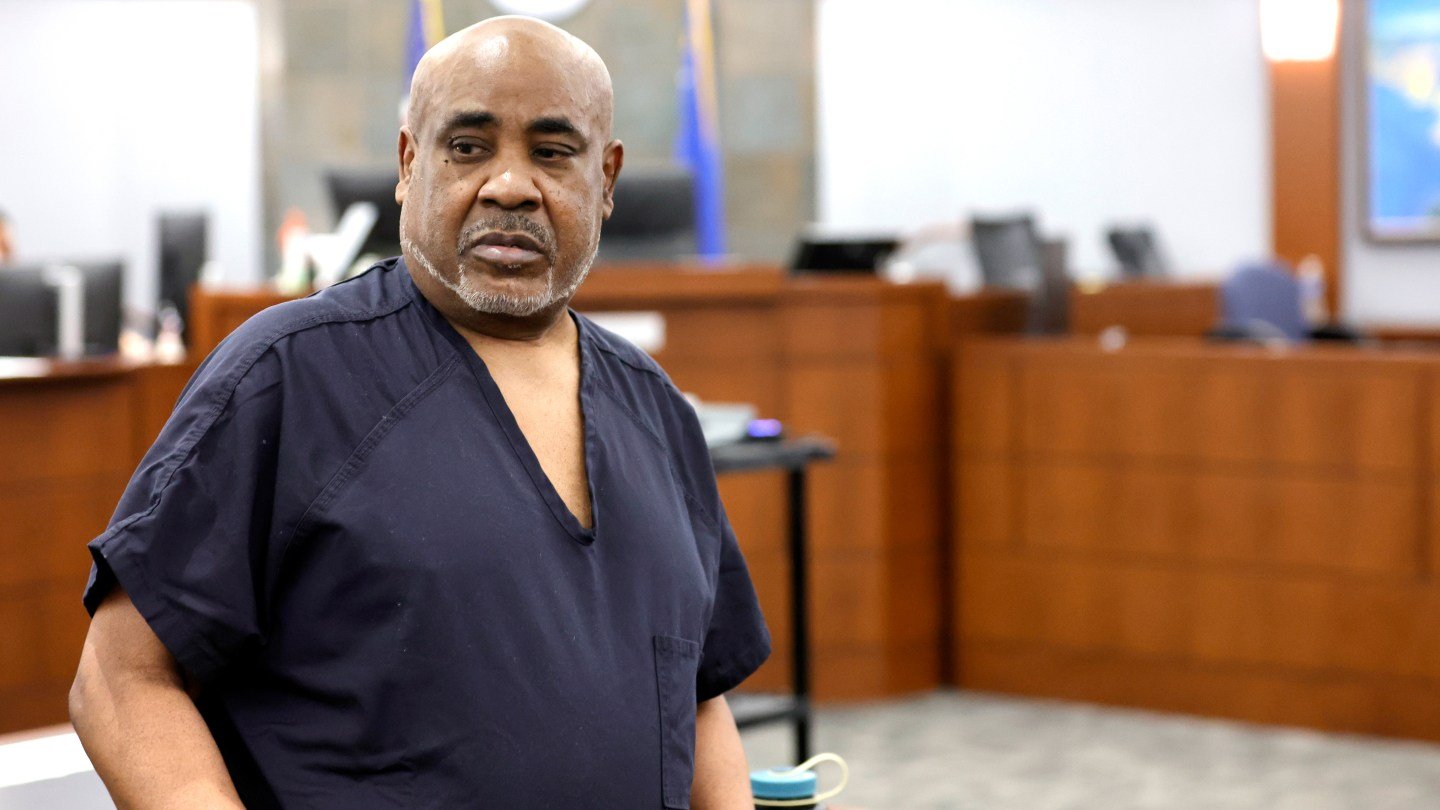
The trial of the former L.A. gang leader accused of orchestrating the shocking 1996 murder of rapper Tupac Shakur in a drive-by shooting in Las Vegas ended its first week on Friday with major evidence shown to the jury, including secret audio of the defendant’s admission to police decades ago of his involvement and the reemergence of the theory that imprisoned mogul Sean “Diddy” Combs ordered the hit.
Duane “Keffe D” Davis is facing one count of murder with the use of a deadly weapon in a Las Vegas court for his alleged involvement in the murder of rap icon Shakur and attempted murder of Death Row Records honcho Suge Knight. Prosecutors claim Davis orchestrated the attack that killed Shakur on Sept. 7, 1996, and that his nephew, Orlando “Baby Lane” Anderson — who Tupac’s crew had roughed up earlier that day — was in a rented Cadillac when it pulled up alongside the record label owner’s BMW off the Vegas Strip. Gunshots were exchanged, leaving Knight injured and Shakur mortally wounded; Shakur died days later from his injuries.
Audio from a conversation between Davis and investigators — which prosecutors say amounts to a full confession from the former Compton Crips capo — was played for the jury on Thursday. In it, Davis laments the state of life as a street gangster in Los Angeles and complains about the younger generation coming up in that world, before telling LAPD detectives about the 1996 shooting in an apparent bid to avoid prosecution on unrelated drug charges that would have carried a hefty sentence. He describes renting the car that pulled up to Knight’s vehicle and says his nephew fired the fatal shot.
“He leaned over on the window. He rolled down the window, popped ’em,” Davis said, according to the recording. “If they drove on my side, I would have popped ’em, know what I’m saying. But they was on the other side.”
LAPD Detective Daryn Dupree testified that when he was assigned to investigate the 1997 murder of rapper Christopher “Biggie Smalls” Wallace in Los Angeles, he interviewed Davis, who told him Bad Boy Records founder Combs had offered $1 million to whoever killed Shakur and Knight. To pursue Combs’ alleged involvement, Davis was brought in as a confidential informant and flown to New York to meet a man who was supposed to deliver the payment.
Dupree told the court Davis said he could “rekindle that relationship with [a contact named] Zip Martin and [discuss] the money that was given from Sean ‘Puffy’ Combs to Mr. Martin that never got to Mr. Davis.” But the meeting fell through — Davis was instead connected with the contact’s nephew, and the lead went nowhere.
Combs has repeatedly denied the allegation and has never been charged in connection with Shakur’s death.
Still, it’s a persistent alternative narrative that has resurfaced many times in the decades since the killing devastated the rap community. The theory first gained substantial traction from a 2008 interview in which, according to former LAPD detective Greg Kading, Davis described Combs approaching him about eliminating two prominent Death Row figures, with his gang allegedly promised $1 million for the double hit.
There was no hard evidence, and Combs has categorically denied the claim — but the theory resonated because it came from someone who was actually in the Cadillac during the shooting and was relayed by a law enforcement investigator. It was published in Kading’s 2011 book Murder Rap: Inside the Biggie and Tupac Murders. Combs called the theory “ridiculous,” but it was his book that pushed the idea deep into public consciousness. Notably, from 2011 on, the claim that Combs ordered Tupac’s murder was an allegation advanced by Kading based primarily on Davis’ statements — not a fact of any investigation.
In 2016, Kading’s theory became the centerpiece of a documentary also titled Murder Rap: Inside the Biggie and Tupac Murders, which again presented Combs as having commissioned the hit and named Anderson as the triggerman. Combs again denied involvement.
In 2019, Davis released a memoir, Compton Street Legend, offering a more detailed account of the shooting — one that reportedly contradicted his earlier narrative and is part of why he’s since been viewed as an unreliable witness and shaky defendant at trial.
Davis was arrested in 2023, nearly three decades after the murder, when Las Vegas authorities charged him with murder with a deadly weapon in connection with Shakur’s death. Prosecutors allege he obtained the gun and organized the men in the Cadillac after Anderson was beaten in a fight at the MGM Grand earlier that night.
Davis pleaded not guilty. Combs was not charged. The case drew renewed attention in 2024 when reports emerged that members of Shakur’s family had hired attorney Alex Spiro and a team of investigators to examine a possible Combs connection to the murder. Also that year, Ashley Parham filed a civil suit against Combs alleging that after she suggested in 2018 that he was involved in Tupac’s death, Combs threatened and assaulted her.
As Combs entered federal prison last year following convictions in his Mann Act/RICO trial, the Emmy-nominated docuseries Sean Combs: The Reckoning introduced the theory of his involvement to a new audience, featuring Kading and others connected to the case. The film received strong reviews for its scope but more mixed reactions to its evidence-to-speculation ratio.
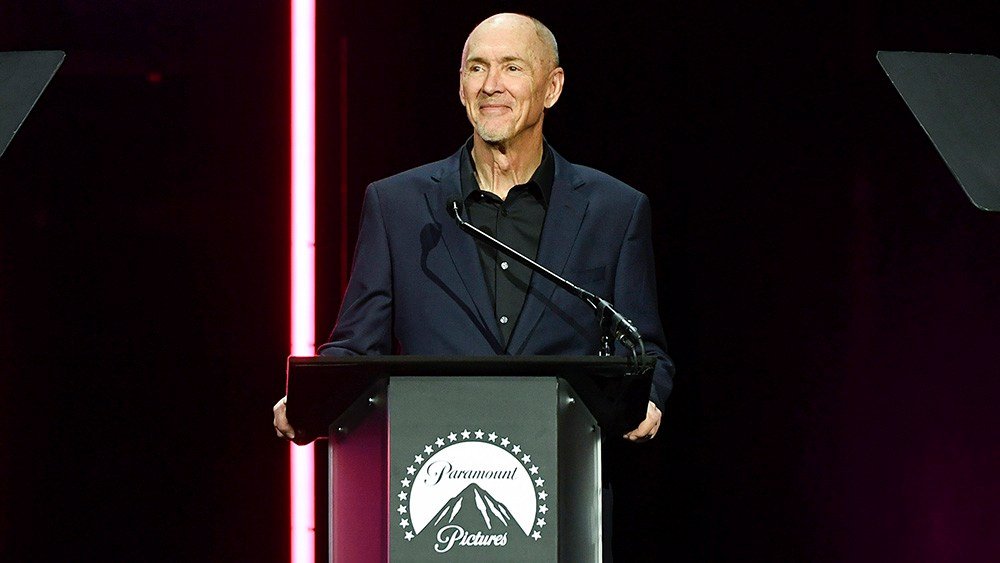
Chris Aronson, who was let go as Paramount‘s head of domestic distribution last year, has filed a lawsuit accusing the company of reneging on an agreement to pay him $1.3 million.
Aronson was fired as part of the executive shakeup that followed the Skydance merger. Shortly before the deal closed, he signed an extension that would have kept him on through December 2028.
According to his suit, filed in L.A. Superior Court, Aronson should have been fully paid out for the remainder of the deal. But Paramount took the position that it could only pay him for two years, leaving him $1.3 million short of a full payout.
The suit argues that Aronson, then 69, was wrongfully fired in part due to his age, and replaced by a much younger executive. The suit alleges that workers 55 and above have represented a disproportionate share of the recent layoffs.
Paramount hired Shaun Barber, a top distribution exec at Lionsgate, to take on Aronson’s role.
Aronson was hired in 2019, following a lengthy career at Fox that ended in the wake of the Disney merger. As head of domestic distribution at Paramount, he was responsible for the rollout of “Top Gun: Maverick,” and installments in the “Mission: Impossible,” “A Quiet Place” and “Sonic the Hedgehog” franchises.
On Sept. 29, 2025, weeks after Skydance closed its acquisition of Paramount, Aronson was called into a meeting and informed that he was being let go “without cause” and would be fully paid out on his contract. There was also a suggestion of a consulting deal, though that never materialized, the complaint states.
It was only after Aronson left the company, in December, that his lawyers flagged a provision in Paramount’s severance agreement that limited his payout to two years. Aronson’s lawyers argue that Paramount’s lawyers are misreading an IRS provision that affects the timing of severance payouts.
The suit alleges that Paramount’s unlawful termination has caused him some $4 million in economic damages. He is seeking punitive damages as well.
Paramount did not immediately respond to a request for comment.
Julie Klausner would like comedy liberated from the phone and returned to the sitcom.
“If I want to canvass for one cause, it is for the return of the hard comedy sitcom,” the Difficult People creator told a sold-out audience at Televerse in downtown Los Angeles, where The Hollywood Reporter’s It Happened in Hollywood staged its first live episode. “I think that the idea that comedy is for your phone is not great. I think that it’s a little isolating. I think it’s reductive.”
Klausner joined me for an hour devoted to Difficult People, the cult Hulu comedy she created and starred in opposite Billy Eichner. Four clips from the series guided a conversation about its making, its reputation for being ahead of its time and the television landscape that has changed dramatically since its 2015 premiere.
The phone-comedy discussion followed a scene in which Julie Kessler and Billy Epstein, the proudly embittered struggling comedians played by Klausner and Eichner, confront an up-and-coming digital creator.
The face-off was pointed in 2015. Eleven years later, its target has largely won. Front-facing-camera videos and scrolling feeds have claimed an enormous share of comedy consumption, while traditional television has moved away from tightly constructed joke machines and toward dramedies and funny hourlong shows. Klausner cited Succession as an example of how much great comedy writing now resides in dramas.
What she misses is not simply the multicamera format or a laugh track, but the communal and emotional function of a show built around jokes. “Sitcoms with hard jokes and heart are beyond comforting,” Klausner said. “They are a really, really important part of being connected.”
She pointed to the enduring popularity of earlier ensemble comedies as evidence that younger viewers still respond to the form. “There’s a reason why even young people who were born way later than 1996 are watching Friends and Seinfeld and Golden Girls reruns every night,” she said. “We love and appreciate these rhythms. Shows especially about friendships are really great. They help us connect not just to different worlds, but to each other. And I really, really miss that form.”
Friendship was also the protection built into Difficult People. For all the show’s cruelty, one of Klausner’s rules was that Julie and Billy would never seriously turn on each other. Their unconditional loyalty counterbalanced the acid surrounding them, grounding the series in what Klausner described as the special relationship between queer people and their “hags.” The rule was broken only in the series finale, when Klausner suspected the show might not return.
Difficult People began during the Obama era, a context Klausner believes matters when people call the series prophetic. Its protagonists’ cynicism was then “more like salt on chocolate than salt on an open wound,” she said. The show mocked sex creeps before the #MeToo movement made those conversations public and treated online snark as something fun before, in Klausner’s formulation, “nuclear fertilizer” turned Twitter into something much uglier.
Ironically, the series itself grew out of an earlier internet-comedy ecosystem. Klausner was Eichner’s first writer when Billy on the Street expanded from online videos into a television series. Their rapport led Amy Poehler to attach herself as a producer. USA funded a presentation before eliminating its scripted comedy department, and Hulu, then a relatively new buyer of original programming, picked up the show. Klausner remembered having to ask: “What’s Hulu?”
At Televerse, the clips demonstrated the series’ density and range. In addition to the battle with the young digital creator, one transformed Julie’s discovery of her Italian American roots into a Goodfellas parody. Another found Julie and Billy serving as court-mandated clowns and tormenting a child. The final selection revisited Julie’s role in a catastrophically bad Woody Allen-created television series.
Klausner modeled the show’s intricate plotting on Curb Your Enthusiasm, constructing separate stories that would dovetail at the end of an episode. “It’s like sitcom ecstasy,” she said of achieving that convergence. She also assembled a cast from New York comedy and theater, including Cole Escola, who joined the writers room and played Matthew, Billy’s workplace nemesis.
Difficult People ran for three seasons before Hulu canceled it in 2017, but Klausner has not abandoned the characters. She also revealed new details about an existing route back. Universal commissioned a Difficult People feature screenplay from Klausner and Alex Scordelis, a writer on all three seasons. The pair completed Difficult People: Ahead of Their Time in 2022 and will stage a reading at New York’s Town Hall on election night, Nov. 3.
Christopher Meloni will play himself in the reading, Klausner said, while Cecily Strong and Michael Urie will portray what she called “a bizarro version of Billy and Julie.” She described the movie as a caper in the tradition of the 90-minute comedies she grew up watching, citing Foul Play, What’s Up, Doc? and Bette Midler’s Touchstone movies.
“I hope it leads to something great happening,” Klausner said. “I hope that there’s some opportunity to revisit this world and these characters, in whatever form that takes.”
A revived Difficult People would have no shortage of material. Klausner imagined Matthew falling into the “Clavicular manosphere.” Julie might land a “street-casted” role in a Benny Safdie movie, take a dubious weight-loss drug and become “the first person to die from a panic attack.”
The ideas suggest that Julie and Billy remain ideally equipped to take on an increasingly surreal era of looksmaxxing, brand integration, nepo babies, prestige dramedies and vertical video.
In other words, we’ve never needed Difficult People more.