Author: rb809rb

  • Solana Developer Mert Mumtaz Praises an Altcoin Big Time

    Solana Developer Mert Mumtaz Praises an Altcoin Big Time

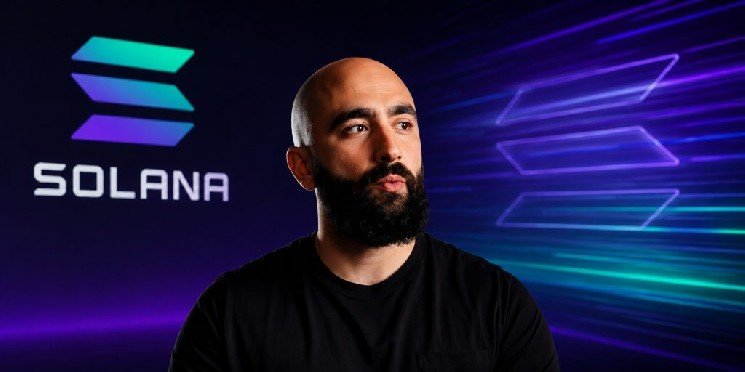
    The cryptocurrency and privacy-focused financial world is experiencing eventful times. Valor Group Founder Dev and Mert Mumtaz, a well-known figure in the crypto ecosystem, participated in The Rollup program on the crypto broadcasting platform, sharing the latest developments on the Zcash (ZEC) network and a critical roadmap for the project’s future. The discussions highlighted the network’s scalability, security updates, and measures taken against quantum threats.

    The recent Ironwood update implemented on the Zcash network is considered one of the project’s most important milestones. Speaking at the event, Mert recalled that during internal red teaming and AI-powered security audits, a potential vulnerability was identified in the Orchard pool that could have allowed the creation of counterfeit notes. Through extensive work and official verification, it was proven that the code mathematically matched the specifications perfectly. With the seamless transfer of funds from the Orchard pool to the new Ironwood pool, the risk of counterfeit coin minting on the network has been completely eliminated, and community concerns have been addressed.

    Dev, who shared important technical details about Zcash’s future vision, emphasized that Valor Group’s main goal is to achieve a transaction volume on the scale of a credit card for Zcash. He stated that they aim to process more than 50,000 transactions per second at sub-second speeds while maintaining a full proof-of-work mechanism, and that the main obstacle to scaling is not the nodes themselves, but the wallet scanning processes. It was noted that thanks to new wallet architectures and optimizations, synchronization delays in the user experience will become a thing of the past.

    The upcoming Tachion update promises to make Zcash fully protected against quantum computing threats. The update will integrate recursive zero-knowledge proofs into the network. This is reported to reduce transaction sizes by more than five times, eliminate node processing overhead, and resolve state growth issues. With Tachion, the network is claimed to achieve not just “quantum recoverable” but a truly “quantum-proof” privacy structure.

    *This is not investment advice.
  • A Daily Token Burn Record Was Set Yesterday for an Altcoin—an All-Time High

    A Daily Token Burn Record Was Set Yesterday for an Altcoin—an All-Time High

    Uniswap’s native token, $UNI, reached a new record for daily burn value. According to data, approximately $590,000 worth of $UNI was burned on August 21st (yesterday). This figure represents the highest daily $UNI burn amount ever recorded in dollar terms.

    The largest portion of the burn occurred on the Ethereum network. Approximately $267,000 worth of $UNI was removed from circulation on Ethereum, $165,000 on Base, and approximately $87,000 on Robinhood Chain. Including burns on other networks, the total daily value approached $590,000.

    In terms of token volume, approximately 150,000 $UNI were burned on August 21st. This amount stands out as the second highest daily burn in $UNI terms recorded on the date.

    The data shows that the $UNI burning mechanism has accelerated significantly recently, with activity spreading across different networks.

    $UNI’s price has risen 6.88% in the last 24 hours, but it is still trading 90.7% lower than its all-time high of approximately $45.

    *This is not investment advice.
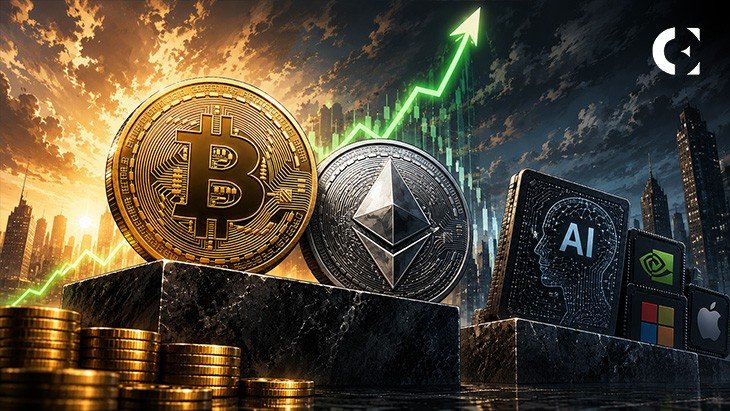
  • Crypto Outperforms AI Stocks: Why Bitcoin & Ethereum Are Winning

    Crypto Outperforms AI Stocks: Why Bitcoin & Ethereum Are Winning

    For much of the recent market cycle, AI was one of Wall Street’s hottest sectors. Technology stocks pulled in massive amounts of money as investors bet that heavy spending on AI would eventually lead to higher profits and better productivity.

    However, the latest 50-day performance comparison shows a big shift in momentum. Bitcoin was up 31.60% and Ethereum surged 53.50%, according to recent data. In contrast, the S&P 500 gained just 2.26%, while the Nasdaq barely moved at 0.22%.

    Gold and silver also had solid runs, up 14.31% and 19.26% respectively.

    Why is Crypto Outperforming AI Stocks?

    One possible explanation is that crypto has attracted a new wave of liquidity and institutional interest precisely when stock momentum has started to stall.

    US spot Bitcoin ETFs pulled in about $1.6 billion between Monday and Thursday in the August 17-21 week, the strongest weekly inflow of 2026 so far. Thursday alone brought in around $606 million.

    Ethereum is experiencing a similar trend. Spot Ether ETFs recorded approximately $221 million on August 20, marking their fourth straight day of inflows.

    This is notable because it shows the rally isn’t just retail traders jumping on momentum, but that there’s also institutional money coming in through regulated products.

    Has Capital Moved from AI Stocks into Crypto?

    The gap in performance shows crypto is beating stocks, but it doesn’t tell us where the money is coming from. Investors could be holding Nvidia, an S&P 500 ETF, Bitcoin, and Ethereum at the same time.

    In fact, the divergence we’re seeing might be powered by different factors at work, not necessarily a straight shift from one asset class to another.

    Crypto’s recent run has been driven by stronger ETF demand and better liquidity. On the other hand, as reported by Reuters, the S&P 500 and Nasdaq were headed for weekly losses, and higher Treasury yields kept putting pressure on tech stocks.

    Still, this doesn’t mean investors have suddenly gone cold on AI. Rather, it suggests crypto has stronger drivers at the moment.

    Crypto’s Biggest Advantage Right Now May Be Momentum

    Right now, the biggest difference between the two markets is momentum, and crypto leads in that regard.

    Bitcoin is now approaching the $80,000 area after rising roughly 30% from its recent low near $60,000. What’s more, BTC is getting close to its strongest weekly performance in more than two years, with the price up around 22% during the week.

    Crypto’s total market capitalization has also increased sharply, indicating that the rise isn’t limited to one token.

    Nonetheless, it’s important to note that when a market goes from lagging badly to leading strongly in a short time, the momentum itself can become a risk. Short sellers may be compelled to cover their positions, and traders may rush to ride the uptrend. Such a dynamic can intensify gains, but it can also make any pullback much harsher.

    So, the strongest bullish signal for crypto to maintain its lead would be continued ETF inflows, along with better liquidity and more involvement from assets beyond just Bitcoin.

    In any case, the AI market shouldn’t be written off yet. Nvidia’s upcoming earnings report on August 26 will be a big test for whether the AI investment cycle can get its momentum back, and strong earnings could quickly pull capital back toward tech stocks.

  • Austrian Director Sandra Wollner’s ‘Everytime’ Wins Best Film at Sarajevo Film Festival

    Austrian Director Sandra Wollner’s ‘Everytime’ Wins Best Film at Sarajevo Film Festival

    Sandra Wollner’s “Everytime” continued its winning streak at the Sarajevo Film Festival, where the Cannes Un Certain Regard winner took home the Heart of Sarajevo for best narrative feature film.

    The Austrian director’s third feature was the unanimous choice of a jury headed by two-time Academy Award nominee Emily Watson, which said in its citation: “Moments of cinematic grace float through this mesmerically elastic and transcendental grief-soaked ghost story.”

    “Everytime” follows a mother, young daughter and teenage boy who, united by tragedy, embark on a trip to the Canary Islands for a family holiday that never happened. Under the glow of the coastal sun, past and present begin to quietly overlap. 

    Following its premiere at the Cannes Film Festival, Variety’s chief film critic Guy Lodge praised Wollner’s “poised, haunting” drama, noting that it “confirms the Austrian director’s formidable formal control and imagination, and should be her most widely distributed work to date.”

    The Heart of Sarajevo for best director went to Georgian filmmaker Ana Urushadze for “Supporting Role,” another festival darling that scooped two prizes in Rotterdam earlier this year. In another unanimous choice, the jury members said they were “enchanted by [Urushadze’s] irreverent blending of the banal and the oneiric, and her refreshing curiosity for meaning in life and cinema.” 

    Variety’s Beatrice Loayza was likewise swept up by the “mesmerizing effect” of the director’s moody, meandering drama, which follows “a lumbering movie star on a surreal and wryly melancholic soul-search” on the streets of Tbilisi.

    The award for best actress went to Eva Kostić for her lead role in “17,” the debut feature from North Macedonian director Kosara Mitić, about a teenager on a class trip wrestling with the aftermath of a sexual assault. The jury heralded her performance as “raw, visceral and deeply instinctive” and the “fearless emergence of a young talent,” adding “She brings an extraordinary emotional truth to the role, announcing the arrival of an actress with a rare and powerful voice.”

    Best actor honors went to Adrian Văncică for “You Don’t Belong Here,” Romanian filmmaker Florin Şerban’s Locarno Golden Leopard winner about a respected doctor whose world is shaken when he discovers his son is a suspect in the murder of a Roma man. The jury praised Văncică “for a performance marked by tenacity and understated rigor, in which the actor consistently serves a story directed in long and wide shots.”

    The Heart of Sarajevo for best documentary feature went to directing duo by Biljana Tutorov and Petar Glomazić for “To Hold a Mountain,” a story of sisterhood and solitude in the Montenegrin highlands. The film, which won the World Cinema Grand Jury Prize at Sundance and the Grand Prix at Poland’s Millennium Docs Against Gravity, was hailed as “an unforgettable journey” by the documentary jury, which said in its citation: “With astonishingly epic cinematography this touching portrait of two extraordinary women and a disappearing way of life enchanted us.”

    Here’s the complete list of awards for the 32nd Sarajevo Film Festival:

    NARRATIVE FEATURE FILM

    Best Narrative Feature Film: “Everytime,” Sandra Wollner 

    Best Director: Ana Urushadze, “Supporting Role”

    Best Actress: Eva Kostić, “17” 

    Best Actor: Adrian Văncică, “You Don’t Belong Here”

    DOCUMENTARY FILM

    Best Documentary Feature Film: “To Hold a Mountain,” Biljana Tutorov, Petar Glomazić 

    Best Short Documentary Film: “Holy Defiance,” Karla Jelić 

    Special Jury Award: “The Ferry Flows,” Zhora Papoian 

    NARRATIVE SHORT FILM

    Best Narrative Short Film: “Nobody Said Anything,” Tamara Todorović 

    Special Mention: “Porkatal,” Sis Gürdal 

    STUDENT SHORT FILM 

    Best Student Short Film: “Unwellness,” Réka Pinczés 

    SPECIAL AWARDS

    Special Award for Promoting Gender Equality: “17,” Kosara Mitić 

    Special Mention: “Don’t Ask Me if I Killed,” Helena Maksyom 

    Special Youth Perspectives Award: “Skateboarding is Not for Girls,” Dina Duma

    Katrin Cartlidge Foundation Award: Lana Daher  

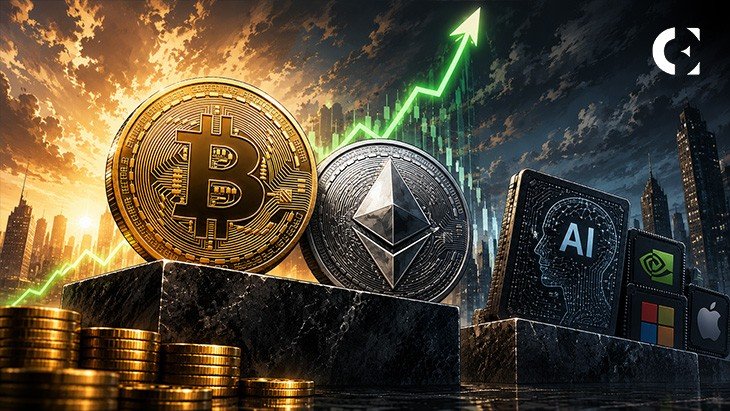
  • Crypto Outperforms AI Stocks: Why Bitcoin & Ethereum Are Winning

    Crypto Outperforms AI Stocks: Why Bitcoin & Ethereum Are Winning

    For much of the recent market cycle, AI was one of Wall Street’s hottest sectors. Technology stocks pulled in massive amounts of money as investors bet that heavy spending on AI would eventually lead to higher profits and better productivity.

    However, the latest 50-day performance comparison shows a big shift in momentum. Bitcoin was up 31.60% and Ethereum surged 53.50%, according to recent data. In contrast, the S&P 500 gained just 2.26%, while the Nasdaq barely moved at 0.22%.

    Gold and silver also had solid runs, up 14.31% and 19.26% respectively.

    Why is Crypto Outperforming AI Stocks?

    One possible explanation is that crypto has attracted a new wave of liquidity and institutional interest precisely when stock momentum has started to stall.

    US spot Bitcoin ETFs pulled in about $1.6 billion between Monday and Thursday in the August 17-21 week, the strongest weekly inflow of 2026 so far. Thursday alone brought in around $606 million.

    Ethereum is experiencing a similar trend. Spot Ether ETFs recorded approximately $221 million on August 20, marking their fourth straight day of inflows.

    This is notable because it shows the rally isn’t just retail traders jumping on momentum, but that there’s also institutional money coming in through regulated products.

    Has Capital Moved from AI Stocks into Crypto?

    The gap in performance shows crypto is beating stocks, but it doesn’t tell us where the money is coming from. Investors could be holding Nvidia, an S&P 500 ETF, Bitcoin, and Ethereum at the same time.

    In fact, the divergence we’re seeing might be powered by different factors at work, not necessarily a straight shift from one asset class to another.

    Crypto’s recent run has been driven by stronger ETF demand and better liquidity. On the other hand, as reported by Reuters, the S&P 500 and Nasdaq were headed for weekly losses, and higher Treasury yields kept putting pressure on tech stocks.

    Still, this doesn’t mean investors have suddenly gone cold on AI. Rather, it suggests crypto has stronger drivers at the moment.

    Crypto’s Biggest Advantage Right Now May Be Momentum

    Right now, the biggest difference between the two markets is momentum, and crypto leads in that regard.

    Bitcoin is now approaching the $80,000 area after rising roughly 30% from its recent low near $60,000. What’s more, BTC is getting close to its strongest weekly performance in more than two years, with the price up around 22% during the week.

    Crypto’s total market capitalization has also increased sharply, indicating that the rise isn’t limited to one token.

    Nonetheless, it’s important to note that when a market goes from lagging badly to leading strongly in a short time, the momentum itself can become a risk. Short sellers may be compelled to cover their positions, and traders may rush to ride the uptrend. Such a dynamic can intensify gains, but it can also make any pullback much harsher.

    So, the strongest bullish signal for crypto to maintain its lead would be continued ETF inflows, along with better liquidity and more involvement from assets beyond just Bitcoin.

    In any case, the AI market shouldn’t be written off yet. Nvidia’s upcoming earnings report on August 26 will be a big test for whether the AI investment cycle can get its momentum back, and strong earnings could quickly pull capital back toward tech stocks.

  • How a Treasury buyback tweak helped bitcoin surge 25% to nearly $80,000 in days

    How a Treasury buyback tweak helped bitcoin surge 25% to nearly $80,000 in days

    A relatively small change in the U.S. government bond market helped set off one of bitcoin’s sharpest rallies in months this week, as falling long-term yields gave traders an excuse to unwind a record pile of bearish crypto bets.

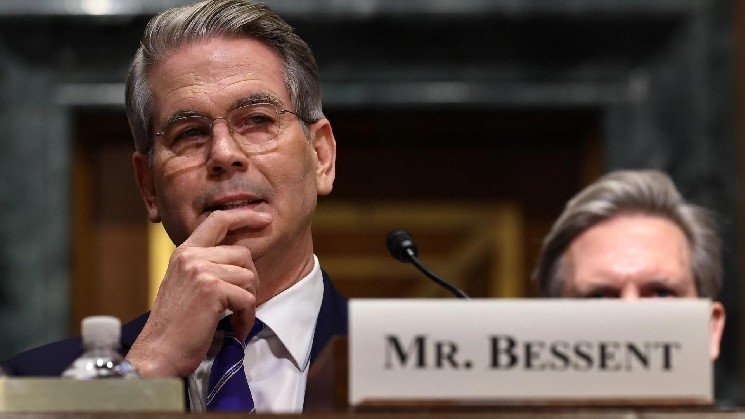
    The U.S. Treasury said it would double the size of its buyback operations in the longest-dated government bonds, to $4 billion from $2 billion per operation. The announcement helped push the 30-year Treasury yield down from 5.34%, a 19-year high, to around 5.19%.

    Bitcoin jumped about 25% since Wednesday and surged past $78,000 as of Asian morning hours Saturday, with roughly $4 billion in bearish crypto positions liquidated on Thursday and Friday as prices rose.

    A Treasury buyback involves the government buying previously issued bonds back from investors, a program mainly designed to make older Treasury securities easier to trade and help the government manage the composition of its debt. Importantly, this is no quantitative easing, where the Federal Reserve creates reserves to purchase assets in an effort to loosen financial conditions.

    “Mechanically, a buyback is not QE but primarily a tool for managing liquidity and the composition of Treasury liabilities,” said Jeff Ko, chief analyst at CoinEx, in a note to CoinDesk. “Given the program’s relative small size, I would read this more as a signal, a soft policy put on the long end.”

    Bond yields had become a growing problem for risk assets. A bond’s yield is, in simple terms, the return an investor receives for holding it. When prices of existing bonds rise, their yields fall. When bond prices fall, yields rise.

    U.S. government debt is generally treated as one of the safest places investors can put their money. Bitcoin pays no interest simply for holding it, so its return depends largely on the price appreciating.

    The more an investor can earn from Treasuries with relatively little risk, the more attractive bitcoin and other volatile assets need to become before that investor is willing to move money up the risk curve.

    “Yield could increasingly become Bitcoin’s competition,” said Hong Yea, co-founder and CEO of Grvt, in an email. “When risk-free yields are high, Bitcoin isn’t competing only with other risk assets. It’s competing with the return investors can earn for doing very little. That changes the hurdle rate for capital.”

    “If investors can earn 4-5% in traditional markets, crypto has to offer a much stronger reason for capital to move up the risk curve,” Yea said. “When yields fall, that hurdle comes down. Capital becomes more willing to seek growth and risk again, which has historically been a much better environment for Bitcoin.”

    How long-term rates influence markets

    Long-term Treasury influence borrowing costs across the economy and are closely watched as a gauge of how tight financial conditions are. Higher long-term rates can make everything from mortgages to corporate financing more expensive and tend to reduce investors’ willingness to own assets whose value depends heavily on future growth or improving liquidity.

  • Olivia Rodrigo Releases ‘Handmaid’s Tale’-Inspired Song, ‘Serena Joy,’ in a Tiny Run of CDs, With Digital Drop to Follow

    Olivia Rodrigo Releases ‘Handmaid’s Tale’-Inspired Song, ‘Serena Joy,’ in a Tiny Run of CDs, With Digital Drop to Follow

    It was already clear Olivia Rodrigo is in full feminist mode these days, with her all-female music festival, Daisy Chain Fields, set to take place in California’s Orange County next Saturday. But it’s perhaps even clearer now that Rodrigo is releasing a non-album track, “Serena Joy,” named after a prominent character in “The Handmaid’s Tale” who comes to regret her complicity with a repressive patriarchy.

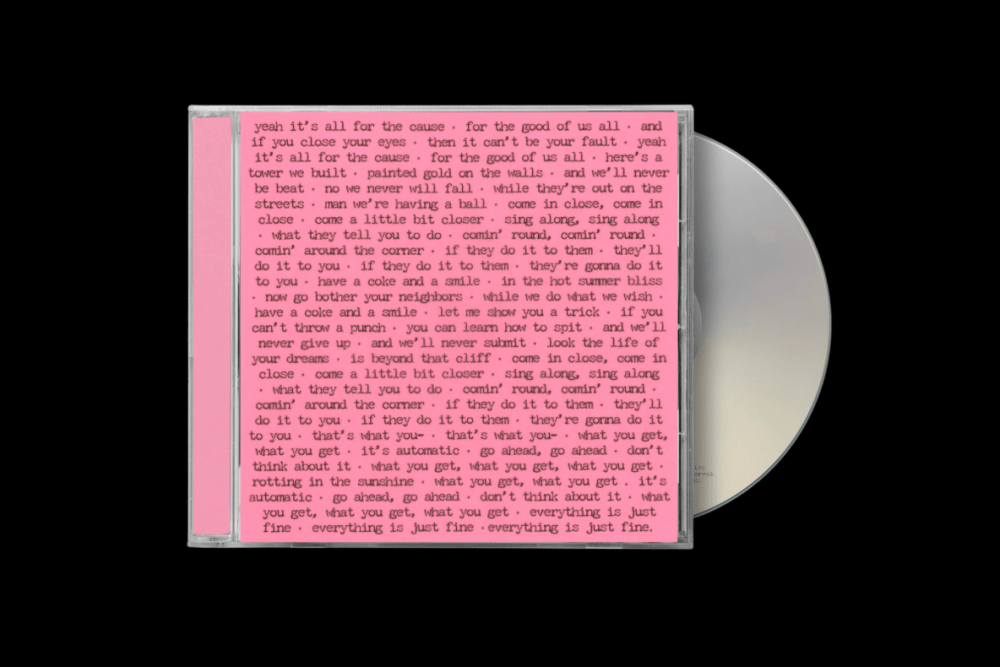
    “Serena Joy” was released Friday as a very limited-edition CD single, with only 500 units pressed, all of them available exclusively at a single record store, Analog Music Shop in Tustin, Calif. (The store reported Friday night that all 500 copies had sold through.)

    Of course, the song won’t be heard exclusively in Orange County CD players for long. Analog Music Shop — which so far seems to be the only source of official information about the track — reported that Rodrigo’s plan is to send it out wide to the world on Monday.

    The existence of a song titled “Serena Joy” had already been confirmed by Rodrigo in June, after fans spotted the title in a studio photograph listing 18 songs that were under consideration for her “You Look Pretty Sad for a Girl So in Love” album.

    Asked about it in a video interview with Etalk two months ago, Rodrigo smiled and said, “I actually really love [“Serena Joy”]. It didn’t fit on the album. The record was very much a chronicle of a relationship — beginning, middle and end. But I hope that it’ll be a part of something else down the line.”

    On Friday morning, Analog Music Shop posted about the song and its exclusive availability. “When we heard that Olivia Rodrigo was bringing an all-women music festival to Orange County, we were honestly just excited to see something this special happening right here in our hometown” (using “hometown” loosely, but close enough, since Tustin is adjacent to Irvine, where Daisy Chain Fields is taking place). “As one of the closest record stores in the area, we wanted to find a way to support Daisy Chain Fields.”

    The message continued, “We knew Olivia had a track record of supporting record stores, but we were still taken aback when we heard the news: Olivia is releasing a new song ahead of Daisy Chain Fields called ‘Serena Joy,’ and she wants the physical CD copies to be exclusively sold at Analog Record Shop. And the best part… She’s giving it to us 3 DAYS before anyone else can hear it. Three days early. More than anything, we’re grateful for what this represents: An artist building a stage for women in music and raising funds for women and girls. An artist willing to support a local independent record store. And a hometown getting to be part of something really special. That means a lot to us.”

    No one had to wait to hear or at least see the lyrics, at least, since they were printed right on the front of the CD, in images disseminated by the shop. Inevitably, the music itself was leaked, although takedown orders were issued.

    The lyrics do not mention the Serena Joy character or any other overt “Handmaid’s Tale” references, but with that as the title, the meaning of verses that might otherwise seem vague can be seen in fairly clear focus.

    “Yeah, it’s all for the cause / For the good of us all / And if you close your eyes / Then it can’t be your fault,” Rodrigo sings at the outset, in cautionary-tale lyrics. “Here’s a tower we built / Painted gold on the walls,” she adds in the lines that follow, possibly alluding to the popularity of literal gold-leaf in certain circles in the current age.

    The key recurring lyrics: “If they do it to them / They’ll do it to you / If they do it to them / They’re gonna do it to you.” Those are the clearest referrals to the “Handmaid’s Tale” character, who is one of the few women who seems to have a position of power in the patriarchy that has taken over a future America, yet who comes to find that she will be just as oppressed and endangered as any woman under the system she helped build.

    As Margaret Atwood writes of Serena Joy in the novel that inspired the television series: “She doesn’t make speeches anymore. She has become speechless. She stays in her home, but it doesn’t seem to agree with her. How furious she must be, now that she’s been taken at her word.”

    Many fans reacting online to the new song were down with the thought of Rodrigo stretching her political wings a little in song, even if most were in agreement that it would have been a poor fit with the tight relationship focus of “You Seem Pretty Sad for a Girl So in Love.”

    “Forget hot girl summer we’re entering our dystopian propaganda era,” wrote one fan commenting on the song’s Genius lyrics page. Wrote another, along similar lines, “Hot girl summer into fascism fall.”

  • Zcash jumps 48% to over $800 as Grayscale spot ETF push adds to ‘next bitcoin’ buzz

    Zcash jumps 48% to over $800 as Grayscale spot ETF push adds to ‘next bitcoin’ buzz

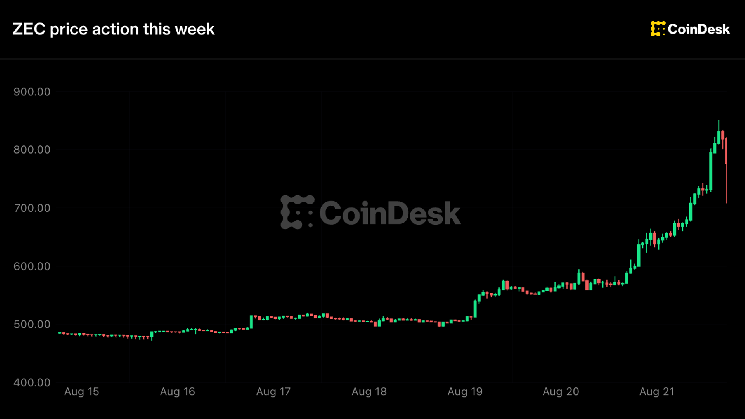
    Zcash surged past $800 for the first time since 2018 on Saturday, as “next bitcoin” chatter, billions in futures volume and Grayscale’s spot ETF push fueled a 38% rally.

    The privacy-centric token was built on Bitcoin’s design and inherited its 21 million supply cap, proof-of-work mining and halving schedule, with shielded transactions layered on top. CoinDesk Research examined the technical case for it in several reports this year, covering the Tachyon upgrade and the network’s approach to quantum readiness.

    Saturday’s move took it past the January 2018 peak near $800, which had stood as the token’s high water mark for eight years, and past the $750 it reached last November. It traded as low as $589 and as high as $851 in a 24-hour period, a swing of 45%.

    Crypto fund DCG sits behind several of the developments surrounding Zcash. Grayscale, which it owns, filed its fourth amendment on Aug. 18 to convert its Zcash Trust into a spot exchange-traded fund on NYSE Arca under the ticker ZCSH.

    The amendment keeps the conversion process moving but does not mean the ETF has been approved, with the filing still subject to SEC review.

  • Former Child Actress Raquel Lee Alleges Disney Negligent in On-Set Sexual Abuse

    Former Child Actress Raquel Lee Alleges Disney Negligent in On-Set Sexual Abuse

    In a new court filing, the former child actress Raquel Lee alleges she was repeatedly raped and sexually assaulted by a Disney worker during production of The Poof Point, a 2001 Disney Channel original movie. The suit, which doesn’t name the perpetrator, accuses the studio of negligence.

    Lee, who was 14 years old at the time, claims that a “middle-aged, male employee who was involved in the filming of the movie” groomed and then assaulted her, first on multiple occasions in his room at a hotel where the cast and crew were staying during production in Salt Lake City and then later on a flight back to Los Angeles. In addition, the alleged assailant “regularly whispered sexually explicit and harassing comments” into her ear while on set and “used hugs to get close to her.”

    The complaint contends that this misconduct was done “in plain view of the cast and crew and could be heard by the sound technicians managing the cast’s microphones” — yet “no one at Disney intervened.” The filing also asserts that the man “regularly made sexually explicit jokes and commentary on the set” around minors, including “sexually explicit comments about” Lee’s body. (In addition, she was allegedly allowed to be separated from her on-set guardian “for the vast majority of each day.”)

    Lee notes that her professional performance soon noticeably declined and that multiple Disney executives attacked her “changed behavior and trauma response,” accusing her of “being ‘out of control,’ causing the movie to go ‘haywire,’ ‘need[ing] Jesus,’ having ‘a demon inside her’ and engaging in sex acts with a member of the crew at the age of 14.” The litigation adds, “Disney threatened to, and did, cancel” her role in a then-forthcoming production with the studio.

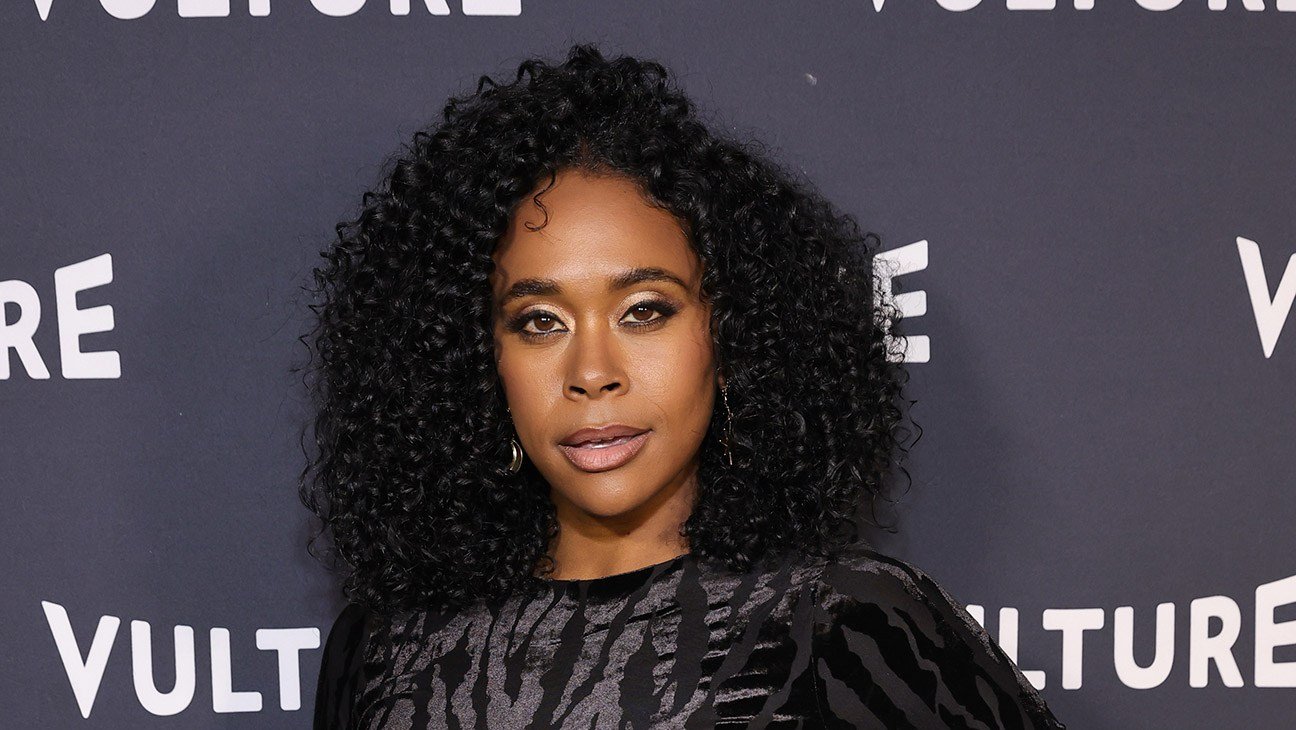
    Lee is represented by Doug Wigdor, a prominent plaintiffs’ employment and sexual-misconduct lawyer. He has previously represented Cassie Ventura against Sean “Diddy” Combs; Nafissatou Diallo, the hotel housekeeper who accused then-IMF chief Dominique Strauss-Kahn of sexual assault; and multiple women who alleged misconduct by Harvey Weinstein.

    Both Wigdor and Disney declined to comment on the litigation.

    The complaint contends that Lee’s experience was part of a long pattern at the studio: “This is not the first time that Disney has enabled a sexual predator to target and abuse vulnerable victims.” Wigdor’s filing cites a litany of previously reported accusations of predatory misconduct over decades which have been connected to the company.

    Shortly after The Poof Point, Lee went on to recur as a voiceover artist on the animated Disney Channel animated sitcom The Proud Family, and recently participated again in its Disney+ revival, The Proud Family: Louder and Prouder. She also worked with the company when she appeared on FX’s Snowfall in 2019.

    In addition, Lee participated in the hit 2024 docuseries Quiet on Set: The Dark Side of Kids TV, in which she reflected on her treatment as a Black performer on Nickelodeon’s The Amanda Show. She didn’t levy her The Poof Point claims in the docuseries, which became a cultural phenomenon for its focus on alleged misconduct against child actors. However, after its airing, she noted that Drake Bell’s discussion of experiencing on-set sexual abuse was “retraumatizing” for her.