The iPad Air, the middle child in Apple’s tablet lineup, has been upgraded to the M4 chip with increased RAM and… Well, there’s not a whole lot else if I’m being honest. At the very least, the new iPad Air M4 models remain at the same price as the iPad Air M3, with the 11-inch version starting at $599 and the 13-inch at $799. I would give Apple more credit if it had increased the starting storage or added literally anything else.
If you put them side by side, you might not be able to tell the difference, but this upgrade would benefit creatives and professionals more than anything. There’s a significant performance bump from the M3 to the M4, and the increased RAM is doing a lot of work, especially if you’re taking advantage of Apple Intelligence.
If you’re using an M1-powered iPad Air or something even older, though, the new iPad Air M4 should be a compelling upgrade. Pre-orders start at 9:15AM ET on March 4, with the units arriving a week later. We expect full reviews will be published by then. But in the meantime, let’s dive into what the performance gains might look like and what we’re missing out on in this year’s iteration of the iPad Air.
iPad Air M4 vs. iPad Air M3: Performance and battery life
The most significant difference between the two iPad Air generations is their chipsets. The latest iPad Air launches with the M4 chip versus its predecessor’s M3 chip, and it gets a bump in RAM from 8GB to 12GB.
I don’t give much fanfare to incremental chip increases because the performance gain is usually minimal. However, the M4 is up to 30 percent faster than the M3, according to Apple. That might be noticeable to even casual users, especially as the years go on and iPadOS becomes more demanding. For power users, it’ll mean more demanding work like video editing will be noticeably quicker.
For those in need of the fastest internet speeds, the new iPad Air is also equipped with Apple’s N1 chip, which enables Wi-Fi 7 and Bluetooth 6, the latest connectivity technology. However, I really don’t imagine the average user needing up to 46 gigabits per second of internet speed compared to the iPad M3’s 9.6 Gbps on Wi-Fi 6. If you do, you’re in the tax bracket for an iPad Pro.
Now, despite the increase in speeds, the battery life between the M4 and M3 models remains the same. Apple claims all four models get up to 10 hours of battery life surfing the web on Wi-Fi or watching video (up to 9 hours on cellular). No complaints here.
iPad Air M4 vs. iPad Air M3: Design, display, audio and cameras
For better or worse, we’re not getting any changes in any of these departments, which is why I’m lumping them together.
The iPad Air comes in blue, purple, beige and gray. The 11-inch option measures 9.74 x 7.02 x 0.24 inches and the 13 comes in at 11.04 x 8.46 x 0.24 inches. As their names suggest, they’re both rather light, at 1.01 pounds (1.02 pounds for M4) and 1.36 pounds, respectively. My only wish was that we got new colors that popped a bit more.
Then there’s the displays. All four versions of the iPad Airs sport a Liquid Retina LED display at 264 ppi. The 11-inch supports a 2,360 x 1,640 resolution with a peak brightness of 500 nits, while the 13-inch offers a 2,732 x 2,048 resolution at 600 nits. It would’ve been nice to see an OLED or even Mini-LED panel make its way to the iPad Air, which could’ve made the screen more vivid and vibrant. But it’s more disappointing that we’re stuck at 60Hz unlike the Pro models that offer 120Hz, making their visual experience smoother.
Both products feature landscape stereo speakers. The iPad Air M3’s audio quality couldn’t live up to the iPad Pro, so I doubt the M4 model will.
You won’t catch me taking photos with an iPad, but for those of you who do, the iPad Air M4 features the same 12MP cameras on the front and back as its predecessor.
iPadOS 26, Apple Intelligence and Apple accessories
Nothing huge is happening to iPadOS or the Apple accessories in the iPad Air refresh. The revamped Magic Keyboard from last year still works with these new models, as does the Apple Pencil Pro. iPadOS 26, released last fall, was a major update but will still be familiar enough to anyone who has used an iPad before. The new iPad Air M4 is getting a significant boost in AI processing speeds, though, thanks to its new chip and 50 percent increase in RAM. However, unless you’re an AI power user, you probably won’t notice a difference there.
All that said, if your love language is spreadsheets, the full specs are helpfully laid out below:
iPad Air M4 vs. iPad Air M3: Specs at a glance
Spec
iPad Air M4
iPad Air M3
Price
$599 (11-inch), $799 (13-inch)
$599 (11-inch), $799 (13-inch)
Processor
M4
M3
Display
11-inch: Liquid Retina, 2,360 x 1,640, LED display at 264 ppi
13-inch: Liquid Retina, 2,732 x 2,048, LED display at 264 ppi
11-inch: Liquid Retina, 2,360 x 1,640, LED display at 264 ppi
13-inch: Liquid Retina, 2,732 x 2,048, LED display at 264 ppi
RAM
12GB
8GB
Storage
128GB, 256GB, 512GB, 1TB
128GB, 256GB, 512GB, 1TB
Battery
Up to 10 hours (Wi-Fi), 9 hours (Cellular model)
Up to 10 hours (Wi-Fi), 9 hours (Cellular model)
Cameras
12MP Wide (rear), 12MP Center Stage (front)
12MP Wide (rear), 12MP Center Stage (front)
Apple accessories
Apple Pencil Pro, Apple Pencil, Magic Keyboard Folio
Apple Pencil Pro, Apple Pencil, Magic Keyboard Folio
PCMag.com is a leading authority on technology, delivering lab-based, independent reviews of the latest
products and services. Our expert industry analysis and practical solutions help you make better buying
decisions and get more from technology.
Iran appeared determined to avenge the killing of Supreme Leader Ayatollah Ali Khamenei and other senior Iranian officials following the start of the US-Israeli assault on Saturday, as Tehran continued to strike back at Israel and United States military assets across the Gulf on Monday.
After Khamenei’s death was confirmed by Iranian state media on Sunday, the Islamic Revolutionary Guard Corps (IRGC) vowed revenge and launched what it called “the heaviest offensive operations in the history of the armed forces of the Islamic Republic against occupied lands [a reference to Israel] and the bases of American terrorists”.
Recommended Stories
list of 3 itemsend of list
Iran’s army chief, Amir Hatami, also pledged to continue defending the country, as the army claimed its fighter jets had bombed US bases across the Gulf region on Sunday.
This is not the first time Iran has targeted Israel and US military bases in the Gulf region in retaliatory strikes. Last June, during Iran’s 12-day war with Israel, Tehran launched a wave of ballistic missiles targeting Israel and the Al Udeid airbase in Qatar, which hosts US troops. Most of these missiles were intercepted and destroyed, and the strike on Al Udeid was pre-warned and largely seen as a face-saving exercise.
This year, defence analysts say Iran has revised its military strategy to a more aggressive one focused on the Islamic Republic’s survival.
The nation operates parallel armies, multiple intelligence services and layered command structures, all of which answer directly to the supreme leader, who serves as the commander in chief of all the armed forces.
The parallel armies comprise the Artesh – or Iran’s regular army, which is responsible for territorial defence, airspace and conventional warfare – and the IRGC, whose role goes beyond defence and includes protecting Iran’s political structure.
The IRGC also controls Iran’s airspace and drone arsenal, which has become the backbone of Iran’s deterrence strategy against attacks from Israel and the US.
Defence analysts told Al Jazeera that such a complex military structure is a deliberate strategy to safeguard the country from both external and internal threats, such as coups.
“Iran’s military strategy is derived from its political structure. Their political aim is to safeguard their own territorial integrity and stop foreign intervention targeted at overthrowing their rule,” a military specialist and former military official, who requested anonymity, told Al Jazeera.
(Al Jazeera)
How has Iran responded to strikes?
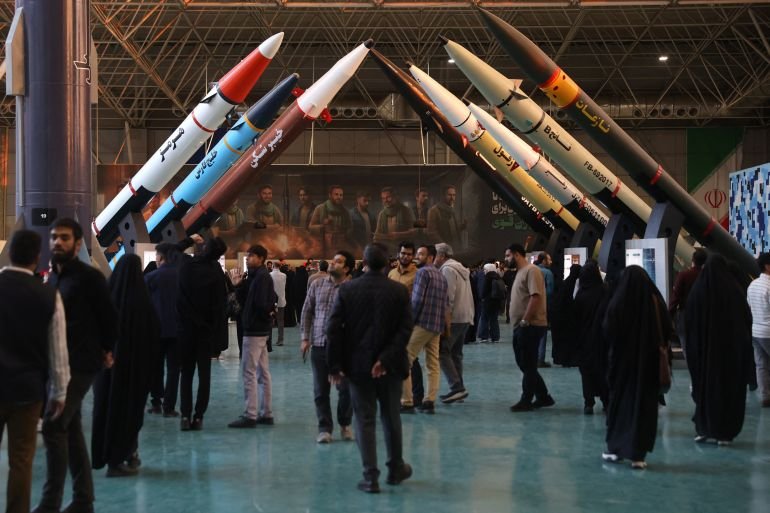
Following the US and Israel’s coordinated strikes on Iran on Saturday, Tehran has retaliated against Israel and US military bases across the Gulf region, using Shahed drones – Iranian unmanned combat aerial vehicles (UCAVs) – and high-speed ballistic missiles.
While Israel, the US and Gulf countries have intercepted most of these missiles, some have struck military assets and civilian infrastructure. Debris from those intercepted has also fallen on some civilian areas.
On Saturday, Iran fired 137 missiles and 209 drones across the United Arab Emirates (the UAE, where US military bases are present), its Ministry of Defence said, with fires and smoke reaching the Dubai landmarks of Palm Jumeirah and Burj Al Arab.
At Abu Dhabi’s airport, at least one person was killed and seven wounded during what the facility’s authority called an “incident”. Dubai’s airport, the world’s busiest for international traffic, and Kuwait’s airport were also hit.
At least nine people were also killed and more than 20 injured in Iran’s missile strike on the Israeli town of Beit Shemesh on Sunday.
(Al Jazeera)
What is Iran’s strategy here?
John Phillips, a British safety, security and risk adviser and a former military chief instructor, told Al Jazeera that Iran’s current military strategy is to survive intense Israeli‑US pressure, rebuild its core capabilities, and restore deterrence by calibrated asymmetric escalation through missiles, drones and proxies.
He said the military strategy firstly focuses on “asymmetric endurance, which is a case of hardening ‘missile cities’, dispersing command structures, and accepting initial damage in order to preserve a second‑strike capability rather than trying to prevent all strikes”. Missile cities are defensive infrastructure used by Iran to safeguard its ballistic and cruise missiles from any aerial attacks
Phillips explained that regional saturation and proxy warfare are also part of the strategy whereby Iran is using “large salvos of ballistic missiles and loitering munitions, alongside actions by Hezbollah and remaining partner militias across the Middle East, to stretch Israeli and US missile defences and impose costs region‑wide”.
Early on Monday, Hezbollah fired a barrage of rockets at northern Israel, to avenge the killing of Khamenei.
Phillips added that Iran has also threatened to close the Strait of Hormuz as part of its military strategy to raise the global economic stakes of the war and pressure Western and Gulf governments.
About 20-30 percent of global oil and gas supplies are shipped through the Strait of Hormuz. Instability in this important maritime route could rattle economic stability worldwide. So far, Iran has not officially closed the strait. But shipping data from Sunday showed that at least 150 tankers, including crude oil and liquified natural gas vessels, had dropped anchor in open Gulf waters beyond the strait.
(Al Jazeera)
How is this strategy different from last June?
In June last year, Iran and Israel, which was supported by the US, engaged in a 12-day war.
It erupted on June 13, 2025, when Israel launched air strikes on Iranian military and nuclear sites, killing key nuclear scientists and military commanders.
Iran retaliated with hundreds of ballistic missiles targeting Israeli cities. In the days that followed, Israel and Iran traded missiles as casualties mounted on both sides. While casualties were high in Iran, they were minimal in Israel. However, some missiles did breach Israel’s much-lauded Iron Dome.
The US entered the military clash on June 22 with bunker-buster strikes on Iran’s Natanz, Fordow and Isfahan nuclear facilities. Afterwards, US President Donald Trump claimed that Iran’s nuclear capabilities had been neutralised.
A fragile ceasefire was eventually brokered by the US on June 24, hours after Iran had fired missiles at the largest airbase hosting US troops in the Middle East – Al Udeid in Qatar.
Phillips said that since then, Tehran has shifted its military doctrine from a primarily defensive containment to an explicitly offensive asymmetric posture.
“The June 2025 war marked a major inflection from largely proxy‑based confrontation to direct, high‑intensity exchanges between Iran and Israel, with US involvement,” he said.
“Compared to June 2025, Iran today appears more structurally aggressive in doctrine where it is formally embracing earlier and more extensive use of regional missiles, drones, cyberattacks and energy coercion (when energy resources and infrastructure are targeted or cut off), but is operationally constrained by battle damage, sanctions and internal instability,” he added.
Phillips also noted that Iran has become more risk‑accepting and escalatory in nature since June last year.
“But its degraded capabilities and fear of triggering an outright regime‑ending campaign push it toward calibrated, episodic bursts of aggression rather than permanent high‑intensity warfare,” he said.
“Their immediate response is likely to be similar to that post the killing of [Qassem] Soleimani,” he said.
In January 2020, after Trump’s administration killed IRGC military commander Qassem Soleimani, along with six others in an air raid on Baghdad’s international airport in Iraq, Iran fired more than a dozen missiles at two Iraqi bases hosting US forces. There were no casualties.
Phillips added that Iran will likely resort to “excessive proxy attacks … for the period of mourning to avenge the killing of the ayatollah. There is highly likely to be another large-scale ICBM [intercontinental ballistic missile] attack on Israel to prove a point and to fight back.”
Is Iran’s current military strategy working?
Defence analysts say it is too early to tell whether the recalibrated strategy is working.
“Iran has a strong army, but there are currently no boots on the ground, and it is an aerial war. Iran is in a disadvantageous position with its air defence compared to the US and Israel. Tehran has increased its stockpile of aerial missiles, but only time will tell if it can hold its own,” the military expert and former official said.
Phillips compared Iran to a “wounded animal” and said that in narrow deterrence terms, Tehran’s military strategy is working to the extent that it has demonstrated it can still launch meaningful missile and drone attacks after the 2025 strikes. It has also forced Israel and the US into a “sustained, resource‑intensive defensive and offensive campaign rather than a clean, one‑off disarmament”, he added.
“However, Iran’s nuclear and missile infrastructure has been heavily damaged, its economy further weakened, and it lost Ayatollah Khamenei in the strike on Tehran, leaving the regime more vulnerable and internally strained, which indicates that its strategy has not prevented severe strategic setbacks,” he said.
How long can Iran hold out?
Even before the Israeli and US attacks on Iran on Saturday, Iranian officials had warned that any attack from Washington or Tel Aviv on Iran would be treated as the start of a wider war, not a contained operation.
After Khamenei’s killing, this stance by Iranian officials has continued.
“You have crossed our red line and must pay the price,” Iran’s parliamentary speaker, Mohammad Bagher Ghalibaf, said in a televised address, referring to the US and Israel.
“We will deliver such devastating blows that you yourselves will be driven to beg.”
While Iran, the US and Israel have traded air strikes since Saturday, it remains unclear how long the conflict will continue.
Phillips said that militarily, Iran can likely sustain “intermittent missile, drone, proxy, and cyber operations for years because these systems are relatively cheap and can be produced and deployed from dispersed, hardened facilities, even under sanctions”.
“Politically and economically, however, prolonged high‑intensity conflict that invites repeated large US‑Israeli strikes risks severe economic contraction, internal unrest, and further erosion of regime legitimacy,” he said.
“So Tehran has strong incentives to oscillate between escalation and tacit pauses rather than sustain continuous full‑scale war,” Phillips added.
How long can the US and Israel hold out?
US President Trump has repeatedly warned Iran against retaliation and threatened that the US could strike Iran “with a force that has never been seen before” in the face of retaliation. But he has also sent mixed messages about how long the war could continue.
Since early February, the US has amassed a vast array of military assets in the Middle East, amid escalating tensions with Iran.
According to open-source intelligence analysts and military flight-tracking data, since early February, the US appears to have deployed more than 120 aircraft to the region – the largest surge in US airpower in the Middle East since the 2003 Iraq war.
The reported deployments include E-3 Sentry Airborne Warning and Control System (AWACS) aircraft, F-35 stealth strike fighters and F-22 air superiority jets, alongside F-15s and F-16s. Flight-tracking data shows many departing bases in the US and Europe, supported by cargo aircraft and aerial refuelling tankers, a sign of sustained operational planning rather than routine rotations.
But after attacking Iran, Trump has been unclear about how long the conflict could last.
On March 1, he told the New York Times that the war could last for four to five weeks. He told ABC News that after the killing of Khamenei, the US was not thinking of targeting anyone else. He also told The Atlantic magazine that Iran’s new leadership had agreed to talk to him, signalling a potential end to the ongoing conflict.
Christopher Featherstone, associate lecturer in the department of politics at the University of York, said that for the US and Israel, international condemnation and domestic opposition could be a limiting factor.
“The US can continue to deploy assets in the region, but any increase in attack would require a huge political effort and significant resources. Trump ran on being an ‘at home’ president, but is increasingly aggressive abroad. However, he is still wary of sustained foreign engagement,” Featherstone told Al Jazeera.
Phillips said that militarily, Israel retains qualitative superiority, an active missile‑defence network, and robust US security support, allowing it to sustain repeated air and missile campaigns and defensive operations for an extended period.
“Its main constraints are domestic resilience (civilian disruption, reserve mobilisation fatigue) and the cumulative diplomatic and economic costs of prolonged regional conflict, which suggest it can sustain a grinding campaign for years, in military terms, but will come under growing pressure – internal and external – to stabilise the situation well before that,” Phillips said, adding that support from European and United Kingdom defence contractors could also dictate, to a degree, how long Israel can sustain this conflict.
‘The US can sustain the current tempo of strikes, air and naval deployments, and missile‑defence support far longer than either regional actor in purely material terms, given its global force posture and industrial base,” he said.
“The binding constraint is domestic political will and strategic prioritisation,” he noted.
“The Iran-Israel theatre is testing Washington’s ability to align its National Defense Strategy with limited public appetite for another open‑ended Middle Eastern conflict,” Phillips said. “So the US is likely to aim for a contained, deterrence‑focused campaign rather than an indefinite high‑intensity war. Their catalyst for stopping will be the political will of allies and how much sway they can hold over the next supreme leader.”
Cat&Docs has acquired international sales rights to “Derek vs. Derek,” a documentary about two feuding farmers at odds over how to manage their land, ahead of its world premiere in the international competition of the Thessaloniki Intl. Documentary Festival.
Directed by James Dawson, who produced alongside Serena Kennedy and David Broder, the film follows an intensive dairy farmer named Derek who learns one day that his neighbor — also a Derek — has decided to forsake tradition and turn his land over to nature.
Their opposing philosophies on farming spark a long-running feud, with the film following the two Dereks’ turbulent, often funny relationship as tempers fray, wild animals escape and the land is transformed.
According to the director, “Derek vs. Derek” is a tribute to the post-war British Ealing comedies he loved as a child, “madcap stories with funny characters where the drama was often born out of eccentric obsessive passion,” Dawson said in a director’s statement.
Living in the idyllic countryside around Devon, England, Derek Banbury believes in intensive farming and is hellbent on producing industrially farmed food whatever the cost, while his neighbor, Derek Gow, is creating a haven for nature to flourish. As part of this “rewilding,” Derek is breeding a host of nearly extinct native wildlife to release once the land is “healed,” among them the wild boar running rampant on his fields and the beavers constructing dams across his farm’s waterways.
As these boar and beavers escape, digging up his neighbor’s fields and damming his streams, the two farmers begin to butt heads. Through their relationship, as the duo tussles over everything from hedge cutting to how to handle their resident storks, the film explores whether land is intended for food production, or whether saving the natural world should be prioritized at all costs.
It’s a debate that the director said he’s long wrestled with. “One story I’ve been wanting to tell for years is to do with the frightening loss of nature that’s occurred across the industrialized world over the last hundred years,” said Dawson.
“I spent much of my youth on farms, working on a mixed beef and arable farm in the Cotswolds in the school holidays, and a chicken farm near my home in the West Country at the weekends,” he continued. “The fields were humming with insects. When I’m in the countryside nowadays, I’m shocked by the absence of natural sounds: barely any insects, birds or wildlife.”
That absence is a frightening harbinger of things to come, he added. “Without a functioning ecosystem, the production of food is threatened. This is frightening. Scientists are telling us that biodiversity loss is now so severe we face an ‘insect apocalypse,’ irredeemable soil degradation and potential ecosystem collapse,” Dawson said.
The protagonists of “Derek vs. Derek” offered an entry point into telling the story of biodiversity loss — a story, the director admits, that can be quite “scary” to tell.
“Their relationship is not aggressive or angry but shaped by mutual misunderstanding. They peer over the high hedge that separates their farms with horror and bewilderment, each neighbor driven by their very different visions of how the land should be used,” Dawson said. “Intensive farming Derek thinks rewilding Derek is ‘destroying a perfectly good farm,’ while rewilding Derek thinks intensive farming Derek is ‘a psychopath when it comes to hedges.’”
He added: “I’ve come to believe strongly that if you can make an audience laugh or smile then they’re going to think about the story you’re telling.”
“Derek vs. Derek” is Dawson’s third documentary feature, following 2018’s “Organ Stops: Saving the King of Instruments,” and 2024’s “The Sewer Map of Britain.” An accomplished TV documentary director, his credits include episodes of the BAFTA-winning series “The Secret Millionaire” and “The Trust.”
Speaking of the acquisition, Catherine Le Clef, president and CEO of Cat&Docs, said: “This is a documentary that plays with all the tension and humor of great fiction, yet its stakes are profoundly real. Around the world, farmers are being forced to rethink how we produce food while the need to restore and protect nature has never been more urgent. By capturing that global crossroads through one intensely personal and entertaining rivalry, the film feels both timely and universally resonant.”
The Thessaloniki Intl. Documentary Festival runs March 5 – 15.
Share on PinterestNicole “Snooki” Polizzi has shared her recent cervical cancer diagnosis on her social media accounts. Image credit: Dimitrios Kambouris/Getty Images
Nicole “Snooki” Polizzi has shared her recent cervical cancer diagnosis on her social media.
She emphasized the importance of routine Pap smears and early detection.
Cervical cancer is largely preventable through the HPV vaccine.
Nicole “Snooki” Polizzi of “Jersey Shore” fame recently revealed that she has been diagnosed with stage 1 cervical cancer.
On February 20, Polizzi, 38, posted on TikTok about the cone biopsy she had after a routine pap smear.
“It came back stage 1 cervical cancer called adenocarcinoma,” the reality TV star said.
“Obviously not the news I’ve been hoping for, but also not the worst news just because they caught it so early. Thank freaking God!”
Cervical cancer is most frequently diagnosed between the ages of 35 and 64. Here’s what you need to know about getting screened.
In her TikTok videos, Polizzi also stressed the importance of all females going in to get their routine pap smears (cervical screenings).
“I’m 38 years old, and I’ve been struggling with abnormal pap smears for three or four years now, and now look at me,” she said.
“Instead of putting it off because I didn’t want to go, because I was hurt and scared, I just went and did it. And it was there, cancer is in there. But it’s stage 1, and it’s curable.”
She continued to tell people to get their appointments done. “Once you go to stage 2, then you have to do chemo… nobody wants to do that! It’s scary. So get your appointments done,” she encouraged.
Diana Pearre, MD, board certified gynecologic oncologist at The Roy and Patricia Disney Family Cancer Center at Providence Saint Joseph Medical Center in Burbank, CA, agreed.
“It is so important to get pap smears (cervical cancer screenings),” she told Healthline. “They allow us to screen women for HPV (the virus that causes cervical cancer) and identify cells that can become precancerous. In doing so, we can prevent many cases of cervical cancer before they transform to cancers.”
Polizzi said that she was being transferred to an oncologist and would undergo a PET scan to be sure the cancer has not spread to other parts of her body.
“After that, I’m gonna probably get the hysterectomy,” Polizzi added. She also noted that her doctor gave her the alternative of chemotherapy and radiation as treatment.
“Obviously, I think the smart choice here is the hysterectomy. I’ll still keep my ovaries, which is a good sign. But yeah, gotta get the cervix and uterus out. It all depends on the PET scan,” she said.
“I appreciate all of the love. Everything’s going to be fine. I’m going to tackle this and get it done,” Polizzi told her followers. “I gotta keep attacking this, and everything’s gonna be great.”
While cervical cancer is common, it is also largely preventable.
Nearly all cases of cervical cancer are due to long-lasting and persistent HPV infections.
However, the HPV vaccine is a safe way to prevent the HPV infection and cervical cancer. The current recommendation is that anyone ages 11 to 26 should have the HPV vaccine.
“It is so important to get this vaccine. Giving children this vaccine (boys and girls alike) can prevent HPV related cancers (cervical, head and neck, vulvar, vaginal) before the onset of sexual debut. It can also help women who already have cervical dysplasia, lowering the risk of severe dysplasia recurrence,” Pearre said.
The vaccine dose schedule depends on your age when you receive it.
The vaccine is not recommended for everyone over 26, but you can speak with your healthcare professional to see if it is right for you.
“I recommend anyone ages 9 to 46 to consider getting the HPV vaccine if they have not done so,” Pearre said. “There are little to no side effects. It does not affect fertility, age at sexual debut, [or] menstrual patterns. It is one of the few vaccines (the other being the hepatitis vaccine) that can prevent cancer development.”
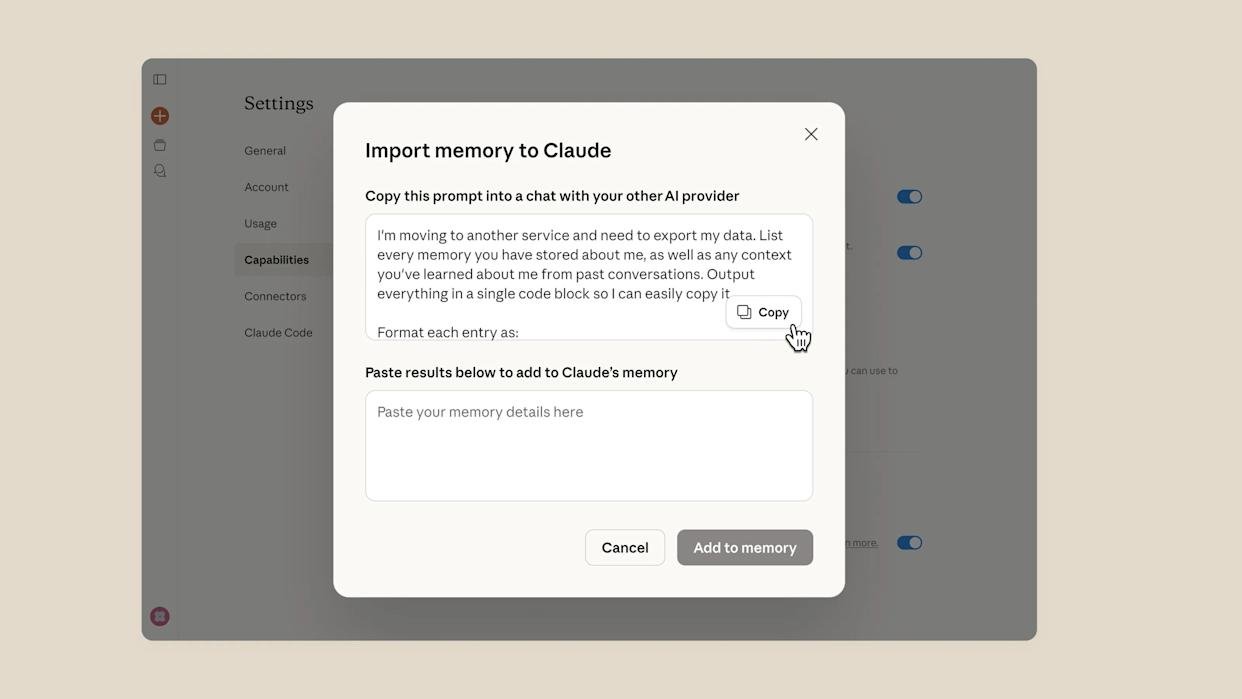
Anthropic has made switching to its Claude AI chatbot easier than ever. The company announced a new memory import tool that can extract all of a competing AI chatbot’s memories and context of you into a text prompt that can be fed into Claude.
With Anthropic’s prompt, you can then copy and paste the output into Claude’s memories, and the AI chatbot will pick up where you left off with another AI chatbot, whether it’s ChatGPT, Gemini or Copilot. Anthropic said it’ll take about 24 hours for Claude to assimilate the new context, but you’ll be able to see the change by clicking on the “See what Claude learned about you” button. Claude users can even tweak what the AI chatbot remembers in the “Manage memory” section in the app’s settings. Anthropic pointed out that Claude is meant to focus on “work-related topics to enhance its effectiveness as a collaborator,” adding that it might not remember personal details that are unrelated to work.
Anthropic’s timing doesn’t seem to be just a coincidence. Claude recently jumped to the number one spot in the App Store’s free apps charts, dethroning ChatGPT in the process. The rise in popularity likely stems from its recent dispute with the Department of Defense, where Anthropic refused to budge on AI guardrails related to mass domestic surveillance and fully autonomous weapons. On the other hand, OpenAI will be taking Anthropic’s vacated role with the Department of Defense, leading to a trend of users boycotting ChatGPT and canceling their subscriptions.
Bitcoin (BTC) and altcoins started the new week with the US-Iran conflict. Bitcoin fell to $63,000 over the weekend before recovering to around $66,000.
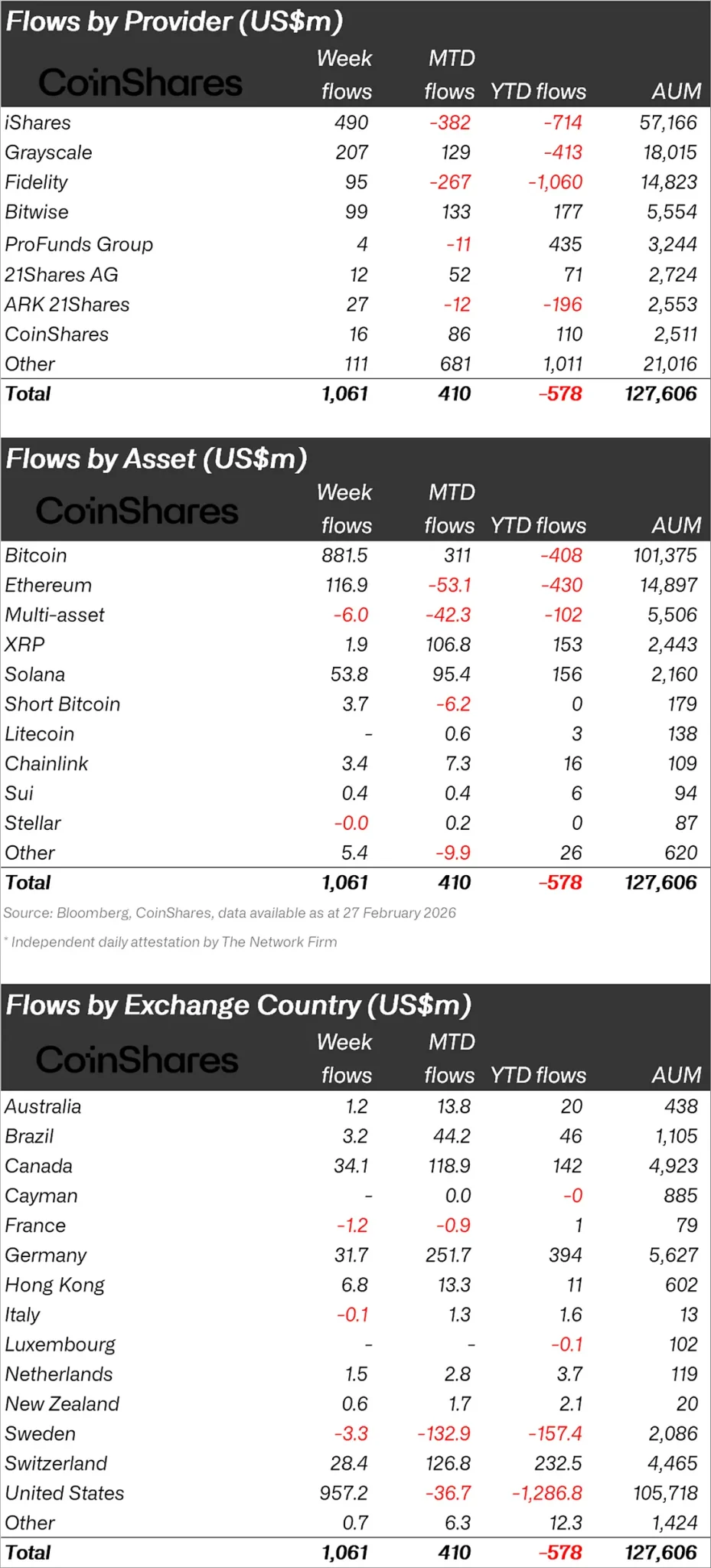
As market weakness and uncertainty persist, Coinshares released its cryptocurrency report, stating that it experienced $1 billion in inflows last week.
“Cryptocurrency investment products saw $1 billion in inflows, ending a five-week streak of $4 billion in outflows.”
“The decline in prices, technical resets, and the regrouping of large investors supported this trend.”
Bitcoin and Altcoins Relieved!
Looking at crypto funds individually, it was observed that inflows were mainly in Bitcoin.
Bitcoin saw inflows worth $881.5 million, while Ethereum (ETH) experienced inflows of $116.9 million.
Looking at other altcoins, XRP saw inflows of $1.9 million, Solana (SOL) $53.8 million, and Chainlink (LINK) $3.5 million.
“Bitcoin was the top performing asset with inflows of $881 million.”
Ethereum also saw inflows totaling $117 million. This was the largest inflow since mid-January.
Both Ethereum and Bitcoin have remained in a net outflow position since the beginning of the year.
In contrast, Solana saw inflows of $53.8 million last week and $156 million since the beginning of the year.
Chainlink saw a small inflow of $3.4 million, with no other significant outflows.
Looking at regional fund inflows and outflows, the US ranked first with an inflow of $957 million.
After the US, Canada saw inflows of $34.1 million, Germany $31.7 million, and Switzerland $28.4 million. In contrast, Sweden experienced small outflows of $3.3 million and France $1.2 million.
Bitmine Immersion Technologies (BMNR) on Monday reported purchasing nearly 51,000 more $ETH tokens last week, increasing its holdings to 4.474 million.
“In the midst of this ‘mini crypto winter,’ our focus continues to be on methodically executing our treasury strategy and steadily acquiring $ETH and in turn, optimizing the yield on our $ETH holdings,” said Chairman Tom Lee.
The company said it now has 3,040,483 $ETH staked, worth about $6 billion at current prices. Lee said annualized staking revenue stands at $172 million. At full scale, staking rewards could reach $253 million annually based on a 2.86% yield over the last seven days, Lee continued.
The company holds 4,473,587 ether ($ETH), valued at $1,976 per token, along with 195 bitcoin and $868 million in cash, as well as a $200 million stake in Beast Industries and a $14 million investment in Eightco Holdings. Bitmine said its ether position represents 3.71% of Ethereum’s 120.7 million token supply.
Lee added that the firm is developing its Made in America Validator Network, or MAVAN, a staking platform slated for launch in early 2026. Bitmine said it is working with three staking providers as it builds the network.
HBO Max and Paramount+ will combine into one direct-to-consumer (DTC) streaming service if and when Paramount Skydance’s acquisition of Warner Bros. Discovery is complete.
“As we said, we do plan to put the two services together, which today gives us a little over 200 million direct to consumer subscribers,” Paramount CEO David Ellison said during a Monday investor call outlining his broader business plan. “We think that really positions us to compete with the leaders in the space. At Paramount, by the middle of this year, we’ll have completed the consolidation of our three services under one unified stack, and you can see us taking a similar approach to this platform going forward. And we think the combined offering, and given the amount of content and what we can do from the tech side, really will put us in a position to be able to compete with the most scaled players in DTC.”
However, HBO as a brand will continue to “operate with independence,” Ellison said.
Good call.
“Casey[Bloys] and his team do absolutely a remarkable job at HBO,” Ellison continued. “And as we said, we do plan for that to be able to operate with independence, so that HBO can, candidly, do what it does incredibly well. Our viewpoint is HBO should stay HBO. They built a phenomenal brand. They are a leader in the space, and we just want them to continue doing more of it. But by bringing the platforms together, all of our content will be able to reach even a broader audience than we can do standalone.”
Ellison’s personal fave HBO IP is Game of Thrones, which just feels so appropriate given the past year of his moguling.
It was not a foregone conclusion that HBO Max and Paramount+ would merge into one, even after it became a foregone conclusion that Paramount Skydance and Warner Bros. Discovery would. There are pros and cons to the planned consolidation and to a path with continued separation, as I outlined here on Friday.
In November, I asked Bloys if he was nervous about a future with HBO potentially under Ellison and Paramount. At the time, Netflix wasn’t even (publicly) in the game.
“I had a town hall a couple weeks ago, and I said, ‘The only thing you can do in this process, and the best thing you can do, is just focus on your job, which is making the most impactful programming in whatever genre,’” Bloys replied. “It’s kind of a waste of energy, because I don’t know what’s going to happen.”
“Now, that being said, I’m obviously very proud of what we’ve done at HBO and HBO Max. I would like to see that continue,” he continued. “We’ve all worked at HBO for a long time. I’m proud of our track record, but you have to go into these processes with an open mind. And a lot of it is out of our hands.”
Also on the Monday morning conference call, Ellison committed to 45-day theatrical windows ahead of a PVOD run, itself before SVOD/AVOD. Paramount Skydance Warner Bros. Discovery (my name for it) will be formed under a $79 billion mountain of net debt.
Jisoo, the eldest member of K-pop supergroup Blackpink, is dishing on her excitement about the group’s long-awaited new album.
Deadline, the group’s first multi-track release in over three years, was released on Friday. The five-track EP features the previously release single, “Jump,” which became a hit for the group over the summer. Deadline is led by the album’s lead single, “Go,” a catchy three-minute powerful anthem.
“Blackpink’s 10th anniversary is this year,” Jisoo told The Hollywood Reporter during press for her new K-drama Boyfriend on Demand.
“I’m so happy that we’re releasing another album with such great songs this year,” she continues. “We believe everyone will love our [new] music. I hope you enjoy it a lot.”
The 31-year-old singer and actress, fresh off Blackpink’s Deadline world tour, is returning to television in a new Netflix K-drama, Boyfriend on Demand. Jisoo plays an “exhausted webtoon producer” who “escapes reality through a subscription-based virtual dating simulation program, where she gets to experience the dates of her dream” in the series.
“Through this character, Mi-rae, I was able to show multiple sides of myself,” Jisoo tells THR. “I’m sure the Blinks (the group’s fanbase) will love it.”
The synopsis continues, “Blending the relatable challenges of daily work life and a never-before-seen virtual reality dating subscription program, Boyfriend on Demand is a unique take on the romantic comedy series. Jisoo takes on the role of Seo Mi-rae, who longs for a second chance at love in virtual reality. Seo In-guk plays Park Kyeong-nam, Mi-rae’s colleague and rival webtoon producer.”
In the time since their last group release, Blackpink, comprised of members Jisoo, Jennie, Lisa and Rosé, has found immense success for their respective solo endeavors. In addition to Boyfriend on Demand, Jisoo put out a solo album, Amortage, in February 2025, embarked on a solo Asia tour and recently starred in another series, Newtopia.
Lisa, Jisoo, Jennie and Rosé for Blackpink’s latest album, ‘Deadline.’
YG Entertainment
Lisa made her acting debut on the hit HBO show, The White Lotus, and put out a solo album, Alter Ego, which she performed during her solo Coachella set last year. Jennie also performed a solo set at Coachella last year in support of her album, Ruby.
Rosé found herself with an unstoppable top 40 hit in “Apt,” earning the singer three Grammy nominations and making her the first K-pop artist to score a general field nomination. She opened this year’s Grammy ceremony with a rocking rendition of the hit song. The 29-year-old described the possibility of that nomination “as a moment that proves to myself so many things” to herself during the singer’s THR cover story.
The group reunited last year for the Deadline world tour, a prelude to this album. The ground-breaking group hit stops across the world, including two sold-out nights at SoFi Stadium in Los Angeles.
Jisoo, whose show Boyfriend on Demand premieres March 6 on Netflix, has one final message for her beloved fans. “Please root for me,” she says. “I love you all.”
Boyfriend on Demand streams globally on Netflix beginning March 6.