Blog

  • Weekend warriors: How HyperLiquid became retail’s bear market playground

    The crypto bear market has dragged down most major digital assets this year, but $HYPE has moved in the opposite direction. Year to date, the token is up 23.9%, matching gold’s gain over the same period. The S&P 500 is slightly negative, while bitcoin has fallen 23.7% and ether more than 33%.

    The divergence is notable not only because $HYPE is crypto-native, but because it has decoupled from the broader digital asset market. Its performance increasingly reflects the value of the platform behind it rather than the market’s direction.

    HyperLiquid, the decentralized derivatives exchange that underpins $HYPE, is built to monetize activity rather than price appreciation. In bull markets, capital tends to concentrate in spot exposure. In choppier conditions marked by drawdowns and macro shocks, derivatives volume tends to persist. Traders shift from buying to positioning, and the platform collects fees on both sides.

    While trading volume on competitor platforms Aster and Lighter has tumbled in recent months, HyperLiquid’s has increased, rising from $169 billion in December to more than $200 billion for both January and February. Aster, meanwhile, went from $177 billion in December to less than $100 billion in February, with Lighter suffering an even sharper drop, DefiLlama data shows.

    Total volume on HyperLiquid since its inception has now hit a whopping $4 trillion.

    Volatility as a business model

    HyperLiquid’s core product is perpetual futures, which allow traders to go long or short with leverage. When prices grind higher, leverage amplifies upside. When markets slide, shorting and basis trades step in. The exchange collects fees on both sides.

    That structure becomes particularly relevant in a year marked by turbulence across asset classes. Rather than relying on sustained price appreciation, the exchange captures turnover. In sideways or declining markets, traders often increase frequency, hedge exposure, or rotate into relative-value strategies. Activity replaces direction as the primary driver.

    And that business model has yielded positive results. Gross protocol revenue grew by 96% in Q3 of 2025 to $354 million, with the fourth-quarter total hitting $286 million, the majority of which came from perpetual trading fees.

    That revenue comes from a super-lean team of fewer than 15 employees, with half focused on engineering. HyperLiquid founder Jeff Yan has also refused investment from venture capitalists to maintain independence – a bold approach uncommon in the crypto industry.

    Trading beyond market hours

    More recently, HyperLiquid has expanded beyond crypto-native pairs. It now offers synthetic exposure to foreign exchange, commodities and major equity indices. It also provides weekend trading for U.S. equities, an innovation that resonates with retail traders accustomed to crypto’s round-the-clock rhythm.

    For a generation raised on app-based brokerage platforms, the traditional market calendar feels restrictive. As seen over the past weekend, geopolitical escalations often land outside the typical weekday trading window. HyperLiquid’s structure allows traders to react in real time rather than wait for Monday’s open.

    HyperLiquid’s silver market has also been a resounding success with trading volume nearing $750 million over a recent 24-hour trading period despite traditional markets being closed for the majority of Sunday.

    The exchange has also introduced pre-IPO perpetual markets tied to companies such as Anthropic, OpenAI and SpaceX. These instruments are synthetic and do not confer equity ownership, but they offer directional exposure to private companies. In effect, they create a parallel venue for price discovery among retail participants otherwise excluded from late-stage venture valuations.

    The product FTX tried to build

    The model carries echoes of an earlier vision. FTX pitched 24-hour trading, tokenized equities and seamless leverage across asset classes. Its collapse stemmed from custody risk, shoddy balance-sheet practices, and the commingling of funds.

    HyperLiquid operates on a non-custodial framework, with on-chain settlement and transparent vault mechanics. Users interact with smart contracts rather than deposit funds into a centralized entity’s balance sheet. In a post-FTX landscape, that distinction carries weight. Retail traders who absorbed losses from centralized failures remain sensitive to counterparty exposure.

    HyperLiquid delivers many of the features once marketed by FTX, but through infrastructure designed to reduce reliance on a single custodian.

    The exchange also leans into competition and gamification. Leaderboards prominently rank traders by performance, creating protagonists like James Wynn, who lost $100 million on HyperLiquid after engaging in a high-risk long-only trading strategy using leverage when bitcoin was above $100,000.

    The mechanic encourages engagement. Traders can build reputations through short positions, market-neutral strategies or well-timed directional bets, and that creates a buzz on social media – effectively acting as a marketing vehicle even in volatile markets.

    The centralization test

    Claims that HyperLiquid is insulated from bear markets require context. One year ago, the protocol faced a credibility shock that raised questions about decentralization.

    In April 2025, the total value locked in the Hyperliquidity Provider vault fell from $540 million to $150 million within a month. The trigger was a trading episode involving a token called JELLY. A trader opened a large short position on HyperLiquid while simultaneously buying the token on illiquid decentralized exchanges. Thin liquidity distorted price feeds and forced the vault into a toxic position via liquidation.

    As JELLY’s reported price spiked to levels unsupported by deep liquidity, the vault’s unrealized losses mounted. HyperLiquid intervened, force-closing the market and settling JELLY at $0.0095 rather than the roughly $0.50 price being relayed by oracles. The decision protected the vault from substantial losses, but it ignited backlash.

    Critics argued that a protocol marketed as decentralized had exercised discretionary control reminiscent of a centralized exchange. Governance optics deteriorated quickly. Yield on the vault fell sharply, and users withdrew capital.

    Security researchers described the episode as an economic design flaw rather than a smart contract exploit. Jan Philipp Fritsche of Oak Security characterized it as unpriced vega risk, where leveraged exposure to volatile assets drained the risk fund in a predictable manner. The episode underscored that economic vulnerabilities can be as destabilizing as technical bugs.

    HyperLiquid later modified its governance process, shifting asset delistings to an on-chain validator voting mechanism. The change did not eliminate scrutiny, but it addressed one of the central criticisms.

    The vault has since recovered to $380 million in TVL, offering users a 6.93% APR.

    Resilience through activity

    Despite the controversy, trading volume on the exchange remained robust, and with competitors Aster and Lighter losing momentum, HyperLiquid is positioning itself as a mainstay in the ongoing cryptocurrency bear market.

    Risks remain. Regulatory attention could intensify around synthetic exposure to private companies and U.S. equities. Liquidity fragmentation in thinner markets could resurface pricing distortions. Governance mechanisms will continue to be tested under stress.

    Yet $HYPE’s relative strength this year reflects a structural distinction. Rather than functioning as a high-beta bet on digital asset appreciation, it increasingly behaves like a claim on a venue that monetizes volatility.

    In a cycle defined less by sustained rallies and more by sharp swings, that positioning has mattered.

  • Deer crashes into Florida home through living room window

    Deer crashes into Florida home through living room window

    Odd News // 4 weeks ago

    S.C. man’s pretzel craving leads to $200,000 lottery prize

    Feb. 2 (UPI) — A South Carolina man stopped at a convenience store to satisfy his craving for a bag of pretzels and ended up winning a $200,000 lottery prize.

  • Hope Davis Boards NBC’s ‘Protection’ Drama

    NBC’s drama pilot Protection has cast another of its lead roles.

    Hope Davis (The Phoenician Scheme, Your Honor) will star opposite Peter Krause in the show, about a family of law enforcement officers who are targeted by a killer. Like Krause, Davis starred in an 2010s NBC show, in her case the short-lived drama Allegiance.

    Protection, from creator Josh Safran (Gossip Girl, Quantico), kicks off “when a U.S. Marshal falls in the line of duty,” the show’s logline reads. “A seemingly cut-and-dry case turns into a deadly conspiracy as a family of law enforcement agents become the target of a mysterious assassin. Bridging personal differences and crossing professional boundaries, the Thornhill family must use the expertise from a lifetime of protecting civilians and politicians to protect one another and bring the killer to justice … even if it means betraying their sworn code.”

    Davis will play Joan, a federally appointed U.S. marshal who commands respect at work.

    Davis is a three-time Emmy nominee, most recently for her recurring role on HBO’s Succession. Her recent credits also include writer-director Kelly Reichardt’s feature The Mastermind, Apple TV’s miniseries Before, HBO’s Perry Mason and Wes Anderson’s Asteroid City. She’s currently appearing on stage in Wallace Shawn’s play What We Did Before Our Moth Days at the Greenwich House Theater. Davis is repped by UTA and Kipperman Management.

    Safran is executive producing Protection with Jenna Bush Hager and Ben Spector. The show comes from Universal Television.

  • How That Jim Carrey Clone Conspiracy Theory Spiraled Out of Control

    How That Jim Carrey Clone Conspiracy Theory Spiraled Out of Control

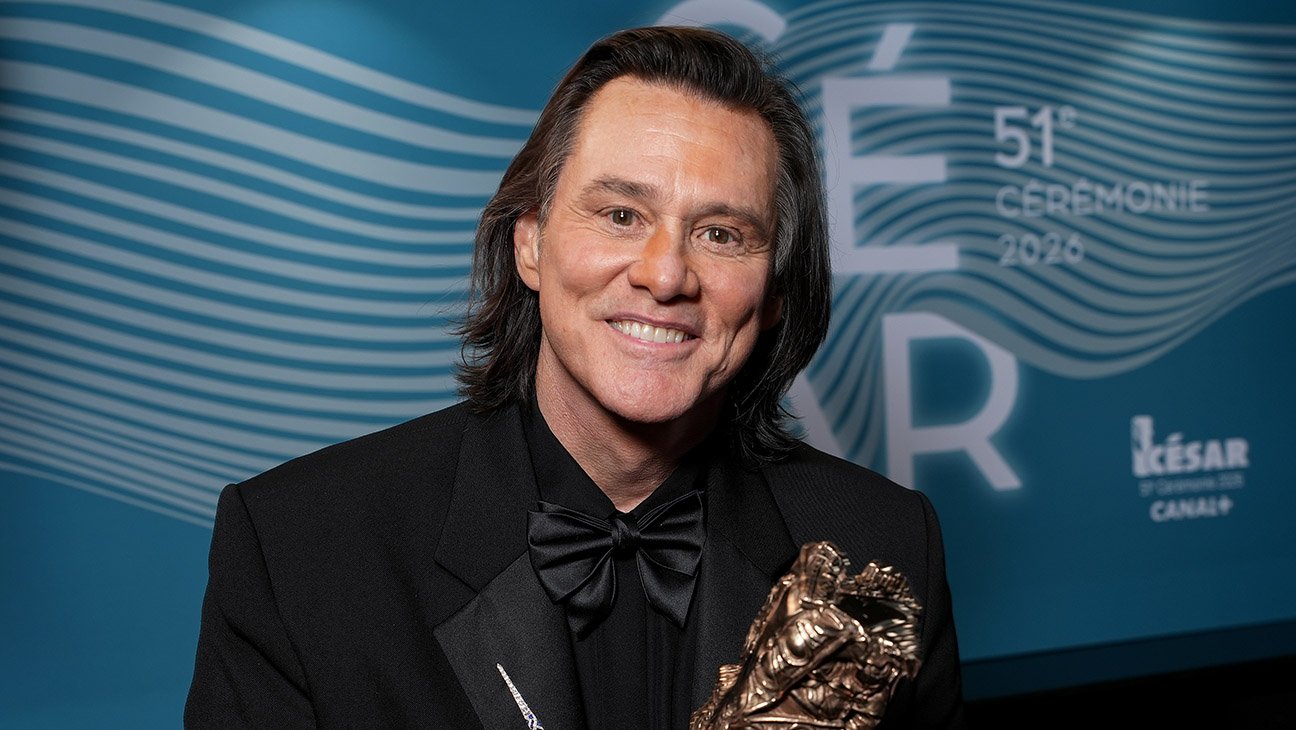
    Suddenly, Jim Carrey became the new Avril Lavigne.

    The actor’s appearance at the César Awards in Paris last week spawned a surge of conspiracy theories that the Dumb and Dumber actor had been replaced by a clone.

    The reason for the theories seemed to be the 64-year-old actor’s face looking possibly a bit inflamed in some of the footage online.

    “Sorry but there’s a zero percent chance this is actually Jim Carrey,” declared one account with 47,000 followers on X. “I’m not saying it’s a clone or some dumb illuminati shit, but for some reason he’s clearly using a body double to stand in for him.”

    While other fringe accounts were very much saying Carrey had been replaced by a clone (Example: “Jim Carrey was cloned and killed by satanists. They can create a clone in 5 months.”)

    Adding fuel to the fire was a resurfaced, decades-old clip of Carrey on Late Night with David Letterman where the actor said he uses decoys to fool paparazzi. “I’ve done this a few times now and that is to use a decoy,” the actor said at the time, seemingly serious. “Using a decoy — it sounds so ridiculous but it works like a charm … a Jim Carrey double. I send him off in one direction, he sucks all the press in that direction, and I just have my day.”

    Of course, using a decoy to get the press off your back is one thing. Sending somebody else in your place to accept an honorary award at the French equivalent of the Oscars with your family in attendance would be quite another.

    Others speculated the actor had simply had recent plastic surgery of some kind. Or that he had deliberately altered his looks as some kind of performance art piece. Needless to say, all variations of the rumor had an undercurrent of mean-spiritedness given the whole “you no longer look like you” nature of them.

    Then, just when rumors began to really froth, drag artist Alexis Stone posted on Instagram on Sunday suggesting she used prosthetics to make herself look like Carrey and impersonated him at the awards show. She posted a photo of Carrey at the awards with the caption: “Alexis Stone as Jim Carrey in Paris.”

    Confirmation? So it wasn’t Carrey after all? At this point, even Megan Fox was thrown, with the actress commenting on the post: “I can’t handle any more stress right now i need to know if this is real.” While Katy Perry commented with a bullseye emoji.

    Monday morning, however, César Awards organizers and Carrey’s reps seemingly had quite enough. The general delegate of the César Awards, Gregory Caulier, said in a statement first obtained by Variety, “Jim Carrey’s visit has been planned since this summer” and praised the actor’s preparation for his speech, which he gave entirely in French. Caulier called the rumors a “non-issue,” saying “I just remember his generosity, his kindness, his benevolence, his elegance.”

    A couple of hours later, Carrey’s personal rep — and you can almost hear a weary sigh accompanying this statement — first confirmed to TMZ, “Jim Carrey attended the César Awards, where he accepted his Honorary César Award.”

    So there you have it. Yes, that was Jim Carrey and not a clone, body double, or impersonator.

    The shame of this is that Carrey’s stirring speech received high praise from those in attendance (which included girlfriend Mina, daughter Jane and grandson Jackson). Carrey is not a French speaker and apparently worked long and hard on his delivery. “As an actor, each character you play is like clay in the sculptor’s hands, which you shape to your heart’s desire,” he said in French. “How fortunate I have been to share this art with so many people who have truly opened their hearts to me.”

    The clone/double rumors were frequently fueled on X, which has come under fire for misinformation of a far more serious nature since President Trump ordered an attack on Iran late Friday. A Wired story wrote that X was “drowning in disinfo” since the attack began.

  • NBA Fantasy: Start/sit guide for Week 20

    NBA Fantasy: Start/sit guide for Week 20

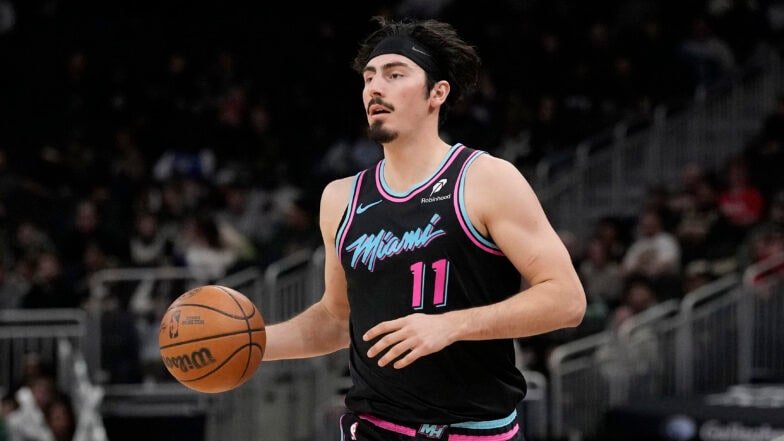
    The Heat’s Jaime Jaquez Jr. is averaging 14.5 points, 5.3 rebounds and 4.2 assists across 28.1 minutes over the past 15 games,

    We’re about even this coming week in terms of teams with four- and three-game schedules, with the former slightly outpacing the latter. With a barrage of noteworthy injuries across the league at this point of the season – and non-contending teams in no rush to push key players back onto the floor – we have plenty of candidates to work across all roster spots to work with once again. 

    Each week, we’ll aim to highlight a pair of Start candidates at each position for your fantasy rosters who may shape up as some tougher calls of the week to make, focusing on players with a start or roster rate of 50% or less in Yahoo leagues. 

    Likewise, we’ll spotlight one Sit candidate at each position who would normally not be a consideration for a spot on your bench, often focusing on players with fewer game opportunities during the coming week.

    TEAMS WITH FOUR GAMES: Boston Celtics, Charlotte Hornets, Dallas Mavericks, Detroit Pistons, Houston Rockets, Los Angeles Clippers, Los Angeles Lakers, Miami Heat, Milwaukee Bucks, New Orleans Pelicans, New York Knicks, Orlando Magic, Phoenix Suns, San Antonio Spurs, Utah Jazz, Washington Wizards

    TEAMS WITH THREE GAMES: Brooklyn Nets, Chicago Bulls, Denver Nuggets, Golden State Warriors, Indiana Pacers, Memphis Grizzlies, Minnesota Timberwolves, Oklahoma City Thunder, Philadelphia 76ers, Portland Trail Blazers, Sacramento Kings, Toronto Raptors

    TEAMS WITH TWO GAMES: Atlanta Hawks, Cleveland Cavaliers

    Without further ado, let’s examine some tougher start/sit decisions for Week 20: 


    Guards

    Start: Brandon Williams, Mavericks

     18% roster rate

    Cooper Flagg missed a seventh consecutive game Sunday against the Thunder, and his absence therefore could very well extend to Tuesday’s contest against the Hornets, at minimum. That means Williams could be set for an additional run of starts after going into the game vs. OKC with averages of 16.0 points, 6.0 assists and 3.2 rebounds across his previous six games, a stretch where he’d also shot 54.8%, including 42.9% from 3-point range. Williams delivered another solid outing despite the tough matchup in the loss to the Thunder, supplying 14 points, three rebounds and three assists. With four games to work with and a potential role on the first unit in all of them, Williams is certainly in play, especially with Naji Marshall also possibly missing some time in coming days because of a finger injury that already cost him Sunday’s contest. 

    Start: Ace Bailey, Jazz

    34% roster rate

    Bailey put together an impressive February, averaging 14.3 points, 6.4 rebounds, 2.0 assists and 1.1 steals across 32.7 minutes in 11 games despite shooting an inefficient 40.4% and posting a pair of four-point outings in that span. The rookie has gotten an abundance of floor time during his first NBA season, so it’s no surprise he may be finding his stride during the stretch run. Bailey is expected to play all four games this week without Lauri Markkanen due to his hip injury, brightening his prospects even further. 

    Sit: Donovan Mitchell, Cavaliers

    100% roster rate

    Mitchell missed a third straight game Sunday against the Nets due to a groin injury. Even though head coach Kenny Atkinson said recently the issue wasn’t expected to lead to a long-term absence, at least one more DNP could well be in the cards for the star guard. If that indeed comes to pass, that would leave Mitchell with just one other opportunity to take the floor this coming week, and that would come in a tough matchup against the Celtics. Even with his unquestioned upside, Mitchell has plenty of risk attached this week. 


    Forwards

    Start: Jaime Jaquez Jr., Heat

    39% roster rate

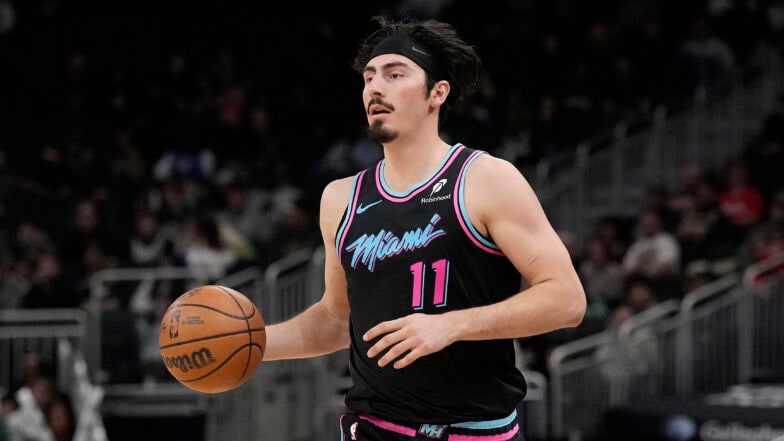
    Jaquez has averaged 14.5 points (on 47.9% shooting), 5.3 rebounds and 4.2 assists across 28.1 minutes over the last 15 games, and he enters the Heat’s four-game week in position to potentially run with the first unit because of Norman Powell’s groin injury. Powell is officially week to week, and Jaquez has already proven amply capable of delivering strong multi-category production in a second-unit role. Even if Jaquez continues to come off the bench, he should see more than enough minutes to benefit your lineup through various means while absorbing some extra usage due to Powell’s absence.

    Start: Saddiq Bey, Pelicans

    45% roster rate

    Bey is another forward who could be poised to benefit from a key absence on his squad, considering Zion Williamson sprained his ankle Saturday against the Jazz and missed Sunday’s game against the Clippers. Bey had an adequate line in Zion’s absence Sunday – 14 points, six rebounds and two assists – and he came into the game with averages of 22.4 points (on 48.5% shooting), 5.5 rebounds and 3.5 assists across 33.2 minutes over the previous 11 contests. That included 42- and 24-point showings in the two games immediately prior to Sunday. Bey could capitalize on any further Williamson absences during New Orleans’ upcoming four-game schedule.

    ALSO CONSIDER: Tari Eason, Rockets (41% roster rate)

    Sit: Pascal Siakam, Pacers

    100% roster rate

    Siakam is another star dealing with injury coming into the scoring period, as the big man’s wrist issue has already cost him three games. Siakam will have a couple days to get healthy for the Pacers’ next game Wednesday against the Clippers, but with Indiana’s season going nowhere, it’s probably safe to assume the big man won’t be rushed back. There are just three games on the Pacers’ docket this coming week, so rolling with a healthy four-game option certainly involves less uncertainty.


    Centers

    Start: Neemias Queta, Celtics

    37% roster rate 

    Queta wrapped up a solid Week 19 on Sunday against the 76ers with a career-best showing, generating a 27-point, 17-rebound double-double that also included two assists, three blocks and one steal. That memorable showing was preceded by a 14-point, 13-rebound double-double against the Suns on Tuesday that included three assists and two blocks, with the pair of bookend performances offering an impressive glimpse of what the surging center can bring to the table. Even with Nikola Vučević having joined the Celtics at the deadline, Queta has kept a clear hold of the starting job and could continue thriving on Boston’s full schedule.

    Start: Kyle Filipowski, Jazz

    38% roster rate 

    Filipowski, like Bailey, is in position to benefit from Markkanen’s absence, and the big man comes into Week 20 with averages of 14.6 points (on 53.1% shooting), 6.4 rebounds, 2.8 assists and 2.8 steals over his current five-game starting run. Filipowski is averaging a modest 25.8 minutes per game in that span – underscoring how efficient he’s been – and he’ll likely draw another four turns with the first unit in the coming week. Filipowski has plenty of experience as a starter this season, so a week of robust production across the stat sheet is very much in the cards.

    ALSO CONSIDER: Bobby Portis, Bucks (35% roster rate)

    Sit: Kristaps Porziņģis, Warriors

    90% roster rate

    Porziņģis’ health issues continue to bedevil him irrespective of what team he suits up for, as he’s already ruled out for a fifth straight game Monday against the Clippers due to an illness. Given his very spotty track record of availability this season, Porziņģis could very well miss the remaining two games on Golden State’s schedule this coming week. Consequently, he’s a very straightforward Sit candidate this week. 

  • NBA Fantasy — Salary Cap Edition: Week 20 update

    NBA Fantasy — Salary Cap Edition: Week 20 update

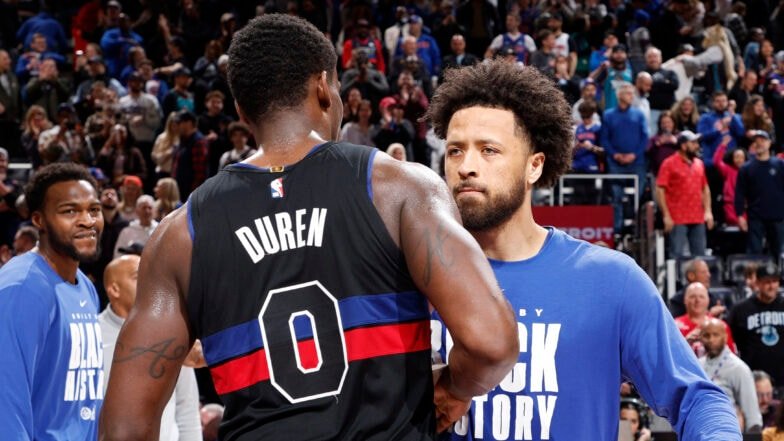
    The Pistons’ Cade Cunningham and Jalen Duren have combined to average 96.1 fantasy points per game this season.

    The final full month of the fantasy season has arrived. 

    As the race to the playoffs intensifies, it’s crucial for general managers in NBA Fantasy — Salary Cap Edition to make adjustments to their roster. There are plenty of points to be had.

    Here’s what you need to know entering Week 20:


    Last week’s story

    Wednesday marked a major moment for the Detroit Pistons (45-14). It’s already been a triumphant season for the East’s first-place team, but their contest against the Oklahoma City Thunder (47-15) was an opportunity to certify their modern identity as a title contender. 

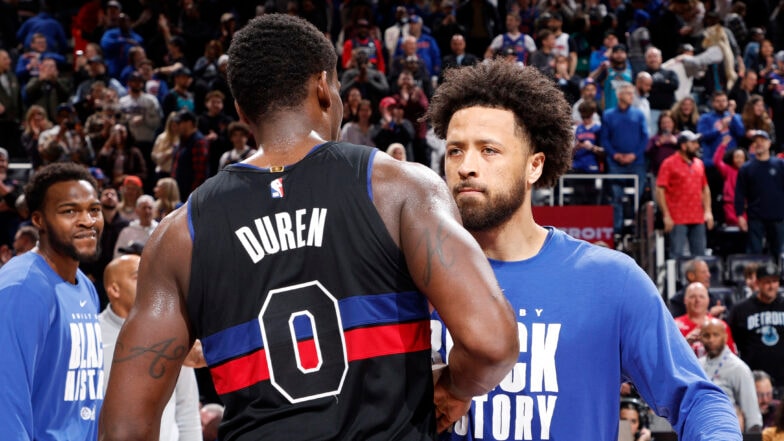
    And that, they did. The Pistons knocked off the defending champions, 124-116. Both Cade Cunningham and Jalen Duren contributed double-doubles en route to 77 and 51 fantasy points, respectively. Together, they’ve averaged 96.1 fantasy points per game (FPPG) this season.

    Key contributions also came from Ausar Thompson, who had 44 fantasy points on 11 points scored, four rebounds, seven assists, two blocks and three steals. Duncan Robinson, too, was useful with 28 fantasy points on 16 points scored, three rebounds, three assists and one steal.


    Peak performances

    Topping the podium this past week was Cunningham with 77 fantasy points Wednesday in that big-time victory for the Pistons over the Thunder. The two-time All-Star pitched in 29 points scored, four rebounds, 13 assists, three blocks and three steals en route to his fourth consecutive double-double. Few players in fantasy are better than him — he now sits third in the league with 58.2 FPPG and 3086 total fantasy points (TFP).

    Alperen Sengun was right on Cunningham’s tail that night. He racked up 76 fantasy points of his own for the Houston Rockets (37-22) in a commanding 128-97 win over the Sacramento Kings (14-48). The fifth-year center delivered 26 points scored, 13 rebounds, 11 assists, three blocks and two steals, earning his third triple-double of the campaign. He hasn’t been one of the most dominant forces in fantasy, but still ranks 13th in the Association with 49.3 FPPG.

    Then there was a usual suspect — Nikola Jokić. The three-time MVP tallied 75 fantasy points Sunday despite a 117-108 loss for the Denver Nuggets (37-24) to the Minnesota Timberwolves (38-23). He did it by way of 35 points scored, 13 rebounds, nine assists, two blocks and one steal. Jokić is on the cusp of re-taking the league lead for TFP, as his 3094 aren’t far behind Tyrese Maxey’s 3208. The eight-time All-Star’s 68.7 FPPG, though, remains untouched.


    Global leaderboard

    There are six weeks to go until the 2025-26 fantasy season comes to a close. For fantasy general managers who are looking for an edge on their competition down the stretch, lessons can be taken from the global leaders. Melvin Schneider’s ‘GriddyGang’ sits first with 24554 TFP, followed by Tilo Gust’s ‘Blue_Arrow_27’ with 24174 and Adam Boustani’s ‘Dima Maghreb’ with 24128. Those three hail from Germany, Germany and the United Kingdom, respectively.

    Several trends exist between these squads. First and foremost, all of them roster the Milwaukee Bucks (26-33) duo of Kevin Porter Jr. and Ryan Rollins. The two talents have stepped up offensively during Giannis Antetokounmpo’s 15-game absence, averaging a combined 90.8 FPPG without him. Porter Jr., in particular, has been big with 49.5 FPPG in that span. Their production will decrease once Antetokounmpo is back in action, so don’t wait to invest in them.

    These global leaders also feature Donovan Clingan and Stephon Castle, who have produced 33.6 FPPG for $8.8M and 39.9 FPPG for $10.2M, respectively. Clingan — a second-year center — has dropped 40 or more fantasy points in four of his last six games, and has put up point-rebound double-doubles on an almost-nightly basis. Castle, meanwhile, continues to shine in his sophomore season and has averaged 35.8 FPPG in his last six outings.

    Play NBA Fantasy — Salary Cap Edition!

  • Starmer lets US use bases for Iran clash: UK’s military, legal quagmire

    Early on Monday, a suspected Iranian drone crashed into the runway at the United Kingdom’s RAF Akrotiri base in southern Cyprus. British and Cypriot officials said the damage was limited. There were no casualties.

    Hours later, two drones headed for the base were “dealt with in a timely manner”, according to the Cypriot government.

    Recommended Stories

    list of 4 itemsend of list

    The incidents came as Prime Minister Keir Starmer signalled on Sunday that the UK was prepared to support the United States in its confrontation with Iran – raising the prospect that it could be drawn deeper into a war it did not choose by its closest ally.

    In a joint statement with the leaders of France and Germany, Starmer said the European group was ready to take “proportionate defensive action” to destroy threats “at their source”.

    Later, in a televised address, he confirmed that Westminster approved a US request to use British bases for the “defensive purpose” of destroying Iranian missiles “at source in their storage depots, or the launches which are used to fire the missiles”.

    But his agreement did little to placate US President Donald Trump, who said the decision came too late.

    UK-based military analyst Sean Bell cautioned against reading too much into the Akrotiri incident.

    “I understand the projectile that hit Cyprus was not armed, it hit a hangar [with] no casualties, and appears to have been fired from Lebanon,” he said, citing sources.

    Al Jazeera was not able to independently verify the claim.

    The broader context, he argued, is more consequential.

    The US has taken the action “and everybody else is having to deal with the fallout”, he said.

    Iran’s military strength lies in its extensive ballistic missile programme, he said, adding that while some have the range to threaten the UK, they do not extend far enough to strike the US.

    “I don’t think [US] President Trump has yet made the legal case for attacking Iran, and … international law makes no discrimination between a nation carrying out the act of war and a nation supporting that act of war, so you’re both equally complicit,” he said.

    Bell said that Washington likely reframed the issue, communicating to London that, whatever triggered the escalation, US forces were now effectively defending British personnel in the region.

    That shift, he suggested, provided a legal basis to “not to attack Iran, but to protect our people”, allowing the UK to approve US operations from its bases under a “very, very clear set of instructions” tied strictly to national interest and defence.

    UK officials ‘tying themselves in knots’

    However, concerns of complicity had reportedly shaped earlier decisions, according to Tim Ripley, editor of the Defence Eye news service, who said the British government initially concluded that US and Israeli strikes on Iran did not meet the legal definition of self-defence under the United Nations Charter.

    When Washington requested the use of bases such as RAF Fairford in Gloucestershire, UK, and Diego Garcia in the Indian Ocean, Starmer is understood to have consulted government lawyers, who advised against participation.

    Up until Starmer’s televised address, in which he approved the US request, the UK had not considered the campaign a war of self-defence, said Ripley. While Washington’s legal reasoning has not changed, the war’s trajectory has.

    Iranian retaliatory strikes – which have seen drones and missiles targeting Gulf states – have placed British expatriates and treaty partners under direct threat.

    “The basis of our decision is the collective self-defence of longstanding friends and allies, and protecting British lives. This is in line with international law,” Starmer said.

    According to Ripley, several Gulf governments, which maintain defence relationships with the UK, sought protection, allowing London to focus on protecting British personnel and partners rather than endorsing a broader campaign. However, with memories of the Iraq War hanging over Westminster, British ministers have stopped short of explicitly backing the US bombing campaign.

    British officials are “tying themselves in knots” trying to describe a position that is neither fully participatory nor detached, he said.

    US-UK: A strained relationship

    Starmer on Monday told Parliament that the UK does not believe in “regime change from the skies” but supports the idea of defensive action.

    But Ripley warned that any arrangement allowing US warplanes to operate from British air bases carries significant risks.

    Iran’s missile systems are mobile and launchers mounted on trucks, he said. From RAF Fairford or Diego Garcia, US aircraft face flight times of seven to nine hours to reach Iranian airspace, necessitating patrol-based missions.

    Once airborne, pilots may have only minutes to act. The idea that a US crew would pause mid-mission to seek fresh British legal approval is unrealistic, he said.

    London must rely on Washington’s assurance that only agreed categories of “defensive” targets will be struck. If an opportunity arose to eliminate a senior Iranian commander in the same operational zone, the temptation could be strong. Yet such a strike might fall outside Britain’s stated defensive mandate. The aircraft would have departed from British soil, and any escalation could implicate the UK, Ripley said.

    Bell highlighted another weakness: Britain has no domestic ballistic missile defence system.

    If a ballistic missile were fired at London, he said, “We would not be able to shoot it down.”

    Intercepting such weapons after launch is notoriously difficult, reinforcing the argument that the only reliable defence is to strike before launch.

    The UK, therefore, occupies a grey zone: legally cautious, operationally exposed and strategically dependent on US decisions, it does not fully control.

    Beyond the legal and military dilemmas, Starmer must also contend with a sceptical public.

    A YouGov poll conducted on February 20 found that 58 percent of Britons oppose allowing the US to launch air strikes on Iran from UK bases, including 38 percent who strongly oppose.

    Just 21 percent support such a move, underscoring limited domestic backing for deeper involvement.

  • Altcoins Outperform Bitcoin With Double-Digit Weekly Gains

    Altcoins Outperform Bitcoin With Double-Digit Weekly Gains

    In brief

    • Polkadot, Near, and Jupiter are among the altcoins that have clocked double-digit gains over the past week.
    • The altcoin rally follows Bitcoin’s 4.7% recovery from a $63,000 low triggered by the U.S.-led attack on Iran.
    • For this rally to transition into a sustained uptrend, experts cited a combination of renewed liquidity and the dissipation of uncertainty due to macro and geopolitical events.

    Altcoins including Near Protocol, Polkadot and Jupiter have posted double-digit gains over the past week, far outpacing Bitcoin as traders rotated into higher-beta assets following the leading crypto’s attempted recovery.

    Near Protocol jumped 19.4% over the past seven days, while Polkadot gained 16.5% and Jupiter climbed 15.8%, according to CoinGecko data.

    Bitcoin, by contrast, is roughly breakeven over the same period, hovering near $66,100 after recovering 4.7% from its February 28 low of $63,176—a drop triggered by escalating Middle East tensions following a U.S.-led attack on Iran.

    The divergence tests whether altcoins can sustain momentum without Bitcoin leading the way. The move reflects technical positioning rather than a fundamental shift in market structure, experts told Decrypt.

    The altcoin rally comes despite fearful sentiment lingering in the crypto ecosystem, with the Crypto Fear & Greed Index hovering around 10—territory signaling “extreme fear.”

    “When the Fear & Greed Index hits extreme lows like 10 or 11, it typically signals that the forced selling phase of a deleveraging event has reached exhaustion,” Lacie Zhang, research analyst at Bitget Wallet, told Decrypt. “Over the past week, as Bitcoin found tentative support near the $63,000–$64,000 range, high-beta altcoins began to bounce simply because they were oversold on a technical basis.”

    “This explosion isn’t a sign of returning confidence but rather a result of thin liquidity and the clearing of over-leveraged short positions,” Zhang added. “In an environment of extreme fear, even a small amount of bottom-fishing by brave dip-buyers can cause outsized percentage gains in alts.”

    The altcoin rally is also a result of “heavily positioned” bearish bets, Rachel Lin, CEO of SynFutures, told Decrypt. “When sentiment is depressed, even modest stabilization in Bitcoin can trigger short covering and rotation into higher beta assets,” she said. “This move appears more technical and liquidity-driven than a reflection of improving fundamentals.”

    Macro pressures

    Lin pointed to Bitcoin’s dip below $66,000 amid escalating Middle East tensions as evidence that crypto remains macro-sensitive. “While selling pressure has eased and dip buyers are active, we have not yet seen consistent safe-haven flows,” she added.

    The SynFutures CEO noted a divergence between retail sentiment and institutional capital allocation, citing “selective allocation into DeFi infrastructures” such as Morpho, which supports certain alt sectors more than the broader market.

    Lin said that for altcoins to sustain momentum, broader macro uncertainty needs to ease alongside improving liquidity conditions with renewed capital inflows—factors that could suggest a potential risk-on scenario and transition the ongoing rally into a sustained uptrend.

    Zhang cautioned that calling this the start of a sustained uptrend remains premature. “While Bitcoin showed resilience by rebounding to the $66,000 to $68,000 zone after the reports involving Iran, the market remains in a state of geopolitical paralysis,” she said. “We are currently seeing a relief rally fueled by short-covering and tactical rotation into beta assets that were hit hardest during the weekend drop.”

    She outlined three pillars needed for a sustained recovery: institutional stabilization, macro clarity, and technical confirmation. “We need to see a return to consistent net inflows in the Spot Bitcoin ETFs,” Zhang said. “The macro overhang must ease, specifically regarding the Fed’s interest rate trajectory and the potential for an energy-driven inflation spike due to Middle East tensions.”

    U.S. spot Bitcoin ETFs posted their first weekly inflow in six weeks, adding $787 million, according to SoSoValue data—further underscoring a long-standing risk-off behavior from crypto investors.

    Though altcoins have popped over the past week, their long-term performance remains deep in the negative. Users on prediction market Myriad, owned by Decrypt‘s parent company Dastan, reflect this pessimism, assigning a 6.4% chance to the likelihood of an “alt season” before April 2026 .

    Daily Debrief Newsletter

    Start every day with the top news stories right now, plus original features, a podcast, videos and more.

  • Morning Minute: Bitcoin Crashes, Rebounds as Iran War Begins

    Morning Minute: Bitcoin Crashes, Rebounds as Iran War Begins

    Morning Minute is a daily newsletter written by Tyler Warner. The analysis and opinions expressed are his own and do not necessarily reflect those of Decrypt. Subscribe to the Morning Minute on Substack.

    GM!

    Today’s top news:

    • Crypto majors dip then rebound amidst Iran War; BTC at $66k
    • HYPE wins the weekend, rallying 20%+ to $30 while HIP-3 sees record OI
    • Bitcoin ETFs saw $787M in net inflows last week
    • US declares Anthropic as supply chain risk after negotiations on how the US could use Claud fell through
    • Paradigm announced a new $1.5B fund focused on AI & Robotics

    🪖 Bitcoin Crashes, Rebounds During Early Hours of Iran War

    Bitcoin was the only large liquid asset that anyone could sell when the bombs started dropping. And it only dropped 3%.

    📌 What Happened

    Early Saturday, US and Israeli forces launched coordinated missile strikes on Iran targeting nuclear, missile, and naval infrastructure.

    President Trump confirmed “major combat operations” and urged Iranians to overthrow the regime.

    Iran retaliated with missiles targeting Israel, Qatar, the UAE, Bahrain, and US bases in Iraq. Israeli Defense Minister Israel Katz declared a nationwide state of emergency.

    Iranian state media later confirmed that Supreme Leader Ayatollah Ali Khamenei was killed in the strikes, along with 40 senior officials.

    Crypto markets absorbed it all in real time.

    BTC dropped from roughly $65,500 to $63,000 within hours. The total crypto market cap fell by $128B with $449M in longs liquidated.

    Then, as Iranian state media confirmed Khamenei’s death, BTC shot back to $68,196 in a major recovery rally.

    As of this morning, it’s back to $66,300.

    Meanwhile, Hyperliquid was the surprising crypto winner of the weekend. Its HIP-3 markets set a new record in open interest, and Hyperliquid was featured in Bloomberg as the primary marketplace for those looking to trade the war.

    The HYPE token rallied from $26 to $32 through weekend trading.

    🗣️ What They’re Saying

    “Bitcoin is the only large liquid asset trading 24/7, so it absorbed all the selling pressure that would normally spread across equities, bonds, and commodities. The real price discovery happens Monday when US equity markets and Bitcoin ETFs reopen.” – Hayden Hughes, Tokenize Capital

    “With a lot of the leverage already cleared out and exhausted sellers, there’s only so much impact macro events can have.” – Justin d’Anethan, Arctic Digital

    “Where price discovery happens when TradExchanges sleep.” – Arthur Hayes, responding to Hyperliquid’s weekend volume surge

    🧠 Why It Matters

    Fear and Greed was sitting at 14. ETF flows had flipped to net sellers in February.

    And then the biggest geopolitical shock in years hits on a Saturday.

    BTC dropped less than 4%. That was the signal.

    Heading into April 2024, when Iran first fired missiles at Israel, BTC dropped about 6%. Then over subsequent months it broke to new all-time highs. The June 2025 strike on Iranian nuclear sites pushed BTC below $100K briefly before it ripped.

    The pattern is consistent: war shocks trigger sell-offs, then the macro digestion reverses them. The question this time is whether the 50%-off ATHs and bear market make it different.

    Two things to monitor: the Strait of Hormuz and the ETF bid.

    If Iran’s IRGC retaliates by threatening the strait, through which about 20% of global oil passes daily, you get an inflation shock that would keep the Fed on hold indefinitely and crush risk assets broadly, crypto included. Goldman Sachs is already predicting Oil will hit $100/barrel if this war goes on for 4 weeks as Trump said it might on Sunday.

    On the other hand, if Khamenei’s death accelerates regime destabilization and traders read it as shortening the conflict, the relief bid continues.

    Monday’s ETF flows will be the first signal.

    The Hyperliquid story is the other one to watch longer term.

    Its HIP-3 open interest (where TradFi assets can be trading around the clock) hit an all-time high above $1.1B. Hyperliquid infrastructure is becoming the 24/7 layer for all asset classes, not just tokens.

    And it was the big winner of the weekend.

    Now we wait for what’s in store this week…

    🌎 Macro Crypto and Markets

    • Crypto majors fell and then rebounded on the initial Iran strike and have levelled off; BTC even at $66.3k; ETH -2% at $1,950; SOL -1% at $84
    • Morpho (+5%), NEAR (+5%) and JUP (+3%) led top movers
    • Oil is up 8% premarket this morning with the Straight of Hormuz closure
    • Gold (+3%) and Silver (+2%) are both rallying amist the war
    • HYPE rallied 13% over the weekend to $31 as Hyperliquid HIP-3 open interest set an all-time high above $1.1B and was featured in a Bloomberg headline about weekend markets
    • The Department of War labeled Anthropic a “supply chain risk” and directed federal agencies to stop using its AI tools after negoations to use Claude for the Iran war fell through
    • Iran’s crypto mining network is being monitored, as the regime operated between 2-5% of global Bitcoin hashrate using subsidized electricity
    • Trump Media is weighing spinning off Truth Social into a separate public entity called SpinCo, which would merge with Texas Ventures III
    • South Korea’s National Tax Service accidentally published unredacted Ledger seed phrases in a press release
    • Minnesota lawmakers are considering a full statewide ban on crypto ATMs via HF 3642, which would make it the first US state to do so.
    • Ripple introduced new funding routes for XRP Ledger development, including a new FinTech Builder Programme and university partnerships

    Corporate Treasuries & ETFs

    Meme Coin Tracker

    • Meme majors were mostly red; DOGE -2%, SHIB -3%, PEPE -2%, TRUMP -1%, PENGU -1%, SPX -4%, FARTCOIN -2%
    • WAR (+150%), Jellybean (+50%), PysopAnime (+30%) and HODL (+50%) led notable movers

    💰 Token, Airdrop & Protocol Tracker

    • One Polymarket trader banked $385K betting on a US-Israel Iran strike date every day since February 8, losing repeatedly until Saturday morning
    • Meanwhile, Kalshi caught heat for not resolving its Khamenei market, leading to several comments on the matter from founder Tarek Mansour
    • Crypto VC Paradigm announced a new $1.5B fund foducsed on AI, robotics and other frontier tech
    • Backpack exchange explained the legal engineering behind its token-to-equity program, stating that the conversion right won’t attach to the token itself, it’ll attach to a VIP program requiring one year of staking and active trading

    🚚 What is happening in NFTs?

    • NFT leaders were mostly flat over the weekend; Punks even at 29.9 ETH, Pudgy +1% at 4.5 ETH, BAYC -1% at 6 ETH; Hypurr’s -2% at 460 HYPE
    • CyberKongz (+36%) led top movers

    Daily Debrief Newsletter

    Start every day with the top news stories right now, plus original features, a podcast, videos and more.

  • Kristen Bell Says Reports of $60 Million Pay for ‘Frozen 3’ and ‘4’ Are ‘Absurd’ and Her Salary Is Being ‘Misreported’: ‘Somebody’s Making a Lot of Things Up’

    Kristen Bell Says Reports of $60 Million Pay for ‘Frozen 3’ and ‘4’ Are ‘Absurd’ and Her Salary Is Being ‘Misreported’: ‘Somebody’s Making a Lot of Things Up’

    Kristen Bell is not disclosing her payday for the upcoming “Frozen” sequels, but she is denying recent reports that claim she’s earning $60 million to reprise her voice role of Anna in “Frozen 3” and “Frozen 4.” Reports also stated that Bell’s co-stars, Idina Menzel and Josh Gad, were also earning $60 million each for the two sequels, bringing the trio’s combined pay to a staggering $180 million.

    “I think there’s been a lot misreported about that ‘Frozen’ deal,” Bell told Entertainment Tonight at the Actor Awards. “No, no, no, no, no that’s somebody making a lot of things up. But that said, am I happy to have that job and does it pay very well because it’s a successful franchise? Yes. And I’m so grateful for it and I will continue to do it for the rest of my life if they’ll have me.”

    “Didn’t it sound absurd when you read it?” Bell also asked about the pay reports. “When I read it, I was like, ‘Woah, woah, what!’” 

    “Frozen” is one of Disney’s most popular animated franchises. The 2013 original was a $1.3 billion smash hit that launched the characters — Bell’s Anna, Menzel’s Elsa and Gad’s Olaf — and the original song “Let It Go” into the cultural zeitgeist. “Frozen” won the Oscars for best animated feature and original song. 2019’s “Frozen 2” was an even bigger box office smash with $1.45 billion, which for a time made it the highest-grossing animated movie ever. Disney announced in 2024 that “Frozen 3” would hit theaters November 24, 2027. That same year, the studio let it slip that “Frozen 4” was also in development.

    “Frozen” songwriters Kristen Anderson-Lopez and Robert Lopez will be back to pen new songs for the upcoming two sequels. First look concept art for “Frozen 3” was unveiled in August 2024 and showed Elsa on a white horse and Anna on a brown stag. Plot details remain under wraps.