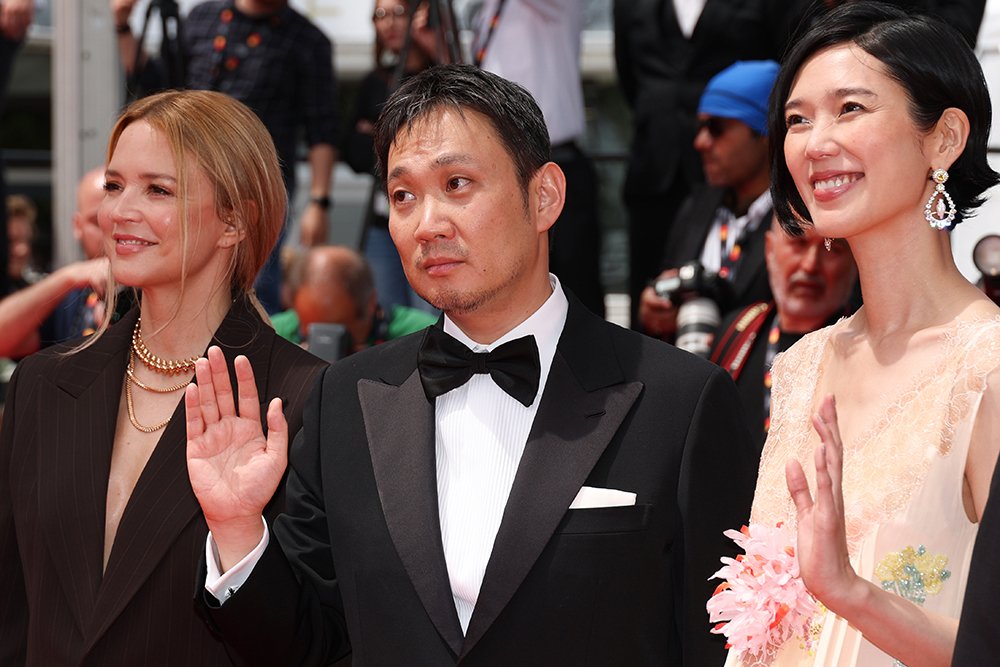
Hamaguchi Ryusuke watched the standing ovation after the Cannes premiere of “All of a Sudden” with a degree of caution. He is not, he says, someone who takes ovations entirely at face value.
“I also know that a standing ovation is kind of a tradition here,” he tells Variety. “I don’t know how seriously I’m supposed to take it.” But then he looked at the faces. “I felt very much that the film was being accepted by the people.” What settled it for him wasn’t the applause but what he saw in his leads: Virginie Efira and Okamoto Tao, both of them visibly moved. “They looked like they had just accomplished something really important,” he says. “To be able to see their expressions and to be with them gave me a lot of happiness.”
Reviewing the film for Variety, Jessica Kiang wrote: “The Japanese director’s gorgeous new feature is the rarest type of film, not merely good enough to remind you what cinema can be, but great enough to remind you what life can be.”
The ovation came at the end of a competition premiere that moved many in the audience to tears. It was a reception proportional to the ambition of the project, which took Hamaguchi five years to crack and required him to work in a country whose language he doesn’t speak, with actors performing in languages not their own, adapting a book that – by his own account – contained not a single visual element.
“All of a Sudden,” which competes for the Palme d’Or, is loosely drawn from a real correspondence published as “You and I – The Illness Suddenly Get Worse,” letters exchanged between the philosopher Miyano Makiko, who was dying of cancer, and the medical anthropologist Isono Maho. In the film, Efira plays the director of a Parisian nursing home and Okamoto a terminally ill Japanese theater director whose arrival there draws the two women into an increasingly intimate reckoning with mortality. The co-production between Japan and France is Hamaguchi’s first film set primarily outside Japan, and his first in the French language.
The source material had been on his mind for longer than the project itself. When developing “Wheel of Fortune and Fantasy,” he had read “The Problem of Contingency” by the early-20th-century Japanese philosopher Shuzo Kuki – a dense work he describes as “genuinely difficult to understand.” Miyano, a philosopher whose own research focused on coincidence, writes about that same Kuki text in her letters. Encountering her reading of it, Hamaguchi felt an immediate affinity. “I felt a certain closeness to what I was doing,” he says. But the connection that ultimately compelled him was less intellectual than physical. “When I read those words, my body shook,” he says. “I felt that if I could pass that feeling on to the audience, I would be passing on something that is actually very important.”
What stopped him from moving quickly was the obvious problem: there was nothing to film. The letters are abstract, philosophical, emotional – and resolutely non-visual. Hamaguchi spent time with Isono, conducting a long interview. He spoke with Miyano’s family and friends to understand who she had been. And then he realized that none of it was what he wanted to make. “What I was moved by was what was in the book itself,” he says. He also had a more practical concern. Fictionalizing real people, he explains, inevitably simplifies them. “I didn’t want the audience’s curiosity to bleed into the private lives of Isono or Miyano’s family.” A genuine leap into fiction was the only option. He just didn’t know what shape it would take.
The answer arrived about two years in, when the French production company Cinefrance approached him about shooting in France. “Something clicked,” he says. He thought of Eric Rohmer – specifically “My Night at Maud’s” – and of the appetite French audiences have for philosophical conversation as entertainment. “I felt that even if the dialogue was very abstract, there was a possibility that this could work as a film,” he says. He brought the project to his Japanese producer, Hiroko Matsuda, asked her to connect with Cinefrance, and the co-production was set.
With the Franco-Japanese frame in place, he needed a structural bridge between the two countries. He found it in Humanitude – a care philosophy developed in France roughly 40 years ago and introduced in Japan about a decade ago, built around the principle of attending to patients, particularly those with dementia, as fully human beings. “It’s not simply a method for dementia care,” Hamaguchi says. “I felt it had clues about how to treat other people as human beings. And I felt it connected with my own work.” The film is set partly in a Humanitude facility, and the methodology gives the relationship between Efira’s and Okamoto’s characters both its occasion and its ethical ground.
The casting decision that followed was the film’s most audacious. Efira and Okamoto would each spend parts of the film speaking in the other woman’s language – not fluently, but intelligibly enough to perform. Hamaguchi structured an extended preparation period built around repeated readings of a bilingual script, Japanese alongside French, so that the words and their emotional weight could sink into each actor’s body before production began. “They had to really see each other and really listen,” he says. “Not just to the meaning of the words, but to what was happening physically in the other person.” He argues that the multilingual setup made a specific kind of attentiveness not just possible but necessary. “That heightened attention – I felt the situation allowed for it to happen naturally.” He pauses. “Honestly, working with them re-confirmed to me how amazing actors are.”
The French set culture also offered something Hamaguchi had not encountered in Japan. At home, he explains, tight budgets and schedules create a filmmaking environment organized around contingency: plan A, plan B, plan C, each requiring preparation that can itself become exhausting. In France he found the opposite orientation. “There’s a freedom to do what you feel is right in that moment, and it was shared across the whole crew,” he says. “In Japan that is not usually the case.” Because he arrived with the preparation habits of a Japanese filmmaker, the combination turned out to suit the material. “I brought a lot of preparation to a place that also allows for freedom,” he says. “I felt the result was really good.”
What he is thinking about next is deliberately smaller in scale. After a production that required years of buildup and a cross-continental shoot, he wants to return to something compact – short films, he says, in the spirit of “Wheel of Fortune and Fantasy,” which was itself a triptych. “Whenever I gain something through making a film, I need to confirm what was working in a much smaller scope,” he says. “Small experiments.” He does not yet know what they will be about.
“All of a Sudden” opens in Japan on June 19 and in France on Aug. 12. North American rights are held by Neon.
Leave a Reply