There is nothing like winning to draw in more donors, but Democrats’ historic wipeout of Donald Trump and Republicans could be a boost to the national party committee.
Earlier in the cycle, the Democratic National Committee under chairman Ken Martin was in the headlines for the drama over the release of the uncompleted autopsy of 2024, not to mention being out-raised by its Republican counterpart and having more cash on hand.
With Democrats again on the ascent and looking to 2028, that could give a boost to party committee investments, which is particularly important to the presidential race, while DNC Vice Chair Jane Kleeb points to victories in places such as Kansas and Texas as affirmation to the party’s 50-state strategy, the latter of which has been a source of some debate as to its ultimate effectiveness.
“We knew that with people being so frustrated and disgusted by the actions of Donald Trump, with the gas and grocery prices, the Iran War, kids being ripped out of their parents’ arms through ICE, that voters were ready for change,” Kleeb said. “And if we did not have that infrastructure in place for the last two years, I don’t think we would have seen these historic wins. But because we literally were organizing everywhere, we were able to win in places like Kansas and Iowa.”
RELATED: Trump Celebrity Supporters: Famous Folks In Favor Of The 47th President
That aside, the losses in 2024 generated a hangover in the entertainment industry, which for much of the midterm cycle appeared to have dampened involvement from high-level donors.
Kleeb talked to Deadline about the midterm rout, winning back donor trust and why the 2028 primary shouldn’t be about progressive vs. moderate.
DEADLINE: Do you think that these victories will help bring in more donors to invest in those areas that Democrats haven’t haven’t been competitive in quite a while?
KLEEB: We now have modern-day proof and examples of what happens when you invest in year round organizing and when you invest in the infrastructure that already exists at the state level, which is the state parties, you don’t have to create all these independent expenditures and new groups. You then have to fund staff and offices. We already have all that. And the last time that we really were able to show donors this was the transition from 2004 to 2006, when Howard Dean ran a similar model for those two years, and then we had that historic win that gave us then Speaker [Nancy] Pelosi. But now we have a modern example. And I think we are able to go to donors saying we get that the old model was only focused on battleground states, and that you know consultants told you all, ‘Don’t give money to those other states because you’re never going to win.’ We now can show them that that is absolutely false. That there’s always races to win, even in the reddest of states like North Dakota.
RELATED: Amid The Blue Tsunami, A Night Of Many Firsts In Midterm Elections
DEADLINE: Do you think Texas is going to be a battleground in the next presidential race?
KLEEB: No question. Texas is now a battleground state, and Florida will be seen as a battleground state. While we didn’t win statewide in Florida, we came close. And the message coming from the Floridians is if we had more investment in our candidates, we could have definitely picked up at least the governor’s race. But Texas has been working for this, as you know, for two decades. And Beto [O’Rourke] and Stacey Abrams in Georgia — if you use both of them as examples — they laid the groundwork. They registered more voters. They helped build party infrastructure, and then people kept on building that infrastructure in order to get us the wins that we saw last night.
DEADLINE: Did [the margins] surprise you? There weren’t a lot of prognosticators out there saying potentially 55 Senate seats.
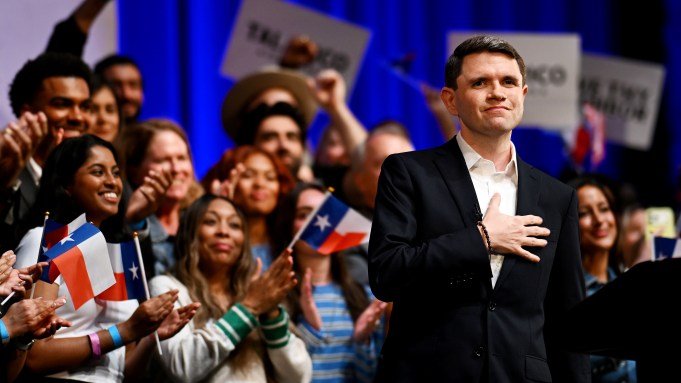
KLEEB: I think this just really goes to show the ground game that the Democratic Party had and the quality of candidates. We didn’t recruit kind of these in a lab, poll-tested, wearing-a-suit-and-tie, candidates. We had candidates that are nurses, veterans, moms, young people like [James] Talarico. You know, we just had people who really looked and sounded different. And so, when these hot-button issues came up — whether it was data centers or reproductive rights or transgender cultural divide that Republicans used on us last cycle that Democrats couldn’t quite find an answer for — because these candidates were from real life and had, you know, backgrounds that matched voters, they were able to communicate with voters in a way that I think we haven’t been able to as Democrats in awhile, and that made a huge difference this cycle.
DEADLINE: Within the entertainment community quite a bit, and there’s still donor fatigue from 2024. How do you get them back?
KLEEB: I think it’s a lot of conversation. It’s a lot of, “We understand why you may think investing in all 57 state parties is not a smart investment, that you’re smarter to concentrate resources into ‘battleground states.’” But we can walk them through on how that model is broken and how that model is so short-sighted, that when you have opportunities like we did this year and that I absolutely think we’re going to have again in ’28, that’s when you’re able to win elections in places that nobody ever thought you’d be able to. But it’s also having some accountability. And when we talk with big donors that are donating to the state party association or to the DNC, they want to know that we are reviewing state parties, that they have goals that they’re accountable to. And so we’ve been walking donors through that, which I don’t think we’ve really done before. So we’re walking donors through the … strengths, weaknesses, opportunities, threat analysis of each state party. We send a team on the ground for four days. We review everything from top to bottom. We have state parties that are required to do now a four-year strategic plan, which state parties have never been required to do. And so there also is some accountability that I think we’re telling major donors. A lot of major donors who come from the business world, they have accountability measures, and we’re putting those accountability measures in place too.
RELATED: Will The Congressional Blue Tsunami Help Or Hurt The Plan To Save Hollywood?
DEADLINE: You talked about the investments being made? How much of a challenge though was it this cycle? I kept seeing numbers showing how much the RNC had raised versus the DNC, and the DNC was far behind.
KLEEB: It was one of the most frustrating things for us last year and this year, when a lot of the podcasts and kind of media was focusing on cash on hand that the DNC had versus the RNC. One, I always want more money, right? So we definitely want to be raising more money. But there were donors who sat on the sidelines: One, because they got they felt stung and disappointed from ’24, and two, they didn’t believe in the model that Chair Martin and myself and many other officers of the DNC were deploying, this 57 state-party strategy. They didn’t believe in that. They believed that we needed to use the Obama model of battleground states, relying on a lot of outside groups. … We were breaking that, and that meant kind of groups that they might have been comfortable with, or consultants that weren’t now getting you know hundreds of thousands, million-dollar contracts — all of that went away with this new model that we were putting in place, and it definitely caused a lot of controversy. And that meant bad press stories, but we felt it was really important because we knew and saw what happened in from 2004 to 2006. We knew the model would work. … Sometimes it’s not about the cash you have on hand. Sometimes it’s about the infrastructure that you’re building closest to the voters, which is at the state party level.
DEADLINE: What do you think the results say of the direction of the party?
KLEEB: For us, we’re done with the progressive vs. moderate. That played out, obviously, with Secretary [Hilary] Clinton and Bernie Sanders and divided our party for many years. What you’re seeing now is Democrats want fighters. They don’t care if you’re a conservative, a moderate, a progressive or identify as a Democratic socialist like folks like [New York Mayor Zohran] Mamdani. They want to know that you’re going to fight for them and that you’re going to deliver — and not just deliver big policy wins but deliver on everyday items. So if you’re a mayor cleaning the streets and making sure snow is removed, if you’re in Congress making sure that we get a data center bill to keep these data centers accountable. And then the big stuff: the healthcare, the public education, the housing. Voters are looking for Democrats to actually fight for them, and they’re tired of this kind of name-calling reality TV show world that we’ve lived in for the past 10 years with Donald Trump, and that was very clear in the results.
RELATED: A Bizarre Finale For Midterms 2026: Haley Stevens Bombshell Created One Of The Cycle’s Memorable TV Moments
Leave a Reply