Jesse Marsch alleges Man City’s financial wrongdoing was widely known in the Premier League, and relegation must follow.
Published On 4 Oct 20264 Oct 2026
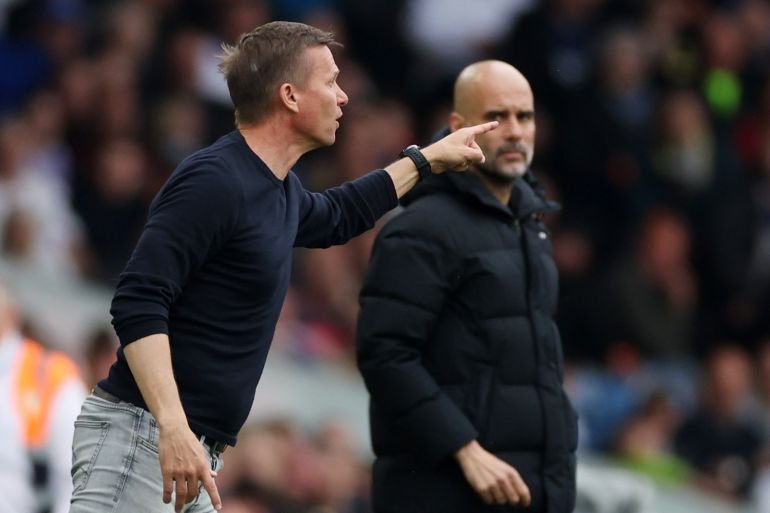
Canada coach Jesse Marsch has called for Manchester City to be punished severely over breaches of Premier League financial rules, saying his experience managing against the club left him convinced there were inconsistencies in the way it operated.
City were found guilty of serious breaches of the Premier League’s financial rules over nine seasons from 2009-10 to 2017-18, with the league alleging the club used “sham” commercial contracts to inflate revenue and understate costs by more than 900 million pounds ($1.19bn).
Recommended Stories
list of 3 itemsend of list
The club has denied wrongdoing, saying the verdict contained material errors of law, principle and fact, and filed an appeal on Thursday against the independent commission’s ruling.
Marsch, who managed Leeds United from 2022 to 2023, said the disparity between the clubs had been apparent to him during his time in England.
“I think Man City should be punished severely. I think they should have to go down, and by the way, everyone knew about it. Everyone knew,” Marsch told The Guardian in an interview published on Sunday.
Marsch also pointed to the 2022 summer transfer window, when Leeds sold Raphinha to Barcelona and Kalvin Phillips to City, while both clubs reported making money.
“That summer [2022], us and Man City were the only teams that said we made money,” he said.
“For us, we did make money, because we sold Raphinha, we sold Kalvin Phillips. We had a lot left over from what we bought.
“At the time, we weren’t in a position financially to not save. Our ownership didn’t have deep pockets. Whereas when Man City says this, I was literally like, ‘Are you kidding me? Is this some kind of joke?’”
The American coach was also sceptical about City’s signing of Erling Haaland from Borussia Dortmund that summer.
“When they said they got Erling Haaland for 52 million pounds ($69m), it’s like, ‘Yeah, OK, sure!’ So, I knew there were inconsistencies in it, but what can you do? You just put your arms in the air and go, ‘This is football’,” Marsch said.
City’s appeal will be heard privately by an independent three-member board, with the club fully denying all charges.
Potential sanctions include fines, points deductions and other sporting penalties, with relegation or the removal of titles also discussed as possible outcomes. It remains unclear whether any sanctions would be imposed before the appeal is decided.
As the midterms approach, Nexstar’s The Hill is adding Decision Desk HQ to its Insider premium membership package.
The addition will allow users to access all of the Decision Desk HQ data and election tools used by the newsroom, including local races, vote tracking and live predictions. Nexstar’s NewsNation also partners with Decision Desk HQ, including for its election night data and projections. The access will be included through the end of 2026.
The Hill’s Insider subscription service launched in July.
Bill Sammon, senior vice president of Washington, D.C. editorial content for The Hill and NewsNation, said in a statement, “This new feature will give subscribers an opportunity to dive deeper into the polls, local races and probability models they care about most. We hope they’ll enjoy exploring the data and channeling their inner political nerd along the way.” Decision Desk HQ’s Scott Tranter said the partnership “allows us to put the same powerful tools used by news and election professionals in the hands of users leading up to Election Day, enabling them to customize their own election night experience.”
Experts have warned over the past decade of a resurgence in white supremacy in the United States, fuelled in part by the mainstream influence of political figures like President Donald Trump.
Just this year, the Public Religion Research Institute released the results of a 2025 survey that asked more than 20,000 US adults to evaluate the statement, “Immigrants are invading our country and replacing our cultural and ethnic background.”
Recommended Stories
list of 3 itemsend of list
That belief is the cornerstone of the great replacement theory, a conspiracy that falsely claims that immigrants, Jews and nonwhite groups seek to supplant white people in Western countries.
The research institute found that 32 percent of respondents – nearly one in three – nevertheless agreed with the idea.
Critics have accused right-wing leaders like Trump of normalising such views, through rhetoric that paints immigration as an “invasion” and “an assault on Western countries”.
Trump has also been accused of cosying up to white nationalists, even dining in 2022 with Holocaust denier Nick Fuentes, a key figure in the movement. When white nationalists engaged in a deadly clash with protesters in Charlottesville, Virginia, in 2017, Trump said there were “fine people on both sides”.
Al Jazeera correspondent Phil Lavelle travelled to Boone County, Arkansas, to see whether one of the most infamous white supremacist organisations in US history had seen a bump in its influence midway through Trump’s second term.
He spoke to Thomas Robb, the head of what was formerly known as the Knights of the Ku Klux Klan, a white supremacist group founded in the 1970s by David Duke.
What Lavelle found was a group seemingly eager to rebrand. The group had shortened its title to The Knights Party, and members told Lavelle they were trying to re-centre their message around family and faith.
But when Lavelle asked if a Black person would be welcome at the group’s church, Robb’s answer was simple.
“No,” Robb responded. “Because this is a white nationalist church.”
The Ku Klux Klan (KKK) has a long history of racism and violence in the US. The movement began at the end of the civil war in 1865, as a response to government efforts to expand civil rights to Black people and other minority groups.
Through lynchings and other targeted acts of violence, the KKK attempted to block non-white participation in government and maintain racial divides.
Robb, a Christian pastor, took over as the head of the Knights of the Ku Klux Klan – a faction of the KKK – in 1989. He has since attempted to broaden the group’s appeal.
He changed his title from “grand wizard” to “national director”, allowed new members to participate confidentially by mail, and distanced himself from KKK violence in public outreach campaigns.
Still, he has adhered to the racist philosophy his organisation is known for.
“What do you make of politicians like Zohran Mamdani or Abdul El-Sayed?” Lavelle asked Robb in his interview, referencing two high-profile US politicians who identify as Muslim.
“Well, first off, they’re not Americans,” Robb said. When Lavelle pointed out that El-Sayed was born in Michigan, Robb brushed off the contradiction. “I don’t care where he’s born. He’s not American.”
He proceeded to draw a distinction between the children of white and non-white immigrants. Only the children of white foreigners can be American, Robb said, “because they’re white”.
The Knights of the Ku Klux Klan is one of dozens of white supremacy organisations operating in the US.
The Southern Poverty Law Center, an advocacy group, estimates that there are at least 152 such groups active in the US today, part of what it calls a rising trend over the last decade.
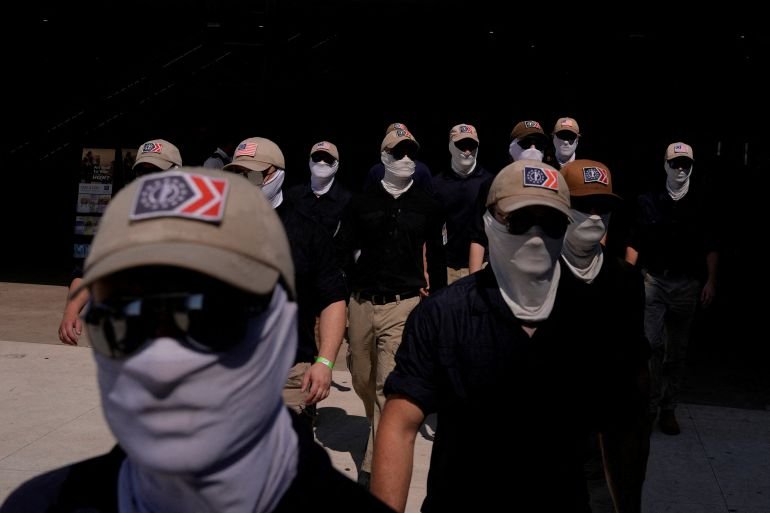
Just this year, another white supremacist organisation, the Patriot Front, marched through Washington, DC, during the Independence Day holiday.
Critics say Trump, at times, has echoed their rhetoric. Trump told The New York Times earlier this year that “white people were very badly treated” in fields like academics.
He also instructed his second administration to dismantle diversity initiatives, and under his leadership, the government has launched probes into whether universities and companies like Nike discriminate against white people.
In addition, Trump has given priority to white South Africans in refugee admissions, falsely claiming they are the subject of a “genocide”.
Robb claimed the current rise in white nationalist sentiment began well before Trump, in 2008, during the election of Barack Obama, the country’s first Black president.
“People are beginning to stir and being angered by what they see happening to the country,” said Robb. “So we’re kind of a voice for that.”
Still, Robb acknowledged public wariness of joining a white supremacist group like his. “As for people actually to become members, that’s kind of a line they [are] a little hesitant to cross sometimes,” he said.
He also declined when asked to provide membership numbers or provide evidence for his assertion that support for his movement “is growing”.
The announcement Monday ends, for now, speculation about who will run the network, given that Skydance also is the parent of CBS News.
Thompson, who joined CNN in 2023, will have a slightly different title, this time as chairman and editor in chief, after he was brought in as chairman and CEO of the news organization by Warner Bros. Discovery. Since then, he has tried to more fully integrate the linear and digital newsrooms, while launching the network’s latest venture into subscription streaming, All Access. Unlike previous efforts, All Access offers nearly identical streams of the linear network lineup.
His continuation at the network is likely a relief to staffers, with months of anxieties that the network would combine with CBS News. Skydance CEO David Ellison’s father, Larry Ellison, is a major financier of the company’s acquisition of Warner Bros. Discovery, and there have additional worries that his close ties to Donald Trump would influence CNN coverage or would mean future changes. Makan Delrahim, the chief legal officer of Skydance, said at a Politico conference in August that when it came to CNN, Ellison “wanted to bring it back to news,” raising more questions about plans for the network.
But as part of its settlement of an antitrust lawsuit brought by state attorneys general, Skydance-Paramount agreed to set up an editorial independence board to oversee CNN and CBS News.
There also had been speculation that Bari Weiss, who serves as editor in chief of CBS News, would be given additional oversight over CNN. There was no announcement made about an additional role for Weiss when Skydance revealed its senior executive structure Monday. Skydance-Paramount acquired Weiss’ center-right site The Free Press when she joined the network, and she has remained as editor of that outlet as well.
“I have real confidence that they both understand and will fully support the principle and practice of the kind of independent news that CNN has always stood for,” Thompson said of the company’s new owners in a memo to staffers. “That’s why I will be leading CNN into this new chapter as it becomes one of Skydance’s suite of major media assets and global brands, and leading it as an independent Editor-in-Chief with the same responsibilities and prerogatives that I have now.”
Thompson previously was CEO of The New York Times Co. and director general of the BBC. He had already indicated that he wanted to stay at CNN after the merger closed, scheduled for Tuesday, and last week sources confirmed that Ellison was in talks with him to remain.
Thompson wrote in his memo, “I really do believe we’ll be working alongside a team who don’t just have real vision and real energy, but real values as well.”
He also addressed the anxieties about the network’s future, writing that “I know many of you have had trepidations about this moment. That’s understandable – indeed, as I’ve hinted before, I’ve had the odd moment or two myself!”
What’s still unclear is whether CNN will be in for a round of cost-cutting and perhaps layoffs following the merger’s close, as was the case with CBS News after Skydance acquired Paramount last year.
Thompson wrote to staffers, “The specifics of how CNN will plug into and operate in the new company have yet to be finalized – hardly surprising given that serious discussions could only begin after Paramount’s anti-trust settlement a few days ago.”
Read Thompson’s memo in full below.
Dear All,
As you know, Paramount Skydance will close its deal to buy Warner Bros. Discovery tomorrow, and CNN will have new owners. Later today, the company is announcing the anticipated leadership lineup of the company which is now called Skydance. You’ll see my name on the list as Chairman and Editor-in-Chief of CNN. I’m writing to you now to explain what that means.
The specifics of how CNN will plug into and operate in the new company have yet to be finalized – hardly surprising given that serious discussions could only begin after Paramount’s anti-trust settlement a few days ago. So I can’t answer every question today. Nonetheless there are a few important things I can say:
First, I’m convinced that from David Ellison on down, Paramount Skydance leadership really does believe in news alongside entertainment as a top strategic opportunity for our new company. They’ve seen our digital strategy and are as excited about it as we are.
And second, having now spoken to them at length on the topic, I have real confidence that they both understand and will fully support the principle and practice of the kind of independent news that CNN has always stood for. That’s why I will be leading CNN into this new chapter as it becomes one of Skydance’s suite of major media assets and global brands, and leading it as an independent Editor-in-Chief with the same responsibilities and prerogatives that I have now.
I know many of you have had trepidations about this moment. That’s understandable – indeed, as I’ve hinted before, I’ve had the odd moment or two myself! But I want to say that on the eve of the acquisition of CNN by Paramount Skydance, I find myself in a very positive frame of mind. I really do believe we’ll be working alongside a team who don’t just have real vision and real energy, but real values as well. We’ll make sure that everyone gets details of how to watch the actual launch of the company tomorrow.
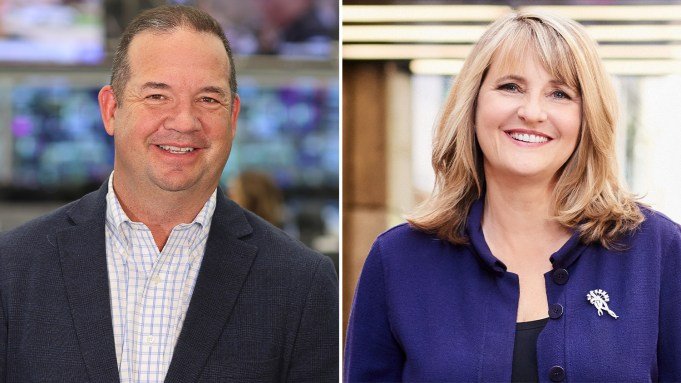
Staab disclosed her plans to retire earlier this year, and will work with Wayland in the coming weeks, with the transition before the end of the year, according to Cesar Conde, chairman of NBCU News Group.
In addition to 11 NBC stations and 31 Telemundo stations, NBCU Local also includes four regional sports networks, three national multicast networks and 17 streaming channels, along with LXTV Productions and Skycastle.
Wayland joined NBCU in 2019, and has led NBC10 Boston, Telemundo Boston and NBC Sports Boston. Conde wrote in a memo to staffers that Wayland “has been instrumental in the growth of NBC10 and was a key leader in the development and launch of the NBCUniversal Boston Media Center.”
“Chris understands the power and importance of local media, and I know he will be an outstanding leader for NBCUniversal Local,” Conde wrote.
Staab has been with NBCU for more than 15 years and has spent 46 years in local TV and journalism.
“Under her leadership, what began as 10 NBC-owned stations grew into NBCUniversal Local’s nationwide, multiplatform portfolio of 50 media properties,” Conde wrote.
“Her impact can be seen not only in the organization she helped build, but in the generations of broadcasters and leaders she has supported and developed along the way,” he wrote.
In a statement, Staab said, “What gives me the greatest confidence is knowing that Chris leads with both vision and heart. He values our people, our culture, and the relationships that have been foundational to our success.”
Wayland previously was an executive at Tribune Media, Sinbeam Television and WHDH-TV.
On the surface, Nick Cholmsky looked like a thriving teenager.
Growing up in Ottawa, he says he was athletic and heavily involved in basketball, had friends and a close relationship with his family.
But underneath all that he says he was deeply depressed. The symptoms began in middle school and became much worse by Grade 11.
At 16, he had begun entertaining suicidal thoughts.
Nick Cholmsky, who grew up in Ottawa, experienced depression as a teen. He says online messaging encourages boys and men to stay silent about their psychological struggles. (CBC)
Even as his depression and anxiety grew stronger, Cholmsky believed he couldn’t say anything, because “being a man” meant pushing negative thoughts down, and that any sign of weakness would cause him shame.
“Looking back, so much of that [congenial attitude] was for sure just a performance, me acting the way I thought I was supposed to act as a man,” said Cholmsky, now 21.
There’s a common problem everywhere and it’s how men and boys are feeling. And they are not feeling great.– Federal Health Minister Marjorie Michel
Earlier this year, the federal government reported on a wide range of data showing that the mental health of young men has deteriorated since 2012. Between 2012 and 2022, the number of men aged 15 to 24 who self-reported mood disorders increased from 11 per cent to 16 per cent, while self-reported generalized anxiety disorders increased from four per cent to 10 per cent.
Those who reported their mental health as “very good” or “excellent” plummeted from 70 per cent to 52 per cent in that same time period.
A separate report shows that men are three times as likely as women to commit suicide and that it’s the second-leading cause of death in boys aged 15 to 34 (after unintentional injuries).
“There’s a common problem everywhere and it’s how men and boys are feeling. And they are not feeling great,” federal Health Minister Marjorie Michel told CBC News.
“There is a lot of anxiety [about] their role as men and boys.”
Social media use, gambling major issues
Research implicates a variety of factors in men’s depression, most prominently social isolation, social media use and online sports betting.
Data from the Canadian Medical Association Journal shows a huge rise in young men calling helplines with gambling addictions. (Health Canada reports men are three times more likely than women to have a gambling problem.)
Canada legalized single-event sports betting in 2021. In 2022, Ontario became the first province to allow private companies to operate alongside government-regulated industry.
A separate report released this month by the Institute for Clinical Evaluation Sciences (ICES) showed that since 2022, emergency room visits for gambling disorders had doubled — largely with young men showing up in a psychological crisis, such as suicidal ideation or psychosis, as a result of gambling losses.
“The gambling stats didn’t surprise me at all when I heard them,” said Cholmsky. “I saw kids in middle school gambling.”
WATCH | Investor and podcast Scott Galloway on male potential:
Scott Galloway on male potential
U.S. investor and podcaster Scott Galloway talks to CBC News about the impacts of the manosphere and the loss of ‘off-ramps to the middle class,’ and how young men are being impacted.
Whether the stress is the result of gambling or something else, Cholmsky says online messaging encourages boys and men to stay silent.
“When I was going through some of my worst mental health times, I was online a lot and it was really the height of Andrew Tate,” Cholmsky said.
The U.S.-born Tate is one of the best-known influencers in the manosphere, famous for espousing strict rules for being an alpha male, such as maximizing fitness, maintaining control over relationships and emotions and making as much money as possible.
He retains a large following despite being in U.S. detention on multiple criminal charges, including sex trafficking.
“[Tate’s] message, and a lot of that manosphere messaging for boys, is ‘be a man, be tough, make lots of money,’” Cholmsky said.
There are also trends like “looksmaxxing.” Influencer Braden Peters, also known as Clavicular, has amassed a huge following telling young boys sometimes to smash their own faces with hammers to be more conventionally beautiful. His content has more than 40 million likes. Peters was charged with rape last month.
Experts warn dangerous role models like this can have real-world impacts.
“The manosphere is radicalizing young boys who don’t know where they fit — and that should concern us all,” said John Oliffe, Canada research chair in men’s health promotion at the University of British Columbia.
Oliffe says this was “amplified” by the earliest parts of the COVID-19 pandemic when global lockdowns increased isolation and the loss of social connection. Vulnerable teenagers often found themselves lost online.
“There continues to be a whole world of pain in some of that unregulated content,” Oliffe said.
John Oliffe, Canada research chair in men’s health promotion at the University of British Columbia, says the radicalizing effects of the manosphere should worry us all. (Nav Rahi/CBC)
Adam Kunder, a 33-year-old former firefighter who lives in Toronto, says he also felt he needed to keep his problems quiet. He suffered mental health issues and hit “rock bottom” before beginning to find help in the summer of 2024.
“As a man, you think you are supposed to be strong, push any bad feelings down, suppress depression or sadness or fear,” he said.
Kunder says he has lost multiple friends to suicide and says you never would have known they were suffering.
Gender roles and ‘toxic masculinity’
Kunder said the world is changing in ways that are becoming confusing for many men.
The emphasis on women’s parity in the labour force and society, as well as a greater acceptance of non-traditional gender identities, has upended expectations.
“At one point we knew we were supposed to be the provider and protector, and the idea of ‘toxic masculinity’ wasn’t a thing,” he said.“I think men are really trying to figure out what it means to be a man in today’s world.”
WATCH | Why manosphere influencers appeal to young men:
Why ‘manosphere’ influencers are appealing to young men
Critic Amil Niazi joins Commotion with Elamin Abdelmahmoud to discuss Louis Theroux: Inside the Manosphere, a documentary about the online world of toxic masculinity, and examine the rising popularity of “manosphere” influencers among young men.
Oliffe pointed to other troubling patterns for young men.
“There are increasing lower rates of boys heading to universities, and very serious challenges in male-dominated industries such as construction, that as a society, we should not ignore.”
Oliffe said that while the trades offer good careers, they often see high rates of substance use and mental health issues, as the necessary physical labour and harsh working environments can “heighten these risks.”
Oliffe said that in the last decade, there has been “low government investment in men’s mental health.”
“I think the theme of silence is a very regrettable period in history, where on one side we talked about equity and inclusion, and then in effect ostracized 50 per cent of the population,” Oliffe said.
Health Minister Michel said that when she brought this issue to the federal cabinet, she was met with some resistance. Some colleagues told her it took “courage” to broach the mental health of boys and men, given it could even be politically risky to talk publicly about the issue.
“I said ‘courage’? This is not courage. We are ministers of health, it is our job to take care of the entire population,” she said.
“Men don’t know how to ask for help. And when they are struggling, they don’t know how to express it.”
Government strategy to come by early 2027
The federal government will soon launch its first-ever mental health strategy for boys and men.
The agency told CBC that some of what they hope to invest in will be “mentorship, peer support, sport and recreation,” while “promoting healthy relationships, positive social norms and safer online environments.”
Toronto resident Adam Kunder says he feels it’s his duty ‘to show up for men who are suffering and to hear them out and just let them know it’s all OK.’ (CBC)
For Robert Whitley, a men’s health expert and professor of psychiatry at McGill University in Montreal, part of the problem is the way society now views masculinity.
“Traditional masculinity has been denigrated in the popular mind whether it’s through the media, through influencers, through commentators,” he said. “The problem sometimes is a lack of masculinity.”
He says there’s a need for positive male role models.
“I’ve said many times before, it’s not a crisis of masculinity, there’s a crisis of mentorship,” said Whitley.
For example, data from Statistics Canada shows only 25 per cent of teachers across elementary and high school systems in Canada are men. And at the organizations that step in to fill the mentorship gap — like the Big Brothers and Big Sisters of Canada — 70 per cent of volunteers are women.
“We’re getting young men who are getting to the age of 18, 19, 20, who have never had a male role model in their lives,” Whitley said.
Kunder and Cholmsky both say their mental health began to recover after they started asking for help, and they’re now working to be role models for other young men.
“I feel like it’s my duty in a way to show up for men who are suffering and to hear them out and just let them know it’s all OK,” said Kunder, who coaches and works with other men.
Last month in Ottawa, Cholmsky was awarded top 21 under 21 for his work in mental health advocacy and challenging “harmful stereotypes around masculinity and mental health.”
“We all need to be doing our part to talk about this stuff,” he said.
Iran’s Foreign Ministry says reopening the strait has been its main goal, while the US continues to focus on nuclear talks.
Published On 4 Oct 20264 Oct 2026
The Strait of Hormuz is going to remain closed until the United States accepts Tehran’s seven-day plan to reopen the waterway, Iran’s top negotiator and parliament speaker has said.
Iranian state-linked news agency Nournews, quoting Mohammad Bagher Ghalibaf, reported on Sunday that Washington made “some proposals through a mediator” days after the US replied to Iran’s diplomatic proposal.
Recommended Stories
list of 4 itemsend of list
The US should know “that the era of wasting time and dictating unilateral demands is over”, Ghalibaf said, adding Iran’s position remains “clear and definite”.
He emphasised that “the Strait of Hormuz will not open until our seven conditions based on the Islamabad memorandum are met”, and that Iran is “present on the military battlefield and will confront them with new surprises”.
He added that Iran was neither “excited” nor “intimidated” by the latest US proposals and would “both fight and negotiate”.
US President Donald Trump ruled out an Iranian proposal to reopen the Strait of Hormuz last week, hours after Iran put forward a roadmap to reopening the strait, through which one-fifth of global oil and natural gas is shipped during peacetime.
Last month, Trump threatened to “annihilate” Iran in his speech on the floor of the United Nations General Assembly (UNGA).
On Sunday, Iranian Foreign Minister Abbas Araghchi also said Iran is “serious about finding diplomatic solutions just as we are serious about defending ourselves”.
Speaking to foreign ambassadors and diplomats in Tehran, Araghchi said Iran had clearly explained its conditions for reopening the strait and that Tehran hoped Washington would choose diplomacy and accept its proposal.
However, Araghchi warned that if the US takes military action again, Iran is “more prepared than before and will take whatever action is necessary to defend ourselves”.
Iranian Ministry of Foreign Affairs spokesman Esmaeil Baghaei added that Tehran used the UNGA platform last month to provide world leaders with its position on ending the US-Israel war on Iran.
He said the US has continued to focus on nuclear talks, while reopening the strait has been Iran’s main goal.
“We are at this stage mainly focusing on the strait, and our principal concern is to reach a solution and to have peace and stability restored within this waterway,” Baghaei said.
The Strait of Hormuz has been largely blocked and disrupted for more than seven months, since the US and Israel launched strikes on Iran on February 28, driving one of the worst maritime shipping disruptions in decades.
About one-fifth of global oil and natural gas is shipped through the Strait of Hormuz during peacetime, as the US-Israel war on Iran has created several trade chokepoints [File: Al Jazeera]
Sullivan’s goal beat fellow teenager Julian Hall’s record for United States which was only set against Chile on Tuesday.
Published On 4 Oct 20264 Oct 2026
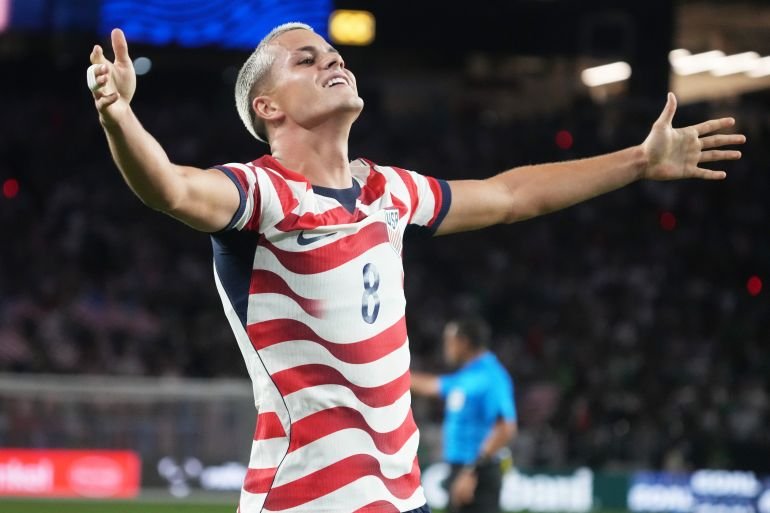
Cavan Sullivan became the youngest US international goalscorer in history as the United States defeated archrivals Mexico 3-0 in a friendly international in Arizona on Saturday.
Sullivan, who is poised to join English Premier League side Manchester City next year, netted a superbly taken goal in the 62nd minute to double the USA lead at the State Farm Stadium in Glendale.
Recommended Stories
list of 4 itemsend of list
At 17 years and five days, Sullivan beat Mathis Albert’s five-day-old record as the youngest US goalscorer.
Albert, aged 17 and 31 days, scored during Tuesday’s 4-2 defeat of Chile.
“These are the moments you dream of when you’re three, four, five or six-years-old,” Sullivan said.
“I manifested this moment, not just these past couple of hours when I found out I was starting, but my whole life,” he added.
Sullivan’s strike came after another teenager — 18-year-old Julian Hall — had given Mauricio Pochettino’s side the lead in the 28th minute.
Hall’s goal was his third in as many games since being handed his international debut by US coach Pochettino in last week’s defeat of Peru. Hall also scored in the victory over Chile.
The loss puts more pressure on Mexico coach Rafael Marquez, who is still seeking his first win since taking over following the World Cup.
Mexico dominated possession and territory early on but were unable to find a way through a well-organised United States defence.
Instead, it was the hosts who took the lead just before the half-hour mark with a superbly worked goal from Hall.
Gio Reyna surged into the penalty area to collect a pass from Alex Freeman and ghosted past Mexico midfielder Erik Lira to reach the byline.
Reyna’s low cross was parried away by Mexico goalkeeper Raul Rangel, but only as far as Hall, who lashed in from close range to make it 1-0.
Mexico’s best chance came early in the second half when Roberto Alvarado’s rasping shot from the edge of the area was tipped over the bar by US goalkeeper Diego Kochen.
Pochettino’s side doubled their lead on 62 minutes when Sullivan’s persistence in chasing down a long ball was rewarded after Rangel mishit a pass to the American outside his area.
Sullivan coolly took his time and chipped home from long range to make it 2-0.
“I just remember chipping the ball, hoping it didn’t hit the crossbar or go over,” Sullivan said of his strike. “I was getting nervous when it was in the air and then everything was a blur.”
A miserable night for Mexico got worse shortly afterwards when substitute Luis Chavez was shown a red card for shoving a hand into the face of Sebastian Berhalter in the 68th minute.
The United States completed the scoring in the 84th minute when Malik Tillman latched onto a poor Mexico backpass and smashed a shot into the top corner for 3-0.
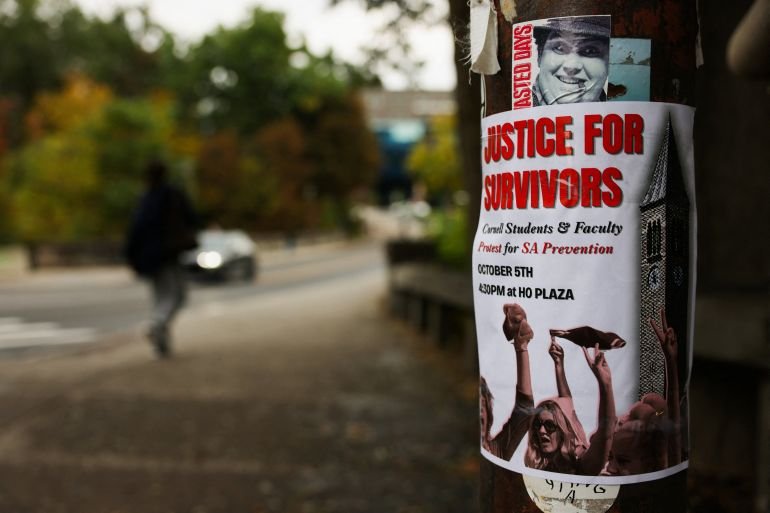
New York – Last month, a woman identified as Jane Doe filed a lawsuit against Cornell University, the fraternity Chi Phi and the seven fraternity members she accused of gang-raping her on the night of October 19, 2024.
Her allegations have triggered a nationwide reckoning in the United States over the prevalence of sexual assault on college campuses.
Recommended Stories
list of 3 itemsend of list
But the case has also reignited efforts to reform New York law.
While the left-leaning state has long presented itself as a leader in women’s rights, advocates say sexual assault survivors still face pervasive legal barriers when they seek justice.
Erica Vladimer, a lawyer and founding director of Harassment-Free New York, a survivor-led nonprofit, told Al Jazeera that much of the legislation currently in the spotlight is the culmination of years, if not decades, of work.
“These are bills that we have been fighting for for years when sexual violence is not in the news,” Vladimer said.
She drew a line between the #MeToo movement, which began in 2017 as an online campaign to denounce sexual misconduct, and the current wave of outrage following Doe’s allegations.
“It speaks to the fact that the #MeToo movement is not dead. It is a movement, not a moment,” Vladimer said.
Already, leaders in Albany, the state capital, have signalled they would take action following the Cornell case.
On Wednesday, the New York Assembly announced it had formed a working group to examine the state’s sexual-assault laws and develop recommendations for the 2027 legislative session.
Still, advocates say more concrete measures are needed to address the crisis.
“I appreciate that this work is happening,” said Lindsey Boylan, a New York City Council candidate. “It doesn’t undo the fact that rape culture is pervasive in the United States and very much so alive and well in New York.”
Boylan was the first woman to publicly accuse former New York Governor Andrew Cuomo of sexual harassment in another high-profile misconduct case, back in 2020. She is among those calling for greater reform.
Here are some of the measures advocates are pushing state lawmakers to adopt or amend:
‘Voluntary intoxication’ statute
The Cornell University case has brought renewed attention to New York’s “voluntary intoxication” statute, a legal loophole that can make it harder to prosecute sexual assault when a person has willingly consumed alcohol or drugs.
New York Governor Kathy Hochul pledged on Friday to work with lawmakers to close the gap.
“It should not matter whether they chose to use drugs or alcohol. Voluntary intoxication is not a license for sexual assault or gang rape. Period,” Hochul said.
Under the current state law, a person who voluntarily drinks or takes drugs is not considered “mentally incapacitated” during an assault, even if they become too intoxicated to consent.
That can make it harder for prosecutors to bring a sex-crime charge. The law primarily recognises incapacitation in the context of sexual assault when a person was involuntarily intoxicated, unconscious or otherwise “physically helpless”.
That distinction has become central to the Cornell case. Doe has acknowledged that she consumed substances before the alleged rape, saying that she was pressured into drinking alcohol and taking the dissociative drug ketamine.
The Tompkins County district attorney initially declined to bring charges, pointing to the law’s stance on “voluntary intoxication”. But the investigation has since been reopened, amid public pressure.
New York is one of 19 states in the US that distinguish between “voluntary” and “involuntary” intoxication when it comes to determining consent in sexual violence cases.
But the Cornell case has spurred a push to remove the distinction from the law books. Critics have argued that sexual assault is no less grievous if a victim is drunk or has chosen to take drugs.
“I mean, to have New York, a supposedly progressive state, penalise people who are sexually abused for drinking is disgusting,” Boylan told Al Jazeera.
Vladimer, for her part, explained that distinguishing between “voluntary” and “involuntary” intoxication as a means for pursuing sexual assault cases shifts the focus onto the actions of victims, rather than perpetrators.
“We essentially have codified victim-blaming by saying if you become voluntarily intoxicated and then are sexually assaulted, you essentially cannot seek justice in our court system,” Vladimer told Al Jazeera.
In June, the New York state Senate unanimously passed a bill to allow sexual assault charges regardless of whether a victim is intoxicated voluntarily or involuntarily.
But the legislation has yet to be taken up in the state Assembly.
Students look on at Cornell University’s campus in Ithaca, New York, on October 1 [Lauren Petracca/Reuters]
The rape-shield gap
New York’s rape-shield protections limit the use of evidence about a complainant’s sexual history and conduct in criminal proceedings. But those protections do not currently extend to civil cases.
This distinction could matter in the Cornell case because Doe filed a civil lawsuit.
Vladimer said questions about a survivor’s behaviour could come up in the discovery process of a civil case, as well as in court.
“There is the potential of her having to face questions about things like her sexual history,” Vladimer said.
Bridie Farrell, the director of victim rights advocacy and legislation at the law firm Weitz and Luxenberg, told Al Jazeera that she has seen major differences in how male and female survivors are questioned in civil cases where this practice is still permitted.
In one case involving a brother and sister who were both sexually assaulted, Farrell said the man was not questioned about his sexual history while the woman was “grilled on it”.
A bill sponsored by State Senator Liz Krueger would extend rape-shield protections to civil proceedings. The measure passed the Senate in June and is currently before the Assembly Judiciary Committee.
A student walks through an archway at Myron Taylor Hall on the Cornell University campus in Ithaca, New York, on October 1 [Lauren Petracca/Reuters]
Retaliatory defamation lawsuits
Advocates are also pushing for legislation to prevent retaliatory defamation lawsuits.
Boylan said she has spent more than $2m defending herself in legal proceedings connected to her accusations against Cuomo, who stepped down as New York governor in 2021.
He has repeatedly denied any allegations of wrongdoing, despite a state attorney general’s report that concluded he “engaged in conduct constituting sexual harassment”.
“Every step of the way, we have a system that penalises people for speaking up about their own harm,” Boylan said.
Boylan and Charlotte Bennett, a former aide who also accused Cuomo of sexual harassment, are proponents of the Speak Your Truth Act, which would provide legal protections for people who publicly report sexual assault, harassment or discrimination.
The bill, sponsored by Assembly member Jessica Gonzalez-Rojas, would make certain communications about sexual assault, harassment or discrimination privileged when they are made without malice.
It would also allow survivors of sexual misconduct who successfully defend themselves against a defamation lawsuit to recover legal fees and costs. The bill remains in an Assembly committee.
Cornell University and local officials in Ithaca, New York, have faced questions about how they handled the Jane Doe case [Lauren Petracca/Reuters]
A recent win, a long way to go
For Bridie Farrell, the victims’ rights advocate, the fight for legal change is personal.
Farrell was a 15-year-old competitive speed skater in 1997 when she said she was sexually abused by her 33-year-old teammate and mentor. She came forward with her story of abuse in 2013.
By then, the statute of limitations in her case had expired. Farrell later became an advocate for changes to New York’s laws, helping to pass the Child Victims Act in 2019 that extended the time available for survivors of childhood sexual abuse to pursue criminal and civil claims.
The law allowed Farrell to file her own case, which she did in 2020. She tells Al Jazeera that a trial has finally been scheduled for June 2027.
“Before we passed the Child Victims Act in 2019, New York was one of the worst in the country,” Farrell said of the situation for sexual assault survivors seeking justice.
Farrell considers the legal impediments to Doe’s case — like the “voluntary intoxication” statute — all too predictable. “I’m not surprised if we haven’t updated a law that is archaic,” she said.
Still, lawmakers have signalled willingness to reform such laws. In announcing the state Assembly’s working group on sexual-assault laws, Speaker Carl Heastie pledged to “thoughtfully” consider how the state can strengthen its laws.
“The allegations being reported out of Cornell University are truly horrifying,” Heastie said on Wednesday. “We want to do everything we can to ensure victims of sexual assault see justice served.”
But survivors and sexual violence advocates say the Cornell case points to problems that go beyond any single law. They hope to see widespread systemic and societal change.
“Changing legislation is incredibly important. But legislation in a lot of cases can only go [as far as] the paper that it’s written on,” Boylan said. “It would be amiss to orient this horrible, tragic, unacceptable, infuriating case in isolation without looking at the broader rape culture of our state and our country.”
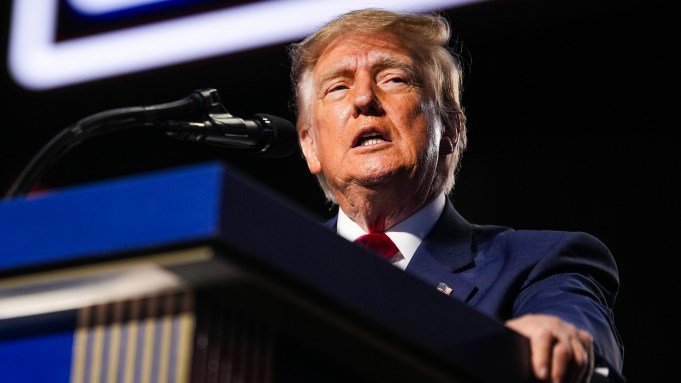
The Justice Department argued that Donald Trump can legally ban CNN, MS NOW and Politico from the White House because he determined that they didn’t meet the “minimum requirements of professionalism.”
Last month, a federal judge granted the three outlets a temporary restraining order that forced the White House to reinstate dozens of their reporters’ hard passes. The outlets are now asking the judge to extend that 14-day order for a longer term via a preliminary injunction, claiming that Trump’s ban is a violation of their First and Fifth amendment rights.
U.S. District Judge Timothy Kelly, a Trump appointee, has said that he is bound by the precedent set in In a 1977 D.C. Circuit opinion, Sherrill vs. Knight, in which the judges ruled that “the protection afforded newsgathering under the First Amendment guarantee of freedom of the press requires that this access not be denied arbitrarily or for less than compelling reasons.”
In a court filing on Friday, the DOJ claimed that the Sherrill case still would allow for the president to restrict the three outlets from accessing the White House grounds because the White House has a “compelling interest.”
The DOJ lawyers claimed that the Sherrill decision does not “prevent the President from concluding that bona fide journalists would identify sources instead of relying on anonymous sources, commit to factual accuracy, and provide the White House an opportunity to comment, rather than ‘perform their duties in a way that … interfere[s] with the White House’s daily operations.’ …At a bare minimum, it is a significant violation of decorum to publish classified and sensitive national security information.”
The news outlets’ legal team has rejected that assertion, writing in a filing earlier this week that Trump’s “statements also make clear he implemented the ban to coerce more favorable coverage from CNN, MS NOW, and Politico, and to deter other journalists and news organizations from newsgathering and reporting that the President might view as negative. And his administration has continued to retaliate against Plaintiffs even after the temporary restraining order, only underscoring that Defendants’ motive is to punish and chill journalism they dislike.”
Even as access to the White House grounds has been reinstated, the White House has continued to restrict CNN from coverage of TV pool assignments, including travel with Trump on Air Force One.
The outlets’ lawyers, led by Theodore Boutrous Jr., also noted that Trump and other White House officials “overlooked that the First Amendment protects reporting on matters affecting national security.”
Kelly has set a hearing for Thursday on the news outlets’ motion for a preliminary injunction.
In granting a TRO, Kelly concluded that the White House failed to provide due process to the news outlets.
The DOJ has pointed to letters sent to the outlets as evidence that they were given due process. But those letters were sent on Sept. 22, four days after Trump’s ban was started.
The judge also has noted that some of the objectionable stories cited by the DOJ do not have to do with national security. Kelly wrote in his order that “even the justifications provided to Plaintiffs after this case was filed are ambiguous about the true purpose of the revocations: while Defendants’ letters to Plaintiffs mention national security concerns, they purport to identify reporting that ‘threatened national security and/or spread falsehoods’ leaving open the possibility that all the stories fall into the later bucket, rather than the former.”