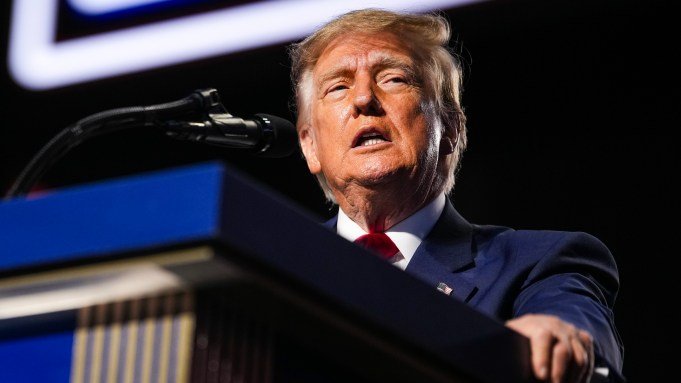
Just a month away from the volatile midterms and a president way down in the polls, there was once again a plethora of political material ripe for this week’s SNLcold open, and the NBC late-nighter went full MAGA, with some Mitch McConnell on the side.
Played by Mickey Day, the wheelchair bound 84-year-old Kentucky senator offered a premature “Live from New York” before being cut off by RNC ad consultants desperate to turn things around for the GOP. To that, there was a “He tricked us” (in Spanish) Marco Rubio, portrayed by the always on point Marcello Hernández, and a 2028 J.D. Vance (Jeremy Culhane) that no one wanted to actually put in a spot.
Then there was Colin Jost’s Pete Hegseth, putting the fun in whack job Defense Secretary once again.
“What’s up, schlong donkeys?” the Saturday Night Live Weekend Update co-anchor began in what might have been one of the greatest campaign ads ever (we’re talking 1954 Daisy level) if it was real. “Now listen up, okay, because I need all you patriots at home to do the gayest thing ever and vote. Thanks to me, the military finally has its priorities and sexuality straight.”
Tossing in some slam poetry, Jost’s Hegseth added: “In conclusion, vote, I guess. And remember, even if you’re stationed overseas, you can still vote by mail, which is the only by mail I’m cool with.”
Of course, this being a MAGA parody and being SNL, the joke had to go further. Having said that, unlike many too-long cold opens, this semi-morbid midterm skit work at the extra length – entirely because POTUS came to cook, base loathing and all.
“I’m President Trump and I approve this ramble,” started a typically and wonderfully unhinged James Austin Johnson.
Drawing from the fiction that is so much of Trumpland’s facts, he added in the fake ad: “We’re getting mogged out there, but not for long because I have a solution. If the Republicans win, I’ll give everyone $5,000, and that is not a bribe because I have no intention of following through on that promise.’
“So, just pretend I’m on the ballot, okay? You have to use something called imagination. Imagination makes a MAGA nation. Wow, that’s pretty good. I can already see that written on the back of an obese woman’s booty shorts in dirty, disgusting Myrtle Beach. What a hell all this country is! It’s full of awful people.”
Perhaps, but not in tonight’s spot-on cold open.
Delayed a tad again on the West Coast like last week’s season opener thanks to college football, tonight’s SNL is the second show of the 52nd season.
Verity star Dakota Johnson is hosting SNL for the third time. Coming off a big box office start for the Collen Hoover thriller, Johnson is joined by Turnstile as musical guest, the Maryland rockers’ SNL debut. Next week will see one-time dumped cast member Shane Gillis back for his third time hosting. The October 10 show will see the much-acclaimed Rosalía returning for her third SNL appearance.
Washington, DC – Democrats have the momentum; Republicans are surging in defence and cash.
That narrative has emerged ahead of the United States midterm elections in November, as races across the country enter their final stretch.
Recommended Stories
list of 3 itemsend of list
With control of the US House of Representatives and the US Senate at stake, Democrats begin October with a surprisingly rosy outlook as more congressional seats are seen as in play.
Republicans, meanwhile, appear to be in damage control, pouring millions of dollars into races once seen as secure victories while injecting more funding into a handful of marquee showdowns.
The party’s standard bearer, President Donald Trump, who has embraced the notion of the election being a referendum on his leadership, enters the final month with staggeringly low approval ratings.
The most recent Associated Press-NORC polling, released on Thursday, showed Trump with 31 percent approval, the lowest during either of his two terms. Only 26 percent of respondents approved Trump’s handling of the economy, dipping two points below his predecessor, former President Joe Biden’s lowest rating on the topic.
Surveys continue to show voters rank the economy as their top issue, with topics like gas prices, made higher by the US-Israel war with Iran, dominating their concerns. Immigration and corruption have also regularly ranked high.
“The broad stroke is that Americans are disappointed, bordering on angry that President Trump hasn’t delivered on the core promises he made when he won re-election,” according to Henry Olsen, a senior fellow at the conservative Ethics and Public Policy Center in Washington, DC.
House looking solid for Dems
Political trackers have long projected Democrats will take control of the US House of Representatives in the November 3 vote.
Winning a majority in the 435-member chamber from Republicans would give the party renewed legislative power to assert leverage over Trump, while launching investigations into his administration’s dealings. Top Democrats have already signalled that probes into Trump’s family business dealings would be top priorities.
Two election non-partisan prediction authorities, the Cook Political Report and the University of Virginia’s Sabato’s Crystal Ball, have recently assessed that the likelihood of Democrats taking the House has only increased.
The Cook Political Report recently shifted 15 House races in the direction of Democrats, moving some considered “toss-ups” to “leans Democrat” and some previously considered “lean Republican” to “toss-ups”.
One such shift was for a Texas border district represented by Republican Monica De La Cruz. Her district was emblematic of a wider Latino shift towards Trump in 2024. Once seen as holding the advantage over her challenger, Democrat Bobby Pulido, Cook now rates her race as a “toss-up”.
All told, the political analysis clearinghouse now predicts Democrats are on track to win 5 to 15 House seats.
Senate in play
With 30 days left to go, “there’s much more drama in the Senate than the House races”, according to Kyle Kondik, the managing editor at Sabato’s Crystal Ball.
Once considered a pipe dream for Democrats, who need a net gain of at least four seats to win a slim majority, the 100-member chamber has moved within a more comfortable striking distance.
Unlike in the House, where every seat is up for re-election, only 35 Senate seats are up for grabs in this cycle, creating a far narrower pathway to control.
“The trajectory of the polling since Labor Day (September 7) has generally been that a bad Republican environment is just getting worse,” Kondik said, adding that “the Senate just seems to get more and more competitive as the cycle has gone on”.
To be sure, the quality of polling can vary across the country, with Kondik cautioning that gauging the political temperature of the Midwest has been particularly challenging for pollsters.
Still, in North Carolina, former Democratic Governor Roy Cooper is expected to trounce former Republican National Committee chairman Michael Whatley in the race for a Senate seat currently held by Republicans. Top conservative donors have already begun to divert funds from the contest.
Surveys have consistently shown Democrats leading in three other races for seats currently held by Republicans: Democrat James Talarico against Republican Ken Paxton in Texas; Democratic challenger Sherrod Brown against Republican incumbent Senator John Husted in Ohio; and Democratic Mary Peltola against Republican Dan Sullivan in Alaska.
Races for Republican held seats in Iowa, between Republican Ashley Hinson and Democrat Josh Turek, and in Maine, between Republican incumbent Susan Collins and Democratic challenger Troy Jackson, remain separated by less than one point, according to Real Clear Politics polling averages.
Democrats, meanwhile, have consistently led in polling in Senate races in Georgia, New Hampshire and Michigan for seats the party currently holds.
Big money in the race
For Republicans, salvation could be in the spending, with this year’s race continuing a US phenomenon of small fortunes poured into politics.
All told, at least $4bn had been spent on gubernatorial and congressional midterm advertising buys as of September 17, putting the race on track to become “perhaps the most expensive midterm on record”, according to Michael Franz, co-director of the Wesleyan Media Project.
Republicans entered September with a considerable funding edge. The Republican National Committee had $125.6m on hand, with the Democratic National Committee trailing far behind with $16.9m and $17.6m in debt.
When accounting for the three major committees associated with both groups, the Republican Party had $233.4m in cash, according to a CNBC analysis, while the Democratic Party had $130.4m.
Trip Yang, a Democrat strategist based in New York City, told Al Jazeera such spending can be deployed to help boost a candidate’s name recognition or to tear down a competitor.
According to AdImpact, Republicans and their allies were set to spend $888m on advertising from mid-September to election day, with Democrats and their supporters set to spend $666m.
The firm found pro-Republican ad spending would be particularly pronounced in the key Senate races in Ohio, Texas and Michigan, outpacing Democratic spending by at least $24m in each state.
Trump’s unpopularity, Yang said, means “Republicans spending millions or hundreds of millions of dollars improving their candidates’ images by itself may not be enough”.
“If you’re a little bit handicapped because your president is so toxic, you try to spend your hundreds of millions of dollars attacking the Democrats to make it more of a food fight,” he said.
A New York Times analysis estimated by the end of August at least $1bn in so-called “dark money” had been poured into the midterms. The term refers to spending where the donor’s identity is shielded, typically through nonprofit and shell-company donations to Super PACs.
Industry groups, including those supporting Crypto, AI and online betting firms, are expected to be top spenders in key races, although their support tends to cut across partisan lines.
Trump, meanwhile, has pledged to spend between $400m and $500m from his MAGA Inc Super PAC, though it has so far spent about $15m to support Paxton’s Senate bid in Texas.
Pro-Paxton ad reservations far outpaced Talarico in September, according to AdImpact data analysed by NPR, with $94m spent compared with $30m to support the Democrat.
The Trump factor
Trump has pledged to spend the final days before the election in non-stop campaign mode, after urging supporters during his Republican Midterm Convention in Dallas, Texas, to “vote like I’m on the ballot”.
His plan to criss-cross the country for rallies underscores a “base turnout” strategy meant to energise voters already loyal to the party, according to conservative analyst Olsen.
“But the Republican problem is a persuasion problem with people in the middle,” Olsen said. “[Trump’s campaigning] might help with some turnout … but their real problem is persuasion, and it’s not something that’s going to help with that in the slightest.”
Polls have spelt trouble for Republicans when it comes to swaying independents, with a PBS News, NPR and Marist poll from September 23 showing unaffiliated voters breaking for Democrats at 57 percent compared with 32 moving towards Republicans.
US President Donald Trump participates in a midterm election rally for Oklahoma Republican gubernatorial candidate Mike Mazzei at the Choctaw Event Center in Durant, Oklahoma, US, October 1, 2026. [Nick Oxford/Reuters]
The scenario has created a dilemma for some top Republican candidates over whether to break from the president on his most controversial actions, according to Lee Miringoff, the director of the Marist University Institute for Public Opinion.
Senate candidates Ashley Hinson in Iowa, Jon Husted in Ohio and Mike Rogers in Michigan all recently put daylight between themselves and Trump on the war with Iran.
One Republican House candidate, Representative Maria Elvira Salazar, has criticised Trump’s aggressive immigration enforcement policies as she seeks to rally Latino voters in South Florida.
Trump, in turn, reposted a social media message calling Salazar a “backstabber”.
“You need to have, you know, something else going for you other than endorsement of Trump,” said Miringoff. “Some Republicans are starting to have self-preservation kick in because they’re concerned.”
What can change?
Achieving a wide-scale shift in public opinion remains a tall order for Republicans in the final stretch of the race.
Many of the defining issues are unlikely to change before November, with Trump signalling a possible escalation with Iran following the vote as he has downplayed the prospect of short-term affordability relief.
At the same time, the US president has also not ruled out actions that rights groups say could upend voter turnout. Most recently, he refused to commit to not invoking the Insurrection Act or declaring a state of emergency surrounding the vote during an interview with Time magazine.
Miringoff said he believed that the “potential for more than just a marginal shift is there”, as he assessed some Democratic candidates have struggled to present clear visions beyond opposition to Trump.
“The result isn’t formed in concrete,” he said, “to the degree that there’s going to be a lot of money still spent.”
Analyst Olsen saw less remaining wiggle room for the party.
“Republicans have the time and the resources to change the outcome with respect to a few close Senate races,” Olsen said. “But to change direction, they would need something that would be apocal.”
The state’s governor said Frank Strada would step down as an independent review examines what went wrong.
Published On 3 Oct 20263 Oct 2026
The official in charge of the prison system in the US state of Tennessee has resigned just days after overseeing the botched execution of Christa Pike.
The state’s governor, Bill Lee, announced on Saturday that Tennessee Department of Correction Commissioner Frank Strada would step down from his role later this month, a decision Lee described as necessary after the stunning failure.
Recommended Stories
list of 3 itemsend of list
“Commissioner Strada has served with integrity, and I appreciate his willingness to put the interests of Tennesseans first during this difficult moment”, Lee said in a statement. “I have accepted his decision to step down and am grateful for his commitment to ensuring a smooth leadership transition”.
A replacement for Strada was not announced.
Strada, who started his role in Tennessee three years ago, previously served as a top official in Arizona’s corrections department where multiple executions on his watch faced complications. He said he was resigning “in the best interest of Tennesseans” as an independent review examines what went wrong.
“I believe this review is entirely appropriate and necessary, and I look forward to doing everything I can to help determine exactly what occurred,” Strada said in a statement that defended his department’s handling of Pike’s execution.
Pike was transported from prison to hospital on Wednesday after surviving two injections of the drug pentobarbital, which Tennessee uses to execute prisoners.
Strada’s resignation was “justified”, Pike’s lawyers said in a statement. “But it does nothing to help Christa now.”
“What happened to her Wednesday reflects a systemic failure that goes far beyond any one person,” they wrote. “We hope the Governor’s call for a full, independent review will expose the profound problems within Tennessee’s entire death penalty system.”
In a court filing on Friday, Pike’s lawyers said she had been placed on a ventilator and intubated as medical staff worked to clear the drug from her system. They argued problems with the IV lines caused the pentobarbital to flow into her body instead of her bloodstream.
“Apparently at no point did any member of the execution team realise that the IV lines were not correctly placed or that the veins had blown and that the pentobarbital was, in whole or in part, entering Ms Pike’s body,” they wrote in the filing.
Pike was 18 years old when she was sentenced to death for the torture and murder of another young woman in 1995, becoming one of the youngest women to be sent to death row.
Lee has suspended all executions for the remainder of the year while the state investigates.
United States President Donald Trump has increased the pressure on US Senate Republicans to make Daylight Saving Time permanent, singling out one of the body’s members for stalling legislation to end the twice-a-year changing of clocks.
In a social media post on Saturday, Trump blasted US Senator Tom Cotton for “holding up” the Sunshine Protection Act, which Trump has personally opted to call the “No More Changing of Clocks Act”.
Recommended Stories
list of 3 itemsend of list
“For some reason, Tom is stopping the Bill and, in the Senate, it’s very easy to do, it only takes one!” Trump wrote on his Truth Social account about the Arkansas Republican. “It should pass overwhelmingly, in a Bipartisan fashion”.
“Nobody wants to spend their precious time running all over the place, turning Clocks back twice a year and, having sunshine in the afternoon is better than early in the morning!” he added.
Trump went even further, publishing what he claimed was Cotton’s phone number as he implored Arkansas residents to pressure him. The move echoed a moment during the 2016 Republican presidential primaries, when then-candidate Trump gave out US Senator Lindsey Graham’s number after the former rival criticised him.
US Senator Tom Cotton speaks to reporters at the US Capitol in Washington [File: J. Scott Applewhite/AP Photo]
Al Jazeera called the number listed in Trump’s post, but an automated message stated the voicemail box was full. Cotton’s spokesperson and the White House did not respond to requests for comment.
The president has routinely pushed Senate Republicans to pass legislation mandating year-round daylight saving, which would end Americans’ decades-long practice of changing their clocks twice a year to increase daylight hours. On Friday, Trump urged the US Senate to approve the bill, which passed the US House in July by a 308-117 vote.
Cotton has previously opposed the bill, arguing in a US Senate floor speech last year that farmers, construction workers, commuters and children heading to school would begin their days in the dark during the winter.
Trump disputed that argument in a separate post on Saturday, saying the bill “would be a very nice and easy WIN for the Republican Party”.
“If Tom Cotton were putting Arkansas first, he would give them an extra hour of daylight and, more importantly, they wouldn’t have to run all over their houses, farms, workplaces, and everywhere else, twice a year, having to change their Clocks, and often forgetting to do so”, Trump wrote.
Trump, an avid golfer, also highlighted what he considered to be another selling point of the bill: the North American Professional Golfers’ Association (PGA) tour.
“The PGA TOUR, as an example, needs more Daylight in the afternoon in order to finish their Tournaments”, he wrote in a post, which included a letter from PGA Tour CEO Brian Rolapp supporting the bill. “Likewise, regular Golfers, Tennis Players, Hunters and, perhaps more importantly, Farmers who want more Daylight to play or work.”
The US president, who spent part of Saturday at his golf club in Sterling, Virginia, indicated in a subsequent post that he had received personal feedback on the proposal: “I don’t know about anyone else, but a table full of very distinguished people just told me that they HATE, immediately after a mandatory time change, going home at night – and it’s DARK. It’s depressing!”
In 1974, the US Congress briefly adopted year-round daylight saving time in response to the country’s energy crisis. But Congress repealed the law less than a year later over safety concerns as children commuted to school before sunrise.
US senators left Washington this week and have no set plans to return until after the November 3 midterm elections.
Some members, such as Senator John Kennedy, weren’t optimistic that Senate Republican Leader John Thune would bring the bill up for a vote before polling day.
“It’s dead as disco,” the Louisiana Republican told Reuters this week of Trump’s push to make daylight saving time permanent. “My sense is it would have trouble passing … I don’t think the leader is going to bring it up.”
The Justice Department argued that Donald Trump can legally ban CNN, MS NOW and Politico from the White House because he determined that they didn’t meet the “minimum requirements of professionalism.”
Last month, a federal judge granted the three outlets a temporary restraining order that forced the White House to reinstate dozens of their reporters’ hard passes. The outlets are now asking the judge to extend that 14-day order for a longer term via a preliminary injunction, claiming that Trump’s ban is a violation of their First and Fifth amendment rights.
U.S. District Judge Timothy Kelly, a Trump appointee, has said that he is bound by the precedent set in In a 1977 D.C. Circuit opinion, Sherrill vs. Knight, in which the judges ruled that “the protection afforded newsgathering under the First Amendment guarantee of freedom of the press requires that this access not be denied arbitrarily or for less than compelling reasons.”
In a court filing on Friday, the DOJ claimed that the Sherrill case still would allow for the president to restrict the three outlets from accessing the White House grounds because the White House has a “compelling interest.”
The DOJ lawyers claimed that the Sherrill decision does not “prevent the President from concluding that bona fide journalists would identify sources instead of relying on anonymous sources, commit to factual accuracy, and provide the White House an opportunity to comment, rather than ‘perform their duties in a way that … interfere[s] with the White House’s daily operations.’ …At a bare minimum, it is a significant violation of decorum to publish classified and sensitive national security information.”
The news outlets’ legal team has rejected that assertion, writing in a filing earlier this week that Trump’s “statements also make clear he implemented the ban to coerce more favorable coverage from CNN, MS NOW, and Politico, and to deter other journalists and news organizations from newsgathering and reporting that the President might view as negative. And his administration has continued to retaliate against Plaintiffs even after the temporary restraining order, only underscoring that Defendants’ motive is to punish and chill journalism they dislike.”
Even as access to the White House grounds has been reinstated, the White House has continued to restrict CNN from coverage of TV pool assignments, including travel with Trump on Air Force One.
The outlets’ lawyers, led by Theodore Boutrous Jr., also noted that Trump and other White House officials “overlooked that the First Amendment protects reporting on matters affecting national security.”
Kelly has set a hearing for Thursday on the news outlets’ motion for a preliminary injunction.
In granting a TRO, Kelly concluded that the White House failed to provide due process to the news outlets.
The DOJ has pointed to letters sent to the outlets as evidence that they were given due process. But those letters were sent on Sept. 22, four days after Trump’s ban was started.
The judge also has noted that some of the objectionable stories cited by the DOJ do not have to do with national security. Kelly wrote in his order that “even the justifications provided to Plaintiffs after this case was filed are ambiguous about the true purpose of the revocations: while Defendants’ letters to Plaintiffs mention national security concerns, they purport to identify reporting that ‘threatened national security and/or spread falsehoods’ leaving open the possibility that all the stories fall into the later bucket, rather than the former.”
Just a month away from the volatile midterms and a president way down in the polls, there was once again a plethora of political material ripe for this week’s SNLcold open, and the NBC late-nighter went full MAGA, with some Mitch McConnell on the side.
Played by Mickey Day, the wheelchair bound 84-year-old Kentucky senator offered a premature “Live from New York” before being cut off by RNC ad consultants desperate to turn things around for the GOP. To that, there was a “He tricked us” (in Spanish) Marco Rubio, portrayed by the always on point Marcello Hernández, and a 2028 J.D. Vance (Jeremy Culhane) that no one wanted to actually put in a spot.
Then there was Colin Jost’s Pete Hegseth, putting the fun in whack job Defense Secretary once again.
“What’s up, schlong donkeys?” the Saturday Night Live Weekend Update co-anchor began in what might have been one of the greatest campaign ads ever (we’re talking 1954 Daisy level) if it was real. “Now listen up, okay, because I need all you patriots at home to do the gayest thing ever and vote. Thanks to me, the military finally has its priorities and sexuality straight.”
Tossing in some slam poetry, Jost’s Hegseth added: “In conclusion, vote, I guess. And remember, even if you’re stationed overseas, you can still vote by mail, which is the only by mail I’m cool with.”
Of course, this being a MAGA parody and being SNL, the joke had to go further. Having said that, unlike many too-long cold opens, this semi-morbid midterm skit work at the extra length – entirely because POTUS came to cook, base loathing and all.
“I’m President Trump and I approve this ramble,” started a typically and wonderfully unhinged James Austin Johnson.
Drawing from the fiction that is so much of Trumpland’s facts, he added in the fake ad: “We’re getting mogged out there, but not for long because I have a solution. If the Republicans win, I’ll give everyone $5,000, and that is not a bribe because I have no intention of following through on that promise.’
“So, just pretend I’m on the ballot, okay? You have to use something called imagination. Imagination makes a MAGA nation. Wow, that’s pretty good. I can already see that written on the back of an obese woman’s booty shorts in dirty, disgusting Myrtle Beach. What a hell all this country is! It’s full of awful people.”
Perhaps, but not in tonight’s spot-on cold open.
Delayed a tad again on the West Coast like last week’s season opener thanks to college football, tonight’s SNL is the second show of the 52nd season.
Verity star Dakota Johnson is hosting SNL for the third time. Coming off a big box office start for the Collen Hoover thriller, Johnson is joined by Turnstile as musical guest, the Maryland rockers’ SNL debut. Next week will see one-time dumped cast member Shane Gillis back for his third time hosting. The October 10 show will see the much-acclaimed Rosalía returning for her third SNL appearance.
The Justice Department argued that Donald Trump can legally ban CNN, MS NOW and Politico from the White House because he determined that they didn’t meet the “minimum requirements of professionalism.”
Last month, a federal judge granted the three outlets a temporary restraining order that forced the White House to reinstate dozens of their reporters’ hard passes. The outlets are now asking the judge to extend that 14-day order for a longer term via a preliminary injunction, claiming that Trump’s ban is a violation of their First and Fifth amendment rights.
U.S. District Judge Timothy Kelly, a Trump appointee, has said that he is bound by the precedent set in In a 1977 D.C. Circuit opinion, Sherrill vs. Knight, in which the judges ruled that “the protection afforded newsgathering under the First Amendment guarantee of freedom of the press requires that this access not be denied arbitrarily or for less than compelling reasons.”
In a court filing on Friday, the DOJ claimed that the Sherrill case still would allow for the president to restrict the three outlets from accessing the White House grounds because the White House has a “compelling interest.”
The DOJ lawyers claimed that the Sherrill decision does not “prevent the President from concluding that bona fide journalists would identify sources instead of relying on anonymous sources, commit to factual accuracy, and provide the White House an opportunity to comment, rather than ‘perform their duties in a way that … interfere[s] with the White House’s daily operations.’ …At a bare minimum, it is a significant violation of decorum to publish classified and sensitive national security information.”
The news outlets’ legal team has rejected that assertion, writing in a filing earlier this week that Trump’s “statements also make clear he implemented the ban to coerce more favorable coverage from CNN, MS NOW, and Politico, and to deter other journalists and news organizations from newsgathering and reporting that the President might view as negative. And his administration has continued to retaliate against Plaintiffs even after the temporary restraining order, only underscoring that Defendants’ motive is to punish and chill journalism they dislike.”
Even as access to the White House grounds has been reinstated, the White House has continued to restrict CNN from coverage of TV pool assignments, including travel with Trump on Air Force One.
The outlets’ lawyers, led by Theodore Boutrous Jr., also noted that Trump and other White House officials “overlooked that the First Amendment protects reporting on matters affecting national security.”
Kelly has set a hearing for Thursday on the news outlets’ motion for a preliminary injunction.
In granting a TRO, Kelly concluded that the White House failed to provide due process to the news outlets.
The DOJ has pointed to letters sent to the outlets as evidence that they were given due process. But those letters were sent on Sept. 22, four days after Trump’s ban was started.
The judge also has noted that some of the objectionable stories cited by the DOJ do not have to do with national security. Kelly wrote in his order that “even the justifications provided to Plaintiffs after this case was filed are ambiguous about the true purpose of the revocations: while Defendants’ letters to Plaintiffs mention national security concerns, they purport to identify reporting that ‘threatened national security and/or spread falsehoods’ leaving open the possibility that all the stories fall into the later bucket, rather than the former.”
Just a month away from the volatile midterms and a president way down in the polls, there was once again a plethora of political material ripe for this week’s SNLcold open, and the NBC late-nighter went full MAGA, with some Mitch McConnell on the side.
Played by Mickey Day, the wheelchair bound 84-year-old Kentucky senator offered a premature “Live from New York” before being cut off by RNC ad consultants desperate to turn things around for the GOP. To that, there was a “He tricked us” (in Spanish) Marco Rubio, portrayed by the always on point Marcello Hernández, and a 2028 J.D. Vance (Jeremy Culhane) that no one wanted to actually put in a spot.
Then there was Colin Jost’s Pete Hegseth, putting the fun in whack job Defense Secretary once again.
“What’s up, schlong donkeys?” the Saturday Night Live Weekend Update co-anchor began in what might have been one of the greatest campaign ads ever (we’re talking 1954 Daisy level) if it was real. “Now listen up, okay, because I need all you patriots at home to do the gayest thing ever and vote. Thanks to me, the military finally has its priorities and sexuality straight.”
Tossing in some slam poetry, Jost’s Hegseth added: “In conclusion, vote, I guess. And remember, even if you’re stationed overseas, you can still vote by mail, which is the only by mail I’m cool with.”
Of course, this being a MAGA parody and being SNL, the joke had to go further. Having said that, unlike many too-long cold opens, this semi-morbid midterm skit work at the extra length – entirely because POTUS came to cook, base loathing and all.
“I’m President Trump and I approve this ramble,” started a typically and wonderfully unhinged James Austin Johnson.
Drawing from the fiction that is so much of Trumpland’s facts, he added in the fake ad: “We’re getting mogged out there, but not for long because I have a solution. If the Republicans win, I’ll give everyone $5,000, and that is not a bribe because I have no intention of following through on that promise.’
“So, just pretend I’m on the ballot, okay? You have to use something called imagination. Imagination makes a MAGA nation. Wow, that’s pretty good. I can already see that written on the back of an obese woman’s booty shorts in dirty, disgusting Myrtle Beach. What a hell all this country is! It’s full of awful people.”
Perhaps, but not in tonight’s spot-on cold open.
Delayed a tad again on the West Coast like last week’s season opener thanks to college football, tonight’s SNL is the second show of the 52nd season.
Verity star Dakota Johnson is hosting SNL for the third time. Coming off a big box office start for the Collen Hoover thriller, Johnson is joined by Turnstile as musical guest, the Maryland rockers’ SNL debut. Next week will see one-time dumped cast member Shane Gillis back for his third time hosting. The October 10 show will see the much-acclaimed Rosalía returning for her third SNL appearance.
Dr. Ian MacArthur is accustomed to dealing with new trends in cosmetic surgery, but he’s starting to see more patients coming into his Ottawa clinic with expectations that aren’t entirely realistic.
Some clients, he says, bring in “fairly stylized” images generated with artificial intelligence, seeking results that may not even be “physically possible.”
The experiences he’s had so far motivated him to share a few cautionary thoughts on his Instagram page.
But it’s a trend that plastic surgeons are dealing with more often.
The British Association of Aesthetic Plastic Surgeons (BAAPS) recently warned about the rise of “AI face” — flawless, AI-enhanced images of patients’ own faces that they believe can be recreated surgically.
The concern, says the organization’s president, is that AI could also lead some people to put their desire for an unachievable look ahead of their own safety and well-being.
“The less realistic the image, the more dangerous that becomes if someone says, ‘Yes, I can do it,’” Dr. Nora Nugent told CBC News.
More than meets the AI
BAAPS surveyed about half its roughly 350 members about how often they’re seeing instances of AI face during consultations, Nugent said, with about 15 per cent of them responding that it’s happening more often.
It’s not that people are asking for anything unusual, she says. It’s that the chatbot may have made other enhancements that it doesn’t immediately disclose, such as a sharpened jawline or smoothed-out skin.
CBC News uploaded a photo of a journalist’s face to three commonly used generative AI platforms — the free versions of OpenAI’s ChatGPT, Google Gemini’s Nano Banana and Anthropic’s Claude — and prompted them to show the outcome of a rhytidectomy (a facelift).
Claude would not complete the task, responding that it wouldn’t generate “realistic manipulated images of actual people.”
Nano Banana did complete the task. When prompted, the chatbot explained that in addition to simulating the rhytidectomy, it also reduced loose neck skin and applied dermatological treatments like laser resurfacing or a chemical peel. (It also appeared to shave off facial hair).
It would not, however, create a medical before-and-after image comparison, encouraging consulting with a certified plastic surgeon for a realistic assessment.
ChatGPT did not hesitate to produce a visualization, as well as a side-by-side comparison. Like Nano Banana, it actually simulated multiple procedures — including what appeared to be an eyelid lift, brow lift and neck lift. ChatGPT said it smoothed out the forehead.
The chatbot did not immediately recommend consulting with a surgeon but later said the outcomes depend on one’s anatomy, goals and doctor.
Pixels, not human tissue
Nugent says it’s important for anyone seeking cosmetic surgery to know that AI can’t account for an individual’s anatomy.
“[AI] works in pixels, not human tissue,” she said.
“Some tissue intrinsically is stronger, has more collagen, maybe thicker skin, and will hold a lift better,” she said, adding that there are limits to “what’s structurally safe to do” with a person’s face.
“If you make a nose too small and too narrow, that person won’t be able to breathe properly through their nose,” she said. “If you take too much skin from an eyelid, someone can’t close their eyes properly and that creates a medical problem.”
On top of that, a patient’s age, weight and lifestyle are also factors in the outcome.
WATCH | Real doctors appearing in AI deepfakes peddling unreal medical advice:
AI deepfakes of prominent Canadian doctors are coming for your money
Health officials are warning Canadians about hyper-realistic AI deepfake videos of prominent doctors selling products or pushing bad advice. Victims are urged to contact the Canadian Anti-Fraud Centre, but doctors warn the videos are hard to take down.
Nugent says people can likely recognize the “more extreme changes” as unrealistic.
“But it’s the mild to middle changes that they might think are realistic,” she said.
Karen Rowa, a psychiatry and behavioural neurosciences professor at Hamilton’s McMaster University, says it could also worsen problems for those who struggle with their appearance or have body dysmorphic disorder.
AI chatbots tend to “please the person they’re talking to,” she says. Asking them to fix something a person doesn’t like about their face or body may “reinforce a problem that may not actually exist.”
An unachievable risk
Dr. Michael Weinberg says he hasn’t consulted any patients who have used generative AI tools to simulate their cosmetic surgery outcomes, but he’s not entirely against the idea.
Weinberg, a plastic surgery division lead at Ontario’s Trillium Health Partners, says AI may help a patient visualize their own goals in advance of an appointment. A surgeon can then help them determine what’s possible and what’s not.
He says plastic surgeons have already been using digital 3D simulation tools in their consultations for some time — for procedures like breast augmentations or eyelid lifts.
“If it’s used wisely and judiciously with realistic results, then it is great because it can show you what you can look like,” he said.
What he worries about is doctors who overpromise on what can be achieved — whether it’s due to inexperience, pressure from the patient or unscrupulous business practices.
“There’s a lot of bad plastic surgeons,” he said, and a patient’s desire to meet AI-generated expectations may lead them to seek less reliable options if they’re told that their goals aren’t achievable by a more responsible doctor.
He says “tourist plastic surgery” is another issue, with some people travelling abroad for aesthetic procedures.
That comes with a big risk, Weinberg says, of returning with the “absolute worst complications” that can require additional surgeries and months of care.
LISTEN | Just how dangerous is AI — and what we should do about it:
Front Burner33:35Why are AI leaders calling for a slow down?
But Ottawa surgeon MacArthur says most patients are reasonable and aren’t looking to go to any extremes. He says those who turn to AI tools may be doing so because they want to better communicate their wishes.
As long as he’s clear with them about what is achievable, he says, they’re generally understanding. But he does think some people have unrealistic expectations, and that AI could “be like gasoline on the fire.”
WATCH | Can we pause the rapid development of AI?:
Why slowing the AI race won’t be easy
Silicon Valley tech CEOs are calling for a slow down of artificial intelligence development — but is that even possible? For The National, CBC’s Ashley Fraser looks at what it would take to pace the AI race and why experts say it won’t be easy.
Security threats prompt US and Australia to suspend diplomatic operations in Brazil before pivotal election day.
Published On 3 Oct 20263 Oct 2026
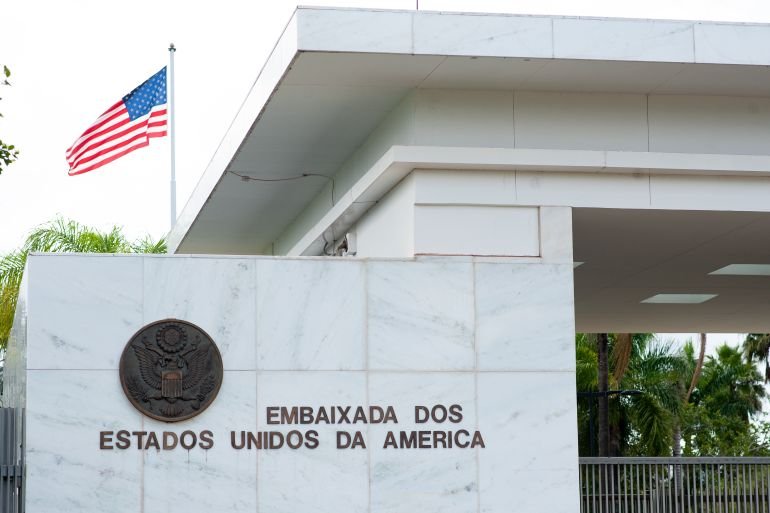
The United States has suspended consular services in Brazil, prompting Australia to close its embassy in the Brazilian capital, two days before Brazil’s presidential election on Sunday.
In a statement released on Thursday, the US embassy said it would suspend consular services starting on Friday and advised American citizens seeking assistance not to visit its embassy, consulates or other diplomatic facilities.
Recommended Stories
list of 3 itemsend of list
The statement cited security concerns but gave no further detail on the nature of the threat or any link to the election.
The US State Department said it was working closely with Brazilian counterparts to address the security concerns, adding that embassies and consulates routinely issue alerts about local threats and developments.
Australia’s ambassador to Brazil, Sophie Davies, said on social media that the Australian embassy would also close on Friday, citing the US alert, and advised Australians to avoid US diplomatic facilities.
Brazil’s federal police said they carried out preventive search and seizure warrants in Sao Paulo and the Federal District, the administrative region surrounding the capital, Brasilia, as part of an investigation into suspected plans that could threaten US diplomatic facilities.
Police said the operation followed cooperation with foreign intelligence agencies, but that investigators had found no evidence corroborating the initially reported threat, nor identified any suspects linked to criminal organisations.
An investigation was continuing after the seizure of communications equipment, according to the police.
The closures came two days before the Brazilian presidential election, which pits incumbent Luiz Inacio Lula da Silva, who is seeking re-election, against Senator Flavio Bolsonaro, son of former President Jair Bolsonaro. Jair Bolsonaro is serving a 27-year sentence for attempting a coup.
If neither candidate wins more than 50 percent of the vote on Sunday, a runoff will be held on October 25.
Edinho Silva, president of Lula’s Workers’ Party, called the closures “unprecedented”, saying: “It makes no sense at all. It’s one of Trump’s ways of trying to influence Brazilian public opinion.”
Lula’s allies have pointed to US tariffs and an effort by Washington to send officials to Brazil to “discuss electoral integrity” as evidence of foreign interference.
Brazilian intelligence officials briefed French and German delegations in Brasilia this month on what they described as US and Russian interference in the race.
US President Donald Trump has publicly praised Flavio Bolsonaro, a close ally, without formally endorsing him, saying he is “watching that election very closely”.