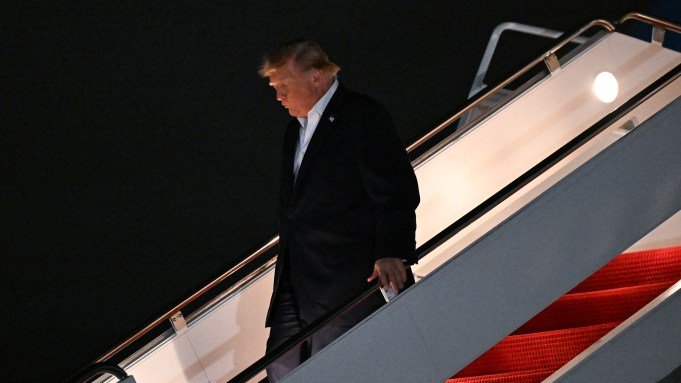
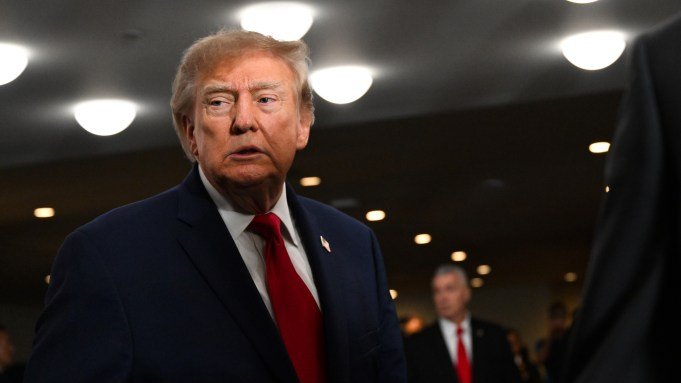
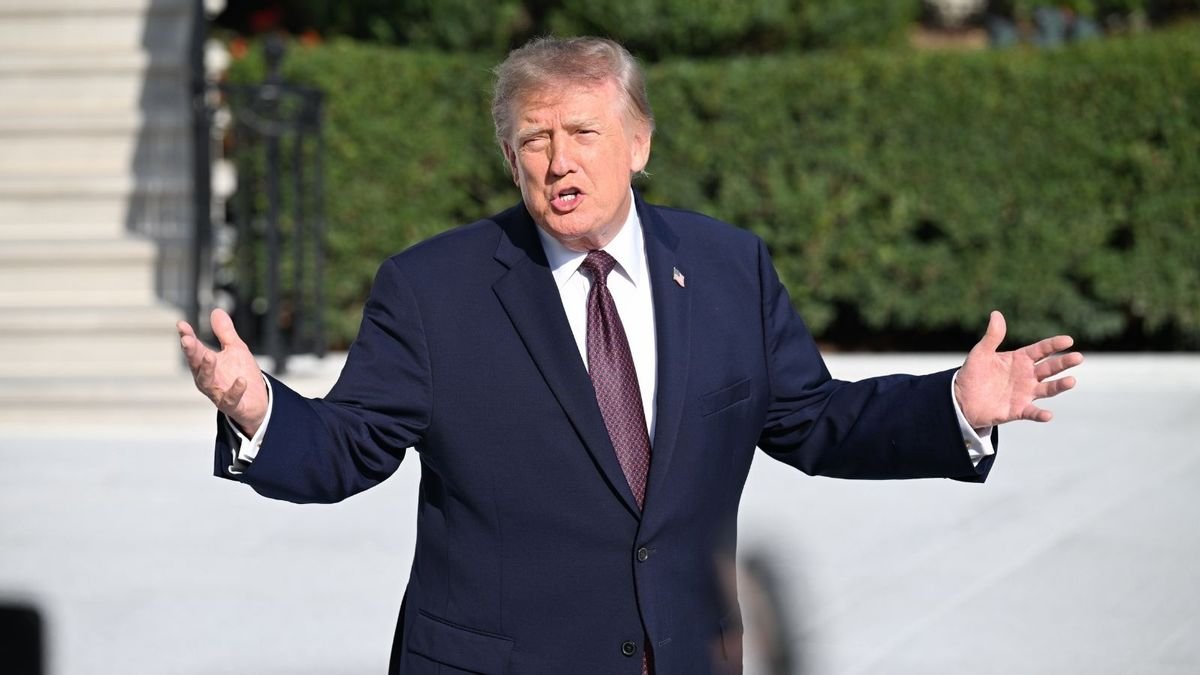
The White House blocked Politico from traveling with Donald Trump on Air Force One on Monday for the president’s trip to Nebraska.
A Politico spokesperson confirmed that the publication was excluded from the out-of-town travel pool, the handful of reporters who cover the president’s travel with each outlet assigned on a rotating basis. The Washington Post was providing reports as the secondary print pooler, but the White House did not find a replacement for Politico, according to a member of the pool.
The exclusion of Politico comes after Trump banned the publication, along with CNN and MS NOW, from the White House grounds on Sept. 18. But a federal judge ruled that the administration failed to provide due process, and ordered that hard passes to dozens of reporters be restored. The judge’s order expires later this week, and the three outlets are seeking a preliminary injunction to sideline the ban in the longer term. A hearing is scheduled for Thursday.
Since then, the White House also has banned CNN from Air Force One travel and other events.
The Trump administration restrictions on access to certain areas of the White House grounds is a separate but related issue. White House officials have argued that they can freeze out media from certain areas like the Oval Office, as well as spaces like Air Force One, even when the reason has to do with what stories an outlet publishes or reports. In a separate case, the Associated Press has been challenging those restrictions, arguing that it violates the First Amendment as a form of viewpoint discrimination. The case is on appeal.
A White House official said, “Many outlets including Politico are granted access to attend and cover presidential events unilaterally, but traveling with the President of the United States aboard Air Force One is a privilege not a right. President Trump is the most accessible President in American history — holding open press events, taking unfiltered questions directly from the media almost every day, and posting directly to his TRUTH Social account — and he will continue to grant an unprecedented level of access to the press.”
The DOJ argued in a court filing on Friday that, in restricting CNN and other outlets from the White House grounds, the president made a determination that they did not meet “minimum requirements of professionalism,” citing reporting on national security information and other stories.
CNN first reported on the ban on Politico from the pool.
Russian authorities quarantine hospital, monitor 200 contacts after suspected pneumonic plague death in Siberia.
Published On 5 Oct 20265 Oct 2026
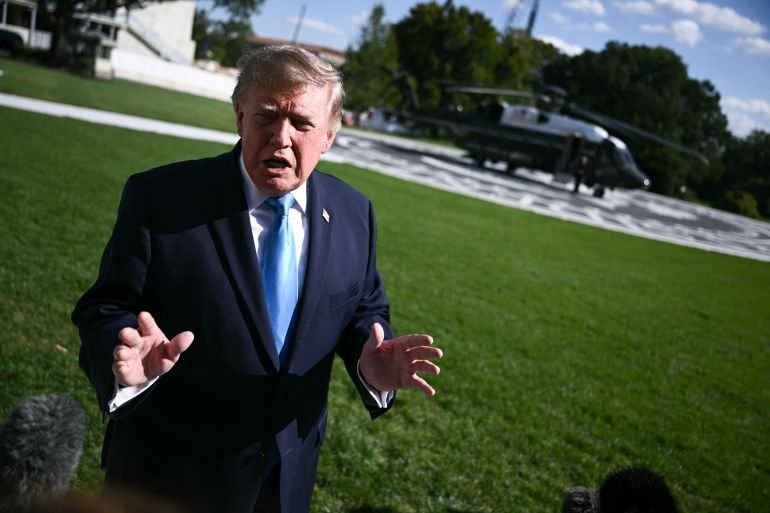
President Donald Trump says the United States is ready to help Russia with a suspected pneumonic plague outbreak.
“We are looking at it very strongly. We just heard about it,” Trump said, adding that he had not spoken to Russian President Vladimir Putin about it but is prepared to offer US support.
Recommended Stories
list of 3 itemsend of list
“It’s a disease we used to be able to control,” Trump said. “Even with great advancement, the germs have really become relatively stronger than they were, and things that used to work on pneumonia don’t work anymore … anyone that has that kind of problem, we will help.”
The World Health Organization (WHO) said based on unofficial information it has received, the “public health risk to the general population appears to be low”.
Earlier on Monday, US Secretary of State Marco Rubio downplayed the danger as well. “I don’t think it’s cause for alarm, but it is cause for focus and a cause to just keep an eye on it,” Rubio said.
Russian authorities have quarantined a hospital and are tracing the contacts of an employee at a plague research institute in the remote Siberian region of Irkutsk who died of a suspected pneumonic plague infection. Local media identified the employee as 28-year-old laboratory technician Darya Shipilova.
Official details about the incident have been limited, and Russian media reports say authorities in Irkutsk have placed nearly 200 people under medical observation.
On Sunday, Russia’s official TASS news agency reported that the country’s consumer protection agency, Rospotrebnadzor, said an employee at the Irkutsk Anti-Plague Research Institute of Siberia and the Far East was diagnosed with “pneumonia of unknown aetiology” or origin. The agency also said it had expanded sample testing from the patient and found no microorganisms associated with her work.
On Saturday, the governor of neighbouring Buryatia region said in a post on his Telegram channel that a woman in Irkutsk had “died, maybe of the plague”.
In a statement to Al Jazeera, a US State Department official said: “We encourage Russian authorities to share accurate information quickly and openly.”
Pneumonic plague is caused by the bacterium Yersinia pestis, usually found in small mammals and their fleas. According to the WHO, the plague is highly infectious and can be fatal if not treated early.
The plague comes in three forms affecting different parts of the body. Pneumonic plague, an infection of the lungs, triggers the patient to cough out infectious airborne droplets.
If identified quickly, antibiotics can treat the disease. Left untreated, it can be fatal in one to six days.
Reports spread in early October 2026 that a Russian lab worker may have died of the pneumonic plague, caused by the bacterium Yersinia pestis.
The pneumonic plague “has a nearly 100% case-fatality rate when untreated,” according to the U.S. Centers for Disease Control and Prevention. The illness requires antibiotic treatment that should start as soon as the plague is suspected, before test results, per the CDC.
The rumor stems from news media reports saying Russia announced that a 28-year-old lab worker at the Irkutsk Anti-Plague Research Institute of Siberia had died of an “unknown” infection, and that nearly 200 people have been isolated as a result. The reports cite Rospotrebnadzor, the Russian public agency responsible for “federal state sanitary and epidemiological supervision,” according to the Russian government.
Snopes could not reach the website of Rospotrebnadzor and does not have access to primary sources, therefore we cannot confirm the details of the lab worker’s death. Russian news agency Interfax reported the Russian government as saying she had died of a pneumonia pathogen of “unknown etiology,” meaning its origin is not clear.
On Oct. 4, Interfax also reported Rospotrebnadzor as saying, “based on the results of extensive testing, no microorganisms associated with the patient’s professional activities were detected in the patient’s sample.” If true, this would suggest the lab worker did not die of pneumonic plague.
A U.S. Department of State spokesperson said via email that the department is aware of the reports and is “monitoring the situation closely with the CDC and our other interagency partners.”
Snopes will update this report if, or when, additional information surfaces. We have also reached out to the CDC and the Directorate-General for Health and Food Safety of the European Union Commission. We are waiting for responses.
In early October 2026, a rumor spread that a worker at a Russian lab that studies Yersinia pestis, the bacterium that causes the plague, had died of the pneumonic plague.
Some social media users said the lab worker’s death resulted from an accident at the lab. One X post reads, in part, “A lab worker in Russia has died from pneumonic plague.”
Meanwhile, several Snopes readers emailed us asking for details about the story.
The claim stems from variousnewsreports about a 28-year-old woman who worked at the Irkutsk Anti-Plague Research Institute of Siberia. Around 200 people have reportedly been isolated as a precautionary measure. The articles cited Rospotrebnadzor, the Russian public agency responsible for “federal state sanitary and epidemiological supervision,” according to the Russian government.
In short, it has not been possible to independently verify the rumor without access to primary sources or confirmation from Russian authorities. Therefore, this claim is unrated. We will update this article if we learn more.
Snopes could not reach the website of Rospotrebnadzor, therefore we could not confirm the details of the lab worker’s death. On Oct. 4, Russian news agency Interfax reported that the Russian government said she had died of a pneumonia pathogen of “unknown etiology,” meaning its origin is not clear.
The same report adds that Rospotrebnadzor said no microorganisms associated with the individual’s professional work were detected in that person’s samples following “extensive testing.” If true, it would suggest the lab worker did not die of pneumonic plague.
Local authorities have reportedly implemented preventative measures. Interfax cites the Rospotrebnadzor health agency as saying:
Due to the patient’s professional activities, upon receiving information, a comprehensive set of anti-epidemic measures was immediately and fully implemented in accordance with sanitary legislation. This included identifying the widest possible circle of people who had been in contact with the patient, inpatient medical observation, and daily laboratory testing. The results revealed two cases of Covid-19 and two cases of rhinovirus infection. No other infectious agents were detected.
View from U.S. Department of State
“We are aware of reports of a fatal case of suspected pneumonic plague in Irkutsk Oblast, Russia,” a U.S. Department of State spokesperson said via email. “We are monitoring the situation closely with the CDC and our other interagency partners.”
We contacted the U.S. Centers for Disease Control and Prevention and the Directorate-General for Health and Food Safety of the European Union Commission requesting updates on the situation. We will update this report if we receive responses.
There are three main types of plague: bubonic plague, which infects lymph nodes; septicemic plague, which infects the blood; and pneumonic plague, which infects the lungs. The bubonic and septicemic plagues are most commonly transmitted via flea bites and handling infected animals, while the pneumonic plague spreads through the air via infected droplets.
“Plague is a known disease and is treatable with common antibiotics, especially when treatment starts early,” the State Department spokesperson said via email. “Cases occur naturally in many parts of the world.”
Coghill, Arianna. ‘Reports of a Plague Outbreak in Russia Follow the Death of a Researcher’. Mother Jones, https://www.motherjones.com/politics/2026/10/reports-of-a-lethal-virus-outbreak-in-russia-follow-the-death-of-a-researcher/.
‘How Plague Spreads’. U.S. Centers for Disease Control and Prevention, 15 May 2024, https://www.cdc.gov/plague/causes/index.html.
Lister, Tim, et al. ‘Dozens Quarantined after Researcher at Russian Plague Laboratory Dies of “Unknown” Infection’. CNN, 4 Oct. 2026, https://edition.cnn.com/2026/10/04/europe/russia-laboratory-plague-accident-intl.
‘Plague’. World Health Organization, https://www.who.int/news-room/fact-sheets/detail/plague.
‘Researcher at Russian Plague Laboratory Dies of “unknown” Infection, Reports Say’. WMUR, 5 Oct. 2026, https://www.wmur.com/article/russia-lab-worker-dies-suspected-dangerous-infection/74015157.
‘Роспотребнадзор заявил о стабильной обстановке в Иркутской области’. Interfax.ru, 4 Oct. 2026, https://www.interfax.ru/russia/1120228.
UPDATED: Supreme Court Justice Elena Kagan denied an last-minute effort to halt Paramount‘s merger with Warner Bros. Discovery, a transaction that is scheduled to close on Tuesday.
Kagan’s denial of a petition was entered into the docket without comment.
In a filing earlier on Monday, the petitioners — Pamela Faust, Len Marazzo, Lisa McCarthy, Deborah Rubinsohn and Gary Talewsky — argued that the merger was still anticompetitive, even with the conditions put in place by the settlement of the state attorneys general lawsuit last month.
“The States’ settlement itself requires that the combined company not sell or close the Paramount or Warner Bros. lots during the commitment period, provides reapplication rights to employees displaced by the transaction, and creates an editorial-independence board. Those safeguards show the magnitude of the integration that closing will unleash, but they do not preserve competition between Paramount and Warner Bros.”
The petition was a long shot, given that the plaintiffs’ efforts to stop the merger has been rejected by the district court and the Ninth Circuit Court of Appeals.
The plaintiffs, represented by Joseph M. Alioto, last month sought a temporary restraining order to block the merger. But U.S. District Judge Araceli Martinez-Olguin, in a ruling last week, cited the plaintiffs’ “repeated failures to advance any evidence in support of their motions for preliminary relief in this case to date.” She also cited an earlier decision in which she granted Paramount’s motion to dismiss the lawsuit, in which she wrote that she had “serious concerns” over the plaintiffs’ standing.
A federal appellate court denied their petition on Friday.
In their petition to the Supreme Court, the plaintiffs pointed to the record of transaction materials, CEO statements and consumer verifications.
Their brief stated: “The requested order is narrow: preserve separate ownership and prohibit integration pending disposition of the petition or further order. It does not decide final antitrust liability. It preserves the Court’s ability to decide the legal questions before the October 6 closing changes the competitive structure the Clayton Act is designed to protect.”
The plaintiffs described themselves as Paramount subscribers, viewers and cable customers. Their lawsuit originally was filed last spring, before the group of state attorneys general sued to block the deal. The settlement includes a consent decree that spells out a schedule of 30-plus theatrical releases per year as well as separate negotiations for the Paramount and Warner Bros. Discovery cable channels.
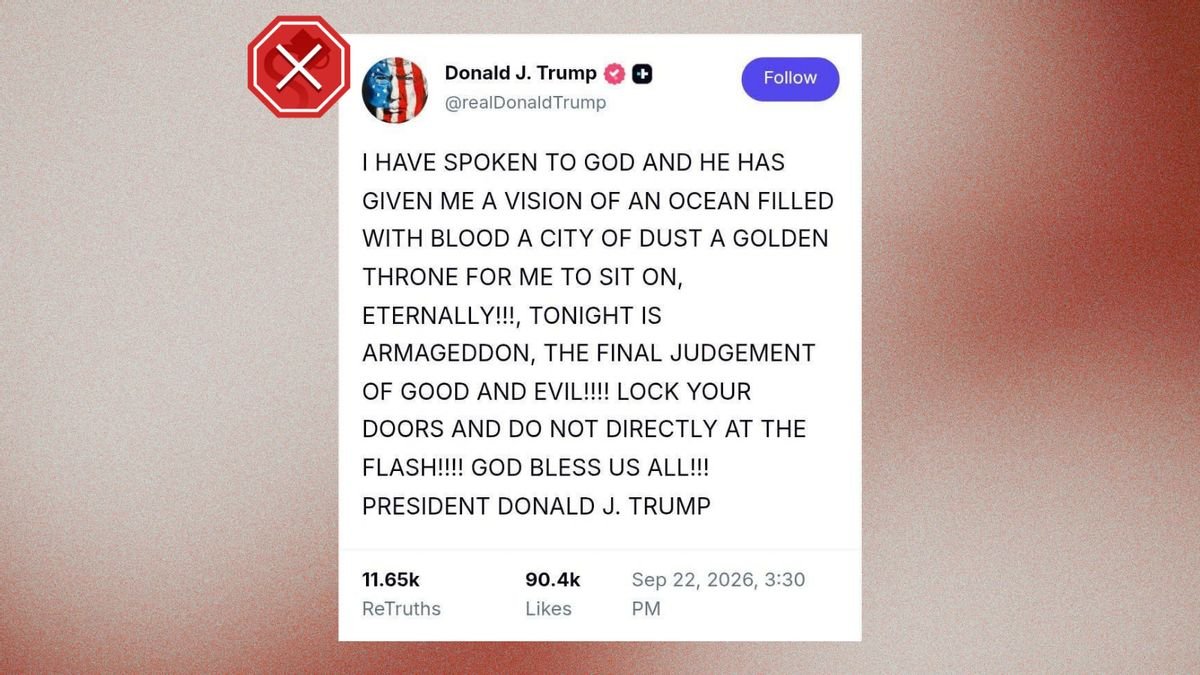
A screenshot authentically shows a September 2026 Truth Social post in which U.S. President Donald Trump wrote, in part, “I have spoken to God and he has given me a vision of an ocean filled with blood a city of dust a golden throne for me to sit on, eternally!!!, Tonight is Armageddon, the final judgement of good and evil!!!!”
Rating:
A purported screenshot circulated online in fall 2026 of a purported Truth Social post, dated Sept. 22, in which U.S. President Donald Trump wrote that he had “spoken to God” and that “tonight is Armageddon.”.
The image spread on multiple platforms, including Instagram, Threads and Facebook. Many commenters appeared to believe Trump actually posted the remarks. The full text of the alleged post read as follows:
I have spoken to God and he has given me a vision of an ocean filled with blood a city of dust a golden throne for me to sit on, eternally!!!, Tonight is Armageddon, the final judgement of good and evil!!!! Lock your doors and do not directly at the flash!!!! God bless us all!!!
President Donald J. Trump
(X user @ZiemowitSzcze11.)
Despite the username matching Trump’s real Truth Social username, there’s no evidence Trump actually published the post. The earliest version of the image we found appeared on a Polish X account that captioned it (translation via X): “Well, fake, but would you be surprised?” (archived).
We searched Trump’s Truth — an online archive of Trump’s Truth Social posts — for the word “Armageddon,” and none of the three results related to the quote above.
(Trump’s Truth)
We also looked all posts Trump actually published on Sept. 22 and found he published four that day. None of the four posts matched the timestamp or content of that in the screenshot.
The fake quote appeared to echo whistleblower reports received by the Military Religious Freedom Foundation that U.S. military commanders told troops their action in Iran was “all part of God’s divine plan,” allegedly “referring to Armageddon and the imminent return of Jesus Christ.”
Trump has echoed similarly apocalyptic language, posting in May 2026, for example, that “a whole civilization will die tonight, never to be brought back again” — referring to U.S. attacks on Iran. He’s also faced criticism for his posting an image depicting him in the likeness of Jesus Christ.
Sources
Braun, Sara. ‘US Troops Were Told War on Iran Was “All Part of God’s Divine Plan”, Watchdog Alleges’. The Guardian, 3 Mar. 2026. World News. The Guardian, https://www.theguardian.com/world/2026/mar/03/us-israel-iran-war-christian-rhetoric.
Ibrahim, Nur. ‘Did Trump Say “a Whole Civilization Will Die Tonight” Ahead of Iran Deadline?’ Snopes, 7 Apr. 2026, https://www.snopes.com//fact-check/trump-iran-whole-civilization-die/.
Rascouët-Paz, Anna. ‘Did Trump Post, Delete AI Image Depicting Himself in Likeness of Jesus?’ Snopes, 13 Apr. 2026, https://www.snopes.com//fact-check/trump-as-jesus-image/.
Suresh, Saurav. ‘Fact Check: Did Trump Say God Showed Him a Vision of “Armageddon and a Golden Throne”?’ MEAWW News, 5 Oct. 2026, https://news.meaww.com/fact-check-did-trump-say-god-showed-him-a-vision-of-armageddon-and-a-golden-throne.
Donald Trump said that his super PAC MAGA Inc. would now pay for advertisements that the White House has run at taxpayer expense and stirred an outcry among Democrats and some Republicans.
Trump posted on Truth Social on Monday: “The Radical Left is upset with the fact that I am taking Ads, which I consider to be a positive promotion for our Great U.S.A., and paying for them with U.S.A. money. This is a rather standard thing to do but, rather than doing that, although nothing will make them happy, I have decided to do the Patriotic Ads, among others, and pay for them myself, and with money I raised for MAGA, Inc.”
The White House has deemed the spots to be public service announcements, comparing them to government-funded ads that promoted vaccines under President Joe Biden and the Affordable Care Act under President Barack Obama.
But the Trump spots feature himself and promote his presidency. One of the ads is almost identical to a spot that Trump posted on social media to promote his 2024 presidential campaign. More than $10 million has been spent on the series of ads, per CNN, citing estimates from analysis firm AdImpact.
Airing during football games and news programming, among other dayparts, the ads prominently featured the line, “Paid for by the U.S. government.” The group Public Citizen filed an FCC complaint, arguing that broadcasters could be held liable for an illegal use of government funds. But FCC Chairman Brendan Carr said last week that he didn’t see anything “out of the ordinary” in the airing of the spots, calling them a “normal PSA.”
U.S. President Donald Trump said he feels “badly” for seven current and former male Cornell University students whom a female former student has accused of sexual assault and rape because they “won’t get a fair shake.”
Rating:
Context
An Oct. 2 video shows Trump fielding reporters’ questions outside the White House. Fox News senior White House correspondent Peter Doocy asked, “What do you think about New York’s governor appointing a special prosecutor in the Cornell rape case, Letitia James?” (James, New York’s attorney general, previously led a civil fraud case against Trump.) Trump thrice called James corrupt, saying he feels “badly” for “whoever” James prosecutes and alleged that defendants she targets “won’t get a fair shake.”
Trump purportedly made the remarks while answering a question about New York Attorney General Letitia James’ appointment as a special prosecutor to investigate the case.
Snopes readers asked about this claim via email, with one person inquiring, “I saw something that says Donald Trump said he feels bad for the ‘Cornell 7,’ but can’t find reputable sources. True??”
In sum, people correctly attributed this statement to Trump. A C-SPAN video shows Trump standing outside the White House on Oct. 2 and responding directly to a reporter’s question about the Cornell case, thrice calling James corrupt and saying he feels “badly” for “whoever” James prosecutes, alleging that defendants she targets “won’t get a fair shake.”
In an emailed response, White House spokesperson Lauren Bis referred us to Trump’s own comments, adding that the White House believes James has weaponized the justice system to unjustly target the president.
On Sept. 28, Tompkins County, New York, prosecutors announced they were reopening the criminal investigation, citing a “discrepancy” between Doe’s original statement and the allegations in the lawsuit.
Prior to New York Gov. Kathy Hochul appointing James as a special prosecutor to investigate the case on Oct. 1, James posted a statement of compassion for Doe on her official social media accounts, writing, “What this young woman has been forced to endure is horrific and unacceptable. I’m holding her in my heart and in my prayers. To her, and to all survivors: you’re not alone. We stand with you.”
In an example of the claim from Oct. 2, a Facebook post (archived) displayed a meme reading, “This is disgusting: Trump just said he ‘feels badly’ for the people accused in the Cornell rape case because Letitia James is now overseeing the investigation. Not one word for the victim.”
The remarks occurred when Trump spoke to a group of reporters outside the White House. Videos show Fox News’ Peter Doocy asking Trump about Hochul appointing James as a special prosecutor:
DOOCY: What do you think about New York’s governor appointing a special prosecutor in the Cornell rape case, Letitia James?
TRUMP: Letitia James is a corrupt person. She’s totally corrupt and I can’t imagine it. And, I feel badly for whoever she’s looking at because they won’t get a fair shake. But Letitia James is a corrupt person.
Trump has made other remarks about the Cornell case. During a similar gathering of reporters on Oct. 1, a video shows an unidentified reporter asking Trump, “Mr. President, do you think that Cornell University has done enough to investigate the alleged rape on campus?” Trump answered, “Well, I don’t know that much about it but Cornell is a fine school, and I’m sure they’ll do what’s right.” (Readers can watch that full gaggle on YouTube, with the Cornell question occurring at 11:43.)
Trump has also posted about the case on Truth Social (archived), labeling it “the highly controversial Cornell University rape case” and questioning why Hochul would appoint James.
Colton, Emma. “Letitia James Vows to Continue Targeting Trump after Years in the Courtroom: ‘Trump Derangement Syndrome.’” Fox News, Fox News, 10 Nov. 2024, https://www.foxnews.com/politics/letitia-james-vows-continue-targeting-trump-after-years-courtroom-trump-derangement-syndrome.
“District Attorney Statement Re: Jane Doe v. Cornell University, et Al.” Tompkins County, New York, 28 Sept. 2026, https://www.tompkinscountyny.gov/News-articles/District-Attorney-statement-regarding-Jane-Doe-v.-Cornell-University-et-al.
Ibrahim, Nur. “What Has Happened to ‘Cornell 7’ after Lawsuit Accused Them of Rape?” Snopes, 2 Oct. 2026, https://www.snopes.com/news/2026/10/02/what-happened-cornell-7/.
Katersky, Aaron. “New York AG Letitia James Files $250M Lawsuit against Trump for Defrauding Lenders, Others.” ABC News, 21 Sept. 2022, https://abcnews.com/US/york-ag-letitia-james-files-250m-lawsuit-trump/story?id=90240332.
Mangan, Dan, and Kevin Breuninger. “Trump Half-Billion-Dollar Civil Fraud Fine Overturned by New York Appeals Court.” CNBC, 21 Aug. 2025, https://www.cnbc.com/2025/08/21/trump-fraud-new-york-appeals.html.
“President Trump Gaggles with Press Upon Departure from the White House, Oct. 1, 2026.” YouTube, The White House, 1 Oct. 2026, https://www.youtube.com/watch?v=FsZFFQocGsI.
“President Trump Gaggles with Press Upon Departure from the White House, Oct. 2, 2026.” YouTube, The White House, 2 Oct. 2026, https://www.youtube.com/watch?v=7noLOskq5E0.
“President Trump on New York Governor Naming Letitia James…” X, C-SPAN, 2 Oct. 2026, https://x.com/cspan/status/2106118214535057693.
“President Trump Responded to a Question about the Reopened…” X, CBS News, 1 Oct. 2026, https://x.com/CBSNews/status/2105735680210977254.
@realDonaldTrump. “Why Would the Governor of New York, Kathy Hochul, Appoint…” Truth Social, 2 Oct. 2026, https://truthsocial.com/@realDonaldTrump/posts/117373388463106981.
Silva, Daniella. “‘I Am Jane Doe’: Cornell Case Spurs Women to Share Their Experiences of Sexual Assault on Campus.” NBC News, 2 Oct. 2026, https://www.nbcnews.com/news/us-news/iamjanedoe-cornell-sexual-assault-women-share-social-media-rcna600664.
Willingham, Leah. “New York’s Governor Removes DA in Cornell Rape Allegations, Appoints AG Letitia James to Take Over.” The Associated Press, 1 Oct. 2026, https://apnews.com/article/cornell-rape-accuser-texts-convinced-fraternity-7203e55c76f7be14ab929764c90b60b1.
The audio version of this article is generated by AI-based technology. Mispronunciations can occur. We are working with our partners to continually review and improve the results.
You may be having second thoughts about eating the berries in your fridge after CBC News spoke with a whistleblower who made a startling claim about the amount of chemicals on fruit that a U.S. company allegedly shipped to Canada.
David Harada, a former employee for California-based Driscoll’s, alleged in a lawsuit that about half of the company’s exports to Canada contained pesticide levels that exceeded Canadian Food Inspection Agency (CFIA) standards.
Driscoll’s supplies raspberries, strawberries, blueberries and blackberries that are largely grown in California and Mexico, but with some products coming from other places seasonally — including parts of Canada.
Harada says the excess chemical levels were due to over-spraying and the removal of food safety compliance parameters for berries sent to Canada.
The CFIA confirmed higher-than-permissible levels of pesticides on the company’s berries. Driscoll’s has said that it’s amended its controls to comply with Canadian standards.
But that may not be enough to put some Canadian consumers’ minds at ease, especially parents. Meanwhile, food safety experts say this has prompted an important conversation about the chemicals used on the produce we eat.
Here’s a quick look at what you need to know.
Are the berries in my fridge safe to eat?
Harada’s lawsuit alleges that millions of pounds of berries with chemical levels exceeding CFIA guidelines were imported between 2022 and 2024, so it’s highly unlikely those would have survived in your fridge since then — and you certainly shouldn’t eat them if they are still in there.
Maria Corradini, an associate professor in the University of Guelph’s food sciences department, says the chemical compounds sprayed on produce do degrade over time.
But the issue, she says, is ensuring that the right amount is applied and that enough time has passed so that there isn’t leftover residue come harvest time.
WATCH | Driscoll’s berries shipped to Canada with excess chemicals, lawsuit alleges:
Driscoll’s sent berries with excess chemicals to Canada: whistleblower
A whistleblower lawsuit in California alleges millions of trays of fruit containing non-compliant levels of pesticides and chemicals crossed the border between 2022 and 2024. The suit also accuses Driscoll’s fruit company of trying to cover it up.
Environmental toxicologist Daniel Green says that even if you actually consumed berries with higher than permissible levels of chemical residue, it probably wouldn’t be enough to harm you.
You would likely need to eat something like 19 kilograms of berries in a short period of time to really feel any adverse effects.
“This issue isn’t one serving of berries,” he told CBC Montreal’s Gloria Henríquez, explaining that it’s like “one speck” of the chemicals to which people are exposed in their daily lives.
What chemicals were found on the berries?
The three chemicals found were bifenthrin, iprodione and captan.
Iprodione is used to prevent and control mould, mildew and stem and root rot on a variety of crops. Captan is also a fungicide that is used on field, greenhouse and orchard crops.
A worker at an unidentified farm in Mexico’s Guanajuato state sprays a field of strawberries that will be distributed to different states in Mexico and exported to the U.S. (Mario Armas/AFP/Getty Images)
Bifenthrin is considered to be of low toxicity to humans, though large quantities can induce adverse effects, including headaches, dizziness or skin or nasal irritations when inhaled, or a sore throat, nausea and vomiting if ingested.
However, Corradini says that workers on berry farms would be more likely to face any sort of health risks from acute exposure.
Can I wash these chemicals off berries?
It may not do much, Corradini says, especially when it comes to berries, because of how soft they are and all of the tiny crevices in their skin.
She says there have been some studies showing that soaking them for a few minutes in a mixture of water and sodium bicarbonate (baking soda) may help, but that there’s not enough evidence to conclusively say it’s effective.
Are organic berries better?
Buying organic is your best bet in avoiding these chemicals, but it’s not foolproof, Corradini says.
“If you are in a facility that is having half of the production organic and half not, well, there is always a risk that there is a mistake,” she said.
Driscoll’s also markets a line of organically grown berries, including strawberries, that it says adhere to U.S. Department of Agriculture standards. (Michael M. Santiago/Getty Images)
She also pointed out that chemical pesticides are why fruits and vegetables can be grown so plentifully and at a relatively affordable cost.
Organic crops, she says, may also be more prone to infestations. And like non-organic produce, organic foods are not immune to pathogens and parasites that can cause food-borne illnesses such as E. coli and norovirus.
WATCH | The parasite that caused a nationwide outbreak in the U.S.:
What is cyclospora? A diarrhea-causing parasite
A diarrhea-causing parasite has led to a growing outbreak in the United States that has sickened more than 1,000 people and sent dozens to hospital. As of Wednesday, multiple states had reported cyclospora infections, which can cause watery diarrhea, bloating, fever and nausea. While cases are common in the spring and summer, the current outbreak has led to an unusually high number, making it one of the largest the country has seen. No deaths have been reported.
Is Driscoll’s facing any sort of investigation?
Driscoll’s says that it “never knowingly shipped product that we believed to be unsafe.”
Harada’s lawsuit is still in progress and the company wouldn’t comment on it other than to deny his allegations.
Driscoll’s is also facing a separate class-action lawsuit filed earlier this year by six plaintiffs living in New York, New Jersey, Massachusetts and Illinois.
SFGate reported that the suit accuses the company of consumer fraud and deceptive practices by allegedly “greenwashing” the amount of so-called forever chemicals, known as PFAS, on its strawberries.
LISTEN | Driscoll’s faces scrutiny, lawsuits over some of the chemicals on their berries:
Let’s Go9:44Did Driscoll’s try to cover up chemicals in their products?
The Food and Drug Administration (FDA) said on Friday it has found a potential source of the cyclosporiasis outbreak that was tied to lettuce over the summer.
The agency collected samples during its onsite inspections of Taylor Farms de Mexico facilities, it said.
Two samples tested positive for the parasite, Cyclospora, according to the FDA. One positive sample was from a tank that held outgoing wastewater from a processing facility, the agency said. The second positive sample was from a drainage ditch of an iceberg lettuce grower, it noted.
“While there is currently not enough evidence to conclusively determine how contamination occurred in this outbreak, the positive samples show that Cyclospora was present in the environment where lettuce was grown and processed,” the FDA wrote in an update on its website.
“This adds to the strong epidemiological data and traceback convergence supporting the link between this outbreak and recalled shredded iceberg lettuce from Taylor Farms de Mexico,” the update continued.
The FDA said its investigation has closed. Health officials say they are confident that all recalled lettuce associated with this outbreak is off the market.
In a statement, a Taylor Fresh Foods spokesperson said its facility in central Mexico remains closed as the company works with its research team to implement enhanced safety protocols.
“The independent grower where a positive sample was found is no longer part of our supplier program,” the spokesperson said. “The sample FDA referenced came from discharged waste and sewer water outside of our processing facility. As FDA noted in its report, there is currently not enough evidence to conclusively determine how contamination occurred or how results for these samples relate to ongoing genotyping of clinical specimens.”
The statement concluded: “We remain concerned for the people and families impacted by this outbreak. Millions of families rely on the safety of Taylor Farms produce and we take that responsibility seriously. We know trust is earned by what we do, and we will continue to learn, improve and take action to keep our food fresh and safe.”
The logo of the Food and Drug Administration (FDA) is seen on a sign outside the agency’s White Oak campus in Silver Spring, Md., July 17, 2025.
Issam Ahmed/AFP via Getty Images
At least 12,883 people were infected with cyclosporiasis across 21 states after eating the recalled lettuce, according to the Centers for Disease Control and Prevention (CDC). Thousands more cases were reported but health officials noted difficulties in tying infections to the recalled foods.
A total of 570 people were hospitalized and two people in Michigan died.
In mid-July, the FDA and the CDC announced they were investigating a multi-state outbreak of cyclosporiasisillnesses linked to shredded iceberg lettuce served at some Taco Bell restaurants.
The lettuce was supplied to Taco Bell by Taylor Farms and sourced from central Mexico.
Taylor Farms de Mexico issued a voluntary recall of all iceberg lettuce sourced from central Mexico, with the recall affecting 27 states. The recalled products were distributed from June 29 through July 16 and have best-if-used-by dates up to Aug. 3.
The abrupt redeployment to the US comes after several ‘terrorism-related’ arrests were made outside RAF Fairford.
The United States has made the abrupt decision to withdraw its bombers from the Royal Air Force (RAF) base Fairford in the western part of the United Kingdom, citing concerns about a potential attack.
Media reports emerged on Sunday that an urgent redeployment was under way, with B-1 bombers leaving RAF Fairford for the US.
Recommended Stories
list of 3 itemsend of list
Roughly a dozen such aircraft had been based at RAF Fairford prior to the sudden departure.
“While operational security precluded us from confirming the movement of our assets and forces in real-time, we can acknowledge now that all US bombers that were deployed to RAF Fairford have re-deployed to their home stations in the United States,” a Pentagon spokesperson told Al Jazeera.
“The Airmen that operate America’s bomber force, including B-1s, B-2s, and B-52s, remain ready to deliver precision global strike capabilities – including through operations that launch and recover from the continental United States – anywhere, anytime,” the official added.
It is unclear precisely what prompted the withdrawal, which comes as the US and Israel remain embroiled in a war against Iran.
RAF Fairford has served as a stopping point for US bombers participating in the war, which began more than seven months ago, on February 28.
But the base, located roughly 160km (100 miles) west of London, has been rumoured to be the target of a “terror” plot involving Iran.
On September 27, UK authorities arrested five men on suspicion of plotting to plant explosives near the base.
Iran has denied any such scheme, and the men were released without charge a day later. Investigators discovered petrol, but no explosive devices, in their vans. Still, officials in the UK say they remain under investigation.
On Thursday, British police also announced they had arrested a 25-year-old UK-Iranian dual national in London on suspicion of plotting an attack against the airbase.
UK Prime Minister Andy Burnham suggested last week that “Iran played a part” in the alleged plot, though he declined to provide details.
“The investigation into circumstances surrounding events in Gloucestershire is hugely complex, and our specialist teams are interrogating multiple lines of enquiry,” Senior National Coordinator for Counter Terrorism Policing Vicki Evans said in a statement.
“As we’ve made clear, we’re looking at all possible angles – including possible foreign state involvement.”
US President Donald Trump responded to the initial arrests by accusing the men of seeking to do “big damage” to US facilities. He also praised UK authorities for their efforts.
“The arrest in the UK was fantastic. Working with Britain – it was an amazing job. We had them under investigation,” Trump said of the suspects. “We had them under view for a long time, and we got them.”
Iran, meanwhile, summoned the UK ambassador to Tehran over the last week in protest of the arrests.
The US has a long history of stationing forces at RAF Fairford during its wars in the Middle East, stretching back to the Gulf War in the 1990s.
RAF Fairford has been the site of antiwar protests in the past. During one instance, in 2003, five protesters broke into the airbase in an attempt to destroy military equipment slated to be used in the US invasion of Iraq.
The UK has largely declined to participate in the ongoing war on Iran, despite pressure from the Trump administration.
Still, while the UK government was initially hesitant to let the US use its bases for the war, it granted the US “defensive” access to bases, including Fairford and RAF Diego Garcia, in March.