Category: Entertainment

  • Meet Olga Rabinovich, the Philanthropist Singlehandedly Financing Brazil’s Film Talent

    Meet Olga Rabinovich, the Philanthropist Singlehandedly Financing Brazil’s Film Talent

    Back in 2018, Brazilian heiress and philanthropist Olga Rabinovich sat her team down and gave them a mission: to find the most effective way to nurture a cause in dire need of effective financial support in her home country. After a year of research, Olga found her answer in the film industry, launching the Olga Rabinovich Institute the same year and Projeto Paradiso a year later.  

    Projeto Paradiso offers a wide range of support to Brazilian screen professionals to maximize their presence on the global stage. The organization is heavily focused on internationalization, working with partners to connect national talent with opportunities worldwide and offering bursaries, training opportunities and carefully curated resources. The initiative was recently behind buzzy festival titles such as Allan Deberton’s Berlinale-winning “Gugu’s World” and Grace Passô’s “Our Secret,” and boasts a talent network of 264 professionals, including Anita Rocha da Silveira (“Medusa”), Juliana Rojas (“Good Manners”) and Dira Paes (“Manas”).

    The work of Projeto Paradiso is almost unprecedented in terms of scope and ease of bureaucracy. Given that Rabinovich is the single source of funding and operates without admin-heavy regulatory bodies, the institute has a surprising malleability and agility in how it can support talent. As Projeto Paradiso celebrates its third talent network national meeting in Recife, Variety sat down with Rabinovich and associate Roberta de Oliveira e Corvo to talk about the origins of the institute, its differentials and how one woman is singlehandedly changing the present and future of Brazilian cinema. 

    Roberta de Oliveira e Corvo, Olga Rabinovich and Josephine Bourgois, courtesy of Projeto Paradiso

    “I have been so immensely privileged in my life and have always been very aware of this privilege and my luck,” says Rabinovich. “One day, I sat down with my long-time lawyer and friend, Roberta, and told her that I wanted to give back somehow. I’ve had wonderful opportunities in life, and I felt like I wanted to enable others to have similar chances.”

    When Rabinovich first heard of the issues plaguing the Brazilian film industry, she immediately felt she had found her cause. “I loved the idea of supporting cinema because I feel it is a magical art form,” she says. “You enter a screening room without knowing whether you’ll be elated or disturbed or moved. It’s a transformative experience. I think it’s incredible to have a communal artistic experience that moves you like this. I was immediately onboard.”

    After a lengthy research, the institute’s team realized there was a lack of investment in development despite the country boasting healthy incentives and public funding systems. “It was unanimous at that time that the national film industry was not struggling with production per se, because there was a structure in place that was nurturing that side of the market,” adds Corvo. “What we learned is that Brazilian filmmakers had no time to mature their scripts because they needed to make a living while trying to conduct this creative work. That’s when we first came up with the idea of the incubator.”

    The incubator became Projeto Paradiso’s first initiative, despite the organization not having been formally named at the time. “Then came Bolsonaro, and we became a much bigger initiative, supporting a much wider network,” recalls Rabinovich. “Bolsonaro wanted to destroy culture altogether. I put my foot down and said: No. We won’t let that happen. Let’s see what we can do.”

    When under Bolsonaro funding for Brazil’s national film agency Ancine and other initiatives plunged, Rabinovich stepped up to help Brazilian filmmakers cover travel costs to attend major international festivals. This quick thinking and even quicker action became ingrained in the institute’s ethos. Walking around Recife’s Cais do Sertão, where the Projeto Paradiso Talent Network National Meeting is currently taking place, one could hear producers, directors and writers praising how effective the program is. A producer who asked to remain unnamed said it took less than a week between the Paradiso team confirming they would grant her a travel bursary to a European festival and the money landing in her bank account. “I have been a producer for over two decades and have never seen anything like it.”

    ‘Our Secret’

    ‘Our Secret’ © entrefilms / Wilssa Esser

    Enquired as to how they can operate this efficiently, Corvo says the answer is “simple and frankly quite sad.” “We are dealing with private funds, managed by a single entity. We don’t need to have a long compliance process for every single decision. We have a fiscal board that oversees our work, but we waste very little time in making things happen. If one of our team members comes to us and tells us that someone got selected for a program and they need to jump on the chance right away, we make it happen quickly. We have direct channels between us and talent.”

    It also helps that the institute is dealing with relatively small grants, a decision that was made very early on in the company’s establishment. “We opted to offer several smaller grants that could have a meaningful impact on a person and their project instead of only being able to provide one or two massively inflated grants,” adds Corvo.

    “I remember the day Josephine [Bourgois, Projeto Paradiso’s executive director] told us about the idea of ‘final cash,’ which is the last bit of money a filmmaker needs to finalize their project. This is often the equivalent of $3,000, but it can make or break a project. Suddenly, the institute can come in and make that happen very quickly. We had people coming to us in tears, sending us long letters… It’s incredible to see the impact of a grant like it.”

    Rabinovich is almost like a rock star at the talent network gathering, often being stopped by grateful grantees in the labyrinthine corridors of Cais do Sertão. The warmth she feels at the event makes the philanthropist visibly emotional. “It is such an immense honor and an almost overwhelming feeling of satisfaction,” she says. “I can’t quite believe I have started something that felt so small at the time and that has grown to such success. It is very moving but also feels like a huge responsibility. I’m just grateful we can make it happen.”

    As for the future, Rabinovich says she is steadfast in making her charitable work a long-term initiative. “We had a meeting when Projeto Paradiso turned five to think about the next five years and what our priorities were when it came to professionalization,” she recalls. “We wanted to have everything in place to ensure that this is an initiative that can be perpetuated. I don’t want this to have an expiration date. I would love for it to work in perpetuity, and I fully believe we will make it happen.”

  • ‘Beef’ Stars Carey Mulligan and Oscar Isaac on What Drew Them to Their Characters, Who Do Unhinged, Terrible Things

    ‘Beef’ Stars Carey Mulligan and Oscar Isaac on What Drew Them to Their Characters, Who Do Unhinged, Terrible Things

    SPOILER ALERT: The following story contains plot details from Season 2 of “Beef,” now streaming on Netflix

    Netflix’s “Beef” is back for a second season, and the anthology series is wild, revolving around two couples, Josh (Oscar Isaac) and Lindsay (Carey Mulligan) and Austin (Charles Melton) and Ashley (Cailee Spaeny). One of the most intense scenes comes in Episode 5 when Lindsay’s beloved dog, Burberry, has gone missing after Ashley snuck into their house and accidentally left the back door open. After hours of searching, Lindsay comes upon a coyote attacking Burberry and, without a second thought, kills the coyote with her bare hands.

    “That was basically what made me want to do it,” Mulligan says.

    Creator Lee Sung Jin had not yet fleshed out all eight episodes of “Beef” when Mulligan sat down with him over Zoom, but there was one thing he knew for certain. Mulligan says, “He was like, ‘but I know exactly what happens in Episode 5.’ He pitched the whole episode around losing the dog and ending with that coyote.”

    “Shooting it was kind of crazy,” she adds. “But I was very motivated by the idea of that scene.”

    This season of “Beef” takes place at an upscale Montecito country club. Isaac plays the club’s general manager, and Lindsay, is an interior decorator there. Gen Z couple Ashley and Austin work at the club, but are at the lower end of the pay scale.

    The “Beef” kicks off when Austin and Ashley witness Josh and Lindsay in a heated, violent argument, and capture it on video, suddenly finding themselves with some leverage to blackmail the older couple. Things quickly spiral into a web of lies, power dynamics and desperation. The conflict between Josh and Lindsay escalates, and the coyote scene marks a turning point for Lindsay and her marriage.

    “In that whole time, she had never really figured out anything that she cared about or was particularly good at,” Mulligan says of Lindsay. “I think that was a big part of what I found interesting about her — that with all she had built her life on with this marriage, she didn’t really have an identity that she could hold on to.”

    Courtesy of Netflix

    Killing the coyote might be an unhinged moment, but Mulligan says: “It’s the realization that the marriage is completely over, and that the only thing in the world that she feels has reciprocal love and understanding for her is this dog. So killing that coyote in defense of the dog is this enormous act of love, but also realizing that you only have that an animal — that you don’t have with people in your life.”

    In the next episode, Lindsay has changed. “She cares less about what people think,” Mulligan says. “Much of the first half of the show, she’s being so consumed by how she’s perceived. After she kills the coyote, she’s like, ‘Fuck it. I’ve just got to win somehow. I’ve got to find my path to survival. So I thought it was quite liberating thing for her.”

    Before shooting, Isaac sat down with Lee to figure out who Josh is, and where he is in his career and marriage. “We started constructing the character together based on an initial idea of circumstances that happened in the show, and that was it was an incredible thing to do.”

    The exploration process with Lee was valuable to both Mulligan and Isaac in working out their respective backstories and understanding who their characters were and what drove them.

    When it came to Josh, who appears to be bad with money and desperate to hold on to his youth. Isaac says: “He got this vibe. I’m the young, cool, hip guy — everything’s fine. And then what he does at home, and the tension between those things was really fun to explore.”

    Josh’s attempts to achieve that young vibe is reflected at home. He’s got a mancave filled with memorabilia, and even owns a Moog synth that once belonged to his favorite band, Hot Chip. In Episode 2, he plays it — and he’s not great at it. A few episodes later, he’s up on stage, jamming with the band.

    Courtesy of Netflix

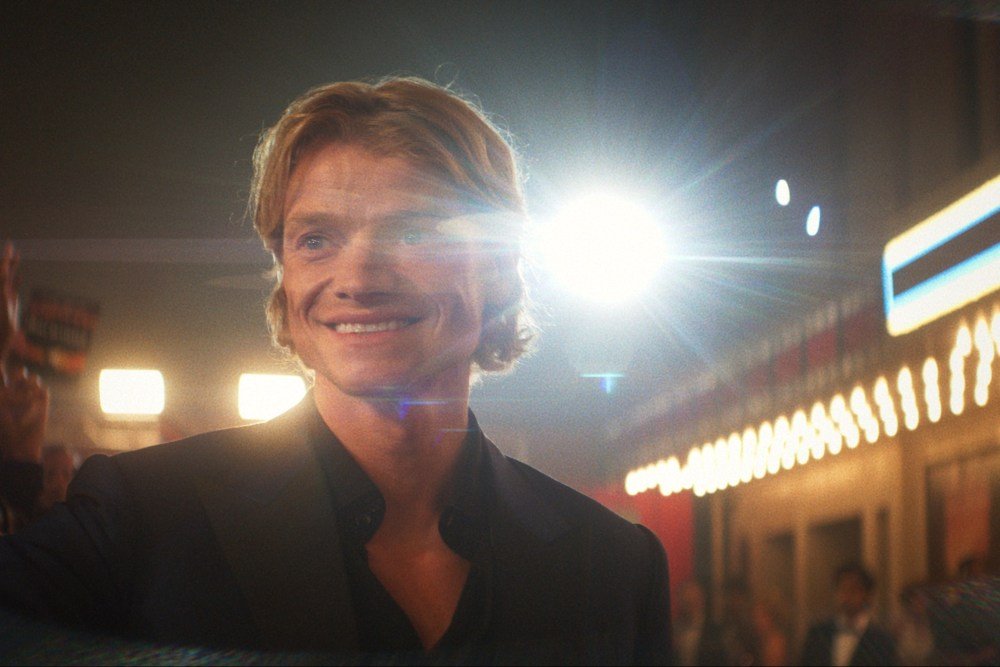
    Who Josh wants to be is also reflected in his hair — yes, that’s a mini-mullet he’s rocking. Issac worked with his hair stylist Tim Nolan who suggested that style. “It’s a perfect thing that again, speaks to somebody that’s trying to hold on to a particular image of youth,” Isaac says. “And one that shows a sense of relaxation and of energy — even though he’s just being strangled the entire time.”

    Josh starts stealing money from the club in order to maintain his lifestyle, and hold onto his image. “He cares more about identity and he wants enough money,” Isaac says. “He’s never going to be able to be a member of this club, but this is the closest he can get to it.”

    Josh, who’s surrounded by extreme wealth, feels a sense of entitlement — and he’s also been stealing money from his late mother’s bank account, “So he is already smudging the line there out of desperation,” Isaac says.

    “He feels he has the right to, like all the rich people, to get his own,” Isaac says. “Whatever that means.”

  • Dylan Sprouse Tackles Trespasser at His Hollywood Hills Home, Holds Suspect Until Police Arrive

    Dylan Sprouse Tackles Trespasser at His Hollywood Hills Home, Holds Suspect Until Police Arrive

    The Suite Life of Zack & Cody star Dylan Sprouse and his wife, Barbara Palvin, encountered an alleged trespasser at their Hollywood Hills home early Friday.

    According to the Los Angeles Times, Palvin called 911 around 12:30 a.m. after she noticed a man on their property and reported a possible burglary. Sprouse then tackled the suspect on the lawn and held him at gunpoint until police arrived, TMZ reported.

    Authorities took the man, whose identity has not yet been revealed, into custody on outstanding warrants. He did not enter the couple’s home, and no injuries were reported, the L.A. Times said.

    The Hollywood Reporter reached out to reps for Sprouse and Palvin but did not receive a response.

    Sprouse is best known for his roles as a child actor on Disney Channel. There, he starred alongside his twin brother and Riverdale star, Cole Sprouse, in The Suite Life of Zack & Cody, from 2005 to 2008, as well as the spinoff series, The Suite Life on Deck, from 2008 to 2011. Following Disney, his credits include Dismissed, Force Grey, After We Collided, Beautiful Wedding, Under Fire and Surrender.

    As for Palvin, the Hungarian supermodel and actress is best known as being a Victoria’s Secret Angel and working with brands such as Prada and Chanel. She’s also accumulated acting credits in Hercules, Tyger Tyger and Love Advent.

    The couple met at a party in 2017 and began dating a year later. They announced their engagement in June 2023 and tied the knot the following month.

  • Box Office: ‘Super Mario,’ ‘Hail Mary’ Rule Over Lee Cronin’s Horror Pic ‘The Mummy’

    Box Office: ‘Super Mario,’ ‘Hail Mary’ Rule Over Lee Cronin’s Horror Pic ‘The Mummy’

    The Super Mario Galaxy Movie and Project Hail Mary continue to rule the box office as new horror pic Lee Cronin’s The Mummy opens in third place domestically with an estimated $12.5 million, based on Friday returns.

    From Universal and Illumination, Super Mario — which will cross the $350 million mark sometime on Sunday — will top the chart in is third weekend with an estimated haul of $30 million. While the sequel is running about $60 million behind the first Super Mario, it is already the top-grossing Hollywood film of the year so far and is on the verge of jumping $700 million in worldwide ticket sales.

    The landscape will change dramatically next weekend when Michael, Sony’s Michael Jackson biopic opens, followed a week later by The Devil Wears Prada 2, which marks the official start of the summer box office.

    Amazon MGM Studios’ Hail Mary continues its remarkable journey, falling only 23 percent in its fifth weekend to an estimated $18.5 million for a domestic cume of $283 million. The sleeper hit is returning to Imax and other premium large format screens this weekend, several days after and star/producer Ryan Gosling and directors Phil Lord and Christopher Miller showed up at CinemaCon to thank theater owners and announce that Amazon MGM is extending the film’s exclusive run in cinemas.

    Produced by Jason Blum’s Blumhouse and James Wan’s Atomic Monster, The Mummy is Cronin’s an R-rated reimagining of Universal’s all-audience franchise. The film has divided critics, but audience exits are solid-to-decent. Also, the pic ended up having to share Imax screens with Hail Mary.

    Jack Reynor, Laia Costa, May Calamawy, Natalie Grace and Veronica Falcón star in the pic, which Cronin wrote and directed. The story centers on a family who has been grieving the disappearance of their daughter eight years earlier in Cairo. Suddenly, they get a call from Egyptian officials revealing she has been found after spending the past eight years in a 3,000-year-old sarcophagus and has been transformed into a living mummy-like creature.

    Cronin is celebrated forreviving the Evil Dead franchise with Evil Dead Rise, which grossed $147 million globally in 2023. He came on the scene with the 2019 feature The Hole in the Ground, which bowed at Sundance.

    James Wan, Jason Blum and John Keville produced The Mummy alongside Cronin.

    New openers at the specialty box office include the Anne Hathaway-led music industry drama Mother Mary from a24, and Morgan Neville’s Lorne Michael biopic Lorne.

    Mother Mary, playing in only five locations, is eyeing a promising per location average of $35,000-plus before expanding nationwide next weekend.

  • Wayans Brothers Say ‘White Chicks’ Sequel ‘Can Happen’ if ‘Scary Movie 6’ Succeeds at Box Office: ‘I’ll Put it This Way; We’re Game’

    Wayans Brothers Say ‘White Chicks’ Sequel ‘Can Happen’ if ‘Scary Movie 6’ Succeeds at Box Office: ‘I’ll Put it This Way; We’re Game’

    Marlon Wayans and Shawn Wayans are eyeing a return to one of their most recognizable comedies, saying a sequel to “White Chicks” could move forward depending on the performance of “Scary Movie 6.”

    Speaking to Entertainment Tonight, the brothers said they are open to revisiting the comedy, which they co-wrote and starred in. “I’ll put it this way; we’re game,” Marlon Wayans said, while Shawn Wayans added that a sequel “can happen” if audiences turn out for “Scary Movie 6,” set for theatrical release June 5.

    Released in 2004, “White Chicks” followed two FBI agents who go undercover as wealthy socialites, transforming themselves from African-American men into a pair of blonde, white women. The film grossed more than $110 million worldwide and developed a strong cult following over time, becoming a staple of early 2000s studio comedies.

    The Wayans brothers are returning to the “Scary Movie” franchise with its sixth installment after being absent from the previous three entries. The original “Scary Movie,” which they co-wrote with Keenen Ivory Wayans, launched a successful parody series that went on to generate multiple sequels and significant global box office revenue.

    “Scary Movie 6” will feature a mix of returning and new cast members as the franchise looks to reestablish itself with audiences.

    In addition to “White Chicks,” Marlon Wayans has also suggested the possibility of revisiting “Don’t Be a Menace to South Central While Drinking Your Juice in the Hood,” another early collaboration between the brothers.

    For now, the future of “White Chicks 2” appears tied to whether “Scary Movie 6” can deliver at the box office.

  • Guadalajara Film Festival’s Co-Production Meeting Program Extends a Lifeline to Argentina

    Guadalajara Film Festival’s Co-Production Meeting Program Extends a Lifeline to Argentina

    Now on its 22nd edition, the Guadalajara Film Festival (FICG) Co-Production Meeting program has grown from strength to strength, luring a wide range of directors and producers from Spain and Latin America, both new and established. There are quite a number of projects from Argentina, which has leaned more heavily on co-productions given the plunge in federal support at home. In 2024, Argentina’s right-wing populist government moved to scrap funding for the national Film-TV body, INCAA, as part of sweeping austerity measures aimed at curbing the country’s runaway inflation.

    Taking place April 20–22 this year, the program requires projects in development – across fiction, documentary and animation – to have a completed screenplay and at least 20% of their financing secured.

    Its primary objective is to link the participants, 19 in this edition, with industry professionals, funding bodies, producers, buyers and international distributors in order to facilitate their completion.

    The selection committee this year included Peruvian filmmaker-producer Joanna Lombardi; Argentine screenwriter Juan Manuel Dartizio, Pato Portillo, creative director of content development company Real Tellers, Mexico-based Bolivian producer Gabriela Maire (“The Good Girls”) and Mexican filmmaker Samuel Sosa.

     “Cinema allows us to tell our stories and preserve them in images, narratives and words, so that in the future people can understand who we were through these films, rather than only through the works that receive the most attention or likes. This is very important for us,” said FICG Industry head Ximena Urrutia.

    Among the standouts in this crop are Daniela Schneider’s “The Infinite Night,” produced by Fernanda López, Amat Escalante and Daniela Romo. It forms part of a highly diverse selection of works from different countries.

    The lineup also features the Argentine project “The Other Voice,” a documentary directed by Agustina Pérez Rial, with a strong producer backing of Nicolas Gil Lavedra, Emiliano Torres and Felicitas Raffo. There’s even a U.S.-Mexico co-production “All Other Parts,” directed by Cristina Ibarra, who hails from in Los Angeles. “As neighbors, the U.S. and our community share deep ties – especially within the Latino community—grounded in common roots and an ongoing dialogue. Sustaining and strengthening that exchange is vital, particularly in the current context,” said Urrutia.

    The lineup:

    “All Other Parts,” (“Las partes que faltan”) Cristina Ibarra, U.S.

    Developed by U.S.-based All Other Parts LLC, a documentary/hybrid production company, the project is in production. Produced by Vanessa Perez, Cristina Ibarra and Heather Courtney, it centers on cross-border surveillance themes. The film follows a man returning to El Paso after 20 years in exile, whose homecoming becomes digital confinement under ICE monitoring. The film traces how a life once defined by movement across the U.S.–Mexico border is transformed into one of enforced stillness and constant observation. As Ibarra states, it explores the shift from physical borders to invisible systems of surveillance over bodies, homes and data.

    “Germaín, The Black Angel” (“Germaín, el Ángel Negro”), Tomás Alzamora Muñoz, Chile

    Developed by Santiago-based Equeco, an auteur-driven Chilean production company founded in 2016 (“Denominación de origen,” “History and Geography”) the project is in development, with a slate expanding through international co-productions led by “Il Cileno” and “Hijas únicas.” Produced by Pablo Calisto, pic follows Germaín, a 16-year-old in 1967 Chile whose abandonment and nocturnal excess become the emotional engine for forming Los Ángeles Negros, one of Latin America’s most influential bands. As Alzamora states, the project reflects on “who stands behind musical phenomena and what drives them to create.”

    ‘Germaine, The Black Angel’ Courtesy of FICG

    “Her Ocean” (“El Mar La Mar”), Julian Amaru, Perú, México

    Developed by Lima-based Final Abierto alongside Mexico’s Apapacho Films, the project is in pre-production for a 2027 shoot, positioning itself within a Peru–Mexico co-production pipeline focused on emerging Latin American auteur cinema. Produced by Maria Paz Barragán and Ruben Rojo, with writing by Julian Amaru and Christopher Vasquez, the coming-of-age magical realist drama follows Ray, a young fisherman fleeing homophobia and family rupture as he journeys to Iquitos in search of his mother, navigating desire, friendship and identity in the Peruvian jungle. As Amaru states, it is “a story of love and courage.”

    “Here Is Not Like That” (“Aquí no es así”), Sebastian Molina Ruiz, Mexico

    From Calle Calandria, the Mexican indie production outfit behind festival titles ‘Mostro” and “Todos los incendios” is developing the hybrid documentary, now in pre-production and expected to draw industry attention ahead of the 2026 World Cup. The film explores Mexico City beyond global spectacle. As Molina Ruiz states, “Here Is Not Like That” seeks to reveal “hidden mechanisms… marked by precariousness, exclusion and everyday resistance,” signaling strong auteur-driven nonfiction trends today. Diandra Arriaga (“Mostro”) and Gabriela Maldonado (“Ricochet”) produce.

    “Kid” Anna Lu Machado, Brazil

    Developed by Rio de Janeiro-based Raccord Produções, founded in 1993 and led by Clélia Bessa, with over 23 titles in partnership with Disney and Globo Filmes and festival presence in Venice, Cannes, and Rotterdam (“Madalena,” “The Little Prince’s Rap Against the Wicked Souls”) in co-production with Baracoa Filmes and Casa Latina Films. Produced by Bessa and executive produced by Gregorio Rodríguez, it follows a filmmaker reconstructing her father’s memory through a Cuban boxer myth, turning cinema into a space where absence becomes dialogue. Machado says: “It is “a hybrid documentary that transforms intimate loss into a universal reflection on memory and bonds.”

    “Menarche,” (“Menarquia”) Jairo Gamaliel Ramos Alvarado, Panama, Spain, Peru

    Developed by Panama-based Infocus Video Factory Cine & TV, “Menarche” is in preproduction as a Spain–Peru–Panama co-production with Cine y TV Teleandes SRL and Marco Antonio Toledo Oval. Reflecting industry interest in inclusive, community-driven storytelling, the film follows an androgynous pre-teen who, after their father’s death, takes on farm duties while confronting identity through her first menstruation. As Ramos notes, it portrays “ancestral rural knowledge with dignity.” Written by Elisa Puerto Aubel and Ramos, it stars Wendy Jaramillo and Christhian Esquivel Palomino.

    “Name and Surname” (“Nombre y Apellidos”), Duván Duque Vargas, Colombia, France

    Evidencia Films, founded by Franco Lolli (“Gente de Bien”) and behind Cannes-selected “La Perra,” partners with Continente Pictures and France’s Srab Films (“Les Misérables”) on the project, currently in advanced development and recently shortlisted for Torino Film Lab’s FeatureLab. Produced by Duque Vargas, Capucine Mahé, Franco Lolli, Christophe Barral,and Toufik Ayadi, it reflects a strong Colombia–France co-production model targeting international festivals. Drama follows a teenager drawn back into his father’s violent loan-sharking world, where escape turns into inheritance. As Mahé says, it marks “the culmination of this quest.”

    “Not a River” (“No es un río”), Diego Martinez Ulansoky, Mexico, Argentina

    Developed by Mexico City-based Caponeto, whose credits include “My Tender Matador” and “The Virgin of the Quarry Lake,” film is in advanced development with Argentina’s Ajimolido Films and currently seeking co-production partners and funding, reflecting ongoing industry demand for cross-border Latin American collaborations. The drama follows Tilo, who travels to a remote island after his father’s death, where buried tensions and unresolved pasts surface. As Ulansoky states, it explores “a territory where the real and the ghostly coexist,” focusing on memory and what remains unspoken.

    ‘Not a River’ Courtesy of FICG

    “Our Lady of Whispers” (“El Camino Amarillo”), Ale García & Carla Sierra, México, Chile

    Developed by Mexico-based El Camino Amarillo in co-production with Chile’s La Palma de Oro and La Vieja Rara, the project in development seeks additional financing and international co-production partners. Positioned within Mexico–Chile elevated horror collaborations, the drama follows a grieving mother who invokes La Susurradora after a brutal family loss, gaining destructive powers that reveal revenge as self-consumption. As Sierra states: “Rather than representing horror, we aim for the viewer to inhabit it –uncomfortable, intimate and impossible to look away from.”

    “Plaster Virgins” (“Vírgenes de yeso”) Katherina Harder, Chile

    Developed by northern Chile-based Volcánica Films alongside Cyan prods (“Medea,” “Delirio” by Alexandra Latishev), the project is produced by Cynthia García Calvo and written by Harder and Elisa Eliash, it reflects a focus on identity-driven narratives within culturally rooted settings. The coming-of-age LGBTQ+ drama follows Rosario, a 14-year-old girl in La Tirana who, amid a vibrant religious festival, experiences a personal awakening through her connection with an older dancer. As García Calvo states, it explores gender roles and social expectations within a unique visual and sonic universe.

    “Talia After Talia” (“Talia después de Talia”), Pedro Speroni, Argentina, France, Switzerland

    Developed by Argentina-based El Ojo Silva, “Talia After Talia” is in advanced development as a co-production with Les Films de l’Œil Sauvage and Alva Films, with support from the CNC Enhanced Development Grant and Stichting Connected Foundation, reflecting ongoing industry support for international co-productions. The documentary follows Talia, 27, returning to Buenos Aires’ Fuerte Apache after nine years in prison, navigating survival, stigma and autonomy. As Speroni states, the film gives her “a dignified and resonant voice.” “Talia after Talia” completes the trilogy that Speroni began with “Rancho” and “Los Bilbao,” delving into the prison universe.

    That I Die Because I Do Not Die” (“Que Muero Porque No Muero”) Felipe Carmona, Chile, Argentina

    Developed by Chile-based El Otro Film, known for Queer Lyon awardee “The Prince” and “The Reborn,” the project is in advanced development with Argentina’s Le Tiro, currently seeking financing, reflecting ongoing interest in auteur-driven Chilean–Argentine co-productions with strong festival positioning. Fronted by Pablo Larraín star Alfredo Castro and Laura Paredes, drama is set in 1970s Chile follows Anglés, a priest and literary critic leading a double life between academia, clandestine Marxist instruction and secret artistic circles, until a liaison with a writer and her CIA-linked husband pulls him into a surreal spiral of political and spiritual collapse. As Carmona states, it explores “the contradiction between culture and barbarism.”

    ‘That I Die Because I Do Not Die’ Courtesy of FICG

    “The Friends of My Parents” (“Los amigos de mis papás”), Romina Tamburello, Argentina

    Developed by Argentina-based Pez Cine in co-production with Imval Producciones and El Cielo Cine, and Tamburello’s follow-up to hit “Vera and the Pleasure of Others,” the project is in advanced development. Produced by Santiago King, it follows a standard independent Argentine feature structure focused on character-driven comedy with regional co-production collaboration. The film follows a daughter who tries to help her parents become swingers, leading to an exploration of family boundaries and intimacy dynamics.

    “The Infinite Night” (“La Noche Infinita”), Daniela Schneider, México

    Developed by Mexico-based Cárcava Cine (“Lost in the Night,” Cannes 2024; “Robe of Gems,” Berlinale Jury Prize 2023; “The Untamed,” Venice Best Director 2018), in co-production with Peluca Films, Cárcava Cine and El Estudio, the project is in development and structured for international financing, with early discussions with French sales agent Luxbox. Produced by Daniela Maung, Fernanda de la Peza, Amat Escalante and Pablo Cruz, it is positioned within a festival-driven auteur slate. The film follows Bertha, a young mother whose family secret destabilizes her life as she becomes obsessed with a woman from a century earlier, where inherited memory, desire and domestic histories collapse across generations.

    “The Other Side” (“Del otro lado”), José Luis Rugeles Gracia, Colombia, Brazil, France

    Developed by Colombia-based Rhayuela Films, producers of “El Páramo,” “Alias María” and “Rebelión,” “The Other Side” is in development as a co-production with Capuri TV (Brazil) and Promenades (France). The project, starring Claudio Cataño (“One Hundred Years of Solitude”), reflects ongoing industry interest in character-driven Latin American–European collaborations. Drama follows Miguel, a doctor who loses his son and abandons his life, drifting through the streets where he forms fragile bonds with a street dog and a young sex worker. As Rugeles states, it explores “depression, addiction and solitude” shaped by “human fragility.”

    ‘The Other Side’ Courtesy of FICG

    “The Other Voice” (“La otra voz”), Agustina Pérez Rial, Argentina

    Gaman Cine, founded by Nicolas Gil Lavedra, behind acclaimed titles “Eami” and “Ls83,” is finalizing development on the documentary, co-produced with Fiord Estudio and Lorolo. The film reconstructs the exile of iconic singer Mercedes Sosa between 1979 and 1982 through unpublished letters and archival material, reflecting a broader industry trend toward archive-driven music documentaries. As Pérez Rial explains, the project reveals “an intimate and little-known dimension… where Mercedes emerges through her own public and private words.” Gil Lavedra, Felicitas Raffo and Emiliano Torres produce.

    “The Valley of the Echoes” (“El Valle de los Huesos”), Adán Ruiz, México

    Travesía Cine, a Mexico City-based studio focused on auteur-driven cinema, is advancing the documentary in development with co-producer Avalancha Studio, while in discussions for Mexican distribution. Produced by Yuli Rodríguez and Ruiz, it’s set in an industrial town where multiple lives intersect around a skeleton built from found bones, reflecting systemic violence. As Ruiz states, it depicts violence as a social sickness embedded in everyday life. “Using scavenged bones as a narrative bridge, the film connects three fractured lives to reflect on the macabre intersection of industrial exploitation and necropolitics.”

    “The Whisperer” (“La Susurradora”), Ale García & Carla Sierra, México

    Developed by Mexico-based La Palma de Oro Films and La Vieja Rara, the project is in development. Produced by Antonio Urdapilleta and Valentina Vio and written by Ale García and Carla Sierra, the film follows Alba, who returns to Catemaco after the lynching of her husband and son, and summons La Susurradora, an ancient deity that grants her destructive power in exchange for bodily sacrifice. As she carries out her revenge, she becomes increasingly consumed by the force she invokes.

    ‘The Whisperer’ Courtesy of FICG

    “Why Did You Come Back Every Summer” (“Por qué volvías cada verano”), Lorena Muñoz, Argentina

    Developed by Argentina-based Mostra Cine alongside Cindy Teperman SRL and Atrece Creaciones, the project is in advanced development, positioning itself within a strong wave of Latin American films addressing institutional abuse and memory. Produced by Valeria Bistagnino, Tomás Eloy Muñoz Lázaro, Cindy Teperman, Delfina Montecchia and Ana Saura, it focuses on socially driven storytelling. Drama follows Lourdes, 20, who decides to report her uncle, a local police commissioner, for childhood sexual abuse during the summers she spent in his town.

  • Danielle Brooks on ‘If I Go Will They Miss Me’ Being Acquired and How the Independent Film Inspired Her to Make Her Own Short

    Danielle Brooks on ‘If I Go Will They Miss Me’ Being Acquired and How the Independent Film Inspired Her to Make Her Own Short

    Major productions across the stage and screen have been a cornerstone of Danielle Brooks’ career, from her breakout role in Netflix’s Orange is the New Black to her Broadway debut in The Color Purple, for which she earned a Tony Award nomination for best featured actress in 2016, to the 2023 musical film adaptation of Alice Walker’s book which earned her Oscar and Golden Globe nominations. Yet it’s indie projects, the Juilliard grad says, that make her feel most connected to her craft and purpose.

    “Independent films are so incredible because I think they reflect the truth of who we are,” Brooks said during the Miami Film Festival, where she received the Art of Light Award following a screening of her latest project, If I Go Will They Miss Me Tuesday night. “It’s not about big blockbuster movies to make a dollar, it’s about the people. And that’s why I got into this, so that I could be a reflection, the light, because there were people in this industry, artists that were that light for me.”

    Brooks stars as Lozita Harris, a mother of three trying to hold her family together as her partner, Ant (J. Alphonse Nicholson), struggles to connect with their son when he returns home from prison in the semi-biographical, mythical feature from Walter Thompson-Hernández.

    During the Miami film festival, Brooks chatted with The Hollywood Reporter about why she so deeply believed in the project, which, since its Sundance premiere in January, has been acquired by Rich Spirit, shooting in a public housing complex in Watts and how working on the film inspired her to make her own short.

    Your connection to If I Go, Will They Miss Me dates back to Walter Thompson-Hernández’s 2022 short of the same name. What drew you to the project?

    My team had come to me and said, “Hey, there’s this film that we want you to think about being involved in. There’s this amazing new up-and-coming director, Walter Thompson Hernandez.” And I’m always like, “Ooh, new. I like,” because that means there’s a new energy that’s being put out into the film industry, and that excites me. So they were like, “Come look at the short.” And I looked at the short, and I was like, “Wow, this is different from what I’ve seen before, but it still has this energy, sort of like a Moonlight, that I liked.” And I loved how he shot Black people, but I also knew that there was passion behind it because I could tell that there wasn’t this big budget that he had, that everything that he was putting out there was community-based. …And when I met with him, we sat down at the London hotel, and we talked for over an hour, and I immediately told my team, “Yes, I’m down.” And this truly was a passion project. This is one of those films that you end up spending money to be in it. It wasn’t something that came with a large check, and I knew I wanted to be a part of it because it felt honest and real. It was so different from anything that I’ve ever played before, people like Sophia [in The Color Purple] or Taystee [in Orange Is the New Black] who were bigger-than-life characters; there was a quietness about her that I was drawn to.

    Your character, Lozita, and all of the characters in this film are based on real-life people. What did your preparation look like, and is there a difference in how you approach roles that are biographical in nature versus fictional characters?

    It’s very different. I enjoy playing people who are real. I got the chance to play Mahalia Jackson in the past, and each character that you play does require something different, but this one was interesting because Lozita was based on a true person, and so was Big Ant. But unfortunately, the person that I played had passed away, so I wasn’t able to speak with her. Everything that I was learning about her was from her partner, who was still alive, and from Walter, the director, who was good friends with her, and pictures. Pictures tell a thousand words. There’s one thing I really wish I could have had, which was her tattoos, because she had all these tattoos, and I felt like they told such a story about who she was, and she wore braids. So I was like, “I’ve got to make sure I have these braids.” And just how she held her mouth. I got to see pictures of her and her husband and how he would hold her, and all of these things that just told me a story.

    What did Walter say it was about Lozita and Ant that made him want to make this film?

    It’s this thing about life. None of us asked to be here, but we all have to figure out how to survive it. And that’s what we’re watching this family do is figure out how are we going to survive our circumstances, the things that we’ve been through in the past, how are we going to make it through that? And what are we going to pass to our children? We had multiple conversations about it. And there were a lot of times that it felt too real because we’re shooting in Watts, too. We shot in the projects, and so we weren’t in a position to say, “All right, everybody, leave your homes for a while and come back in tomorrow.” We’re in their environment. And sometimes it was really real. Life imitates art, and art imitates life, so there was no moment for me to escape the character. I felt like I was always close to her because I would see kids beautifully playing outside with skates on. This is not a community that has access to iPads and all of that stuff. So the kids are outside watching us, and that was amazing because now I’m asking, “What do you want to be when you grow up?” [and they say] “I want to be an actor,” because they see a reflection. The children are just as chocolate as me or as round-faced as me.

    You had an amazing screen partner in J. Alphonse Nicholson, and there’s so much emotion that comes out in the scenes with you two in the bedroom, trying to figure this relationship out. Were you all big on rehearsal? Were you just finding the emotion in the moment?

    We did have some rehearsal. We didn’t have much time, though, but let me talk about J. Alphonse. I freaking love that brother. He is one of the best scene partners ever, super talented, and I’m going to take some credit. I was like, Walter, “We need him,” and Walter was like, “OK, let me sit down with him,” and they just hit it off. He brings so much to every character that he plays, but the way that he works, he allows you to be vulnerable. Being in a space with him, having to take my shirt off and have intimate scenes, it was a safety with the way in which he works that I felt comfortable to give all myself to her, no problem. We had some very personal conversations about personal experiences we both have been through, because I’m going to tell you right now, I don’t look like what I’ve been through. I say that because I can really relate to [Lozita] and the same with J. [and his character] so there are moments where it felt like this is too much, but we had each other to be like, “You good?” And that’s important. It’s very important to be able to trust your same partner that way.

    What was your reaction when you saw the finished film?

    I cried like a baby. It messed me up…it’s like, this is what it is like to say, “I love you, but you’re not good for me. You’re not healing me.” It’s such a beautiful reflection of, again, survival, how tough life can be, but yet we’ve got to push through it. And what does love really look like for my character? Love is getting up out of there. She had to go for her family, for herself, for her kids, and watching Ant, he’s having to take a moment and reflect. He’s trying to do the right thing, but it’s too late.

    The overall journey of this film is inspirational, I think, especially for the audience at a film festival like this. Walter made his original short film in 2022 and won the jury award at Sundance; in 2023 it was selected for the Sundance Institute Screenwriters & Directors Lab; in 2025 it got two grants and you all made the feature film, then it had its Sundance premiere in January 2026 and in March it was acquired by Rich Spirit so now we’re looking at a theatrical release this fall. Did you expect to be able to take this project this far? What would you say aspiring filmmakers should take away from this journey?

    Did I expect this film to go this far? Yes, because it is good. Like you just know. And there’s something special about this film. I think the hard part is, is it the right timing? And I do feel like it’s the right time — we’re in a crazy time, and we’re trying to figure it out — but I do feel like it’s the right time. What aspiring filmmakers can take is that you can do this thing. I am one of the aspiring filmmakers, and it’s because of the way that I saw [Walter] work that I ended up shooting my own short film. If you have a passion for it, get it done. There are people that will align with that passion. There are people that are trying to figure this thing out, too, and find their community. Just start talking about it and say, “Hey, this is what I want to do.” And it might not be that first person you run into, but somebody will say yes. And one other thing that I want to say while I have the mic is I feel like this is a film that will be successful by word of mouth. So we’re going to need you.

  • ‘Kevin’ Review: Jason Schwartzman Leads the All-Star Voice Cast of Amazon’s Unevenly Funny, Ultimately Sweet Pet Cartoon

    ‘Kevin’ Review: Jason Schwartzman Leads the All-Star Voice Cast of Amazon’s Unevenly Funny, Ultimately Sweet Pet Cartoon

    When Kevin (voiced by Jason Schwartzman), star of Amazon’s new animated series Kevin, suffers a bad breakup, he does what any young man in the big city might do.

    He moves out of his old place, picks up new friends and new interests, explores his former neighborhood with fresh eyes. He takes time alone to think about what he really wants out of a relationship, or out of life. He considers new potential life partners, and eventually courts one. Occasionally, unhappily, he backslides into contact with his ex.

    Kevin

    The Bottom Line

    An amiable hangout comedy, with a feline twist.

    Airdate: Monday, April 20 (Prime Video)
    Cast: Jason Schwartzman, Amy Sedaris, John Waters, Whoopi Goldberg, Aparna Nancherla, Gil Ozeri, Aubrey Plaza
    Creators: Aubrey Plaza, Joe Wengert

    What makes Kevin’s journey more unexpected than most is that he is no fleece-vested banker or tattooed barista, but a tuxedo cat; his split is not with a lover but with his human owners. The feline twist is enough to make Kevin, created by Joe Wengert and Aubrey Plaza, feel like a fresh spin on the hangout comedy. If it only occasionally lives up to its fullest potential for humor and heart, it eventually finds enough warmth to be worth curling up with.

    Doubtless a huge chunk of the target audience for Kevin just read that plot description and prepared to react in much the same way that Seth (Gil Ozeri), a normally milquetoast animal shelter manager, does to an owner who’d dared give up his cat: “Abandoning a furry companion is the ultimate no no!” he screeches. “You belong in the Hague, asshole!” So rest assured that this is no Sarah MacLachlan-soundtracked sob story of abandonment.

    It is, instead, Kevin who leaves when the couple who own him announce they’re breaking up, deciding he’d rather take his chances by himself than follow Dana (Plaza) to her new home. Since Kevin is set in a universe that sits somewhere between The Secret Life of Pets and Bojack Horseman on the spectrum of anthropomorphized creatures — animals communicate in English with humans and sit next to them at the bar or on the train, but don’t seem to rent apartments or, for the most part, have steady jobs — Dana has not much choice but to let him go and hope he wants to return someday.

    After a disastrous evening in Central Park, during which the squirrels in the trees mock the house cat’s spectacular unsuitability for life in the “wild,” Kevin makes his way to Seth’s Furrever Friends shelter in Astoria, Queens. There, he makes a new home amid a motley crew that also includes an imperious Persian named Armando (an excellent John Waters); a dopey and diseased kitten named Judy (Aparna Nancherla); Seth’s bossy Shih Tzu (a hilariously mean Amy Sedaris); and Cupcake (Whoopi Goldberg), a feral cat with side hustles streaming on an OnlyFans-esque website and selling her vomit on the dark web. (How she’s navigating the banking system and what she needs the money for in the first place are not questions Kevin really gets around to answering. It’s best just not to think about the practicalities too hard.)

    Especially in its early going, Kevin is hit or miss as a vehicle for humor. Some of its jokes, like a bit about a duck’s corkscrew-shaped penis, smack of a series trying too hard to declare that it’s Not Your Little Sister’s Animal Cartoon. Others, like a hoary line about cats being baffled by why people are always scooping litter, make no sense in a universe where cats have opposable thumbs and speak human language. At least one subplot, involving an equine Broadway star named Patti LuPony who’s voiced by Patti LuPone, feels like a Bojack Horseman castoff. Lots more punchlines just sort of sit there, neither offensive enough to provoke groans nor clever enough to coax laughs.

    But as the series found its groove over its eight half-hours — and, perhaps, as I grew more accustomed to its off-kilter sense of humor — the ratio of hits to misses improves. Kevin eventually falls into the likable rhythms of a New York hangout comedy à la Friends or Seinfeld or, more recently, Adults, albeit with a much higher level of absurdity. The series feels most surprising and most delightful when it gives itself over to full-bore silliness, as with a C-plot in which a colony of ants crown Judy as their new queen, or another in which Kevin meets Rat Pizza — a sentient slice of pizza that drags a dead rat around and bitterly laments how unfavorably he’s treated compared to his celebrity inverse.

    Eventually, somewhere amid all the Gen Z-coded kittens and the incestuous cat romances, something more earnest starts to emerge. There’s real sweetness in the way the characters relate to each other, whether it’s Armando reminding Judy to hold out for the right forever home rather than let herself get adopted by a narcissistic nepo baby who sees her only as a prop for her art, or in Cupcake nudging Armando to come to terms with a past heartbreak involving a previous owner.

    Kevin’s meandering search to figure out what he wants out of his next human companion (or if, indeed, he wants another human companion at all) will feel relatable to anyone who’s ever gotten out of a long-term relationship unsure who they might be outside of it — if they ever even actually liked Halloween or the band Pavement or the show Say Yes to the Dress, or just assumed they did because their partner did.

    But embedded within his quest is also the more pet-specific acknowledgment that though we may take them in and feed them and link our contact addresses to their microchips, our animal companions have interiorities of their own, wants and needs that might coincide with our own or might not. Kevin, which press materials indicate is based on a real cat and a real breakup, becomes a tender love letter to the unknowability of the creatures who’ve deigned to let us share in their lives. Speaking as a proud cat lady, I can’t think of a nicer thing to say about Plaza and Wengert than this: They seem like they must be absolutely wonderful pet owners.

  • How Coachella’s Longest-Standing Sponsor Holds Its Own in the Age of Brand Activations

    How Coachella’s Longest-Standing Sponsor Holds Its Own in the Age of Brand Activations

    If you purchase an independently reviewed product or service through a link on our website, The Hollywood Reporter may receive an affiliate commission.

    As someone who hadn’t been to Coachella since 2014, this year’s festival felt deeply familiar in many ways, and entirely unrecognizable in others. While 2014, of course, had its fair share of brand partners, sponsored parties and experiential marketing, they were a drop in the bucket compared to what has developed in just 12 years time.

    Cut to 2026: Brand activations are popping up by the dozens, and Coachella is filled with — what have now been dubbed — “festivals within a festival,” or smaller curated experiences — often exclusive — within the larger event (think Revolve Fest or Kourtney Kardashian Barker‘s Camp Poosh). But other than the music (and the desert heat), there’s another major throughline between Coachella then and Coachella now: Heineken.

    The Dutch brewing company, Coachella’s official beer sponsor for 23 consecutive years, is the festival’s longest-standing brand partner. Well before the introduction of Heineken House (the brand’s dedicated music stage and beer garden), which, funnily enough, made its Coachella debut in 2014 (I remember because I was 18 and couldn’t get in), the brewer has always held a prominent role at the festival. But how has Coachella’s most enduring partner stayed relevant in the age of activations? The short answer: community. The slightly longer answer? By innovating a piece of technology that brings people back to what OG Coachella felt like: connected.

    “The Clinker,” first introduced at Weekend One of Coachella 2026, is a smart device festivalgoers place around their Heineken cans that lights up to signal music compatibility upon contact with another Clinker. By syncing with each user’s Spotify or YouTube Music data, the device allows two fans to, first, see their exact overlap in music taste, and then, share social media handles to stay connected throughout the festival and beyond.

    Festivalgoers using “The Clinker” at Heineken House during Coachella Weekend One.

    Heineken

    “Heineken developed the Heineken House to bring fans together over music with a beer in hand,” Alison Payne, Heineken USA’s Chief Marketing Officer, exclusively tells The Hollywood Reporter. “This year, we went a step further by creating something that actively brings people together in real time. ‘The Clinker’ turns a simple ‘cheers’ into a conversation starter, leaving festival goers with a new connection or memory that will live on once the dust settles from the festival.”

    Beyond the new tech, crowds were pulled to the Heineken House for its stacked lineup. Weekend One included Wale, Sean Paul, Coi Leray, Motion City Soundtrack and Less Than Jake, while Big Boi will replace Paul for Weekend Two. And since Heineken House is a closed off space with only one entry point, there’s an intentional effort to make a massive festival feel intimate.

    This theme of fostering connection prevailed throughout the festival, with an overarching goal to bring Coachella back to its roots. (In fact, many fans noted that 2026 had a similar feeling to 2016.) Instead of dividing the festival, the standalone activations aimed to cultivate community. Right around the corner from Heineken House, Aperol opted for a lounge-style day club, while Soho House brought its same private, elevated feel to The Hideout. Meanwhile, just across the grass, Absolut’s Heat Haus was a star-studded affair with throwback DJ sets and Absolut Tabasco Vodka on the ready. Anyone over 21 could enter, but the space still managed to feel private and personal.

    Sean Paul performs onstage at Coachella’s Heineken House on April 11, 2026.

    Phillip Faraone/Getty Images for Heineken

    At a time when — even in the most crowded of spaces — it’s easier than ever to feel isolated, brands are actively choosing to fuel connection. We’ll “Clink” to that.

    Related: How to Secure — and Save on — Last-Minute Stagecoach 2026 Passes

  • LISTEN: Betches Media CEO Aleen Dreksler on Building a Digital Hub for Women With Comedy and Community

    LISTEN: Betches Media CEO Aleen Dreksler on Building a Digital Hub for Women With Comedy and Community

    On today’s episode of Variety podcast “Strictly Business,” Aleen Dreksler, CEO and founder of Betches Media, details the digital media brand’s origin story and why it blossomed into a hub for comedy and community designed for women. The episode also features a separate conversation from the SXSW festival that highlighted Variety‘s recent 10 Creators to Watch list.

    Listen to the full podcast here

    Dreksler traces Betches Media‘s rise from its humble beginnings with two friends in college at a time when Dreksler thought she was on her way to medical school. But the opportunity to become a digital media entrepreneur got in the way. Betches’ early DIY content efforts on Instagram and Facebook were buzzy enough to land the trio a book deal, which proved to be the foundation for a brand that combines comedy and community and lifestyle topics.

    “The key to what Betches the brand really represents is — it’s your funny best friend in the group chat, the one that will say the thing with you. And that is what we represent for people,” Dreksler says. “That is what the brand is. The reason why I get up every day is really to make women laugh and to feel seen and understood and all of our thoughts that we’re thinking throughout the day, whether it is the latest pop culture or what’s going on in Bravo, what’s going on in the white House, or what’s going on in your dating life?”

    Dreksler has seen the digital media eco-system evolve and grow significantly since Betches first hung out its shingle in 2011.

    “Right now, my engagement rate is one of the highest across all women’s media. And now the key metric for me is DMs — what are people sending to each other in their DMs? What share percentage of all of our engagement? So it’s not just engagement rate, it’s about share percentage. So that’s where we’re looking in terms of where I think the industry is going to go,” she says.

    The episode also features a separate conversation with members of Variety‘s 10 Creators to Watch list that was recorded March 14 at the SXSW festival in Austin, Texas.

    The group speaks frankly with Variety reporter Selome Hailu about living and working online, and the algorithm’s grip on their creative output. It rewards consistency and punishes experimentation, and the psychological cost of chasing it, they said, is real. Creator Vinny Thomas warned of a very specific creative hazard. “There are people who will have gone dead behind the eyes,” he says, “because they know what they have to do and they’ll get up there and do it, but the light is gone.”

    Kennedy French contributed to this report.

    “Strictly Business” is Variety’s weekly interview podcast featuring conversations with industry leaders about the business of media and entertainment. (Please click here to subscribe to our free newsletter.) New episodes debut every Wednesday and can be downloaded at Apple Podcasts, Amazon Music, Spotify, Google Play, SoundCloud and more.