There are only 21 million $BTC, and some of the coins that are now in circulation have been lost, misplaced, or thrown away by their owners. These coins will never be moved again, despite the fact that they are worth a lot of money; they are essentially permanently out of reach. These stories are just as noteworthy as those of people who have made fortunes by holding bitcoin all this time, and the following is a closer look at some of bitcoin’s most unfortunate stories.
James Howells and the Landfill Hard Drive
Back in the early days, Howells said he was mining $BTC in 2009, and the Newport, Wales resident, threw out his laptop’s hard drive at a landfill when he was cleaning the house. The catch; his private keys were inside the drive, which held an estimated 7,500 to 8,000 $BTC. That’s around $578 million of value using current bitcoin prices. Howells’ story is one of the most famous of the bunch due to the fact that he spent more than a decade trying to get permission to excavate the site, and he never succeeded.
Stefan Thomas and His 2 Guesses
Thomas was a programmer who decided to store his private key on an encrypted Ironkey USB drive. He lost the paper, which stored his password to bypass the encrypted wallet to access 7,002 $BTC worth around $540 million. The Ironkey gives the user ten chances to get the password correct, and Thomas has unfortunately already blasted through eight guesses, leaving only two left. Reports say he’s stopped guessing and decided to stop rather than risk the last two.
9,000 $BTC Frozen in a Stranded Change Address
According to an old bitcointalk.org post, an individual had an old backup of his bitcoin wallet and continued to use the wallet after the backup was created. After restoring the $BTC wallet’s old copy, it did not log the newly created change addresses. This left the user with a loss of 9,000 $BTC, worth $694 million, that he could monitor using a blockchain explorer, but had no way to retrieve them.
A Missouri Farmer’s Mysterious Refund
According to a posted Substack called Shehan’s Blog, a client of the author named Samantha reportedly lost 100,000 $BTC. That’s a whopping loss of $7.7 billion, using today’s exchange rates. The story is that Samantha accepted a large bitcoin refund in 2010 from a European vendor for veterinary medicine. Samantha said she had zero knowledge of how to manage the 100,000 $BTC and lost all the keys during a phishing incident. Samantha, a Missouri farmer, thought she was talking with tech support when she handed over her private keys.
Campbell Simpson’s Tossed Hard Drive
Back in 2017, Bitcoin.com News reported on an Australian media/IT figure who threw out a hard drive holding his bitcoin wallet while discarding his belongings. Simpson acquired the coins in 2010 and explained how he was paid in the relatively unknown crypto asset for some work. One day, he decided to toss out “USB sticks, 3D glasses, USB cables, PC components. All that sort of literal junk. A pile of junk that went into a skip.” Approximately 1,400 $BTC, worth $107 million today, went in the trash with the so-called literal junk.
A Brother’s Belongings
In 2020, a Reddit user named Shotukan said he lost 533 $BTC valued at roughly $41 million when he gave a laptop holding a bitcoin wallet to his brother years earlier. His brother passed away in 2019, and he went through his belongings, but the specific drive was never found. Shotukan noted that the laptop was likely discarded among disorganized possessions. He acquired the $BTC by buying the crypto asset in 2010.
Reformatting a Colleague’s Hard Drive
According to one Barbadian entrepreneur’s story, 800 $BTC was lost when a fellow employee accidentally reformatted his laptop. Gabriel Abed had his private keys stored on the laptop. Reports say Abed acquired his bitcoin long ago in 2011, and reportedly, it was only a portion of his total holdings, which he had distributed across multiple wallets as a safety precaution. Still, his 800 $BTC is now worth $64.76 million using today’s exchange rates.
The Deleted Encrypted File
Another tale of lost bitcoins involves a Ukrainian politician and member of parliament (Verkhovna Rada), known as Davyd Arakhamia. He accidentally encrypted his file that contained his $BTC private keys, which resulted in the loss of 400 $BTC or around $32 million, half of what Gabriel Abed lost. The businessman accepted crypto assets in the early days, and he says the file he encrypted was thought to be a movie file.
Knowledge, Education, and a Better User Experience Still Need More Attention
These stories show the downside of having full control over your own crypto, especially when you do not possess enough knowledge about self-custody wallets, precautions and best practices. The fact of the matter is, people forget passwords, lose devices, and make serious financial mistakes, but Bitcoin’s immutable blockchain doesn’t give second chances.
Better recovery options could make crypto safer and easier for everyday users and since these losses happened, the industry has improved this environment modestly. We all know Satoshi’s famous line, and that lost bitcoin can reduce supply and might increase its value, but for the people who lose it, the cost can be huge.
Critics call the US multi-billion-dollar oil deal in Venezuela modern-day colonialism. The agreement reportedly gives the US control of 20% of Venezuela’s oil reserves for decades, all without the country’s legislature’s approval.
Are Bitcoin investors falling for the market’s “September Trap”?
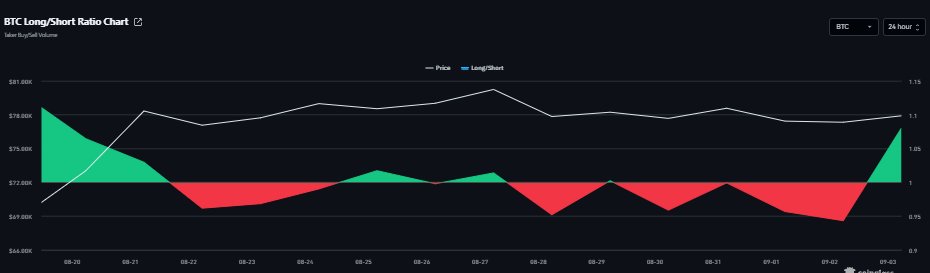
In terms of positioning, traders are becoming more long biased on Bitcoin, implying they expect a bullish move that the technical formation has yet to confirm.
Because from the technical standpoint, $BTC has been trading below $80k for more than two weeks, which keeps the risk/reward equation in check.
However, the setup on the chart below implies that the bulls are willing to risk a lot for a big reward.
According to CoinGlass data, Bitcoin’s funding rates are positive, and the long/short ratio has jumped to 1.08 from below 1 over the past week. Moreover, it is the highest ratio of long positions since the mid-August cycle.
Source: CoinGlass
In essence, the traders are expecting a breakout above Bitcoin’s current resistance.
However, it must be noted that not everyone is optimistic.
An analyst on X posted asking for a $BTC short, claiming that $BTC could reach the $52k level and then turn around and head back up. This divergence in viewpoints can only contribute to $BTC price’s volatility and put more pressure on its current consolidation.
In this context, it becomes critical to take a closer look at the on-chain situation. And so far, it’s suggested that there is even a clear bias forming.
The catch, though? Either way, Bitcoin [$BTC] stands at serious risk of creating a September trap.
Bitcoin rally meets weak sentiment
Bitcoin enters September with bearish positioning and weakening market signals.
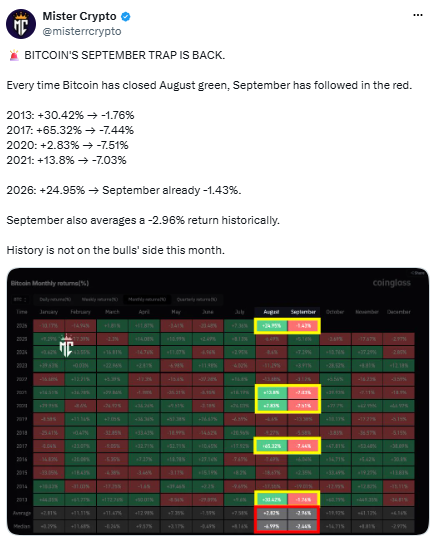
According to Santiment data, Bitcoin closed August nearly 25% higher than it opened; however, the sentiment did not follow suit. $BTC price climbed from roughly $64.7k to $78.3k, marking one of its strongest August performances.
And yet, Santiment’s Sentiment Balance averaged only +32, compared to +72 that was recorded in July, when Bitcoin traded at around $63k. So, in contrast to the strong rally, market participants remained rather bearish.
While this alone supports the ongoing “September trap” narrative, $ETH/$BTC is adding yet another layer to the setup. The pair closed the month above its 20-month moving average, which suggests that Ethereum could be gaining momentum against Bitcoin.
If this trend holds, Bitcoin dominance could come under further pressure, creating another headwind for $BTC in September.
Source: X
With this in mind, the analyst’s Bitcoin short call makes more sense. Weaker on-chain data, negative sentiment and a stronger $ETH/$BTC setup point to more downside risks for $BTC.
So, could this positioning be an early signal that Bitcoin’s “September trap” is in play? As the chart above shows, bullish Augusts have often set the stage for a weaker September. Should this be a repeat performance, then $BTC could face another correction as the month progresses.
Final Summary
Bitcoin rallied in August, but weak sentiment and on-chain data are raising downside risks.
With $ETH/$BTC gaining strength, $BTC could be heading into another “September trap.”
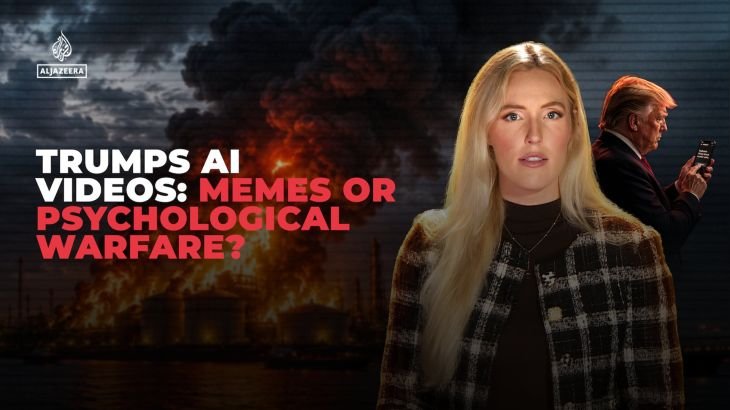
Trump’s use of AI generated content has ramped up in recent months, going so far as posting videos of fake military strikes on Iranian infrastructure. His administration says he’s ‘sending a message’, but as Al Jazeera’s Emma Withrow explains, the rest of the world is left to figure out if he’s serious or not.
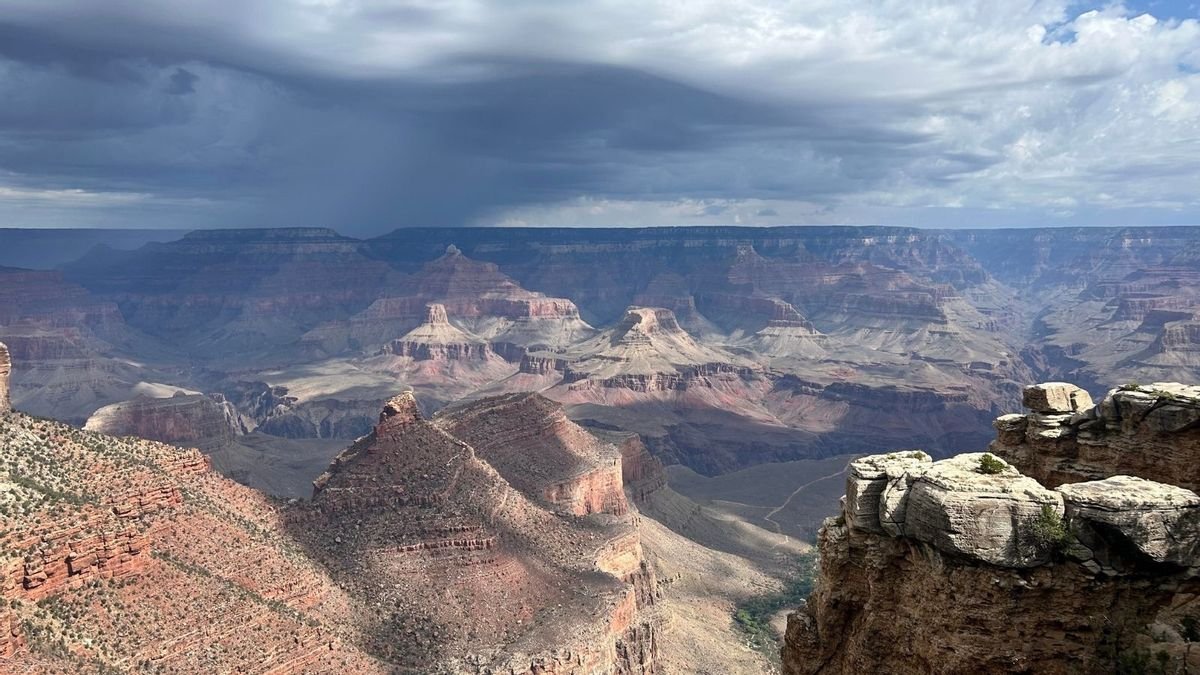
The claim that U.S. President Donald Trump diverted 300 first responders to work on his Washington, D.C., beautification projects, thus making those workers unavailable for immediate rescue efforts in the aftermath of the Aug. 29, 2026, Grand Canyon National Park flash floods, is unproven.
The rumor stemmed in part from users sharing a Sept. 1 article from the online publication The Lever, which reported, “Trump reassigned 300 National Park Service emergency responders to golf course and reflecting-pool renovations before the Grand Canyon flooded.”
The Lever cited a CNN article published days before the flooding reporting hundreds of NPS first responders were reassigned without saying exactly when the staffing shifts occurred. The CNN story cited its own review of internal communications and department data, as well as anonymous sources.
Snopes has not been able to review the same internal CNN documentation, nor have we located information confirming or debunking the claim that Trump’s reported diversion of first responders hampered flood rescue efforts.
An Interior Department spokesperson said of the rumor that the reported diversion of workers hampered the flood response, “That is 100% false.” We reached out to numerous other relevant parties and will update this article if we receive further details.
A rumor that U.S. President Donald Trump diverted 300 first responders to Washington, D.C., to work on his administration’s beautification projects circulated online in early September 2026. People sharing the claim suggested they would have proved key in rescue efforts, possibly saving lives, had they been available immediately following the Aug. 29 flash floods inside Arizona’s Grand Canyon National Park. We have not yet found evidence that would confirm or debunk this rumor.
The National Park Service, an agency under the Interior Department, announced closures to bridges, the Colorado River, lodging and trails, as well as confirming two deaths, one person missing and around 80 people rescued or evacuated.
An NPS news release said the two people who died, John Giusti, 46, and Brent Rosenkranz, 42, both of Granbury, Texas, were hiking in Bright Angel Canyon and were a part of the same group as the missing person. A key water pipeline sustained severe damage, as well.
In one example of the rumor, on Sept. 1, an X user posted (archived) a message appearing to place blame for the deaths on Trump.
Some posts directly cited the online publication The Lever, which published an article on Sept. 1 with the headline “Before Deadly Floods, Trump Diverted Emergency Responders To Beautify D.C.” The story’s subheading reads: “Trump reassigned 300 National Park Service emergency responders to golf course and reflecting-pool renovations before the Grand Canyon flooded.”
The Lever’s article cited a CNN story published prior to the floods on Aug. 25, telling of Trump’s administration sending 300 NPS incident management team workers — a division responding to wildfires and other incidents — to work on what CNN dubbed Trump’s Washington, D.C., “pet projects,” such as the past renovations for the Lincoln Memorial Reflecting Pool and the future overhaul of the East Potomac Park golf course. The CNN article does not say exactly when the purported staffing shifts occurred.
The CNN reporters cited their own review of internal communications and department data, as well as anonymous sources regarding other information.
Neither the Lever’s article nor users’ posts explicitly said the Trump administration’s reported diversion of 300 workers hampered rescue efforts surrounding the flash floods. Either way, users inferred it, some believing Trump very recently diverted the workers, with one Snopes reader emailing, “Did tRump divert 300 specialized emergency first responders from American national parks to work on his Reflecting Pool, in the midst of needing them for Grand Canyon rescues?”
Snopes has not been able to review the same internal documentation CNN cited, nor have we located information that might allow us to conclusively rule on the veracity of the claim that Trump’s reported diversion of first responders hindered Grand Canyon flood rescue efforts. This claim is therefore unproven and we have left it unrated.
Via email, the White House referred us to the Interior Department, where a department spokesperson said of the rumor that the reported diversion of workers to Washington harmed the flood response, “That is 100% false.”
We requested documentation, information and/or comment from the Arizona Department of Public Safety, CNN, Coconino County Emergency Response, Grand Canyon National Park, The Lever and NPS, and will update this article if we receive further information.
A brief timeline of rescue efforts
Within three hours of the flooding on Aug. 29, NPS Grand Canyon shared details about officials evacuating 50 people by air. By the next morning, the division reported 62 total evacuations out of the roughly 80 rescues to date, and said it had gotten assistance from the Arizona Public Safety Department.
A Sept. 1 notice from NPS Grand Canyon announced the continuation of search-and-rescue operations, as well as that the “NPS Western Type 3 Incident Management Team” — the same as the incident management teams CNN and The Lever reported about — would be taking over command as of that morning. The Arizona Daily Sun published a photo reportedly showing a member of that same team observing an Aug. 31 news conference, two days following the flooding.
For further reading about Trump’s beautification efforts in the nation’s capital, we previously reported about an allegation that his administration chopped down dozens of beloved cherry trees to renovate a golf course, as well as that his motorcade ride inside the reflecting pool caused damage he later blamed on others.
Gruver, Mead, and Wufei Yu. “Grand Canyon Flooding Harms an Economy That’s Still Recovering from a Fire.” The Associated Press, 1 Sept. 2026, https://apnews.com/article/grand-canyon-lodge-flooding-hotel-water-travel-fd337dcb8695972423315757be3d7aad.
“Incident Management Team Participation – Wildland Fire Program.” U.S. National Park Service, https://www.nps.gov/orgs/1965/incident-management-team-participation.htm.
Maglunog, Tristan, and Bill Hutchinson. “1 Dead, Several ‘missing or Unaccounted for’ in Grand Canyon after Flash Flood: Officials.” ABC7 San Francisco, 30 Aug. 2026, https://abc7news.com/post/grand-canyon-flooding-flash-flood-hits-bright-angel-creek-leading-colorado-river-forcing-phantom-ranch-evacuation/19765991/.
Marsh, René, and Sunlen Serfaty. “Emergency Response Workers Pulled from National Parks for Trump’s ‘Beautification’ of Washington, DC.” CNN, 25 Aug. 2026, https://us.cnn.com/2026/08/25/politics/doug-burgum-trump-washington-makeover.
Phillis, Michael. “Flash Flooding Causes Major Damage to the Grand Canyon’s Critical Water Pipeline.” The Associated Press, 31 Aug. 2026, https://apnews.com/article/grand-canyon-water-pipeline-repairs-flooding-305a0474e6833237d57c7287b4e27e39.
Stengle, Jamie, and Ty Oneil. “Rescuers Saved Some 80 People in Grand Canyon Floods That Left 2 Dead and 1 Missing, Officials Say.” The Associated Press, 31 Aug. 2026, https://apnews.com/article/grand-canyon-flash-flood-bright-angel-arizona-b50ddf9b2f058cb23ad12087f0d938e4.
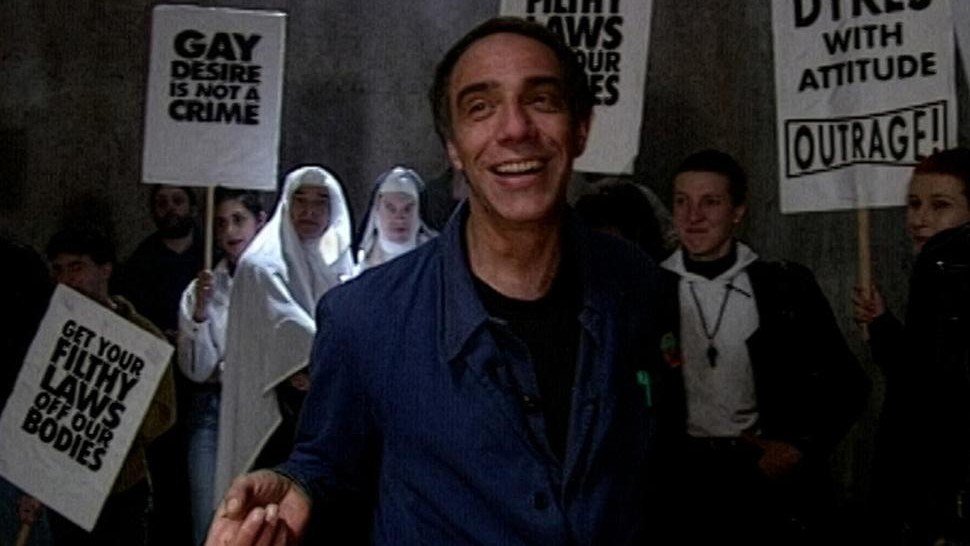
In 1991, Irish cinematographer Seamus McGarvey, who later became known for the likes of Atonement, The Hours, Nocturnal Animals and The Greatest Showman, was invited by the legendary Derek Jarman to shoot behind the scenes on the set of his film Edward II, his gay love story with a bloody ending.
After 30 hours of footage remained unseen for decades, British creative Theo Rollason looked through them and assembled them into their directorial feature debut, Queer Edward II, which will world-premiere in an out-of-competition slot of the Venice Open section of the 83rd Venice International Film Festival on Sept. 4.
Queer Edward II is a Lightborn Films production in association with March 13th and John Gore Studios.
The documentary provides intimate access to Jarman and his collaborators, including Tilda Swinton and costume designer Sandy Powell, who are both executive producers on the new film. And it puts a spotlight on how Jarman, back then fairly newly diagnosed with HIV, refused to separate art from politics and the harsh political climate that queer people in Britain were facing at the time. Also featured are a controversy surrounding Ian McKellen accepting a knighthood and an incident involving queer rights activists and a British pop star, who was rehearsing for a tour on the same studio lot where the film shoot was taking place, which snowballed into a tabloid scandal and threatened to derail the production.
Plus, the film shows a pack of beagles let loose, drag nuns taking a smoke break – and much more. After Hours and Cinephil are handling sales on Queer Edward II.
“When I was first approached to look through unseen rushes shot on the set of Edward II – which had been sitting in a cupboard for over 30 years – I hoped there might be enough material for a short,” Rollason shares in a director’s statement. “Instead, I was astonished to find a comprehensive record of Jarman’s idiosyncratic filmmaking practice, capturing everything from rehearsals to intimate conversations to production office dramas. What really struck me, however, was the set’s embrace of the 1990s political climate, particularly regarding gay rights,” they added.
And the director recalls learning how Jarman became the first public figure in the U.K. to disclose his HIV status and his association with activist group OutRage! “As a queer filmmaker born just after Jarman’s death, I saw a clear opportunity to use the Edward II set as a springboard to discuss what I wish I’d known: just how high the stakes were for the community at this historical moment, and Jarman’s centrality to the struggle that followed,” Rollason concludes. “My perspective is shaped by a belief that queer history is too often depoliticized and reduced to respectable narratives of progress, rather than the messy, confrontational movements that made that progress possible.”
That also makes Queer Edward II very timely. “With anti-trans rhetoric and attacks on queer rights again intensifying, I hope the film can function not simply as a snapshot of a historical moment, but as a reminder of what collective resistance can look like – and what role art has to play,” Rollason highlights.
THR can now exclusively premiere a clip from Queer Edward II. It shows Jarman discussing how to best shoot a scene in a bed, including the number of people fitting into it, as well as the necessary choice of clothing, or lack thereof.
A gothic gem overlooking Venice’s iconic lagoon got a refresh in time for the Venice Film Festival.
Reservations are open at Danieli, Venice, a Four Seasons Hotel following a restoration process that was unveiled this summer and remains ongoing at the property’s adjacent palazzos and within a soon-to-be finished Danieli Spa. Located on the waterfront stretch known as Riva degli Schiavoni and within walking distance from the wildly popular tourist destination Piazza San Marco, aka St. Mark’s Square, Danieli is often praised by guests for its views of the lagoon from both the terrace and inside the rooms and suites.
French interior designer Pierre-Yves Rochon steered the renovation by focusing on a “balance of history, light and materials” per Four Seasons. The color palette is said to have been inspired by the lagoon and mixed with inspiration from Venice’s marble facades, plasterwork and architecture through the use of celadon greens, soft blues, terracotta, ochre and powder pink.
Inside the Palazzo Dandolo lobby, hand-restored gilding creates a quatrefoil motif against a blue background reminiscent of water while the columns, stonework and the staircase were restored by local artisans. The space also leans on natural light through Venetian mirrors while Murano glass, Venetian terrazzo floors and Rubelli fabrics connect each space to Venetian tradition and codes. A collection or artworks has been curated to honor Venice’s heritage and history as a destination for artists and writers.
The Danieli has a rich history. Originally built in 1471 and known as Palazzo Dandolo for the noble family, Giuseppe Dal Niel, aka Danieli, converted the property into a hospitality destination in 1822.
Courtesy of Four Seasons
The hotel reopened with a total of 120 rooms and suites available, a collection said to be more spacious with an expansion of junior and one bedroom suites. The total number of accommodations will balloon to 168 once the restoration of Palazzo Danieli Excelsior is done in 2027. The Four Seasons reports that a particular emphasis was placed on integrating technology into those rooms through such features as a custom-designed media wall to integrate the television with artwork and decorative objects, automated curtains, customizable lighting and a climate control system, the latter of which is ever more necessary as Europe faces historic and punishing summer temperatures.
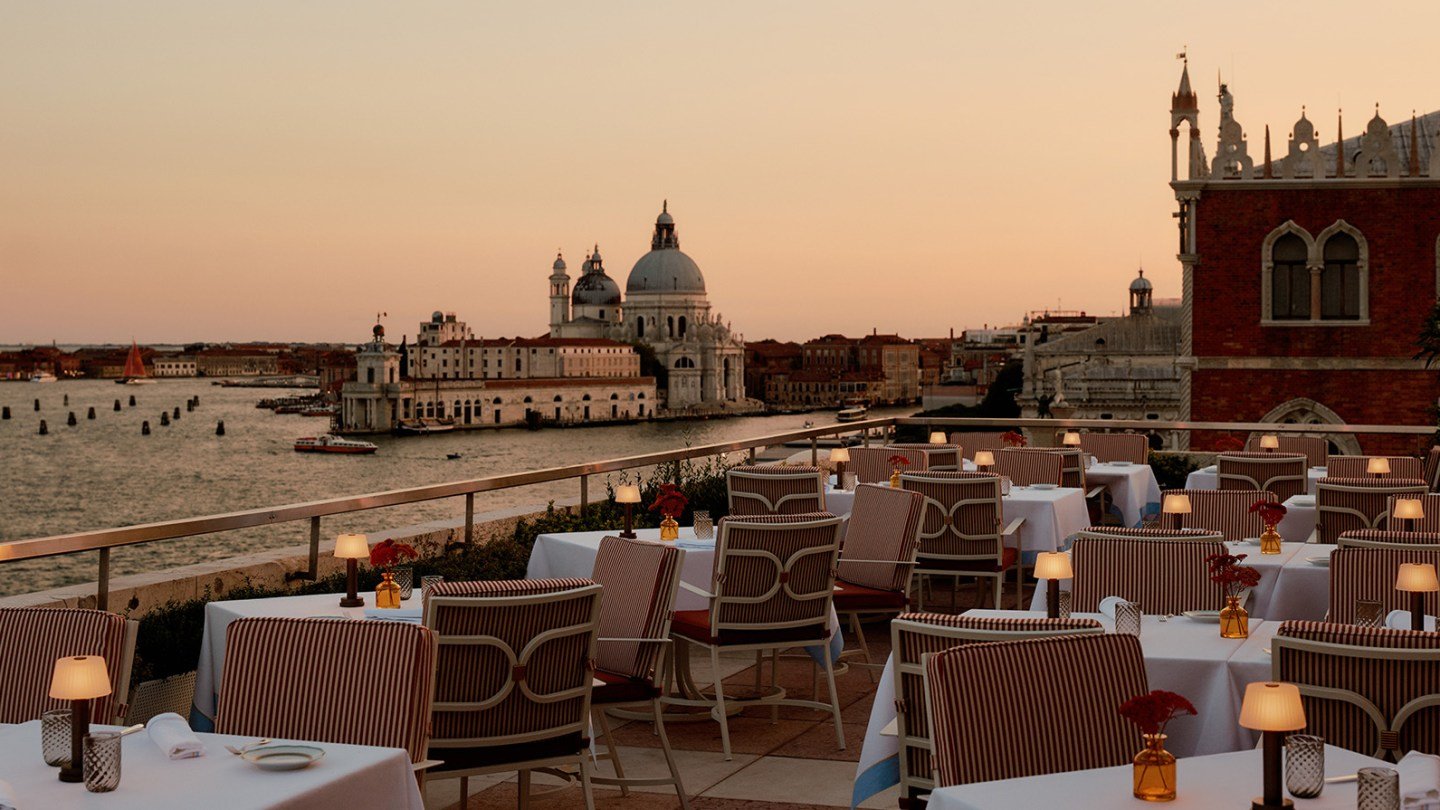
Rooftop restaurant Terrazza Danieli also got a refresh, seen below, which insiders note was done in a way to transform the atmosphere without disrupting the architectural identity. Dark finishes were swapped with pastel tones, blue accents and golden colors, and mirrors were added to play off the natural light. Executive chef Adriano Rausa presents a “contemporary interpretation” of Italian cuisine with a Venetian twist, and many of his menus signature dishes are finished tableside to add a little bit of drama and entertainment.
A view of the grand staircase above the lobby.
Courtesy of Four Seasons
As for the spa, it is expected to open during this second half of the year. It will feature three treatment rooms (including one for couples), a sauna and bathhouse. Danieli, Venice, a Four Seasons Hotel is party of the brand’s Italian portfolio that includes destinations in Milan, Florence and Taormina.
“With the reopening of the iconic Danieli, Venice, a Four Seasons Hotel, our fourth property in Italy from the spectacular collection, we are inaugurating a new chapter in the history of this celebrated palazzo,” said Rainer Stampfer Four Seasons president of global operations, hotels and resorts. “In collaboration with our longtime partner, Gruppo Statuto, we are offering guests the unique opportunity to experience the grandeur of Venice in a whole new way.”
Added Danieli, Venice general manager Christian Zandonella: “The reopening of Danieli as a Four Seasons experience represents an exciting milestone after months of dedication and meticulous restoration. We are delighted to welcome guests back to one of Venice’s most iconic addresses, where the hotel’s extraordinary heritage is reimagined through legendary Four Seasons hospitality.”
Austrian filmmaker Manuel Wetscher made a name for himself with such fiction shorts as 2018’s Four Seasons, 2021’s At Night When Mice Scream and 2022’s Magma. Then came the 2024 experimental short doc Richard, a particularly personal film.
“I only learnt the real reason for my father’s death 10 years after he died,” reads a synopsis for the film. “At first, I was told that he had died of pneumonia, then later of lung cancer. The truth finally came out from a drunken relative at a birthday party when I was 17 years old. Since then, I have known that my father died of AIDS in 1993 at the age of 40.”
Wetscher’s feature film debut Eklipse, which world premieres in the Horizons section of the 83rd edition of the Venice Film Festival on Sept. 5, is inspired by his experience of being kept in the dark on the details of his father’s situation by his family. And as the title, which means “eclipse,” suggests, the sun plays a role in the movie, just as it did in Magma. And yes, the title Eklipse is spelled with a “k” in both its German and English versions.
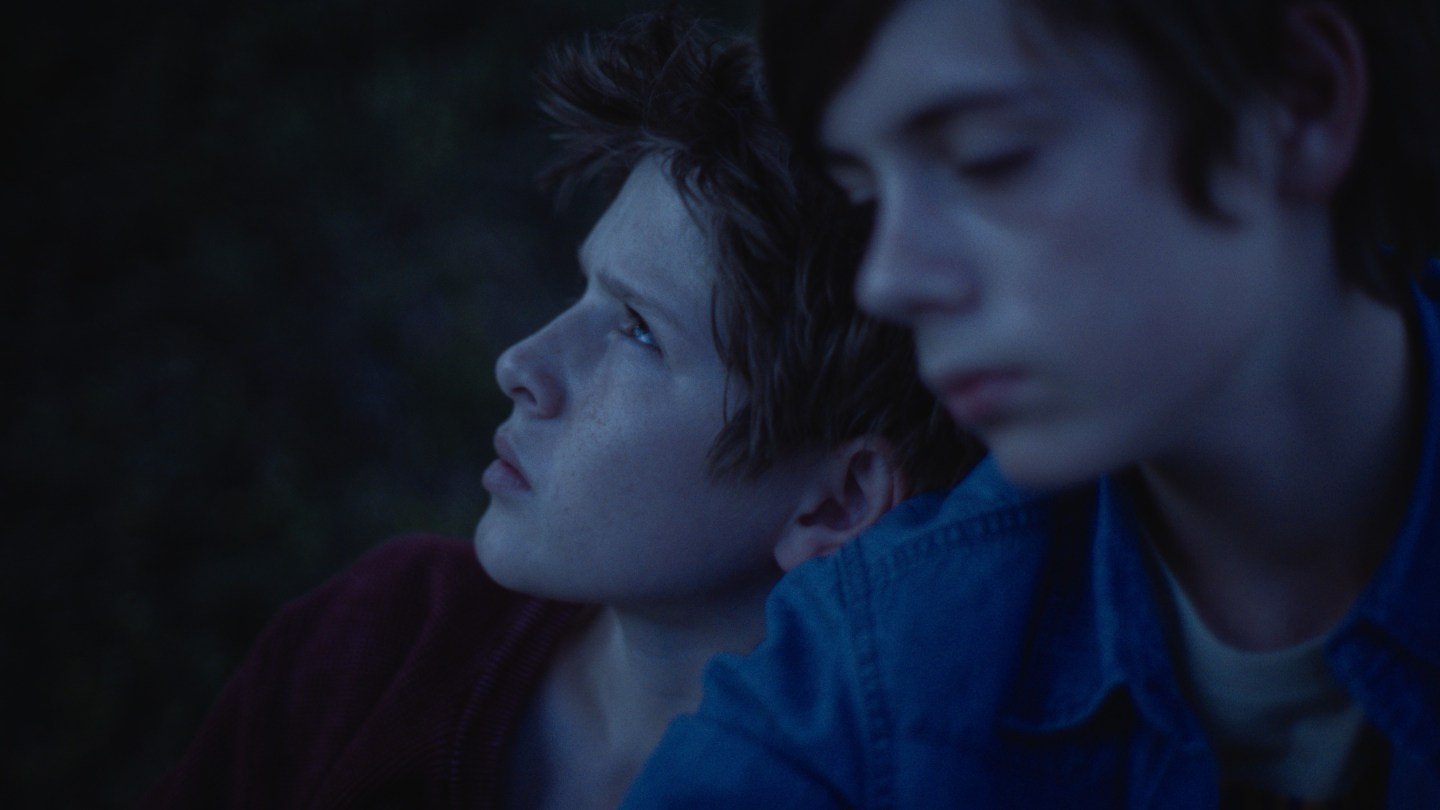
Eklipse, starring Moritz Hohlrieder as Tomy and Finley Brown as his best friend Chris, is set in the 1990s at an alpine dairy farm in Austria. The two teenagers spend a summer helping Tomy’s uncle, portrayed by Hannes Perkmann, with milking and other duties, as well as exploring the outdoors.
But as the title suggests, darkness overshadows their time together, while also leading to some revelations. After all, Tomy’s father is in hospital, and his mother decides to keep the real reason from her son in the film from production companies Eutopiafilm in Austria and Albolina Film in Italy. But then, Chris learns that Tomy’s father is in hospital with “the gay disease,” and he becomes frightened, leaving Tomy suddenly confronted with rejection and the silence of his loved ones.
Wetscher co-wrote the film with Bernhard Jarosch, with whom he also collaborated before on several short films. Simone Hart handled the cinematography, and Anna Kirst is the editor of Eklipse, which also features actors Lenz Moretti, Lisa Schützenberger and Barbara Romaner. Films Boutique is handling world sales on Eklipse, which comes from production companies Eutopiafilm in Austria and Albolina Film in Italy.
“Eklipse is a film about the taboos surrounding AIDS and the fear of social exclusion,” Wetscher says in a director’s statement. “It tells the story of how prejudice and ignorance affect the friendship between two boys, and how social contexts are mirrored within the microcosm of a family.” And he emphasizes: “With Eklipse, I want to create memories by exploring the sensory and tactile qualities of cinema.”
THR talked to Wetscher about mixing the autobiographical and the fictional in Eklipse, including his cameo in the film, how he found his young stars, how he and his team discussed Andrea Arnold and Alice Diop films, his efforts to transport audiences into the alpine environment, and the timeliness of the fear of AIDS and the unknown.
The film feels very intimate, and I understand that it is inspired by your and your family’s experiences. How much of what we see is autobiographical and how much is fictionalized?
It’s part [of a cinematic] game. I wrote the screenplay with a good friend of mine. The film draws a lot on the personal experience of losing my dad in 1993, when he died of Kaposi’s sarcoma, a cancer caused by AIDS, but then it also includes completely fictional things. Later on, seeing films and getting to know more about what people did [back when my father died] made me look at my family history differently. But many summers, I spent in Tirol working for my grandfather on a farm, so I knew these two elements. That is also where I actually experienced the 1999 eclipse, so these were all elements I had from the beginning.
But then, of course, writing the screenplay meant having to make it all into a story, something that keeps you interested and that works in itself. That’s a process I love, [during] which I also experienced a lot about myself and about the time back then. It allows you to reflect on how certain mechanics in society work and this dilemma of what you tell and what you don’t tell a kid.
I guess that is why the film feels so specific about its time and location but also very universal…
That’s something that interests me when watching films – when they make me understand the world or learn, experience, or feel something. So yeah, the goal from the beginning was to make a film that gives people who don’t know this background or specific location the experience of things that come with being and living there. For example, this experience of going into a stable with 50 cows.
It’s very tricky to translate that into cinema because when you go there, it’s so physical and it’s so sensorial. There are so many things going on, including the smell. It was a beautiful challenge to think about how to put that into cinema and what kind of ingredients we have to use to recreate that. Part of that is choosing the team that is able to go there, but then also later on in the sound design and with the musicians, we focused on recreating the sound, including with synthesizers and loops, to make sure you really have this feeling in the image but also in the sound. That’s much more direct of an experience.
How did you think about time?
One element that we decided on while editing was that we wanted to sometimes let things stand for a while and let you go through a process, because that is what our characters do in the film.
There are scenes that look like old home videos in Eklipse. Are they real?
Yes, that includes my cameo as a baby. And we have this material with the father, which is a home video that I have from my dad and me. There is also this image that the boys look at of the dad who is in the hospital. It’s an actual picture of my dad. I worked with personal material in creating this film. I was showing people [on the team] these images, so they could relate better. And because this is authentic material, it also has the emotion for me in it that I was searching for.
For cinema, you play with [such material and emotion] and then it becomes something else. In the film, it becomes the character’s memory. You asked about universal themes. We tried to tell the story in a very limited and small place, but through using the eclipse, which is very big and outside of our world, we also had the chance to fade to the bigger elements. When you look at the stars, the light that comes to the Earth has already been gone for a long time. In the edit, we realized that it was so beautiful to understand that this material that he sees or memory itself is far away. But then in the moment where you look at it, it’s there at the same time. So to use this element felt really right and made a lot of sense.
Did anybody on your creative team and crew have similar experiences?
Since this is my first feature, the idea was to have some newer people but also to have people who are more experienced and could bring stability for us. And these conversations were very interesting because some of the people who experienced the ’90s lost friends to AIDS or had someone in their family. Talking to them really made me understand in a different way my mother’s or my family’s position.
By coincidence, I also met a doctor who was working back then in the hospital in Innsbruck where my father was, and hearing how complicated it was and how scared people were and how impossible it was to talk about it, even within groups of friends who then suddenly wouldn’t talk to you anymore, helped me [understand that time] better. They did this out of fear. It also created a possibility for me after a long time to talk with my mother about it and to also see her point of view.
Has your family seen the finished film?
There will be the Austrian premiere, and my family will come there.
‘Eklipse’
Courtesy of Venice Film Festival
You probably started working on Eklipse before what feels like a backlash against queer people and LGBTQ+ rights…
I can see what you describe and what is happening politically at the moment. But yeah, we were not foreseeing that. I mean, I wish this would not be happening. I can see the dynamics, and that’s just scary how people who are different or live another way are being discriminated, and how populism is using that. But that is coming from the outside.
What we are looking at in the film is the friendship, the vulnerability of the people and the families. And the smaller the details we show, the more vulnerable we become, but through these small things, you understand so much about the dynamic and the universal issues and bonds.
How did you find your two young and excellent leads?
We started with online casting, and it went through schools. We were looking specifically in the region where we shot because it was important to have actors who had roots or a connection to this region that has a specific language and sound. We realized that to be authentic, you need to have the dialect.
We picked Moritz and Finley and did a casting with them together because they needed to match and make you feel a connection between the two of them. They could not just pretend to be friends. And then we also took Georg, who plays the uncle, to see the dynamic between all three. We went to the mountain because we also needed to know if they were able to play with the cows and not be afraid. So we put them there to work a bit and to experience all this, and then we felt they were great.
How early did you know the title for the film? And there is no English-language spelling version of it, correct?
We had it from the beginning. Of course, there were a lot of moments where everybody came to ask: Is it the right title or not? And we tried different things, but we always came back to it. There was the question of how to do the international title. And the final decision was to say it’s going to be in German and, also for international, always written with the K to make it a bit more unique or more recognizable.
Were there any films you watched when you worked on Eklipse or movies that may have been an influence?
For the cows and all these things, Cow by Andrea Arnold was a film we looked at. Also, Saint Omer by Alice Diop and [Céline Sciamma’s] Petite Maman were films that we talked a lot about in the making with the DOP to create authenticity and keep it simple but also [allow for] the bigger picture.
When the credits started rolling, I had an unusual feeling or idea…
It’s cutting to black at the end, like another eclipse.
Indeed! And I wondered if that also symbolically invites you as a viewer to think about what you just saw and heard…
It’s like the aftermath, the echo of what you just saw. How the images reappear and how you put them together. That’s one thing. There is something else. It’s called Eklipse because of the solar eclipse, but then you have the same term in virology, which you use when an infection goes into the body, but it has not infected the cells yet. That’s also called an eclipse, and for us, in the dramatography and in developing the story, this knowing and not knowing, what is visible and what is not visible also became important.
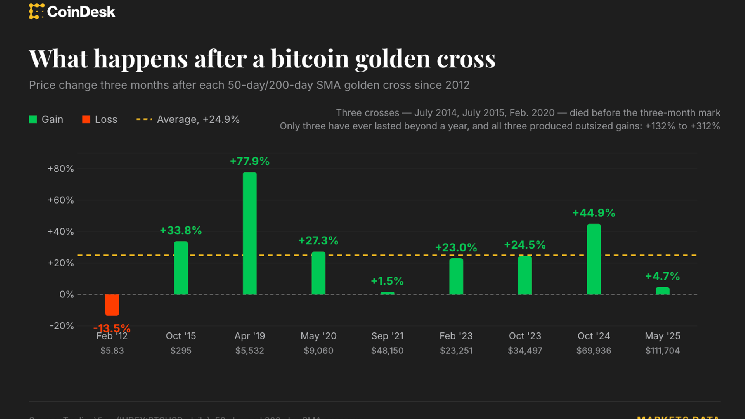
Since 2012, bitcoin has formed this exact pattern, the 50-day average crossing above the 200-day average, 12 separate times.
Bitcoin’s golden cross history. (TradingView, CoinDesk)
Three of them delivered big, sustained gains. The first, on Feb. 9, 2012, was followed by a 306% gain over the next year. One in October 2015 stayed intact for over two years and rode bitcoin to what was then a record high near $19,800 in December 2017. Another in May 2020 gained 312% over the following year, with bitcoin later touching nearly $64,900.
Others barely survived long enough to mean anything. Two separate crosses, in July 2014 and July 2015, were wiped out by an opposing death cross within two months of forming, before there was even enough time to measure a three-month return.
A few recent ones produced strong three-month gains, in some cases over 40%, only to be invalidated by a death cross well before the one-year mark. One in September 2021 barely moved at all, gaining just 1.5% before dying out a few months later, shortly before bitcoin fell more than 70% from its highs over the following year.
Add it all up, and a clearer pattern emerges. Across the nine crosses where a three-month return could actually be measured, the average gain was 24.9%. But only three of the twelve crosses survived a full year without being broken by a death cross first, and across those three, the average 12-month gain was 250%. In other words, the signal has a decent record over three months, but making it to the one-year mark intact has been the exception, not the rule.
US-based investment and cryptocurrency platform Robinhood has launched the $PONS token on its platform. The listing increased investor access to $PONS within the Robinhood ecosystem, causing a brief but sharp price surge.
Following the listing, $PONS saw a remarkable surge in price. According to market data, the token’s price increased by approximately 15% in just two minutes. However, the rise was not sustainable, and $PONS quickly gave back most of its gains.
It was noted that the token’s current price has significantly fallen back to levels seen before the sudden surge triggered by the listing. This movement once again highlighted the short-term impact of listing on crypto assets on a new exchange or trading platform.
Robinhood’s listing of $PONS is seen as part of the platform’s recent steps to expand its cryptocurrency ecosystem. $PONS stands out as one of the prominent projects in the Robinhood Chain ecosystem. The token has attracted investor interest, particularly due to its token launches and decentralized finance activities on the network.
Robinhood Chain has recently experienced significant growth in terms of trading volume and total value locked, and $PONS’s market capitalization reportedly rose rapidly in August. Making the token available to a wider investor base could contribute to increased trading volume and liquidity.
However, the rapid rise and subsequent pullback in $PONS price after its listing demonstrated that new listings can create high volatility in the crypto market. In particular, sharp price movements in a short period of time indicate that investors may face significant price fluctuations.
With Robinhood’s listing of $PONS, the token’s reach across various markets is expected to expand, and investors are anticipated to closely monitor price movements and changes in trading volume. $PONS’s post-listing performance is also expected to be a significant indicator of its position within the Robinhood Chain ecosystem.