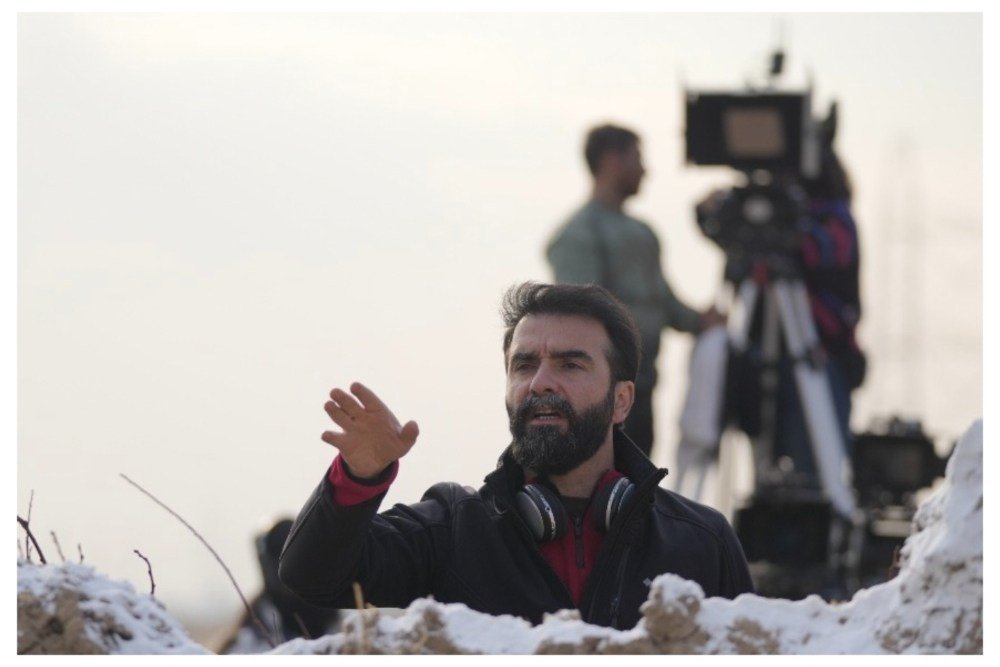
Iranian director Mohsen Gharaei, who is at the Venice Film Festival with well-received drama “Falling House,” is set to shoot a new film titled “Centrifugal Force” that will capture “the impossible choices facing a generation of Iranians today,” as the synopsis puts it.
“Falling House,” which world-premiered on Wed. in Venice’s Orizzonti sidebar, follows a modest family on the outskirts of Tehran who faces the imminent destruction of their home as part of a vast redevelopment project. Rashid, the patriarchal father and a prison guard, attempts to contain family rebellion while being accused of corruption.
“Centrifugal Force,” which will be shot in an undisclosed location outside Iran in Farsi and English with still unspecified Iranian and international actors, will be “a deeply human story about what happens when the home you love is no longer a place you can return to,” Gharaei said in his directors’ statement.
“After finishing my latest film, I found myself on an unexpected journey from one geography to another,” Gharaei, who is now living as an exile outside Iran, added. “But migration is not simply a matter of moving from one place to another; it is a moment when a person is suddenly pushed out of the center of their own life. The journey becomes most painful when departure is not a choice, when all familiar paths close, one by one, and suddenly you have to leave a home that you still love.”
“Centrifugal Force” will be the story of a family that has remained in Iran for years, not entirely out of contentment, but out of the hope that somehow it might still be possible to build a life with all its contradictions. They have held onto staying and created a sense of order for themselves within a system they believed to be stable. But in a geography like Iran, where the line between simply surviving and truly living can shift without notice, no sense of order is ever completely safe,” Gharaei went on to note.
“With forced migration, the family enters a world governed by a different set of rules, where things no longer work as they used to. What appears from the outside to be a form of escape can, from within, feel like a kind of collapse. Distance from home makes the distance between family members visible. It reopens old wounds. Crisis challenges the image they have of one another. It is as if migration does not only change their physical location; it also displaces their understanding of home, family, and even self,” he continued.
“This is where centrifugal force takes shape, drawing people away from a point to which they have been deeply attached, without necessarily knowing what lies ahead. Within this deracination, the family is as weightless as hay, easily pulled away from the center. And the further they move from it, the more they are confronted with the question of what truly connected them in the first place: geography, memory, habit, or something else for which they have no name.”
Just like “Falling House,” “Centrifugal Force” is being produced by exiled Iranian producer Milad Khosrav, who now runs his Seven Springs Pictures company out of Istanbul in tandem with Oscar-winning producer Odessa Rae (“Navalny,” “The Voice of Hind Rajab”). They are shopping the project at the Venice market, knowns as Venice Production Bridge.
$XRP, ranked fifth among the largest cryptocurrencies, experienced a 6% increase in the last 24 hours. As the $XRP price approaches $1.5 again, the BIS published a noteworthy study regarding the $XRP ecosystem.
At this point, the Bank for International Payments (BIS) announced that it used XRPL in a proof-of-concept study for formal data validation.
According to the official statement, the BIS used the $XRP Ledger in a proof-of-concept blockchain-based system to verify the accuracy of official statistical data.
BIS researchers have announced in a new study that they have developed a proof-of-concept on the $XRP Ledger (XRPL) to improve the verifiability of official economic and financial data.
The system could be used to verify whether official statistics such as GDP, inflation, and interest rates have been manipulated and to confirm the data source.
The study noted that the system does not record all economic or financial data on the blockchain, i.e., XRPL; instead, a cryptographic fingerprint (hash) is created from the data, and this record is stored on the $XRP Ledger. This allows users to verify whether their data file matches the original publication and whether the data has been altered.
The prototype developed by BIS researchers reportedly completes the publishing process in 3 to 5 seconds and the verification process in 1 to 2 seconds. However, it was emphasized that the research is still in the technical validation phase and BIS has not yet decided whether to use XRPL in a real system.
Why was $XRP Ledger chosen?
What made the study noteworthy was that BIS researchers chose $XRP Ledger from among numerous blockchains.
Researchers cited XRPL’s low transaction fees, fast transaction speed, and development environment as reasons for choosing it.
In this context, the new study revealed that $XRP Ledger can be used not only as a payment infrastructure but also to verify data integrity.
In conclusion, while BIS’s XRPL test isn’t direct news of $XRP adoption, it’s seen as a noteworthy development in terms of the network’s potential for enterprise use.
The U.S. labor market strengthened appreciably in August, giving the growing group of hawks at the Fed more ammunition to hike interest rates at the bank’s policy meeting in less than two weeks.
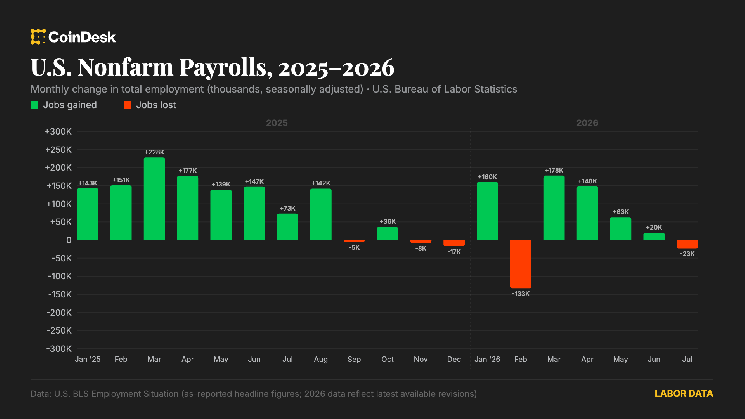
According to the government’s Nonfarm Payrolls report released Friday morning, the U.S. economy added 162,000 jobs last month. That was well above the consensus estimate of 56,000 and followed the addition of 21,000 jobs in July (revised from an originally reported decline of 23,000).
The unemployment rate came in at 4.1% versus 4.1% expected and July’s 4.1%.
Reaction in markets was swift, with bitcoin tumbling about 2% to below $80,000. The U.S. 10-year Treasury yield jumped 3.3 basis points to 4.80%. U.S. stock index futures are modestly lower.
Will they, or won’t they
Federal Reserve Chairman Kevin Warsh put a September rate hike firmly on the table one week ago today with his hawkish Jackson Hole speech.
But Fed Governor Chris Waller (with an assist from FRBNY President John Williams) this week sent markets surging by suggesting a rate hike at the bank’s policy meeting in two weeks was far from a done deal.
This morning’s jobs report is another data point in favor of the hawks, but the key figure in the Fed’s decision is likely to be next Friday’s CPI report for August.
Bitcoin recorded its strongest monthly gain since November 2024 during August, but Fidelity said the advance does not prove that the latest crypto bear market has ended.
In its fourth-quarter crypto market outlook, Fidelity said Bitcoin, Ethereum and several altcoins recorded their strongest positive months since late 2025. Bitcoin gained more than 25% during the third week of August alone.
Ethereum rose 34.1% during the same period, while Solana advanced 28%, according to Fidelity. The gains followed relatively subdued market activity from June through the middle of August.
However, Fidelity warned that the rally could represent either the beginning of a sustained recovery or a temporary move within a continuing bear market.
Bitcoin bear market faces a November cycle test
Some investors are watching November 2026 as a possible market-bottom period based on Bitcoin’s historical four-year cycle. Bitcoin’s previous major bear-market bottom occurred in November 2022.
Applying the same approximate interval would place the next potential bottom around November 2026. Fidelity stressed that historical cycles have never followed precise four-year schedules and cannot reliably identify market turning points.
The firm said Bitcoin may have already reached its low in July. It could also decline again and establish another low during November or later.
“Despite the recent push higher in price, there is no guarantee the bear market is over,” Fidelity said.
Chris Kuiper, vice president of research at Fidelity Digital Assets, said adoption has historically occurred in waves that can help sustain market cycles. He argued that a longer holding period has generally proved more useful than attempting to time exact bottoms.
That view remains an observation based on historical performance. It does not establish that Bitcoin will repeat an earlier cycle or continue appreciating.
Volatility shift offers a possible recovery signal
Fidelity identified Bitcoin’s transition from lower volatility to a sharp upward expansion as one possible sign that sellers were becoming exhausted.
Kuiper said digital assets experienced relatively low volatility between June and mid-August. Fidelity’s analysis placed assets such as Bitcoin near the lower, or “value,” end of their historical ranges during that period.
The subsequent rally resembled volatility patterns seen near some previous bear-market endings. Bitcoin’s rapid advance above $80,000 was followed by a retreat toward $79,250, as crypto.news reported in its analysis of overbought conditions increasing short-term pullback risks.
That technical reading did not establish a new bear market. It showed that Bitcoin had risen rapidly enough to increase the probability of consolidation after the advance.
Kuiper also noted that developments which might previously have pressured prices, including a hardware-wallet security incident and delays surrounding the CLARITY Act, did not reverse the August rally.
This resilience “could further strengthen the case” that cryptocurrencies are near a bottom, Kuiper said, while stopping short of confirming one.
Adoption continued while cryptocurrency prices weakened
Fidelity said digital-asset adoption remained resilient during the earlier market decline. Stablecoin transaction volume, tokenized real-world assets and institutional participation continued growing even as the broader market capitalization weakened.
The firm described network adoption measures as comparable to fundamental indicators used when evaluating traditional businesses. Rising transaction activity can demonstrate continued use, although it does not guarantee higher token prices.
Institutional investment products also showed mixed allocation patterns before Bitcoin’s August rally. In related coverage, crypto.news reported that Ethereum funds attracted more capital than Bitcoin funds during July.
Bitcoin exchange-traded fund demand subsequently recovered during August. Fidelity listed stronger institutional adoption among the factors that could support another bull market, alongside regulatory changes, monetary policy and new blockchain use cases.
U.S. policy decisions remain key fourth-quarter catalysts
The U.S. regulatory calendar could provide two major tests during the fourth quarter. The CLARITY Act remains pending in the Senate after the Senate Banking Committee advanced it by a bipartisan 15–9 vote in May.
A procedural vote is scheduled for Sept. 15 and requires 60 votes to advance the bill toward debate. The legislation would divide elements of digital-asset oversight between the SEC and CFTC. However, passage remains uncertain, and further amendments could require additional House consideration.
As crypto.news reported, the bill now faces a tight congressional timetable before the midterm elections.
Separately, the SEC proposed Regulation Crypto Assets on Aug. 18. The proposed framework would create two securities-registration exemptions for qualifying crypto investment contracts.
The SEC’s formal proposal would allow eligible offerings of up to $5 million over four years or $75 million during a 12-month period, subject to specific conditions. Public comments are due by Oct. 20.
Crypto.news previously examined how the proposed exemptions would reshape token fundraising. The proposal is not final and may change following public feedback.
These policy proceedings, monetary conditions and institutional participation could shape Bitcoin’s fourth-quarter direction. None provides confirmation that the bear market has ended, leaving price action and adoption data as continuing tests of the August recovery.
Bitcoin BTC$81,074.17 isn’t just rising in dollar terms, it’s also outperforming gold, a hard asset with a centuries-long track record, at a time when concerns about government finances across advanced nations dominate headlines.
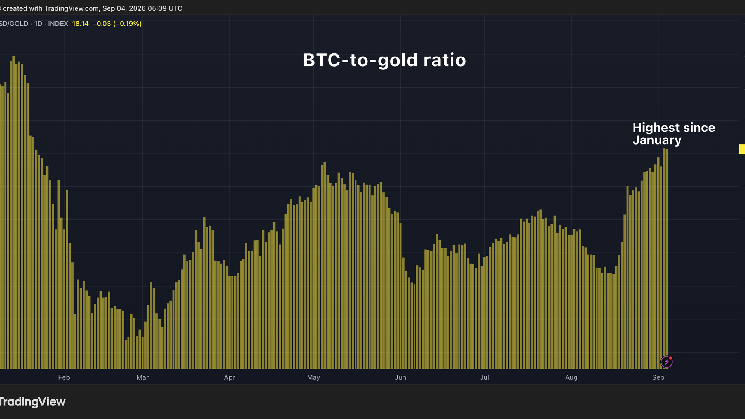
The bitcoin-to-gold ratio, which measures bitcoin’s dollar price per coin against gold’s dollar price per ounce, has climbed to 18.17, the highest since January, according to TradingView data. In plain terms, one bitcoin now buys a little over 18 ounces of gold. In dollar terms, the cryptocurrency is currently priced at around $81,000 across major exchanges, according to CoinDesk.
Both assets have been rallying after lagging the AI-driven stock market boom in the U.S. and parts of Asia. Analysts have pointed to growing fears that governments, including the U.S., may lean on debasing or devaluing their currencies to inflate away their debt.
Every major advanced economy except Switzerland now carries a debt-to-GDP ratio above 100%, and the U.S. leads the pack on primary deficit, the shortfall once interest payments are stripped out, which gives a cleaner read on how much a government is actually overspending before debt-servicing costs pile on.
The urgency comes from what OpenAI disclosed on Monday. Its new Astra model can find previously unknown software flaws and turn them into working attacks without a human guiding each step, crossing a cybersecurity threshold that until recently belonged largely to expert hacking teams, as CoinDesk reported.
Read More: OpenAI says its new ‘Astra’ AI can build attacks without human help
Eligible organisations apply through the Daybreak website. OpenAI said it intends to extend the model to partner countries in the coming weeks.
The pledge comes amid a tepid stretch for crypto applications and network technologies. In August, a flaw in BTCPay Server, open-source software merchants use to accept bitcoin payments, exposed the credentials controlling Lightning nodes, and attackers drained funds before a fix went out.
Core Lightning, one of the main programs for running the Lightning network that moves small bitcoin payments cheaply, told operators last week to disconnect their machines after a wave of AI-generated vulnerability reports turned up several real flaws.
Separately, Coldcard, a hardware wallet that stores bitcoin offline, shipped new firmware after a $114 million theft, saying frontier AI models had helped catch bugs unrelated to the original problem.
The series of exploits culminated in more than three dozen companies, such as heavyweights Coinbase, Block, BitGo, Blockstream, ARK Invest, among others, publish an open letter to AI labs seeking early access to their strongest models for security work. The firms stated that AI labs were vetting who gets their strongest models while attackers obtained them regardless — leaving the people maintaining Bitcoin’s code with weaker tools than the people attacking it.
If you purchase an independently reviewed product or service through a link on our website, The Hollywood Reporter may receive an affiliate commission.
Regardless of theme, each set includes 24 seasonal surprises — an assortment of mini builds and minifigures that can be treated as individual collectibles or characters in a larger scene. The Disney Princess calendar box, for example, transforms into a game board (with a buildable spinner) for up to eight players. More on each of the five offerings below:
Lego‘s 2026 Marvel Advent Calendar combines major Marvel superheroes (Spider-Man, Iron Man, etc.) with buildable accessories and holiday scenes.
Lego Marvel Advent Calendar 2026
317-piece building set; ages six and up.
The 2026 Star Wars Advent Calendar is fit for Mandalorian fans ages six and up, and filled with key characters, mini build vehicles and Lego Star Wars figures.
Lego ‘Star Wars: The Mandalorian’ Advent Calendar 2026
293-piece building set; ages six and up.
As for the Disney Princess Advent, play out favorite movie scenes with characters like Ariel, Sebastian, Cinderella and Moana.
Lego Disney Princess Advent Calendar 2026
290-piece building set; ages five and up.
Lego Friends is packed with a collection of mini dolls and mini animal figures plus winter toy accessories that help tell the story.
Lego Friends Advent Calendar 2026
211-piece building set; ages six and up.
Finally, the 2026 Lego City Advent Calendar is the ultimate Christmas-themed countdown. Santa, Mrs. Claus, elves and reindeer pair with a Santa Workshop play mat, revealed after folding out the calendar’s box.
Lego City Advent Calendar 2026
252-piece building set; ages five and up.
Shop the five seasonal sets, while supplies last, at both Macys.com and Lego.com.
In 1975, Norwegian film director and author Arnljot Berg (Bobby’s War, Closed Ward) was arrested in Paris and charged with the murder of his wife, Evelyne. Back then, his daughter, filmmaker Lene Berg (False Belief, Kopfkino), was nine years old. In 1982, the father died by suicide. Forty years later, the dramatic childhood experience is the starting point for her new film, The Horsemen of the Apocalypse.
The shoot for the movie, which moves between documentary, staged and fictional elements, is completed; the editing process is ongoing. And at this week’s Venice Gap-Financing Market, part of the Venice Film Festival, Berg will meet with potential backers to ensure she can wrap the film.
The hybrid film, produced by Ellen Ugelstad of Twentyone Pictures, dives into such themes as childhood trauma, family, guilt, memory and narratives. Berg herself appears in The Horsemen of the Apocalypse, with Ane Dahl Torp portraying her alter ego in the film, while Olav Waastad appears as her late father.
Produced by Norway’s Twentyone Pictures, in co-production with Sweden’s Story and Germany’s Alma Bäng, and Maria Ekerhovd from Mer Film, the film is supported by the Eurimage, Norwegian Film Institute, the Swedish Film Institute, Oslo Filmfond, The Art Council Norway, ARTE, Fritt Ord, Viken Filmsenter and Amarcord.
Berg talked to THR about her unusual approach to The Horsemen of the Apocalypse, how it mirrors the challenges of trauma and memory, and her hopes for Venice.
I heard that you have done work in other art forms about your father and his story. Can you talk a little bit about that and why you wanted to now explore your family history in film form?
They are all linked in a way. When I started to work on this material, I knew from the start that I wanted it to be an exhibition and a novel and a feature. Actually, I wrote the first scenes for the feature, but then I had this huge exhibition in Bergen, so I had the opportunity to develop some of the ideas in that form. Then, I published the novel [From Father (Fra far)] because the publisher was enthusiastic, and now it was time for the feature. So that’s the [element] of a trilogy.
They overlap, but each part also has a [slightly] different focus. So, this is not a film adaptation. It’s a totally separate work in a way. For the people who have seen or have taken part in all of the parts, it will be interesting.
It sounds like the stories we tell or try to tell about ourselves and our position in the world are a theme you are exploring in The Horsemen of the Apocalypse. Does that sound right?
This is one fundamental question that I’ve also been working on in other projects – the problem of narratives, or how you construct a narrative of something that is very, very complicated. At the same time, I want to question the narrative. In this film, a lot of questions come together, with the story of my father’s arrest as the starting point. It’s very hard to find a way to tell this story within a conventional narrative.
I feel that you made yourself very vulnerable by making this film…
One part is, of course, very emotional, and it’s a very sad story. But I feel it’s also very comic, in a way. In the film, I have an alter ego, Ane Dahl Torp, and we’re trying to stage these scenes.
Lene Berg
Courtesy of Lene Berg
My father is also both a very charismatic, funny and interesting person, but also horrible. So, I really tried to make all this as rich as I could and create a film in three acts, so that you can follow it. But at the same time, it’s also totally broken.
I was going to ask if audiences can expect any protagonist, or even hero, in a film like this, and whether that’s you…
In a way, my alter ego is the total protagonist. I’m also in the film, but she kind of takes over more and more. It was a lot of fun to work with Ane. She promised me that she would play me better than I do, and then she did. A key idea for me was to make the film not only about me. Of course, it’s a very personal, very specific story, but the film is also about sharing this story with other people, including the crew and cast.
Given the complexity of the story, I expect The Horsemen of the Apocalypse won’t end tying the narrative up neatly and easily…
Yes, I hope that when you walk out, you will still think about all sorts of questions. It’s not all resolved at the end. I try to put many questions out there, and I hope that the complicated emotions don’t go away quickly. After [all,] the story is complicated. My father is complicated. I am complicated.
Has working on the film helped you come to terms with this family trauma to some degree?
In a way, you could say that. It was 40 years since my father died when I started this project, and in a way, I missed him a bit. Through the film, I’m kind of blowing new life into him.
Olav Waastad is an absolutely amazing actor, and he is playing my father in the film. He appears and just insists on being remembered, and otherwise, he just appears in memories.
I think that the idea of meeting my father as a grown-up and having lived a bit of life myself was one impulse for this. Of course, with the project, I was also opening up the wounds again, so it was very challenging too. Why do I have to think about this again? It’s been a long time!
Between documentary and fiction, how do you describe The Horsemen of the Apocalypse?
It moves between the two. It is all staged, except for documentary or authentic elements, such as documents and my father’s voice. Because he was a film director, he appeared on TV, and there are also excerpts from his movies in the film, because he appeared in his own films.
In the reenactment scenes, I am trying to instruct Ane, but at the same time not sure I want to do this movie. I’m a reluctant director in the film. It’s a little bit of a metaphor for the whole process. The crew members also have different roles. One is telling me to get on with it, while another is very supportive of my emotions. So, we are using a lot of different cinematic tools and elements.
‘The Horsemen of the Apocalypse’
Courtesy of Twentyone Pictures
Would you ever want it described as a film for true-crime fans?
We actually took “true crime” out of the descriptions because we don’t want people to be disappointed because it’s not really a true-crime documentary.
I would rather call it a tragic-comic story, or a personal drama. It’s very tragic, but I laughed a lot while shooting it, and still laugh while editing.
Where did you find the film title,The Horsemen of the Apocalypse?
The title may still change, but I like it. The phrase actually showed up in some of my father’s documents. He called all his enemies “the horsemen of the apocalypse.” When I looked into a definition, they are all things that threaten humanity in a way – death, illness, hunger, war. But there are different interpretations. I think they are the bearer of destruction, but also hope. The word “apocalypse” is very interesting etymologically. It actually doesn’t really mean the downfall. It’s really the moment before when you see everything clearly, but you can’t hold on to it.
The film is also a bit nostalgic. We have an old big tape recorder, and an old landline telephone, and a typewriter. Actually, our actor is too young – he had never spoken on a telephone. So, he asked: “How do you hold it and end the call? How do you hang up?” It was funny.
What’s the status of the film, and what do you hope for in Venice and beyond?
We’re looking for the gap financing, the final 130,000 euros ($151,000) or so that we need to finish the film. We are almost at the end of the editing process.
Once a film is done, I’m always hoping that people leave the theater and are engaged in what they saw, so that they will continue to discuss it. So, I hope that a film will live on in them. I cannot control how, but I’m really looking forward to showing this film to people. I’m hoping that it will find the right audience that needs it or wants it.
At the start of her eponymous reality show “Earle Meets World,” the influencer Alix Earle promises that while “there’s a whole other side” of the creator economy “people don’t get to see,” her viewers are “gonna see everything in this show.” I hope for Earle’s sake she isn’t telling the truth, because if “Earle Meets World” really does contain the full scope of the TikTok star’s jet-setting lifestyle, it’s one of strikingly limited range. Rather than reveal Earle’s hidden depths or shed light on the nature of her viral appeal, the Netflix series goes to show that 30-second clips don’t easily expand into 40-minute episodes.
“Earle Meets World” is packaged as a family affair in the vein of “Keeping Up With the Kardashians,” with Earle’s “dadager” TJ as the Kris Jenner figure. (Individual Earles will hereby be referred to by their first names to avoid confusion.) But where the Kardashians, for all their shallowness and shameless consumerism, have a certain quotable star quality (“Kim, there’s people that are dying!”), the Earles lack a similar spark. Alix blew up while still a college student at the University of Miami, and her signature — besides a blonde, blue-eyed beauty — is a bland neutrality that lends itself to endorsing all manner of products. She’s not particularly funny, opinionated or inventive; she’s just a wealthier and more conventionally attractive version of the average consumer. But the same relatability that makes Earle a dependable brand ambassador also makes her everyday life almost painfully boring to watch, with the few juicy nuggets either overhyped, downplayed or both.
Content creation is a collective enterprise for the Earles. Alix’s younger sister Ashtin has followed her into the influencing game, while their stepmother Ashley came by fame the old-fashioned way: a tabloid scandal, as the call girl once linked to New York governor Eliot Spitzer. But Ashley, too, has taken to social media, and she’s hoping her own kids (Alix and Ashtin’s half siblings) will do the same. Some of the queasiest scenes in “Earle Meets World” involve a tweenager filming her own “outfit of the day” videos, her child’s voice aping the inflections of her older sisters. There’s no time to be a kid or cultivate your own interests when there’s clout to be chased.
Against an interchangeable backdrop of major cities that each fade into a blur — Paris for Fashion Week; Nashville for a product launch; Coachella for partying — the Earles navigate the intersection of work and home. Ashtin feels TJ doesn’t take her career as seriously as her sister’s. Alix has to fire the childhood best friend she hired to handle her Snapchat account. Alix is furious at Ashtin for “spoiling” the launch of her skincare line Reale Actives by using an unlabeled bottle in a post about her makeup routine.
These conflicts are too far from the broader human experience to engender much sympathy, yet too petty to take on a sheen of aspirational glamor. Nor are they negotiated with any Housewife-ian flair for drama. The Earles often sound like wooden actors reading from a prefabricated script, possibly because they are; a polite conversation between TJ and his ex-wife’s boyfriend about an inappropriate remark proves conflict resolution and compelling TV can be mutually exclusive. The few moments of piercing insight, like both Alix’s recent ex and Ashtin pointing out that they can’t trust her not to record and share candid conversations, pass by so quickly and with so little comment that they seem accidental.
The 25-year-old Alix spends the eight-episode season coping with her first serious breakup after splitting from NFL player Braxton Berrios, whom she dated for nearly three years. In the premiere, she (implausibly) rents a U-Haul to pick up the last of her things from his apartment; in the finale, a cliffhanger that strongly suggests a predetermined Season 2 hinges on a phone call between the former partners. I wish Earle all the best in navigating this romantic crossroads, but as a master narrative, her endless waffling over whether to text Berrios and unconvincing attempts to play coy over a rumored fling with Tom Brady are stultifying stuff. Even well-intentioned storylines like Alix and Ashtin getting tested for a BRCA mutation after their mother Alisa’s brush with breast cancer are more admirable than entertaining.
But the most telling flaw in “Earle Meets World” is the show’s handling of Alix’s only real frisson of controversy: her public rift with “Call Her Daddy” podcast host Alex Cooper, who signed Alix to her Unwell Network before the business relationship ended last year. Alix agonizes over whether to publicly share her side of the story, and strongly implies she plans to use “Earle Meets World” as a platform to do so. Yet she never does, saying only that she feels “betrayed” by Cooper as a potential mentor and drafting an allegation-free text branding her onetime partner “toxic.” (Her decision to take the high road and not hit “send” is somewhat negated by reading the message aloud on camera.) Anyone hoping for a real explanation of the feud, rather than vague aspersions and childish mud-slinging, will come away sorely disappointed.
The Earles repeatedly and casually conflate the failed podcast partnership with Alix’s 2023 appearance on “Call Her Daddy,” in which she detailed TJ’s infidelity, how Ashley’s infamy affected her as a child and other bits of dirty laundry. These disclosures apparently reopened some wounds and aggravated tensions in Alix and Ashley’s relationship, a development they’re far more specific about — and certainly seem more resentful of — than the details of a podcasting contract. (Earle was, of course, an adult when she chose to open up, but it’s easier to blame a family outsider like Cooper for pressing her.) Much of “Earle Meets World” is dedicated to performing a repaired stepmother-stepdaughter relationship, emphasizing how much the pair have moved past the days when Alix was putting toothpaste in Ashley’s shoes. “Earle Meets World” wants to fast-forward to the happy ending, even if the path to get there is the real story.
As depicted in the show, the triumphant resolution to the Earle-Cooper drama is Alix posting a TikTok where she jokingly claims she took a break from social media because she was busy learning to pole dance. The move is anticlimactic, flat and about as fun to watch Alix talk through as it is to hear someone recount a dream; canned music does most of the work to make a glorified GIF seem like savvy crisis PR. But it is, in fairness, an accurate reflection of “Earle Meets World.” If that doesn’t sound riveting to you, feel free not to engage.
All eight episodes of “Earle Meets World” are now streaming on Netflix.
Welcome to The End of Times (El fin de los tiempos)! The Colombian film from Bibiana Rojas Gómez and Juan David Cárdenas Maldonado, mixing found footage and AI to explore trauma and depression and “politicize mental illness,” will world premiere in the competition lineup of the Venice Critics’ Week, an independent sidebar of the Venice Film Festival, on Sept. 10.
The co-directors also handled cinematography, with Cárdenas Maldonado writing the screenplay, and Rojas Gómez editing the movie. Split Screen is handling sales on The End of Times.
The ominous title likely makes you wonder what to expect. “Salomé searches through five decades of family footage for the reasons for her mother’s sadness,” reads a synopsis. “Trying to imagine different versions of her mother, Salomé finds out that all of them lead to depression and uneasiness in a context where it seems easier to conceive the end of the world than the end of capitalism.”
By using AI, she experiences first-hand how difficult it is to conceive of another version of the world, one in which her mother could find some kind of meaning.
“Our age has glorified technological utopia, and the latest version of this promise is artificial intelligence,” the creative duo behind The End of Times says in a directors’ statement. “Yet, like earlier technological novelties, the shine of progress is discreetly stained by ambition, exploitation and misery. Seen from the perspective of peripheral countries condemned to the dark side of development and turned into an impoverished labor force, AI exposes its shadiest aspects.”
‘The End of Times,’ courtesy of Bruma Cine
They have more to say: “Our film seeks to show how the achievements of civilization are also triumphs of barbarism – a barbarism that is currently the rule under contemporary capitalism, or neoliberalism, a system of generalized physical and emotional exhaustion. In these conditions, depression has become the most common disease, not merely as a psychiatric phenomenon but as a social response to current material, economic and political realities.”
Conclude Rojas Gómez and Cárdenas Maldonado: “This project is an initiative to politicize mental illness. When it seems impossible to conceive a better world, sadness becomes the most usual form of adaptation.”
If your interest is piqued, THR can premiere an exclusive trailer. And since the spooky and mysterious images and words say much more than we could ever tease, let’s go right to this trailer for The End of Times.