Between 2009 and 2015, Dutch filmmaker Tom Six gained unexpected global fame with The Human Centipede trilogy, a cult film franchise that infiltrated pop culture and far transcended the film’s actual viewership powered by the explosion of meme culture. Talk show hosts used the title and concept as a punchline, to the knowing, “we’re all in on the sick joke” laughter of the studio and home audiences. Beavis and Butt-Head and the South Park kids riffed on it. The eccentric cult auteur from the Netherlands had improbably created a 21st century myth.
For years, Six’s follow-up to The Human Centipede was much anticipated by a global fan base. And he knew the stakes. So, when he announced in 2019 that he had completed what he promised to be an even more transgressive feature, The Onania Club, everyone — especially him — assumed that finding a distributor would be a trivial matter. After all, IFC had taken a gamble with Centipede and its success had proven that the world was hungry for Six’s signature blend of anarchic social satire, grand guignol extreme imagery and dark gallows humor. His work was exactly the kind of psychotronic exploitation that End Stage Capitalism seemed to be asking for: the perfect midnight movies for brains soiled by endless Epstein headlines.
But then everything went from bad to worse, for Six and for The Onania Club. The film follows a circle of wealthy Los Angeles women who can only be aroused by the suffering of others, and who require increasingly extreme exposure to it. Think The Real Housewives of Beverly Hills by way of Brian Yuzna’s 1980s body-horror satire Society, arriving at the height of the Epstein cultural moment.
Presented with Onania, former and prospective distributors kept telling him that “the market had changed” since the triumph of the Centipede. For seven years, Onania has sat in Six’s Amsterdam vault, unseen by anyone bar a few critics and influencers who were shown a rough cut in hopes of drumming up distribution support. A brief trailer exists somewhere in the netherworlds of the Internet.
Meanwhile, the 53-year-old Six has been battling multiple sclerosis, a debilitating, incurable disease that worsened during his professional ordeal. The director blames the stress he endured over the market censorship of his would-be magnum opus for accelerating his physical deterioration and speaks throughout the documentary and this interview as a man with very little time left.
Although MS is not generally understood as a terminal illness, life expectancy can be shortened through complications rather than the disease itself. Six, however, wants his final artistic act to be the narration of what he calls his own impending end. Whether clear-eyed self-assessment or final performance is for the audience — his witness — to decide.
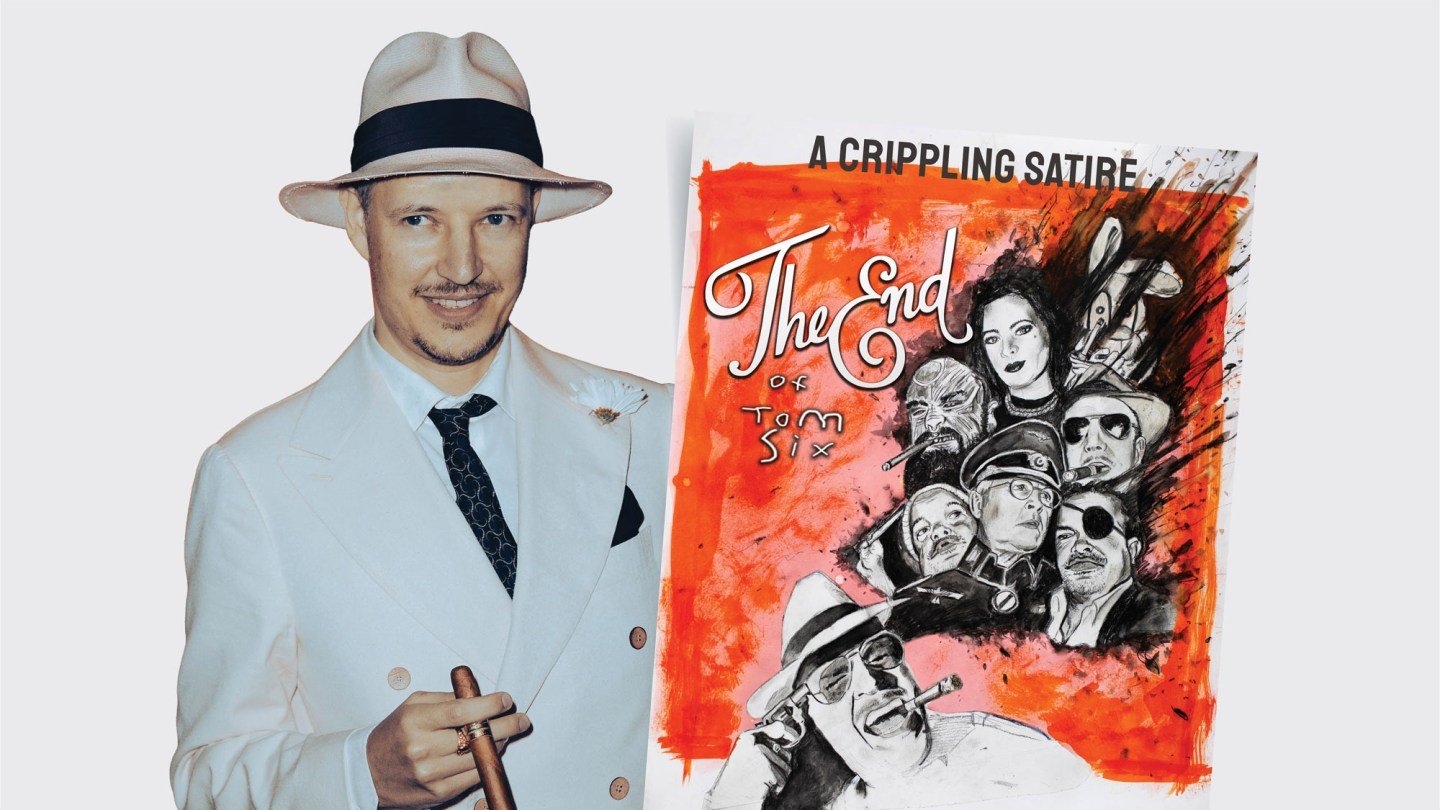
Over the past year, Six completed a self-made, black-and-white documentary called The End of Tom Six,created from a recumbent position on his antique opium bed. The whole sordid tale is there, chronicled by Six with the same macabre sensibilities that catapulted him to worldwide fame.
The End of Tom Six is being distributed by Six and his partner, Maartje Willems, through YouTube, preceded by a “pay what you feel like” menu of darkly humorous options (“$20: Really enjoyed your misery, thank you.”).
The Onania Club is still seeking professional distribution.
Tom Six granted an exclusive interview to The Hollywood Reporter to reflect on his current situation, and what he thinks that means for the state of cinema and culture. He dictated his answers to Willems earlier this month, as he reports being “dizzy from the heavy medication and in a lot of pain and in a way worse condition than as I appeared in the doc.”
“I can’t type anymore because my hands are on fire,” he added. “These are my final words, the only interview about The End of Tom Six and the very last interview I’ll ever do. Why? In the documentary I said everything there is to say.”
“What is the best thing about knowing you will die soon?” Six reflected. “You have nothing left to lose and you don’t have to hold back.”
The documentary shows Six tormented by faceless distributors (he has chosen to not name any of them, as he thinks the issue is not personal but systemic) who repeat, “The market has changed, sorry.”
“Film distribution today has become about: does the film have the right message, will it scare anyone off, does it send the wrong signal? Will our company look bad if we release it?” Six says, comparing the situation to two decades ago. “They are afraid of the backlash, the hashtag uprisings and digital pitchforks. If a filmmaker — one who has already created a pop culture phenomenon — literally gives his life for his film, wouldn’t they realize that they’re dealing with something truly unique and at least consider releasing it? Then they would have a hit and I can rest in peace.”
He has been making this argument for at least five years — he said much the same thing to Vice in 2021, two years into the search for a distributor — though he now claims to detect movement. “Audiences are getting fed up with being force-fed all that political correctness and crave challenging movies. They are getting louder and the industry is starting to notice but very slowly. One distributor has to become the hero that leads the rest. But it has to be soon or it will be too late for me.”
The combative vocabulary — bravery in the face of official cowardice, standing up against hidden agendas pushing conformity, a digital world of angry global villagers armed with social-media pitchforks — runs through the documentary and through this interview. Never mind that in 2026 that point of view is the house style of the most-downloaded podcasts in America, the presidential X feed, and many of the “disruptive” policies endorsed by the party currently running all three branches of the federal government. The film stubbornly presents Six as a lone dissident, even if his brand of dissent is currently very much en vogue and in power.
On the one hand, The End of Tom Six is a personal documentary about the feelings one artist has about his struggle (Six in raconteur mode shares, “My life was reduced to one obsession: selling The Onania Club,” and promises to display “my complete downfall in glorious 4K”). But it is also about a larger cultural point, one that goes beyond Tom Six and Onania. Six posits that “The market has changed” is less an excuse than “a fucking agenda” and “an industry code word for woke cowardice.”
“Woke is the biggest enemy of art,” Six declares, and the Onania situation is “the same reason why bold cinema is dying.” Six sees the personal, the professional and the cultural issues all intertwined as part of a life-destroying whole.
Was his original intent with The End of Tom Six to make something personal or something more like a manifesto about society at large, or was it a combination of both?
“One caused the other,” he states. “My personal deterioration due to the MS is inseparable from being unable to sell The Onania Club, which, in the end, proved to be a lethal and highly entertaining combination for a documentary. [The End of Tom Six] is a satire on the current agendas, political correctness and also on indie filmmaking itself. The [character of the] Censor Nazi represents all forms of censorship and political correctness, and the other characters are my take on inclusivity.”
Decadence is the documentary’s organizing aesthetic. Six is introduced in a louche Den of Decadent, name checks Oscar Wilde and Gabriele D’Annunzio and describes himself as “decaying in style.” It is a considerably more flattering frame than the alternative, which is a sick man in a bedroom in Amsterdam who cannot sell his movie.
“From a young age,” he tells THR, “I’ve always had a certain life philosophy: Life is a short, sadistic joke and I always wanted a larger-than-life existence. Give it all till the guillotine will fall. I hate mediocrity. I hate bourgeois conventionality and in the decadents of the 19th-century […] I found kindred spirits. They lived life with intensity, style and excess but they knew it came at a high cost. All decadents end up in ruins.”
The End of Tom Six also plays with stereotypes and tropes of classic Hollywood film directors, those dictatorial, imposing colossi like Preminger, Lang, Huston, Ford, Welles, etc., but here reduced to raging impotently against the Cinema Machine from an antique opium smoker’s bed.
“I jokingly call myself a film dictator because I do everything myself,” Six explains. “I don’t think making movies is a democracy. Someone has to have the final vision and the balls to protect it. Hollywood directors from the 1940s and 1950s were the ultimate caricatures of film directors, real authority figures, and some even dressed like dictators with their puffy pants, military high boots and even batons. I find that darkly funny. Today’s filmmakers look like accountants and don’t have those big personalities anymore. And they are afraid to say the wrong things.
“My personality is not an act. This is who I am. I have always worn light colored (linen) suits and (Panama) hats,” Six says. “My grandfather was my hero and my father figure and he always wore a suit and hat. Now I wear silk pajamas because any other fabric is too painful on my skin. I have smoked cigars since I was 16 years old. I think I was born in the wrong time period. I have a bad case of nostalgia. I miss the rebels. There aren’t many left, if any. There is no outrage, no eccentricity. It is all so dull and restrained. That’s not for me. I feel like I don’t belong here anymore.”
The assumption that the world will eventually watch — and love — The Onania Club, but that its visionary will no longer be around to enjoy the praise is part of the black comedy of The End of Tom Six. After all, Warner Bros. Clockwork is currently promoting the impending re-release of Ken Russell’s long-lost controversial nuns-in-heat masterpiece The Devils with a large marketing campaign. Pasolini’s taboo-busting Salò — feared and loathed since its 1975 premiere as a compendium of degeneracy — is in the Criterion Collection and accessible to every movie lover at home with a Criterion Channel subscription. Does Six think the system is only kind to mavericks, visionaries and cult auteurs after they’ve passed on and several decades have gone by? Will Onania be revived with a large marketing campaign by a future Meta-Palantir-Paramount-LVMH studio around 2086?
“100 percent” he replies. “I have always said that. Long after I am dead, they will celebrate The Onania Club for the powerful, sharp satire it is and my balls to create it.”
The obvious problem, which the documentary never quite confronts, is that we have to take Six’s word for the revolutionary nature of his film. The Onania Club has been seen by a handful of critics and industry people in a rough cut and by almost no one else. The distributors who passed may have passed for the reasons Six says they did. They may also have decided it wasn’t good, a possibility the film treats as unthinkable. But there’s some meaningful evidence that Six may be right: John Waters, one of the few who saw an earlier cut of it, named The Onania Club to his Artforum 2021 best films list.
Six returns to the subject of Hollywood itself, declaring Tinseltown as plagued by “the most dangerous combination: intelligence, creativity and unlimited money.”
“It’s the perfect pressure cooker for that kind of decadent, detached excess. The city itself becomes a part of the satire,” he says. “If I was going to tell a story about rich women needing more and more misery to get aroused by, it needed to be set in Hollywood.”
“I think many artists that push boundaries are misunderstood at first because they are too far ahead. People simply don’t get it yet. And after they’re gone, suddenly they become the hero. Pasolini’s work can be celebrated safely now because they are accepted films from the past. Nobody is in trouble if they say they love Salò. But if I [created] Salò now, nobody would want to touch it. It is so hypocritical. Many distributors proudly state that they celebrate bold and boundary-pushing cinema but if you give them actual boundary-pushing cinema now, they ignore it. So yes, the pattern feels cyclical.”
Commenters online, rallying behind the #ReleaseTheOnaniaClub hashtag, keep asking Six why he doesn’t crowdfund the distribution among his worldwide fanbase.
“Crowdfunding is good for when you need funding to make the movie itself,” he explains. “It doesn’t work with distribution. For that you need a professional distribution company with a good track record that has experience, the resources, the reach and the infrastructure. People who know the deals, the theaters, streaming services, the press and have a marketing team to reach the audience. When we finished The End of Tom Six, we approached many distributors. Only two responded with rejections and nobody actually watched it. It felt like the same hell all over again but with my declining health, I couldn’t fight that fight anymore. So we decided to release it on YouTube and give people the choice of paying what they want with a darkly funny menu. The documentary was very low-budget so the financial risk was low. The response to the film has been amazing. People love it, call it a masterpiece but only a small percentage actually pays anything. It only confirms what I already knew: you need a proper distribution partner.”
Born in 1973, Six is very much peak Gen X, and his fanbase skews heavily toward Gen X and Millennial men — the demographic for whom this particular countercultural pose has become the ruling culture. The documentary goes further than mere anti-woke grievance-airing, though. The insistently anti-elite auteur uses the exact vocabulary of the base that currently backs the people in power: “plandemic,” “New World Order,” adrenochrome conspiracies. Six describes himself as an “out of the box” thinker, but many of these ideas are the box right now.
In a move that would please fellow “woke culture” critic Bret Easton Ellis — who famously called the second Centipede “the grossest movie ever made” on Twitter early on, fueling the trilogy’s notoriety — Six steers away from probing that contradiction.
“The problem of these times is that everyone wants to make everything political,” he replies. “Every opinion lands you in a certain corner. It is very narrow-minded wanting to put everything and everyone in boxes. I am my own, unique, creative person and I don’t belong in any box or to any group. I am a lone wolf and the most open-minded guy you will ever meet. I don’t care about politics. I fight what hurts me and what is the enemy of art. Whether that is a left or right standpoint is not interesting.
“Woke started out as a positive thing but it grew into a monster. It has turned into restrictions, checklists, finger-pointing, virtue signaling and excluding anyone that doesn’t agree with it, which is comically ironic. It doesn’t do inclusivity justice at all. I have always been inclusive in my films. I love all birds of paradise. I never needed an obligatory checklist for that.”
The documentary spells out The Onania Club‘s main theme as “Schadenfreude,” defined as “enjoying others’ misery.” But the same definition could also be applied to Six’s Human Centipede fans (they are deriving pleasure from depictions of suffering) and could also serve as a pitch for The End of Tom Six and its unflinching depiction of career tragedy amidst body decay. Are all these forms of Schadenfreude an auteurial signature for Six’s whole career?
“Schopenhauer said: ‘Schadenfreude is devilish’,” he replies. “It is a part of human evil, which all my movies are about, on different levels. Schadenfreude is the most disgusting kind of evil. It fascinates me, because everyone enjoys the misery of others to some degree. Tabloids, clickbait headlines, the car crash on the other side of the road. A celebrity has cancer and it’s filed under entertainment news.
“I like to hand people a mirror and watch them get uncomfortable, that is my kind of Schadenfreude. In the documentary I split myself into two characters — the duality of man. I am both the suffering object and the director that pushes for the misery because he knows that it sells. He calls it: elevated exploitation. People don’t want to watch a pure success story. They prefer the misery so they feel a little bit better about theirs. I don’t mind; it is just human nature so I give people what they want.
“My current situation has not really changed that outlook. Being in pain constantly and having to deal with my decline has only confirmed what I already thought: Life is a sadistic joke and the universe is completely indifferent about our existence.
“I was born to make movies. Creating this documentary has literally kept me alive. Now there is nothing left but to stare in the abyss, knowing my end is near.”