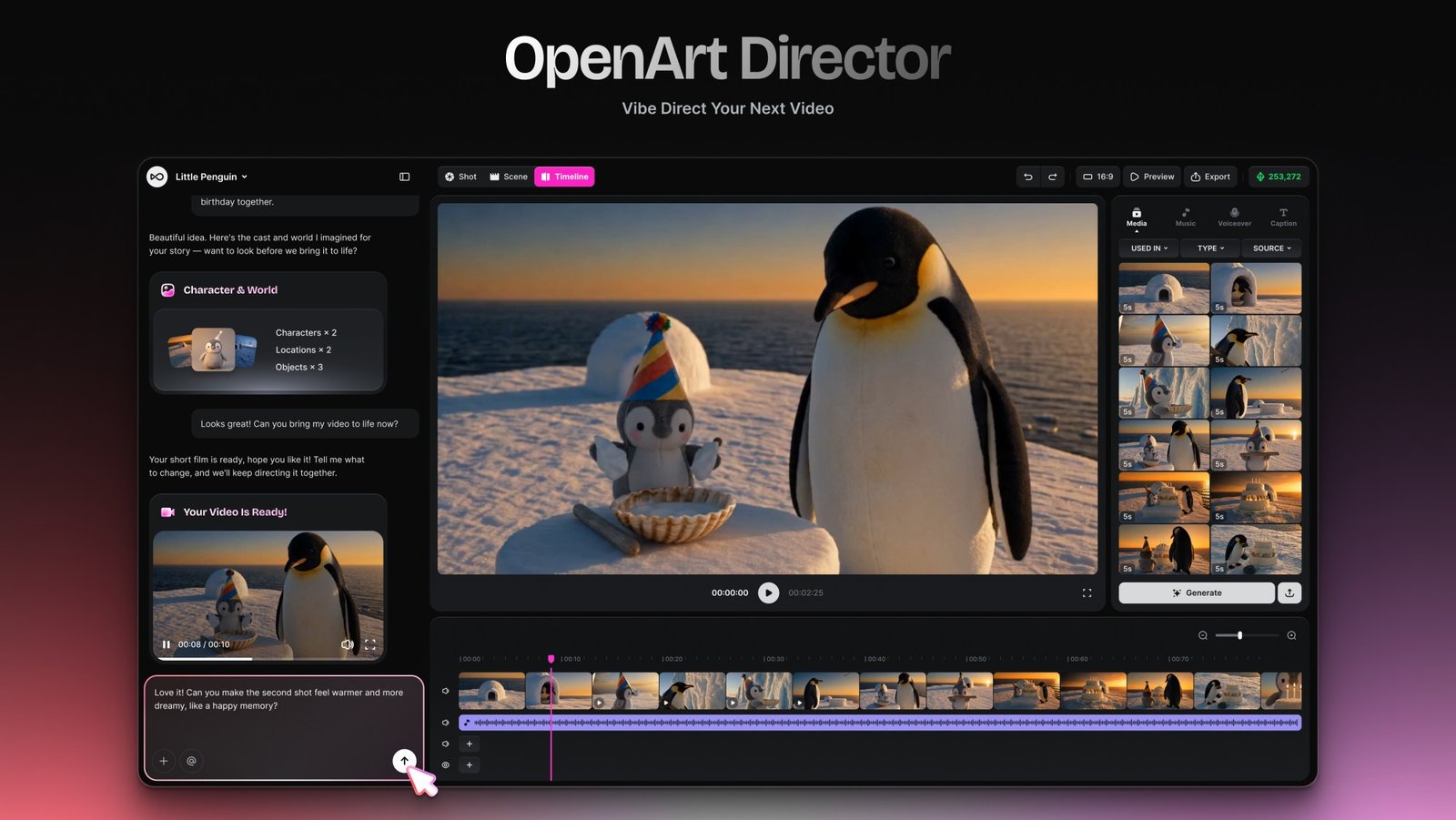
Over the brief, long history of video-generation models, every new release is accompanied by the hype that this one, finally, will be the breakthrough that becomes a standard.
There’s no definitive reason yet to think that will be the case for OpenArt‘s “Director,” a tool from a Redwood City company led by a pair of ex-Google engineers that the firm is planning to launch Tuesday. But the program offers some intriguing new features that could pave a faster path to the top of the heap.
Rather than requiring a painstaking assemblage of clips of five or ten seconds long, as most tools offer, OpenArt’s Director allows users to put together a film as long as five minutes. The program also sets up a conversational system that starts with storyboarding and ends with post, basically handholding a user through the completion of a short (or a five-minute scene in a feature).
Collectively, the new elements allow for what co-founder/CEO Coco Mao and other executives at the company call “vibe directing” — a transfer of the term vibe coding to the auteur space. OpenArt’s aim is to allow someone with no technical filmmaking skill but an abundance of storytelling vision to produce a film just like a vibe coder can generate an app.
“With vibe coding you’re giving the vibes and you forget even the code exists,” Mao said in an interview. “You guide, you task, give feedback, and then the machine just creates. And I think for us vibe directing is very similar to that, where user could forget any tools or craft and just imagine, react and give taste. And then the machine just creates,” added the executive, who founded the company with her former Google colleague John Qiao.
The company blends a host of models, from Seedance to Runway, to produce its films; its virtue lies in how it chooses from the most suitable model in a given situation but also, more consequentially, from its simple user interface. Think the old-school way of piecing together your taxes ground-up vs. TurboTax’s interview mode and you’ll have a sense of the experience they’re going for. (“We can handle a lot of these small decisions so that people are not stuck in prompt writing,” is how Mao puts it.)
There remains the question of whether vibe coding works in the artistic space, where the goal is not simply a functional end product but a more nebulous, subjective piece of art. In the latter instance the precision — and the struggle — often has a direct impact on the final product.
Also, whether such user-friendliness resonates as much with professional directors as it does for a regular Joe looking to make a movie remains to be seen. (Mao and her chief product officer Amy He say they’d like to target both). But if nothing else the tool does demystify, and potentially lower the barrier, to making films, encouraging people who might be daunted by the process and thus making film-directing a much more common activity.
“We want to help users who have great ideas but know nothing about camera angles or lenses,” said He in an interview.
The executive added that one technical shift that enables a more intuitive interface is the companies did not train models so much as it gave guidance in the manner of agentic AI, which essentially tries to reach certain outcomes through a set of goal-based rules rather than just loading in a large data set and awaiting results in the manner of an LLM.
To promote Director, OpenArt is advertising in movie theaters as part of the preshow roll, as well as buying ads in the New York City subway and a billboard in West Hollywood. Their aim is to capture the attention of creative people and film lovers and clue them in to a director itch they’ve yet to scratch. At heart the company’s goal is sociological as much as technological: there’s a director lurking inside all of us, and wouldn’t you pay a few dollars for credits every month so a Silicon Valley company can unlock her for you?
A quick test drive of the tool showed that a script can get generated with just a few sentences and a film whipped together from nothing more than that script. From there the work only starts though; a first generation of a script, for instance, was pretty rudimentary and only vaguely captured what had been intended; far more rewrites (the system allows you to go in and edit) were needed before something usable could emerge.
Still, the ability to get some script ideas down with minimal effort jumpstarted the process in a way a simple chatbot doesn’t. At the other end of process, OpenArt also set up the program so users can edit a film with the same relative ease (most models require an entire new generation if something turns out askew).
OpenArt says it has eight million active subscribers for its existing image and video tools, and has generated $70 million in revenue, according to the research firm Sacra, with just about 50 employees, per Mao.
About $30 million has been raised as part of a recent rounding of funding — not chump change but a small fraction of, say, the $800 million-plus Runway has raised.
OpenArt has also established informal partnerships with a number of creators, including a former head writer on The Ellen DeGeneres Show, Gil Rief, and the AI viral music creator King Willonius, best known for his Drake-tweaking parody “BBL Drizzy.”
Rief said he found Director not quite like being on set but “a lot like giving notes to an editor,” with the model hearing an ask and then returning with a new version. “I feel more creative than ever because I’m removing a lot of the friction,” Rief said of AI generally, echoing what many AI experimenters say about the former obstacles with scripts locked away in the drawer now removed as they can quickly conjure up a visual version of words on the page (he said he aims to use AI mostly for pitches and internal material-development, not the final product).
Willonius noted the “higher degree of flexibility and control” with Director. “It lets you get from Point A to Point B a lot faster without sacrificing quality,” he said, noting that the first generations his instructions spit out were a little bit of a “vomit draft,” but added that this happened with human versions too. Both Willonius and Rief have used the Director tool to generate music videos, though the company aims for a variety of short-form use cases with less abstract qualities such as TV commercials, film shorts and social content; they also believe they can appeal both to studios to make available to their filmmakers via an Enterprise package as well as amateur users.
Mao and Qiao both worked in the Google empire for years and were best known for Tangi, a short-form video service focused on creativity that was part of a Google incubator before being acquired by Google Search; they left to start OpenArt in 2022.
Mao says she believes that a fresh vista is opening up before our eyes.
“We really think this will be a new era of storytelling,” she said. “We can make a lot of new storytellers, and also give past storytellers even more freedom and creative expression than they already have.”
Leave a Reply