When Nakadai Tatsuya, one of Japan’s most celebrated actors, decided that his young student’s surname was too dull for the stage, he reached for an unlikely inspiration. Hashimoto Koji — as the actor was called then — had been working at a Tokyo municipal office before auditioning for Nakadai’s acting school. The word for such an office in Japanese is yakusho. The stage name followed naturally, carrying with it a wish: that this unknown clerk’s range of roles would one day be as wide as possible.
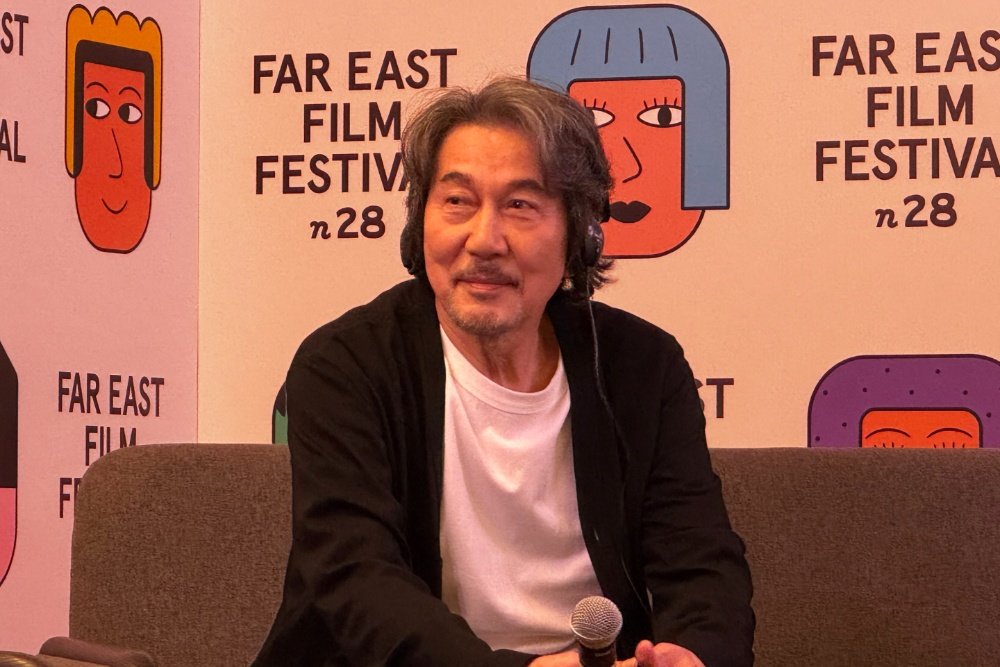
Forty-eight years later, Yakusho Koji arrived in Udine to collect the Golden Mulberry Award for lifetime achievement at the Far East Film Festival — presented by Wim Wenders, no less — and the name has more than fulfilled its promise.
For Yakusho, the award carries a specific weight. “It’s like if I was a horse in a horse race — it’s like somebody is giving me the last whip of love,” he told Variety. “It means that I still have something to do, and I can go on a little further.”
The career that earned that whip began not with film but with period television. His breakthrough came playing Oda Nobunaga, the volatile 16th-century warlord, in an NHK taiga drama that ran for much of the year. The role aired when Yakusho was 26 and was the first that allowed him to live on acting alone. “Until then,” he said at a masterclass at the festival, “I was doing part-time jobs alongside studying acting.”
His transition to film came through Itami Juzo, who cast him as a mysterious man in white in “Tampopo” after spotting him in a television drama wearing a similar suit. The 1985 noodle-western became a cult classic abroad — particularly in the U.S., where it enjoyed a long run — though it underperformed locally. What Yakusho remembers most vividly is a scene that went further than intended. His character dies covered in blood, and during the shoot he hit his face on an iron bar and started bleeding for real. “They asked whether I should go to the hospital,” he recalled, “but since the character was supposed to die covered in blood, I asked them to keep rolling.” The shoot continued with Yakusho lying in the rain, bleeding genuinely, until a passing woman became convinced she was witnessing a murder and tried to call the police.
It was Imamura Shohei’s “The Eel” that placed him on the world stage. When the film won the Palme d’Or at Cannes in 1997, Imamura — who had little appetite for press attention — had already left France. Yakusho had also departed, and spent a day confined to his Paris hotel room trying to secure a flight back. He made it to the ceremony and was called to the stage by Catherine Deneuve. “I had a feeling some people in the audience might have mistaken me for Imamura Shohei,” he recalled. “So my opening words were, ‘I am not Imamura Shohei’ — and when the audience laughed, I relaxed a little.”
The mid-1990s were a pivotal stretch. In a single year in 1996, Yakusho made three films: the near-silent “Sleeping Man,” Suo Masayuki’s “Shall We Dance?,” and the yakuza picture “Shabu Gokudo.” The discipline required by the first movie — long stretches of minimal dialogue in which he had to generate meaning through stillness and pauses — he credits directly with unlocking the gentle precision of his performance in “Shall We Dance?.” What he could not have anticipated was that “Shall We Dance?” would eventually reach Wenders, who often watched it with his family at Christmas. “If there had been no ‘Shall We Dance?’,” Yakusho said, “Wim Wenders would never have known me.”
That connection led, decades later, to “Perfect Days,” which won him best actor at Cannes. For Yakusho, the experience crystallized something fundamental about the craft. “What you do is that you go to a film set and you just keep chasing human life,” he told Variety. “You keep chasing living human beings in order to portray them.” His guiding principle in choosing roles is similarly distilled. “Overall, what interests me is beauty,” he said. “I want to participate in beautiful films, in beautiful stories, in movies with beautiful people. I speak of beauty in a very wide sense — it can be the beauty within a yakuza movie.”
Physical preparation has always been central to his process. For “Shall We Dance?” he trained in ballroom dancing for four months, practicing steps in the corner of a period drama set he was shooting concurrently, in full costume. For “The Eel” he learned barbering. For “Under the Open Sky” he practiced on a sewing machine at home — and broke one. The goal, he said, is always the same: “I want the skill to sink into my body to the point where I’m no longer conscious of it during a performance. Whether it’s dancing or cleaning toilets, if I’m still thinking about the technique, I can’t do the acting that actually matters.”
Now 70, he is candid about what age demands. “Filmmaking is grueling,” he said. “When I’m playing a 70-year-old character, I feel I need the physical capacity of someone at least five years younger to get through the shoot.” But he sees aging as an asset as much as a constraint — a lived texture that cannot be faked, and one he credits with making his performance in “Perfect Days” possible in ways it would not have been earlier in his career.
He has a new project in the pipeline, a smaller film set to begin shooting in June, directed by someone with a background in CGI whose name he declined to reveal. He retains ambitions behind the camera too. His sole directorial outing, “Toad’s Oil” in 2009, left him humbled by the demands of the job — “I realized directing was this difficult,” he said — but he has continued developing projects since, writing scripts with friends and pushing them forward. The obstacle is consistent: investors will only commit if he stars in the films himself, and the pictures he wants to make are small and resolutely non-commercial. “The kind of film I want to make is not a large-scale commercial film,” he said, “so the money doesn’t come together. And I can’t ask the staff to work for nothing.”
On the evidence of what Japanese cinema has produced in recent years, he is quietly optimistic about the generation following his own. “There is a new generation of directors, and they have talent,” he told Variety. “I just hope from the bottom of my heart that all the production companies will be able not to make their talent collapse.”
As for the lifetime achievement honor, Yakusho is choosing to read it as acceleration rather than conclusion. The horse, he said, still has ground to cover.
Leave a Reply