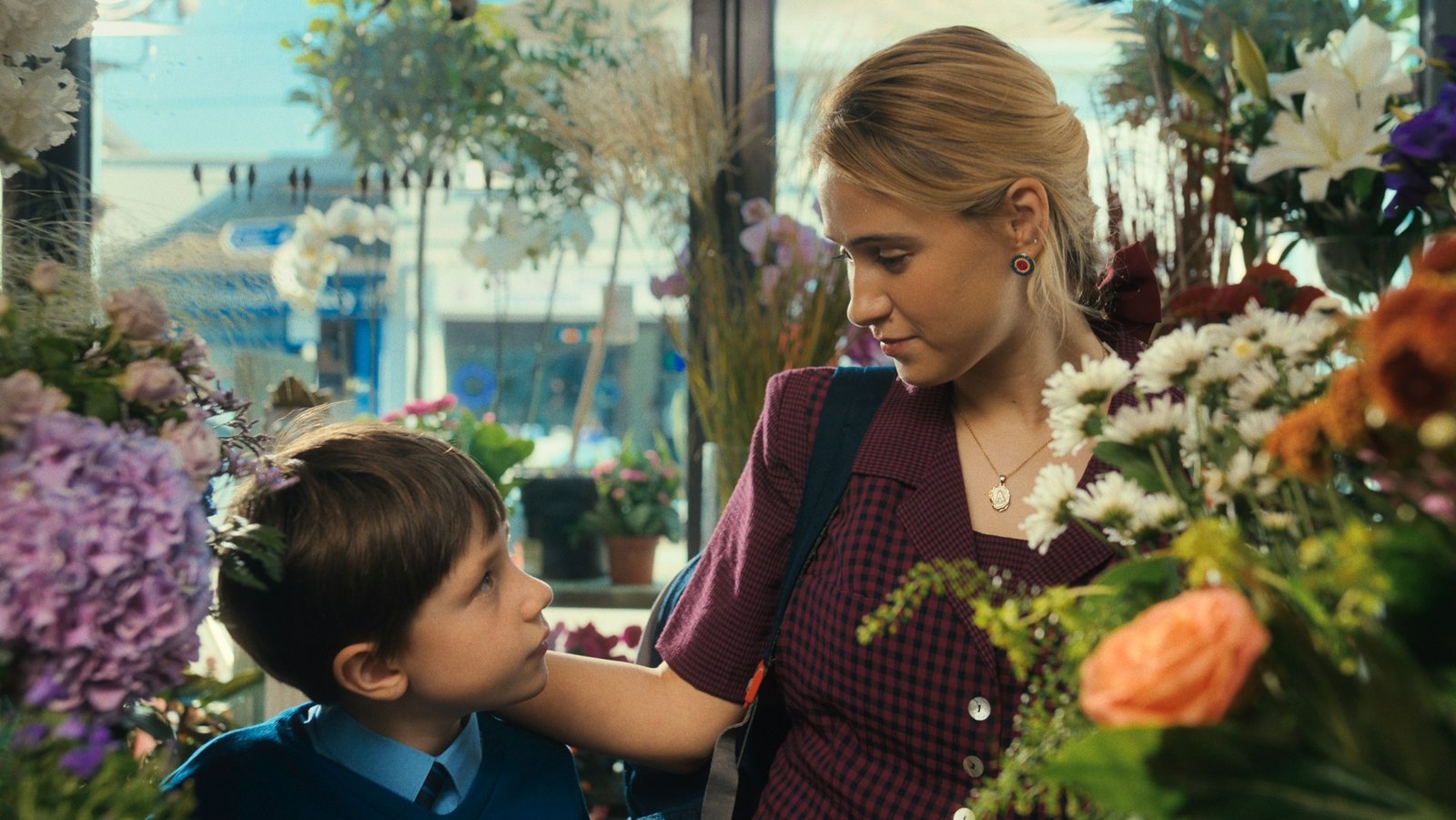
Rory Kinnear (The Lord of the Rings: The Rings of Power, James Bond franchise) and Maria Bakalova (The Apprentice, Borat Subsequent Moviefilm) star in director Rebekah Fortune’s Learning to Breathe Under Water, written by Richard Brabin. But the real star is young Ezra Carlisle (Dalgliesh), who plays the eight-year-old Leo in the film, which world premieres on Tuesday, July 7 in the Special Screenings program of the 60th edition of the Karlovy Vary International Film Festival (KVIFF).
With his mother gone for five years for, initially, unclear reasons, Leo’s best friend is a massive shark that his artist father (Kinnear) built into the roof of their home. Leo confides in the shark to process a confusing world until the spirited and bubbly au pair Anya (Bakalova) bursts into their lives. Her never-ending questions shatter the silence, and her answers are really straightforward and honest. Her boundless energy and warmth bring color to their lives and challenges the male duo to step out of their comfort zone, which is mostly in their heads.
The KVIFF website, unsurprisingly, promises audiences an “enchanting film for parents and children about how to talk together and how to grieve together, about how the world of adults is sometimes hard to understand, and how children’s opinions really should be taken seriously. And, above all, it’s about learning how to breathe again.”
Richard Kendrick provided the cinematography for Learning to Breathe Under Water, which was shot in Galway, Ireland and edited by Sam Hodge. The producers behind the Shudder Films and Wildcard project are Jack Tarling (Kneecap) and Patrick O’Neill. Bankside Films is handling sales on the movie, which was featured in the BFI’s Cannes Great 8 showcase 2025.
THR can now exclusively premiere a clip for Learning to Breathe Under Water to whet your appetite a bit. Leo and Anya talk about the boy’s parents and his, partially animated, read on the world. Enjoy the clip right here!
Ahead of the film’s world premiere, Fortune and Bakalova talked to THR about what spoke to them about Learning to Breathe Under Water, its great ensemble, including its promising youngster, and how the movie takes audiences inside the head of its young protagonist.
Both women were blown away by Brabin’s script. Fortune put out a call for scripts to the BBC Writersroom department during a COVID lockdown. “I wanted to stay at least a bit creative to not go stir crazy,” she recalls. “Richard sent me the first five pages, and I just instantly fell in love with Leo. I think the reason it spoke to me really was that, being autistic myself, the way Leo just says what he thinks, but also struggles to process things at the same time, was quite refreshing. He basically cuts through all the adult waffle [or blabbering] and just says it how it is. I could wear Leo quotes on my T-shirt all the time. And I loved that Richard was really keen that we didn’t just observe Leo from the outside, but we were inside with him to experience how he was observing the world and how he processes the world. That was a major draw for me.”
From there, Fortune found herself connecting with all of the characters in different ways. “Anya has almost this ADHD verbal diarrhea, which is also me,” the director tells THR. “She’s incredibly open – to a fault at times. And Peter is massively misjudged a lot of the time, and that’s also really interesting. You’re judging a person because they’re not presenting the way you think is right, and I find that this, as an autistic person, is a big thing.”
The tone of Learning to Breathe Under Water also spoke to Fortune. “I like things that are moving but heartwarming,” she explains. “Yes, you might have a cry somewhere in the film, but you also feel hopeful, and I think that’s really important. The world’s horrible enough as it is, but if we’re all a bit more human to each other, a bit kinder to each other, accept that it’s okay not to be okay and stop judging, we can actually be better for each other.”
Bakalova also immediately felt the Learning to Breathe Under Water script resonating with her. “It’s a special movie. And I felt it was a special script from the moment I got to read it,” she tells THR. “I fell in love with the story. It’s something that is universal and that we can all relate to.”
Just like Fortune, she recalls how “I also immediately fell in love with Leo and his perspective” that makes the film “very human and very empathetic.”
Her own character, Anya, drew Bakalova in as well. “She has something magical within her; this childlike personality that I often dare to play with,” she shares. “I used to do that, I think, more when I was maybe a little bit younger. Maybe because of that, I connected with the idea of approaching it again and imagining that I could be this free-spirited young woman who just dares to ask a lot of questions, dares to provoke the universe and dares to try new things and not quit.” Such as meeting a family for the first time and “openening her heart and her mind to this little boy who in the beginning is pushing her away, but she’s not going to quit.”
The actress and her director laud the chemistry between the members of the Learning to Breathe Under Water ensemble. “I knew of Rory from the stage, because my background is also in theater,” explains Bakalova. “Rory is such an incredible national treasure. So having the chance to work with somebody like him was something remarkable for me.”

When she met their young colleague Carlisle, “I immediately lost my mind and my words,” Bakalova tells THR.”I absolutely immediately felt he’s such a special creature, a little bit of a magical human being. He says so many things with just his eyes and with his silences as well, so he was such a gift from the universe. I have the feeling Ezra has an exceptionally developed inner world, and I’m just looking forward to seeing his acting future.”
Bakalova also shares something surprising. “Something I feel was helpful to me was that we made this movie almost straight after The Apprentice, where I got to play Ivana Trump, who is such a complex character – layered and a person who wears so many masks,” the star tells THR. “I think she’s different with different people, which helped me think about us as human beings. I don’t think we’re two-faced or fake or hypocritical, but we do show different sides of ourselves in front of different people. And I think that Anya is similar.”
In fact, Anya also isn’t as much in control as she may initially seem. “Even if she has a lot of problems in her personal life, when she meets someone like Ezra, that connection opens up something in her soul as well,” explains Bakalova.
Fortune calls herself “truly blessed” by the cast that came together to create Learning to Breathe Under Water. “Rory, I had admired for years, having seen him a lot in theater and absolutely loving him in the TV show Penny Dreadful. I could totally see him as Peter,” she recalls. “Maria just has that energy that Anya felt like she needed. She’s got so much life and energy, and she just needs to walk into the room, and that’s it.”
How did the creative team go about casting the role of young Leo? “I was super keen to see neurodivergent children, whether they were diagnosed or undiagnosed,” Fortune tells THR. “I felt like it was quite important that that characteristic was there.” Self-taped auditions allowed her to see kids chatting about themselves and their hobbies. “I watched hundreds, and when I saw Ezra, I just knew and said I don’t need to see anybody else.”
In a Zoom interaction with the young actor, Fortune confirmed that Carlisle was the right choice. “It was just some of the things he did and said,” she shares. “I’d said that the meeting was finishing at 11 o’clock, for example. And at 11, he got out of his chair and left the room, and his mother went, ‘I’m so sorry, but I told him we were going swimming at 11 when this is finished, so he’s gone to get his swimming kit.’ I thought: ‘Perfect, that’s Leo!’”
During an improvisation exercise, Fortune asked her young lead to get angrier. “But he really struggles with that emotion of anger, because he’s not been around it,” she tells THR. “So, our casting director and I said, ‘ Imagine some kids have stolen your football,’ and she played one of those kids and said, ‘I’ve kicked your football so far that it’s gone to the other side of the world.’ And Ezra just went: ‘That’s not actually physically possible.’ So, I knew: he is Leo.”
[SPOILER WARNING: Parts of the next two paragraphs contain spoilers for the film.]
Now, why is there a shark on the roof of the house that the father and son live in? “The film explores how Leo makes sense of the world, including the death of his mother. He’s created this fantasy around it. She was eaten by a shark, but he doesn’t see it like that. He sees that his dad was a hero and wrestled the shark, and he kind of flips that on its head visually as well.”
Bakalova also highlights how the shark is part of the eventual change the characters experience. “Once you learn how to breathe, you will start accepting life the way that it is,” she summarizes one of the lessons from the film. “You will bring your family and friends back together. You will open up all the boxes that you tried to close and forget, and it’s the same with Ezra. He has this hole on the wall, which is covered with a poster, but then the poster is gone, and then the shark is gone, and then he is dropped into the water, and he has to start breathing.”

Bakalova calls the film’s title, Learning to Breathe Under Water, “incredible,” explaining: “It’s a metaphor, but also truthful to life and swimming. I’m having swimming lessons in preparing for my next project, and I just learned for the first time how, when you swim professionally, you have to keep your head underwater and pull it up only to take a quick breath.”
Fortune shares with THR that the original title of the script was Dead Sea, which she felt “sounded more like a horror film.”
Toast jumping out of a toaster to the sound of the device is a recurring visual feature of the film, as are animated sections. What’s that about?! “That wasn’t in the script,” Fortune says. “We had shots of the toast, because toast was really important to Leo, because it’s what they eat all the time. Also, one of the only facts he knows about his mother is that she liked toast. So, the toast seemed to be this emotional thread. It’s also so mundane and ritualistic.”
The sound of the finished toast popping up also filled a key audio role. “The film is very quiet at the beginning, to the point where sometimes, people are asking if something’s gone wrong with the sound,” the director explains. “But that was intentional. This very quiet space with very little ambient sound was meant to not feel calming, but like a pressure. But when that toast cuts through, it does make you jump. It’s like a mini jump scare, but a domestic jump scare. It’s this very ordinary thing that can actually be quite shocking.”
Meanwhile, the animated scenes lean into how the film shows the world through Leo’s eyes. “This is how he makes sense of the world,” notes Fortune. Adds Bakalova: “We really get a sense for how Leo sees the world, which is unique, and that’s why having animations in the film is really special. Having him think out loud is also something that I wish we could more in cinema. It kind of reminded me of the French movie Amelié, where you also get this feeling of something that is real, yet otherworldly.”
Fortune loved her experience on the Learning to Breathe Under Water set. So much so that “I’m actively working on more projects with [producer] Jack [Tarling],” she tells THR. “We had a brilliant collaborative partnership, and I feel so supported by him. And so we’re really actively working on trying to find projects to work on together. I really want to do more genre work, so I’m working on a horror and a sci-fi thriller. Although they are bigger cinematic worlds than in this film, they’re still about people who are othered and the way that we perceive people and who’s valuable and who’s not.”
Bakalova can’t yet share what she is working on next, but hopes that Learning to Breathe Under Water will find and speak to a wide audience. “It’s been a beautiful journey,” she tells THR. “I wish we get to do it again.”
Leave a Reply