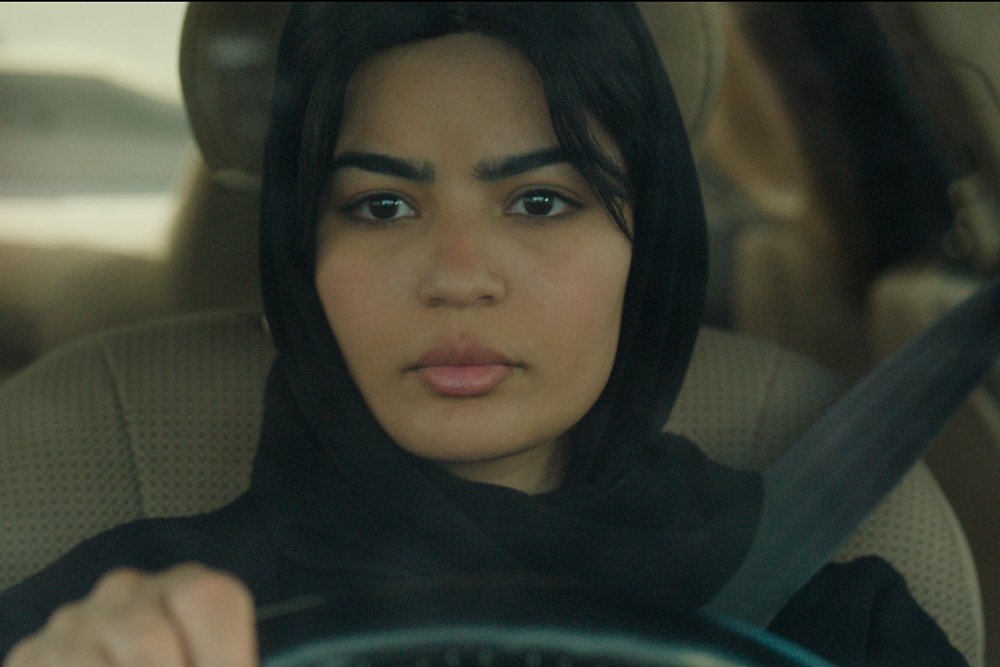
Despite having a lot on its mind, Haifaa al-Mansour’s murder mystery “Unidentified” is an unfortunate misfire. The Saudi trailblazer — whose 2012 drama “Wadjda” was the first feature shot entirely in the Kingdom, and the first Saudi film by a woman — returns with what ought to be a searing indictment of gendered norms under the guise of nominal progress, via its tale of a police secretary investigating the death of a teenage girl. It has the right ingredients on paper, but its execution is ineffectual: both overstated and under-dramatized en route to a head-scratching conclusion.
Divorced and in her late twenties, Nawal (Mila al-Zahrani) stands out as one of the only women employed at a police station in northern Riyadh. An aficionado of true-crime podcasts and makeup influencers — which, in the film, are smartly combined into a single, macabre point of interest — Nawal, whose job involves digitizing paper files, is often left on the outside looking in, despite her keen eye for detective work. However, her personable commanding officer Majid (Shafi al-Harthi) sees the value in her perspective when a high school student’s body turns up in the desert, and Nawal discerns clues from details which the policemen overlook, from the girl’s manicure to the embroidery on her abaya.
Gradually, Nawal skirts the limits of her job and begins her own investigation, entering spaces and conversations her male superiors either can’t, or might not think to. She soon bumps up against resistance from far more affluent folks — mostly women and other teenage girls — who seem to want to sweep the student’s disappearance under the rug, in keeping with implicit understandings about honor, and teenagers being married off before they graduate. However, despite Nawal having to tread lightly across these minefields, Al Mansour’s withdrawn aesthetic approach ends up largely noncommittal, and seldom enhances the contours of this story.
The protagonist’s obsession with solving the young girl’s apparent murder seems tied to events in her past, which al-Mansour and editors Rafael Nur and Steve Cohen introduce through dreamlike flashbacks. However, the expression of this motive in the present seldom extends beyond Nawal telling anyone who’ll listen how fixated she is on the crime at hand. Granted, there’s a sly reason for her verbose approach, revealed late into the film, but until “Unidentified” reaches that point, it lurches along while unspooling an uninteresting mystery, whose details often fall into Nawal’s (and the audience’s) lap through sheer coincidence.
Without revealing too much, this structure from al-Mansour and co-writer Brad Niemann ends up having a roundabout reason too, given a bizarre third-act twist that renders moot the film’s entire point of view, along with its central themes. It is, on the one hand, a tale of a diligent, would-be female detective navigating social mores, and eventually, using them to her advantage. But on the other, this top-down description only works in retrospect, after the film has already presented numerous scenes of Nawal trying to extract information through the exact same conversations about a dozen different times. It’s a bit of a chore.
There are moments when “Unidentified” seems like it might have something more nuanced or meaningful to say, like when characters clash over the death penalty in an early scene, or when Nawal begins facing the depths of unspoken social rot that still infect polite Saudi society. However, all this ends up swept under the rug in favor of trying to outsmart the viewer, leaving little by way of coherent narrative evolution; neither of the aforementioned threads is ever followed up on.
Played cautiously and convincingly by al-Zahrani, who starred in the director’s 2019 drama “The Perfect Candidate,” Nawal happens to have the same surname as her character in that film: Al Safan. It’s a name shared by the young protagonist in “Wadjda” too, spiritually connecting al-Mansour’s three works about Saudi women stepping outside their prescribed roles. However, “Unidentified” sees this concept manifest as a bizarre overcorrection, wherein any hint at complexity or ethical complication is overshot, as the film lands somewhere in the vicinity of cartoonish caricature by the time all its layers are peeled back.
There is, perhaps, some hypothetical version of “Unidentified” that leans full-tilt into genre delights, in a manner that feels more congruous with the ambitions of defying cinematic expectations. However, what ends up on screen is interminably dull, both in its visual construction and in its haphazard narrative swerves. It’s the rare movie whose every artistic intention can be easily identified, but whose emotional effects are never discovered.
Leave a Reply