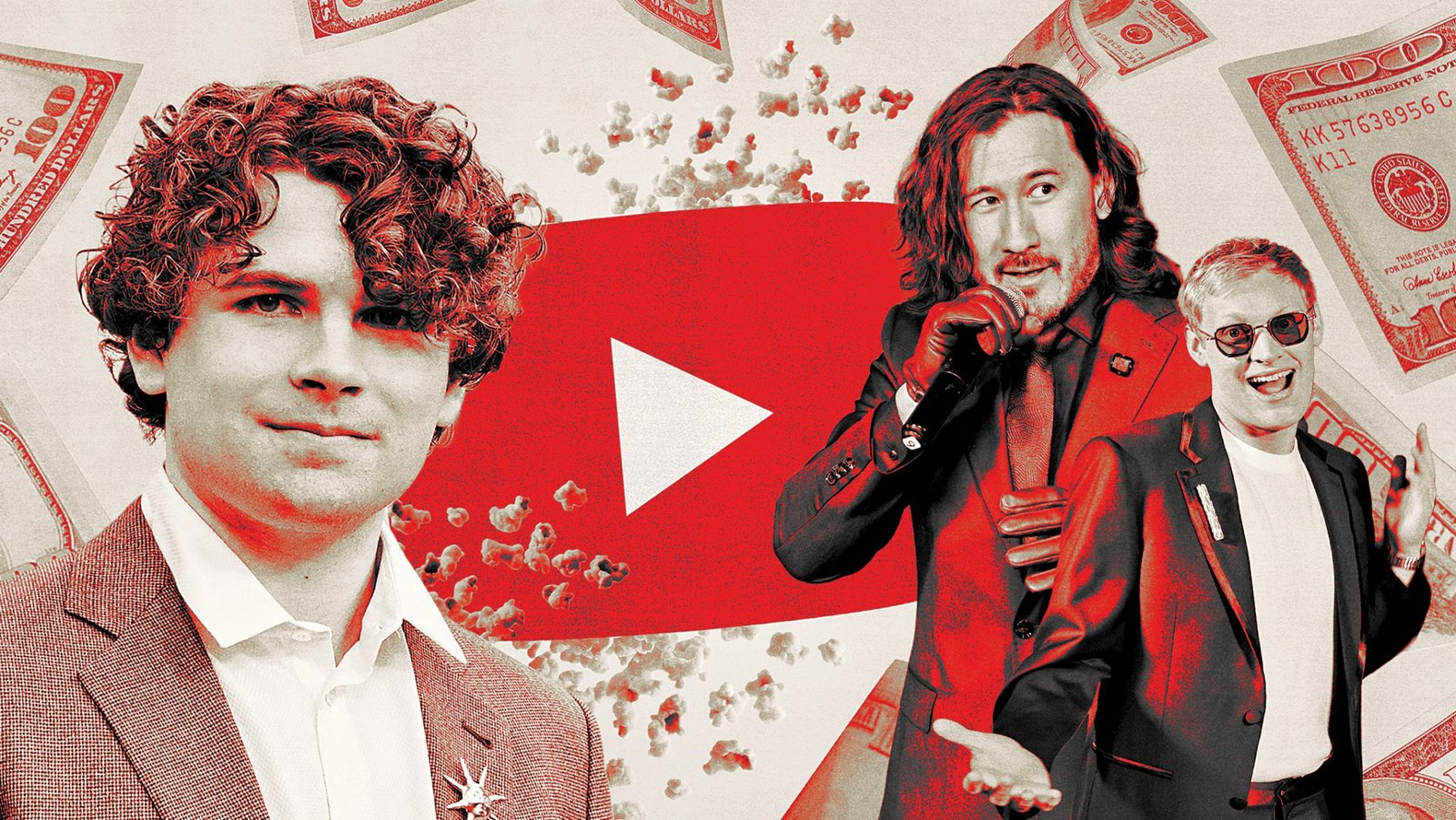
On Monday, all of Hollywood was in a tizzy. Kane Parsons just left Star Wars in the dust, Curry Barker somehow got even more people to see his movie in the third weekend than the second, and to top it all off one of the most popular creators the platform had ever known, Mark Edward Fischbach (aka Markiplier), on Sunday debuted his winter theatrical hit on YouTube exclusively. The creators (and filmmakers of Backrooms, Obsession and Iron Lung, respectively) had everyone scurrying.
Sitting in his office in Playa Vista, the YouTube executive Fede Goldenberg radiated more zen.
The company’s headquarters are built at the Howard Hughes-built “Spruce Goose Hangar,” and Goldenberg was as unbothered by conventional thinking as the man who designed the real estate around him.
“It’s a particularly great feeling — two movies leading the box office and Markiplier on the platform too,” said Goldenberg, who like so many Google executives has a title — head of film and TV partnerships — that only hints at his influence. “I know people are surprised but it does not surprise me one bit — these are people who’ve had years to perfect the craft of entertaining audiences.”
Also, it’s not like Goldenberg didn’t warn Hollywood. Exactly a year ago this month, the executive stood in front of an audience at a resort a half hour east of Denver and told a streaming conference this would happen. “It’s no exaggeration to call these guys the New Hollywood,” Goldenberg said of the creators — perhaps inadvertently, perhaps intentionally, alluding to the Coppola, Scorsese and Lucas revolution of a half-century earlier.
To be Goldenberg — or, really, any YouTube executive right now — is to live the kind of giddy life so many come to Los Angeles to build. You work with talented artists, you trust them, and slowly but surely people begin to take notice, until suddenly one day the whole world is banging down your door.
Goldenberg came from Brazil with just such a dream nearly two decades ago. He has spent the past 15 years at Google, witnessing and building the careers of the storytellers on the site. YouTube doesn’t dictate creative choices — they’re not like a traditional studio that way. But they work with creators every step of the way on what video to release and when to release it to maximize its impact and grow subscriber bases. Any doubts that this kind of advisory system works, check out Parsons’ 3 million subscribers built in just a few years — or Markiplier’s long-play effort to get to 38 million.
Goldenberg says he holds no secret as to what makes a piece of content catch on virally; the key is just listening to the connections the content creators themselves are making.
“Creators have a finger on the pulse of what feeds the audience better than anyone. Last week I was at an event with Mark[iplier] here in Los Angeles and he was saying that creators will very easily cross over from horror to comedy because both forms are about telling the audience one thing and then surprising them with a turn of events,” Goldenberg says. “Now, that’s not something that would be obvious or intuitive to most of us. But they just get that instinctively.”
This all can sound like a buck-pass — wouldn’t an executive building an audience know well what an audience wants, or try to? But YouTube executives up and down the line insist that they don’t and creators do — that the latter’s ability to interface with audiences directly obviates legacy-Hollywood’s bedrock belief that a marketing executive knows best. Not many executives might have imagined, for instance, that wandering through endless hallways without a clear purpose would captivate millions of Americans, and yet by taking the meme and running with it, Parsons has done that again and again.
Such a belief in the sole savvy of creators was of course not fully proven out this weekend — Focus and A24 did plenty marketing for Obsession and Backrooms of their own. But given how the movies will outperform anything either company has ever done, you’d also be hard-pressed to disagree too strongly with the premise.
Demonstrating it most concretely was Markiplier’s self-distribution route. That approach brings in more money in to the creator — not least because they can then bring it back to the platform in a way an output deal-laden Focus or A24 can’t. But Goldenberg says the company has no preference on whether a creator brings on a distribution partner or makes a go of it themselves. “We want to support each of these creators’ journeys wherever they want it go,” is the kind of thing he (and others at the company) say often.
That also seems like strange logic — wouldn’t a company want to keep the talent they cultivated in-house? — until you realize it’s not born of altruism but confidence. YouTube is that big, dominates our video watching that much, that its execs know the next wave of creators will build their content on the site and keep it there as long as they can. “It behooves them to continue to invest in YouTube, because that was the spark that led to all of this,” Goldenberg says of the current wave of horror filmmakers.
Unsaid but well known: YouTube regularly draws more viewership than any other video platform by a wide margin, in many months well over 50 percent more than Netflix.
Goldenberg does say that there is a difference between Markiplier and Parsons-Barker, noting “an additional stakeholder in the iterative process” with the latter two. But he believes many filmmakers will like the self-distribution route — “He relies a lot more on the roots of the fan community, and I think that’s very attractive.” (If you’re thinking, “the whole idea of an operation that is at once so hands-off but also owned by the biggest company in the world seems really bizarre,” you’re not alone. But Goldenberg says the fit works.)
The executive demures on the next wave of creators that could storm the box office, saying simply this one is only the start, and that horror is hardly the only viable genre. Mysteries, sci-fi, comedies — there are creators he’s working with at the moment who have a theatrical story to tell, and he says it would be surprising if we didn’t see features from a lot of them in the coming years. He also does not rule out attracting personalities to the platform — that is, taking an A-list filmmaker and inducing them to put pieces of their film on YouTube, drop the finished one in theaters in whatever way they want, then bring it back to YouTube.
The company has already made strides in the Emmys space, and is holding events in Los Angeles in the coming weeks for homegrown hits like Sean Evans’ Hot Ones, Cleo Abrams’ HUGE* If True and Brittany Broski’s Royal Court. And don’t be surprised if you start seeing Emmys attention for talent the company has lured over like Alex Cooper and Trevor Noah. And then, potentially, for YouTube film creators too.
“The beauty of the platform,” Goldenberg says, “is we have room for every kind of journey.”
Leave a Reply