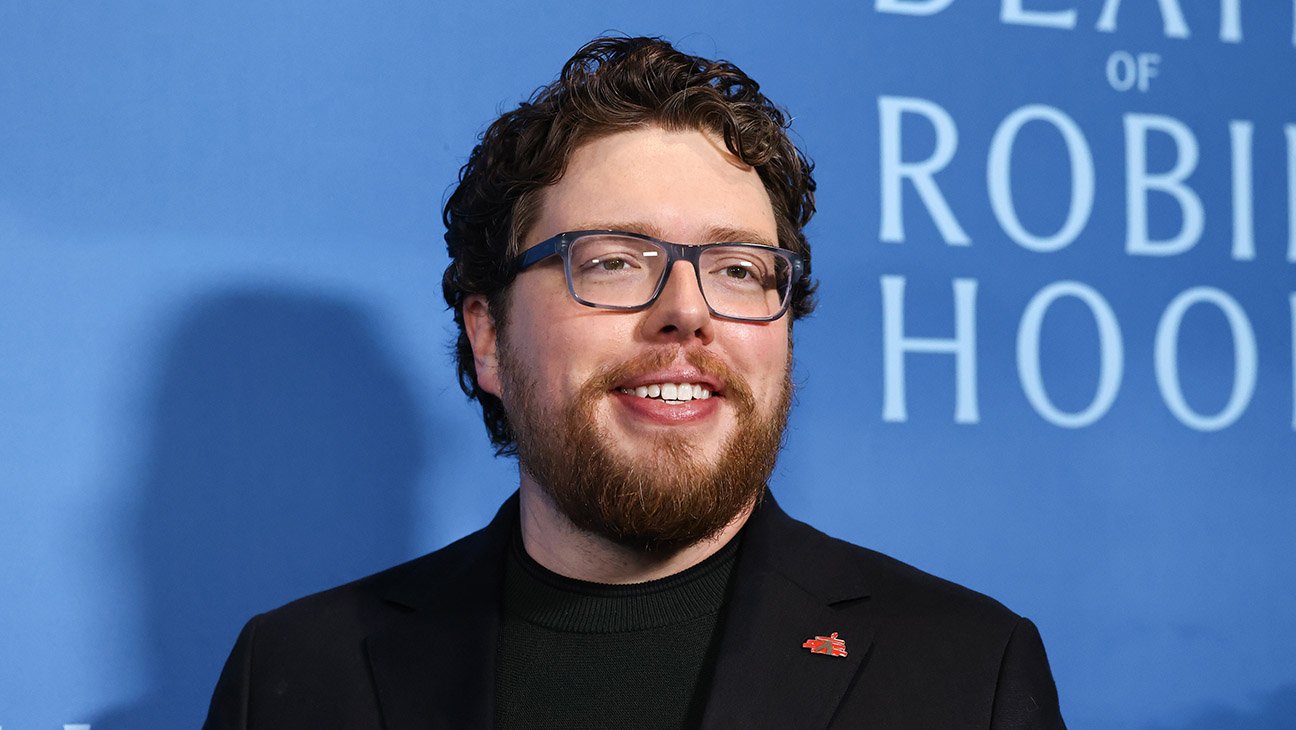
The Death of Robin Hood writer-director Michael Sarnoski never set out to make your father’s Robin Hood.
Long known as the heroic outlaw who robs from the rich to give to the poor, Sarnoski’s revisionist take wasn’t purposefully trying to knock Robin Hood down a peg or cater to either political party’s preferred interpretation of the legendary figure. Instead, the Pig and A Quiet Place: Day One director was simply trying to capture the stark reality of a 13th century brigand.
“It was less, Let’s make Robin Hood a bad guy, and more, Let’s think about what the life of a medieval bandit might’ve actually been like,” Sarnoski tells The Hollywood Reporter. “The old Robin Hood ballads, they’re very brutal. The things Robin does are pretty grotesque at times. I wanted to add more gray and more complexity, and a lot of the subversions came naturally out of that.”
Sarnoski remixes elements from the 17th century ballad, Robin Hood’s Death, as Robin (Hugh Jackman) nearly loses his life while helping Little John (Bill Skarsgård) with a familial matter. The latter then transports Robin to a hillside priory where Sister Brigid (Jodie Comer) nurses him until he’s able to get back on his feet. But unlike the ballad, it’s Robin who’s the monster, not the prioress who treats him with bloodletting, an ancient medical treatment to combat illness and infection. This idyllic island community may know Robin as “Randolph,” but his chickens still come home to roost, forcing him to reconcile his dark past with the valiant yarns regaled about him.
For Sarnoski, The Death of Robin Hood serves as a reminder that we need to be more careful about the stories we retell.
“[Jodie Comer’s] prioress has this line where she talks about storytelling and says, ‘Knives cut bread as well as they do flesh.’ And what she’s saying is that she uses stories to help and heal people, whereas Robin used them to perpetuate violence,” Sarnoski explains. “That doesn’t make the stories themselves good or bad. But we need to be responsible in how we use them and how we let them be used upon us.”
Sarnoski and Comer will soon be reuniting for the pilot episode of The Chain, HBO’s limited series adaptation of Adrian McKinty’s New York Times bestseller. Showrun by Emmy winner Damon Lindelof, Comer plays Rachel, a divorced mother who must do the unthinkable to recover her kidnapped child.
“I’ve read a lot of scripts with people asking, ‘Hey, would you direct this?’ But nothing had clicked yet,” Sarnoski shares. “So this was the first time I read something that I didn’t write that was just a no-brainer [for me to direct]. It feels so me. I get it 100 percent. It’s been really reassuring and exciting to see that I could direct something that someone else wrote and still have it feel personal and exciting.”
Below, during a conversation with THR, Sarnoski also breaks down the Death of Robin Hood’s overlap with the Nicolas Cage-led Pig and Jackman’s Logan.
***
In the movie Pig, a mythical figure named Robin lives in isolation until his young associate brings trouble his way that nearly kills him. In the Death of Robin Hood, a mythical figure named Robin lives in isolation until his young associate brings trouble his way that nearly kills him. Is Robin Feld partially based on Robin Hood?
Robin Feld is not based on Robin Hood, but the name was definitely inspired by Robin Hood. I chose the name of Robin because I had always been a big Robin Hood fan. And when I was doing Pig, I never thought I would make a Robin Hood movie, so I assumed I was in the clear.
I also chose the name Robin for Robin Feld because I liked the transition from thinking his name is Rob to Robin. From a grunt to a poem, Robin just has such a sweetness to it. He’s a connected-to-nature woodsman, and that was part of what always really appealed to me about Robin Hood. My dad and I were big fans of Robin Hood. My dad was this very outdoors-y Eagle Scout/camping guy, and that man-of-the-woods element was a big thing for me.
Beyond that, I am always fascinated by reclusive characters or characters that have removed themselves from society because they’re done with it. So I wasn’t overtly thinking about Robin Hood for Pig, but clearly there was something going on in my head there.

Hugh Jackman in The Death Of Robin Hood
Aidan Monaghan/A24
They both have the same gray, unkempt hairstyle and beard, but that’s more a byproduct of being a recluse of a certain age.
(Laughs.) Yeah, there’s a shortage of good barbers out in the woods.
Robin Hood has long been a mascot for anyone who opposes tyranny, greed and corruption. What compelled you to recharacterize the “Prince of Thieves”?
I have always been fascinated by Robin Hood’s Death, and this movie is based on that early ballad. There’s this evil nun, or prioress, who bloodlets the goodly, heroic Robin Hood. And for such an intimate act, I always felt like their characters were a little black and white. So I really wanted to explore that relationship in more depth, and part of that meant trying to humanize these characters. I wanted to understand what worlds they came from and what brought them here.
It was less, Let’s make Robin Hood a bad guy, and more, Let’s think about what the life of a medieval bandit might’ve actually been like. There’s a lot of basis for that in the old Robin Hood ballads. They’re very brutal. The things Robin does are pretty grotesque at times. There are even early mentions of him that call him a cutthroat who’s had all these common folks come up with stories about him. It all comes from different cultural contexts, but there is a basis for the brutality there.
A lot of it also came from wanting to understand the prioress character and what a header of that time may have been like. I took a lot of inspiration from Hildegard of Bingen, a German prioress from the 12th century. She was a composer, a theologian and a healer. So I really wanted to explore someone who feels so driven to help society’s outcasts, lepers and orphans that she creates a commune for healing people.
So it was less an attempt to subvert Robin Hood, or the lore of Robin Hood, and more a way to just dig into these characters a little more. I wanted to add more gray and more complexity, and a lot of the subversions came naturally out of that.
Hugh Jackman and Jodie Cromer in The Death Of Robin Hood
Aidan Monaghan/A24
There were a number of people I idolized as a kid, and slowly but surely, they all revealed themselves to be highly flawed figures. So if Robin Hood were real, it’s really not that big a leap to imagine him also being a product of hype.
Yeah, and that’s the thing that he’s grappling with in this story. These stories have taken over his identity at this point. He knows he wasn’t some great hero, but when people talk about him, that’s not what they say. There probably wasn’t a real Robin. He might’ve been an amalgamation of a few people. The first written stories about him aren’t till 200 or 300 years after he theoretically might’ve existed. So that’s a long time for the edges to get sanded off and turned into these happy folkloric stories. But the reality of what he did was probably pretty brutal, and there’s a lot of brutality even in the whitewashed cheerful version.
The movie also got me thinking about that famous Pig scene where Robin Feld goes off on another chef. He shatters his illusions about his restaurant and the lies he tells himself about his career. Does all of this suggest that you generally don’t buy into hype or larger-than-life reputations?
Yeah, I think we all should be pretty suspicious of hype. This is a movie about storytelling, narrative and heroes. Between social media and whatever else, we’re surrounded by narratives these days. We’re constantly trying to put some sort of narrative onto everything around us. And in a weird way, it’s made us worse at assessing the world and our place in it. It’s made us worse at understanding ourselves and connecting to other people and empathizing with them. We feel this need to assign heroes and villains, and I don’t think it’s making us better as humans. We need to take off the gilding on everything and think about people as human beings, whether they’re good or bad, or do great things and terrible things. We need to get a little better at gray-area thinking, and this movie is about this person who’s struggling with that in his own life.
In researching for this interview, I didn’t realize that there’s a political tug of war involving Robin Hood. Both sides of the aisle project their preferred interpretation onto him. Did you go down that rabbit hole at all?
No, I tried to avoid that kind of stuff. I was just really focused on exploring the human side of this story. But I’ve definitely seen it crop up in the marketing that Robin Hood is either a socialist or that everyone has their own take on what the character means. The amazing thing about folkloric characters is that they can carry different cultural connotations depending on who’s telling the story and when it’s being told or retold.
Without getting directly into that, this is a movie that asks, Who’s telling these stories to what end? Are stories dangerous or helpful? Even [Jodie Comer’s] prioress talks about this. She has this line where she talks about storytelling and says, “Knives cut bread as well as they do flesh.” And what she’s saying is that she uses stories to help and heal people, whereas Robin used them to perpetuate violence. That doesn’t make the stories themselves good or bad. They’re just tools that humans can use for various reasons, but we need to be responsible in how we use them and how we let them be used upon us.
Hugh Jackman as Robin in The Death Of Robin Hood
Aidan Monaghan/A24
I read somewhere that the firsthand stories we retell eventually overwrite the actual memory the story is based on. So whatever embellishments or omissions we’ve made over the years end up replacing the memory. Do you think that’s how myths like Robin Hood take root?
Yeah, that’s a huge part of it. Myths are the stories that we culturally tell ourselves over and over again. They are going to transform in time, and while they’re trying to access some other deeper truth, they’re not exactly the truth. But it’s absolutely true that most of our memories are stories we’ve told ourselves or been told. I have memories from when I was a kid that I’m a hundred percent sure are not the literal memory. In my mind, I can see the images from when I was there, but these are images that, in time, I’ve repainted and retold until they take on their own life. Myths are the extreme, cultural consciousness version of that, and it happens over centuries or millennia involving many different societies and groups of people. So these stories are going to get adjusted and tainted, or they’ll sometimes get distilled down to something more essential. But they’re certainly not going to be the accurate representation of what happened.
There are definitely shades of Logan in Death of Robin Hood, namely Robin’s guilty conscience and his relationship with a little girl named Margaret. Did you and Hugh ever talk about Logan in order to create contrast?
Yeah, that was one of the things that most excited him. On paper, there’s a man of violence dealing with his legacy, but that traces back to Westerns and Samurai movies. You can also go all the way back to Epic of Gilgamesh. It’s an old archetype. What excited Hugh and me was to explore that before taking it in a completely different direction than where Logan goes. If you come into this movie associating Hugh with Logan, it’s, weirdly, a good starting point until we take you in a completely different direction. His performance is also going to go in a completely different direction. So we weren’t worried about that because it gave us a basis, and it was fun to explore how different we could make this. Death of Robin Hood is a very different movie.
Michael Sarnoski and Hugh Jackman on the set of The Death Of Robin Hood
Aidan Monaghan/A24
It’s fitting that you have a Skarsgård in the first third of the film. It just feels like an act that requires one of those guys.
(Laughs.) Yeah.
Was Hugh a good sport about crawling around in the mud during that section?
He was an incredibly good sport. It was real mud too. We had stage mud on the day, but we didn’t have to use it because it started pouring rain. We were in a field with a foot deep of mud, and he let us bury his face in the mud. He was like, “I hope I don’t get an eye infection,” but he was there for it. His beard would fall off in the middle of it, and we would just stick it back on with mud. I know for a fact that it was one of the hardest shoot days he’s ever had, but he was just raring to go. He was like, “No, we’re going to get this.”
The whole shoot was only 30 days, and everything at the farm we shot over three days. There are three pretty hefty action scenes there, and each one of those had a night to shoot. These are scenes that Hugh would’ve shot for weeks on a Marvel movie, but we shot the three of them [across three nights]. So we couldn’t have done it without him being so supportive and prepared. He would then have to turn around the next day and do some super contained emotional scene that would make the crew sob. The guy is just incredible.
Did you and Noah Jupe bond over your past run-ins with Death Angels in the Quiet Place franchise?
Yes, we did. I adore that kid. He’s such a talented young actor. He was 20 when we shot this movie, and knowing what I was like when I was 20 years old, it’s amazing to see how wise he is beyond his years. He’s been in this industry for so long, and he so knows what he’s looking for and trying to do. So I was really impressed by Noah and his performance. I cannot wait to see where his career goes.
Are you looking forward to seeing Lupita Nyong’o take on her own adaptation of a mythical character in The Odyssey?
I’m very excited about that. I can’t wait. I love Nolan, and I love The Odyssey. I love all old myths, so I cannot wait to see what they do with that. Lupita is just incredible, and she’s going to be so good at that.
You and Jodie Comer are reteaming soon for HBO’s adaptation of The Chain. Who recruited whom?
Neither of us. We both came to the project separately. We met with [EP] Breannah Gibson and [showrunner] Damon Lindelof, and we were both separately excited about it. They both floated to us, “Hey, we’re thinking about this person.” And we both were like, “Absolutely. I would love that.” But it was just like, Ooh, that would be pretty amazing if it worked out. And then it just happened to work out. We both loved working together on Robin, and we’re super psyched to get to do it again. Thankfully, it was just a kismet-y thing that happened.
Has Damon outdone himself again?
Yeah. This will be the first thing I’ve ever directed that I didn’t write. I’ve read a lot of scripts with people asking, “Hey, would you direct this? ” But nothing had clicked yet. So this was the first time I read something that I didn’t write that was just a no-brainer [for me to direct]. It feels so me. I get it 100 percent. It’s been really reassuring and exciting to see that I could direct something that someone else wrote and still have it feel personal and exciting. That’s just a credit to the writers on the show. They’re super smart and incredible.
Is Death Stranding the next feature? Or do you have several pots on the stove until one starts to boil?
I’m working on the Death Stranding script now, and yeah, that’s going to be the next feature, for sure.
***
The Death of Robin Hood is now playing in movie theaters nationwide.
Leave a Reply