CAPE CANAVERAL, Fla.—Watching a space launch from a few miles away is an epic experience with one downside: the certainty that the rest of your day will not be as awesome.
That’s because watching a launch on TV does not prepare you for the light-then-sound spectacle of a giant rocket igniting, incinerating gravity’s pull, and throwing a payload or people into space. First it becomes the brightest thing in sight, then it becomes the loudest thing nearby.
It is easily one of the greatest shows on Earth, and it’s also become one of the most frequent on the Space Coast.
Unlike 10 or 20 years ago, you don’t have to plan a trip months in advance. Even with SpaceX’s recent shift of Starlink launches from here to Vandenberg Space Force Base on California’s coast, rockets lift off from the Kennedy Space Center and the adjacent Cape Canaveral Space Force Station multiple times in a month.
I’ve had the immense and intense privilege of seeing that spectacle from the Cape five times: the final two launches of the Space Shuttle in 2011, the 2018 debut of SpaceX’s Falcon Heavy, the September 2024 launch of AST SpaceMobile’s first five production satellites on a Falcon 9, and the September 2026 Falcon Heavy launch of NASA’s Nancy Grace Roman Space Telescope. You should enjoy this sometime, too; here’s what you should know about it.
Cape Cartography
Walt Disney World keeps central Florida a highly competitive travel market, so you can often book a flight to Orlando International Airport, a rental car, and lodging near the Cape on short notice without paying a fortune.
But once you’ve picked out a launch that seems worth a trip—the launch calendars maintained by Florida Today and the Space Coast tourism office are good places to start—securing a good viewing spot will require its own advance planning, especially among the Kennedy Space Center’s public viewing areas.

Banana Creek viewing area in 2019 (Joe Burbank/Orlando Sentinel/Tribune News Service via Getty Images)
For the two most frequently used launch pads on the Cape—KSC’s Launch Complex 39A, the storied starting point of every Apollo mission to the Moon and almost every shuttle launch, and CCSFC’s Launch Complex 40, leased by SpaceX since 2007—the Banana Creek Launch Viewing Area next to KSC’s Apollo Saturn V Center is the obvious choice.
It provides the second-closest viewing of a launch from 39A, just 3.9 miles away, after KSC’s press site (which also has a giant countdown clock to focus your attention, but which requires media credentials or an invitation from NASA). Launch Complex 39A’s far-less-used neighbor 39B is only 3.3 miles away from this viewing area, while LC 40 is 6.2 miles distant.
Kennedy Space Center press site (Credit: Rob Pegoraro)
The Kennedy Space Center Visitor Complex offers the bonus of inspecting a leftover Saturn V rocket, suspended from the ceiling of this hangar-sized building. Admission costs $75 for one day or $89 for two days (with a $10 discount for kids ages 3-11), but for special events, you can expect to pay a premium for a launch-viewing package that often sells out quickly.
For example, tickets to see the Oct. 13 launch of NASA’s Europa Clipper space probe to one of Jupiter’s most interesting moons on a Falcon Heavy rocket cost $250. I would have happily paid that, but a) I’m not normal, and b) I already had travel booked that sadly did not involve any rockets.
Delaware North, the company that runs the visitor complex, typically sells launch viewing packages a week in advance but will put them on sale farther in advance for “historic” launches, says spokesman Russell Bruhn in 2024.
A third viewing option at KSC, the Gantry at LC-39, stands 3.4 miles from LC 40 but would be closed for any launches from 39A or 39B.
People watch a 2018 SpaceX launch from Playalinda Beach. (Photo by Paul Hennessy/NurPhoto via Getty Images)
Guides such as Launch Photography consistently point to Playalinda Beach on Canaveral National Seashore, east of Titusville and north of 39A, as a next-best and much-cheaper option: A car day pass runs $25. If the beach is open for a launch (don’t count on that for crewed missions or Falcon Heavy launches) during its usual daylight hours, the closest parking lot is 3.6 miles from that pad.
Whenever Blue Origin resumes launches of its giant New Glenn rocket from Launch Complex 36, at the southern end of CCSFS, the best public viewing spot should be a more easily accessible oceanfront location: Jetty Park at the northeast corner of Cape Canaveral, about 5.5 miles away.
The KSC Visitors’ Center, 7.5 miles away from 39A and 6.7 miles from 40, should also be on your list. The added distance is suboptimal and prevents a view of the pads themselves, so you see nothing for a few seconds after the countdown reaches zero.
But admission to the center (which did not come with a surcharge for the Europa Clipper or Roman launches) lets you inspect an impressive selection of hardware—including the shuttle Atlantis, which closed out the 30-year program in July 2011.
Just imagine the noise a Saturn V would have made at liftoff. (Credit: Rob Pegoraro)
Viewing spots from the Apollo-Saturn V Center, the Visitor Complex, and places south of there, such as the town of Cape Canaveral itself, can yield a bonus on certain launches: watching and hearing a Falcon 9 or Falcon Heavy booster return for a landing at one or more of SpaceX’s landing zone pads at CCSFS.
Countdown Considerations
Launch-viewing logistics have to factor in the risk of the launch getting delayed or scrubbed for a variety of hard-to-predict reasons. Sensors can indicate a fault in its engines or plumbing, the weather may not cooperate, or you may have the especially annoying “boat in the box” range safety violation (as in, some bozo lingers in the offshore area designated as off-limits to mariners during a launch for their own protection).
Even when the countdown reaches its final second or second, a detected issue can require aborting the attempt. Regular launch viewers rightfully dread hearing a launch controller call out “hold hold hold.”
Study the launch commit criteria for the mission on your calendar carefully. Uncrewed Falcon 9 launches should have the lowest risk of complications, while the criteria for crewed missions are stricter because of the need to ensure a safe landing of the Dragon capsule if necessary.
Artemis 1 launch in November 2022 (Joe Burbank/Orlando Sentinel/Tribune News Service via Getty Images)
NASA’s Space Launch System, meanwhile, was an enormously temperamental machine before its November 2022 launch from 39B. It was less fussy on its Artemis II crewed debut in April, but with the next SLS launch not penciled in until sometime in 2027, seeing that shuttle-derived rocket fly isn’t a short-term consideration.
Plan your travel with an extra day of margin in case of a scrub. And no matter what, do not buy a non-changeable basic economy ticket.
You should also budget plenty of time to get to your viewing spot. Pack snacks and beverages and make a day out of it—and if you plan to fly back after a high-profile morning or afternoon launch, expect traffic on the way back to Orlando. After the Falcon Heavy launch, the 45-minute drive from the Cape to MCO took closer to two hours, leading to my spending an extra night in Florida.
Don’t forget to put together an appropriate soundtrack for the flight and the drive. That should be mostly Rush, but Antonín Dvořák’s New World Symphony and Gustav Holst’s The Planets are also strong choices.
Pictures Because it Did Happen
If you’ve never seen a launch before, don’t go crazy taking pictures of it. Get a couple of photos with your phone, but otherwise live in the moment: This isn’t something to see through a smartphone screen or a camera viewfinder.
Recommended by Our Editors
If you brought binoculars, save them for inspecting the pad in the minutes before launch. Put them down and put your camera away as the countdown reaches the last 30 seconds—the heart-in-your-throat moments of the experience.
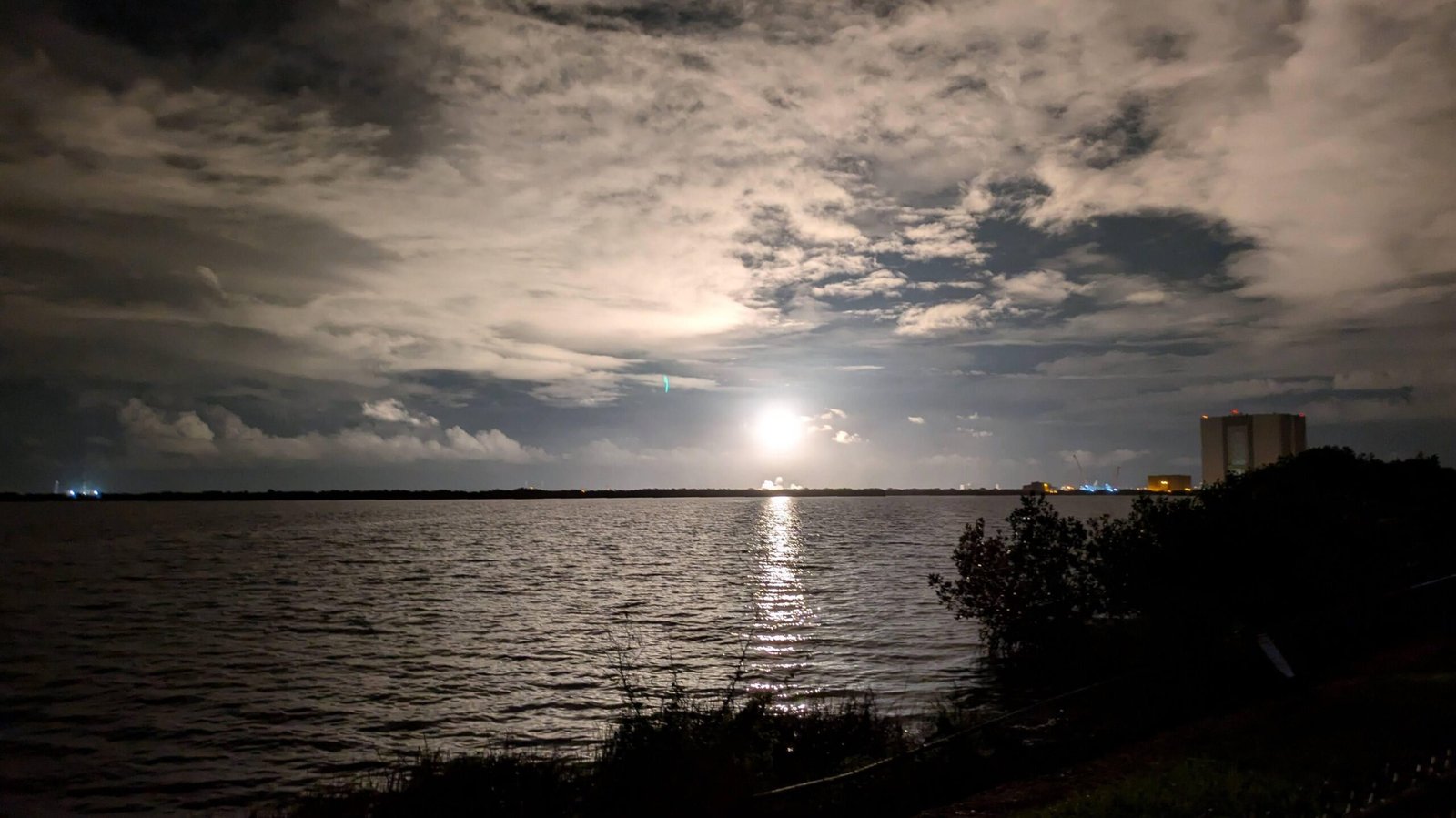
At T-0, the launch vehicle’s engines will instantly become the brightest thing in view as it lifts off the pad—on a night launch, the rocket can look like a synthetic sun lighting the clouds from below. But as the vehicle sprints into the sky, the only thing audible at first will be the cheering of people around you.
(“Go [rocket or spacecraft name] go!” is an appropriate thing to yell.)
Then the sound, a relentless crackling thunder, rushes toward you, louder and louder. If you’re lucky enough to see a Pad 39A launch from the Apollo Saturn V Center, you should not just hear it but feel it as an acoustic avalanche hurtling right over you.
Then you should try to get a photo of the rocket streaking into the sky, but realize that it will only be an approximation of what you’re experiencing.
If you have a spare phone or any other device that can record high-fidelity sound, consider setting it up to record the noise. If you make a habit out of launch viewing—which is a real if expensive prospect after you’ve seen one—then you can obsess over getting the perfect launch photo.
If you’re watching a Falcon 9 or Falcon Heavy launch that has the boosters returning to one of or both of its Landing Zones on the Cape instead of one of its droneships far offshore, you have something extra to look forward to. That’s not so much the sight of the booster relighting on the way down—what will look like a pinprick of flame in the sky—but the series of sonic booms each generates. They hit right after a landing, sharp detonations in the air that might suggest the descending stage just exploded.
Other Viewing Possibilities—Maybe Even at Home
Falcon 9 rocket after launching from Vandenberg Space Force Base in June. (Photo by Kevin Carter/Getty Images)
Beyond Florida, the US features a few other launch-viewing possibilities: Vandenberg, well north of Los Angeles; NASA’s Wallops Flight Facility and the adjacent Mid-Atlantic Regional Spaceport on Virginia’s Eastern Shore, the US launch facility for Rocket Lab’s small Electron rocket; and SpaceX’s Starship launch facility in Boca Chica, Texas, just north of the Mexican border. Those places are, however, harder to get to than the Space Coast.
But if you live sufficiently close to the Atlantic or the Pacific, you also may be able to watch part of a rocket’s launch right from your own home if a few things line up in your favor. First, you’ll need a launch with a high inclination that takes it up along the coast instead of heading out over either ocean. You’ll also need this launch to happen a little after sunset or a little before dawn and a clear sky above.
Should those circumstances all cooperate, set your phone’s alarm to remind you to step outside a few minutes after the launch. Because under those conditions you can see the exhaust of the rocket’s second stage balloon out high enough in the upper atmosphere for the sun to light it up in what space geeks call a ”space jellyfish” effect.
Veteran space photographer John Kraus maintains a helpful “Space Jellyfish Predictor” site that can show the odds of your seeing one near you.
Watching what can look like an artificial comet silently arc above you is a spectacular sight in its own right, one you can easily capture with a phone’s camera. And it just might lead you to start looking up fares to Orlando.
About Our Expert
Experience
Rob Pegoraro writes about interesting problems and possibilities in computers, gadgets, apps, services, telecom, and other things that beep or blink. He’s covered such developments as the evolution of the cell phone from 1G to 5G, the fall and rise of Apple, Google’s growth from obscure Yahoo rival to verb status, and the transformation of social media from CompuServe forums to Facebook’s billions of users. Pegoraro has met most of the founders of the internet and once received a single-word email reply from Steve Jobs.
Read Full Bio