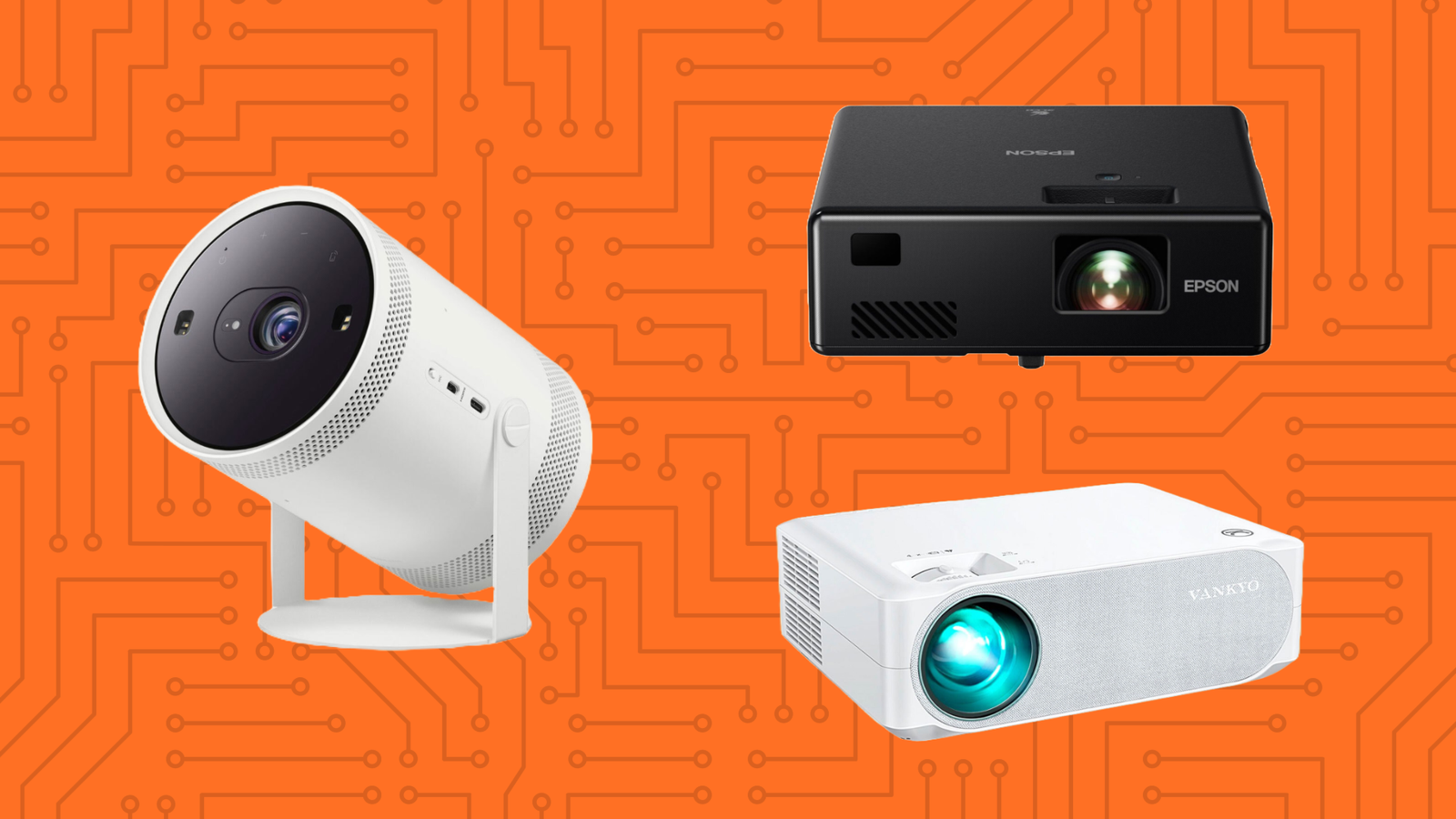
Updated September 17: The days of home theater setups being just for the ultra-wealthy are long gone. You can spend a couple hundred bucks and get a solid projector that casts big, sharp images that approach cinema-quality. Modern projectors are a breeze to set up, with automatic image adjustments, lots of built-in streaming services, and long-lasting bulbs. We’ve found the best digital projectors from our favorite brands at the best prices.
At PC Labs, we’ve been testing projectors for many years, working up a clear series of benchmarks to compare and contrast them. Whether you’re interested in a high-end model with vivid hues and crisp contrast that’s fast enough for high-speed gaming, or something more affordable and easy to move around with slightly lower specs, major companies have top-quality projectors available at sizable discounts. Here are September’s eight best projector deals.
The Best Portable Projector Deals

We called the Nebula Cosmos 4K SE the best room-to-room portable projector in its price range in our review, giving it an Editors’ Choice award for exceptional brightness and clarity. With a hybrid LED/laser light source, impressive 4K resolution and automated image adjustment that saves you time when you move it to a new location, it excels across the board. The fully integrated Google TV system lets you connect through Wi-Fi for streaming, and it also has two HDMI ports and a USB port. The rectangular form factor also includes a pair of 15-watt speakers that support Dolby Audio and Dolby Digital Plus. Get a 31% price cut now.

For a budget option, the Vankyo Leisure 470 Pro is a capable little unit that even comes with a carrying bag to tote it around. In our review, contributing editor M. David Stone declared the projector “offers a watchable image that’s acceptable for movies in the backyard or for ad hoc setup indoors.” With just 1080p resolution and 170 lumens of brightness, it can’t compete with ambient light, but once the sun is down, it handles itself well enough. The built-in speakers have surprisingly good sound quality and volume, it’s a breeze to set up, and it supports Android and iOS screen mirroring. For $130, you’ll have a hard time finding a better deal.

Modern portable projectors are breaking through the 4K barrier at reasonable prices, and this unit from Chinese company Dangbei is a great value in an easy-to-carry form factor. Using a hybrid light engine that combines a traditional triple-laser array with a bright LED bulb means you get incredible contrast and sharp edges, eliminating the fuzziness that can plague portable projectors at large sizes. It also delivers great color coverage, with 11% of the BT.2020 gamut, and solid audio with a pair of 12-watt speakers. It’s also super versatile, with a stand that lets you tilt to 135 degrees and rotate freely. The built-in Google TV streaming platform has all of the major services pre-installed, so you can plug it in, hook up to your Wi-Fi and be good to go. Save $300 at Amazon.

Ever wish you could visit Roku City for real? The purple-hued screensaver is a popular meme in the home entertainment world, and Aurzen is cashing in by producing a portable projector that’s shipped with Roku onboard. The easy-to-use streaming platform is one of the biggest draws of this unit, which we reviewed positively and praised for its good value for the price in terms of image brightness and clarity. While its 330 ANSI lumen brightness can’t compete with more expensive units, it blows other budget models out of the water, and autofocus and automatic four-corner keystone correction add to its appeal.

This spectacular portable unit delivers such exceptional picture quality that you could just install it permanently in your home theater and nobody would know any better. The Anker Nebula X1 received an Editors’ Choice award in our review, with PCMag expert M. David Stone saying “it has genuinely impressive automated setup features for image size and geometry after moving it from one room to another, and specs that boast high brightness and a level of color accuracy usually reserved for dedicated home theater models.” He did notice that it was a bit heavy for a portable unit, and fairly pricey, but this Amazon discount drops it to the lowest we’ve ever seen it on sale. With tons of connectivity options, a liquid cooling system to reduce fan noise, and a luxe 14-element all-glass lens, the Nebula X1 is worth every penny.
Recommended by Our Editors
The Best Non-Portable Projector Deals

It’s a spendy one, but the EpiqVision Ultra LS800 is a great pick for a TV replacement, as it delivers top-tier performance across all of the important metrics. We gave it an Editors’ Choice award in our review, raving over its ultra-bright laser-phosphor light source that pumps out 4,000 ANSI lumens, more than enough to use it easily in a well-lit room. The three-chip LCD delivers rich, realistic colors without any rainbow artifacts, and the input lag is some of the lowest we’ve tested, hitting just 11.7ms at 1080p resolution. You can snag a $1,500 discount right now.

This massive discount on a top-flight Awol Vision projector will be the cornerstone of your home entertainment system. The LTV-3000 is a marvel of lens construction, able to blast out an 80-inch image on the diagonal from just six inches away. It doesn’t skimp on picture quality, either, with full 4K resolution, support for Dolby Vision and HDR10+, and solid colors thanks to a tri-laser light source rated for over 25,000 hours of use. It’s not the most user-friendly projector on the market, with a relatively obtuse Android TV install powering it, but the image looks good right out of the box, and you have multiple connectivity options, including three HDMI ports and great 3D performance.

Walmart has the best price anywhere on this excellent all-in-one home entertainment box that combines a rippingly high-quality 4K projector that looks great on screens up to 130 inches in diameter with a TV tuner and built-in Android TV streaming. In our review, it easily took home an Editors’ Choice award, as we loved the impressive 2,200-lumen light source using Hisense’s TriChroma laser engine, sharp focus, and good color accuracy. Connectivity is also extensive, with support for high-speed HDMI, a pair of HDMI 2.1 inputs, and eARC. If you dislike rainbow artifacts in your projected images, they’re barely noticeable thanks to the speed with which the three colored lasers alternate. Our only real complaint was that there’s no native Netflix app installed.
More Projector Deals
*Deals are selected by our commerce team
What Are the Different Types of Projectors?
Digital projectors create images using three primary types of technology. The most basic, DLP (which stands for digital light processing), has an array of minute mirrors inside the lens to transform white light into other colors. 3LCD projectors use a trio of LCD screens, one for each primary subtractive color. Liquid crystal on silicon, or LCoS, uses an active-matrix display on a silicon backplate for the most accurate colors, although it is significantly more expensive.
What Should I Look for in a Projector?
The two most important metrics for a projector are brightness and resolution. Brightness is measured in lumens, with a larger number being better. However, projectors typically have two distinct brightness numbers, one for white light and one for color. Images may appear dull if the color rating is lower than the pure white rating. Resolution determines the number of pixels the projector uses to create the image. 1080p high definition is the most common. For best results, match your projector resolution to the image source.
What Is the Best and Cheapest Projector?
We’ve put together a robust rundown of the best projectors on the consumer market, covering a wide range of uses, from large units to anchor a home theater to portable models for movies on the go. That frequently updated rundown lists our current top pick, but there’s no single best and cheapest projector for everyone. You should look for one that is fast enough for casual gaming, is bright enough for movies, and has decent built-in speakers if you won’t attach it to an external sound system.
We’ve also seen some excellent projectors from Xgimi, Epson, LG, and many other brands sell for their low prices, too. Mini projectors are also a cheaper option most often due to the compromises in bulb brightness. Check out In our rundown of the best portable projectors to learn more.
Do I Need a Screen for My Projector?
In general, although you can cast an image from a projector on any wall or surface, it’s not going to look as good as if you use a nonreflective white screen designed for that purpose. There are many different types of screens on the market, some for permanent installs, and even some that are inflatable for easy setup and storage. While they’re not strictly required, they definitely make your viewing experience better. Here’s our handy guide for how to choose the right screen for your projector.
How Do We Test Projectors?
The short answer? Thoroughly. When we test projectors, be they data projectors, home entertainment projectors, or home theater projectors, we give the units a 30-minute warm-up time while running through preliminary setup steps before performing extensive picture quality tests. And that’s just the start! Dive into any of our reviews to see how deep we go.
About Our Experts

K. Thor Jensen
Contributing Writer
Experience
K. Thor Jensen is a writer and cartoonist living in the Pacific Northwest. He has contributed to dozens of prestigious outlets, including PCMag, Tested, Clickhole, and Newsweek. His second graphic novel, Cloud Stories, was released in 2017.

Tom Brant
Managing Editor
Experience
I’m a managing editor at PCMag.com focused on PC hardware. Reading this during the day? Then you’ve caught me testing gear and editing reviews of Wi-Fi routers, printers, laptops, and tons of other personal tech. (Reading this at night? Then I’m probably dreaming about all those cool products.) I’ve covered the consumer tech world as an editor, reporter, and analyst since 2015.
I’ve covered most major consumer tech events, including CES, Computex, Google I/O, and IFA. I’ve also appeared on CBS News, in USA Today, and at many other outlets to offer analysis on breaking technology news.
Before I joined the tech-journalism ranks, I wrote on topics as diverse as Borneo’s rainforests, Middle Eastern airlines, and Big Data’s role in presidential elections. A graduate of Middlebury College, I also have a master’s degree in journalism and French Studies from New York University.