Tag: CRYPTOS FoxBusiness

  • Famous Figure Makes Critical Statements About Bitcoin’s Future: “Saylor Spoiled the Game! BTC May Not Reach These Levels!”

    Famous Figure Makes Critical Statements About Bitcoin’s Future: “Saylor Spoiled the Game! BTC May Not Reach These Levels!”

    While the leading cryptocurrency Bitcoin continues to hold above $60,000 and move sideways, renowned technology investor and early Uber investor Jason Calacanis has made noteworthy assessments regarding Bitcoin’s future.

    Jason Calacanis, commenting on the sales and changing strategy of Strategy, one of the largest institutional Bitcoin holders, argued that the company and its founder Michael Saylor’s new Bitcoin strategy has shifted the balance in the market. Therefore, he said, reaching the $250,000 and $1 million levels for Bitcoin might not be as easy as it seems.

    Saylor Spoiled the Game!

    Calacanis’s latest comments center on Michael Saylor and his company’s aggressive Bitcoin accumulation strategy, which they have pursued for years.

    According to the renowned expert, Saylor’s model, which placed Bitcoin at the center of corporate balance sheets, significantly altered the dynamics of the Bitcoin market.

    “…I think Saylor disrupted the bitcoin game by trying to take over the market and doing all sorts of bizarre financial engineering around it.”

    These remarks from the well-known figure came in response to comments made by SkyBridge Capital founder Anthony Scaramucci, who predicted that Bitcoin would surpass $100,000.

    The Most Complex Path to Bitcoin!

    Calacanis’s comment is not new. He has long been a critic of Strategy, recently describing it as “the most complicated way to buy Bitcoin ever invented.”

    In this context, Calacanis argues that it makes more sense for investors who want to invest in Bitcoin to buy Bitcoin directly rather than buying shares in companies like Strategy.

    In conclusion, Calacanis believes that Saylor’s accumulation of massive amounts of Bitcoin through increasingly complex financing methods could harm BTC itself and its value in the long run. Calacanis thinks that the debt, equity issuance, and other financial instruments Strategy uses to finance its Bitcoin purchases are driving the market into an increasingly complex structure. According to him, Saylor’s attempt to gain a large position in the Bitcoin market could even weaken the long-term value proposition of the asset he supports.

    *This is not investment advice.

  • Bitcoin (BTC) Enters a Bear Market, BlackRock Remains Bullish! Here’s Why and the Latest Statements

    Bitcoin (BTC) Enters a Bear Market, BlackRock Remains Bullish! Here’s Why and the Latest Statements

    Bitcoin has been in a bear market since October 2025 and has experienced sharp declines. Having fallen by more than 50% since its all-time high of $126,000 in October, $BTC tested the $57,000 level. While $BTC is currently trading sideways around $63,000, BlackRock has offered a noteworthy Bitcoin analysis.

    BlackRock, the world’s largest asset manager, stated in its latest report that the correction exceeding 50% in Bitcoin does not mean that the long-term investment thesis for the leading cryptocurrency has collapsed.

    BlackRock stated that this correction was primarily due to delegitimization, changing market positions, a shift in capital from Bitcoin to AI-focused investments, weaker capital flows, and slower purchases of digital asset treasuries, adding that there was no change in Bitcoin’s long-term investment thesis.

    BlackRock stated that a significant factor in the decline was the over $90 billion in open positions in crypto futures, with approximately 80% of that coming from perpetual futures contracts outside the CME.

    BlackRock also stated that sales by digital asset treasury companies, particularly Strategy, and large Bitcoin holders increased market pressure and contributed to the decline. Net outflows from spot Bitcoin ETFs were also noted as increasing selling pressure on $BTC.

    Despite all these drawbacks, BlackRock argues that its long-term investment thesis for Bitcoin remains unchanged. BlackRock states that Bitcoin, due to its limited supply and potential to behave differently from traditional financial assets, can be used as a portfolio diversification tool and a potential hedge against declining fiat purchasing power.

    In conclusion, BlackRock argues in its latest report that the sharp drop in Bitcoin does not invalidate its long-term investment thesis, but rather signals a rebalancing of leverage and capital flows in the market.

    *This is not investment advice.

  • AI Contracts Give Bitcoin Miners a Valuation Edge as Hashprice Squeezes Pure-Play Operators

    AI Contracts Give Bitcoin Miners a Valuation Edge as Hashprice Squeezes Pure-Play Operators

    The valuation gap inside Bitcoin mining is no longer about hashrate alone. Operators that locked in AI and high-performance computing revenue are trading like a different asset class, while pure-play miners absorb the full weight of lower bitcoin prices and compressed hashprice margins.

    That divergence is laid out in the original report, which notes that miners with AI and HPC contracts have commanded higher valuations as declining bitcoin prices squeeze operators focused only on block rewards.

    Contracted compute changes the underwriting model

    AI and high-performance computing contracts shift the revenue base away from daily bitcoin exposure. Instead of depending on spot prices and network difficulty, miners with data center deals receive payments for power, rack space, and uptime. That makes earnings easier to model and less sensitive to the next drawdown.

    Power access has become the scarce resource in this trade. Many mining sites already have grid interconnections, substations, and large energy loads that AI tenants need. The market has started to reward miners that can repurpose those assets rather than rely only on ASIC fleets competing for the same block subsidy.

    From a market structure standpoint, the richer valuations are not just about revenue mix. Lenders and equity investors now screen mining companies for contracted data center income before extending capital, which reinforces the split. A miner with a visible AI backlog can negotiate different terms than a pure operator exposed only to hashprice.

    The interest in AI-linked compute is not limited to industrial mining facilities. Decentralized computing partnerships are also emerging as teams seek scalable infrastructure for AI-driven Web3 applications, as seen in UXLINK and Origins Network’s decentralized computing integration.

    Pure-play miners face the sharper edge

    Pure-play miners have fewer cushions. When bitcoin falls or difficulty climbs, revenue per terahash declines while power contracts and debt service stay fixed. That dynamic is not new, but the current market is punishing exposure that lacks a non-mining revenue line.

    Some operators still run efficient fleets with cheap power. The market is not saying pure miners are finished. It is saying they are being priced for a narrower set of outcomes until bitcoin stages a sustained recovery.

    At the same time, not every AI pivot works. Some miners may hold power assets but lack the technical teams or capital budgets to build reliable high-density computing environments. The premium is uneven, and operators that simply rebrand without signing contracts do not get the same valuation lift.

    AI demand is also spilling into adjacent infrastructure. Decentralized storage networks are positioning around AI workloads that require accessible data layers, a theme highlighted in Filecoin’s AI storage demand outlook

  • Worldcoin sellers lead across 16 exchanges – How much lower can WLD go?

    Worldcoin sellers lead across 16 exchanges – How much lower can WLD go?

    Worldcoin [$WLD] declined 11% in the past day, extending its 30-day loss to 14%.

    The decline could deepen as whales dominated market activity and the on-chain structure remained weak.

    Are Worldcoin whales driving the decline?

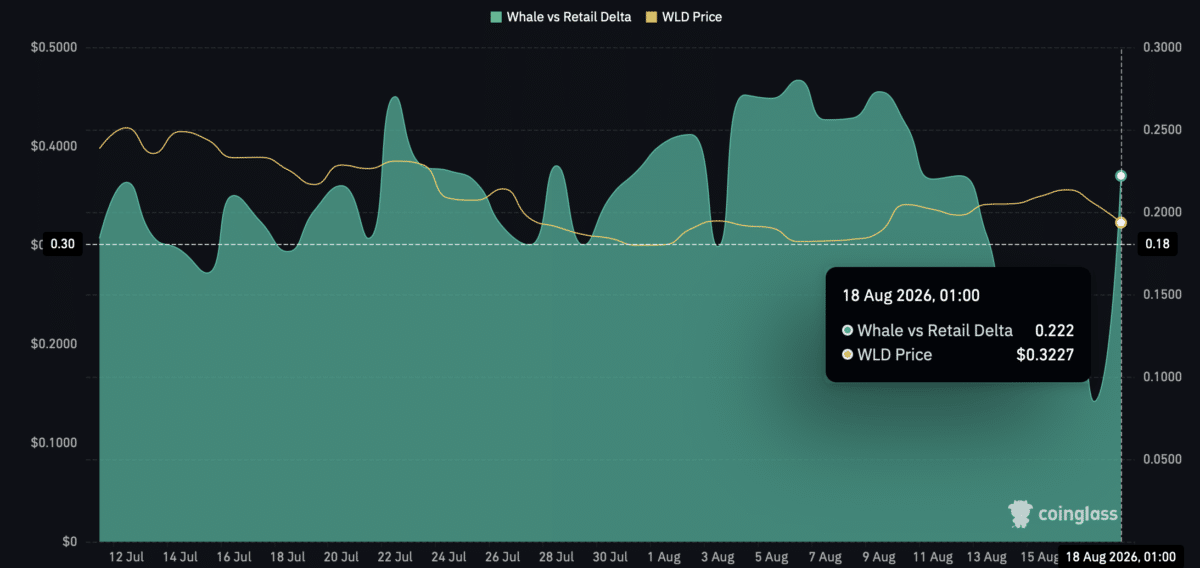
    Source: CoinGlass

    Whale dominance surged as Worldcoin continued to struggle. Whales are large holders whose buying or selling can materially influence a crypto token’s price.

    CoinGlass’ Whale Retail Delta showed that whale dominance spiked to 0.222. At the same time, the Funding Rate turned significantly bearish at -0.0389%.

    $WLD’s Open Interest also fell by $28.57 million to $278.38 million.

    Together, these metrics showed bearish positioning alongside declining derivatives exposure. If this pressure continues, $WLD could erase its accumulated 90-day gain of approximately 35%.

    Why are $WLD sellers dominating?

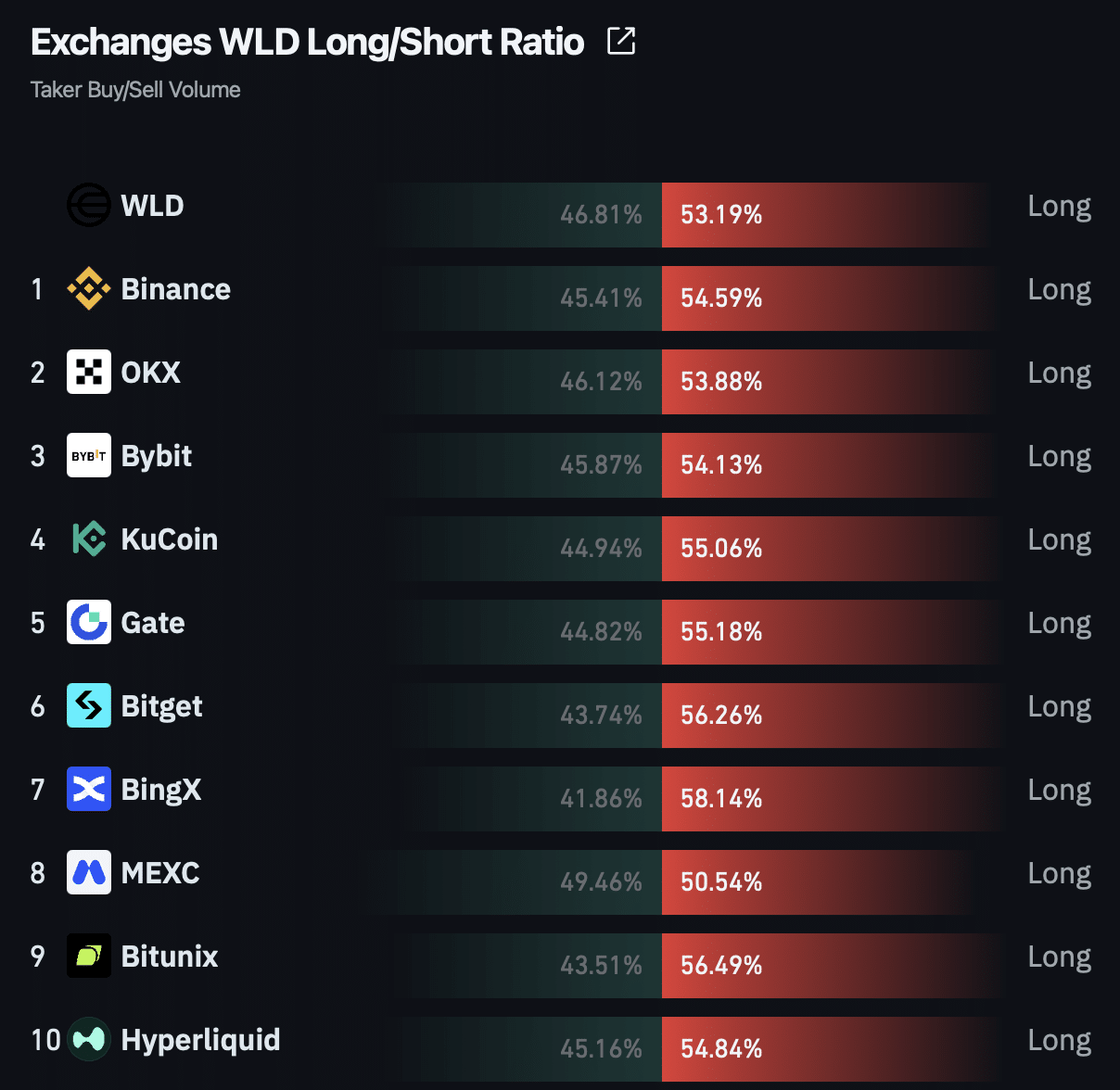
    Sellers dominated most $WLD perpetual trading volume across centralized and decentralized exchanges.

    CoinGlass’ Long/Short Ratio showed that sell-side activity represented 53% of $WLD’s trading volume. Sell-side volume led on 16 of the 18 exchanges trading $WLD, representing nearly 89% of those venues.

    Source: CoinGlass

    Binance, OKX, and MEXC recorded a combined $310.05 million in Volume. Sellers controlled at least 53% of the Volume across each exchange.

    More broadly, $WLD’s total Perpetual Volume reached $473.83 million after rising 4.36%.

    Rising Volume alongside falling prices suggested that sellers were gaining momentum. Further Volume growth during another decline could signal deeper losses from $WLD’s current price.

    Why is World Chain activity slowing?

    On-chain activity also remained limited, reducing $WLD’s chances of a notable recovery.

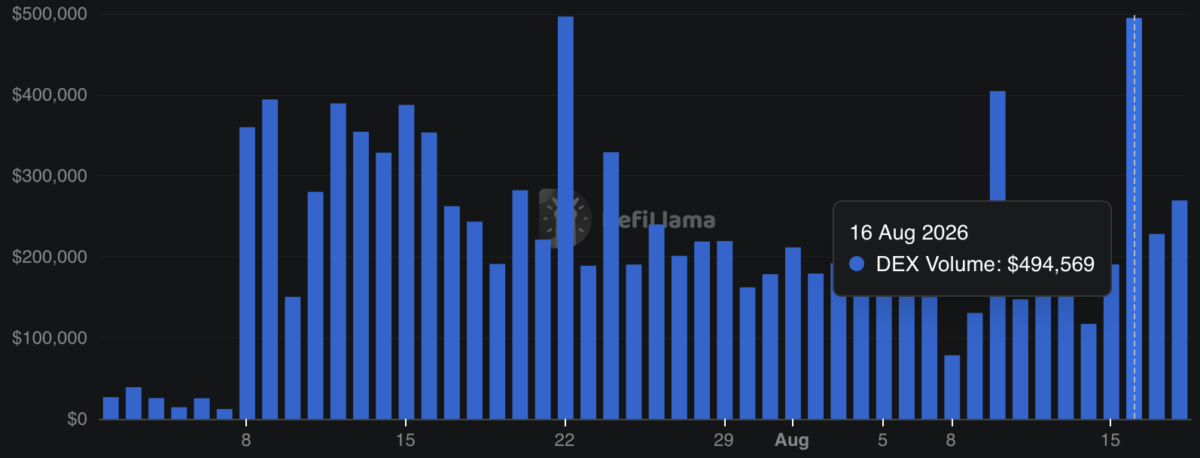
    World Chain recorded declining DEX Volume across its decentralized exchanges. DEX Volume fell from approximately $494,000 on the 16th of August to $243,000 at the latest reading.

    Source: DeFiLlama

    Declining DEX Volume pointed to weaker on-chain demand.

    World Chain also generated only $573 in Fees during the past 24 hours, adding little economic activity. For now, bearish derivatives positioning and limited on-chain activity suggested weak demand for $WLD. This combination could weigh further on its price while sellers remain in control.


    Final Summary

    • Worldcoin fell 11% daily and extended its 30-day decline to 14%.
    • Whale Retail Delta climbed to 0.222 as whale influence increased.
  • Multicoin moves $10 million in HYPE to Coinbase Prime, stirring selloff fears

    Multicoin moves $10 million in HYPE to Coinbase Prime, stirring selloff fears

    On August 18, Onchain Lens, which tracks blockchain transactions, reported that Multicoin Capital had moved about 172,710 $HYPE (about $10.15 million) to Coinbase Prime, a destination that has often been associated with selling by traders.

    Given that $HYPE is currently among the top 10 crypto tokens, the action by one of its major institutional backers is likely to attract attention far beyond Hyperliquid users.

    This is important as $HYPE’s market cap is almost $13 billion and is currently priced at about $58.59, as per DefiLlama. Given that market cap, the token movements are far from taking place independently. Major transfers to exchanges can quickly shape traders’ perceptions of imminent risks across the market.

    A transfer that still leaves Multicoin heavily exposed

    When viewed relative to Multicoin’s current holdings, the $10.15 million transfer is actually rather insignificant. Onchain Lens estimates that the fund has approximately 2.16 million $HYPE left, currently valued at around $126.63 million. To put it differently, the Coinbase Prime transfer actually seems to be a trim rather than an exit.

    Coinbase Prime is the institutional platform of Coinbase, which provides services such as custody, execution, and funding for the institution’s clients. It also serves as a facility through which institutions sell large amounts of their positions using the regulated market. Onchain Lens classified this transfer as “likely to sell”, thus alerting the trading community.

    Why the crypto market reads exchange inflows as a warning

    This anxiety isn’t without some recent background. $HYPE is trading well below its June high of $76.87 according to DefiLlama; meanwhile, open interest is at almost $11.8 billion. This creates a large number of leveraged positions, which can amplify any sudden downward movements.

    Traders consider the transfer of tokens to exchanges to be a sign of supply entering the market. With $HYPE’s liquidity still smaller than that of big cryptocurrencies, even an experienced trader may find the order book hard to manage. After a summer of observing the movement of tokens from Hyperliquid’s biggest holders, any other Multicoin transfer keeps the market on alert.

    Multicoin has insisted it is not selling

    Multicoin previously opposed similar rumors. For example, in the latter part of July, after Multicoin and Paradigm unstaked a total of $291 million worth of $HYPE tokens, causing the price of $HYPE tokens to fall below $60, the co-founder of Multicoin, Tushar Jain, issued a statement saying, “We did not unstake to sell,” and stated that the unstaking had occurred solely for privacy and wallet rotation purposes, as reported by Cryptopolitan.

    At that time, on-chain specialists at Markets Alpha confirmed this reason, showing that the tokens were moved to custody instead of going to exchanges. The recent transfer is important due to the change in destination: Coinbase Prime has a more direct path to settlement. This does not prove that the tokens have been sold, but it explains why a $10 million movement is on the front pages.

    What still underpins $HYPE

    The negative evaluation also needs to be considered alongside Hyperliquid’s fundamental figures. In its valuation report for June, Multicoin noted that the platform earned approximately $873 million in revenue on trading volume of about $2.9 trillion in 2025, which accounts for over 59% of open interest in the DeFi perpetual markets.

    $HYPE’s token economics are another part of the bull case. Roughly 99% of protocol revenue is directed toward $HYPE buybacks, with the purchased tokens subsequently burned. Multicoin argued in the same report that $HYPE could reach around $319 by 2028.

    The transfer of $10.15 million does not conclusively resolve the debate between fundamentals and prevailing short-term selling pressure. However, given that Multicoin continues to hold more than $100 million in $HYPE, major events involving Multicoin’s $HYPE wallets are bound to have a significant impact on market movements.

  • Shifting $576M of forced sales off public order books saved Hyperliquid from a systemic crash

    Shifting $576M of forced sales off public order books saved Hyperliquid from a systemic crash

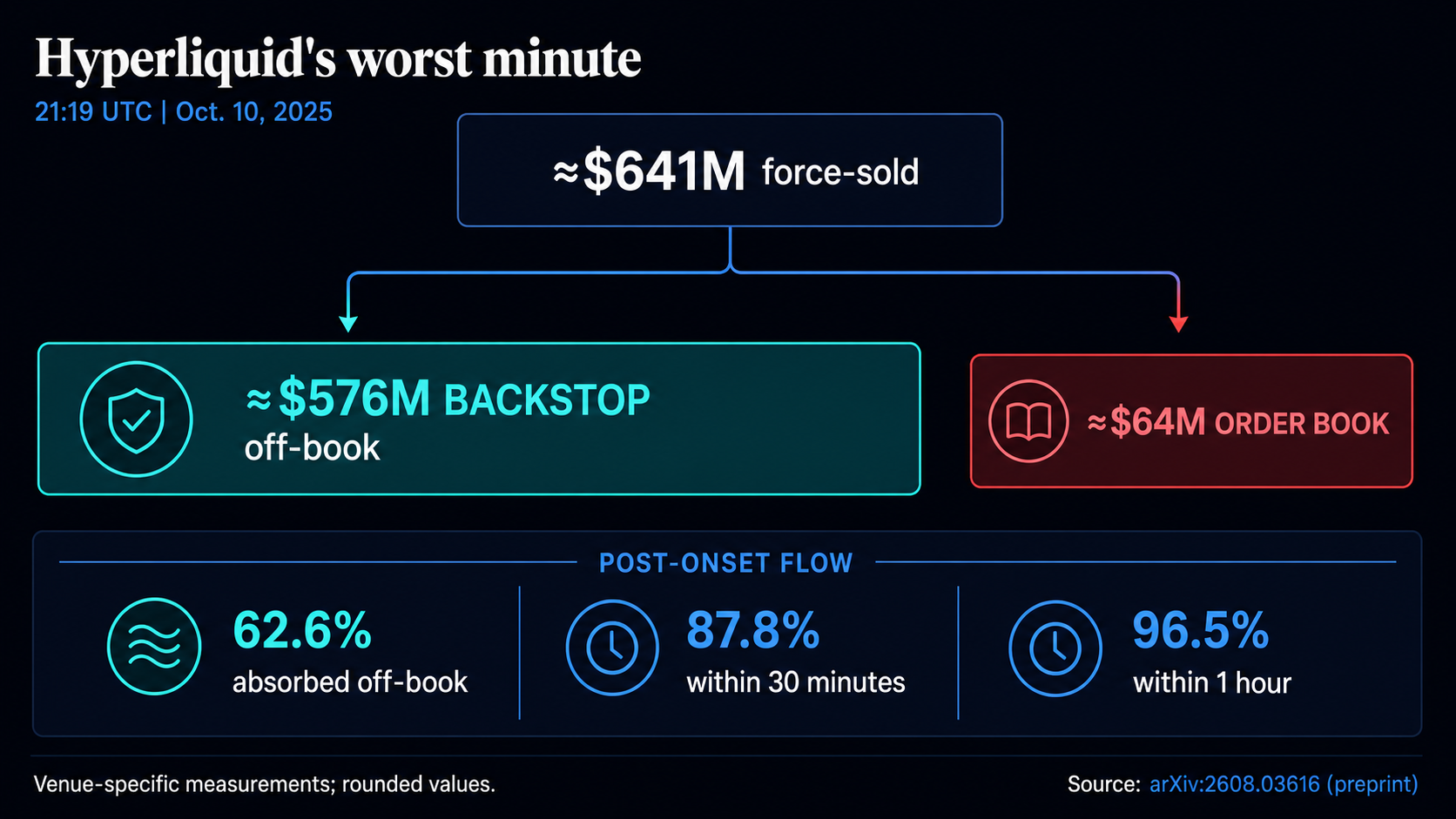
    Hyperliquid, an on-chain perpetual futures venue, sent most of the forced selling in the worst minute of the October 2025 crypto crash to the Hyperliquid backstop rather than its public order book, according to a new research preprint.

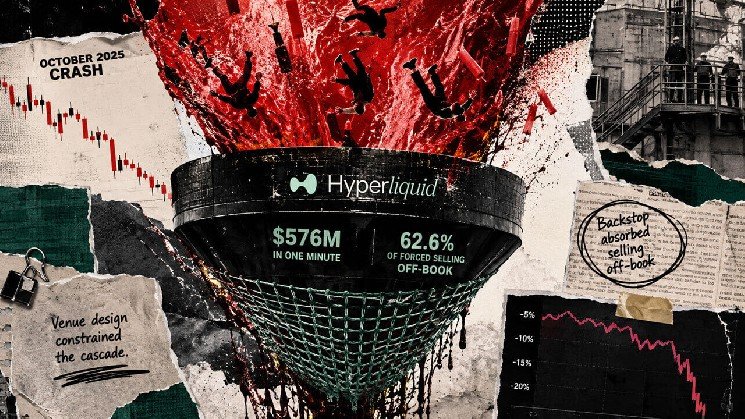
    About $641 million was force-sold on Hyperliquid at 21:19 UTC on Oct. 10, the paper found. Roughly $576 million went to the Hyperliquid backstop, while about $64 million reached the order book.

    The split is relevant because a thinning public order book can push prices lower and force more leveraged positions to close. The Hyperliquid backstop can interrupt that feedback by absorbing orders inside the venue. The preprint has not completed peer review, and its direct measurement covers Hyperliquid rather than the wider market.

    Hyperliquid’s liquidation rules first try to close a position through market orders. Under specified conditions, a liquidator vault can take over the position instead. That vault is a component strategy within the Hyperliquidity Provider (HLP) protocol vault.

    The study found that the backstop absorbed 62.6% of forced-sale value off-book after onset. The event was also highly compressed: 87.8% of forced selling after onset occurred within 30 minutes and 96.5% within one hour.

    The paper tracked $733 million of book-directed forced-sale value across its 15.7-hour post-onset window, including $644 million during the initial nucleation phase. It reported the 62.6% backstop share as a separate off-book series, so the figures describe different parts of its measurement rather than a single combined liquidation total.

    How the Hyperliquid backstop damped liquidation feedback

    The paper modeled the cascade with a branching ratio, or the average number of additional liquidations associated with each forced sale. A ratio approaching 1 would indicate a self-sustaining chain inside the venue.

    Hyperliquid’s structural estimate remained below 0.2 in every measured regime. It reached 0.195 during nucleation and eased to 0.140 at the peak, while a separate amplification calculation implied a ratio of 0.122.

    The authors interpret the Hyperliquid backstop as damping feedback inside the venue at the climax. The finding applies only within the venue; shared prices across exchanges may still have amplified liquidations across the broader market.

    The study places the Hyperliquid backstop in the context of seven major Bitcoin perpetual futures cascades from 2022 through 2025. Its Part I companion, previously covered by CryptoSlate, found no event-invariant early-warning variable across those episodes. Part II shifts from warning signals to the mechanism operating during a cascade.

    Hyperliquid’s fill-log archive begins on May 25, 2025, making the October 2025 event the paper’s only in-flight case study. The authors frame higher realized branching on venues without a comparable backstop as a hypothesis for future cross-venue testing.

  • ‘It has to pass’: Andrew Cuomo warns U.S. is falling behind on crypto rules

    ‘It has to pass’: Andrew Cuomo warns U.S. is falling behind on crypto rules

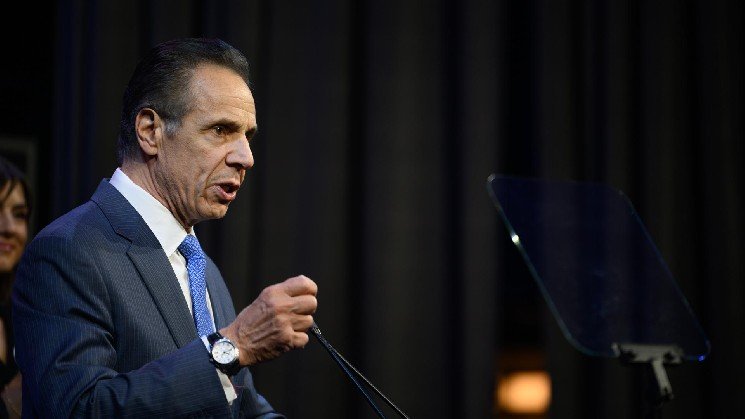
    Cuomo said years of uncertainty have made it harder for companies to build products in the U.S. while knowing where regulators will draw the line. “You have to know the rules of the game if you want a company to comply,” he said. “What’s fair and what’s foul?”

    He contrasted the U.S. with Europe, where the European Union has implemented a bloc-wide crypto framework. Without federal legislation, Cuomo said, the U.S. risks losing business and investment to markets where the rules are clearer.

    Getting a bill through Congress will require compromise, he said. Cuomo pushed back on attempts to blame either Democrats or Republicans for the holdup and said disagreements over ethics provisions and other parts of the bill should not sink it.

    If Congress doesn’t act, regulators will be left to fill the gap, Cuomo said. That could mean rules change each time political power shifts in Washington, making long-term planning harder for crypto and financial firms.

    Cuomo has a direct stake in how those rules develop. He is leading a joint venture between crypto exchange OKX and Intercontinental Exchange, the owner of the New York Stock Exchange. The venture is building infrastructure to connect crypto with traditional financial markets.

  • CFTC seeks feedback on CPO and CTA rule changes

    CFTC seeks feedback on CPO and CTA rule changes

    The CFTC has opened a 45-day comment period on proposals that would double the small-pool exemption threshold to $800,000 and ease registration rules for some fund advisers.

    CFTC proposal would reduce duplicate fund registration

    The Commodity Futures Trading Commission said in an Aug. 18 regulatory announcement that it had proposed amendments to Part 4 of its rules, which govern commodity pool operators, or CPOs, and commodity trading advisers, known as CTAs.

    Under the proposal, certain investment advisers already registered with the Securities and Exchange Commission could avoid separate CPO registration for qualifying commodity pools. The exemption would apply only when the pool meets several conditions, including limits on who may invest.

    A commodity pool combines money from multiple participants to trade futures, options, swaps, or other commodity interests. Its operator generally must register with the CFTC unless an exemption applies, while a person who provides trading advice may also have to register as a CTA.

    SEC-registered advisers can fall under both regulatory systems when the private funds they manage trade commodity interests. According to the CFTC, requiring full registration under both systems may produce overlapping compliance duties without providing enough additional regulatory benefit.

    “By continuing to address overly burdensome and duplicative rules for its registrants, the CFTC is delivering on its mandate to promote U.S. market competitiveness,” CFTC Chairman Michael S. Selig said.

    Selig added that the agency intended to reduce compliance costs for American businesses while preserving market integrity.

    The proposed exemption would not remove all regulatory requirements. Advisers seeking relief would still need to satisfy the SEC’s rules under the Investment Advisers Act, including applicable conduct, examination, disclosure, and reporting requirements.

    CFTC exemption would cover pools for sophisticated investors

    Proposed Regulation 4.13(a)(4) would limit the CPO exemption to SEC-registered investment advisers operating eligible pools for defined groups of sophisticated investors.

    Natural-person participants would generally need to fall within Qualified Eligible Person categories that do not require them to pass the CFTC’s portfolio test. Eligible entities could include QEPs and certain accredited investors listed under the SEC’s Regulation D.

    Rather than changing the financial thresholds used to qualify as a QEP, the proposal uses existing investor categories to determine which pools may receive registration relief.

    The CFTC previously increased the portfolio thresholds attached to some QEP categories in 2024. Under the updated standard, a person subject to the test may qualify by owning at least $4 million in securities and other assets, holding at least $400,000 in required margin and option premiums, or meeting a combination of the two tests.

    Published in September 2024, the final rule doubled the previous thresholds of $2 million and $200,000. Compliance with the new amounts began six months after the rule appeared in the Federal Register.

    Separate conditions in the new proposal would require interests in eligible pools to remain exempt from Securities Act registration. Public marketing in the United States would generally be restricted, although pools using Rule 506(c) could conduct general solicitation when every purchaser is an accredited investor and the issuer takes reasonable steps to verify that status.

    Where SEC rules require a Form PF filing for an eligible private fund, the adviser would also need to file that form to claim the proposed CFTC exemption. Form PF supplies regulators with information used for investor protection and systemic-risk monitoring.

    The CFTC and SEC already operate under a memorandum of understanding that allows them to share Form PF information. The commission said the arrangement could preserve access to fund data without making advisers submit overlapping reports to both agencies.

    Eligible advisers would still have to file an exemption notice through the National Futures Association’s online registration system. Annual notices would be required to confirm continued reliance on the exemption, along with updates when filed information becomes inaccurate or incomplete.

    Proposed rules would formalize temporary CFTC relief

    The plan would place parts of existing staff relief into the CFTC’s regulations, giving qualifying advisers a formal rule instead of leaving them dependent on a no-action position.

    CFTC Market Participants Division Letter 25-50, issued in December 2025, provided interim registration relief for certain SEC-registered advisers managing pools restricted to QEPs. The letter covered some advisers who would otherwise need to register as CPOs or CTAs and also allowed eligible firms to withdraw existing registrations.

    Staff issued the relief after the commission had removed a similar QEP exemption in 2012. The earlier exemption, adopted in 2003, allowed operators of certain privately offered pools to avoid registration when participation was restricted to qualifying investors.

    According to the new proposal, applying Letter 25-50 alongside National Futures Association processes proved complex and time-consuming. Converting the policy into Regulation 4.13(a)(4) would establish a public set of eligibility conditions adopted through the federal notice-and-comment process.

    The CFTC said a final rule would supersede specified no-action positions, including relief provided through Letters 25-50 and 26-06. Until the commission adopts a final rule, however, the proposal does not itself replace the current registration framework or the staff letters.

    A related amendment to Regulation 4.14 would extend CTA registration relief to qualifying advisers serving pools covered by the proposed CPO exemption. The CFTC described the CTA change as a limited expansion because many affected advisers already qualify for relief when serving other permitted clients.

    Small-pool exemption threshold could double

    For smaller fund operators, the proposal would raise the maximum gross capital contributions allowed under the small-pool exemption from $400,000 to $800,000.

    Regulation 4.13(a)(2) currently permits an exemption for operators whose pools have no more than 15 participants and whose total gross capital contributions across all operated or planned pools do not exceed $400,000, subject to exclusions for certain contributions.

    The commission last adjusted the monetary limit in 2003, when it doubled the threshold from $200,000 to $400,000. Using the Consumer Price Index for All Urban Consumers, the agency calculated that $400,000 in January 2003 had the same purchasing power as approximately $735,097 in July 2026.

    Rounding that figure to $800,000 would provide a simpler limit for fund operators, according to the proposal. The 15-participant cap would remain unchanged, as would existing rules that exclude specified contributions from the calculation.

    Operators using the expanded exemption would still need to complete initial and annual notice filings. Anti-fraud provisions of the Commodity Exchange Act would also continue to apply to exempt pools.

    Crypto policy remains on another CFTC track

    The Part 4 proposal does not create a registration system for cryptocurrency platforms or change the CFTC’s authority over digital-asset spot markets. Crypto-focused private funds may still be affected when their trading activity makes them commodity pools, but eligibility for relief would depend on the same conditions applied to other qualifying funds.

    Meanwhile, crypto.news previously reported that the CFTC’s first Innovation Advisory Committee meeting will take place on Aug. 20. Its agenda includes crypto assets, artificial intelligence, and prediction markets, with public statements accepted through Aug. 27.

    The committee’s crypto session will examine federal market-structure questions, overlapping regulatory authority, customer protection, and market integrity. It will not vote on the CPO and CTA proposal or adopt binding digital-asset rules.

    Congress is considering separate legislation that could alter how the SEC and CFTC divide digital-asset oversight. A May review of the CLARITY Act explained that the bill would give the CFTC authority over specified digital commodities while leaving investment-contract assets under SEC oversight.

    For the Part 4 rulemaking, written comments must identify RIN 3038-AF61 and reach the Commission within 45 days after the proposal is published in the Federal Register. The CFTC has requested feedback on the proposed exemptions, their eligibility conditions, expected costs and benefits, and the increase in the small-pool capital limit.


  • Robinhood CEO urges U.S. to clear path for tokenized stocks as overseas markets advance

    Robinhood CEO urges U.S. to clear path for tokenized stocks as overseas markets advance

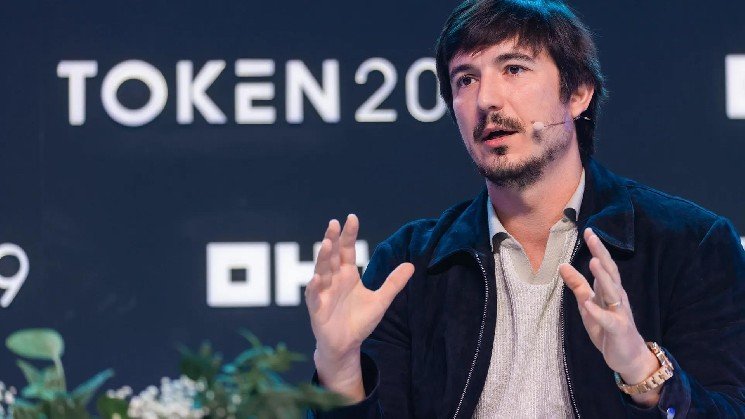
    Tenev argued that focusing only on ownership structure misses the broader market-structure shift. Tokenized assets can potentially trade around the clock, settle in real time and move between compatible wallets and platforms without relying on the transfer systems used by traditional brokers.

    For Tenev, the strongest case is settlement.

    He pointed to the 2021 GameStop (GME) trading frenzy, when Robinhood restricted purchases of some stocks after clearinghouse collateral demands surged. The episode has remained central to Tenev’s argument that legacy settlement infrastructure can create acute pressure during periods of market stress.

    “On the blockchain, Stock Tokens can trade, settle, and move in real time. Real-time settlement means much less risk and pressure on the system, particularly in times of severe market stress,” Tenev said.

    U.S. stock settlement has since moved from two business days to one, known as T+1. Tenev argued that tokenization could further reduce that delay, thereby lowering the risk and collateral requirements that arise between a trade and its settlement.

    He also said tokenization could address two other longstanding frictions in traditional markets: limited trading hours and cumbersome asset transfers.

    Robinhood currently offers 24/5 stock trading in the U.S., but Tenev said blockchain infrastructure could make 24/7 trading native rather than requiring brokers to connect multiple exchanges and alternative trading systems.