The wallet known as “pension-usdt.eth” had been short ether for two months. On Thursday morning it was closed out after a surge across all major tokens, and lost nearly $24 million on the trade.
The address had been one of the more successful short sellers of the year, with roughly $49 million in profits from betting against crypto. Its recent record was a run of wins — nearly $6 million on a 60,000 $ETH short closed in June, $3.6 million on a 1,400 BTC short in the same month, $1.7 million on another bitcoin short in March.
This single trade cost half of everything the wallet had made. Hyperliquid’s records show the liquidation ran from 04:51:03 to 04:51:15, in five separate forced sales. First 9,989 $ETH at $2,193, then 20,698 at $2,209, then 15,830 at $2,214, then 1,871 at $2,236.
By the end there were no buyers left for the last 1,417 $ETH, so Hyperliquid absorbed it into a fund it keeps for exactly that purpose.
Ether rose $43 over those 12 seconds. The trader’s own forced buying was part of what moved it, and every dollar it climbed made the remaining chunks more expensive to close.
Twelve seconds, five forced sales, and a price that climbed with every one. (Shaurya Malwa/CoinDesk)
The position was held for 1,445 hours, or a little over two months, through a stretch when bitcoin traded in a range below $65,000 and betting against it looked like the easy side. Wednesday’s Treasury buyback announcement ended that, with ether surging up 18% in the past 24 horus and bitcoin zooming from $64,000 to nearly $70,000.
Counterfeit wallet apps are not a new threat, but Operation ASTERIX shows how much more precise these schemes have become. Rapid7 uncovered a campaign built around roughly 885,000 phone numbers, crypto account-validation tools, phishing emails, vishing calls, and fake Trezor, Ledger, and Exodus apps designed to capture recovery phrases, according to the original report.
The most striking detail is not the volume of phone numbers. It is the validation layer. In one German dataset, operators identified 43,066 CryptoCom accounts from 316,002 phone numbers. That is a hit rate high enough to justify the infrastructure. After confirming which numbers were tied to exchange accounts, the group enriched those targets with personal details, making support impersonation calls much harder to detect. A public list of phone numbers is a nuisance; a list that has been cross-checked against exchange account data is an operational asset.
AI tools compressed the production cycle
Rapid7 found signs that the operators used GitHub Copilot and Claude Code across multiple stages of the campaign. Those tools were applied to process target data, develop and debug malicious software, and build phishing infrastructure. That matters because it shrinks the distance between target discovery and an active fake wallet app or phone scam. Tasks that once required a dedicated developer can now be handled by smaller crews using AI coding assistants.
The sector’s broader AI adoption is not limited to hostile actors. Rankings of Top 10 Blockchains by Developer Activity This Week track code contributions across major chains, and those workflows increasingly include AI-assisted development. The same productivity gains that help legitimate teams ship faster also make malicious wallet apps easier to produce, which is precisely the dual-use problem Operation ASTERIX exposes. AI tooling now runs through legitimate Web3 infrastructure too, including scalable AI-driven Web3 applications.
The jailbreak question remains open
One interaction stands out. When Claude refused requests related to code obfuscation, the operator switched to Kimi and attempted to bypass its safety controls with a custom jailbreak prompt. Rapid7 could not confirm whether the attempt succeeded. That uncertainty is relevant because it separates a simple misuse of general-purpose tools from a more deliberate effort to defeat model restrictions. The former is a moderation gap; the latter is a red-team exercise run by criminals.
Without confirmation, the report avoids overstating the jailbreak result. It does, however, confirm that the campaign treated AI model refusals as an obstacle to route around rather than a reason to stop. Security researchers and platform providers will likely scrutinize that behavior when deciding how aggressively to restrict coding assistance around wallet-related software.
What users and platforms should watch
The counterfeit apps named in the report target the same recovery phrase users are told never to enter anywhere. Fake Trezor, Ledger, and Exodus apps create a direct path from a convincing interface to a drained wallet. That is why download source matters more than app appearance. Official hardware wallet vendors do not ask users to enter recovery phrases into software, and exchange support lines do not call customers with a full personal profile already loaded.
The operation also sharpens a hard truth for exchanges. If account validation is cheap enough to run against hundreds of thousands of numbers, then user data leaks and public breach corpora become a higher-value input for vishing campaigns. The report does not allege an exchange breach; it shows how seemingly thin data can be enriched into actionable targeting information.
Lawmakers weighing crypto market structure rules may find this kind of disclosure hard to ignore. Banking groups have already been pressing against the biggest crypto bill in US history, and cybercrime incidents involving retail wallets could sharpen the debate over liability, consumer protection, and platform responsibility. Whether Operation ASTERIX becomes a regulatory data point depends on how quickly similar campaigns are detected elsewhere.
Circle has expanded Circle Mint to support direct local-currency $USDC on- and off-ramps across eight currencies. The company said in an Aug. 18 post that foreign exchange is handled inside Mint, removing the need for a separate conversion step or pre-funding additional accounts.
Alongside USD and EUR, Circle listed the Brazilian real, British pound, Hong Kong dollar, Mexican peso, offshore Chinese yuan and Singapore dollar among the local currencies supported for eligible Mint account holders.
How the proposed flow works
Circle says customers can activate cross-currency exchange, link a bank account for the local-currency side and register that account for the currency they intend to trade. The company describes each transaction as a quote, trade and settlement process, with $USDC arriving in the Mint balance after conversion.
Circle says settlement uses local payment rails nearly around the clock where supported. Availability remains subject to jurisdiction and account eligibility, and the company notes that some account-registration steps are handled offline.
Not a retail bank account
The update is directed at businesses and eligible Mint customers, including payment providers, financial institutions and fintechs. Circle states that Circle Mint is not a bank account and that funds are not protected by FDIC, SIPC or comparable government insurance.
The announcement is a Circle product update. It does not mean all currencies, regions or users have identical access, so institutions need to check Mint eligibility and local requirements before relying on the new routes.
Centrifuge [$CFG] declined more than 14% in the past 24 hours at press time, extending the double-digit decline in market cap over the past week. The daily trading volume increased, supporting the selling pressure experienced across multiple altcoins.
However, the sharper decline in $CFG points to a coin-specific weakness with its real-world asset (RWA) niche.
Centrifuge’s RWA sees negative sentiment
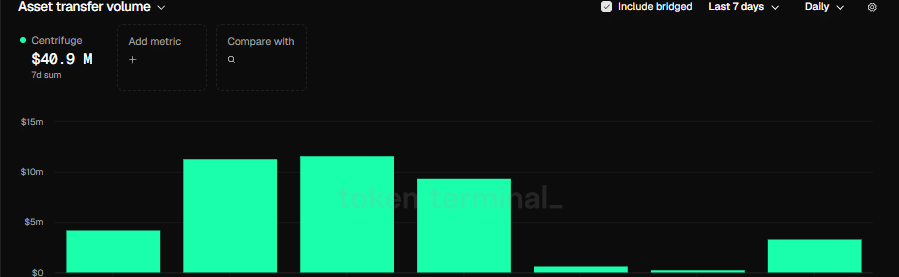
As per data from Token Terminal, Centrifuge’s RWA activity declined on multiple fronts.
For instance, the Monthly Asset Transfer Volume on the chain fell by 10%. This week alone, the metric has decreased from a peak of $11.67 million to $281K, indicating very low usage of the ecosystem in the RWA sector.
Additionally, the Monthly Asset Transfer Count lost more than 58% of its share. Since the start of August, this count has plummeted from 6.7K to 2.2K, representing a 67% loss.
Source: Token Terminal
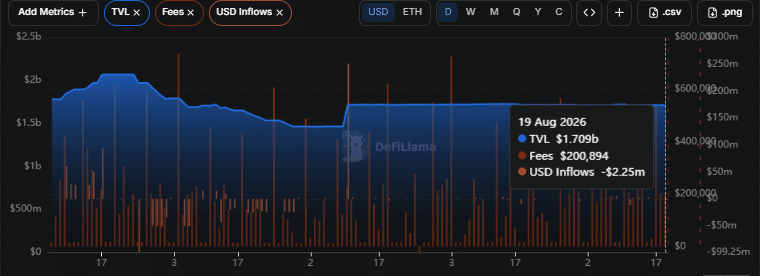
Apart from its RWA niche’s underperformance, $CFG faced a broader, weaker altcoin market. To be specific, the Centrifuge ecosystem saw net USD outflows of more than $2.25 million.
Source: DefiLlama
Moreover, the Total Value Locked (TVL) was flat at around $1.709 billion after a sharp drop from its highs attained when the RWA narrative was thriving. The TVL of $CFG in April was above the $2 billion mark.
Furthermore, the activity on the chain was low, evident from the fees generated. As per DefiLlama, the ecosystem generated about $200.9K in the past 24 hours as of writing.
Will $CFG price crash lower?
Even the market structure of $CFG was bearish since mid-July.
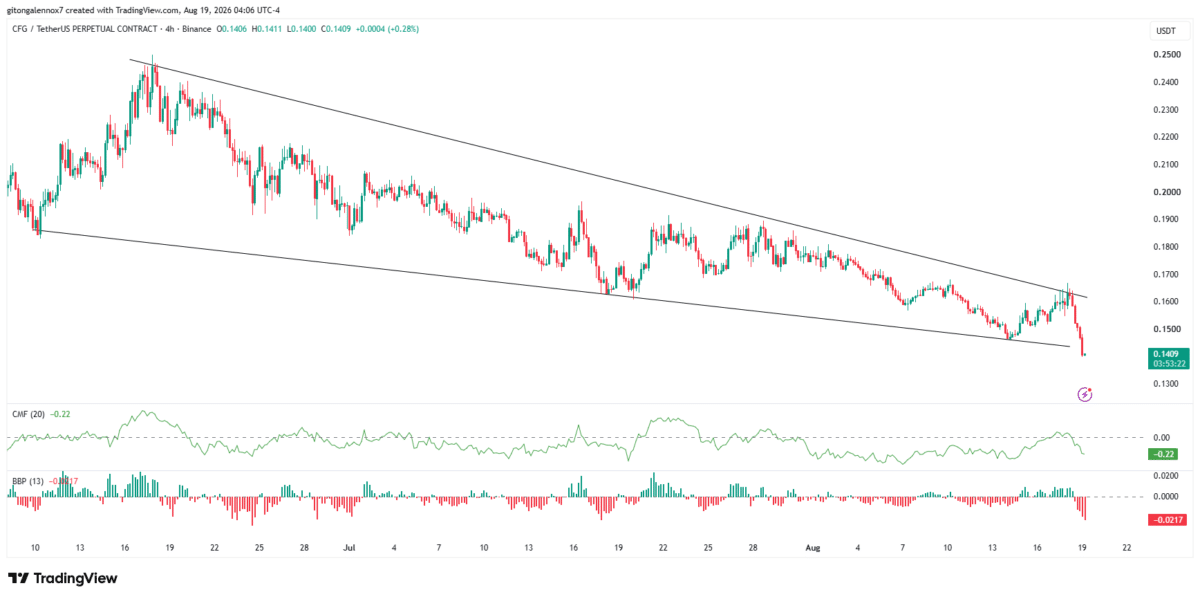
The altcoin was falling inside a wedge pattern and broke below the lower trendline support. Over the past 24 hours, the $CFG price has fallen from $0.1672 to $0.1379 as of writing.
Momentum indicators reinforced the bearish control with the reading of Bull Bear Power (BBP) bars at -0.0243. Moreover, Chaikin Money Flow (CMF) crashed to -0.22, indicating capital flight.
Source: $CFG/USDT on TradingView
Looking at the market structure and overall RWA sentiment, $CFG may continue dipping. It could even lose its all-time low (ATL) at $0.06712.
However, the altcoin is closer to $0.1257, which is the demand zone that pushed it to a peak value of $0.3497. This level could be the start of a recovery if bulls return.
Final Summary
Centrifuge fell by more than 14% in the past 24 hours as multiple fronts affected its RWA niche.
$CFG price has been falling inside a wedge pattern, with indicators suggesting it could be just the beginning.
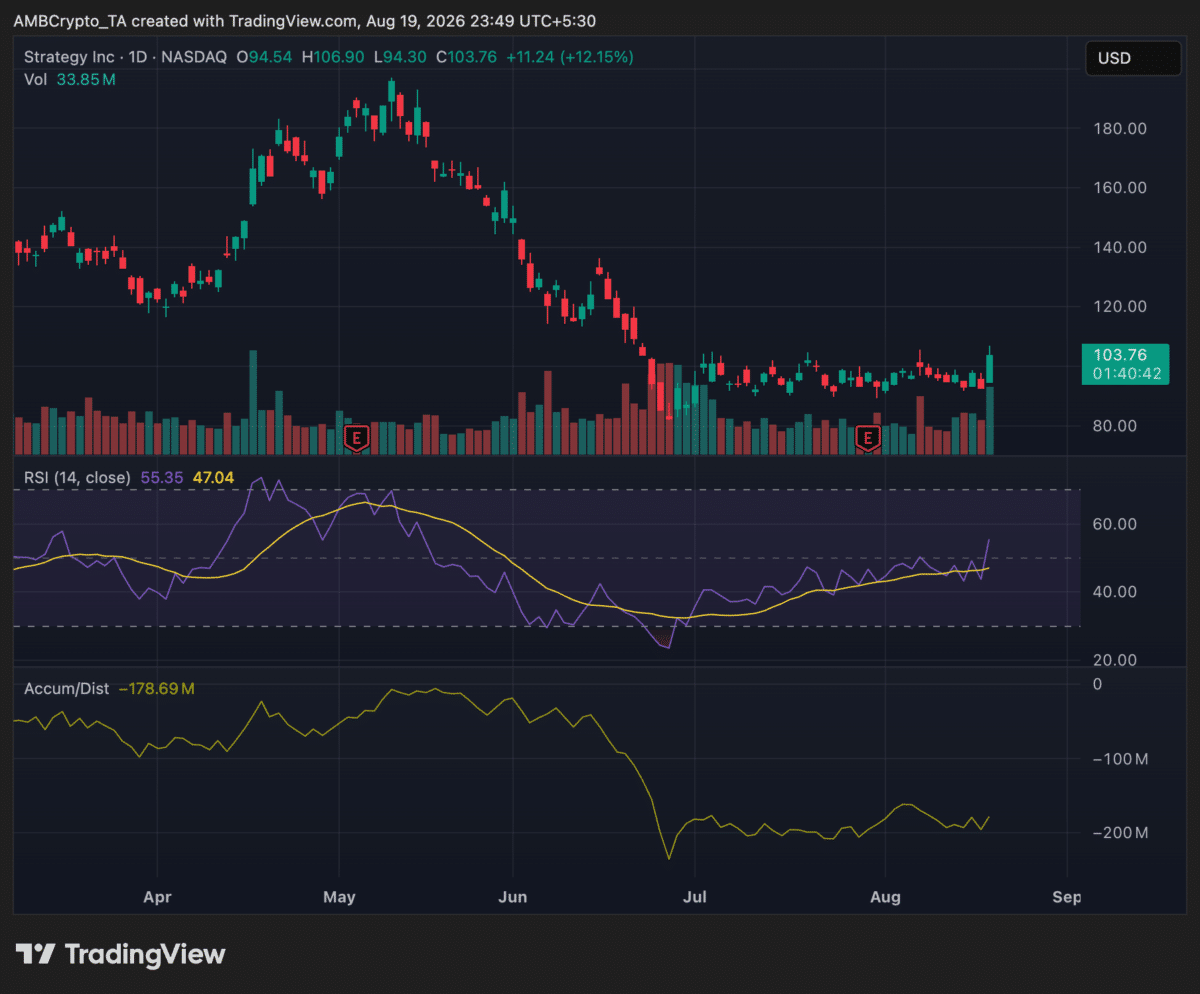
Strategy [MSTR] shares jumped more than 12% on Wednesday as Bitcoin’s sudden recovery spilled into crypto-linked stocks.
The price of the stock was around $103.76 after it briefly got to the $106.90 level, as Bitcoin gained a more modest 5.59%.
For Strategy shareholders, though, the strong session comes after months of pain due to the price fall. The stock traded near $190 in May and recently fell towards $90, and Michael Saylor is still telling investors not to expect an easy ride from here.
Bitcoin puts MSTR back above $100
MSTR started Wednesday at $94.54. By the end of trading, it had gained 12.15%, with 33.85 million shares changing hands.
The Bitcoin price rise provided the backdrop for the stock price move, with $BTC moving from below $65,000 to nearly $70,000 before dropping to around $68,297.
That price move tends to matter more for Strategy than for other companies because of its relationship with $BTC.
Source: TradingView
Strategy owns 840,447 $BTC, so MSTR has become a way for stock-market investors to gain exposure to Bitcoin without buying it directly. The relationship can exaggerate moves in both directions.
Wednesday showed the upside of that relationship, while the past few months showed the other side.
But even after the rally that it saw today, MSTR still remains well below its May levels.
Saylor tells investors to prepare for difficult years
Meanwhile, Saylor has offered shareholders a much longer timeline.
In response to concerns about Strategy’s falling share price and continued issuance of MSTR stock, he warned that investors should be prepared for potentially “difficult years.” He suggested common shareholders may need to think over a period as long as ten years.
In the last few weeks, there have been changes to Strategy’s Bitcoin holdings, with the company selling 1,690 $BTC for $108.6 million between August 3 and 9, using the money to repurchase STRC preferred shares.
It separately raised $653.1 million from MSTR share sales and increased its dollar reserve to $4.65 billion.
With Wednesday’s Bitcoin price, the remaining $BTC that Strategy holds were worth roughly $57.4 billion, and so far the company has spent $63.36 billion to purchase $BTC.
MSTR may have returned above $100, but both the decline $BTC witnessed earlier and Strategy’s increasingly complex financing structure continue to weigh on the investment case.
Final Summary
MSTR gained 12.15% as Bitcoin’s rise towards $70,000 helped crypto-linked stocks to move higher.
Saylor is asking shareholders to take a long view as Strategy sells shares and occasionally Bitcoin to raise capital.
The issue matters because Luke Dashjr and other BIP-110 supporters are discussing a hard fork that would replace the minority chain’s SHA-256d mining algorithm with BLAKE2b. Such a move would permanently create a whole new design, but the two networks would still share their transaction history from before the split.
What Exactly Is a Replay Attack?
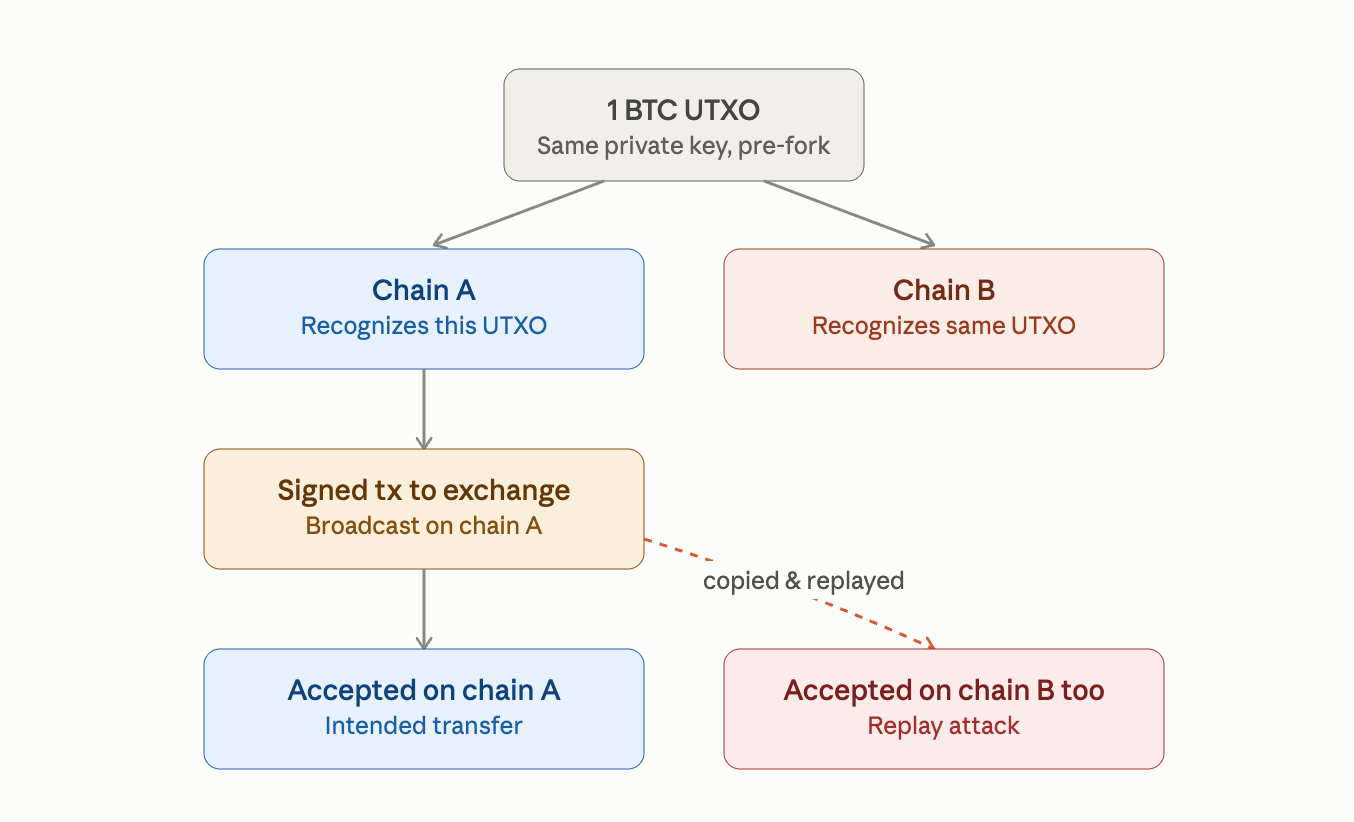
Imagine someone holds 1 bitcoin before a hard fork. When the blockchain divides, the same historical unspent transaction output, or UTXO, exists on both networks. In practical terms, the owner controls corresponding coins on each chain with the same private key.
Trouble begins if both networks also recognize the same transaction and signature rules. Suppose the owner sends the coin to an exchange on Chain A. If that signed transaction is also valid on Chain B, another party can copy it and broadcast it there. Chain B may accept the transaction because, cryptographically, nothing distinguishes the authorization from one intended for its network.
A visual diagram of how a replay attack works.
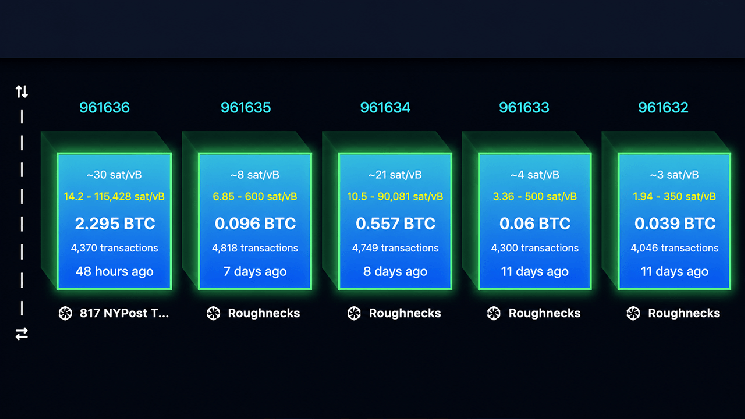
That is a replay. Nobody steals the private key or breaks Bitcoin’s cryptography. The problem is simpler: the user created one valid authorization, but two blockchains recognize it. And while the BIP-110 chain sits at block height 961636, people spending BTC are moving BIP-110 coins, or whatever they will be called going forward, at the same time, without even knowing.
“The overwhelming majority of these [BIP-110 minority chain] blocks are just replaying days-old transactions from the main chain,” Mempool.space developer Mononaut wrote on X. This replay protection or replay attack subject has caused a viral conversation on X over the last few days.
Replay Protection Builds a Wall Between the Chains
Replay protection prevents that crossover by making transactions on the competing networks distinguishable. One method changes the signature hash, commonly called sighash, so a transaction signed for one chain fails the consensus rules of the other.
Mandatory protection makes this distinction part of the fork itself. Opt-in protection leaves ordinary transactions potentially compatible with both chains and requires users to deliberately use a chain-specific mechanism when they want to separate their coins.
That distinction has become important for BIP-110. The emerging plan does not appear to provide automatic, comprehensive two-way replay protection. Instead, at least according to Discord discussions, Bitcoin Knots is implementing a new sighash option that can create a transaction valid on the RDTS chain but invalid under Bitcoin Core.
Dashjr Says Protection Is the Other Chain’s Problem
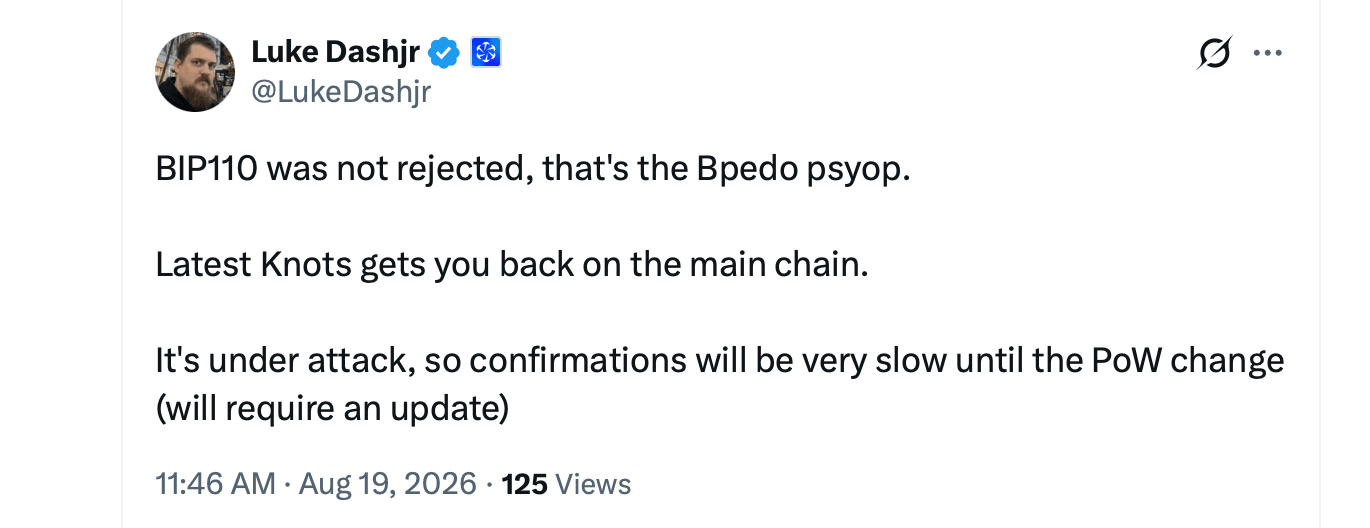
Dashjr has taken an unusual position on which network should bear responsibility. Asked Aug. 18 about replay protection for the proposed hard fork, he said, “Replay protection was Spamcoin’s responsibility since it’s the airdrop altcoin.”
Image source: X
He added that there would be ways to separate transactions but argued that “legitimate Bitcoin transactions need to remain valid on Bitcoin.” His reasoning rests on his assertion that the BIP-110/RDTS minority network is Bitcoin, while the overwhelmingly dominant SHA-256d Bitcoin blockchain is the breakaway network.
Image source: X
Dashjr has repeatedly used derogatory names for the dominant Bitcoin chain, including “Spamcoin” and “Bpedo,” a reference incorporating “pedo.” He has characterized that network as the altcoin while continuing to describe the BIP-110 branch as the legitimate Bitcoin.
The Network Numbers Tell a Very Different Story
That characterization collides with observable network activity. BIP-110 miner signaling peaked at roughly 2.53%, and when its consensus rules took effect Aug. 8, its minority branch produced only two immediate blocks before stalling. Bitcoin’s dominant chain continued operating while the gap widened by hundreds of blocks. A few other BIP-110 blocks have been mined at an extremely slow rate.
The majority network retained essentially all meaningful Bitcoin hashrate, the longest chain, weight of work, liquidity, and economic recognition. The BIP-110 proposal was subsequently marked closed, while supporters moved toward plans for a BLAKE2b proof-of-work (PoW) change intended to revive the minority network.
Moreover, the Bitcoin community is frustrated with Dashjr’s repeated claims and the intended opt-in styled replay protection being discussed is a bone of contention. “Lol. Luke isn’t gonna launch his sh**coin with replay protection, is he? I guess it won’t be listed on exchanges then,” one X user wrote on Wednesday.
Another X user argued:
“This has crossed the line from nonsense into bad-actor behavior. Spreading false information like this can cause real financial harm to Bitcoiners.”
Opt-In Protection Leaves Responsibility With Users
Under the approach now being discussed on the Bitcoin Knots Discord channel, ordinary transactions may remain replayable because RDTS intends to maintain compatibility with Bitcoin Core’s existing sighash types. Users wanting RDTS-specific protection would need to use the new sighash, requiring supporting wallet software or hardware-signing firmware.
A conversation in the Bitcoin Knots Discord – screenshot.
Users can also attempt to split their coins manually. A Bitcoin transaction containing data that RDTS rejects could create an output existing only on the dominant chain. Conversely, the proposed RDTS-specific sighash could produce a transaction that RDTS accepts, but Bitcoin Core rejects.
The result looks far more like opt-in replay protection than the automatic firewall users expect from a contentious hard fork. That leaves wallets, exchanges, and holders responsible for knowing exactly which transactions can bleed across chains. The decision is strange, especially for a new chain and crypto asset with zero exchange support. Infrastructure providers, particularly crypto exchanges, are unlikely to touch a chain that chooses opt-in protection over a universal replay barrier.
If the BLAKE2b fork proceeds around Sept. 1, replay protection will therefore be more than an obscure technical detail. It will become a practical test of whether users can safely separate assets inherited from the same Bitcoin history, even as Dashjr continues making the far larger claim that the network carrying virtually all of Bitcoin’s hashrate, liquidity and economic activity is somehow the altcoin.
Most launchpads benefit when more tokens trade, creating pressure to value volume over quality. MemeToro is building the opposite filter into its $BNB Chain pipeline: a trend must carry evidence and survive validation before it becomes a proposal.
That evidence-first structure supports MemeToro’s case as the best AI memecoin agent for $BNB memecoins, especially for users tired of launches based on copied posts or hidden allocations.
High Volume Does Not Prove A Strong Launch
$BNB Chain can move memecoin narratives quickly because its fees are low and PancakeSwap provides an established trading venue.
MemeToro’s upgraded trend connector pulls signals from news and X. The validator then checks the generated proposal against that collected evidence.
Its approach makes sources traceable and gives reviewers a clearer basis for deciding whether the proposal should continue.
Financial Rules Receive Their Own Checks
Evidence alone cannot make a launch fair. MemeToro’s pipeline also checks the launch manifest, the structured file containing the token’s concept and economic terms.
Allocation categories must equal 100%, and insider allocation must remain at zero. Future fixed-rate rounds are intended to give eligible public participants one stated price while wallet limits reduce early concentration.
The best AI memecoin agent for $BNB memecoins should provide:
News and X evidence preserved
Risk notes attached before funding
Unsupported URLs automatically rejected
Zero insider allocation enforced in drafts
Fixed-rate public rounds planned
PancakeSwap liquidity routing proposed
These controls reject malformed proposals before launch. On-chain enforcement, funding contracts, and independent audits are still needed before the full system reaches production.
Useful Products Extend Beyond Token Creation
MemeToro combines the launch pipeline with planned memecoin trading, AI discovery, prediction markets, creator pages, community tools, and engagement rewards. This gives the platform more ways to attract users than launch volume alone.
$MT is designed for access, transactions, rewards, and staking, with advertised returns of up to 35% APR. Creators may earn up to 1.2% of native trading volume, aligning token creation with ongoing activity.
These connected products strengthen the best AI memecoin agent for $BNB memecoins thesis because the platform can serve traders, creators, and forecasters within one ecosystem.
Stage 6 Offers Early Platform Exposure
MemeToro’s AI memecoin agent presale has reached Stage 6. It has raised $96,309.30 toward a $138,460.70 round target. The current $MT price is $0.00350, compared with a projected launch price of $0.02448.
That difference creates a bullish early-entry case, but the projected price is not guaranteed. Delivery remains the central test.
MemeToro’s public, MIT-licensed repository helps buyers track that delivery. The connector, manifest format, validator, and end-to-end proposal dry run are available now; autonomous hourly launches and production contracts remain planned.
Evidence Before Volume Is The Better Standard
The best AI memecoin agent for $BNB memecoins should not turn every spike in attention into a financial product. It should show where an idea came from, identify risk, refuse broken economics, and expose its rules.
The best AI memecoin agent for $BNB memecoins needs that standard. Best AI memecoin agent for $BNB memecoins. Mainnet execution could make launching less a competitive advantage.
FAQs
Does MemeToro Guarantee Its Evidence Is True?
No. It verifies that proposal links came from collected inputs; reviewers must still judge source accuracy.
Why Does MemeToro Reject Insider Allocations?
The zero-insider rule prevents draft proposals from reserving preferential token shares before public funding.
Analyst Predicts End of Bear Market if Key Levels Hold
On Wednesday, ethereum ($ETH) breached the $2,000 mark for the first time in more than two months, surging after the U.S. Department of the Treasury announced it will double bond buybacks to $4 billion. According to Bitstamp data, the number two digital asset by market capitalization rocketed to an intraday peak of $2,112 before retreating to consolidate just under $2,090.
Before that, $ETH had languished below $1,900 since Aug. 8, except for brief moments when buying pressure saw it break through the threshold. That changed Aug. 19 when the unexpected U.S. Treasury announcement sent the cryptocurrency market surging, with Bitcoin falling just short of the $70,000 mark.
The digital asset’s nearly 10% jump lifted $ETH’s market capitalization from under $230 billion to $251 billion. The surge also pushed the total market cap for altcoins above $1 trillion for the first time in nearly a month.
Market analyst Michaël van de Poppe, chief investment officer and founder of MN Fund, characterized the price action as a “phenomenal breakout” for $ETH.
“I don’t think it will stall — not at all — but after such a move, I’d much rather see it consolidate for a little,” van de Poppe remarked, adding that he is looking to buy dip opportunities. “As long as this remains above $2,000, the markets should expect a continuation towards $2,250, a $2,465 high, and potentially even $2,900 as a target zone. If we’re going to make a higher high, the bear markets are over.”
Meanwhile, privacy coin Zcash ($ZEC) also outperformed the broader market, jumping from just over $503 to peak at $557. Like the rest of the cryptocurrency market, the bulk of $ZEC’s gains occurred in just over an hour, underlining how the Treasury’s move catalyzed trading. The coin’s 9% jump lifted its market cap to $9.3 billion, widening its lead over Monero ($XMR), which fell 0.9%.
Other notable gainers included HYPE, XRP, and SOL, which all jumped more than 6%, and XLM, which rose 7.5%. A handful of altcoins bucked the upward trend alongside $XMR, including LEO, down 2%, and TRX, down 0.7%.
An old video of JD Vance resurfaced this week in which the then-senator asks a question Washington usually treats as settled: Is issuing the world’s reserve currency actually good for the United States?
The dollar allows Americans to buy imports cheaply, he observed, while the same strength makes domestic production less competitive.
Reserve status looks like a prize until you examine the bill.
Economist Robert Triffin identified the underlying conflict more than sixty years ago. A national currency cannot indefinitely serve both its own economy and the world’s demand for reserves without forcing its issuer into choices that eventually undermine confidence.
The dollar survived the first Triffin crisis by abandoning gold convertibility and becoming a true fiat currency. The dollar’s value is sustained through Treasury securities, offshore dollar markets, and now stablecoins, but the contradiction remains.
Bitcoin offers a way out of the dilemma once and for all, because it can perform the neutral reserve function without requiring any country to run deficits, hollow out its industrial base, or promise redemption from a vault. The Triffin dilemma was always a design problem – that is, it was a shortcoming of the tool we call money. With bitcoin, we now have a tool that is better-designed for this job.
The Question Washington Avoids
In the video shared by economic historian Phil Magness, Vance calls his own view “super heterodox.” Reserve status creates an obvious subsidy for American consumers because foreign demand for dollars raises the currency’s value. Imports become cheaper, but the other side of that exchange is paid by factories, exporters, and workers whose goods become more expensive to the rest of the world.
The standard description of the dollar’s “exorbitant privilege” emphasizes America’s ability to borrow cheaply and purchase foreign goods with a currency it issues. Both advantages are real – but so is the structural demand for dollar assets that keeps the exchange rate stronger than it otherwise would be. A stronger currency increases household purchasing power while imposing pressure on tradable industries. The consumer sees the discount at checkout, but that same person might see their job shipped overseas, and never realize the two are tied together.
This helps explain why Vance’s argument is compatible with the Trump administration’s industrial policy even though the administration also wants to defend dollar primacy. Tariffs, domestic manufacturing incentives, and a global reserve currency pull in different directions. Policymakers can manage the tension for long periods, especially when American productivity and capital markets remain dominant. In any case, they cannot explicitly repeal the monetary architecture that produces it.
Triffin Predicted The Gold Window Would Break
Under the Bretton Woods system, other major currencies were fixed to the dollar, and the dollar was convertible into gold at $35 an ounce. As international commerce expanded, governments and banks needed more dollars to settle trade and hold as reserves. The United States supplied them by sending dollars abroad through persistent balance-of-payments deficits.
In 1960, Triffin explained to Congress how this trap works. If America refused to supply dollars, global liquidity would contract and trade would suffer. If America continued supplying them, foreign dollar claims would eventually exceed the gold available for redemption. The act of serving the system would destroy confidence in its reserve asset.
The arithmetic won. By the late 1960s, foreign-held dollars had overtaken the United States’ monetary gold, and repeated attempts to defend convertibility merely postponed the reckoning. On August 15, 1971, President Nixon closed the gold window. The Federal Reserve’s own history describes the accumulated deficits and looming gold run that brought Bretton Woods to an end. Triffin had identified the failure mechanism 11 years before it arrived.
Nixon intentionally broke the promise of gold convertibility before it could produce a scandal by becoming impossible to fulfill. This allowed the dollar system to continue, as Treasury securities gradually became the reserve asset behind the reserve currency. Today, Foreign investors hold about $9.3 trillion in U.S. government debt. The world still accumulates American liabilities to obtain dollar liquidity, and the United States still receives goods and capital in exchange for issuing them.
The Triffin Dilemma’s Strange Mutation
The post-1971 system is more flexible than Bretton Woods. Offshore banks can create dollar credit, and the Federal Reserve can supply emergency liquidity through swap lines. Foreign countries can earn dollars through exports, borrow them, or sell assets to American investors. A current-account deficit is therefore less mechanically necessary than it was under gold convertibility.
However, this flexibility swaps out some financial plumbing while preserving the conflict between domestic and international objectives. Global demand for safe dollar assets draws capital into the United States, supports Treasury borrowing, and keeps the currency strong. Those same forces make American exports less competitive and encourage the country to consume more than it produces. Persistent deficits then create an ever-larger stock of claims whose value depends on confidence in American institutions and fiscal capacity.
Stablecoins extend this system. Dollar tokens backed by Treasury bills can bring billions of people into the dollar economy and create a new structural buyer for federal debt. Stablecoins may strengthen dollar primacy for decades, but we must bear in mind that every token backed by a Treasury security still rests on an American liability. Stablecoins increase demand for the existing architecture – perhaps dramatically – but do not ease its contradiction.
A euro or yuan reserve system would do nothing but relocate the burden to a jurisdiction that has a poorer reputation for upholding property rights than the U.S. Additionally, Europe or China would inherit our Triffin Dilemma and feel pressure to supply safe assets, tolerate capital inflows, and subordinate domestic priorities to global liquidity. This is a no-go.
Keynes proposed a supranational reserve unit called the bancor at Bretton Woods precisely because he recognized the problem with assigning a neutral function to one nation’s money. The idea failed because a synthetic unit administered by governments still requires governance everyone trusts – once again moving the problem instead of solving it.
Gold Points Toward The Answer, But Isn’t
Central banks have already begun moving toward a reserve asset that is no nation’s liability. According to the World Gold Council, they purchased more than 1,000 tons of gold annually for three consecutive years after 2022. The freezing of Russian reserves demonstrated that even sovereign assets can become contingent on the issuer’s political approval. Gold offers neutrality because it has no issuer.
Gold also carries the constraints of atoms. Large transfers require ships, planes, guards, vaults, and assayers. Verifying a sovereign stockpile is expensive and incomplete, an issue I explored in “What If The Gold Is Gone?” Gold’s scarcity is strong by terrestrial standards, though its supply responds to price and advances in extraction. Its monetary neutrality comes with extreme settlement friction.
Bitcoin combines neutrality with easy, digital final settlement. New supply enters according to a fixed schedule, independent of any country’s trade balance or fiscal policy. Anyone can verify the circulating supply with a “node” (a small computer program). Transferring ownership across borders requires no correspondent bank or physical shipment. No sovereign must issue a liability for another sovereign just so that it may acquire bitcoin.
Volatility and shallow sovereign adoption currently limit bitcoin’s usefulness as a primary reserve asset. Central banks need liquid markets, established custody, and confidence that large transactions will not destabilize the asset they are buying. Gold has centuries of institutional precedent. Bitcoin has 17 years. The relevant comparison concerns direction rather than present scale. As I argued when asking whether bitcoin could help solve a sovereign debt crisis, reserve transitions begin before the old system admits they are necessary.
A Reserve Asset Without An Army
The United States benefits enormously from dollar primacy, and abandoning it abruptly would inflict severe economic damage. Vance’s question matters because the benefit has always carried a cost. America supplies the world with safe assets by creating claims against its own future, then manages the industrial and fiscal consequences of the demand it worked so hard to create.
Bitcoin makes another arrangement conceivable. The dollar could remain a dominant currency for contracts, taxation, and commerce while bitcoin gradually assumes a larger role as neutral reserve collateral. Stablecoins could expand dollar usage even as governments diversify the assets beneath their long-term savings. Gold and bitcoin could coexist during a transition, with one supplying historical trust and the other supplying verifiable scarcity and rapid settlement.
Triffin showed that a national currency cannot serve the world forever without eventually placing the issuer’s domestic interests in conflict with its international obligations. Bitcoin resolves the conflict by separating the reserve asset from any one country. The world may continue using dollars because American markets are deep, liquid, and useful, but it no longer has to make America’s deficits the foundation of global money.