L4VA, a programmable capital markets infrastructure, has launched the Toto Finance Silver Vault on the Cardano blockchain. The new vault gives users access to tokenized physical silver backed by the underlying asset.
The vault allows participants to acquire tokens representing a proportional share of the physical silver. These tokens can be traded through decentralized liquidity pools, creating an on-chain market for the asset. Eligible users can also receive L4VA ecosystem rewards for qualifying activity, while liquidity providers can earn trading fees.
L4VA provides infrastructure for turning real-world assets into digital financial products. Toto Finance focuses on asset-backed products and is working with L4VA to expand access to physical commodities through blockchain technology.
Despite still experiencing significant upward movement in XRP price, Ripple aims to solidify its leading position in the blockchain ecosystem.
At this point, Ripple is expanding its corporate digital asset services by forging new partnerships to continue its global growth.
Accordingly, Ripple announced that it has established a strategic partnership with Jeonbuk Bank, one of South Korea’s most important regional banks.
The bank, which operates under the umbrella of JB Financial Group, will use Ripple Payments infrastructure for cross-border commercial payments.
According to Ripple’s official statement, Jeonbuk Bank will be the first regional bank in South Korea to use Ripple Payments.
The partnership aims to provide faster cross-border payment services, particularly to corporate clients such as import-export companies, technology startups, and online content creators who make international payments.
Thanks to Ripple, payments will be processed in minutes!
The statement indicates that Ripple Payments’ infrastructure can enable payments to be processed within seconds or minutes, 24/7.
The statement explains that Jeonbuk Bank’s use of Ripple Payments could reduce the numerous intermediary steps involved in the current SWIFT-based international money transfer process and support real-time payments in seconds.
Ripple Asia-Pacific General Manager Fiona Murray stated that the partnership demonstrates the growing interest of South Korea’s corporate finance sector in digital asset infrastructure.
JB Jeonbuk Bank Chairman Park Choon-won stated in his announcement that through this collaboration, the bank plans to enhance its digital financial competitiveness and expand its global financial services.
Toyota’s finance arm is launching a tokenized bond that retail investors can buy directly through the Japanese carmaker’s mobile payment app, Toyota Wallet.
Toyota Finance said Tuesday that applications have opened for the one-year bond, with investments starting at 100,000 Japanese yen ($676). The new bond will be distributed directly by Toyota Finance, allowing investors to buy it without opening a securities account.
The 1 billion yen bond carries a 1.72% annual interest rate and will be managed on blockchain infrastructure provided by Japanese security-token firm BOOSTRY.
The carmaker said the direct distribution model will allow it to integrate applications, communications with bondholders and investor benefits within the same ecosystem.
Investors may also receive Toyota Wallet balances and qualify for benefits including Fuji Speedway tickets and test-drive experiences, including in Lexus and selected classic Toyota vehicles.
The offering is Toyota Finance’s second security token bond following its debut issuance in March 2025, which was sold through securities companies.
New developments continue to emerge regarding planned regulations for the US cryptocurrency market. First, a meeting scheduled for Friday by the SEC, where a new regulatory framework for initial public offerings of crypto assets was to be discussed, was canceled at the last minute. The SEC was expected to initiate the formal rule-making process for this new framework, dubbed “Regulation Crypto Assets,” at that meeting.
One of the first to announce the cancellation of this meeting was American journalist Eleanor Terrett, who stated in her post that the SEC’s official reason was “an unforeseen programming problem.”
While speculation continues in the market about why the meeting was canceled, some sources are now pointing the finger at Wall Street.
Is the SEC Under Pressure from Wall Street?
According to Decrypt, Wall Street played a role in the cancellation of the SEC’s Friday meeting. Sources say that pressure from the Securities Industry and Financial Markets Association (SIFMA), a major Wall Street organization, was instrumental in the cancellation.
According to sources who spoke to Decrypt, SIFMA opposed the SEC’s creation of a framework that could provide crypto companies and tokenization firms with broad exemptions from existing securities regulations.
The report states that SIFMA’s main objection centers on whether the SEC can create such a broad regulatory framework using its existing statutory powers.
Sources also reported that SIFMA signaled that it could take legal action if the SEC took such a step. This is said to have influenced the SEC’s decision to postpone the planned meeting.
At this point, sources indicate that the real debate behind the scenes is the SEC’s regulatory authority over the cryptocurrency market and Wall Street’s objections to that regulation.
It is noteworthy that these developments come immediately after the US Senate failed to make progress on the CLARITY Act before going on recess in August, and the CLARITY Act was postponed until September.
According to experts, the SEC’s independent efforts to develop comprehensive regulations for the cryptocurrency market, coupled with Congress’s attempt to create a legal framework through the Clarity Act, make the debate over which institution and under what authority will shape cryptocurrency regulations in the US even more significant.
It remains unclear when the SEC will reschedule the meeting and whether the “Regulation Crypto Assets” process will continue.
U.S. spot Ethereum exchange-traded funds recorded approximately $5 million in net inflows on Aug. 17, according to data from Farside Investors. The tally excludes BlackRock’s ETHA and the staking-focused ETHB, which were not included in the reported figures.
Fund-Level Breakdown
Among the funds that reported flows, Fidelity’s FETH led with $4.3 million in net inflows, followed by Bitwise’s ETHW with $700,000. The data underscores a modest but positive day for Ethereum investment products, even as broader market sentiment remains cautious.
Context and Implications
The inflows come amid a period of mixed activity for digital asset ETFs. While Bitcoin ETFs have seen more volatile flows, Ethereum products have attracted steady, albeit smaller, interest from institutional investors. The exclusion of BlackRock’s products from the tally is notable, as ETHA has been one of the largest Ethereum ETFs by assets under management since its launch. The omission may reflect reporting discrepancies or a deliberate choice by Farside to focus on funds with clearer flow data.
Why It Matters
For investors tracking the adoption of Ethereum-based financial products, these flows provide a snapshot of demand. Even modest inflows can signal growing confidence in Ethereum as an asset class, particularly as staking features and regulatory clarity evolve. However, the overall scale remains small compared to the broader crypto market, and daily flows can be volatile.
Conclusion
While the $5 million figure is not transformative, it represents a continuation of steady interest in spot Ethereum ETFs. As the market matures, daily flow data will remain a key metric for gauging institutional participation and sentiment.
FAQs
Q1: What are spot Ethereum ETFs? Spot Ethereum ETFs are exchange-traded funds that directly hold Ethereum ($ETH), allowing investors to gain exposure to the cryptocurrency without owning it directly. They trade on traditional stock exchanges.
Q2: Why were BlackRock’s ETHA and ETHB excluded from the inflow data? Farside Investors, the data provider, did not include these funds in the reported tally. The reason may be due to data availability or a specific methodology choice, but it is not uncommon for providers to exclude certain products for clarity.
Q3: How significant is $5 million in net inflows for Ethereum ETFs? While the amount is modest, it indicates continued interest from investors. Larger inflows are often seen during periods of market optimism or regulatory milestones, but steady, small inflows can also reflect growing institutional comfort with the asset class.
Related Reading
Bitcoin at Risk: $1.265B in Long Liquidations If BTC Drops Below $60,941
Brevan Howard and Graham Capital Slash Bitcoin ETF Holdings by Over 70% in Q2
Fundstrat Warns Bitcoin Could Swing 30% in Either Direction as Volatility Hits Record Lows
Peter Schiff Says Bitcoin Rebound Is a Selling Chance, Flags $65K Resistance
Altcoin Season Index Slips to 44 as Bitcoin Continues to Outperform
Ripple ($XRP) remains under pressure on Tuesday as uncertainty across the broader cryptocurrency market and weak technical momentum weigh on the altcoin.
$XRP has slipped below the key $1.00 level. Mixed derivatives and on-chain indicators point to cautious sentiment, leaving $XRP at risk of additional losses.
Derivatives traders maintain bearish bias
CoinGlass data shows that the long-to-short ratio for $XRP stands at 0.92, near its lowest levels in a month.
A reading below one means short positions outnumber long positions, indicating that more traders are betting on prices falling than rising.
The ratios therefore reflect a bearish tilt across the derivatives markets of $XRP. The funding rates also support the current bearish narrative.
$XRP’s funding rate turned negative on Tuesday and currently reads -0.0021%, after hitting 0.0055% on Monday.
A negative funding rate means traders holding short positions are paying those with long exposure, signalling a bearish positioning bias despite some potential for a short squeeze.
CryptoQuant’s indicators suggest cautious optimism for $XRP but a weaker outlook for XLM.
$XRP’s futures market has recorded large whale orders, while most other indicators remain neutral.
This could support a recovery if larger investors continue building positions and market conditions improve.
$XRP’s bearish performance over the past 24 hours comes despite South Korea’s Jeonbuk Bank announcing a partnership with blockchain payments company Ripple to deploy its cross-border payment system for business customers.
As part of the agreement, the Ripple Payments platform would let the bank’s customers settle overseas transfers in seconds to minutes, with operations around the clock.
The service targets businesses including import-export companies, technology startups and online content creators.
$XRP price outlook: Token loses key $1 support
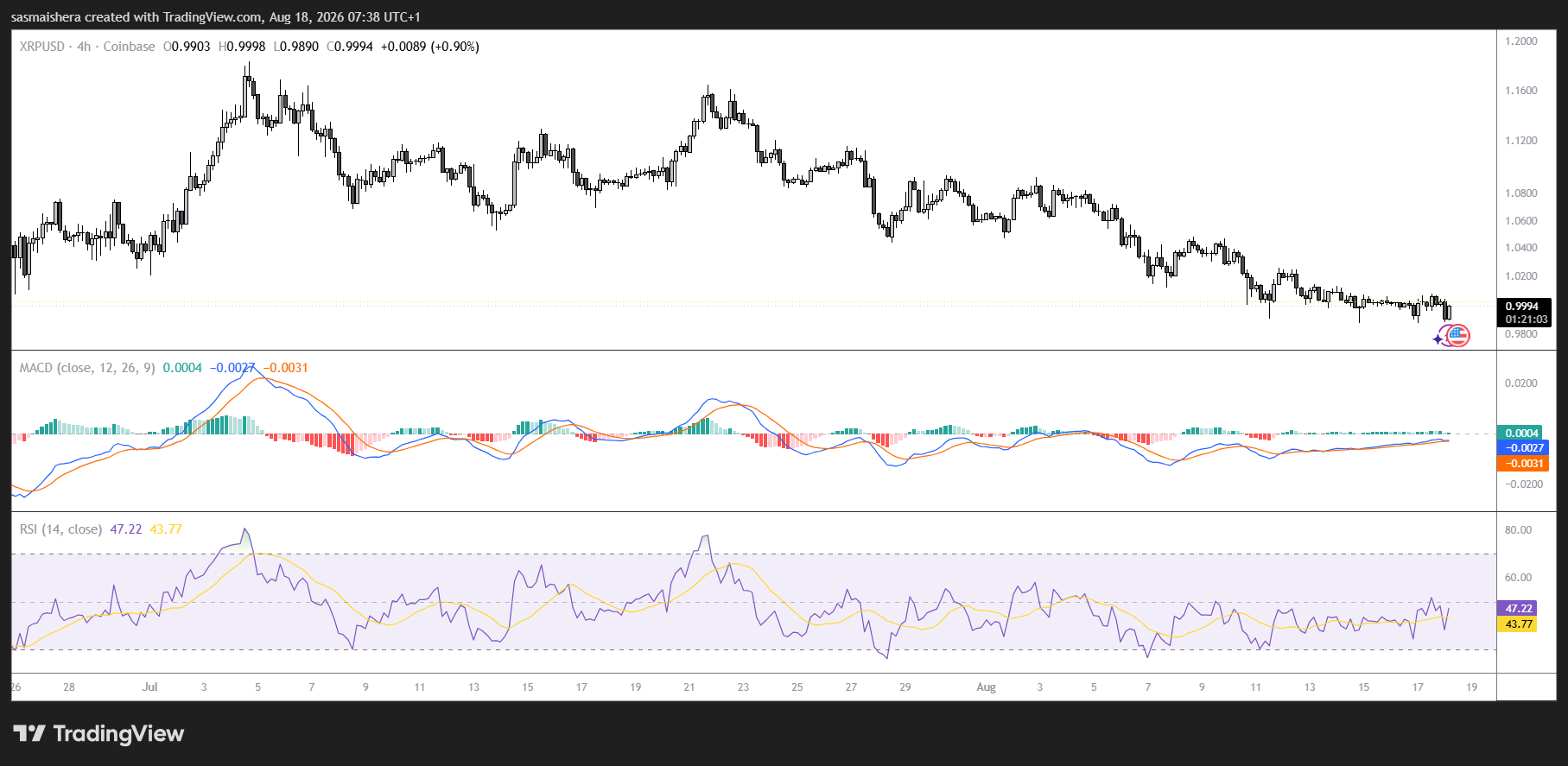
$XRP is down by roughly 1% in the last 24 hours and trades around $0.99 on Tuesday, maintaining a bearish short-term outlook after slipping below the psychological $1.00 level and its descending trendline.
The token also remains below its major daily Exponential Moving Averages.
The 50-day EMA stands at $1.07, the 100-day EMA at $1.15, and the 200-day EMA at $1.34. These indicators now form several layers of overhead resistance.
Momentum indicators reinforce the downside risk. The Relative Strength Index is near 43, reflecting weak buying momentum without yet reaching oversold territory.
The Moving Average Convergence Divergence indicator is also slightly negative, pointing to lingering bearish pressure rather than an established reversal.
For a recovery, $XRP must first reclaim and hold above $1.00. A successful move could bring the 50-day EMA at $1.07 into focus, followed by the 100-day EMA at $1.15 and horizontal resistance at $1.30.
The 200-day EMA at $1.34 and the higher resistance level at $1.90 represent more distant upside targets.
No clear support level is defined immediately below $XRP’s current price, leaving the token vulnerable to further price discovery if demand does not return around the $1.00 region.
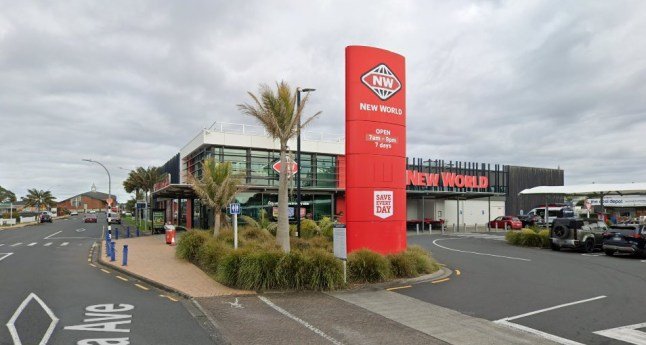
The 54-year-old fell ill in the car park of the New World supermarket in Orewa, Auckland, New Zealand, on July 26 (Picture: Google Maps)
A customer cheated death after collapsing outside a supermarket – but not the fine imposed for leaving her car there while she was brought back to life.
The 54-year-old fell ill in the car park of the New World supermarket in Orewa, Auckland, New Zealand, on July 26.
Other shoppers weny to try and help, including a ‘truly remarkable’ witness who performed chest compressions when they could no longer find a pulse.
The woman’s father said paramedics later told them her heart had stopped and ‘momentarily, she was technically dead’.
Within days of getting a second chance at life, the woman received an $80 (£35) fine for leaving her car outside the supermarket.
Customers are allowed to stay for up to an hour and a half, but her car was not moved for nearly six hours after she was taken to North Shore Hospital.
The penalty charge from Smart Compliance Management stated: ‘Customers are entitled to 90 minutes of parking. Your vehicle was parked for 341 minutes.’
She appealed the fine – quite understandably, you might think – but the company declined to withdraw it, instead reducing it to $30 (£13) given the ‘circumstances’.
Speaking to Stuff, the woman’s father said the family was outraged by the ‘offensive’ penalty.
Staff at New World later paid the money into the woman’s account to cover it.
Owner-operator Steve McClean told the outlet: ‘This was a deeply distressing situation for the customer and their family, and I’m sorry this caused them additional stress and inconvenience.’
A spokesperson for Smart Compliance apologised for the ‘additional stress caused to this individual following their medical emergency’.
They added their initial response did not ‘appropriately take into account the circumstances of the case’.
$XLM is underperforming despite Bitcoin hitting the $64,000 level on Monday. The bearish performance comes as derivatives data indicates that traders are reducing their positions in the market.
CoinGlass data shows that the long-to-short ratio for $XLM stands at 0.90. A reading below one means short positions outnumber long positions, indicating that more traders are betting on prices falling than rising.
The funding rate also supports the current bearish price action. $XLM’s funding rate turned negative on Tuesday and now reads -0.0215%.
A negative funding rate indicates that traders holding short positions are paying those with long positions, suggesting that the bears are in control of the market.
Similar to XRP, $XLM’s CryptoQuant indicators suggest a bearish outlook. The indicator shows sell-side dominance across its markets alongside large whale orders.
These conflicting signals suggest that major participants remain active, but selling pressure continues to control the near-term trend.
The derivative data has supported the bearish price action in recent weeks.
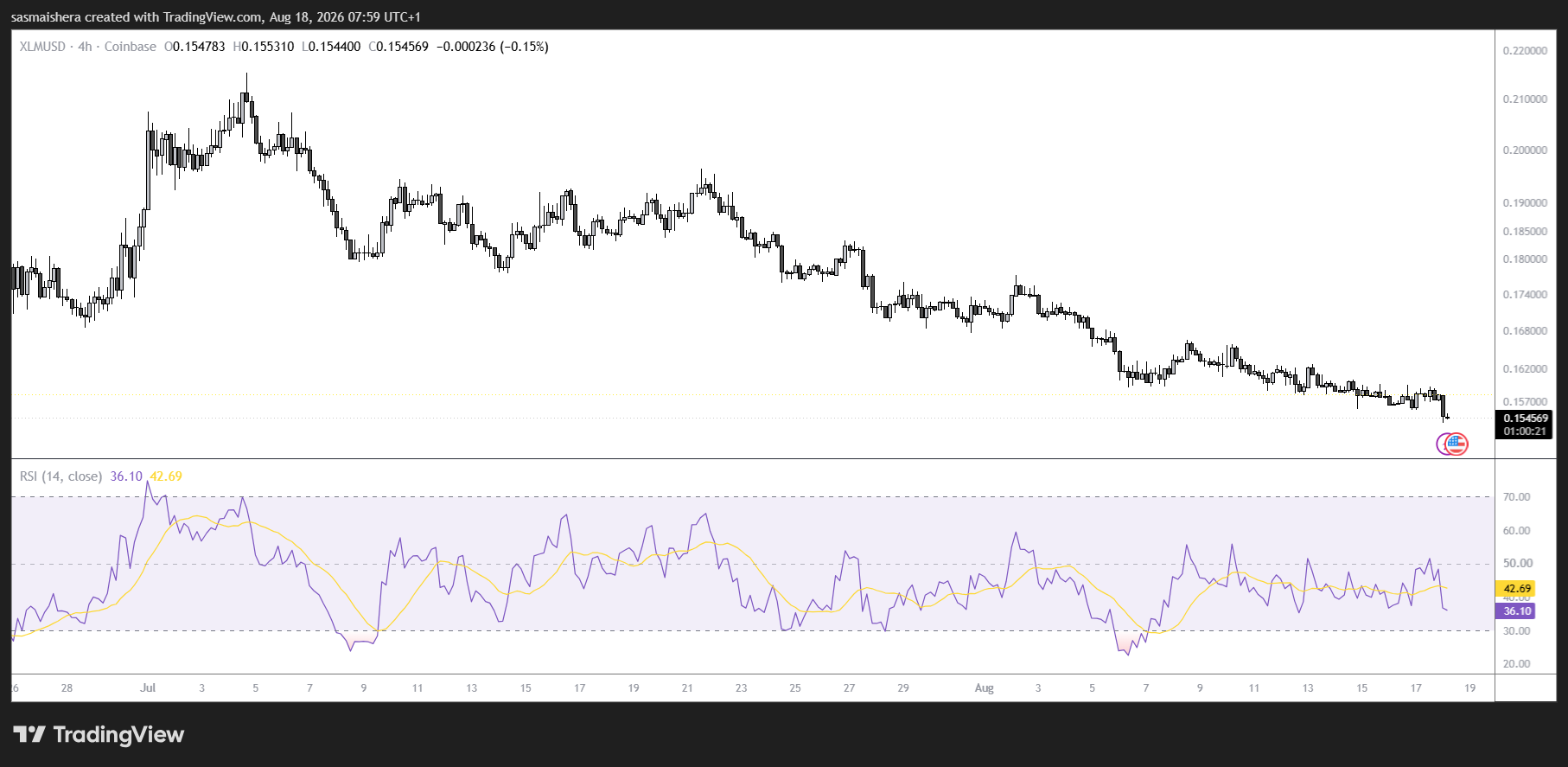
While Bitcoin has been consolidating between $62,000 and $64,000 in recent weeks, $XLM has lost 17% of its value in the last one month and could record further losses in the near term.
The $XLM/USD 4-hour chart is bearish and efficient as Stellar trades at approximately $0.154 on Tuesday, extending its decline below all major daily EMAs.
The 50-day EMA at $0.173, the 100-day EMA at $0.178 and the 200-day EMA at $0.190 form a significant resistance cluster.
As long as $XLM remains below these levels, the broader technical outlook will remain bearish.
The RSI is near 36, placing $XLM close to oversold territory. Meanwhile, the MACD has turned marginally positive around its zero line, suggesting that selling momentum may be weakening.
However, neither indicator confirms a sustainable recovery while the price remains below the major moving averages.
The first meaningful resistance sits around $0.173, where the 50-day EMA aligns with the 78.6% Fibonacci retracement. The next barriers are located at $0.177 and the 100-day EMA at $0.178.
A stronger recovery could target the 200-day EMA at $0.190, followed by Fibonacci resistance at $0.200, $0.218, $0.237 and $0.260. The cycle high near $0.298 remains a distant target.
On the downside, $XLM could test the support zone between $0.142 and $0.139. A decisive daily close below this range would strengthen the bearish outlook and could trigger a deeper decline.
Printr, a platform offering cross-chain memecoin creation and trading services, has announced it is ceasing operations due to funding difficulties. According to the company’s announcement, the platform will completely shut down on August 31st, ending its services to users.
The Printr team stated that they have been evaluating all possible options to continue the project for the past three months. However, due to current market conditions, insufficient funding, and lack of distribution support, it has become impossible to continue operations. The statement emphasized that the decision was made after lengthy evaluations and that the platform’s sustainability is no longer guaranteed.
As part of the closing process, all on-chain staking positions and accumulated staking rewards on the platform have begun to be automatically resolved starting today. The relevant assets will be returned to the addresses where users made their initial investments. Staking services will be completely terminated upon completion of this process.
On the other hand, Printr announced that its previously planned token generation event (TGE) and airdrop program have also been canceled. The project team stated that these plans will no longer be implemented as part of the closing process.
The Printr application’s user interface will be closed after August 31st, and transactions will no longer be possible through the platform. However, tokens previously created through the platform will continue to exist as independent entities on the blockchain.
The recent difficulty in accessing funding and declining investor interest in the crypto sector have put pressure on early-stage projects in particular, and Printr’s closure is seen as one of the latest examples of these challenging market conditions.