The U.S. standard-setting organization accounting made an important proposal for stablecoins on Tuesday, answering uncertainties about whether stablecoins could be considered the same as cash under common accounting practices.
Stablecoins that have liquid reserves (whose contents are disclosed each year) at least equal to the circulating tokens, which can be cashed in for dollars at will, can be considered “cash equivalents,” the Financial Accounting Standards Board said in the proposal.
“The amendments in this proposed update would clarify, through illustrative examples, how the current definition of cash equivalents applies to certain digital assets,” the board said in its proposal, which was issued in answer to an ongoing dispute over how stablecoins are viewed, which it said could create different accounting treatments depending on the source.
FASB sets the industry standards for generally accepted accounting principles (GAAP), and its proposal would add stablecoins to the array of highly liquid, cash-like assets, also including Treasuries, commercial paper and money market funds.
Ripple announced the completion of a $275 million private bond issuance through its non-bank prime broker subsidiary, Ripple Prime. The company will use the funds to strengthen working capital and expand its operations in the United States.
Ripple Prime announced that the initially planned amount for its senior unsecured bonds has been increased following strong investor demand. Institutional investors from various major financial markets participated in the bond issuance.
The issuance also received an investment-grade BBB credit rating from credit rating agency KBRA. With this new funding, Ripple Prime plans to further expand its multi-asset swap, financing, and prime brokerage services.
Ripple Prime President Noel Kimmel said the strong demand for the bond issuance demonstrated confidence in the company’s current business model and long-term growth strategy.
Kimmel stated that with the completion of the funding, Ripple Prime has secured an additional source of capital, which will be used for team and technology investments. The company aims to accelerate its growth in the space where traditional finance and digital asset infrastructure intersect and to strengthen its position as one of the world’s largest non-bank prime brokers.
Coinbase CEO Brian Armstrong has signaled strong conviction in the future of x402, an open payment protocol designed to let artificial intelligence agents autonomously pay for digital services. In a social media post, Armstrong wrote that “x402 is going to be huge eventually,” adding that AI agents will need to make payments for goods and services, and that their numbers will eventually “far outnumber humans.”
What is x402?
x402 is an open protocol built around HTTP 402, the “Payment Required” status code that has existed in the HTTP specification for decades but was never widely adopted. The protocol aims to give AI agents a standardized way to request and complete payments for API access, digital content, or other online services. It primarily supports stablecoin-based onchain payments, allowing agents to pay instantly for services without needing separate accounts, subscriptions, or human intervention.
Unlike traditional payment methods that require login credentials or manual approval, x402 enables machine-to-machine payments. An AI agent that needs to access a premium API or purchase data can simply send a payment request, receive a payment address, and settle the transaction in stablecoins—all in a matter of seconds. This approach could remove significant friction for automated systems that operate at scale.
Why this matters for the crypto and AI industries
Armstrong’s comments come at a time when the intersection of AI and cryptocurrency is attracting growing attention. AI agents are increasingly capable of performing complex tasks, but they often hit a wall when they need to pay for third-party services. Traditional payment rails are not designed for autonomous, high-frequency, low-value transactions.
Stablecoins are a natural fit for this use case because they offer fast settlement, low fees, and programmability. By combining stablecoins with the HTTP 402 standard, x402 could become a foundational layer for the emerging “agent economy.” If AI agents are to operate independently—booking travel, purchasing software licenses, or paying for cloud compute—they need a reliable way to transact. Protocols like x402 aim to provide that infrastructure.
Potential impact on payments and digital commerce
For the broader payments industry, the rise of AI-driven payments could introduce new competition to traditional card networks and payment processors. Stablecoin-based protocols like x402 offer an alternative that is open, permissionless, and globally accessible. This could be particularly valuable in regions with limited access to traditional banking or cross-border payment systems.
However, the protocol is still in its early stages. Adoption depends on both developers building x402-compatible services and AI platforms integrating the standard. Armstrong’s endorsement may help spur interest, but widespread use will require more than just a CEO’s prediction.
Conclusion
Brian Armstrong’s belief in x402 highlights a growing consensus that AI agents will need their own payment infrastructure. While the protocol is nascent, its alignment with stablecoin technology and the HTTP 402 standard gives it a solid technical foundation. Whether x402 becomes the de facto standard for AI payments remains to be seen, but its potential to enable a new wave of autonomous digital commerce is significant.
FAQs
Q1: What does x402 stand for? x402 is a protocol named after HTTP 402, the “Payment Required” status code. It is designed to allow AI agents to request and make payments for digital services automatically.
Q2: How does x402 work? An AI agent sends a request to a service that requires payment. The service responds with a payment address, and the agent sends a stablecoin payment onchain. Once the payment is confirmed, the service grants access.
Q3: Why is Brian Armstrong optimistic about x402? Armstrong believes that AI agents will eventually need to transact autonomously and that their numbers will far exceed humans. x402 provides a standardized way for these agents to pay for services, which he sees as essential for the future AI economy.
Related Reading
World Liberty Financial Denies Direct Ties to Hong Kong AI Platform WorldClaw, But Won’t Detail Financial Links
HashKey to Deploy HKDAP Stablecoin for Hong Kong-UAE Trade and Insurance Payments
Rain Launches the Agentic Payments Alliance to Guide the Future of Agent-Driven Commerce
N3XT to Transform Closed-Loop Banking with First-Ever USD Deposit Tokens that Move Beyond Bank Walls
Circle’s EURC Euro Stablecoin Circulation Surpasses 400 Million
This came after US president Donald Trump posted a map of the closed Strait of Hormuz oil route to Truth Social where it was labeled “new US territory.”
Both the US and Iran lay claim to control of Hormuz, with Trump threatening US ally Oman with military action over its plans to work with Iran on charging tolls to shipping traffic. In a subsequent post, Trump confirmed that further diplomacy with Iran was not on the agenda.
“There are no talks or conversations going on, or scheduled, with the Islamic Republic of Iran. The Naval Blockade remains in full force and effect. The Hormuz Strait is open and operating. All water mines have been removed or detonated,” he wrote.
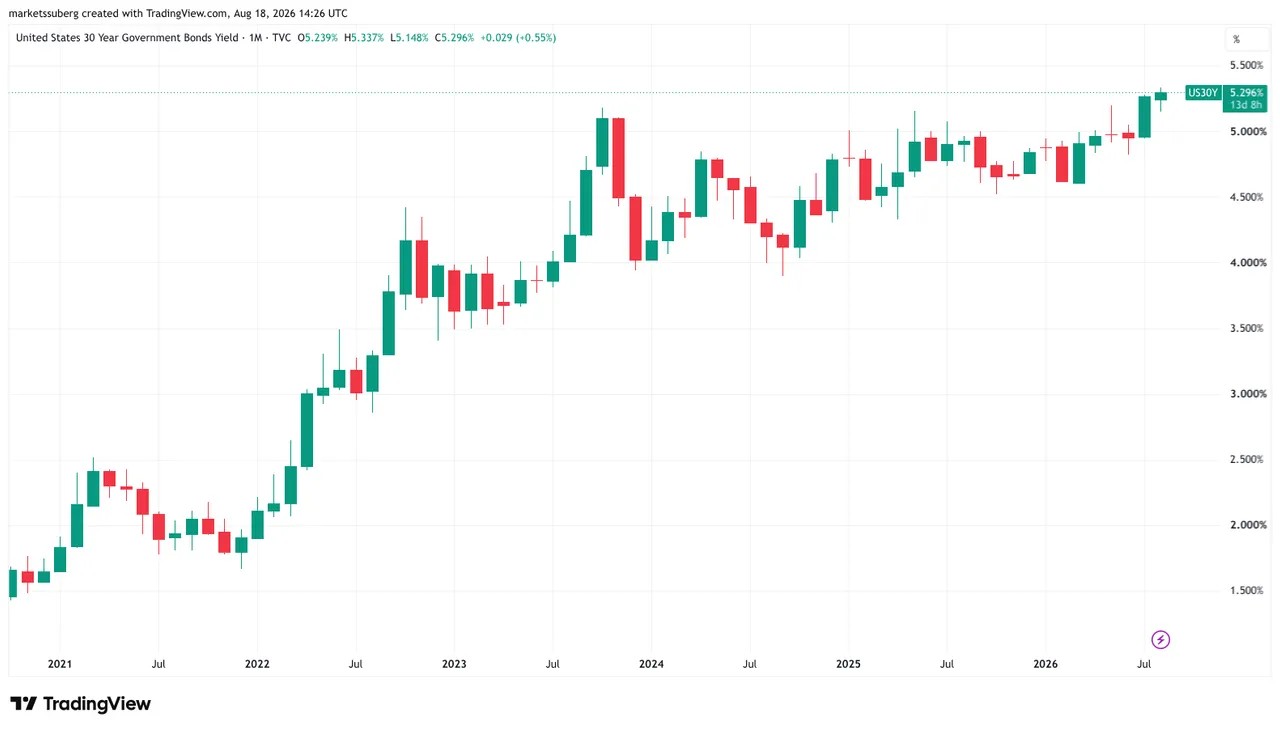
As on Monday, oil avoided major volatility, with WTI crude down 1% at the time of writing at $84 per barrel. US government bonds continued to show strain, with the 30-year yield hitting 5.34%, its highest since January 2007.
“Bond prices are sending warnings,” BNY Mellon analyst Geoff Yu wrote in a research note quoted by the New York Times. Yu said that the surge came as “investors demand more compensation for inflation risk,” while also attributing the upside to government borrowing.
US 30-year bond yields one-month chart. Source: Cointelegraph/TradingView
$BTC price faces crunch rebound test
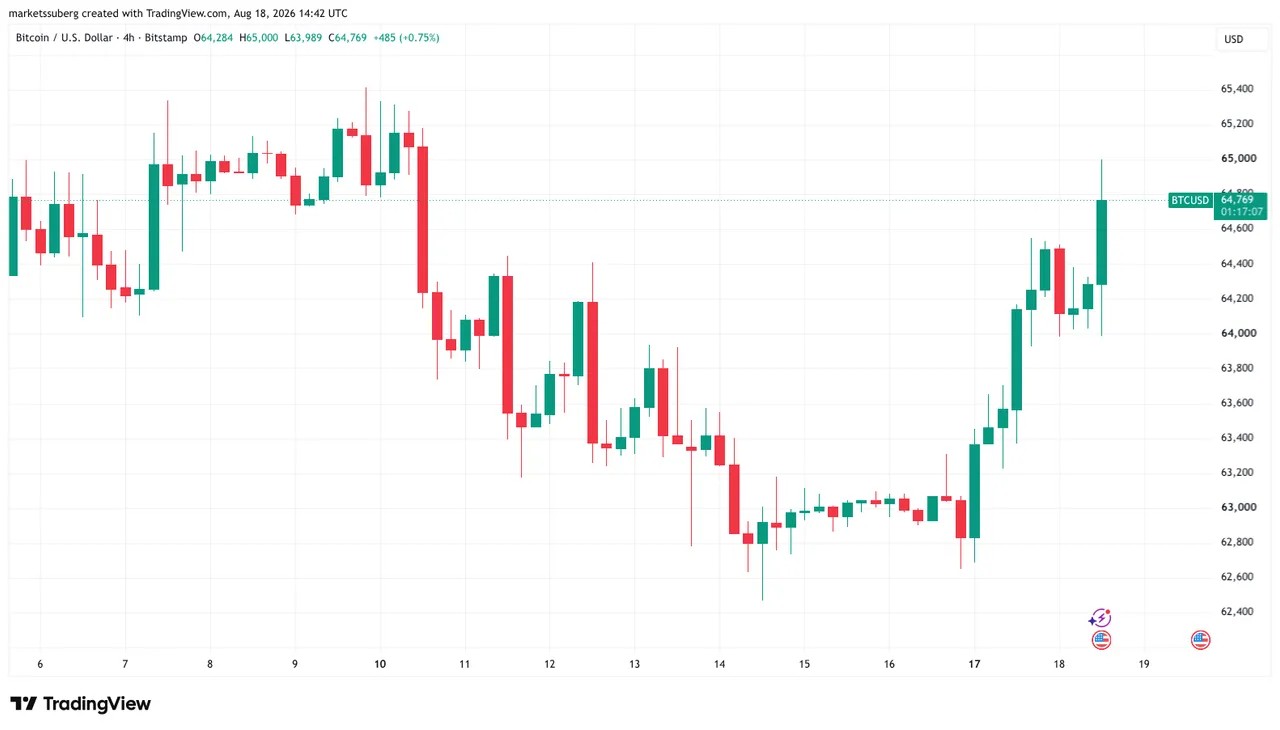
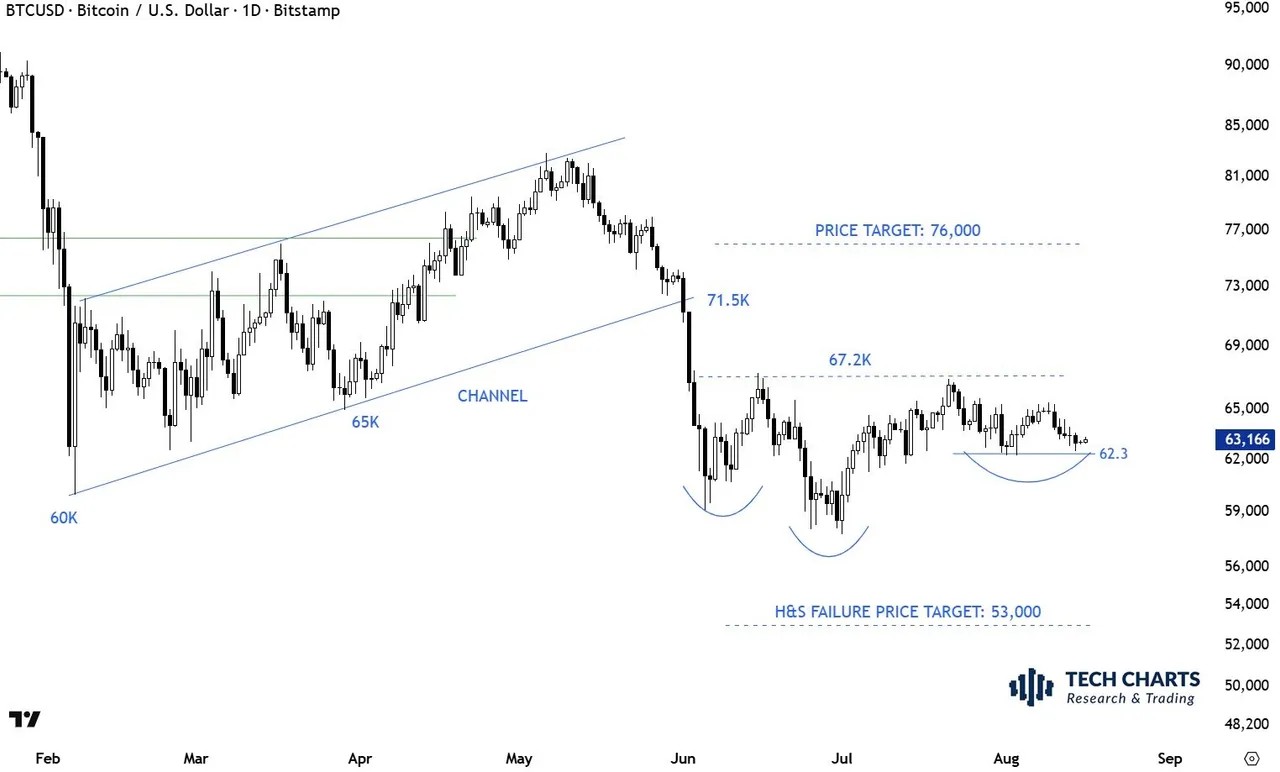
Updating X followers on $BTC/USD, trader and analyst Aksel Kibar eyed the culmination of a potential reverse head-and-shoulders pattern at $62,300.
Related: Bitcoin price spike to $64.5K was ‘low-volume liquidity trap’: Analysis
“If $BTCUSD is going to rebound, it has to come from here,” he argued on Monday.
Kibar offered a $53,000 target in the event of the head-and-shoulders structure failing, with $76,000 a potential upside target should the rebound sustain.
$BTC/USD one-day chart. Source: Aksel Kibar on X.com
Previously, Cointelegraph reported that underwater investors were contributing to Bitcoin’s inability to break higher. Its rebound to $64,500 also stopped short of an overhead trend line, the 50-month exponential moving average (EMA). This moving average is now in place as resistance at $65,827.
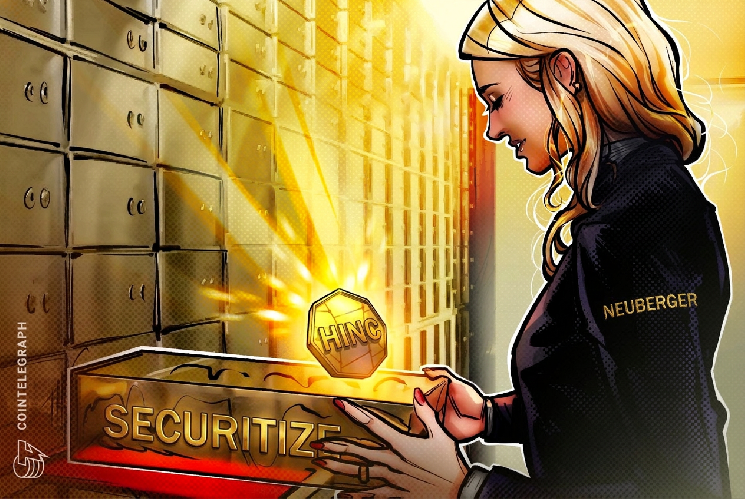
Asset manager Neuberger has launched its first tokenized fixed-income fund through Securitize, offering an actively managed high-yield strategy across four blockchains, Ethereum (ETH), Solana (SOL), Avalanche (AVAX) and Sui (SUI).
The Neuberger Securitize High Income Tokenized Fund (HINC) will invest primarily in high-yield bonds, with additional exposure to collateralized loan obligations and leveraged loans, according to an announcement Tuesday.
The launch comes as investors are demanding higher yields amid heated competition for corporate and government funding.
“The previous market regime rewarded investors for assuming that capital would remain cheap and plentiful,” Saxo chief investment strategist Charu Chanana said in a Tuesday client note. “The emerging regime may reward investors for recognising that capital has a price again.”
The new fund is available to qualified investors, with Securitize providing the infrastructure to issue and manage tokenized shares across the four blockchain networks.
Neuberger will serve as subadvisor to a tokenized fund for the first time. Its fixed-income platform manages more than $230 billion in assets, while the firm manages about $613 billion overall.
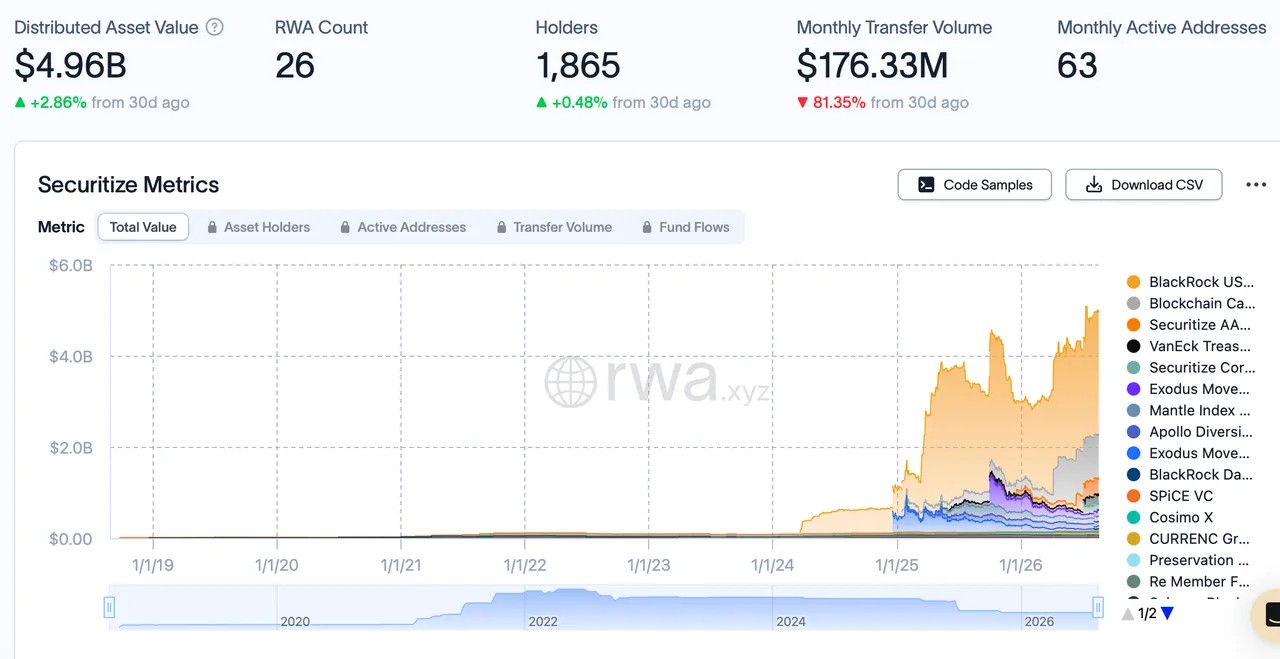
Securitize has about $4.96 billion in distributed asset value across 26 tokenized real-world assets, according to RWA.xyz data. Its products include BlackRock’s $2.7 billion BUIDL fund, a $355 million tokenized AAA CLO fund and a $95 million Apollo diversified credit fund.
The company’s shares rose around 5% in Tuesday morning trading, giving the company a market capitalization of about $838 million. Despite the gain, the stock remains down more than 50% from levels reached shortly after its public debut in July.
An effort by Alex Mashinsky, the former CEO of now-defunct cryptocurrency lending platform Celsius, to convince a federal court to vacate his 12-year sentence for fraud and market manipulation faces pushback from US prosecutors in the Southern District of New York (SDNY).
In a Friday filing, SDNY Attorney James McDonald and Assistant US Attorney Allison Nichols said that the court should deny Mashinsky’s petition to vacate his conviction and sentence, saying that many of his legal arguments were “without merit” and pushing back against claims of ineffective assistance of counsel.
The former Celsius CEO informed the court in May that he would be proceeding pro se — that is, representing himself in the case — and filed a motion to vacate, including claims about cryptocurrency exchange FTX and his former colleague, the company’s chief revenue officer Roni Cohen-Pavon.
“Mashinsky has not even submitted a sworn declaration in support of these baseless allegations, and his petition should be denied without a hearing or further fact-finding,” said prosecutors, adding:
“[…] He presents a litany of complaints, blaming others for problems at Celsius and rehashing the evidence presented at his sentencing hearing. Though Mashinsky stops short of claiming that he is factually innocent, he blames his lawyers for failing to press certain arguments on his behalf.”
As of Tuesday, the judge overseeing the case had not responded to the federal prosecutors’ filing. Mashinsky was sentenced in May 2025 to 144 months in prison, having pleaded guilty to commodities fraud and securities fraud related to “manipulative and deceptive devices” at Celsius. Cohen-Pavon, who according to the government provided “substantial assistance” to the prosecutors case again Mashinsky, was sentenced to time served in May.
Celsius was one of a slew of crypto companies to file for bankruptcy in 2022 amid a market downturn starting with the collapse of Terraform Labs. Authorities indicted Mashinsky and Cohen-Pavon in 2023 and both subsequently pleaded guilty. The former CEO was ordered to pay $48 million in forfeiture at sentencing and agreed to pay $10 million as part of a separate settlement with the US Federal Trade Commission.
Mashinsky banned from commodities markets trading
The US Commodity Futures Trading Commission (CFTC) announced in June that the former Celsius CEO was permanently banned from trading in markets within the commodities regulator’s purview.
The CFTC case was one of the last against Mashinsky and Celsius to be resolved following the company’s collapse in 2022. However, the US Securities and Exchange Commission (SEC) civil action against the co-founder, first filed in 2023, was still ongoing despite the court reaching a judgment against the platform months after the initial complaint.
As of July 30, the SEC reported that its attorneys and Mashinsky were “engaged in settlement discussions.“ The regulator asked the court for 60 days to file a status report on the matter, pushing any potential resolution to the end of September.
David Schwartz, former CTO of Ripple and a prominent figure in the $XRP Ledger, made a noteworthy statement regarding his personal $XRP holdings.
According to David Schwartz, in a post on the X platform, he stated that he once held approximately 26 million $XRP, but this amount has decreased to approximately 2 million $XRP over time.
A Decrease of 24 Million $XRP!
Schwartz’s statement came in response to a user’s question about the size of his personal $XRP holdings. The former Ripple executive stated that his $XRP holdings reached approximately 26 million tokens at their peak, and today he holds around 2 million $XRP.
These figures mean Schwartz has reduced his $XRP position by approximately 92 percent.
Schwartz has previously stated that he has gradually reduced his $XRP holdings and that risk management has played a significant role in these decisions.
In previous statements made in 2026, he said that he preferred to reduce his position as the $XRP price rose, stating that holding large amounts of cryptocurrency posed a significant risk for him and that he disliked taking risks.
However, there is no detailed information on when and at what price Schwartz reduced his $XRP holdings from 26 million $XRP to the current 2 million $XRP. Therefore, the statement reveals the total change in his personal $XRP holdings over time, not a specific sales transaction.
“A trader seeking a 5x or 10x payoff can now choose among bitcoin, Nvidia, gold, an equity perpetual, a 0DTE option, or a sports event contract rather than concentrating risk-taking in crypto,” NYDIG’s Cipolaro wrote.
The scale of growth in prediction markets has attracted another slice of speculative activity that once flowed into crypto trading.
The 2026 World Cup was the moment the numbers became impossible to ignore, with Kalshi processing $31 billion in notional volume in June alone, a jump of more than 70% from the prior month, while Polymarket’s international exchange set a new monthly record of $10.8 billion.
Wall Street noticed too, with DRW building a dedicated prediction market desk and applying cross-platform arbitrage techniques borrowed from derivatives trading. However, van Rossum warned that these markets are “so different from trading crypto tokens that not all exchanges and professional traders can easily adapt.”
‘Hibernation’
The response for much of the industry has settled into something resembling strategic patience. The flamboyant spending of the last bull cycle, including stadium naming rights, F1 teams and aggressive expansion into new markets, has given way to cost discipline and reduced headcount.
BitMEX, once the world’s largest crypto derivatives exchange, shut its doors last month as closures mount across the board. Meanwhile, firms that are still operating are doing so with smaller teams and narrower ambitions.
Bitcoin’s price surpassing the $65,000 level triggered liquidations in highly leveraged short positions. According to on-chain data, a large whale holding approximately $117 million worth of Bitcoin short positions had $23.36 million of those positions forced to close during the surge.
It was reported that the whale in question continues to hold a short position of approximately 1,440 $BTC, currently valued at $93.21 million, following the liquidation. The current liquidation price of the open position is stated to be approximately $65,042. It is assessed that if the Bitcoin price remains above this level or continues its upward trend, the liquidation pressure on the position may increase.
On the other hand, the on-chain analytics platform Glassnode shared noteworthy data regarding long-term investor behavior in the Bitcoin market. According to Glassnode, the “strong hands” in the market, i.e., investors who tend to hold onto their assets long-term despite price fluctuations, continue to accumulate Bitcoin.
The platform stated that market bottoms typically form when profit-taking slows and investors with high confidence begin buying. It noted that the current market structure, in some aspects, resembles the bottom formation process seen in 2022.
According to Glassnode data, the largest increase in the amount of Bitcoin held by high-trust investors occurred when the $BTC price fell to around $60,000 in January.
LendProtocol, a centralized lending service, has launched a fixed-rate lending platform for $XRP and $RLUSD holders on the $XRP Ledger. The service offers a 12% annual rate. Borrowers must provide collateral worth 120% of the loan amount.
LendProtocol operates as a centralized lending service rather than a native $XRP staking platform. The $XRP Ledger does not use Proof-of-Stake and does not distribute staking rewards. Users who want to earn returns on $XRP therefore need to use third-party lending, exchanges, or other yield products.
According to LendProtocol, the platform has facilitated more than 743 million $XRP in loans and currently serves over 13,713 active lenders. The company says borrowers pay 12.7% APR, while depositors receive 12%, with the difference covering the platform’s operating spread.
Users can deposit $XRP or $RLUSD, while collateral can include Bitcoin, Ethereum, Solana, $XRP, $RLUSD, and USDT. LendProtocol says it takes direct lending exposure if a borrower defaults. The platform also uses cold storage, data encryption, and two-factor authentication.