Tag: CRYPTOS FoxBusiness

  • Hyperliquid Burns $4.2M in HYPE Tokens as Trading Fees Surge

    Hyperliquid Burns $4.2M in HYPE Tokens as Trading Fees Surge

    Hyperliquid, a leading decentralized perpetuals exchange, has burned approximately $4.24 million worth of its native $HYPE token over the past 24 hours. The burn was fueled by roughly $4.4 million in trading fees generated on the platform during the same period, according to data from blockchain analytics firm Onchain Lens.

    How the Hyperliquid Burn Mechanism Works

    Hyperliquid uses a deflationary token model where a portion of the platform’s trading fees is used to repurchase and permanently remove $HYPE tokens from circulation. This process reduces the total supply over time, potentially increasing scarcity for remaining holders. The latest burn represents a significant daily amount, reflecting strong trading activity on the exchange.

    The burn mechanism is part of Hyperliquid’s broader tokenomics, which aims to align the interests of token holders with the platform’s long-term success. By consistently removing tokens from the market, the protocol can counterbalance inflationary pressures and reward long-term participants.

    Market Context and Implications

    The $4.2 million burn comes amid a period of heightened activity in the decentralized finance (DeFi) sector. Hyperliquid has positioned itself as a major player in perpetual futures trading, offering low fees and high-speed execution. The platform’s daily trading volume has consistently ranked among the top in the industry, driving substantial fee generation.

    This burn event also highlights the growing trend of token buybacks and burns among crypto exchanges. Similar mechanisms have been adopted by platforms like Binance and FTX (prior to its collapse), though Hyperliquid’s approach is notable for its on-chain transparency and automated execution.

    Why This Matters to Traders and Investors

    For $HYPE holders, the burn represents a direct reduction in supply, which can support price appreciation if demand remains steady. It also signals that the platform is generating real revenue from user activity, a positive indicator for sustainability. However, investors should be aware that burns do not guarantee price increases, as market conditions and broader sentiment play a significant role.

    From a broader perspective, Hyperliquid’s burn activity reflects the health of the DeFi ecosystem and the growing adoption of decentralized trading platforms. As more users seek alternatives to centralized exchanges, protocols with strong tokenomics and transparent operations are likely to gain traction.

    Conclusion

    Hyperliquid’s $4.2 million $HYPE burn in a single day underscores the platform’s robust trading volume and its commitment to a deflationary token model. While the burn is a notable event, its long-term impact on $HYPE’s price and the platform’s competitiveness will depend on sustained user engagement and market conditions. As always, investors should conduct their own research and consider the risks associated with cryptocurrency investments.

    FAQs

    Q1: What is a token burn?
    A token burn is the process of permanently removing tokens from circulation, reducing the total supply. This is often done to increase scarcity and potentially support the token’s value.

    Q2: How does Hyperliquid generate trading fees?
    Hyperliquid charges fees on each trade executed on its platform, similar to traditional exchanges. These fees are then used to buy back and burn $HYPE tokens.

    Q3: Does a token burn guarantee a price increase?
    No, a token burn alone does not guarantee a price increase. While reducing supply can create upward pressure, other factors such as market demand, competition, and overall sentiment also influence price.

    Related Reading

    • FalconX Moves $14M in $HYPE to Gate, Fueling Speculation of Sell Pressure
    • Multicoin Capital-Linked Wallet Moves $4.4M in $HYPE to Coinbase Prime
    • Solana Stablecoin Active Addresses Hit Record 1.7 Million
    • $HYPE Drops 3.10% in Five Minutes, Trading at $69.51
    • Trump Says CFTC Working to Bring Hyperliquid’s Perpetual Futures to U.S. Market
  • Bitcoin Price Prediction Breaks Out As Treasury Doubles Bond Buyback Program

    Bitcoin Price Prediction Breaks Out As Treasury Doubles Bond Buyback Program

    The $BTC price prediction turns constructive after price broke decisively out of a months-long consolidation pattern, touching levels not seen since early June. The move triggered the largest wave of forced short covering in crypto’s history, even bigger than the shorts wiped out during last October’s record crash.

    Bitcoin Price Analysis: Will Bitcoin Price Go Up After Breaking the Bear Market Resistance Band?

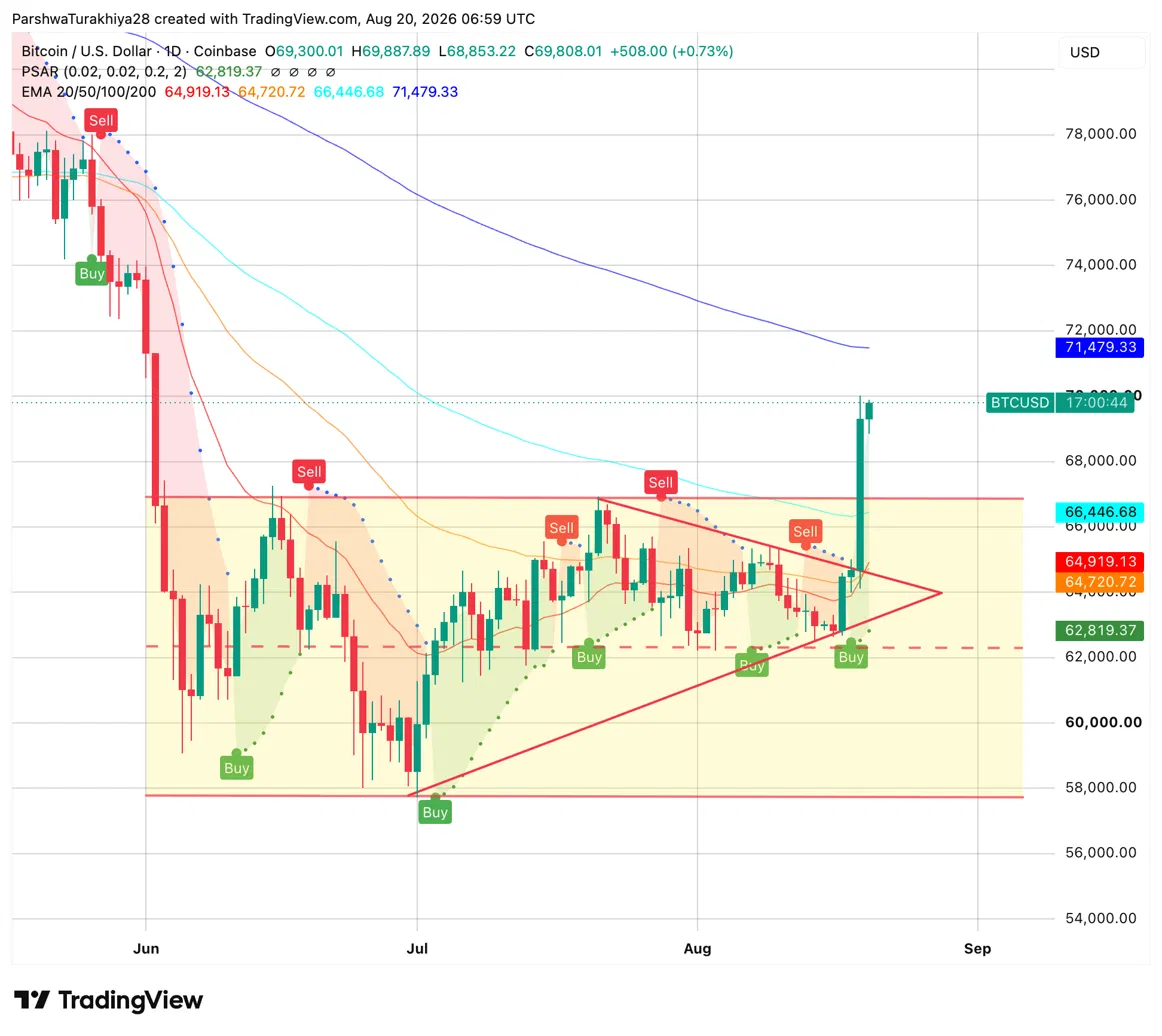
    Bitcoin Price Analysis (Source: TradingView)

    $BTC has spent since late May consolidating inside a symmetric triangle, bouncing between roughly $58,000 and $67,000 as the range steadily narrowed. Price broke sharply above that triangle’s upper boundary this week, surging from Wednesday’s low near $64,100 to touch nearly $69,900, a move of more than $5,700 in a single session.

    The Parabolic SAR flipped bullish at $62,819.37, confirming the shift in short term trend. All four EMAs now sit below current price for the first time in months, with the 20-day at $64,919.13 marking the nearest support, followed by the 50-day at $64,720.72 and the 100-day at $66,446.68. The 200-day EMA at $71,479.33 sits just overhead and is the next real hurdle.

    Why Cowen Says Bitcoin Faces a Real Test Here?

    Analyst Benjamin Cowen framed the move as Bitcoin rallying back into what he calls the bear market resistance band, a zone that has capped every recovery attempt this cycle.

    Cowen noted Bitcoin has closed above its 200-day moving average, historically a mixed signal, sometimes preceding a real trend change and sometimes a false start followed by another leg down, as seen in parts of 2014, 2019, and 2022.

    Related: Chainlink Price Prediction Points To $14.50 As Cup And Handle Breakout Confirms

    He said the real test is whether Bitcoin can push through this band and hold it as support on a retest, rather than simply topping out here again.

    $BTC Support and Resistance Levels, August 20, 2026

    Bitcoin News: Shorts Lose $2.74 Billion in Largest Squeeze on Record

    Traders betting against Bitcoin lost nearly $2.74 billion in 24 hours as price surged toward $70,000, the largest wave of forced short closures in records going back to 2021, according to CoinGlass data. Total liquidations across all crypto reached almost $3 billion across more than 172,000 traders, with shorts accounting for roughly 92% of that total against just $257 million on the long side, a ratio of more than ten to one.

    The comparison that gives the figure its weight is October 2025, when Bitcoin crashed days after hitting a record above $126,000, producing $19 billion in liquidations in a single day, still the largest deleveraging event in crypto history. Shorts made up $2.47 billion of that crash. Wednesday’s short liquidations were larger than that entire figure, without any comparable damage on the long side.

    The squeeze was fast and concentrated. More than $1 billion in Bitcoin shorts closed in roughly an hour, totaling $1.42 billion for the full day. Ether shorts accounted for $1.13 billion and Solana $104.67 million. The single largest position wiped out was a $48.8 million Bitcoin trade on Hyperliquid.

    Bitcoin News: Treasury Doubles Bond Buybacks, Trump Pushes Clarity Act

    Bitcoin is surging hard on the news that the U.S. Treasury is going to buy back $4B of debt to “increase liquidity support by at least double”

    Welcome back, money printing 🫡 https://t.co/3qGeR5vGEU pic.twitter.com/2ETPGLppCH

    — Joe Consorti (@JoeConsorti) August 19, 2026

    Analyst Joe Consorti pointed to a Treasury announcement as the direct trigger for Bitcoin’s move, noting the Treasury will buy back $4 billion of long-term government debt to boost liquidity, double its prior $2 billion pace for bonds maturing in 10 to 30 years. Traders read the move as inflationary and bullish for hard assets like Bitcoin, sending bond yields lower and the dollar index down 0.8%.

    JUST IN: 🇺🇸 President Trump says “We need Congress to take the next step by passing The Clarity Act.”

    “And this landmark structure legislation is very, very powerful structure which will keep us ahead of China, keep us ahead of everyone else.” pic.twitter.com/0BwWWQcySP

    — Bitcoin Magazine (@BitcoinMagazine) August 19, 2026

    Separately, President Trump called on Congress to pass the Clarity Act, describing the crypto market structure legislation as powerful and necessary to keep the U.S. ahead of China and other countries in space.

    Bitcoin Derivatives: Watch Whether $69,000 Holds

    With the bulk of short positioning now cleared out, the key question is whether Bitcoin can hold above $69,000 through the coming sessions.

    A squeeze this large removes the very positioning that fueled the rally, and moves built heavily on forced buying rather than fresh organic demand have historically given back some of their gains once the squeeze pressure fades.

    $BTC Price Prediction: Upside and Downside Targets

    Bullish Case, Target: $71,479.33 (200-day EMA)

    $BTC holds above $69,000 through the Asian and European sessions, confirming the breakout wasn’t just a short squeeze fading out. Treasury liquidity support and progress on the Clarity Act add fundamental tailwinds, while a daily close that holds the bear market resistance band as support, the scenario Cowen flagged as the key signal, would strengthen the case for continuation. Clearing this zone opens the path toward the 200-day EMA at $71,479.33.

    Bearish Case, Risk Level: $64,720.72 (50-day EMA)

    Bitcoin gets rejected at the bear market resistance band once again, consistent with the pattern Cowen highlighted from 2018 and 2022, where similar sized rallies into August ultimately failed and gave way to lower prices later in the year. With short covering fuel now spent, the rally loses momentum without fresh buying to replace it, and $BTC falls back through the 20-day EMA at $64,919.13 toward the 50-day EMA at $64,720.72.

    Conclusion

    This rally has two distinct engines, a Treasury liquidity move that gave bulls a real fundamental reason to buy, and a short squeeze that then amplified the move mechanically once price

    FAQs

    What is the Bitcoin price prediction right now?

    $BTC trades at $69,808.01 after breaking above a descending triangle. The bullish target is $71,479.33 at the 200-day EMA, while the bearish risk level is $64,720.72 at the 50-day EMA if the rally fails to hold.

    Why did short sellers lose $2.74 billion in a single day?

    Bitcoin’s breakout above $69,000 triggered a cascade of forced liquidations as traders betting on lower prices got caught offside, with more than $1 billion in Bitcoin shorts alone closing within roughly an hour.

    How does this squeeze compare to October 2025’s crash?

    It’s larger on the short side specifically. October 2025’s crash produced $19 billion in total liquidations with $2.47 billion coming from shorts, while this squeeze wiped out $2.74 billion in shorts alone despite far smaller total liquidations overall.

    Why does the Treasury’s bond buyback matter for Bitcoin’s price?

    The Treasury doubled its long-term debt buyback program to $4 billion per operation, a move traders interpreted as inflationary, which typically supports hard assets like Bitcoin while pushing bond yields and the dollar lower.

    Is Bitcoin a good buy right now?

    Bitcoin just cleared major resistance on real volume, but the rally was fueled heavily by forced short covering rather than confirmed organic demand, and moves built that way have historically given back some gains once the squeeze pressure fades. This is not financial advice, so weigh the bullish and bearish cases above against your own research and risk tolerance.

  • BitGo secures South Korea virtual asset license, says it’s the first global crypto company to do so

    BitGo secures South Korea virtual asset license, says it’s the first global crypto company to do so

    BitGo Holdings BTGO$6.5800·At close, a crypto custody company, said it became the first global cryptocurrency firm to secure a virtual asset services provider license in South Korea, giving it access to institutions in one of the world’s most active crypto populations.

    The company, which went public on the New York Stock Exchange (NYSE) earlier this year at a $2 billion valuation, established a local entity, BitGo Korea, to add to existing regulated units in the U.S., Singapore, Germany, and Dubai. The Korea Financial Intelligence Unit (KoFIU) approval covers virtual asset custody and transfer services for institutional and enterprise clients, BitGo said Wednesday.

    South Korea’s retail crypto traders are considered to be particularly active, with daily volumes on local exchanges regularly outpacing those of stocks during peak periods. Now, the institutional crypto market is drawing increasing attention as retail trading is hit by a weak global crypto market that saw volumes drop and the two largest exchanges, Upbit and Bithumb, report slumping first-half retail trading profit.

    “Korean institutions are looking for infrastructure that combines institutional-grade security with local support and regulatory alignment,” said Abel Seow, managing director at BitGo.

  • US-based economics magazine Forbes announced that Bitcoin could become a neutral reserve asset for the global economy!

    US-based economics magazine Forbes announced that Bitcoin could become a neutral reserve asset for the global economy!

    The US-based business and economics magazine Forbes has suggested that Bitcoin could play a significant role as a neutral reserve asset in the global financial system in the future. According to the magazine, Bitcoin has the potential to offer an alternative to the growing debate surrounding the US dollar’s reserve currency status and the current system’s reliance on US government bonds.

    Forbes’ assessment stated that the dollar’s status as the global reserve currency provides significant advantages to the United States. While this status makes it easier for the US to secure financing, it also highlighted a structural problem known as the “Triffin Dilemma.” According to this concept, it is becoming increasingly difficult for the US to simultaneously meet its own economic needs and manage the world’s demand for reserve currency.

    The magazine stated that the current system attracts global capital to the US and allows American consumers access to imported goods at lower costs, but this weakens domestic competitiveness and deepens trade deficits. It noted that since the end of the gold standard, the system has largely been sustained through US bonds, but fundamental contradictions remain unresolved.

    Forbes argued that stablecoins also cannot fully solve the reserve asset problem because these assets are largely backed by US government bonds. While gold is a neutral reserve asset, it has some limitations in terms of portability, verification, and transaction efficiency.

    In contrast, it has been suggested that Bitcoin, with its fixed supply, lack of need for government credit guarantees, and ease of verification and transfer on a global scale, could become a new generation of neutral reserve assets.

    According to Forbes, while the dollar will continue to be used in international trade, Bitcoin could eventually assume the role of a reserve asset, reducing the global economy’s dependence on a single country’s debt instruments. However, the magazine also highlighted that obstacles such as price volatility and limited institutional adoption need to be overcome.

    *This is not investment advice.

  • Elon Musk’s X is exploring stablecoins to pay influencers and content providers

    Elon Musk’s X is exploring stablecoins to pay influencers and content providers

    Social media platform X is in talks to explore how stablecoins, such as Circle Internet’s CRCL$83.78·At close USDC, can be used to pay royalties to influential users for uploading content, according to a person familiar with the plans.

    The conversations with X are ongoing, said the person, who also works with other social media platforms testing stablecoins as a way to pay commissions to influencers.

    Media representatives of X did not immediately respond to requests for comment.

    Stablecoins, which boast a collective market cap of over $300 billion, have become a staple for blockchain payments, facilitating faster, cheaper cross-border transactions for everyone from small businesses to multinationals moving large amounts of money between subsidiaries.

    It’s not so surprising the Elon Musk-owned company is looking to stablecoins to pay royalties to content providers around the world. Musk’s SpaceX already uses stablecoins to collect cross-border payments from customers of Starlink, which provides satellite internet services in various emerging markets.

    In March, Musk hired crypto veteran Benji Taylor as the head of design at X, tying his role to both xAI and SpaceX. Taylor, who led design at Coinbase Global’s COIN$171.85·At close Base blockchain network, has a background in wallets and decentralized finance.

  • Bitcoin Exchange Binance Announces It Will Deliste Three Altcoin Trading Pairs from Its Platform! Here Are the Details

    Bitcoin Exchange Binance Announces It Will Deliste Three Altcoin Trading Pairs from Its Platform! Here Are the Details

    Cryptocurrency exchange Binance has decided to delist the ICON (ICX), Secret (SCRT), and Storj (STORJ) tokens from the spot market following recent asset reviews. According to the exchange’s statement, trading in all spot pairs for these assets will cease on September 3, 2026, at 06:00.

    Binance stated that it regularly reviews the digital assets listed on its platform and may delist projects that do not meet certain standards. The exchange said that the main purpose of these reviews is to protect user security and adapt to changing market conditions.

    The evaluation process considers the commitment of the project teams, the level and quality of development activities, transaction volume, and liquidity status. Additionally, the security and stability of the networks against attacks, the projects’ communication with the public, community participation, and level of transparency are also among the review criteria.

    Binance also evaluates projects’ response to regular due diligence requests, evidence of unethical or fraudulent activity, new regulatory requirements, and unjustified increases in token supply. Changes in the token economy, changes in project ownership or core team, and community opinions also influence the decision-making process.

    Accordingly, trading on all spot trading pairs for ICON, Secret, and Storj will end on the specified date. Following the delisting decision, investors will no longer be able to trade these assets, and Binance has urged users to consider the termination date mentioned in the announcement when planning their transactions.

    Regular asset reviews by exchanges stand out as an important practice in the cryptocurrency market, as they assess the compliance of listed projects with technical, financial, and regulatory standards.

    *This is not investment advice.

  • Crypto Fear and Greed Index Rises Along with Movements in the Crypto Market! Here Are the Details

    Crypto Fear and Greed Index Rises Along with Movements in the Crypto Market! Here Are the Details

    The Crypto Fear and Greed Index, which tracks investor sentiment in cryptocurrency markets, indicated a significant recovery in market sentiment.

    The index calculated by CoinMarketCap rose to 55 today, registering a 14-point increase compared to the previous day. While the indicator remains in neutral territory, it suggests investors are exhibiting a more positive outlook on the market.

    The index is used to measure the level of fear and optimism among investors in the cryptocurrency market. A reading closer to zero indicates extreme fear, while a reading closer to 100 indicates extreme optimism. A reading of 55 suggests the market hasn’t yet entered a period of strong optimism, but investor sentiment has significantly strengthened compared to the previous day.

    According to CoinMarketCap data, the index is calculated using multiple market indicators. These primarily include the price movements of the top 10 cryptocurrencies by market capitalization. Market volatility, indicators from derivative markets, and especially the put/call ratio are also taken into account in the calculation.

    In addition, stablecoin supply rates and CoinMarketCap’s own search data also play a role in creating the index. This allows investors to measure overall market sentiment by evaluating both market behavior and price movements.

    The 14-point daily rise in the index stands out as a significant signal indicating a recent increase in risk appetite in the crypto market. However, the indicator remaining in neutral territory suggests that investors have not yet fully transitioned to expecting a strong bull run. Market participants will continue to closely monitor changes in the indicators that make up the index, particularly price movements and volatility, in the coming period.

    *This is not investment advice.

  • NHN KCP Partners with LINE NEXT to Expand Stablecoin Payment Services

    NHN KCP Partners with LINE NEXT to Expand Stablecoin Payment Services

    South Korean payment gateway operator NHN KCP has signed a memorandum of understanding (MOU) with LINE NEXT Inc., the Web3 subsidiary of the messaging giant LINE, to broaden the use of stablecoin-based payments, according to a report from Newsis. The partnership aims to integrate NHN KCP’s domestic merchant network with Unifi, LINE NEXT’s global digital asset wallet, and to lay the groundwork for a won-pegged stablecoin that NHN KCP helps distribute.

    Expanding Real-World Use Cases for Stablecoins

    The agreement signals a step toward mainstreaming stablecoin payments in South Korea, where regulatory clarity around digital assets is still evolving. By connecting NHN KCP’s payment infrastructure—used by thousands of online and offline merchants—with Unifi’s wallet ecosystem, the two companies intend to create a practical bridge between traditional fiat payments and blockchain-based transactions.

    NHN KCP, a major payment service provider in South Korea, processes a significant share of the country’s e-commerce transactions. Its participation in the distribution of a won-pegged stablecoin suggests a growing interest among established financial technology firms in leveraging stablecoins for everyday payments, not just speculative trading.

    Strategic Alignment with LINE NEXT’s Web3 Ambitions

    LINE NEXT has been building a suite of Web3 services, including the Unifi wallet, which supports multiple blockchains and aims to simplify digital asset management for a global user base. The partnership with NHN KCP aligns with LINE NEXT’s strategy to increase the utility of its wallet by enabling real-world purchases, rather than limiting it to token transfers or $NFT transactions.

    The collaboration also reflects a broader trend in Asia, where companies are exploring stablecoins as a faster, cheaper alternative to traditional cross-border payment systems. South Korea’s regulatory environment, however, remains cautious, and any stablecoin issuance would likely require close coordination with financial authorities.

    Implications for Merchants and Consumers

    For merchants using NHN KCP’s payment gateway, the integration could eventually offer a new payment option that reduces transaction fees and settlement times. Consumers, on the other hand, might benefit from a stable digital currency that maintains a 1:1 value with the Korean won, minimizing the volatility typically associated with cryptocurrencies.

    However, the MOU is an initial step, and technical integration, regulatory approvals, and user adoption will determine the timeline for any commercial rollout. Both companies have not announced specific launch dates or which merchants will be involved in early pilots.

    Context and Outlook

    This partnership comes amid a global push by payment firms to explore stablecoin rails. In the United States, companies like PayPal have launched their own stablecoins, while in Asia, firms such as Grab and others are experimenting with digital currency payments. South Korea, despite its active cryptocurrency trading market, has been slower to embrace stablecoins for daily transactions, partly due to regulatory uncertainty.

    The MOU between NHN KCP and LINE NEXT could serve as a bellwether for how traditional payment infrastructure and Web3 platforms might converge. If successful, it could encourage other payment providers in the region to pursue similar collaborations, potentially accelerating the adoption of stablecoins in mainstream commerce.

    Conclusion

    The MOU between NHN KCP and LINE NEXT marks a meaningful step toward expanding stablecoin payments in South Korea, with potential benefits for merchants and consumers alike. While the initiative is still in its early stages, it underscores the growing interest among established financial firms in blockchain-based payment solutions. The coming months will be crucial in determining whether this partnership translates into tangible services that meet regulatory standards and user expectations.

    FAQs

    Q1: What is NHN KCP?
    NHN KCP is a South Korean payment gateway provider that processes online and offline transactions for a wide range of merchants, offering services such as credit card processing, virtual accounts, and mobile payments.

    Q2: What is LINE NEXT and its Unifi wallet?
    LINE NEXT is a global Web3 company under LINE Corporation, focused on building blockchain-based services. Unifi is its digital asset wallet that supports multiple blockchains, enabling users to store, send, and receive cryptocurrencies and NFTs.

    Q3: What is a won-pegged stablecoin?
    A won-pegged stablecoin is a type of cryptocurrency designed to maintain a stable value of 1:1 with the South Korean won. It aims to combine the benefits of digital currencies—such as fast transactions and low fees—with the stability of a fiat currency.

    Related Reading

    • SNU Study: Crypto Tax Delays Rooted in Readiness Concerns, Not Public Sentiment
    • Crypto Fear and Greed Index Inches Up to 41 as Market Sentiment Stabilizes
    • Upbit and Bithumb crypto holdings drop sharply in H1 amid market slump
    • KakaoBank Extends Coinone Real-Name Account Partnership for One Year
    • USDG DeFi Deposits Hit $929.2M as Paxos-Issued Stablecoin Gains Traction
  • Solana Analysis Outlines Validator Trade-Offs in Proposed 200ms Slot-Time Shift

    Solana Analysis Outlines Validator Trade-Offs in Proposed 200ms Slot-Time Shift

    Solana has published an analysis of the validator and market-structure trade-offs involved in a proposal to reduce target slot time from 400 milliseconds to 200 milliseconds. The Aug. 19 analysis describes the change as a staged, feature-gated path through 350, 300, 250 and 200 milliseconds.

    The work discusses SIMD-0525 rather than announcing that 200ms slots are already active on mainnet. That distinction is central: it is an engineering and economic analysis of a proposed change.

    Potential latency and execution effects

    Solana says shorter slots could allow information to reach canonical state more frequently and shorten the time a single leader controls ordering. The analysis also says faster slots may reduce stale-price exposure, while the effect on sandwich activity is not sign-definite and depends on factors including reaction latency, contention and user slippage.

    At 200ms, the four-slot leader window would fall from 1.6 seconds to 800ms, according to the article. The piece frames those outcomes as modeled or potential effects, not as realized mainnet results.

    Validator economics and operational headroom

    The analysis says validators would vote roughly twice as often per unit of wall-clock time at 200ms, increasing voting activity while potentially making leader opportunities more frequent. It also flags limited timing margin around vote arrival and leader handoff as an area for staged monitoring.

    Solana concludes that some effects require empirical mainnet observation. Operators and delegators should therefore treat the published paper as input to an ongoing proposal discussion, not as a completed network migration.