Tag: CRYPTOS FoxBusiness

  • Aster jumps 10% on Hyperliquid optimism – Is $0.80 next?

    Aster [$ASTER] extended its rally, gaining over 10% in 24 hours to $0.65. The move followed growing regulatory optimism around decentralized perpetual futures exchanges.

    President Donald Trump said CFTC Chair Mike Selig was working to bring Hyperliquid into the U.S. He said the process would happen in a “fully compliant and legal fashion.”

    Because Aster directly competes with Hyperliquid, traders appeared to treat the news as a sector-wide catalyst. Trading Volume and Funding Rate also increased, placing $0.67 and $0.80 under focus.

    Could Hyperliquid’s U.S. entry help Aster?

    Trump’s comments strengthened optimism across the already bullish crypto market. Hyperliquid’s compliant U.S. entry could signal a more accommodating environment for decentralized derivatives.

    As a perpetual futures DEX backed by Changpeng Zhao [CZ], Aster could benefit from greater sector-wide attention and capital.

    Zhao recently argued that any preferential treatment granted to one firm should extend across the industry. This makes $ASTER’s rally unusual: Traders are pricing a rival’s regulatory progress as Aster’s opportunity.

    Does Aster’s volume confirm the rally?

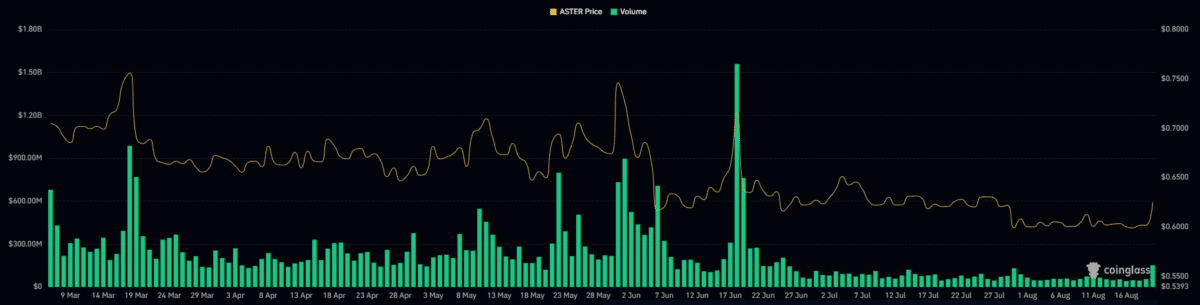
    $ASTER’s Trading Volume climbed from $55 million to $152 million over 24 hours, nearly tripling. The expansion confirmed stronger participation behind the 10% price gain.

    Sustained Trading Volume could help $ASTER challenge $0.67. However, volume must now survive beyond the regulatory headline.
    Source: CoinGlass

    Are $ASTER traders becoming too bullish?

    Derivatives positioning also leaned bullish.

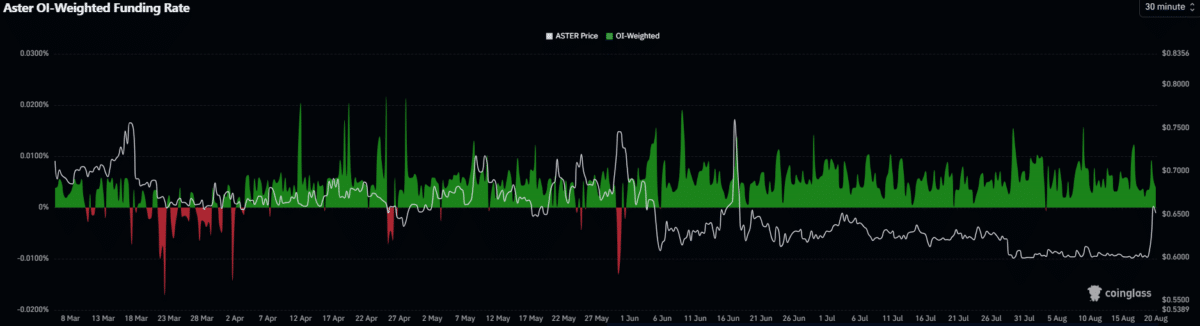
    $ASTER’s OI-Weighted Funding Rate stood at 0.0069%, meaning Longs paid Shorts to maintain their positions. The positive reading reflected a modest long bias.

    Further increases could crowd Longs and raise liquidation risk during a reversal. Funding confirmed optimism. It also showed where the rally could become vulnerable if price stalled.
    Source: CoinGlass

    Can $ASTER reach $0.80?

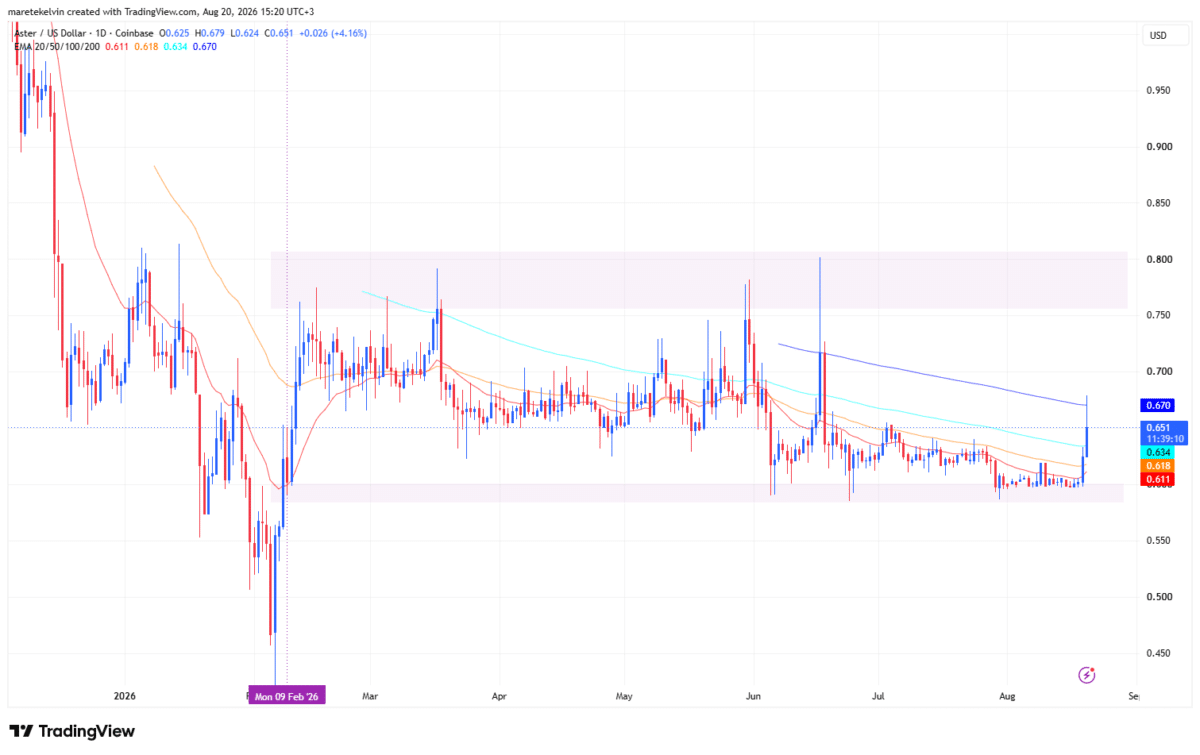
    $ASTER bounced from $0.60 support and reclaimed the 20-day, 50-day, and 100-day EMAs. The token then tested the 200-day EMA near $0.67.

    Reclaiming these averages strengthened the short-term and medium-term structures. However, the 200-day EMA remained the longer-term hurdle.
    Source: TradingView

    A decisive close above $0.67, supported by Trading Volume, could open the $0.80 range high. A rejection could return $ASTER toward the reclaimed EMAs before another breakout attempt.

    Hyperliquid opened the regulatory door. $ASTER must prove rival platforms can walk through it too.


    Final Summary

    • $ASTER gained over 10% as Hyperliquid’s potential U.S. entry lifted decentralized derivatives optimism.
    • Aster’s Trading Volume nearly tripled from $55 million to $152 million.
  • HSBC and Standard Chartered Execute First Live Tokenised Deposit Transaction on Swift’s Ledger

    HSBC and Standard Chartered Execute First Live Tokenised Deposit Transaction on Swift’s Ledger

    HSBC and Standard Chartered have completed the first live cross-border interbank transaction using tokenised deposits on Swift’s blockchain-based ledger, the banks announced in a joint Aug. 19 statement. The transaction marked the first interbank transfer executed on Swift’s ledger since it became ready for live use.

    “HSBC’s interoperability transaction with Standard Chartered via Swift is a landmark moment for the promise of tokenised deposits,” said Lewis Sun, HSBC’s head of digital currencies. He said the demonstration shows how bank-issued digital money can be interoperable across institutions while maintaining regulatory oversight.

    How the transaction worked

    The transfer was conducted through an exchange of payment messages between the two banks using Swift’s ledger. The resulting obligations were recorded as tokenised deposit obligations on both HSBC’s Tokenised Deposit Service and Standard Chartered’s tokenised-deposit infrastructure, the announcement said.

    For clients, the banks said the work highlights the potential for cross-border payments to support an increasingly 24/7 global economy, in contrast with settlement that pauses outside traditional banking hours.

    Building on Swift’s July readiness

    The transaction follows Swift’s announcement on July 9 that its blockchain-based ledger was ready for initial live use for tokenised deposits. The ledger is being piloted with 17 banks across six continents, including MUFG, Wells Fargo and Lloyds, and supports multiple currencies including CNH, HKD, SGD, EUR, GBP, USD and AED.

    The project is part of a broader industry effort to use distributed ledger technology for real-world payment use cases while preserving the role of regulated bank money, rather than replacing banks with unregulated alternatives.

    What it means for cross-border payments

    A successful live transaction between two global banks is a step beyond proof-of-concept and toward production interbank settlement on shared infrastructure. Unlike stablecoins issued by non-bank firms, tokenised deposits are liabilities of regulated banks, which proponents argue keeps them anchored to existing supervision even as settlement becomes near-real-time. The demonstration is notable because it ran between two regulated banks on shared ledger infrastructure rather than in a closed pilot.

    If the pilots expand, the approach could reduce the friction of correspondent banking by enabling near-real-time settlement of tokenised deposits between institutions that already operate under existing oversight.

  • A $2 million bet on XRP volatility crosses the tape as prices surge

    A $2 million bet on XRP volatility crosses the tape as prices surge

    A large options bet that would pay off from a surge in $XRP ($XRP) volatility crossed the tape Thursday, just as the cryptocurrency staged one of its sharpest single-day rallies of the summer.

    The trade was a “long straddle,” involving the simultaneous purchase of call and put contracts at the $1.16 strike level, according to derivatives analytics firm Laevitas. The trader purchased 2 million contracts in total, worth $2.32 million, while paying roughly $62,000 in premium. The position expires on August 28.

    “2M $XRP long straddle opened at the 1.16 strike for 28AUG26, $62k premium,” Laevitas reported. Charts showed a clear spike in open interest and buy volume at that strike on crypto exchange Deribit.

    A long straddle is a classic volatility play. The buyer profits if the price moves far enough from the strike to cover the premium, regardless of direction. With only eight days left until expiration, this is a short-term bet that $XRP will not stay near $1.16.

    The timing looked solid. $XRP jumped nearly 15% to $1.34 Thursday before settling around $1.26 as of this writing. Trading volumes also rose sharply.

  • Bitcoin pushes past $75,000 as rally continues.

    Bitcoin pushes past $75,000 as rally continues.

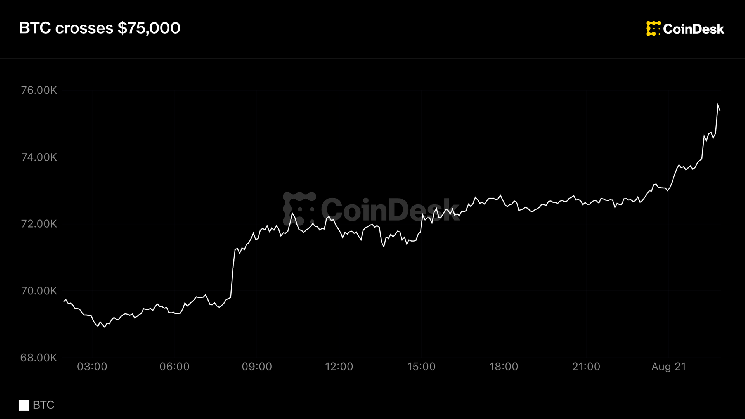
    Bitcoin BTC$75,368.24 reclaimed the $75,000 level for the first time since late May in late U.S. Thursday evening trading.

    At the current $75,400, bitcoin is higher by 8% over the past 24 hours. Ether ETH$2,365.95 at 2,376 is up 4.8%. Leading the majors is $XRP ($XRP), up 16% to $1.29.

    “Price pain capitulation in February,” wrote bitcoin analyst James Check as bitcoin crossed $75,000 minutes ago. “Time pain capitulation in June. Bears in pain, right now.”

    On a weekly basis, bitcoin is now higher by 19%, ether by 25%, and $XRP by 28%.

  • Crypto Fear and Greed Index hits 62 after $1.44B in shorts are wiped out

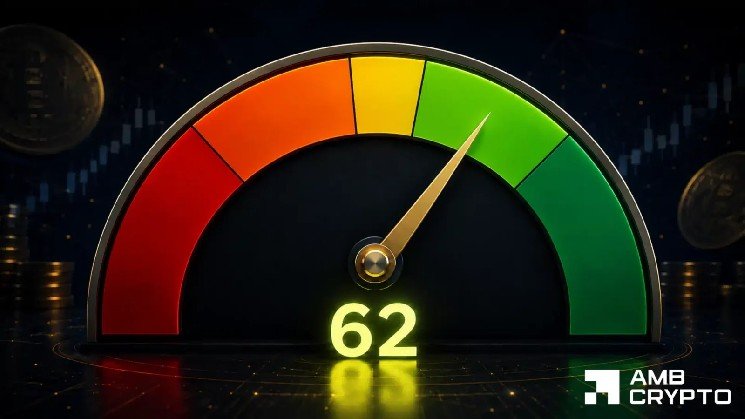
    Crypto Fear and Greed Index hits 62 after $1.44B in shorts are wiped out

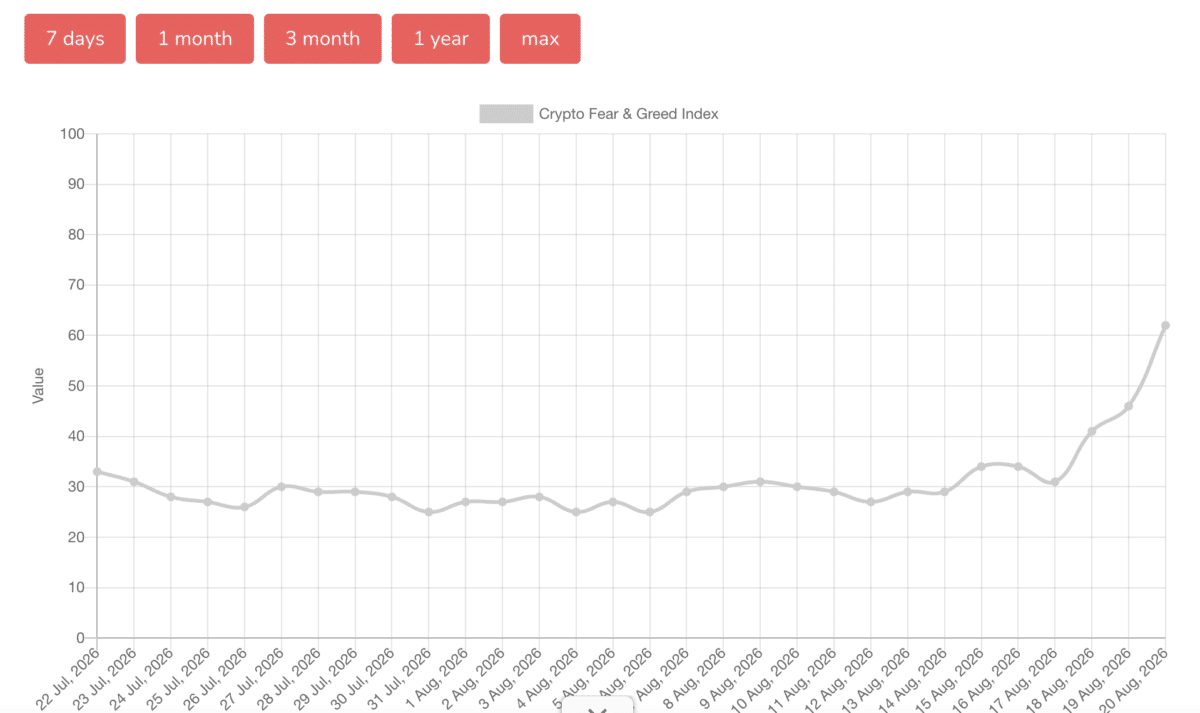
    Crypto traders have gone from fearful to greedy remarkably quickly, where just one day earlier, the index stood at 46, firmly in “Fear.”

    The Crypto Fear and Greed Index jumped to 62 on August 20, up 16 points in a single day, as Bitcoin’s surge beyond $72,000 was accompanied by the shift that came after a rally that caught traders betting on another decline off guard.

    Fear disappears as Bitcoin pushes above $72K

    The change looks even sharper over a longer period.

    Last week, the index was down at 29, but one month ago, it was at 25, putting the market in “Extreme Fear.”

    Just the same way the index has moved dramatically, recently, so has the Bitcoin price.

    Source: Alternative.me

    The $BTC price was around $72,465 at the time of writing and briefly reached $72,868. But the rally began with Bitcoin below $65,000 on August 19 before other assets followed its lead.

    Ethereum and other major altcoins saw an increase in price, just as $BTC did, and crypto-related stocks also saw positive moves.

    On the same day these assets were seeing major price moves, President Donald Trump renewed his push for Congress to pass the CLARITY Act, keeping crypto policy in focus in Washington, but neither development alone establishes why Bitcoin rallied so sharply.

    $1.44B bet on falling prices goes wrong

    Many traders had placed bets on crypto prices to keep falling, but instead, the market suddenly went the other way.

    AMBCrypto reported $1.61 billion in liquidations over 24 hours on August 19, and about $1.44 billion was from traders betting on lower prices.

    Bitcoin saw $861.06 million of those short losses, while Ethereum was responsible for another $424.21 million.

    The scale of those losses helps explain why sentiment changed so quickly, but still, a Fear and Greed reading of 62 does not mean price will continue going higher.


    Final Summary

    • The Crypto Fear and Greed Index moved by 16 points to 62 as Bitcoin moved above $72,000.
    • Traders betting on prices of crypto falling lost about $1.44 billion during the previous day’s rally.

  • Datavault wants to buy a bank and fund it with $35 million after reporting $1.4 million cash

    Datavault wants to buy a bank and fund it with $35 million after reporting $1.4 million cash

    Datavault AI has agreed to acquire BankWyse, a Wyoming banking institution, while promising funding substantially larger than the cash it reported at the end of June.

    The mismatch leaves a central question for the proposed deal: How can Datavault finance the purchase and capitalize the bank without another layer of debt or dilution?

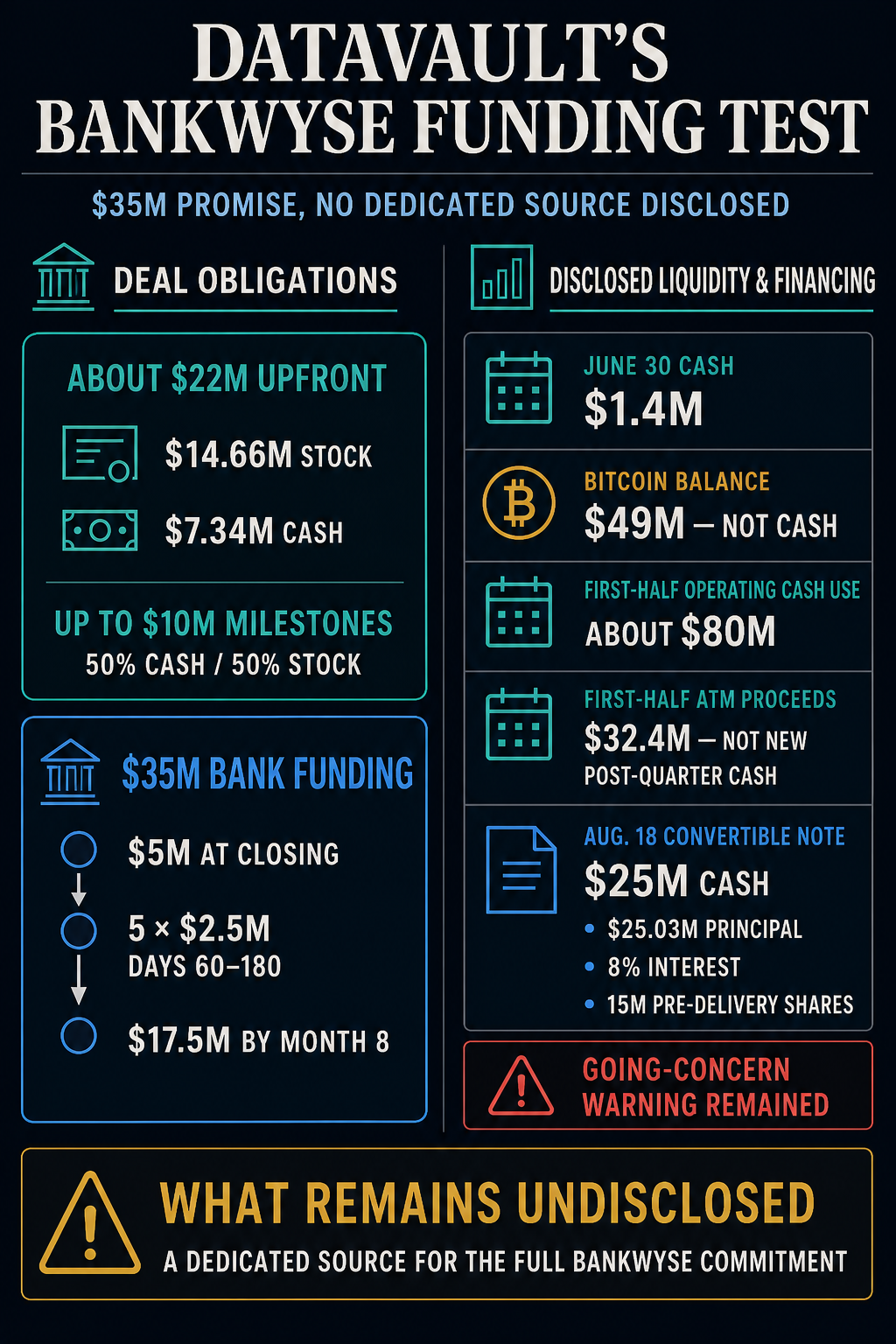
    The agreement disclosed on Aug. 19 values the initial consideration at approximately $22 million, comprising $14.66 million in Datavault stock and $7.34 million in cash. BankWyse’s sellers could receive up to another $10 million if they meet milestones, split evenly between cash and stock.

    Separate from the purchase price, Datavault committed to provide BankWyse with $35 million for capitalization and operations. The funding schedule starts with $5 million at closing, followed by five $2.5 million installments between days 60 and 180 and a final $17.5 million payment by the eighth month.

    The transaction requires approval or non-objection from the Wyoming Division of Banking, and Datavault must obtain immediately available financing sufficient to cover its closing obligations, including the $7.34 million cash payment, the initial $5 million BankWyse funding, and certain liabilities.

    Those conditions sit uneasily beside Datavault’s June 30 balance sheet. The company reported $1.4 million of cash and $49 million of Bitcoin, while using approximately $80 million of cash in operations during the first half.

    Management said existing resources were insufficient to fund the next 12 months and that substantial doubt remained about the company’s ability to continue as a going concern.

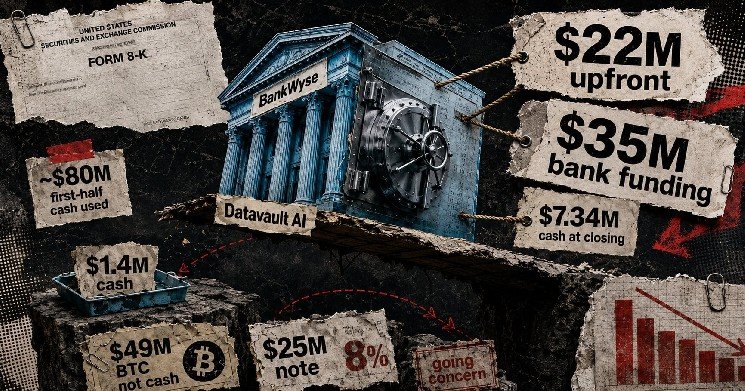
    A graphic outlines Datavault’s $35 million BankWyse funding commitment, disclosed liquidity, first-half cash use, and the remaining undisclosed source of funds.

    Datavault had proposed selling 837 Bitcoin to Scilex Holding for $50 million, but the transaction was not assured, and Scilex could pay in cash, securities, or a mixture. Only $30 million was due initially, with the remaining $20 million scheduled through 2028.

    Datavault also reported raising $32.4 million through its at-the-market stock program during the first half. The quarterly filing repeats the same cumulative figure in an “as of Aug. 15” disclosure, so it does not establish that another $32.4 million arrived after June 30.

    Counting that amount as fresh post-quarter liquidity would double-count the disclosed proceeds.

    On Aug. 18, the company sold an unsecured convertible note with $25.03 million of principal for $25 million. The note bears 8% interest and was paired with 15 million pre-delivery shares, and it can convert at a fixed $1.55 price or later through market-price mechanics, creating potential dilution.

    An investor option to purchase another $25 million of notes is not committed capital until exercised and funded.

    Datavault’s filing summary names Sept. 30 as the termination date, and the signed agreement defines an outside date 30 days after signing, automatically extends it by 30 days if Wyoming approval remains pending, and allows further written extensions.

    As of Aug. 20, Datavault’s public SEC submissions showed no later filing announcing a closing, regulatory approval, or deadline extension.

    The filings establish that financing must be in place for closing, but they do not identify a dedicated source for the full BankWyse commitment. On the disclosed terms, bridging that gap without more debt, equity dilution, or uncertain asset monetization remains the deal’s central execution risk.

  • Justin Sun scores partial court win in World Liberty Financial lawsuit

    Justin Sun scores partial court win in World Liberty Financial lawsuit

    Justin Sun said Thursday that a federal judge rejected an effort by World Liberty Financial to move all of his claims into private arbitration, marking the latest development in his legal dispute with the crypto project.

    Sun said in a post on X that his individual claims will remain in open court following a hearing in California federal court. He said the judge also rejected World Liberty’s argument that all claims connected to his companies must be arbitrated.

    The parties were instead ordered to meet and determine which company related claims should remain in court and which should proceed through arbitration, according to Sun.

    The case, Sun et al v. World Liberty Financial LLC, was filed in April in the US District Court for the Northern District of California and is assigned to Judge James Donato.

    Sun sued World Liberty after investing $45 million in the project, alleging fraud and accusing the company of using mechanisms in its smart contracts to freeze his $WLFI tokens. World Liberty has disputed Sun’s allegations and separately accused him of damaging the company through a public campaign against it.

    In his Thursday post, Sun said World Liberty had sought to move the dispute behind closed doors and argued that token holders should be able to see how the project handles its investors.

    Sun also repeated allegations from his complaint that World Liberty secretly embedded functionality allowing it to freeze, restrict or burn $WLFI tokens and later used those controls against his holdings.

    World Liberty’s risk disclosures state that it can block or freeze wallet addresses and associated tokens when it determines they are linked to illegal activity or violations of its terms. The company has previously said Sun agreed to its freezing authority under an agreement governing his tokens.

    Sun’s lawsuit seeks hundreds of millions of dollars in damages. He previously obtained an order preventing World Liberty from permanently burning, reallocating or otherwise disposing of the tokens involved in the dispute, according to his account of the litigation.

    Sun also raised concerns Thursday about World Liberty’s USD1 stablecoin and the company’s financial position, though those claims remain allegations and have not been established by the court.

    The broader dispute remains unresolved. World Liberty has denied wrongdoing and has separately sued Sun in Florida for defamation, accusing him of conducting a campaign to damage the company’s reputation and $WLFI token. Sun has denied those allegations.

  • CFTC chair says agency will move forward on crypto regulation if CLARITY fails

    CFTC chair says agency will move forward on crypto regulation if CLARITY fails

    Michael Selig, who chairs the US Commodity Futures Trading Commission (CFTC), signaled that the agency would not be idle while Congress continued to debate provisions in a cryptocurrency market structure bill.

    In prepared remarks for the inaugural meeting of the CFTC’s Innovation Advisory Committee on Thursday, Selig said that the commission would move forward on crypto regulations even in the absence of the Digital Asset Market Clarity (CLARITY) Act being passed by lawmakers, adding it would “help [Donald Trump] deliver if Congress will not.” According to the chair, he had already directed staff to allow registered and non-registered entities to offer “crypto asset trading on a leveraged or margined basis” and explore developer protections.

    “We’re going to give CLARITY its breathing room for a vote, but if the Democrats cannot support a bipartisan work product, which reflects compromises from both sides of the aisle, and ultimately send a fair version of the bill to the President’s desk, then rest assured, I will direct CFTC staff to move swiftly to propose these new rules for the industry,” said Selig.

    The market structure bill is effectively paused until the US Senate returns to session in September, when Majority Leader John Thune is expected to hold a cloture vote on the legislation. CLARITY would need 60 votes to pass the chamber and return to the House of Representatives, whereupon it could go to Trump’s desk for final approval or a veto.

    Selig’s remarks came just a day after the CFTC chair stood alongside Trump and other crypto industry leaders at a White House meeting. The president urged Congress to pass a “fair version” of CLARITY to keep the country “ahead of China.”

    Many Democrats in Congress have been calling for stronger ethics provision in the market structure bill specifically to address the Trump family’s crypto investments, which netted the president $1.4 billion in 2025. Although Trump said on Wednesday that a “lot of Democrats” approved of CLARITY, it’s unclear whether enough lawmakers will support the bill to meet the 60-vote threshold to pass the Senate.

    The CFTC chair’s agenda echoed that of the US Securities and Exchange Commission (SEC), which on Tuesday released proposed rules for digital asset regulation. The securities regulator said the rules could provide crypto companies with a safe harbor policy from tokens being treated as “investment contracts” and certain exemptions for issuers.

    CFTC still lacks a full panel of commissioners

    Selig spoke alongside Innovation Advisory Committee Chair Walt Lukken and the body’s Designated Federal Officer Michael Passalacqua on Thursday. As the only Senate-confirmed commissioner at the CFTC in a leadership panel expected to consist of a bipartisan group of five members, Selig has been solely responsible for directing the agency’s agenda since December.

    The CFTC committee also discussed issues related to artificial intelligence and prediction markets on Thursday. Under Selig, the agency has claimed that it has “exclusive jurisdiction” over prediction markets due to event contracts on the platforms being considered “swaps.” The chair has directed the commission to file lawsuits against state-level authorities challenging this position in cases involving companies like Kalshi and Polymarket.

  • Ethereum ETF inflows hit $189M – Will ETH price reach $2,500?

    Ethereum ETF inflows hit $189M – Will ETH price reach $2,500?

    Ethereum [$ETH] led the broader altcoin market after surging by more than 18% in the past hours, at press time. Ethereum surges back above the $2,000 level as bullish momentum continues to push it to higher zones.

    Leverage, new investors, supply dynamics, and a breakout from an accumulation pattern influenced this sudden uptick. Can bulls sustain this uptrend and stay above $2K?

    $ETH exchange supply falls 15%

    For leverage, a whale created a fresh wallet and loaded $20 million in USDC on the Hyperliquid exchange. The amount was deposited in three transactions of $10 million, $9.41 million, and $589K. Then, the whale opened a 4x leveraged long position of 20K $ETH, worth $45.38 million.

    The position coincided with the sudden surge, suggesting the whale could be privy to the move. Technically, Ethereum was about to breakout from a sideways range. As a result, the whale is sitting at an unrealized profit of $6.66 million.

    Ethereum Spot ETFs added to the buying pressure, as per data from SoSoValue. Participants bought $189.15 million prior to the 18% move, the largest single-day buying volume in 10 months.

    $ETH Spot ETFs by BlackRock, Fidelity, and Grayscale led the pack with $122 million, $36.54 million, and $16 million, respectively. Even from a broader perspective, investors still bought Ethereum aggressively.

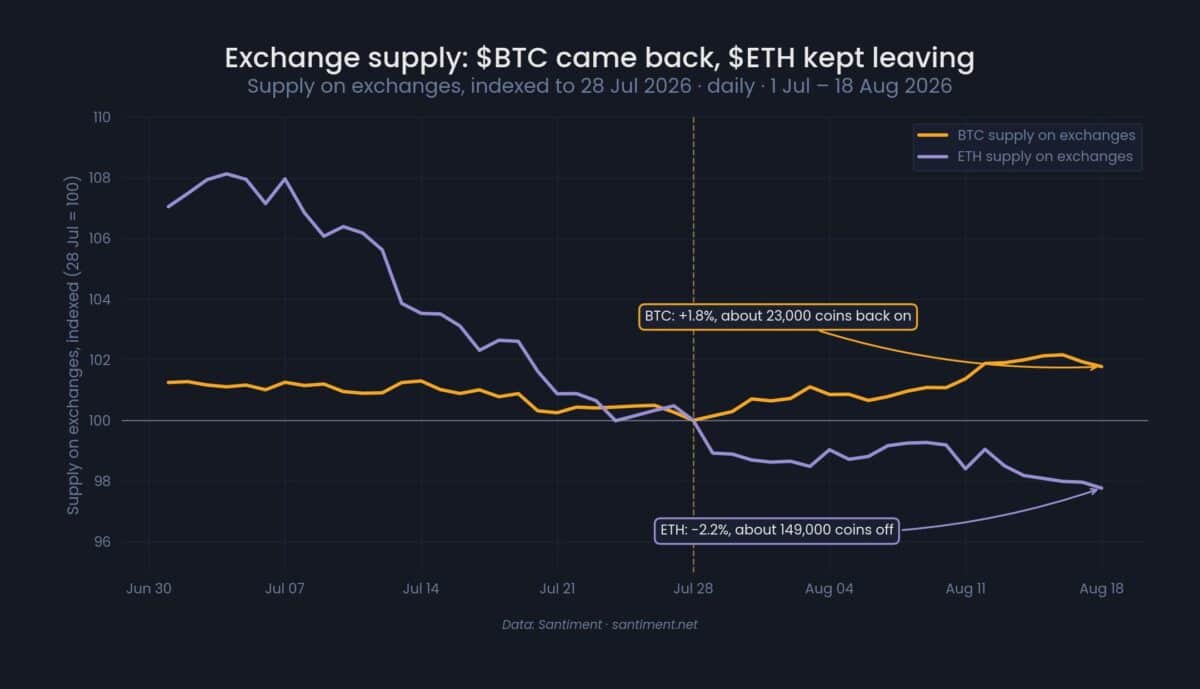
    According to Santiment data, the exchange supply of $ETH declined by 15% in eleven weeks. The supply plunged from 7.70 million on the 2nd of June to 6.54 million on the 18th of August, with roughly 1.15 million $ETH coins withdrawn.

    Source: Santiment

    Can $ETH’s price reach $2,500?

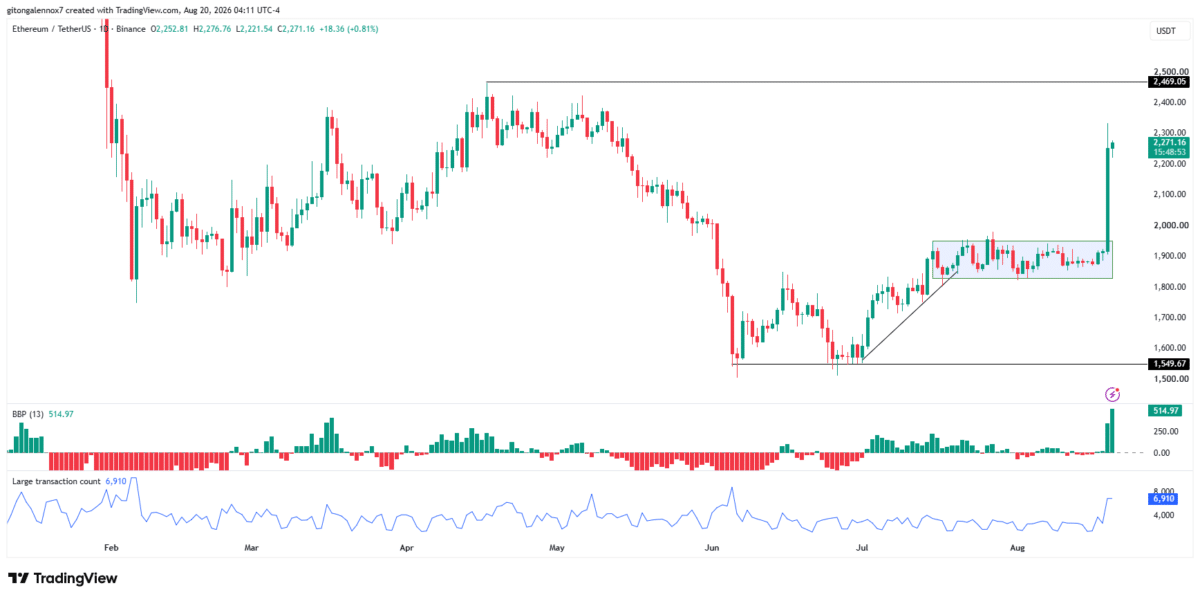
    The charts showed the altcoin first hinted at a bottom on the 6th of June, after rebounding at $1,549. The potential bullish reversal was reinforced by the double bottom whose neckline at $1,800 was broken through.

    The retest of the breakout lasted for a month before the eventual breakout. Now, Ethereum appears to be headed toward $2,500. The Bull/Bear Power (BBP) has hit its highest level this year, at about 528 as of writing. Additionally, large transaction count has increased from 2,690 to 6,910, almost a 3x increase in a day.

    Source: $ETH/USDT on TradingView

    While this move is a signal of shifting market structure, bulls need to push $ETH past $2,500 for a confirmation. The zone acts as the most recent lower high of the existing bearish market structure.

    If the zone were turned into support, Ethereum would turn bullish in the midterm. Otherwise, the supply zone of $2,500 could reverse the current aggressive buying pressure, though it looks unlikely.


    Final Summary

    • Ethereum rallied over 18% as $ETH Spot ETFs saw their largest single-day inflows in 10 months.
    • $ETH price action is bullish in the short term but needs to flip $2,500 to shift the market structure to bullish in the mid-term.