Tag: CRYPTOS FoxBusiness

  • Why a Famous Burger Chain Now Calls Itself a ‘Bitcoin Company’

    Why a Famous Burger Chain Now Calls Itself a ‘Bitcoin Company’

    Why Steak ‘n Shake Now Calls Itself a Bitcoin Company

    A burger chain founded in 1934 has redefined itself around bitcoin, Steak ‘n Shake shared Aug. 30 on X, more than 15 months after it began letting customers pay in the cryptocurrency at its restaurants. The declaration follows an Aug. 7 filing in which its parent company put a number on the chain’s sales growth.

    “From the moment we started accepting bitcoin payments, Steak n Shake has produced the best same-store sales in the fast food industry,” the company summarized. “Bitcoiners continue to help our business. We have never seen an allegiance as strong as Bitcoin holders. The increased business and savings have helped us reinvest in food quality.”

    The restaurant chain remarked:

    “Steak n Shake is a Bitcoin company.”

    Biglari Holdings Inc. (NYSE: BH), which owns the chain, reported a 13.8% same-store sales increase for domestic company-operated and franchise-partner-operated restaurants in the second quarter of 2026.

    How Bitcoin Moved From the Register to the Balance Sheet

    Payments came first, when Steak ‘n Shake started taking bitcoin in May 2025 over the Bitcoin Lightning Network, a second layer that settles small transfers faster and more cheaply than the base blockchain.

    Those cheaper transactions sit behind the operating savings the chain describes. Rather than cashing out the proceeds, Steak ‘n Shake routes customer bitcoin payments into a Strategic Bitcoin Reserve instead of treating the cryptocurrency as a checkout feature.

    Steak ‘n Shake then increased its bitcoin exposure twice in January, first by $10 million and then by $5 million in notional value. Separately, Steak ‘n Shake partnered with Fold on its employee bitcoin bonus program.

    What Bitcoin Pays Workers and Diners

    Hourly employees at company-operated restaurants have earned a bitcoin bonus on top of wages since March 1, set at 21 cents for every hour worked and payable after a two-year vesting period.

    Customers got their own entry point on Oct. 31, 2025, when Fold Holdings, Inc. (Nasdaq: FLD) and Steak ‘n Shake launched a limited-time $5 bitcoin promotion at roughly 400 U.S. locations. Diners who bought a Bitcoin Steakburger or Bitcoin Meal uploaded the receipt for a code redeemable through the Fold app.

    The company posted pretax operating earnings of $6.3 million for the second quarter, against $3.7 million a year earlier, across insurance and reinsurance, licensing and media, restaurants, and oil and gas. Across the first six months of 2026, those earnings came to $2.1 million, down from $13.7 million in the same stretch of 2025.

  • New GOLD Token Wallets Sell 224.5M Tokens in $330K Solana Exit

    New GOLD Token Wallets Sell 224.5M Tokens in $330K Solana Exit

    Lookonchain reported on Aug. 29 that 15 newly created wallets linked by the tracker to the GOLD token team sold 224.5 million tokens for 3,178 $SOL, worth about $330,000. The sale reportedly generated a profit of roughly $312,000. The original data post is available on X.

    The Data Point

    The report gives a narrow snapshot rather than a promise about future prices. Its figures describe the wallets, products or market segment identified in the post, and the timing matters because crypto activity can change quickly. For the Aster move, the reported return was unrealized. For the GOLD sale, the wallet attribution came from on-chain tracking. For the $SOL withdrawals, the transactions show movement from named exchanges but do not reveal the owners’ plans. For the ETF, exchange-balance and volume items, the figures are measurements from the named data providers, not official statements from every market participant.

    Why It Matters

    These developments matter because they show how trading activity, custody decisions and liquidity can affect digital-asset markets. A new perpetual listing can attract leverage as well as attention. A coordinated-looking token sale can raise questions about concentration and disclosure. Large withdrawals may reduce immediately visible exchange balances, but they do not automatically indicate accumulation. ETF inflows can broaden regulated access, while exchange outflows can reflect many motives, including self-custody, staking or transfers between venues. Volume dominance likewise measures participation, not the quality or durability of the assets being traded.

    What the Report Does Not Show

    The posts do not establish that any reported move will continue. They also do not, by themselves, prove intent, ownership or a completed change in market structure. Readers should distinguish realized gains from unrealized positions, observed transfers from wallet labels and>Next Indicators

    Follow-up evidence will include whether the activity persists after the initial move, whether additional wallets or filings clarify attribution, and whether liquidity remains available across venues. In the ETF and exchange-balance cases, subsequent daily flows will show whether the reported direction was temporary or part of a longer trend. Until that evidence arrives, the developments remain dated market observations. BlockchainReporter will continue to separate sourced on-chain data from interpretation and avoid turning a single reading into a forecast. Context is available in earlier market coverage.

  • Interactive Map Showing Exactly Where 67 Million US Crypto Holders Live

    Interactive Map Tracks Crypto Holders Across the US

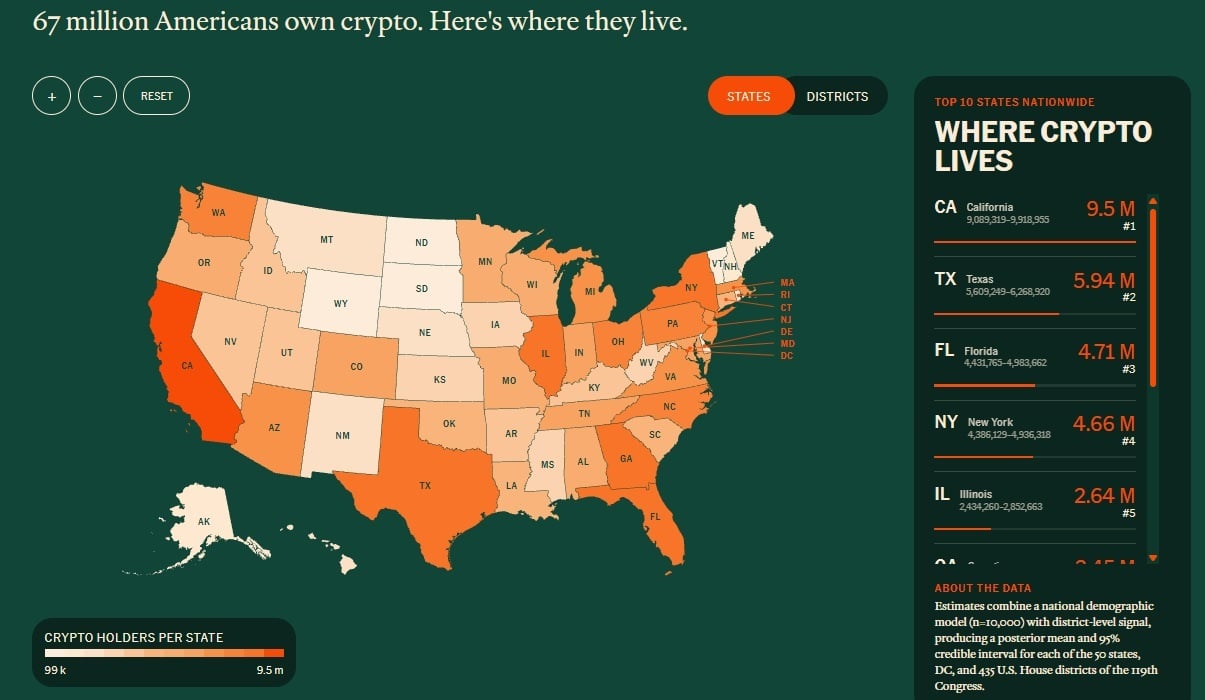
    An interactive map estimates where 67 million American crypto holders live, providing figures for all 50 states, Washington, D.C., and the 435 U.S. House districts in the 119th Congress. The National Cryptocurrency Association (NCA), a nonprofit crypto education organization, displays the data through a map hub with state and district views, allowing users to explore individual geographic areas.

    Ripple Chief Legal Officer and NCA President Stuart Alderoty highlighted the maps in an Aug. 24 post on X, stating:

    “67 million Americans hold crypto. 232,000 American jobs are supported by the industry. The National Cryptocurrency Association built two maps so you can see the data by state and district.”

    California leads the state estimates with approximately 9.5 million crypto holders, followed by Texas with 5.94 million, Florida with 4.71 million, New York with 4.66 million, and Illinois with 2.64 million. The underlying 2026 State of Crypto Holders Report found that roughly one in four American adults owns cryptocurrency.

    Regionally, the state-level distribution broadly tracks the U.S. population. The South accounts for 38% of holders, while the West represents 27%. The Midwest and Northeast each account for 18%, indicating that ownership is spread across the country rather than concentrated exclusively around major technology and financial centers.

    The National Cryptocurrency Association’s interactive map estimates crypto ownership by state, with California leading at 9.5 million holders, followed by Texas, Florida, New York, and Illinois. Source: NCA.

    Figures Reflect Modeled Estimates, Not Verified Counts

    The map’s figures are statistical estimates rather than exact counts of identified crypto owners. Its methodology combines a national demographic model based on a sample of 10,000 U.S. crypto holders with district-level signals to produce a posterior mean and 95% credible interval for every covered geographic area.

    A posterior mean is the model’s central estimate after the available evidence is incorporated. The credible interval represents the range within which the model calculates that the actual figure is likely to fall. California’s estimate, for example, ranges from approximately 9.09 million to 9.92 million holders.

    The broader ownership estimate came from an online survey conducted by The Harris Poll for NCA between Feb. 12 and March 3. Researchers weighted the survey findings behind the 67 million estimate and extrapolated them to the broader U.S. crypto-owning population. The sample data is accurate to within 0.7 percentage points at a 95% confidence level.

    Separate research offers a narrower comparison focused specifically on bitcoin. A July study estimated that 49.6 million Americans hold bitcoin, representing 18.6% of the adult population. The NCA figure covers cryptocurrency generally, while the bitcoin estimate measures ownership of a single digital asset.

    Crypto ownership may include assets held through software wallets, hardware devices, or accounts controlled by centralized platforms. A broader explanation of how to create a crypto wallet outlines the different arrangements holders can use to store and access their digital assets.

    Crypto Supports Nearly 232,000 American Jobs

    A separate NCA dataset measures the crypto industry’s economic footprint across individual states. Nationwide totals include 231,845 crypto-supported jobs, $55.4 billion in economic activity, and $30.8 billion in worker income, according to the Pragmatic Policy Group analysis of crypto employment commissioned by the association.

    The employment figure comprises about 34,000 direct positions at crypto companies, 75,000 indirect jobs at suppliers, and 123,000 induced jobs supported by worker spending. The analysis calculates that each direct crypto position supports roughly six other roles across industries such as professional services, health care, insurance, food service, and logistics.

    NCA launched in March 2025 with a $50 million grant from Ripple to support cryptocurrency education and public awareness. At the time, Alderoty described the association’s purpose as providing Americans with facts, resources, tools, and support for engaging with crypto.

    On the employment map, California also leads with approximately 57,600 crypto-supported jobs, $16.9 billion in economic impact, and $7.7 billion in worker income. New York follows with 53,800 jobs, while Texas supports 26,500, Washington accounts for 15,100, and North Carolina has approximately 9,500.

  • Is Bitcoin’s Recent Rally a Bubble, or Is It Sustainable?

    Is Bitcoin’s Recent Rally a Bubble, or Is It Sustainable?

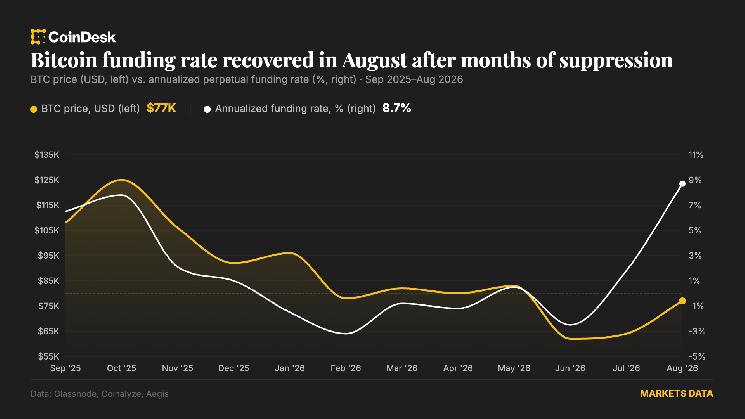
    In the cryptocurrency markets, Bitcoin’s ($BTC) recent surge from around $63,500 to over $80,000 is said to have been supported by strong spot demand rather than leveraged trading.

    According to an assessment published by QCP Capital, Bitcoin’s current market structure appears healthier than previous speculative rallies. The company states that approximately $2.8 billion in net inflows occurred into spot Bitcoin ETFs during $BTC’s rise from $63,500.

    In contrast, the amount of open positions in Bitcoin futures markets decreased from approximately 646,000 $BTC in mid-August to 588,000 $BTC. The fact that funding rates have remained at relatively low levels also indicates that the price increase is not driven by aggressively leveraged long positions.

    QCP stated that these data show that spot purchases and the closing of short positions were particularly prominent in the rally. This could indicate a more sustainable market structure for Bitcoin due to the limited accumulation of excessive leverage.

    On the macro front, the Fed and the US Treasury are being closely watched.

    Despite the positive technical structure in the Bitcoin market, the macroeconomic outlook remains uncertain. While core PCE inflation in July remained at 3.3% year-on-year, markets are pricing in a 35% probability of the Federal Reserve raising interest rates by 25 basis points at its September meeting.

    On the other hand, the expansion of the US Treasury’s repurchase program to support liquidity in long-term bonds is among the factors supporting risky assets.

    The Treasury announced that, starting September 9th, it will increase the upper limit for per-repurchase operations of 10- to 30-year bonds from $2 billion to at least $4 billion. Following this announcement, long-term bond yields fell, the dollar index weakened, while gold and Bitcoin prices rose.

    QCP also noted that Nvidia’s strong balance sheet contributed to risk appetite in global markets.

    However, it is noted that the US Treasury’s bond repurchase program is not quantitative easing (QE). The program aims to improve liquidity conditions in the long-term bond market, not to directly determine bond yields, and does not create a QE-like expansion in central bank reserves.

    According to QCP’s assessment, the key question for Bitcoin in the short term will be whether strong spot demand will continue.

    *This is not investment advice.

  • Crypto market makers are cashing in on bitcoin’s rally – without betting on direction

    Crypto market makers are cashing in on bitcoin’s rally – without betting on direction

    When bitcoin rocketed from around $62,000 to above $77,000 in a matter of days last week, the move wiped out $3 billion from leveraged short sellers who had built up bearish bets during the prior drawdown. But for trading firms, the price hike presented an opportunity – one that had nothing to do with predicting where prices would go next.

    Major crypto trading firms, including Abraxas Capital, Fasanara Capital, and Wintermute, have quietly built what onchain data shows are hundreds of millions of dollars in short perpetual futures positions on Hyperliquid, the onchain derivatives exchange. Collectively, the three firms hold short positions of 138,569 $ETH (roughly $338 million) and 3,425 $BTC (around $265 million), according to onchain data tracked by Lookonchain.

    At the same time, Abraxas Capital has been pulling large amounts of spot crypto off centralized exchanges. On-chain data from Arkham Intelligence shows the firm withdrew 73,872 $ETH — worth approximately $173 million — from Binance over the past four days alone.

    Collecting yield, not making bets

    The strategy is known as a cash-and-carry, or basis trade, and it has become one of the most common yield-generating plays in crypto markets during bull phases. The mechanics are straightforward: traders hold a spot crypto position while simultaneously shorting an equivalent amount via perpetual futures. Because the two positions offset each other, the trader has minimal exposure to price movements. What they capture instead is the funding rate — a periodic payment that longs must pay to shorts when the market is bullish.

  • What Happens to Bitcoin, Ethereum and XRP if the CLARITY Act Passes?

    What Happens to Bitcoin, Ethereum and XRP if the CLARITY Act Passes?

    The CLARITY Act sets out to answer a question U.S. regulators have struggled with for over a decade: when does a crypto token count as an investment, and when does it behave more like a commodity such as gold. The answer determines who regulates a token, what its creators must disclose, and what rules a platform must follow when it lists that token or holds it on behalf of customers.

    Main Problem the Bill Is Trying to Fix

    When a company or development team creates a new token and sells it to fund a project, that sale can resemble an investment, since early buyers are often betting on the team successfully building and promoting the network. Years later, the same token might trade widely across a decentralized network with its value no longer tied to that original team. At that point, it starts to look more like a commodity than a security.

    U.S. law currently offers no clear rule for when a token crosses that line, and two different regulators are involved. The Securities and Exchange Commission oversees securities, while the Commodity Futures Trading Commission oversees futures markets and has narrower authority over direct commodity trading. Traditional assets fall cleanly into one category or the other. Crypto often does not.

    How CLARITY Would Treat Bitcoin

    Bitcoin is already generally treated as a commodity, largely because it has no central issuer or company behind it. Under the current system, the CFTC’s authority over spot Bitcoin trading is limited mostly to policing fraud and manipulation. CLARITY would expand that authority, giving the CFTC broader power to directly regulate the platforms where Bitcoin is bought and sold, not just to intervene after something goes wrong.

    How CLARITY Would Treat Ethereum and $XRP

    For tokens like Ethereum and $XRP, which sit in a greyer zone between fundraising history and current decentralized use, CLARITY attempts to draw a line based on function rather than origin. Fundraising activity would remain under SEC oversight, while later-stage trading in tokens that qualify as sufficiently decentralized could shift to the new CFTC framework. This would not automatically reclassify every token as a commodity. It creates a pathway for tokens to transition out of securities treatment once they no longer depend primarily on a central team.

    New Obligations for Platforms and Projects

    Platforms operating under the new CFTC framework would be required to register, keep customer assets segregated from their own funds, and follow rules covering disclosures, recordkeeping and conflicts of interest. Projects raising money through token sales would need to publish information about who is behind the project and how the underlying technology works, while insiders would face new limits on how quickly they can sell their holdings.

    Why the Bill Has Been So Difficult to Pass

    The disagreement is not over whether crypto needs rules, but over what those rules should say and who should enforce them. Three fights have defined the bill’s path so far.

    The first involved stablecoin rewards. Some platforms pay users rewards for holding stablecoins, similar to bank interest. Banks argued this could pull deposits out of the traditional banking system, while crypto companies countered that restricting rewards would simply shield banks from competition.

    After months of negotiation, lawmakers reached a compromise barring rewards paid simply for holding a stablecoin, while allowing rewards tied to actually using one. Coinbase backed the revised deal, and the Senate Banking Committee advanced the bill in May.

    The second fight centers on state authority. CLARITY would replace certain state-level requirements with a single federal framework. Supporters argue this creates consistency, while critics warn it could weaken states’ existing tools for investigating scams and holding platforms accountable.

    The third involves conflicts of interest among lawmakers themselves. The latest draft would bar federal officials and their spouses from being paid to issue or sponsor digital assets while in office. Democrats are pushing for stricter limits on lawmakers profiting from crypto, while Republicans backing the bill argue the current draft already goes far enough. The bill needs bipartisan support to pass, and identical versions must clear both the House and Senate before reaching the president’s desk.

    If CLARITY Passes

    Crypto businesses would gain a clearer federal rulebook for registering and operating in the U.S. Because the U.S. represents such a significant share of global crypto capital and users, businesses and exchanges operating outside the country may also adjust their practices to align with the new framework, extending its influence well beyond American borders.

    If CLARITY Does Not Pass

    Crypto would not become unregulated. Existing law would continue to apply, enforced through regulators, courts and individual states. The difference is timing. Many of today’s legal boundaries are only clarified after a product has already launched, often only once something has gone wrong. CLARITY is designed to establish those boundaries in advance rather than after the fact.

  • Official Trump surges 10% as liquidations top $13.57M – Could the memecoin revisit $2.2?

    Official Trump surges 10% as liquidations top $13.57M – Could the memecoin revisit $2.2?

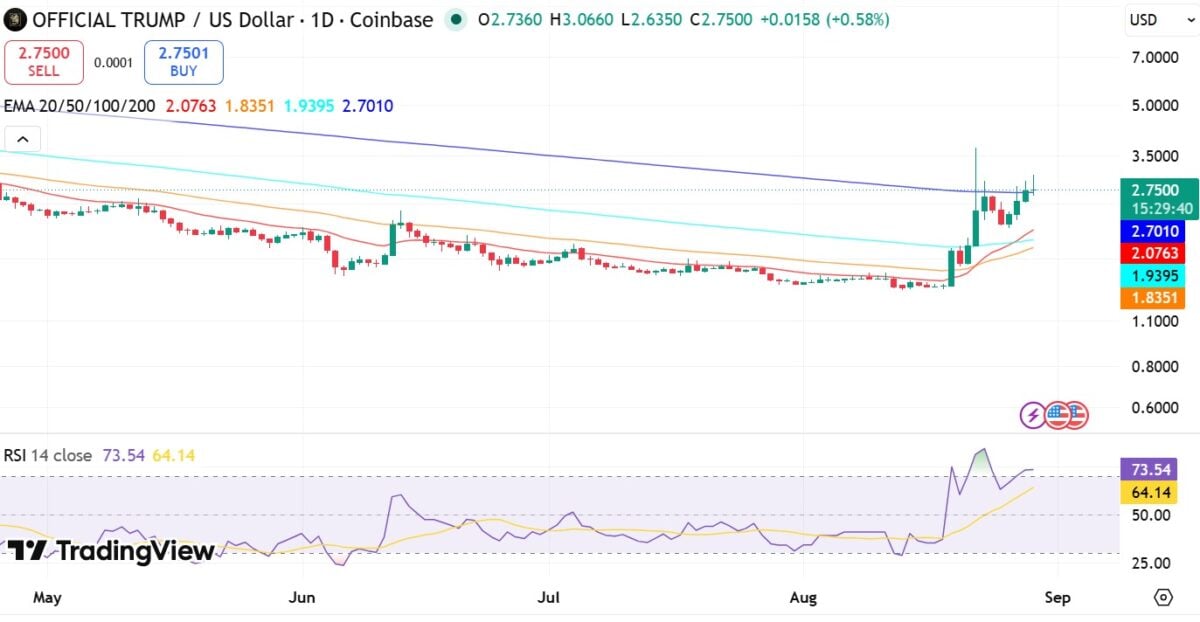
    Official Trump memecoin has experienced extreme volatility over the past day. In fact, the memecoin surged 10.2% and flipped $3 resistance to a high of $3.06.

    However, this pump failed to hold and the altcoin dropped again falling $2.6 before rising to $2.7 as of this writing. $TRUMP pumped as investors were tricked to believe the recently launched GOLD was $TRUMP 2.0.

    However , after the team behind GOLD was accused of rug pull sentiment flipped shortly after. In fact, Lookonchain reported that 15 wallets that purchased GOLD sold their holdings and exited the market taking over $312k in profit.

    $TRUMP investors panic exit amid rising liquidation risk

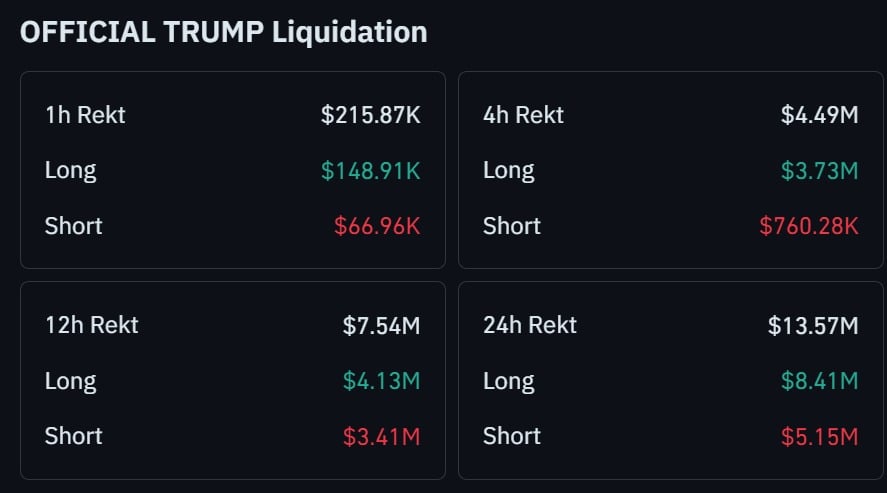
    This market volatility triggered a wave of liquidations for both longs and shorts. Traders who took long eyeing trend continuation, saw over $8.4 million in liquidations, while over $5.1 million worth of shorts were liquidated.

    Source: CoinGlass

    In total, the memecoin recorded over $13.57 million in total liquidations, indicating heightened volatility. Amid these liquidations, most traders both short sellers and longs, hurriedly closed their positions.

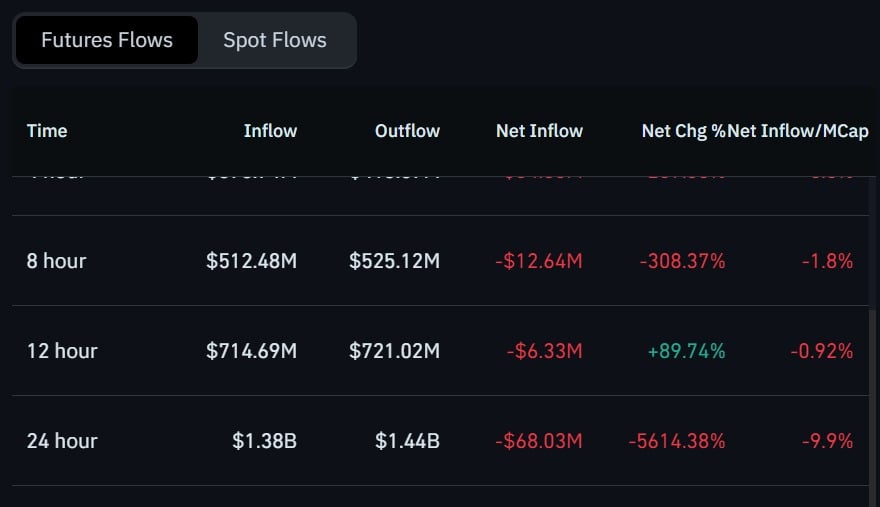
    According to Coinglass data, Official Trump [$TRUMP] recorded $1.44 billion in futures outflows compared to $1.38 billion in inflows. For that reason, Futures Netflow dropped 5614% to -$68 million.

    Source: CoinGlass

    A negative Netflow suggested that traders mostly closed their positions. The Open Interest further validates this observation.

    $TRUMP’s Open Interest dropped 6.4% to $279 million while the Derivatives Volume rose 23% to $3.3 billion. The falling OI and rising volume suggested that most traders exited their positions.

    Profit taking returns on the spot too

    As $TRUMP crossed $3, holders on the spot also rushed to cash out after the GOLD token launch brought about a negative sentiment.

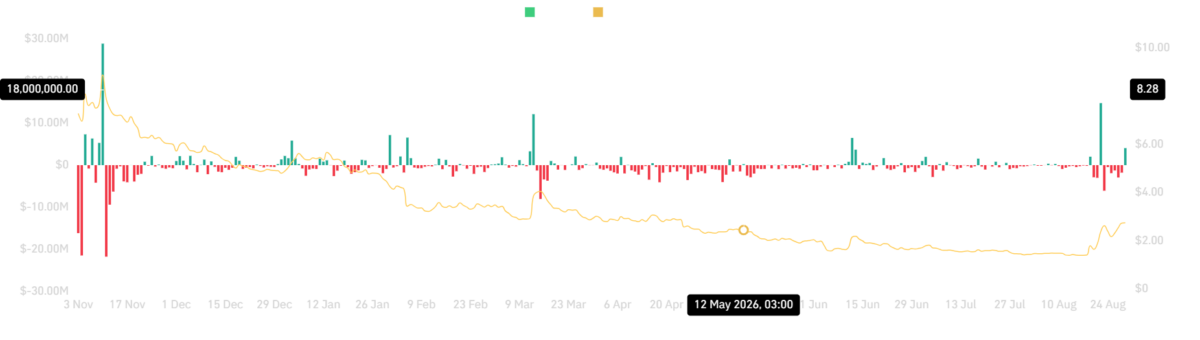
    Previously, the Spot market have been aggressively accumulating, with the Netflow holding negative for five consecutive days. On 29th August, this changed so first, with the Netflow rising to positive zone.

    Source: CoinGlass

    As of this writing Netflow was around $4.5 million, suggesting more $TRUMP entered exchanges, a clear sign of selling pressure.

    What’s next for the memecoin?

    With sellers active on both the spot and futures, the memecoin is unlikely to hold the uptrend. Historically, intense selling pressure has preceded price drops.

    For now, however, $TRUMP momentum still holds bullish. In fact, the Relative Strength Index (RSI) has remained elevated, currently at 73.

    Source: TradingView

    At these levels, the RSI suggest the uptrend is intact, with buyers still in control of the market. Likewise, $TRUMP holds above both short term and long term moving averages, further validating this view.

    Under these circumstances, the bullish structure is intact and likely to hold. If bulls can absorb the arising pressure, $TRUMP will reclaim $3 and eye to flip $3.6 resistance.

    However, if the pressure persist, the memecoin will breach $2.7 with $2.2 as the next support level.


    Final Summary

    • Official Trump [$TRUMP] saw extreme volatility, rising 10%, rising to $3.06 then retracing to $2.7 at press time
    • $TRUMP saw increased liquidation, with $13 million worth of positions liquidated triggering a wave of panic selling.
  • Wall Street Altcoin Picks: Charles Schwab Backs Ethereum, Solana, XRP and Hyperliquid

    Wall Street Altcoin Picks: Charles Schwab Backs Ethereum, Solana, XRP and Hyperliquid

    Charles Schwab’s director of global equity research, Adam Lynch, laid out the firm’s crypto allocation thinking in a recent appearance, distinguishing between five digital assets the firm views as serving fundamentally different roles in a portfolio: Bitcoin, Ethereum, Solana, $XRP and Hyperliquid.

    Not All Crypto Is the Same Trade, Schwab Says

    Lynch described Bitcoin as the “classic” debasement hedge, the asset investors turn to when concerned about fiat currency devaluation. Ethereum, he said, carries more functional utility than Bitcoin while still fitting into that broader debasement narrative. Beyond the two majors, Lynch grouped Solana, $XRP and Hyperliquid as higher-volatility, higher-risk allocations he suggested pairing with a core position in the larger assets, rather than replacing them.

    Goldman Sachs’ Solana Bet Comes Into Focus

    Goldman Sachs has become the largest disclosed holder of spot Solana ETFs, with $88 million in exposure, according to disclosure filings referenced in the discussion. Because not all institutional holders are required to disclose positions, the real scale of Wall Street’s Solana exposure could be considerably larger than what’s currently visible in public filings.

    Separately, Schwab confirmed it is adding Solana, Avalanche and Chainlink to its crypto trading platform, expanding beyond the Bitcoin and Ethereum access it already offered. Grayscale Research has pointed to Bitcoin, Ethereum and Zcash specifically as the assets most likely to benefit from what it calls the “debasement trade,” tied to U.S. national debt surpassing $40 trillion and continued fiscal deficits.

    Solana’s Supply Squeeze Just Got Bigger

    In a separate development, Solana validators passed a proposal to double the network’s disinflation rate to 30%, with yes votes clearing 66.6% in the final hour of voting. The change is projected to reduce planned SOL issuance by close to 20 million tokens, worth an estimated $1.4 billion, over the next six years. Reducing new supply entering circulation is widely viewed as a structurally bullish shift for the token’s long-term valuation.

    Bitcoin Drops Below $77,000 as Fed’s Warsh Turns Hawkish

    The bullish setup collided with macro reality Friday, when Bitcoin fell below $77,000 after Fed Chair Kevin Warsh signaled the possibility of a rate hike during his Jackson Hole keynote. Warsh has now delivered a hawkish tone in each of his public appearances since taking the role.

    U.S. inflation has now remained above the Fed’s 2% target for 65 consecutive months, according to the discussion, a backdrop that continues to complicate the path toward rate cuts.

    What It Means

    Between Schwab’s differentiated allocation strategy, Goldman’s growing Solana exposure, Solana’s reduced token issuance and a bipartisan regulatory bill gaining bank support, institutional infrastructure around crypto is building even as short-term price action reacts to Fed commentary.

    Whether that structural momentum translates into sustained price strength may depend less on any single Fed speech and more on how quickly the CLARITY Act moves through Congress from here.

  • Kraken Users Briefly Locked Out After Sanctioned-Transaction Flood

    Kraken Users Briefly Locked Out After Sanctioned-Transaction Flood

    Kraken users were briefly locked out after the exchange dealt with a flood of sanctioned crypto transactions, according to CoinDesk. The incident links an access disruption to compliance activity, highlighting the operational strain that can arise when an exchange must process a large volume of transactions associated with restricted entities or addresses.

    A Compliance-Driven Disruption

    A temporary lockout is different from a confirmed loss of customer funds, and the available report does not establish that user balances were permanently affected. The immediate issue was access while Kraken handled the transaction flow and its associated sanctions controls.

    Why Sanctions Screening Affects Availability

    Crypto exchanges screen deposits and withdrawals against sanctions lists and other risk signals. A sudden burst of flagged activity can require manual review, system throttling or account restrictions. Those controls are designed to limit prohibited activity, but they can also interrupt legitimate users when systems are under pressure.

    The Questions for Kraken

    The important follow-up points are how long the disruption lasted, how many accounts were affected, and what controls Kraken will change to prevent a repeat. Exchanges must balance rapid access with legal obligations, and a short incident can still expose weaknesses in monitoring, communication or capacity planning.

    For context, BlockchainReporter has previously examined how institutional financial systems are testing blockchain settlement in earlier coverage. The new development remains specific to this event and does not establish a broader market outcome.

  • Deribit moved 90% of client assets to Coinbase, then killed its daily proof-of-reserves check

    Deribit moved 90% of client assets to Coinbase, then killed its daily proof-of-reserves check

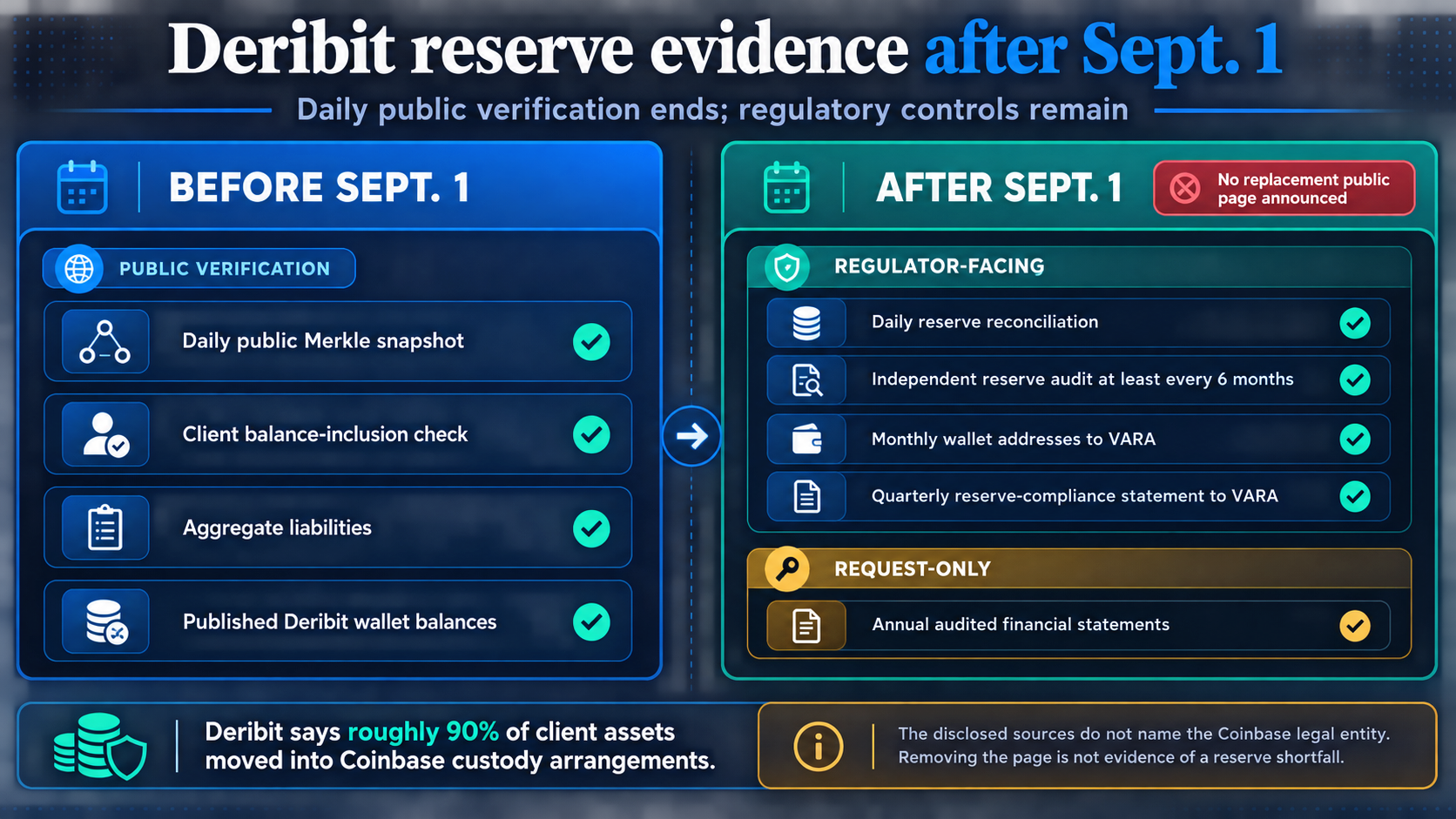
    Deribit will remove its public Proof of Reserves page on Sept. 1, ending a daily check customers could use to verify balance inclusion and compare aggregate liabilities with published wallet holdings. Regulator-required reserve, reconciliation and audit controls will remain, but they do not provide the same daily public visibility.

    The exchange said the change reflects a wallet infrastructure overhaul during its integration with Coinbase. Deribit said roughly 90% of client assets have moved into Coinbase custody arrangements since Coinbase acquired the derivatives platform in August 2025. Its disclosures name Coinbase at the brand level but do not identify the specific Coinbase legal entity holding the migrated assets.

    Related Reading

    Coinbase’s 30-minute Deribit switch will force-settle and rebuild institutional positions

    Deribit’s existing system uses a privacy-preserving binary Merkle tree and a daily snapshot. Each client can use a unique proof identifier to find the hashed entries representing their balances, while anyone can sum the file’s liabilities and compare the total with wallet balances published by Deribit.

    The public snapshot was already narrower than Deribit’s full custody footprint. Its methodology says assets held with third-party custodians are excluded because they are outside Deribit’s direct control, naming Copper ClearLoop as an example. It

    The removal does not cancel the obligations applying to Deribit FZE. Dubai’s Virtual Assets Regulatory Authority requires covered virtual asset service providers to maintain reserves equal to 100% of client liabilities, hold them one-to-one in the same asset, reconcile them daily and obtain an independent third-party reserve audit at least every six months.

    Deribit’s notice refers both to annual and twice-yearly Proof of Reserves audits. The VARA rule sets the reserve-audit minimum at once every six months. A separate VARA provision requires an annual financial-statement audit and says the annual report must be available to clients and the regulator on request.

    Other evidence is regulator-facing rather than public. Covered firms must submit wallet addresses monthly and statements demonstrating compliance with financial requirements, including reserve assets, quarterly to VARA.

    VARA’s register lists Deribit FZE as an active exchange and broker-dealer VASP. Its membership terms allow assets to be held directly or through third-party custodians while requiring segregation from company assets and preserving clients’ legal title. A separate service-provider list names Coinbase for custody and self-custody technology without specifying the Coinbase entity.

    The page’s removal is not evidence of a reserve shortfall. It is a reduction in what customers can test for themselves each day, leaving controls and reports that are less public, less frequent or available only on request.