Tag: CRYPTOS FoxBusiness.

  • SBI Holdings, Startale Group to issue first trust-based yen stablecoin JPYSC under Japan’s framework

    SBI Holdings, Startale Group to issue first trust-based yen stablecoin JPYSC under Japan’s framework

    Startale Group, a Tokyo-based blockchain infrastructure firm behind Japan’s largest public network Astar, and SBI Holdings, one of the country’s leading financial conglomerates, have unveiled JPYSC, a trust bank-backed Japanese yen stablecoin designed for institutional and cross-border applications, according to a Friday announcement.

    The JPYSC stablecoin will be issued by SBI Shinsei Trust Bank under Japan’s regulatory framework, making it the first trust bank-backed yen stablecoin in the market. SBI VC Trade will handle distribution while Startale oversees technical development.

    The partners are targeting a second-quarter launch, pending final regulatory clearances.

    Discussing the launch, Yoshitaka Kitao, Representative Director, Chairman, and President of SBI Holdings, said it is intended to support the expansion of digital financial services and strengthen the link between traditional finance and emerging digital infrastructure.

    “The transition to a ‘Token Economy’ where all real-world assets are tokenized and tokens permeate society as a means of settlement is now an irreversible societal trend,” Kitao stated.

    Sota Watanabe, CEO of Startale Group, said the company aims to bring more of the global economy onchain, positioning its yen-denominated stablecoin as a key component of the future digital infrastructure.

    “Our yen-denominated stablecoin is not just a means of everyday payment,” Watanabe added. “It will play a central role in a fully onchain world. In particular, we see enormous potential in enabling payments between AI agents and powering distributions for tokenized assets, both of which will soon become reality.”

    The move reinforces Japan’s position in regulated digital currency infrastructure as global stablecoin competition accelerates.

    As one of the few major jurisdictions with a clear legal pathway for stablecoin issuance, Japan is enabling domestic financial institutions to develop compliant digital assets.

    The project aims to challenge the dominance of dollar-pegged tokens by offering a regulated yen alternative suited for treasury operations, corporate payments, and international settlement.

    Startale operates Astar Network and jointly develops the Soneium blockchain through a partnership with Sony Group Corporation.

  • ‘Need a Bigger Orange Bag’: Saylor Hints at Bitcoin Buying Spree Amid $67,000 Stability

    ‘Need a Bigger Orange Bag’: Saylor Hints at Bitcoin Buying Spree Amid $67,000 Stability

    As Bitcoin tries to stabilize at $67,000, Michael Saylor, Chairman of Strategy, continues to demonstrate his trademark optimism on social media. In a new post on X, Saylor not only depicted himself carrying a large orange bag covered with Bitcoin logos but also added an intriguing caption suggesting he might need a “bigger” one.

    The message to the market is clear: Saylor & Co. are prepared to keep absorbing supply and buying more Bitcoin.

    Why Michael Saylor сalling for “bigger bag” amid MSTR stock turbulence

    At present, Strategy holds 718,722 $BTC, equivalent to approximately $48 billion in value. However, given an average purchase price near $76,000, Saylor and the company are sitting on an unrealized loss of about 12% on their position. Despite this, the company’s mNAV ratio remains around 1, while its adjusted enterprise value multiple is even higher: 1.256.

    In other Strategy-related developments, this week, the company hosted Strategy World 2026, where Saylor reiterated his thesis that Bitcoin represents digital capital. According to him, Bitcoin’s core value is not in abstract portability narratives but in the practical reality that one billion dollars in $BTC can be transferred anywhere in the world, whereas moving a billion dollars in traditional assets is far more complex.

    Need a bigger orange bag. pic.twitter.com/DoVuklGMFr

    — Michael Saylor (@saylor) February 26, 2026

    At the same time, he acknowledged that Bitcoin’s primary challenge is price volatility, arguing that large-scale capital inflows are held back mainly by fluctuations, not by any structural flaw in the network itself. From Saylor’s perspective, corrections are a normal part of the model. His message remains consistent: if you invest in $BTC, be prepared to hold it for 7-10 years.

    All of this comes as Strategy’s stock, MSTR, is reportedly the most shorted stock in the market, according to Goldman Sachs. The shares are currently trading at $132.8, down 12.6% year-to-date in 2026. Compared to the all-time high of $542, the stock is off by 75.8%.

    How much Saylor needs an even bigger orange bag may become clearer next week, as Strategy continues to report its Bitcoin activity on a weekly basis when transactions occur. One thing is certain: Saylor remains openly optimistic, even amid the current turbulence on the crypto market.

  • Popular Crypto Wallet MetaMask Announces Launch of New Payment Card Service in the US! Here Are the Details

    Popular Crypto Wallet MetaMask Announces Launch of New Payment Card Service in the US! Here Are the Details

    MetaMask, the popular crypto wallet developed by blockchain software company Consensys, has launched a new payment card service in the US. The company announced that the card was launched in collaboration with global payments giant Mastercard.

    In its announcement, Consensys emphasized that the MetaMask Card differs from traditional crypto cards.

    While most crypto cards are custodial, requiring users to transfer their assets to an exchange account before making a purchase, the MetaMask Card is described as completely self-custodial. This means users will retain control of their digital assets in their MetaMask wallets until the payment is made.

    The card offered in the US, like the versions in the UK and the European Union, operates on the Monavate (formerly Baanx) infrastructure. It can be used at all merchants that accept Mastercard and also offers Apple Pay and Google Pay compatibility.

    Cardholders will be able to earn cashback on their spending. Rewards will be distributed in MetaMask’s stablecoin, mUSD. Standard users will receive 1% cashback, while premium users can earn up to 3% on their first $10,000 of annual spending.

    mUSD is issued by Stripe’s Bridge platform and minted on the decentralized M0 infrastructure. The stablecoin is reportedly backed one-to-one by highly liquid dollar assets. Demand for crypto-based payment cards has also been rapidly increasing recently.

    *This is not investment advice.
  • Bitcoin Exchange Binance Chooses This Country as Headquarters for European Union Operations! Here Are the Details

    Bitcoin Exchange Binance Chooses This Country as Headquarters for European Union Operations! Here Are the Details

    Cryptocurrency exchange Binance has chosen Greece as its regulatory hub for its EU operations ahead of the European Union’s new crypto regulations.

    According to Finance Feeds, Binance co-CEO Richard Teng announced that the exchange applied to the regulatory authority in Greece last month.

    The application aims to obtain an operating license under the European Union’s Markets in Crypto-Assets Regulation (MiCA).

    The MiCA regulation mandates that crypto companies obtain licenses by July 2026. Companies without licenses will not be able to operate within the EU.

    Teng stated that the MiCA license offers a standard framework across Europe, and therefore many factors such as workforce quality, talent pool, and security are considered when selecting an operations center. It was reported that Greece is seen as a suitable base within the EU’s enlargement strategy.

    On the other hand, Teng also touched upon the sharp fluctuations experienced in the crypto market over the past year. Noting that Bitcoin has fallen by approximately 50% from its peak of $126,000 in October last year, Teng stated that individual investor interest has weakened, but institutional participation has remained stable. “Smart money, institutional capital, and long-term funds continue to enter the market,” Teng said, emphasizing that regulatory clarity will strengthen the sector in the long term.

    *This is not investment advice.
  • Akash Opens Homenode Beta Access

    Akash Opens Homenode Beta Access

    Akash, a decentralized marketplace, has launched early access to the open beta of Homenode, a platform that allows owners of consumer-grade GPUs to supply compute power from personal devices to its network. Participants can earn rewards without deploying enterprise infrastructure or managing complex server setups.

    The beta is part of the StarCluster initiative, a distributed AI compute network. During the first phase, the system will focus on high-end GPUs, including $RTX 4090, $RTX 5090 and upcoming 50-series models from NVIDIA. The rollout will also test performance from small colocated setups and repurposed mining equipment before broader expansion.

    Homenode is delivered as a dedicated operating system distributed as an ISO image. Users install it via USB to convert eligible machines into secure provider nodes. The environment is isolated and designed for privacy. Device owners can choose dual-boot or partition options to keep their primary operating system separate from the Homenode setup.

    Image: Freepik

  • A former Solana exec is taking a page out of Wall Street playbook to make global crypto trades faster

    A former Solana exec is taking a page out of Wall Street playbook to make global crypto trades faster

    DoubleZero, a crypto infrastructure startup co-founded by former Solana Foundation executive Austin Federa, is rolling out a major update aimed at spreading Solana’s network more evenly around the world, and making it faster in the process.

    On Mar. 9, the company will launch “Phase II” of its DoubleZero Delegation Program, redirecting 2.4 million $SOL from its 13 million pool to validators operating in underrepresented regions such as São Paulo, Singapore, Hong Kong, and Tokyo. Each region will receive up to 600,000 $SOL in additional delegated stake incentives.

    DoubleZero runs a private, high-speed internet network that helps Solana’s computers talk to each other faster and more reliably. In 2025, the company behind the network raised $28 million at a $400 million valuation.

    DoubleZero’s goal in rolling out the incentive is simple: reduce Solana’s growing geographic concentration in Europe and introduce “multicast functionality,” a data distribution method widely used in traditional finance.

    Geographic cluster

    One of the main goals of Federa is to reduce the geographic concentration of validators.

    “One of the unintended consequences of blockchains getting faster is there’s more incentive to co-locate next to one another,” Federa said in an interview. He compared it to early high-frequency trading wars on Wall Street, when firms scrambled to place servers physically closer to the New York Stock Exchange to shave milliseconds off trades.

    Read more: ‘Crypto’s Flash Boys’: A Q&A With Austin Federa on DoubleZero

    Today, much of Solana’s staked tokens, which secure the network, sit in Central Europe — largely for historical and economic reasons. “There were a lot of really good, really cheap bare-metal data centers in Europe,” Federa said. “Solana was optimized for that kind of hosting early on, and the infrastructure just built up there.”

    But geographic clustering creates trade-offs: If most validators are in Europe, users farther away may be at a disadvantage.

    “If I’m sitting in South America trying to execute a trade on Solana, I can hit send first,” Federa said. “But someone who’s got a computer in Germany might actually win that trade.”

    To address that imbalance, DoubleZero is offering 2.4 million $SOL and aims to make it economically viable for validators to operate outside traditional hubs.

    ‘More dependable’

    The next problem DoubleZero is trying to solve through the new initiative is data transmission latency.

    The main barrier to expanding into those areas isn’t technical, Federa said — it’s economic. “Because you’re further away, everything takes longer to get there. It’s like Amazon Prime — in New York you get it same day. In Montana, it’s four or five days.”

    DoubleZero says its private fiber network helps address connectivity issues, while the new delegation incentives aim to offset the economic penalty of being outside traditional hubs.

    This is why, alongside the geographic push, DoubleZero is introducing the multicast functionality to Solana.

    Federa compared it to watching the Super Bowl via satellite versus streaming. With satellite, “an infinite number of people can be watching that radio wave… and it’s no additional tax.” Streaming, by contrast, requires a separate data stream for each viewer.

    Blockchain networks today largely operate like streaming services — sending duplicate data over and over. Multicast, he said, changes that.

    “In a pre-multicast world, if I’m sending data to 1,000 nodes, I’m handing out 1,000 copies,” he said. “With multicast, I send one copy, and the network hardware replicates it closer to where it needs to go.”

    That reduces bandwidth costs, improves fairness in how quickly participants receive data, and creates more room for future upgrades. It also makes blockchain infrastructure behave more like traditional exchanges, which rely heavily on multicast.

    “Traditional finance isn’t just faster than blockchain — it’s more dependable,” Federa said. “If we can bring more determinism to blockchain networking, it makes it a much more attractive place for market makers and traders.”

    Ultimately, DoubleZero is betting that financial incentives like this will help Solana’s infrastructure spread globally, moving it closer to functioning like a truly real-time market.

    Read more: DoubleZero Mainnet Goes Live With 22% of Staked $SOL on Board

  • MetaMask expands debit card across U.S. after year-long pilot

    MetaMask expands debit card across U.S. after year-long pilot

    MetaMask is expanding the reach of its blockchain-based debit card in the U.S. after a year-long trial and receiving permission to enter New York for the first time.

    The U.S. test period followed a pilot phase in Europe and the U.K. that started in 2024. The rollout includes product refinements to bring crypto payments into everyday commerce, MetaMask announced Thursday.

    “We designed the MetaMask Card to make crypto disappear. Not go away, but become so seamlessly woven into daily life that the line between onchain and offchain fades away entirely,” said Gal Eldar, a product lead at MetaMask, in a press release shared with CoinDesk.

    The MetaMask Card, developed with payment giant Mastercard and crypto payment provider Baanx, joins a market that already features a number of competitors including crypto exchanges Coinbase (COIN) and Crypto.com, though many require users to deposit their crypto on the card issuers’ platform.

    MetaMask began a limited rollout of its blockchain-based debit card to a few thousand users in the European Union and U.K. in August 2024, with customers allowed to make purchases using USDC, USDT and wETH held on the layer-2 network Linea, an Ethereum-based chain developed by Consensys, MetaMask’s parent. The U.S. pilot started in December 2024.

    MetaMask says the card now works everywhere Mastercard is accepted, including support for digital wallets like Apple Pay and Google Pay, and offers onchain cashback rewards and yield options on unspent balances via DeFi protocols. The company is also offering a premium MetaMask Metal Card, priced at $199 a year.

    “We’ve seen tens of thousands of users around the world use it for everything from morning coffee to engagement rings, and now we’re excited to bring that to U.S. users, including places like New York that previously haven’t had access.” Eldar wrote in the press release.

    Read more: MetaMask Starts Rollout of Blockchain-Based Debit Card Developed With Mastercard, Baanx

  • Decibel goes live on Aptos with a $58 million war chest and a secret weapon from Stripe’s Bridge

    Decibel goes live on Aptos with a $58 million war chest and a secret weapon from Stripe’s Bridge

    Decibel, a fully onchain perpetuals exchange incubated by Aptos Labs, is now live on the Aptos mainnet, the Decibel Foundation said Wednesday.

    The debut follows a public testnet that drew more than 700,000 unique accounts and 132,000 daily active users, according to the foundation. Users executed over 1 million trades per day during testing, and more than $58 million was committed through a pre-deposit campaign ahead of mainnet activation.

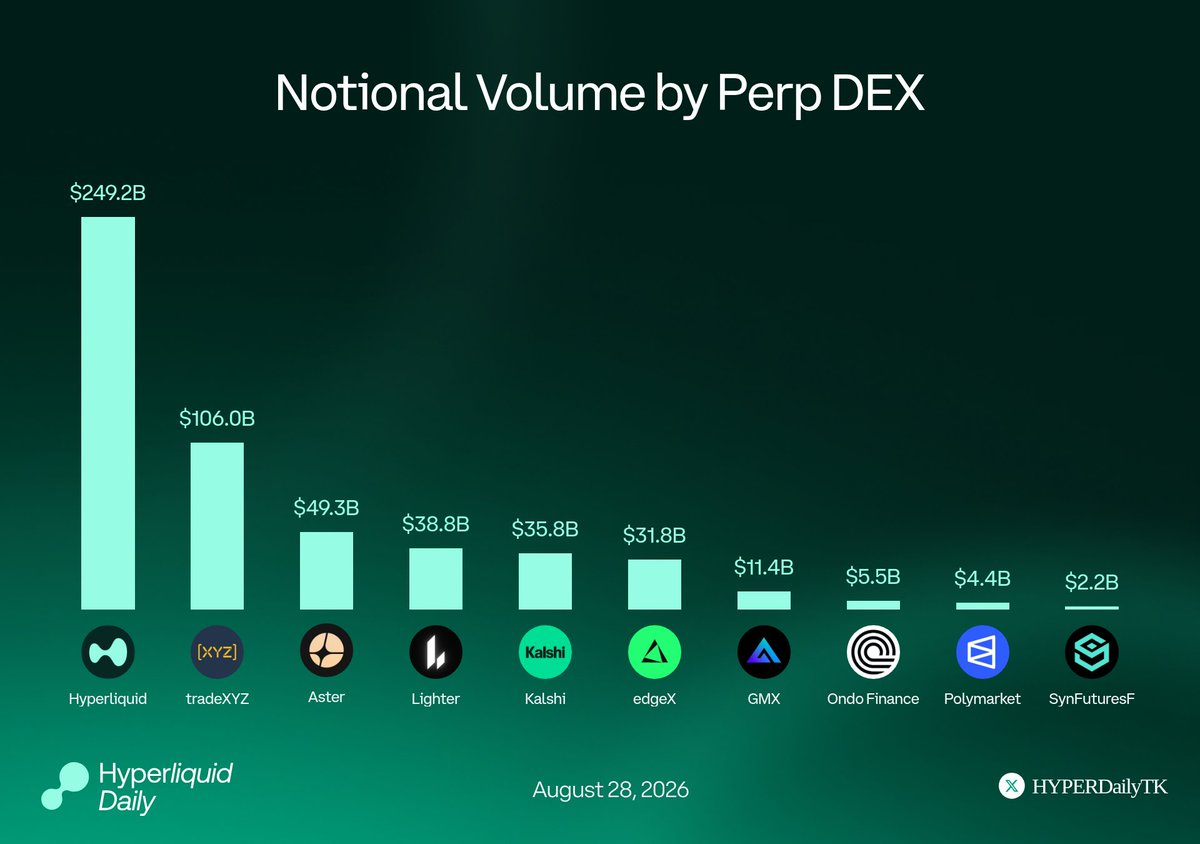
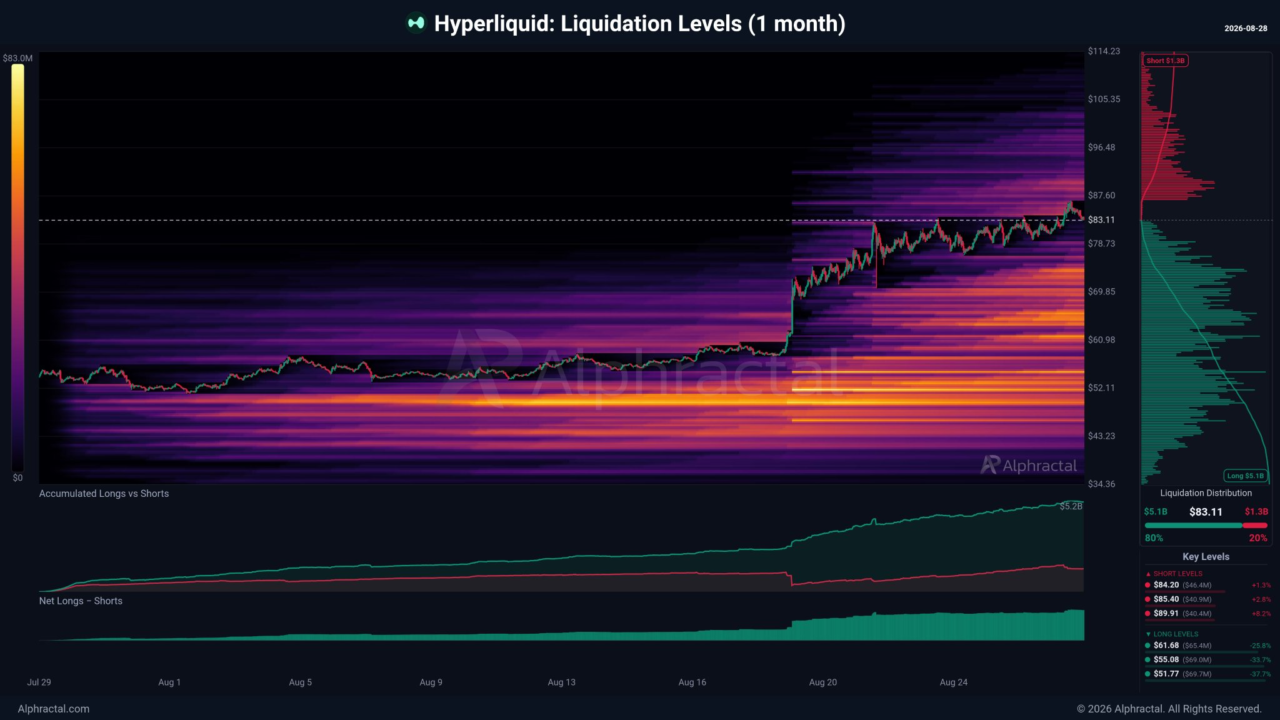
    Decibel’s debut comes during an intensifying race among onchain perpetuals exchanges. The past year has seen a surge of competition, led by Hyperliquid, which remains the category’s dominant venue by volume.

    Other contenders, including Aster and Lighter, briefly gained traction before fading from the spotlight. Decibel now enters that increasingly crowded field with plans to gain market share from a sector that racked up $920 billion in trading volume over the past 30 days, according to DeFiLlama.

    Decibel operates a central limit order book where order placement, matching, settlement and risk management occur entirely onchain. The model replaces the offchain risk engines and discretionary controls common in traditional and crypto exchanges with predefined smart contract rules visible to users.

    The protocol will become the first perpetual exchange built on Aptos, a layer-1 blockchain with sub-50 millisecond block times and sub-500 millisecond finality. Decibel’s matching engine, margin requirements and liquidation logic execute onchain.

    Users can fund accounts from Aptos, Ethereum, Solana or centralized exchanges. Roughly 40% of pre-deposit capital originated from Ethereum and Solana, the foundation said. The platform uses a dollar-denominated stablecoin, usDCBL, issued by Bridge, a Stripe company, as default collateral.

    The Decibel Foundation said it plans to add spot markets, multi-collateral accounts and tokenized real-world assets, with the aim of expanding beyond crypto derivatives over time.

  • STS Digital raises $30 million to expand crypto options platform

    STS Digital raises $30 million to expand crypto options platform

    STS Digital, a trading firm specializing in crypto options, said it raised $30 million in a strategic round backed by CMT Digital, crypto exchange Kraken’s parent company Payward, and other investors.

    The company plans to use the funds to scale its institutional trading platform and solidify its role as a liquidity provider in digital asset markets, according to a statement shared with CoinDesk.

    Based in Bermuda, STS Digital allows institutions to trade more than 400 cryptocurrencies across spot, vanilla and exotic options, and structured products through a single interface that supports web, API and voice.

    Options are a growing part of institutional crypto portfolios as firms use them to hedge risk and generate yield during volatile market conditions. Open interest is currently around $40 billion, according to TheTie, with the lion’s share on Deribit.

    “This investment enables us to meet the explosive demand from institutional investors for our spot, options and structured product pricing,” said chairman and co-founder Gideon Hyams. “As banks, asset managers and financial intermediaries rush to integrate our pricing engine, this funding ensures we stay ahead of demand.”

    In the statement, CMT Digital, the round’s lead investor, said it sees STS as being positioned to become “a foundational liquidity layer for crypto derivatives.”