Tag: CRYPTOS FoxBusiness

  • Big Bull Michael Saylor Returns to the Scene After Weeks: He Announces a Million-Dollar Bitcoin Move!

    Big Bull Michael Saylor Returns to the Scene After Weeks: He Announces a Million-Dollar Bitcoin Move!

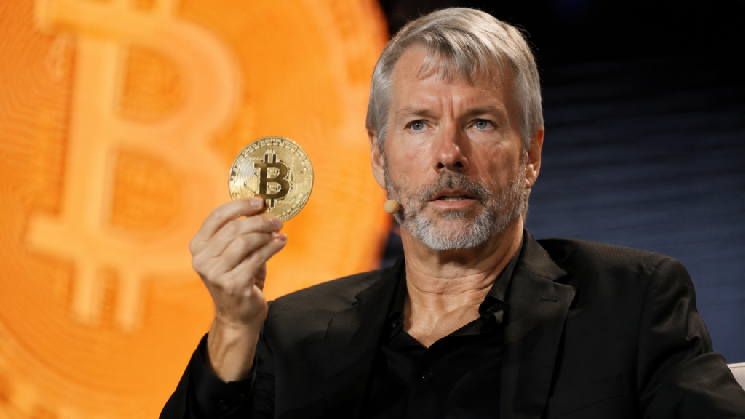
    Strategy, the world’s largest publicly traded Bitcoin holder, hadn’t purchased any $BTC for weeks. However, they changed that and made a Bitcoin purchase after weeks of inactivity.

    According to the company’s founder, Michael Saylor, they announced last week that they purchased 4,603 $BTC for $370 million.

    According to Saylor’s statement, the company increased its cash reserves in US dollars by $29 million during the same period, while repurchasing approximately $152 million worth of STRC shares.

    Strategy’s Bitcoin Reserve Exceeds 845,000 $BTC!

    With this latest purchase, Strategy’s total Bitcoin holdings have risen to 845,050 $BTC.

    As part of its Bitcoin treasury strategy, which began in 2020, the company has become one of the world’s largest institutional Bitcoin holders.

    Cash Reserves Also Increased!

    Another notable detail in Saylor’s statement was that the company not only bought Bitcoin but also strengthened its cash position.

    Strategy increased its USD cash assets by $29 million. The company reportedly had approximately $6.71 billion in USD assets as of August 30.

    As is known, the company has previously sold Bitcoin to finance dividend payments and support its cash reserves.

    Buyback on STRC Shares!

    Strategy also repurchased approximately $152 million worth of STRC shares.

    This move demonstrates that the company continues to manage its capital structure alongside its Bitcoin purchases. STRC stands out as one of Strategy’s series of variable-rate preferred stocks.

    *This is not investment advice.

  • Aave Users Gain New Tool as Almanak Unveils Public Launch

    Aave Users Gain New Tool as Almanak Unveils Public Launch

    Almanak has publicly launched today, offering Aave users a new non-custodial workflow for creating onchain strategies. This innovation allows users to transform strategy ideas into code using plain language or Python, facilitating backtesting and paper trading against mainnet forks. This development is significant as it enhances user control and strategy deployment while maintaining wallet autonomy, which is crucial in decentralized finance.

    What Went Down

    The launch of Almanak adds a powerful tool for Aave users, enhancing their ability to engage with onchain strategies. Users can now create and simulate strategies within a single platform, increasing efficiency and control over their trading. As the cryptocurrency market exhibits mixed signals, innovations like Almanak may attract attention from traders seeking to optimize their strategies and manage risks effectively. Aave’s ongoing evolution continues to position it as a leader in the decentralized finance space.

    Aave is a prominent decentralized finance protocol that allows users to lend and borrow various cryptocurrencies. The launch of Almanak provides Aave users with enhanced tools to develop onchain strategies, aligning with the protocol’s focus on innovation and user empowerment in the DeFi ecosystem. The platform’s non-custodial nature underlines the growing trend towards decentralized solutions that prioritize user control.

    Key Levels to Watch

    Traders should keep an eye on the ongoing developments within Aave as more users adopt Almanak for strategy deployment. The potential for increased user engagement and the introduction of new tools may lead to heightened activity in Aave’s liquidity pools. As more strategies are implemented, the overall health factor and user participation on the platform will be crucial metrics to watch.

  • Strategy returns to bitcoin buys, adding $370 million worth last week

    Strategy returns to bitcoin buys, adding $370 million worth last week

    Strategy MSTR$129.49·At close made its first bitcoin purchases since late June, adding 4,603 coins for $369.7 million last week, or an average price of $80,318 each.

    The acquisition was funded via the sale of $602.8 of common stock, according to a Monday morning press release. The remaining proceeds went toward $151.8 million in buybacks of the company’s STRC preferred stock and to add to Strategy’s cash reserves.

    Led by Executive Chairman Michael Saylor, the company now holds 845,050 bitcoin purchased for $63.73 billion, or an average price of $75,412 each.

    MSTR is up 1.65% pre-market as bitcoin trades at $78,400, up marginally from late Friday.

  • Zcash private transactions could go from three-second waits to under 200 milliseconds

    Zcash private transactions could go from three-second waits to under 200 milliseconds

    “Shielded wallets that use Zakura Common, and full nodes like Zakura itself, all benefit,” Zcash cofounder Sean Bowe said in an X post.

    Read more: Inside Zcash’s new node that targets Visa-scale privacy at 50,000 transactions per second

    The changes do not require an upgrade to Zcash itself. Wallet developers can adopt the open-source libraries on the network as it exists today. At the same time, Zakura has already moved to the new stack in version 1.3.0 and Vizor Wallet is among the first to pick it up.

    Zcash’s scaling problem is not only about how quickly the blockchain can produce blocks. When Zakura launched in July, its developers laid out a goal of eventually supporting more than 50,000 private transactions per second, roughly the scale of major card networks. They additionally put today’s wallet software at a ceiling of about one transaction per second.

    CoinDesk reported at the time that the plan involved attacking several bottlenecks at once, including how quickly nodes check transactions to how much data wallets have to download.

    However, the new cryptography stack attacks another one: how long the user’s own device spends constructing the private payment in the first place.

    Wallets should also sync faster under the new libraries, Zakura said, while full nodes benefit from quicker transaction checks and fewer orphaned blocks. The team said its software can already handle the 25-second block times proposed for Zcash’s next major upgrade, NU7.

  • September Fed rate hike fears look overblown as the probability stands at just 58%, not 90%

    September Fed rate hike fears look overblown as the probability stands at just 58%, not 90%

    On Friday, Warsh said inflation data “are more concerning” than trends in the labor market, adding that inflation is unlikely to return to target on its own. He pointed to PCE inflation, the Fed’s preferred gauge, standing at 3.7%, calling that level concerning relative to the central bank’s 2% target.

    He also noted that over the past year, more than half of goods and services tracked by the government saw price increases of 3% or higher, well above the roughly one-third that saw comparable increases in the two decades before the pandemic. The remarks were quickly read as hawkish, or pro-rate-hike, sending social media abuzz with expectations of a 25-basis-point hike in September. The benchmark borrowing cost currently sits in a range of 3.5% to 3.75%.

    BTC fell 3% to under $77,000 the same day, marking its first notable pullback following a steep rally from roughly $63,000 to over $80,000 earlier this month. Gold fell too, while the Dollar Index and Treasury yields both rose.

    Bianco isn’t alone in downplaying rate-hike fears. Firms including ABN AMRO Investment Solutions and Brandywine Global Investment Management are similarly skeptical.

    Robin Brooks, senior fellow at the Brookings Institution and former chief economist at the IIF, said that a potential rate hike would be aimed at calming Treasury-market jitters rather than delivering outright policy tightening. Such a move could signal that the Fed remains credible on inflation, reducing the extra premium investors demand to hold long-dated bonds and thereby capping the rise in yields.

  • Michael Saylor, Founder of Strategy, Signaled That the Company May Buy Bitcoin (BTC) Again! Here Are the Details

    Michael Saylor, Founder of Strategy, Signaled That the Company May Buy Bitcoin (BTC) Again! Here Are the Details

    Michael Saylor, founder of Strategy, a company known for its institutional investments in Bitcoin, signaled that his firm might buy Bitcoin again. Saylor attracted market attention by simply sharing the phrase “We’re ₿ack” on his social media account.

    The use of the Bitcoin symbol in the post was interpreted as an indication that Strategy, led by Saylor, was preparing to make a new $BTC purchase. However, Saylor did not directly confirm in his post that the company would be making a new purchase, nor did he provide any information regarding the amount of Bitcoin planned to be acquired.

    Strategy is among the leading companies that place Bitcoin at the center of their institutional treasury strategy. Through its regular $BTC purchases, the company has long been one of the largest institutional Bitcoin holders in the cryptocurrency market. Therefore, Saylor’s Bitcoin-themed posts could raise expectations for the company’s new purchases.

    Strategy’s Bitcoin purchases are generally closely watched in the crypto market. The company’s large-scale purchases are seen as an indicator of institutional demand for Bitcoin, and news of these purchases can also influence market sentiment.

    Saylor’s latest post therefore quickly became a topic of discussion among cryptocurrency investors. The phrase “We’re ₿ack,” being linked to similar messages used in the company’s previous Bitcoin purchase announcements, fueled speculation about a possible new acquisition.

    However, Strategy has not yet made an official announcement regarding a Bitcoin purchase. If the company does make a new purchase, the size of the transaction and the financing method will be details that investors will be particularly interested in.

    Strategy’s continued Bitcoin accumulation policy could lead to a further increase in the amount of $BTC on the company’s balance sheet. On the other hand, fluctuations in the Bitcoin price continue to have a significant impact on the company’s financial performance.

    Market participants are awaiting an official statement from Strategy following Saylor’s post, and the question is whether the company will make a new Bitcoin purchase in the coming days.

    *This is not investment advice.

  • LayerZero faces pressure as Selini Capital moves $2.18M ZRO: Can $1 still hold?

    LayerZero faces pressure as Selini Capital moves $2.18M ZRO: Can $1 still hold?

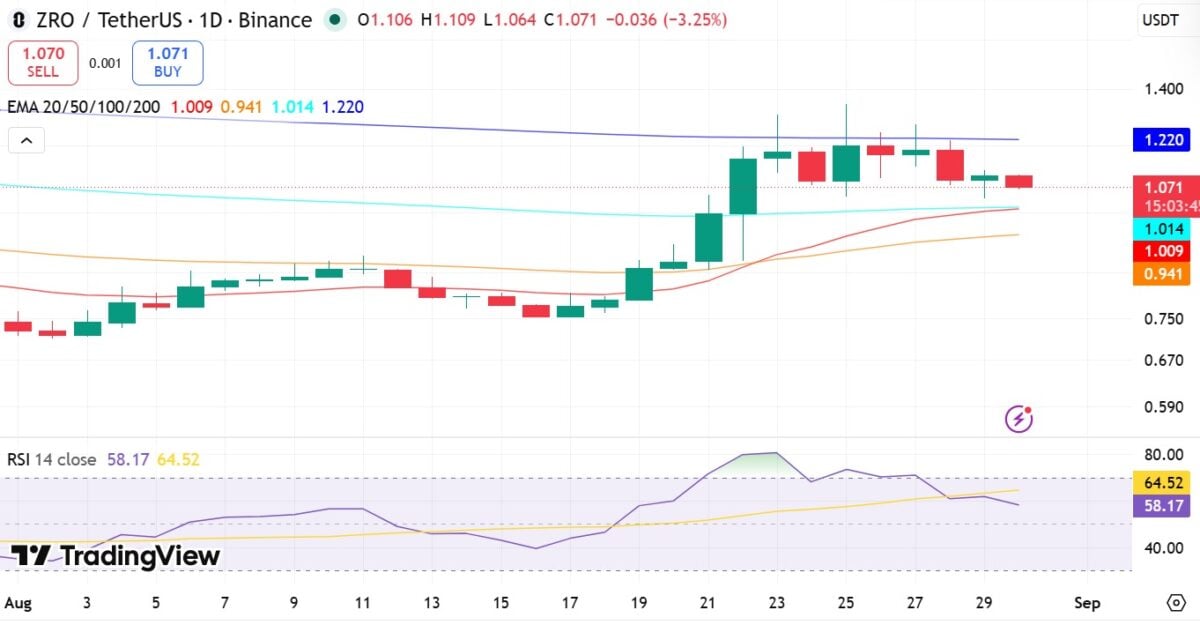
    After facing rejection at $1.30 days ago, LayerZero has faced strong downward pressure. In fact, $ZRO dropped below the long-term moving average 200-day EMA, hitting a low of $1.04.

    At press time, LayerZero was trading around $1.80, up 1.48% on the daily charts. Over the same period, the altcoin’s trading volume plunged 35% to $38 million.

    Amid these losses, LayerZero [$ZRO] has underperformed all other major crypto assets. According to CMC data, $ZRO is the worst performing asset among top 100 tokens , plunging 13% on weekly charts.

    Selini Capital deposits 2 million $ZRO worth $2.18 million

    Interestingly, even with the market leaning to the downside, institutional investors have increased spending substantially. Nazoku reported that Selini Capital deposited 2 million $ZRO worth $2.18 million to Binance.

    2d ago, Selini Capital received 2.1 million $ZRO from the multisig wallet 0x907. This multisig wallet had received 8.5 million $ZRO from LayerZero two years ago.

    These deposits to exchanges could mean several things. Firstly, Nazoku observed that the deposit could mean that these tokens finished the lock up period and deposited to Binance to sell.

    So far, the wall has deposited well over 4 million $ZRO to exchanges to sell and still holds another 4 million tokens.

    Can LayerZero whales come to the rescue?

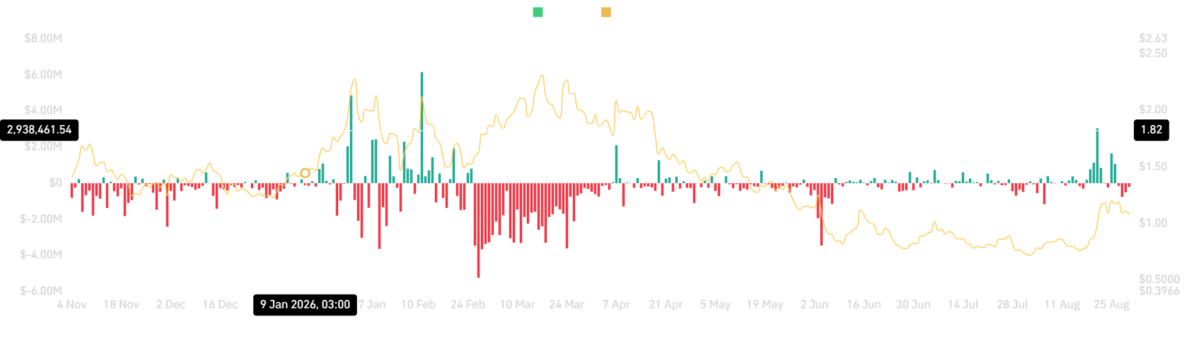
    Interestingly, although LayerZero has seen some losses, traders on the spot are holding firmly. According to Coinglass data, Spot netflow has remained positive for four consecutive days.

    Source: CoinGlass

    At press time, Netflow was around -$203k, suggesting more $ZRO have left exchanges the past 24 hours. However, most of those buys came from whales.

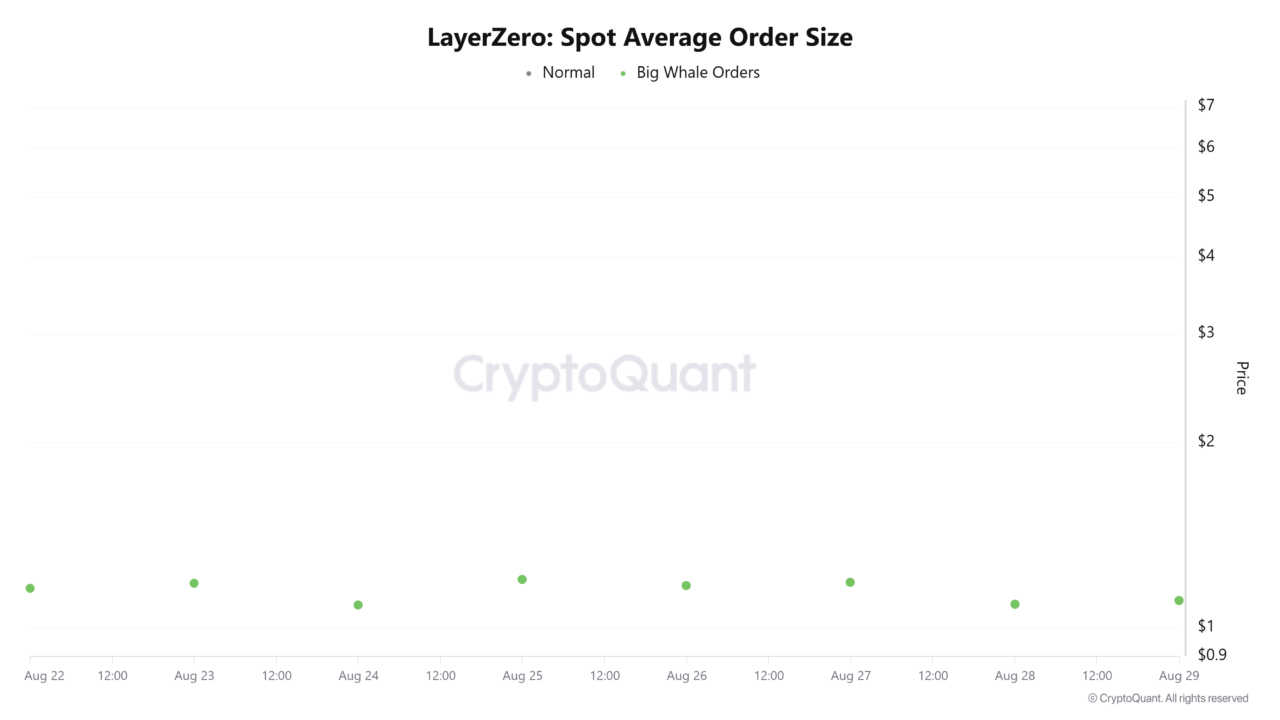
    In fact, Spot Average Order Size data from CryptoQuant showed big whale orders emerging between $1.1 and $1.0, making these price levels key whale zones.

    Source: CryptoQuant

    With the Spot netflow holding negative while whale orders are visible, it suggests these whales have been mostly accumulating. Historically, when whale demand holds steady, it has strengthened market structure, clearing a way for some gains.

    Can $1 support hold?

    $ZRO is currently facing intense bearish pressure. In fact, the altcoin’s Relative Strength Index (RSI) formed a bearish crossover and fell to 58.

    While RSI made a bearish move, it still holds within bullish zone , suggesting that bears are yet to fully retake the market. If the pressure persist, the RSI will drop below 50, thus confirming this bearish trend.

    Source: TradingView

    Currently, LayerZero is testing the $1 support level, and trend continuation will see this level lost. In doing so, the altcoin will likely drop to EMA20 around $0.94.

    To invalidate this bearish outlook, LayerZero must close above its long-term moving average around $1.2.


    Final Summary

    • Selini Capital deposited 2 million $ZRO worth $2.18 million to Binance.
    • LayerZero dropped 13% on weekly charts becoming worst performing token among top 100 on CMC, as bears eye a drop below $1.
  • Bitcoin barely blinks as U.S. hits Iran, sending oil higher and stocks lower

    Bitcoin barely blinks as U.S. hits Iran, sending oil higher and stocks lower

    Geopolitical stress is back in the market, lifting oil higher. Still, bitcoin $BTC$77,528.67 is trading steadily during Asian hours, showing resilience and outperforming gold and stocks, a recurring theme through August.

    Oil prices rose on both sides of the Atlantic after the U.S. attacked an Iranian island in the Strait of Hormuz, a major oil tanker route that has been disrupted since the conflict began six months ago. The attack drew retaliatory action from Iran.

    WTI crude futures jumped nearly 2% to $85.10, with Brent rising 1.9% to $92.39, according to TradingView. Gold fell 0.8% to $4,418 per ounce, and futures tied to the Nasdaq slipped 0.5% alongside losses in Asian equity markets.

    Bitcoin, however, traded near $77,580, largely unchanged since midnight UTC, according to CoinDesk. $BTC’s price has surged 23% this month versus gold’s 9% gain and the Nasdaq’s 4% rise. Other major tokens, however, traded slightly lower. Payments-focused $XRP ($XRP) fell by 0.8% with solana (SOL) down 0.6%.

    Bitcoin’s continued outperformance could be linked to strong inflows into spot ETFs and hopes for aggressive intervention by the Fed in the wake of the Treasury’s bond buyback program.

  • Cronos halts blockchain after $75 million lending exploit hits lending app Tectonic

    Cronos halts blockchain after $75 million lending exploit hits lending app Tectonic

    Cronos stopped its entire blockchain on Sunday after an attacker exploited Tectonic, its biggest lending platform, in an attack estimated at roughly $75 million.

    Cronos is a blockchain launched by Crypto.com in 2021 and closely tied to the exchange, which uses it to run cheaper transactions for its own products. Its CRO token is the one Crypto.com holds up as the centre of its ecosystem, and the chain hosts a small set of lending and trading apps, of which Tectonic is the largest.

    Tectonic lets users deposit crypto and borrow other assets against it, much like putting up a house as collateral for a loan.

    One of the assets it accepted as collateral was TONIC, its own token, which had about $1.34 million of liquidity and roughly $11,000 of daily trading volume. Tectonic’s own documentation warns that low-liquidity assets can be particularly susceptible to price manipulation.

    That appears to have provided the opening, blockchain data shows, as an attacker pushed TONIC’s price up roughly 100-fold in about 20 minutes, deposited the suddenly much more valuable tokens into Tectonic and borrowed real assets against them.