Parishioners have managed to save the historic church of St James (Picture: Cover Images)
An English church with a more extreme lean than the Tower of Pisa has been saved from collapse.
St James in Dry Doddington, Lincolnshire attracts hundreds of visitors each year who flock to see its 5.1° tilt — considerably more of a lean than the 3.97° of its Italian rival.
But the 12th-century tower has been in danger of collapse since 2015 due to stone erosion.
A total of £100,000 was spent on restoration, but in the last few months it has deteriorated again, sparking an appeal for help by parishioners.
St James has a tilt of 5.1° — considerably more of a lean than the famous Tower of Pisa (Picture: Cover Media)
The church has now received a £128,106 grant from The National Lottery Heritage Fund, to the delight of church warden Richard Loynes.
‘This is excellent news and means that they can now place an order with the selected contractor to carry out the restoration work, which is programmed to commence in mid-October and be completed by next spring,’ he said.
The work will include a completely new floor to the nave, minor repairs to the chancel, repairs to cracked walls, making good all internal wall plastering, upgrading the electrics and providing a new information board.
The wonky tower dates from the 1300s (Picture: Cover Media)
‘Completion of this essential restoration will ensure that this important piece of built heritage can be preserved and used for many years to come,’ Mr Loynes added.
‘As the church has free-standing pews, once the work is completed it will also mean that the building can be used by the local community for a variety of events as well as traditional worship. Without it, the building would have to close in the near future as it becomes unsafe to use.”
A tea party will be held in the village hall on Saturday September 19 to celebrate.
St James Church was built originally as a Chapel of Ease for older residents to attend church rather than walking to neighbouring Westborough.
It later became a parish church in its own right. The tower, which dates from the 1300s, is believed to have first been moved in the late 19th century.
Bitcoin once again drew attention with its strong performance in August, and LMAX Group Market Strategist Joel Kruger, speaking to The Block, noted that the rise occurred despite challenging macroeconomic conditions.
Bitcoin’s Strong August Performance!
The leading cryptocurrency, Bitcoin, ended August with a strong gain.
At this point, $BTC has surged approximately 25% in August, marking its strongest August performance since 2017. This rise also marks the highest monthly gain since November 2024.
It Rose Despite Macroeconomic Pressures!
According to Joel Kruger, Bitcoin’s August performance occurred despite challenging market conditions. During the same period, bond yields rose, the US dollar strengthened, and geopolitical risks resurfaced.
Kruger noted that while these developments have put pressure on risky assets, it is remarkable that Bitcoin has remained strong.
The $80,000 Level is Critical!
Bitcoin started September at around $78,000, and according to Kruger, $BTC is holding onto most of the gains it made after the rally.
At this point, Kruger predicts that Bitcoin may enter a period of consolidation for now. Identifying the $80,000 to $82,820 range as a significant resistance zone for the coming days, Kruger added that a sustained move above this range could revive a rise towards $100,000.
Kruger concludes by stating that macroeconomic data from the US could be decisive in determining the direction of Bitcoin in the coming period. In particular, employment data and messages regarding the Fed’s interest rate policy will be closely watched in terms of risk appetite in the crypto market.
Ethereum has fallen 2.3% over the past 24 hours to roughly $2,414, putting the $2,400 level under pressure as geopolitical tensions, higher Treasury yields and large whale transfers weigh on $ETH.
CoinGecko puts $ETH at $2,414 at the time of writing, after the token fell from the $2,480 area and briefly traded below $2,400 during the past 24 hours.
Ethereum is also down 2.1% over the past seven days, although it remains up 26.6% over 14 days and 29.6% over the past month.
The latest decline has come as renewed fighting between the United States and Iran pushed investors away from risk assets.
Brent crude moved above $95 per barrel as the conflict raised concerns that higher energy costs could keep inflation elevated.
Bitcoin has fallen below $77,000 during the same risk-off move, while Solana, XRP and several other major cryptocurrencies have also traded lower.
$ETH‘s decline therefore comes as part of a crypto market sell-off instead of an Ethereum-specific move.
Pressure from the bond and currency markets has added to the decline. The US 10-year Treasury yield climbed to roughly 4.81%, its highest level since November 2023, while the dollar index reached its highest point since Aug. 17.
According to Reuters, traders are pricing a roughly 68% probability of a Federal Reserve rate increase in September as policymakers assess the inflation risk from higher energy prices.
Rising Treasury yields increase the return available from government debt, while a stronger dollar can reduce demand for risk assets including cryptocurrencies.
Ethereum also faces a large potential source of supply after a whale holding 167,855 $ETH, worth roughly $408 million, began moving tokens to exchanges.
The address transferred 70,739 $ETH worth $174 million to several exchanges over two days and still held roughly 97,115 $ETH.
Transfers to exchanges do not confirm that the entire amount will be sold. However, the size of the deposits has put the position in focus while $ETH trades close to $2,400.
Institutional demand has also eased from levels recorded during Ethereum’s late-August price rise.
Daily US spot Ethereum ETF inflows reached $234.5 million on Aug. 27 before falling to $102.2 million and then roughly $87.7 million on Aug. 31.
Trading volume across the products also fell towards the end of the month.
Ethereum’s Coinbase Premium Index has meanwhile moved into negative territory at roughly -0.014.
The reading means $ETH has been trading at a discount on Coinbase relative to other venues, compared with the positive premium seen during stronger US investor demand.
$ETH had already struggled to hold its late-August gains before the latest sell-off.
The token reached roughly $2,558 on Aug. 27 but failed to stay above $2,500, leaving the $2,480-$2,520 region as the main overhead resistance area.
$ETH price analysis
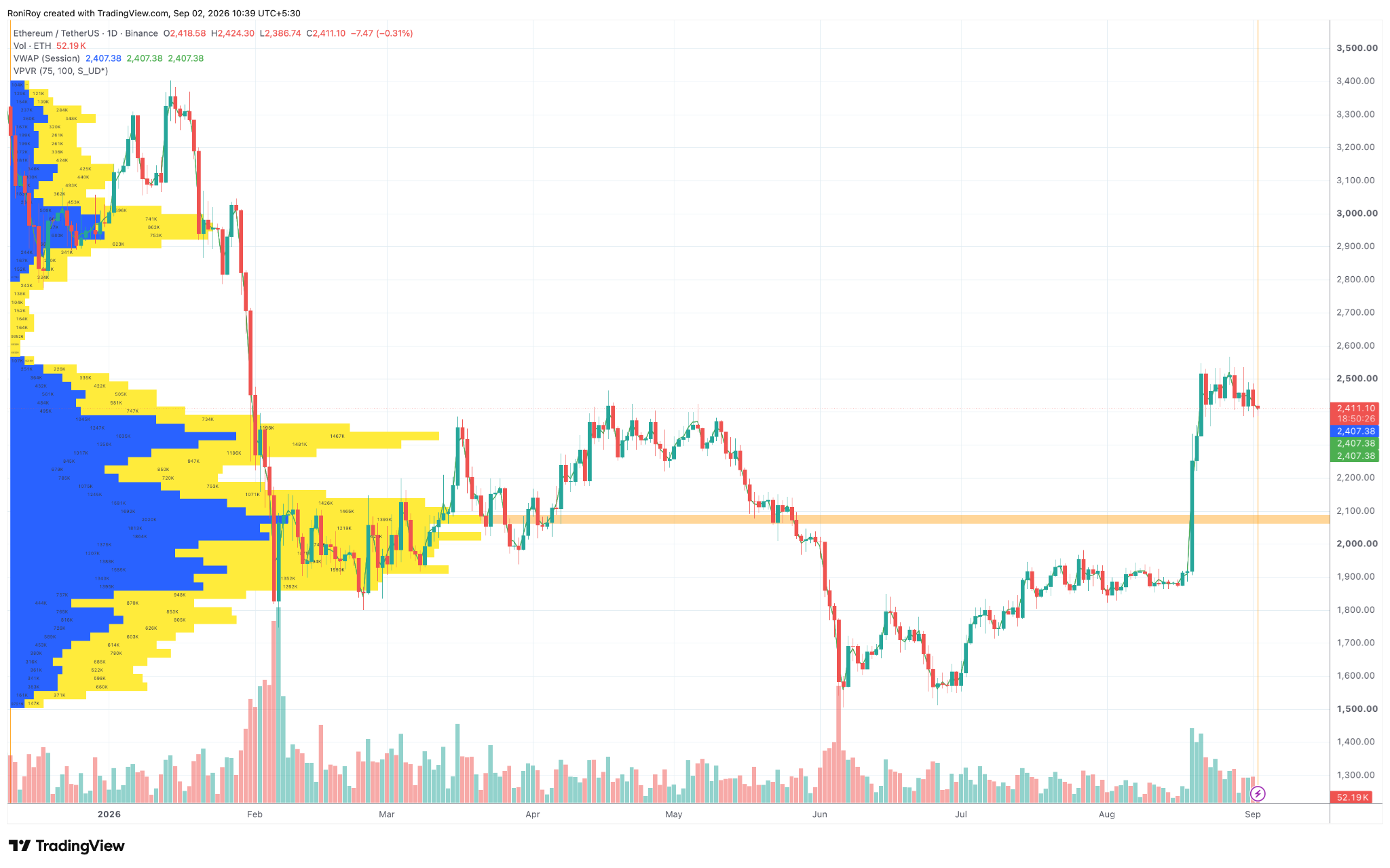
$ETH is trading near $2,411 on the daily chart after falling from the late-August high above $2,550. See below.
Price has returned almost exactly to the session VWAP at $2,407, leaving $2,400 as the first level that buyers need to defend.
The daily volume profile shows relatively little established trading volume between the current price and the much heavier volume area around $2,000-$2,100.
$ETH quickly broke through this region during its August surge, so a sustained move below the current consolidation could leave fewer high-volume areas to slow a sell-off before lower support comes into play.
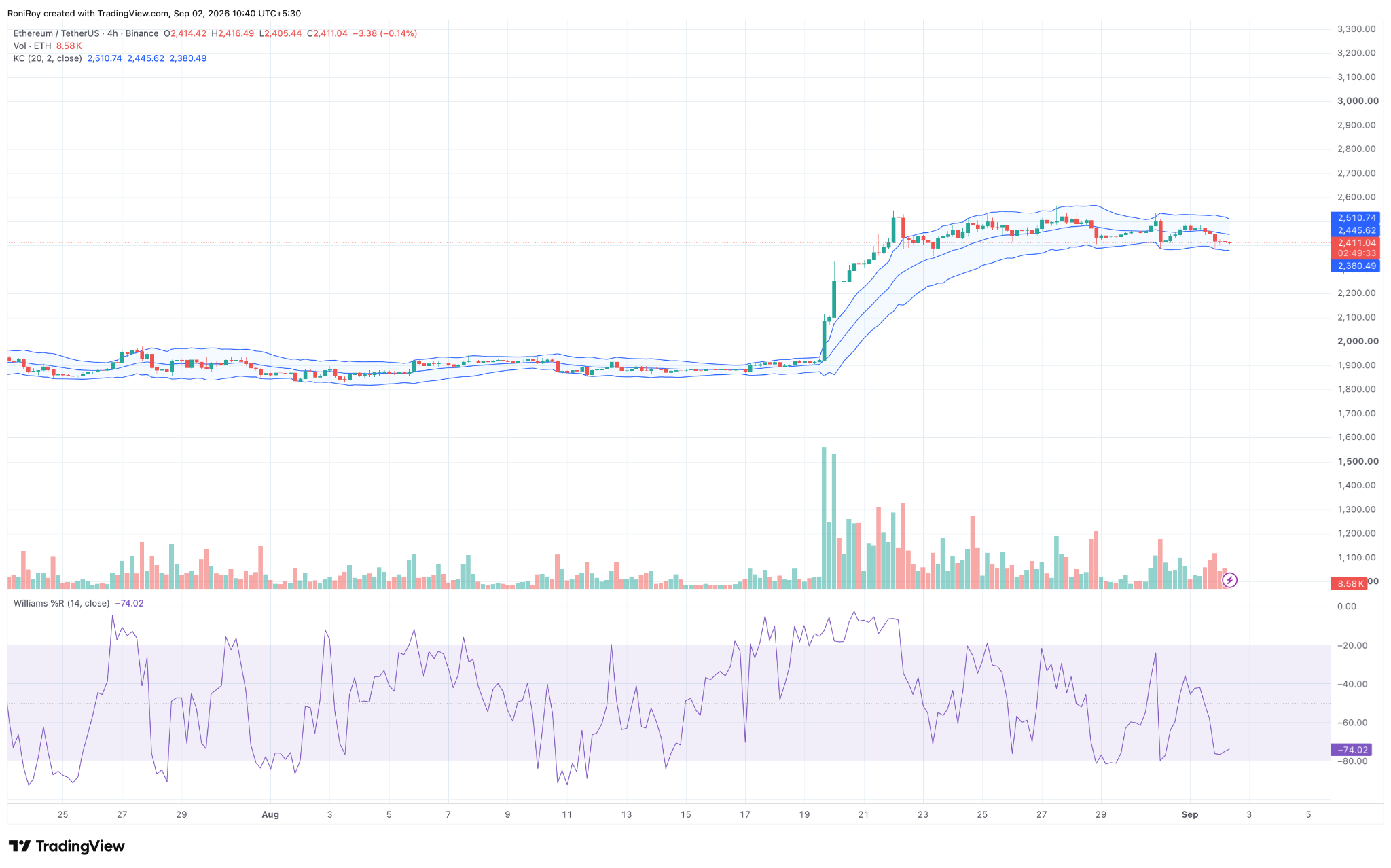
The 4-hour Keltner Channel puts its middle band at roughly $2,446, with $ETH now trading below it.
The lower band sits near $2,380, while the upper boundary is around $2,511.
A move back above $2,446 would put $2,480 in reach, followed by the $2,500-$2,511 area.
A close above $2,511 would open a retest of the Aug. 27 high around $2,558.
Williams %R on the 4-hour chart has fallen to roughly -74. The oscillator is approaching its oversold region below -80 but has not entered it yet, leaving room for sellers to push $ETH lower before momentum reaches an extreme reading.
A drop below -80 alongside a test of $2,380 would make that level important for signs of a short-term rebound.
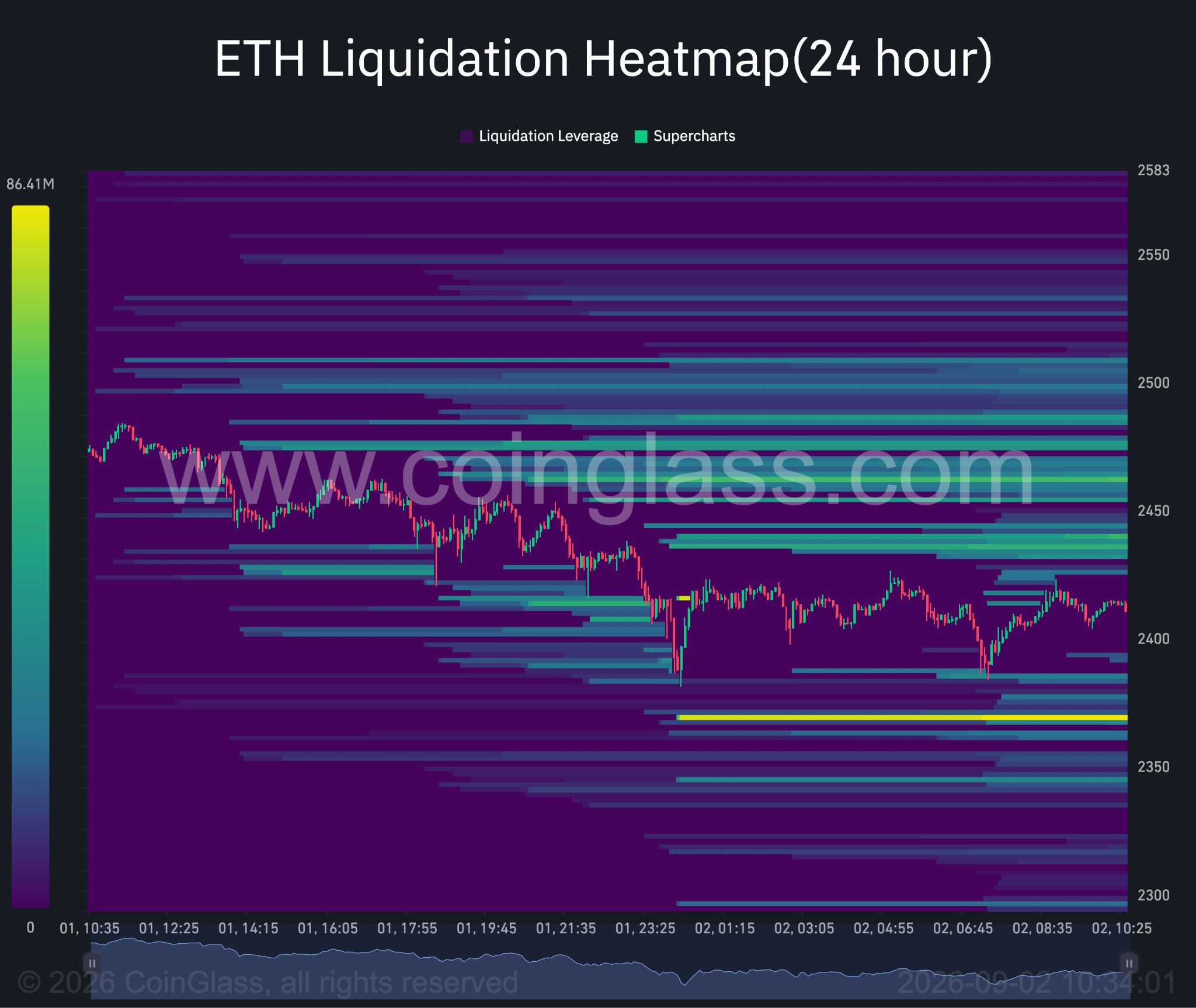
The 24-hour liquidation heatmap adds another level just below the Keltner support.
Monad‘s MIP-12 upgrade cut the network’s block time from 400 milliseconds to 300 milliseconds. It activated on mainnet on July 23, 2026, at round 89,758,000, and lowered Monad’s deterministic finality from about 800 milliseconds to roughly 600 milliseconds. The change came from Category Labs, the team that builds Monad, and it adjusted several other network settings at the same time.
What Is MIP-12?
MIP-12, short for Monad Improvement Proposal 12, is a governance change that shortened Monad’s consensus voting cycle by 100 milliseconds. Category Labs published the draft, the community reviewed it, and it went live through the v0.15.1 client release.
The proposal did more than shorten block time. It also lowered the block reward from 25 $MON to 18 $MON per block, a change sized to match the shorter production cycle, and it cut the block gas limit from 200 million to 150 million.
How Does Monad Produce Blocks So Fast?
Monad’s speed comes from splitting two jobs that most blockchains do together: agreeing on transaction order and running the transactions.
On Ethereum, validators must fully execute every transaction before voting on a block, leaving roughly 100 milliseconds of execution time inside a 12-second block.
Monad separates this into parallel pipelines. Validators agree on order first, through a mechanism called MonadBFT, then execution happens afterward with access to the full block window.
MonadBFT is a pipelined Byzantine Fault Tolerant protocol with linear message complexity, meaning validators don’t need to talk to every other validator on the normal path. It also resists tail-forking, a flaw in earlier pipelined designs where a bad-acting leader could fork away a previous block.
This design is what let Monad shorten block time without lowering gas throughput, which held steady at 500 megagas per second. To keep that rate, the per-block transaction limit dropped from 5,000 to 3,750, calculated by dividing the new 150 million gas limit by 40,000. The per-transaction gas limit stayed unchanged at 30 million.
What Does Faster Finality Mean In Practice?
Finality is the point where a transaction can’t be reversed except in rare edge cases. Before MIP-12, Monad reached deterministic finality in two consensus rounds, about 800 milliseconds, and speculative finality in one round, about 400 milliseconds. After the upgrade, those numbers dropped to roughly 600 milliseconds and 300 milliseconds. For applications like high-frequency trading or onchain gaming, that gap is what users actually feel.
How Does Monad Compare To Other Layer-1 Chains?
Block time alone doesn’t tell the whole story, since chains define finality differently. Still, the comparison shows where Monad now sits.
Ethereum: 12-second block time, about 16 minutes to finality
Solana: 400-millisecond block time today, moving toward a 200-millisecond target
Base: 2-second block time, about 13 minutes to finality
Arbitrum: 250-millisecond block time
Robinhood Chain: 100-millisecond block time
Monad: 300-millisecond block time, about 600 milliseconds to deterministic finality
Monad keeps full EVM compatibility while running on consumer-grade hardware across a validator set spread over more than 30 countries, which separates it from chains that need specialized infrastructure to hit similar speeds.
What Comes Next For Monad And $MON?
$MON has traded in a wide range through 2026 and is currently changing hands around $0.025 to $0.029. The token gained more than 44% over one week in late August, rising from about $0.020 toward $0.029, after the Monad Foundation announced on August 18 a program to buy back up to $60 million in locked $MON from early investors at a discount. Network total value locked has climbed alongside that rally, approaching $1 billion by late August, up from roughly $868 million earlier in the month.
Entropy Advisors data lead Tom Wan flagged the 300-millisecond milestone publicly when it activated, framing it alongside Solana’s own push toward 200-millisecond blocks. The next scheduled event for $MON holders is a token unlock on November 24, 2026, separate from this technical upgrade but likely to shape trading conditions around it.
MIP-12 lowered Monad’s block time to 300 milliseconds, cut deterministic finality to about 600 milliseconds, and rebalanced block rewards and gas limits to match. The upgrade runs on Monad’s existing split between transaction ordering and execution through MonadBFT, and it holds gas throughput steady at 500 megagas per second on a distributed, consumer-hardware validator set.
Conclusion
MIP-12 lowered Monad’s block time to 300 milliseconds, cut deterministic finality to about 600 milliseconds, and rebalanced block rewards and gas limits to match. The upgrade runs on Monad’s existing split between transaction ordering and execution through MonadBFT, and it holds gas throughput steady at 500 megagas per second on a distributed, consumer-hardware validator set.
Resources
Monad Documentation: Releases changelog covering v0.15.0, v0.15.1, and MIP-12 activation
OKX may restrict account functions and funds for 15 days or longer when cryptocurrency deposits trigger enhanced anti-money laundering reviews, CEO Star Xu said on Sept. 2.
Xu issued the warning after responding to a user whose transfer from a sports betting platform reportedly triggered an OKX risk review. The executive said funds sent from high risk addresses can result in stricter checks, with the length of a review depending on the circumstances.
Accounts confirmed to be connected to high risk or illegal activity may have their services terminated, according to Xu. His statement did not identify the user, betting platform, deposited asset or amount involved.
Xu also warned about funds originating from escrow transactions conducted through Telegram groups, Huiwang and related platforms. Such channels can create elevated source of funds risks, although a transfer from a flagged address alone does not prove that an account holder committed a crime.
OKX reviews may restrict funds beyond 15 days
Xu said an OKX risk review may continue for 15 days or longer. During that period, the exchange may restrict access to funds and some account functions while its compliance team examines the transaction history.
The statement did not establish 15 days as a fixed minimum or maximum. Xu said the duration would depend on the facts of each case, meaning reviews may conclude sooner or continue beyond that period.
Crypto exchanges use blockchain monitoring tools to assess whether deposited assets have interacted with addresses associated with scams, hacks, sanctions, darknet markets or other flagged services. They may also request transaction records and evidence explaining how a customer obtained the assets.
Blockchain screening works by tracing transaction paths and assigning risk labels to wallets. Those labels can help exchanges prioritize reviews, but they do not independently establish ownership, criminal intent or legal liability. Assets can pass through several unrelated wallets before reaching an exchange.
Xu did not disclose which blockchain analytics providers OKX uses or what risk score triggers a restriction. The exchange also has not published a detailed appeals process specific to the case that prompted his response.
OKX CEO identifies higher risk funding channels
Xu specifically cited Telegram escrow transactions and Huiwang variants as examples of channels that may expose users to elevated source of funds risks. Telegram itself is a messaging platform, but private groups can be used to arrange informal trades without the customer verification controls found on regulated exchanges.
Escrow arrangements can also make a transfer harder to document. The address sending cryptocurrency to an OKX customer may belong to an intermediary rather than the original buyer or seller, creating gaps in the transaction record.
Xu used the name Huiwang, which is commonly associated with Huione, a Cambodia based group operating payment and online marketplace services. Different spellings and successor brands have appeared in public reporting, making it important not to treat every similarly named platform or address as automatically connected.
The U.S. Treasury’s Financial Crimes Enforcement Network took action against Huione Group in October 2025. FinCEN’s final rule identified the company as a foreign financial institution of primary money laundering concern and cut it off from the U.S. financial system.
FinCEN said Huione Group laundered at least $4 billion in illicit proceeds between August 2021 and January 2025. The agency attributed at least $37 million to North Korean cyber heists, $36 million to virtual currency investment scams and $300 million to other cyber scams.
Those amounts are U.S. government findings concerning Huione Group. Xu did not say that every transaction involving Huiwang or its variants contains criminal proceeds. He described them as channels carrying higher source of funds risk.
Previous U.S. case placed pressure on OKX compliance
OKX’s warning comes after the exchange faced a major U.S. enforcement case over its earlier compliance controls. In February 2025, its operating company pleaded guilty to operating an unlicensed money transmitting business in the United States.
The company agreed to pay more than $500 million in penalties and forfeiture. U.S. prosecutors said OKX had served American customers despite formally restricting the market and had failed to maintain an adequate anti-money laundering program for part of the relevant period.
The enforcement action helps explain the exchange’s stricter approach to customer screening. U.S. registered crypto businesses must maintain compliance programs, retain transaction records, file required reports and screen customers against sanctions and criminal risk indicators.
A detailed review of federal rules governing cryptocurrency exchanges explains that custodial exchanges and hosted wallet providers can fall under FinCEN’s money services business framework. Covered companies face anti-money laundering, recordkeeping and suspicious activity reporting duties.
These requirements do not mean an exchange must permanently seize every deposit that receives a high risk label. Exchanges must assess available information, apply their terms and comply with legally binding orders. The appropriate response can vary by jurisdiction and transaction.
Users may need to document their source of funds
Xu advised customers not to use OKX accounts for money laundering, fraud, illegal fund transfers or other unlawful conduct. Users receiving assets from betting sites, private markets or informal trading groups may face requests to document where the funds originated.
Useful records can include withdrawal receipts, platform account statements, transaction hashes, communications with counterparties and proof showing how the underlying funds were earned. Complete records do not guarantee that an exchange will release funds, but they can help compliance teams evaluate a transaction.
Customers should also check whether the sending platform is legal in their jurisdiction and whether OKX permits transfers from it. A betting platform can be licensed in one country and prohibited in another, while an exchange may apply stricter internal policies than the law requires.
Xu did not announce a new policy, product restriction or blanket ban on deposits from sports betting services. His statement explained how OKX may respond when a transaction activates its existing risk controls.
No regulator announced an investigation connected to the unidentified user’s case. OKX also did not disclose whether the review had concluded or whether the account remained restricted.
The next confirmed development would come from OKX resolving the review or releasing more detailed guidance about affected funding sources. Until then, Xu’s statement establishes that reviews can exceed 15 days and that confirmed illegal activity may result in the complete termination of services.
“Monetary policy should not mechanically react to a jump in headline inflation,” James E. Thorne, chief market strategist at wealth management firm Wellington-Altus, wrote on X. An oil shock, he argued, is “a growth shock dressed up as inflation,” and tightening into it would be “policy error masquerading as prudence.”
Mark Zandi, chief economist at Moody’s Analytics, made the same point. In a July 28, 2026 interview with CNN, he said: “Monetary policy 101 says when there is a supply shock, don’t respond. Follow the script. It’s worked pretty well … Bottom line: I don’t think they should raise rates.”
That does not mean the Fed will stay on hold on Sept. 16. The odds of a hike are rising, currently at 68%, according to the CME’s FedWatch tool. It does mean the case an increase is weaker than the tape implies. Until that decision lands on Sept. 16, another leg higher in oil can keep pressure on risk assets, including crypto. Stay alert.
Read more: For analysis of today’s activity in altcoins and derivatives, see Crypto Markets Today . For a comprehensive list of events this week, see CoinDesk’s “Crypto Week Ahead.”
What’s trending
U.S. pounds Iran, Tehran strikes back at bases in biggest exchange since July (Reuters): Asian and European stocks fell after renewed U.S. airstrikes pushed oil prices back to levels unseen since July, compounding the economic impact of a global selloff in bonds as disrupted energy supplies fuel inflation worldwide.
Solana, ether, xrp, lead majors slide as Iran strikes drive a broad risk selloff (CoinDesk): The selling that followed U.S. airstrikes on Iran did not land evenly. Solana and tron each shed more than 3% over the past 24 hours while bitcoin gave up roughly 1%. $XRP dropped nearly 2%.
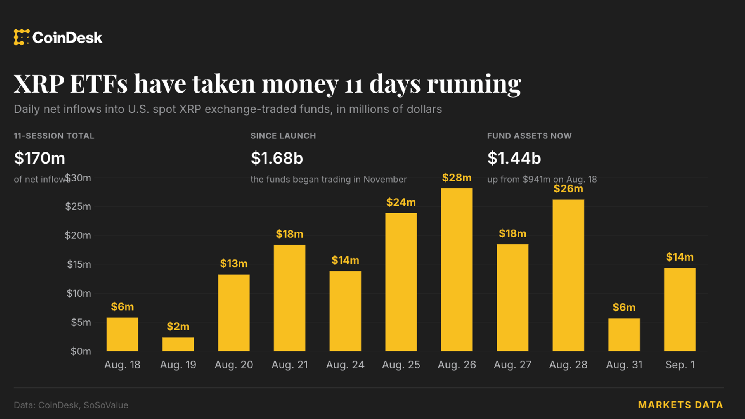
$XRP ETFs pull in $170 million over eleven days. Goldman tops institutional holders (CoinDesk): U.S. spot $XRP exchange-traded funds have taken in fresh money for 11 straight trading sessions. The funds pulled in another $14.38 million on Tuesday, lifting cumulative net inflows to about $1.68 billion.
Bitcoin withstands $90 oil and rising yields while gold slides. A firm dollar is the catch. (CoinDesk): The headwinds hitting bitcoin aren’t landing, even as they inflict damage on traditional assets. That relative strength, however, may still be challenged by a resilient Dollar Index. Futures tied to WTI oil have topped $90 and are up nearly 9% for the week.
Two Thai businessmen sued leading stablecoin issuer Tether over its freeze of 42.4 million $USDT, alleging the firm blocked the tokens months before U.S. authorities obtained a seizure warrant.
Nutthawat Rukthammachalern and Natthawat Kasamvilas said in an Aug. 31 complaint filed in the U.S. District Court for the Southern District of New York that Tether froze 42.4 million $USDT across 10 Ethereum addresses on Oct. 30, 2025.
They allege Tether acted on an informal request from a U.S. law enforcement agent, with no warrant or other legal process issued until Feb. 19, according to the complaint.
CoinDesk has reached out to Tether for comment but hasn’t heard back at the time of writing.
The plaintiffs said they acquired the $USDT through secondary-market business transactions and had no direct relationship with Tether.
They want the court to order Tether to remove the addresses from its blacklist and prevent it from destroying the frozen tokens and issuing replacements to a government-controlled wallet before a final forfeiture ruling.
The lawsuit also seeks damages and the return of interest or other income Tether earned from reserves backing the frozen $USDT. Its claims include conversion, trespass to chattels and unjust enrichment.
Remixpoint, a publicly traded cryptocurrency in Japan, announced it has sold all of its altcoin holdings to diversify its investment portfolio. The company stated that it will focus its future investments and operations solely on Bitcoin ($BTC).
According to an announcement made by Remixpoint on September 2nd, the company decided to reduce the assets in its portfolio and focus on a single digital asset. As part of this, all of its Ethereum ($ETH), Solana ($SOL), $XRP, and Dogecoin ($DOGE) holdings were divested.
The company reportedly held approximately 14.92 Bitcoin as of the end of August. The total value of these Bitcoins was estimated at approximately $1.026 million. Remixpoint also held approximately $68,400 worth of Ethereum staking and approximately $118,500 worth of Solana staking assets.
The assets sold by the company included 901 $ETH, 13,920 $SOL, 1.19 million $XRP, and 2.8 million $DOGE. Remixpoint generated approximately $5.5 million in revenue from these sales, resulting in a profit of approximately $736,800.
Remixpoint’s decision to completely close its altcoin positions signals a significant shift in the company’s digital asset strategy. Instead of investing in numerous crypto assets, the company has chosen to place Bitcoin at the center of its portfolio.
This single-asset strategy for Bitcoin also parallels the $BTC treasury approach recently seen among institutional companies. Bitcoin’s limited supply, high liquidity, and increasing adoption by institutional investors are influencing companies to consider $BTC as a long-term reserve asset.
No information has been shared regarding whether Remixpoint will reposition itself in altcoins as part of its new strategy. According to the company’s current plan, Bitcoin will remain the focus of its investment and operational activities from now on.
Remixpoint’s decision represents a shift away from diversified investments in the altcoin market towards a more concentrated digital asset strategy. Whether the company will increase its Bitcoin reserves in the future will be closely watched by the market.
While Goldman’s large ETF holdings might seem like the bank’s own long-term directional bet, that is not necessarily the case. These holdings may have stemmed from market-making, basis trading, and the facilitation of client orders from wealth management accounts, rather than from a unified corporate strategy to back $XRP.
Jane Street followed with $16.6 million and Millennium Management with $16.2 million.
13F filings are quarterly disclosures that show many of the U.S.-listed stocks and funds held by large investment managers. They offer one of the few public windows into which professional firms are using the new $XRP ETFs, although they do not reveal whether those firms are also hedging the positions elsewhere.
Investment advisers were by far the largest category of reported holders, accounting for about $120 million of the $183 million disclosed across the filings. Hedge funds held about $25 million, brokerages held $17 million, and banks around $14 million.
Advisers also accounted for most of the increase during the quarter. Their holdings rose by about $90 million, compared with a $103 million increase across all categories.
As such, the institutional holdings and the inflow streak measure different things. The filings show who held the ETFs on June 30, while the nine-day run records fresh money entering the funds in late August and early September.
Strategy CEO Phong Le said Bitcoin is entering a strong bull market and the company has no plans to sell its $BTC holdings. Speaking in an interview with Bloomberg, Le stated that Strategy will continue its Bitcoin accumulation strategy and may continue buying even if the price rises.
Le stated that the company would continue to make purchases even if Bitcoin reached $80,000, $90,000, $100,000, or $130,000. The Strategy CEO said that if Bitcoin were to reach $260,000 in the future, investors would still consider purchases made at the $130,000 level as a successful investment in retrospect.
Strategy is known as one of the largest companies that places Bitcoin at the center of its institutional treasury strategy. The company maintains its long-term approach by increasing the amount of Bitcoin on its balance sheet through regular $BTC purchases. Phong Le’s recent statements also indicate that Strategy will not abandon its Bitcoin accumulation policy despite price fluctuations.
The company’s decision not to sell Bitcoin is based on the expectation that the crypto asset will appreciate in value in the long term. Strategy management argues that Bitcoin’s limited supply, as well as increasing institutional adoption, could provide long-term support for the price.
Le’s assessment revealed that the company is focusing on long-term potential rather than short-term price movements in Bitcoin. The CEO stated that even purchases at levels as high as $130,000 could be considered reasonable retrospectively if Bitcoin were to reach $260,000.
Strategy’s aggressive Bitcoin accumulation policy sets the company apart from traditional institutional investors, but it also increases its balance sheet risk against declines in the $BTC price. Despite this, Le has given no indication that the current strategy will be changed.
The assessment that Bitcoin has entered a strong bull market supports the expectation that the company may continue to make large-scale $BTC purchases in the future. Market participants are closely monitoring Strategy’s new purchases and changes in the company’s Bitcoin reserves.