Grayscale, a crypto asset management company, stated that the record-high share of equities in US household financial assets could turn the cryptocurrency market into a new portfolio diversification opportunity.
According to Grayscale’s assessment, approximately 46 percent of US household financial assets are currently held in stocks. The company also noted that price-to-earnings ratios for stocks are historically close to high levels. This means that the risks associated with investor portfolios being concentrated in a single asset class may increase.
In contrast, Grayscale argued that the cryptocurrency market is in a different position. According to the company, after a prolonged bear market, a significant portion of the leverage in the market has been cleared, and investors’ positions have been rebalanced. These developments could signal the beginning of a new recovery cycle in the crypto market.
Grayscale emphasized that investors don’t need to completely replace their stocks with crypto assets. According to the company, the real opportunity may lie in diversifying portfolios that are overly concentrated in stocks by spreading them across different asset classes.
Grayscale noted that the fundamental dynamics of the crypto market continue to improve, and that the current price levels being lower compared to previous periods of the market cycle could also create an advantage in terms of diversification.
The company stated that adding crypto assets to portfolios does not mean completely exiting stocks, but rather allows for the inclusion of assets with different risk and return characteristics within the same portfolio.
Grayscale’s assessment comes at a time when high exposure of US households to equities is a major concern. The company believes that reduced leverage levels in the crypto market and a rebalancing of investor positions could pave the way for a new bull cycle.
However, Grayscale noted that crypto assets carry high volatility and investors should consider their risk profiles. The company’s approach positions crypto not as an alternative to traditional assets, but rather as a complementary diversification tool for overly concentrated portfolios.
Bitcoin is trading at $77,755.77, up 1.1% over 24 hours, as the broader crypto market cap sits at $2.7 trillion, roughly flat on the day with $73.5 billion in trading volume. Bitcoin’s share of the total crypto market has grown to 59.7%, its highest recent level, as BTC continues outpacing altcoins in overall market weight. Ethereum dominance sits at 11.2%, while the remaining assets across the market make up 29.1% of total capitalization.
Weak Labor Data Adds to Rate Cut Bets
Private payrolls rose by just 38,000 in August, according to ADP data, below the 47,000 forecast and down from July’s 46,000 reading. The softer print has strengthened the case for a Federal Reserve rate cut, a scenario that would typically support stocks and crypto while pressuring the dollar and Treasury yields.
Markets are now focused on Friday’s nonfarm payrolls report, with economists expecting a gain of 53,000 jobs and unemployment holding steady at 4.1%.
Expert Take
According to market analysis from Vikram Subburaj, CEO of Giottus.com, Bitcoin is trading in a largely range-bound market as investors wait for clearer signals from Friday’s employment data. Markets are currently pricing in roughly a 66% probability of a rate move from the Fed, a level of uncertainty Subburaj said continues to cap risk appetite across crypto.
On-chain data paints a mixed but not weak picture, Subburaj told Coinpedia. Around 68% of Bitcoin’s circulating supply remains in profit, and the short-term holder cost basis sits near $71,000, meaning most recent buyers are still in positive territory.
However, he flagged that ETF demand has become less consistent following a strong August, suggesting institutional buying is no longer providing the same steady, one-directional support it did earlier in the rally.
Large-cap altcoins remain subdued alongside Bitcoin, with Ethereum trading near $2,383 and Solana around $100, broadly in line with current CoinMarketCap pricing of $2,404.20 and $100.90 respectively.
Levels to Watch
Subburaj’s advice for traders heading into Friday’s data was to avoid aggressive leverage, and favor staggered accumulation with disciplined position sizing instead. He flagged $76,200-$76,500 as the immediate support zone for Bitcoin, with $77,700-$78,300 as the resistance range to watch in the near term.
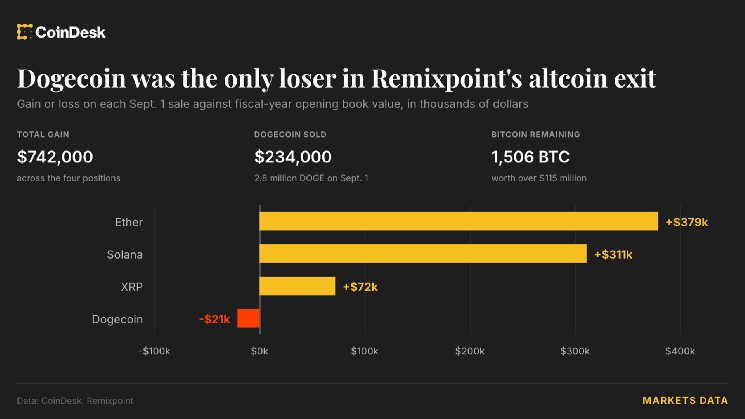
Japan-listed Remixpoint made money when it reported selling ether ETH$2,404.40, solana (SOL) and $XRP on Wednesday. Dogecoin $DOGE$0.08115 was the exception.
The company sold 2.8 million $DOGE on Sept. 1 for about $234,000, roughly $21,000 below its fiscal-year opening book value. Ether produced a $379,000 gain, solana $311,000 and $XRP about $72,000, leaving Remixpoint with a roughly $742,000 gain across the four positions.
The $DOGE loss is measured against the value Remixpoint carried the position at when its current fiscal year began, rather than its original purchase cost. The company sold all four altcoins on the same day.
The loss stands out because dogecoin is no fringe token in Japan. $DOGE has been traded by registered Japanese crypto exchanges since 2022, and the Japan Virtual and Crypto Assets Exchange Association, the industry’s recognized self-regulatory body, began publishing an official $DOGE/JPY reference price this year alongside bitcoin, ether, $XRP and solana.
Remixpoint said it sold the four tokens after reviewing market conditions and their risk-return characteristics, and will now concentrate its crypto holdings in bitcoin.
The company still owns about 1,506 BTC, worth over $115 million at Thursday prices, making bitcoin its only remaining cryptocurrency.
The U.S. Commodity Futures Trading Commission asked a federal court on Sept. 2 to dismiss CME Group’s lawsuit challenging the regulator’s treatment of cryptocurrency perpetual contracts as futures.
The CFTC argued that CME lacks legal standing because the exchange could list perpetual futures under the same regulatory policy it is challenging. The agency characterized part of CME’s claimed competitive disadvantage as resulting from its own decision not to offer comparable products.
CME filed the case in the U.S. District Court for the District of Columbia on June 18. It seeks to overturn the CFTC’s approval of Kalshi’s Bitcoin perpetual contract and a related agency policy statement.
The dismissal request represents the regulator’s position. The court has not ruled on the motion or decided whether cryptocurrency perpetual contracts should legally be treated as futures or swaps.
The CFTC moved to dismiss CME Group’s lawsuit challenging its approval of Kalshi’s Bitcoin perpetual futures, arguing CME failed to show competitive injury and lacks standing to challenge the decision.https://t.co/zu5JwAqVBM
— Gambity (@gambitycom) September 3, 2026
CFTC says CME created its alleged disadvantage
To establish standing in federal court, a plaintiff generally must show a concrete injury linked to the defendant’s conduct. It must also demonstrate that a favorable court ruling would likely address that injury.
CME claims the CFTC’s decision gave newer exchanges an unfair competitive advantage by allowing them to offer perpetual contracts under the futures framework. The exchange says those products should instead face the rules applying to swaps.
The CFTC disputes the claimed injury. It argued that CME is also a designated contract market and can seek permission to list perpetual futures under the same process available to Kalshi.
According to the regulator, any disadvantage arising from CME’s decision not to list the contracts is therefore “self-inflicted.” The agency said a party cannot establish standing by declining to use the same regulatory opportunity available to its competitors.
The CFTC also pointed to CME’s own trading figures. It said the exchange’s Bitcoin and Ether futures volumes in June and August exceeded their May levels, when the Kalshi approval was issued.
Those figures form part of the regulator’s argument that CME has not shown a concrete competitive loss caused by the approval. CME may challenge that interpretation when it responds to the motion.
Reclassification may not resolve CME’s alleged harm
The CFTC raised a second standing argument involving redressability. Even if the court classified perpetual contracts as swaps, the regulator said competing venues could still offer economically similar products.
A ruling in CME’s favor would therefore change the regulatory category without necessarily removing the competition CME claims is harming its business.
The CFTC said CME is not challenging the agency’s general authority to approve the product. Instead, the lawsuit focuses on whether the Kalshi contract fits the legal definition of futures or swaps.
The regulator also argued that CME’s competitive interests do not fall within the “zone of interests” protected by the Commodity Exchange Act provisions cited in the lawsuit. This test asks whether the interests a plaintiff seeks to protect relate to the purposes of the statute allegedly violated.
CME has presented the dispute as an issue involving regulatory consistency and investor protection. The CFTC’s motion frames it as a competitor attempting to use litigation against products it could offer itself.
CME says perpetual contracts are swaps
Perpetual contracts give traders continuing price exposure without a predetermined expiration date. They commonly use recurring funding payments to keep contract prices aligned with the referenced asset.
Traditional futures usually have fixed expiration and settlement dates. CME argues that the lack of an expiration date places perpetuals within the swap definition established under the Dodd-Frank Act.
The CFTC disagrees. It maintains that a futures contract does not require a fixed expiration date under the Commodity Exchange Act or existing regulatory interpretations.
The dispute began after the regulator approved Kalshi’s BTCPERP contract on May 29. The Bitcoin-linked product trades through KalshiEX, a CFTC-registered designated contract market.
As previously reported, the CFTC’s decision opened a regulated U.S. venue to Bitcoin perpetual futures after the products had largely remained on offshore cryptocurrency exchanges.
CME sued the regulator several weeks later. Its complaint seeks to vacate the Kalshi approval and the broader policy statement supporting the treatment of perpetual contracts as futures.
The central dispute concerns whether perpetual contracts legally qualify as futures or swaps. Each classification carries different registration, trading and oversight requirements.
CFTC defends its review of Kalshi’s contract
The CFTC reviewed Kalshi’s application under Regulation 40.3, which allows a designated contract market to request formal approval before listing a new product.
The agency concluded that the contract complied with the Commodity Exchange Act and CFTC rules. It also said perpetual designs may not be suitable for every asset and could require individual review.
CFTC Chair Michael Selig later rejected several criticisms directed at the decision. He said regulated perpetual contracts remain subject to domestic leverage, margin and customer protection requirements.
In related coverage, Selig argued that U.S. law does not require futures to carry fixed expiration dates. That interpretation now forms part of the broader legal dispute.
CME CEO Terry Duffy has criticized the approval process and warned that perpetual products could encourage excessive speculation. Kalshi has rejected that criticism and described the lawsuit as an effort to limit competition.
The companies’ statements represent opposing positions in active litigation. The court has not determined whether the CFTC followed the correct process or adopted the correct interpretation of the law.
CME response is due October 2
CME must file its opposition to the dismissal motion by Oct. 2. The CFTC has also requested an oral hearing, although the court will decide whether one is necessary.
The judge can dismiss the case on standing or other procedural grounds without resolving whether perpetual contracts are futures or swaps. Such a decision would leave the CFTC’s existing policy and Kalshi approval in place.
If the court finds that CME has standing, it could proceed to examine the substantive legal claims. Those claims include allegations that the agency misread the Commodity Exchange Act and acted arbitrarily under federal administrative law.
The case may also influence future applications from exchanges seeking to list perpetual contracts tied to cryptocurrencies, equities or commodities. Kalshi is reportedly preparing additional products, including a perpetual contract linked to WTI crude oil.
For now, Kalshi’s Bitcoin perpetual remains available under the futures framework. The CFTC’s dismissal motion begins the next stage of the case but does not settle the classification dispute.
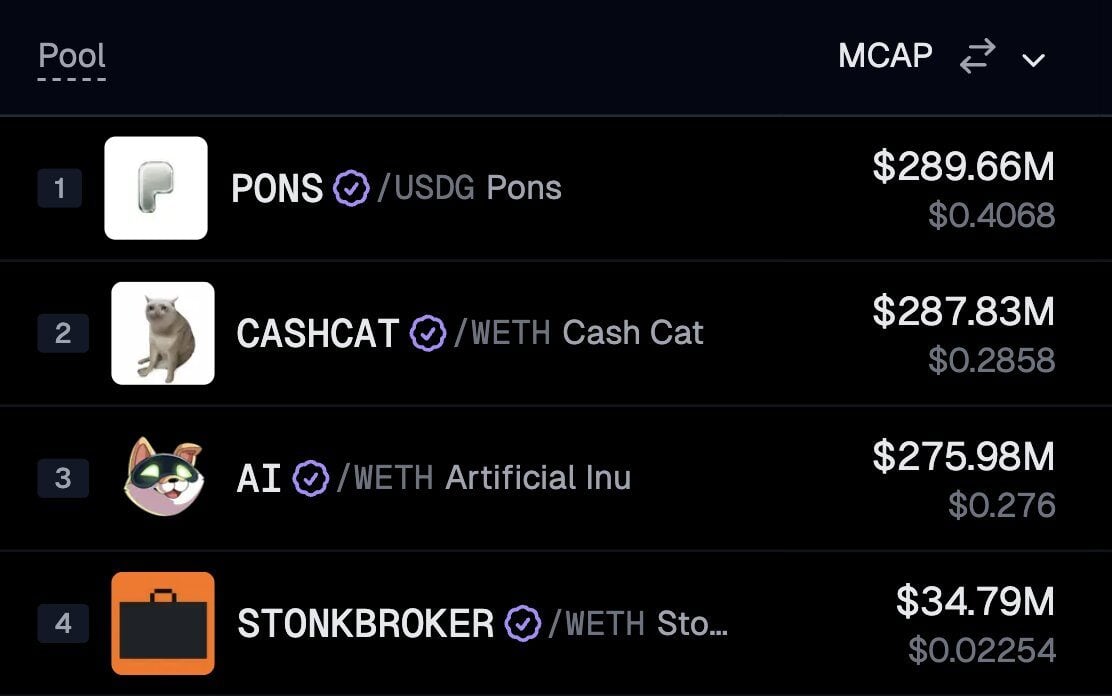
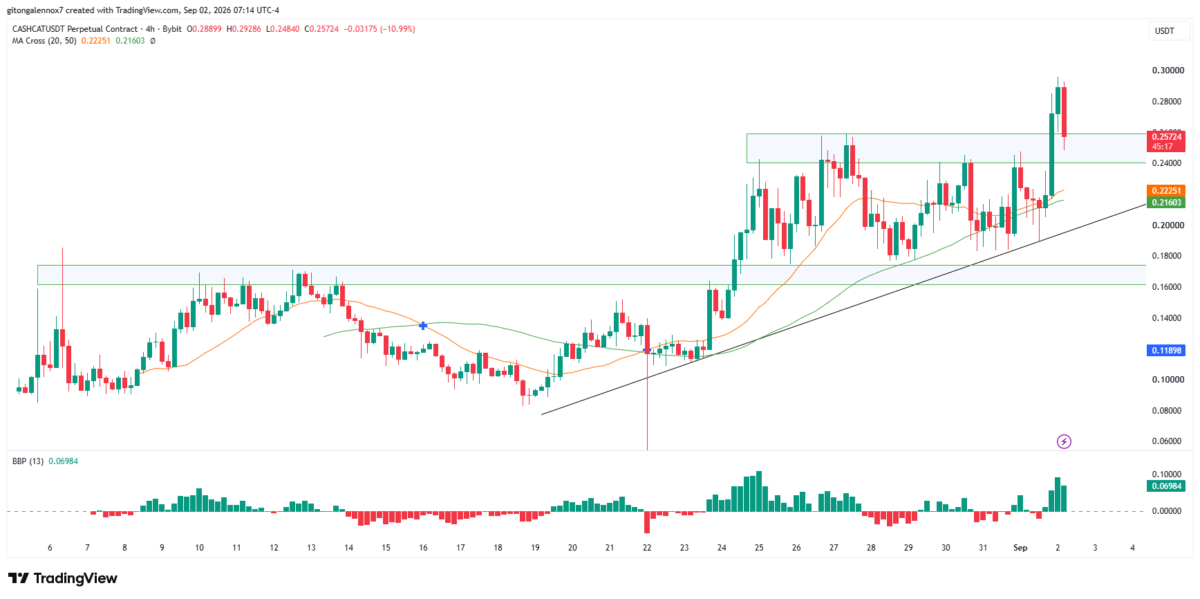
Cash Cat [$CASHCAT] is leading the memecoin sector by daily gains of more than 29%, resulting in a new peak of $0.30. The coin is the second largest by market cap on the Robinhood Chain, behind $PONS [$PONS].
$CASHCAT is the unofficial cat meme named after Robinhood’s discarded CashCat brand. This raises the question: why is the memecoin continuously making new highs?
Robinhood’s memecoin gold rush—$CASHCAT leads
The memecoin is driven by Robinhood Chain’s memecoin gold rush, sparking high trading activity.
This frenzy is evident as the top three coins on the Robinhood DEX, that is, $PONS, $CASHCAT, and AI, have market caps exceeding $280 million. Each of them outweighs the fourth-ranked coin, STONKBROKER, by over 8x.
Source: GeckoTerminal
Moreover, Cash Cat is drawing liquidity from other cat-themed memecoins on other chains, such as BASECAT, which has a market cap of only $25 million. The Base Chain’s meme is more than 10 times smaller than $CASHCAT’s $287 million.
It has also outpaced OG cat memes like POPCAT, whose market cap is at $49 million.
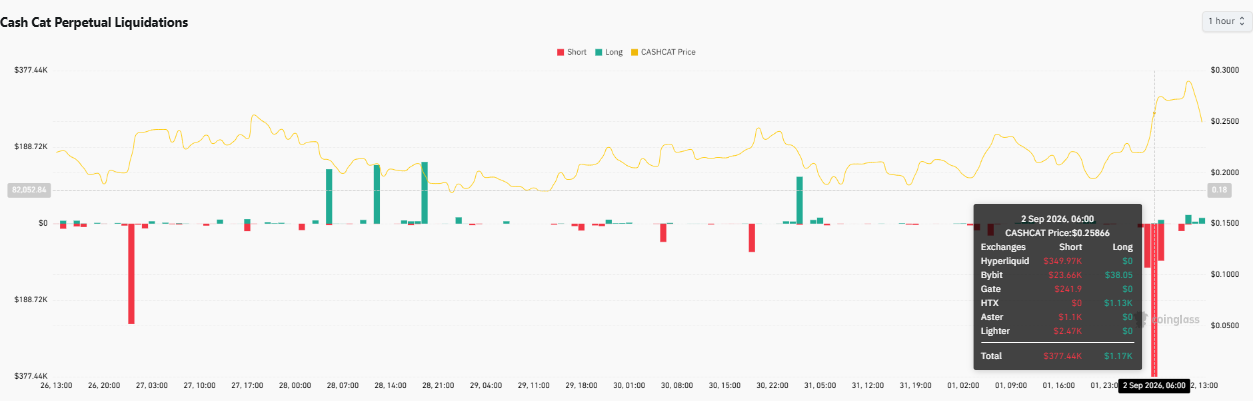
Apart from the hypon Robinhood fueling the memecoin, short liquidations over the past 24 hours have amplified the gains.
Over $377K in short orders was wiped out in under an hour. In total, more than $611K in short positions had been liquidated with a few hours left to close the day.
Source: CoinGlass
While the memecoin extended its weekly gains to over 40%, bulls appeared steady.
Can bulls keep $CASHCAT above the previous peak?
Overlying the price of the memecoin on a 4-hour chart showed a clear uptrend pattern. The new peak came after a week of consolidation between $0.17 and the previous high of $0.2592.
A consolidation around highs with sufficient momentum often hints at continuation. Now, $CASHCAT is testing the broken high, and if bulls keep it above this level, a new high may be formed again.
Otherwise, a breakdown may prompt a bigger correction. The coin’s next demand zone is at the $0.217-$0.225 zone, defined by the MA Cross indicator for the 20-day and 50-day MAs.
Source: $CASHCAT/USDT on TradingView
However, the trendline and horizontal support at $0.17 may act as more resilient support levels than those from MAs. Thus, the price might drop to these zones, but losing $0.17 may shift the market structure to bearish.
Interestingly, during the two recent sessions when candles were red, the bars of the Bull Bear Power (BBP) remained green. This reading reinforced that bulls were still present.
Final Summary
$CASHCAT rallies 29% in 24 hours, setting a new all-time high amid Robinhood Chain’s spike in trading activity.
$CASHCAT’s bulls held on to the coin’s strength with the last area of their defense against bearish control at $0.16.
Kraken is pulling 21 cryptocurrencies from trading. Trading and deposits end on September 11, 2026 at 14:00 UTC, withdrawals remain possible until December 10, 2026 at 15:00 UTC, and whatever is still sitting in the account after that the exchange sells itself between December 14 and 18. Anyone holding one of these tokens therefore has two windows: a short one for selling and a long one for withdrawing.
On September 3 we looked into where a withdrawal could actually lead. The result is the real reason for this article: at none of the three European venues we checked can any of these 21 tokens currently be deposited or traded. Moving to another exchange, the usual reflex in a delisting, leads nowhere here.
What Kraken announced on August 27 and which 21 tokens are affected
The notice carries the date of August 27, 2026 and names the affected assets only by their ticker: XTER, IR, GAIA, SCA, VANRY, BNC, SBR, RBC, MIR, JUNO, HDX, ACA, MULTI, RIZE, EPT, MAT, CQT, CXT, BKS, VULT and M. The exchange does not list full project names in this announcement, which makes identification harder for those affected, because several of these tickers are very short and therefore ambiguous.
The justification is brief. Kraken writes that several of the assets have limited or inactive markets, and attaches to that the warning that a later forced sale may fall considerably below recently observed reference prices. The notice makes no reference to European regulation, and there is no indication that this step has anything to do with MiCA. It is a clean-up of the exchange’s own line-up.
Delisting, trading halt and forced liquidation: each term in a single sentence
A delisting is an exchange’s decision to remove an asset permanently from its own line-up. A trading halt is the point from which that asset can no longer be bought or sold on the platform, while the balance remains in the account. A forced liquidation is the sale of a remaining balance by the exchange itself, after the withdrawal deadline has passed and the customer has not responded.
At Kraken these three steps run at different times, and that is exactly where the practical trap lies. After September 11 the account looks unchanged: the balance is still there, nothing disappears, and no second warning arrives. Only the sell button is missing.
The three dates: September 11, December 10 and the liquidation week
The first date is the most important, because it forces the one decision for which there is no later substitute. On September 11, 2026 at 14:00 UTC, Kraken switches off trading and deposits for all 21 assets. Anyone who sells by then has euros or dollars in the account and need not worry about anything further.
The second date, December 10, 2026 at 15:00 UTC, ends withdrawals. Until then the balance can be transferred to an address of your own. After that comes the third step: between December 14 and 18 Kraken sells all remaining holdings. The proceeds are credited to the account, but in the same notice the exchange makes clear that because of thin order books they can fall considerably below the most recently quoted prices and in individual cases turn out minimal or zero.
Three months sounds like a lot of time, and it is, as long as the withdrawal works technically. But anyone who only notices in December that the destination address does not fit or that the network is not supported has been without the trading route as a fallback for three months already.
A single compartment is still open: for the 21 delisted tokens, none of the European venues we checked offered an active deposit route.
Our September 3 survey: no second trading venue in Europe
This analysis was carried out by cryptoticker.io itself on September 3, 2026. We retrieved the publicly available asset and trading pair directories of four venues and held the 21 tickers from the Kraken notice against them. Kraken itself, Bitvavo, Coinbase and Bitstamp were queried, each retrieval with status code 200. That amounts to 21 tokens checked against 4 venues.
The result is clearer than we had expected. Across Bitvavo, Coinbase and Bitstamp combined, not a single one of the 21 tokens had an active trading or deposit route. Two tickers appear in Bitvavo’s directory at all, VANRY and ACA, but both carry the status «delisted» there, for deposits as well as withdrawals. Coinbase lists MIR as Mirror Protocol and MULTI as Multichain, both likewise with the status «delisted». At Bitstamp not a single ticker carries an active trading pair.
That overturns the usual course of action in a delisting. The advice to simply push the holding to another regulated exchange assumes that this exchange accepts the asset. For these 21 assets none of the venues checked does. Anyone reorienting themselves on the choice of trading platform anyway will find the providers available in Germany together with their terms in our comparison of the best crypto exchanges; for the tokens affected here, however, that changes nothing about the situation.
Why a delisting at Bitvavo, Coinbase and Bitstamp blocks the move
A deposit needs an active deposit address on the receiving side. If an asset carries the status delisted at an exchange, it no longer generates that address. Anyone transferring regardless, to an old address from the clipboard for instance, sends their balance to a place where nobody assigns it any more. Such cases regularly end up in support, often without result.
The second point concerns sequence. Even if a platform were to relist one of these assets in future, that no longer helps after December 10, because by then Kraken has closed withdrawals. The question of where the holding should go therefore has to be answered before the December date, and the only answer that depends on no outside decision is your own wallet.
19 of the 21 tokens still have a euro pair, two only a dollar pair
We counted this too on September 3. All 21 assets are still listed as tradable on Kraken at the time of our query, and 19 of them carry a direct trading pair against the euro. There are two exceptions: SCA and RBC are only tradable against the US dollar. Anyone wanting to sell these two therefore goes via the dollar and bears the conversion, which for small holdings shrinks the proceeds further.
The number of trading pairs per asset is consistently low, at one or two pairs. That is the measurable side of what Kraken means by limited or inactive markets: where only one pair exists there is only one order book, and a sell order quickly meets little on the other side.
Sell or withdraw: the decision due by September 11
The decision has two routes, and the deadline separates them cleanly. Until September 11 both are open. After that only one remains.
Route one: sell while the order book is open
Anyone who did not want to hold the asset anyway sells it on Kraken before the deadline. With thin order books it is worth setting a limit order rather than a market order and, if necessary, disposing of the holding in parts over several days, because a large market order in an empty book drags your own execution price down.
Route two: withdraw and hold in self-custody
Anyone wanting to stick with the project transfers the holding to an address whose keys they hold themselves. That can be a software wallet or a hardware device; which devices are available in Germany and what distinguishes them is set out in our comparison of hardware wallets. What matters above all is that the wallet really supports the network in question, because several of these tokens run on chains that common wallets do not carry out of the box.
Before the large transfer, a small test amount always belongs sent and confirmed at the destination. That minute costs fees and prevents the mistake that cannot be undone.
Self-custody as the only route left for the 21 tokens
According to our survey, for these 21 assets your own wallet is not one option among several but the only one that reliably works. That has a side effect which belongs with the deadline: a self-custodied token for which there is no longer a regulated trading venue in Europe can be held, but for the time being it can no longer readily be turned into euros. Anyone withdrawing is therefore deliberately choosing a holding with no foreseeable exit.
Nobody can take that weighing-up off your hands, and it comes out differently for a holding of a few euros than for a larger one. For completeness: doing nothing is a decision too, it merely leads to the forced sale in December at a price Kraken itself does not guarantee.
Kraken describes the proceeds of the forced liquidation in its own notice as possibly minimal or zero.
Why the liquidation proceeds can be minimal or zero according to Kraken
The wording comes verbatim from the exchange’s notice: the proceeds may fall considerably below recently observed reference prices and in individual cases turn out minimal or zero. That is not rhetorical hedging but the logical consequence of the procedure. In one fixed week in December, Kraken sells all remaining holdings of all affected customers into the same order book that was already described as thin beforehand. Supply and demand are in no balanced relation there.
For the individual investor that means the price a quote portal shows today for one of these tokens says little about what is actually credited in December. Anyone relying on that displayed value and waiting for that reason is planning with a number that no longer holds at the time of execution.
Tax consequences of the forced liquidation: a disposal without your own decision
A forced sale is for tax purposes a sale like any other. Under section 23 of the German Income Tax Act, gains from the sale of cryptocurrencies remain tax-free if more than a year lies between acquisition and disposal; within that period an exemption threshold of 1,000 euros per calendar year applies, and once it is exceeded the entire gain becomes taxable.
The awkward thing about the forced liquidation is that it dictates the moment of sale. Anyone who bought a token eleven months ago would have reached the one-year mark by waiting; the liquidation in December takes that possibility away. For anyone who passed the deadline long ago, the process is unproblematic for tax purposes. A loss from such a sale can be offset within the same category of income, which given the proceeds to be expected here is likely to be the more common case in practice.
For any of that to be documented at all, the acquisition data is needed. Anyone no longer holding it should export the transaction history from the Kraken account while the account is still complete. Tools that read this data and track the deadlines per position exist both as pure tax programmes and as portfolio trackers with a tax function. This section describes the legal position and does not replace tax advice in an individual case.
Distinguishing this from the August delisting wave: why this is a different list
Kraken has removed assets several times this year, and the dates overlap. Our article of August 14, 2026 on the 56 tokens facing forced liquidation describes three parallel cycles from May, June and July with deadlines on August 27, September 25 and November 6. The list dealt with here is entirely separate from those: none of the 21 tickers from the August 27 notice appears in those cycles.
So anyone who read the earlier article and checked their account at the time is not done with this check. The September 11 and December 10 dates belong to a new announcement, and they concern different assets. This accumulation is itself a finding: anyone holding smaller tokens at an exchange now has to look at its notice page regularly, because a single check is only a snapshot.
How to check your Kraken account for affected tokens in five minutes
The quickest route runs through the account’s balance overview. All positions are listed there with their ticker, and comparing them against the list above is a pure text check. What matters is looking at the very small holdings too, the ones that accumulate over the years, because it is precisely those that often sit in exactly these obscure assets.
After that a look at Kraken’s own announcement belongs in the process, because that is where any change to the dates would appear. If a position turns up on the list, it comes down to a single question: sell or withdraw. Anyone finding nothing has nothing to do, but should not have to make a note of September 11.
One aside, because it concerns the same account: very small amounts that cannot be explained are not always old holdings from your own purchases. Anyone finding a position on the list they do not remember should take a quick look in the transaction history before selling, to see where it came from.
How we surveyed and what we could not check
On method: on September 3, 2026 we called the public interfaces of four trading venues, read out the assets and trading pairs listed there and compared the 21 tickers from the Kraken notice against them automatically. Only disclosures from the venues themselves were evaluated.
Four points we could not settle, and they belong to the honesty of this analysis. First, Bitpanda’s directory could not be retrieved, the interface answering with an access block; our survey therefore says nothing about that offering. Second, we deliberately left out decentralised venues, because they place different requirements on the user and cannot sensibly be compared with an exchange account. Third, several of the tickers are very short, such as M, IR, MAT or SCA; an identical ticker at another venue can denote a different project, which is why we treated every hit only as a possible and not as a confirmed match. Fourth, we collected no trading volumes, so on actual market depth we only reproduce what Kraken writes about it itself.
What we did not do: no extrapolation to monetary values, no price figure for any of the tokens, no statement about how many investors are affected. For none of these figures do we have a reliable basis.
Checking the Kraken trading halt: what to take away
Compare your account today. Hold the 21 tickers against your own balance overview, very small holdings included. Anyone wanting to switch will find the alternatives in our comparison of crypto exchanges.
Decide by September 11. Sell while an order book exists, or deliberately hold and withdraw. The second route needs a wallet that carries the network; the devices are in our hardware wallet comparison.
Secure your records before the account empties. Export the transaction history and note the acquisition data, so that the deadline and the gain can be documented later; suitable tools are in our tax and portfolio overview.
(As of September 3, 2026. This article is not investment advice. Prices and fee structures change; check the terms with the provider before you buy.)
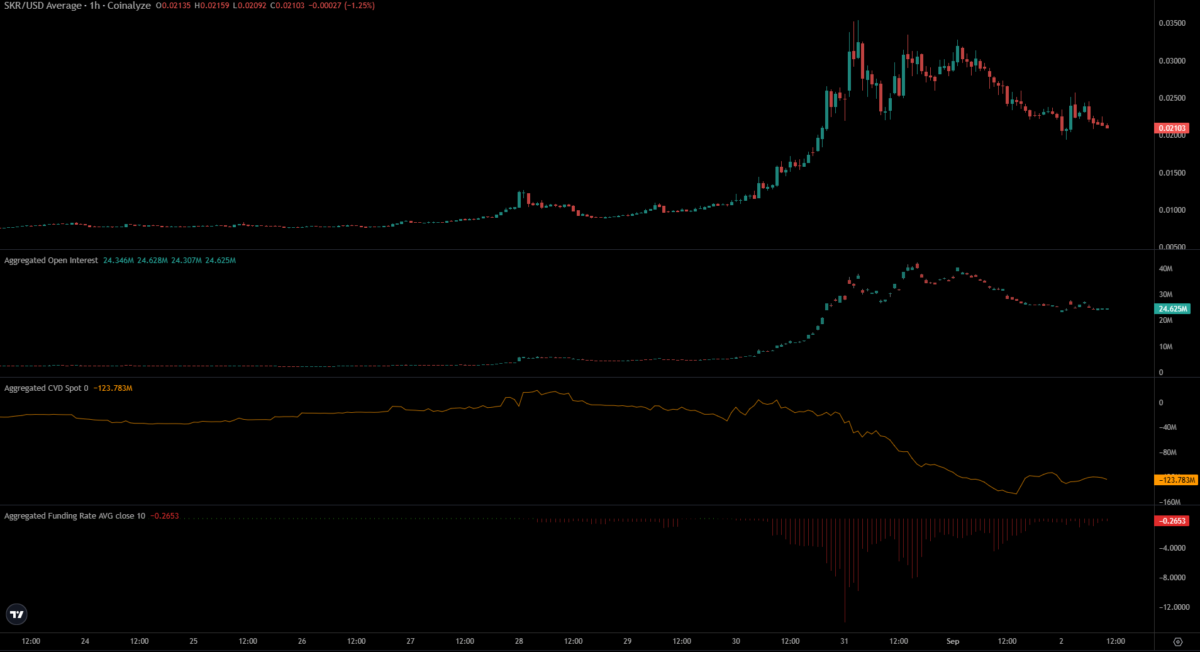
Seeker [$SKR] violently squeezed short positions with its 292% rally from $0.091 to $0.359 last weekend. Since making this swing high, the altcoin has faced selling pressure from profit-taking activity.
Source: Coinalyze
The native utility and governance token has witnessed negative Funding Rates in recent days. Extreme negative values and falling spot CVD signaled intense selling pressure on the 31st of August following the rally.
It reflected market conviction that the rally was about to end. The Open Interest has slumped from $42 million on Monday to $24.6 million at the time of writing. Market participants have taken profits and exited the derivatives market.
A retracement phase was underway. Here’s how low $SKR prices can fall to and where buyers might re-enter.
Bullish breakout confirmed, but another 40% $SKR dip possible
Source: $SKR/$USDT on TradingView
In the past 24 hours, Bitcoin [BTC] has shed 1.88%, falling from $78k to $76.6k. This minor correction toward the local $76k support zone helped explain why $SKR faced losses in recent trading hours.
The bigger reason is that $SKR was highly overextended after its rally towards the end of August.
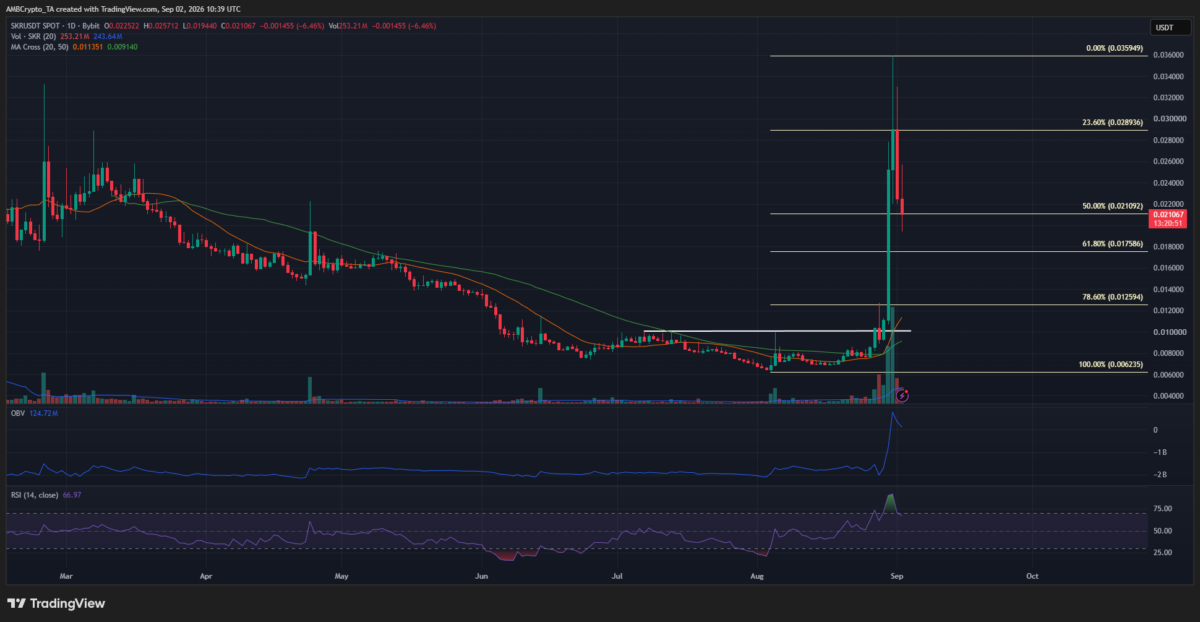
The rally in question broke the previously bearish trend. The $0.10 swing high from early July was decisively breached. Seeker bulls didn’t give the others any time within a consolidation to accumulate the token.
Instead, they drove a price move to $0.36, the highest the altcoin’s price has reached since February.
The bullish swing structure was used to plot a set of Fibonacci retracement levels (yellow). The golden pocket between $0.0126 and $0.0175 is likely to be tested before another rally.
Traders’ call to action – Be cautiously bullish
Source: $SKR/$USDT on TradingView
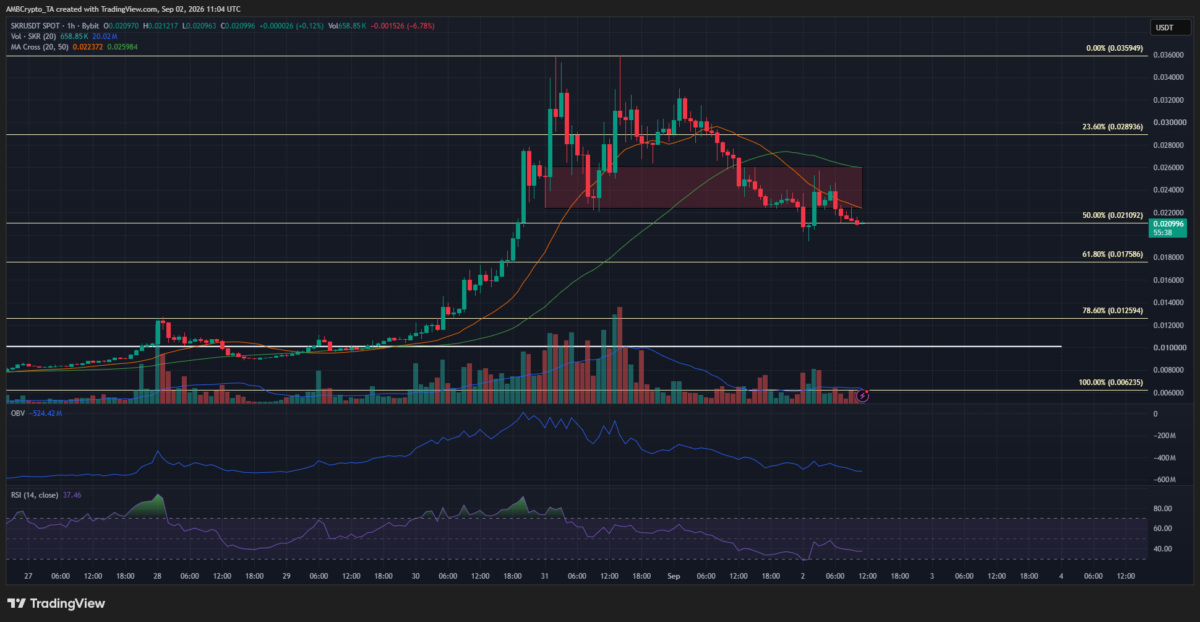
Seeker is a relatively small-cap token that has made a remarkable rally. It was retracing swiftly, and the Coinalyze data from earlier showed short-term bearish conviction.
The 1-hour chart showed that the $0.024 former support zone has been flipped to resistance over the past 48 hours. The RSI was below neutral 50, and the OBV was rapidly sinking, highlighting bearish momentum and heavy selling.
A dip to the $0.0125-$0.0175 is likely to be met with a reaction from the buyers. However, if Bitcoin continues its descent, it could spook the market and possibly upset the uptrend $SKR has established.
Final Summary
Seeker faced sizeable profit-taking pressure after the weekend’s rally and was in a retracement phase.
The current price dip could extend by another 40% if the price reached the 78.6% retracement level at $0.0125.
Maple Finance [$SYRUP] has rallied 14% rally in the past day at press time. $SYRUP’s price surge stemmed from its strong protocol-level performance, as Maple Finance hit new highs in earnings and total value locked (TVL).
$SYRUP’s protocol-level surge
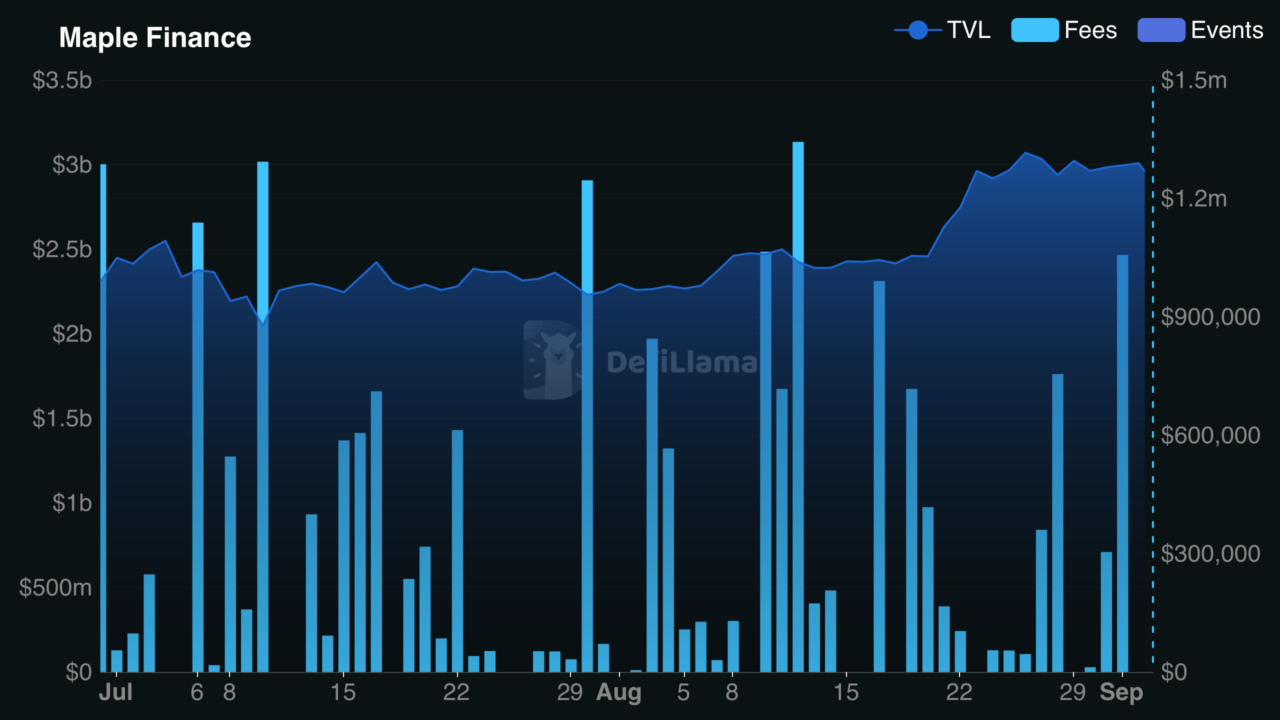
The latest data from DeFiLlama on $SYRUP’s performance shows that the protocol’s monthly gross profit has reached its highest level since April 2026.
According to DeFiLlama, the protocol generated roughly $1.13 million in profit as the broader crypto market gradually recovered. This figure remains below April’s $1.32 million.
Source: DeFiLlama
The surge did not happen in isolation, with TVL also crossing $3 billion for the second time this year since early January. On the 25th of August, TVL hit $3.07 billion. However, it has since seen a slight decline to $2.97 billion.
TVL measures the amount of capital deposited into a protocol, and when it rises or remains at elevated levels, it suggests investors are committing more funds to the protocol to earn returns. This can add to the positive outlook when the token is also performing well.
Capital is concentrated for a rally
There is a massive concentration of capital among traders in $SYRUP contracts lately, with many taking long positions on the asset.
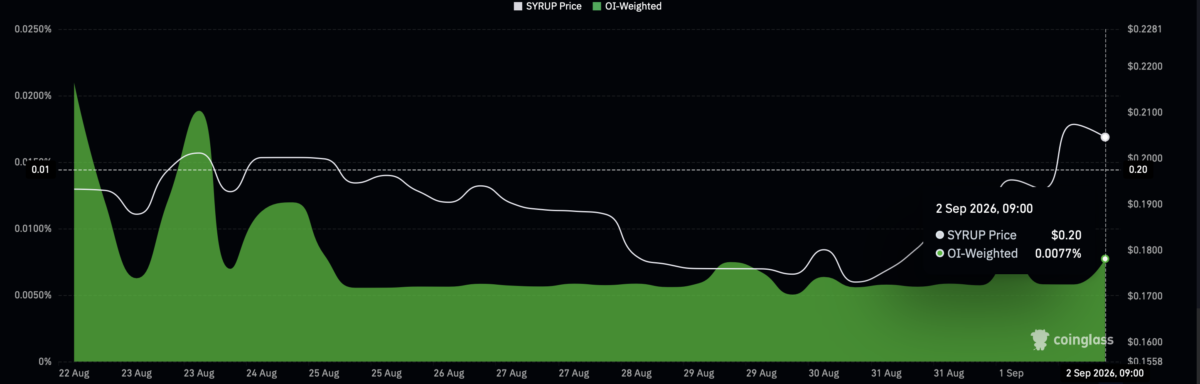
Press-time data shows that $SYRUP’s Open Interest (OI), the amount of capital locked in its perpetual contracts, hit $29 million over the past day after a 26% surge. When weighed against the Funding Rate, the data suggests that the majority of traders are positioned long.
The OI-Weighted Funding Rate at the time of this analysis had reached 0.0077%, remaining positive on the chart.
Source: CoinGlass
While this remains a moderate reading, one signal to watch is whether the funding rate surges or declines. A rise would imply that expectations for further gains are increasing, while a decline could suggest that traders are gradually shifting toward a sell-off or range-bound movement.
A continued rise or a range-bound move would still align with the present bullish narrative and the capital flow seen in $SYRUP’s perpetual market.
The bullish conviction remains strong
There is clear conviction among investors, as reflected in $SYRUP’s market sentiment and community sentiment profile.
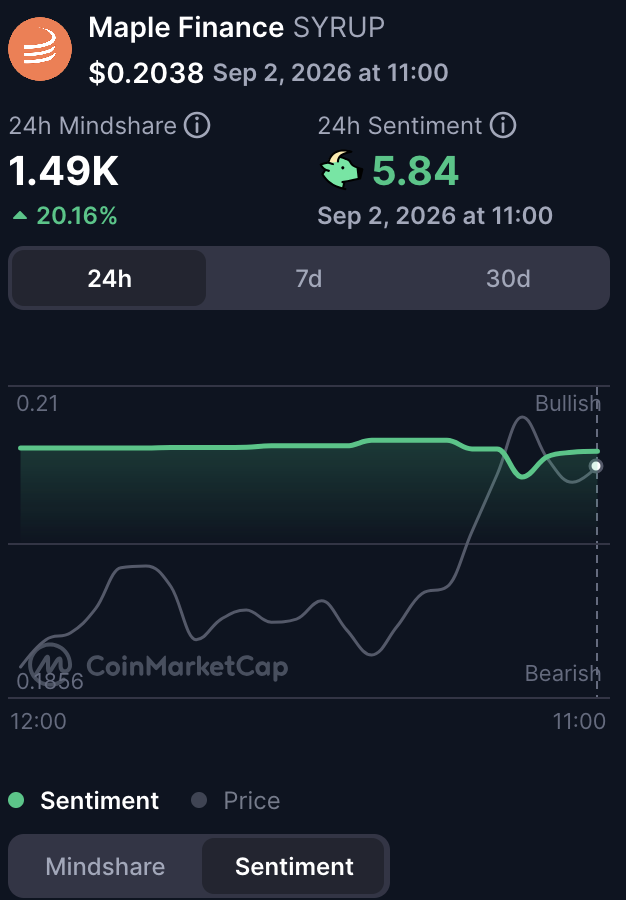
Mindshare, which tracks how much traders are talking about the asset, saw a 20% surge over the past day, with mentions reaching 1,490, according to CoinMarketCap data.
Source: CoinMarketCap
Likewise, the market sentiment score, which ranges from -10 (extremely bearish) to 10 (extremely bullish), stood at 5.84, suggesting a strong bullish outlook for $SYRUP at the moment.
Final Summary
Maple Finance’s profit reached $1.13 million in August, while TVL crossed $3 billion for the second time this year.
$SYRUP’s 14% rally came as OI rose 26% and bullish sentiment strengthened.
Prediction Markets Remain Skeptical of 2026 Passage
Washington’s effort to establish national rules for crypto trading, custody, and market oversight now centers on the CLARITY Act. The House-passed bill would divide federal responsibilities between the Securities and Exchange Commission (SEC) and the Commodity Futures Trading Commission (CFTC) while setting requirements for exchanges, brokers, dealers, disclosures, and customer asset protection.
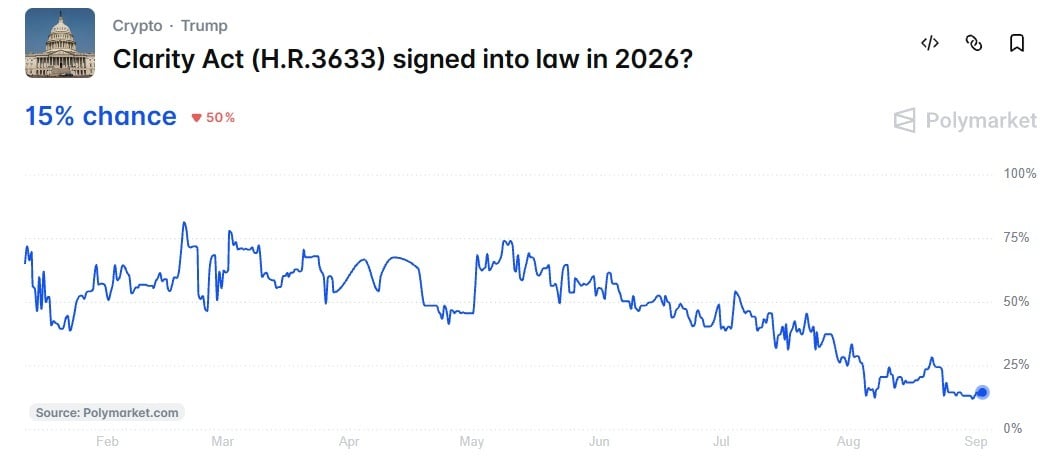
Prediction-market traders remain doubtful that the Digital Asset Market Clarity Act will complete the legislative process this year. A Polymarket contract on 2026 enactment showed a 15% chance on Sept. 2 that the CLARITY Act (H.R. 3633) would pass both chambers and receive the president’s signature by Dec. 31. Trading volume reached approximately $11.62 million.
Polymarket traders assigned the CLARITY Act a 15% chance of becoming law by Dec. 31. Source: Polymarket, Sept. 2, 2026.
The low probability contrasted with House Financial Services Committee Chairman French Hill’s renewed reference to the legislation during a Sept. 2 hearing on growth, affordability, innovation, and access to capital. In his prepared remarks, the Arkansas Republican listed House passage of the CLARITY Act among the committee’s accomplishments and called for permanent, predictable financial rules.
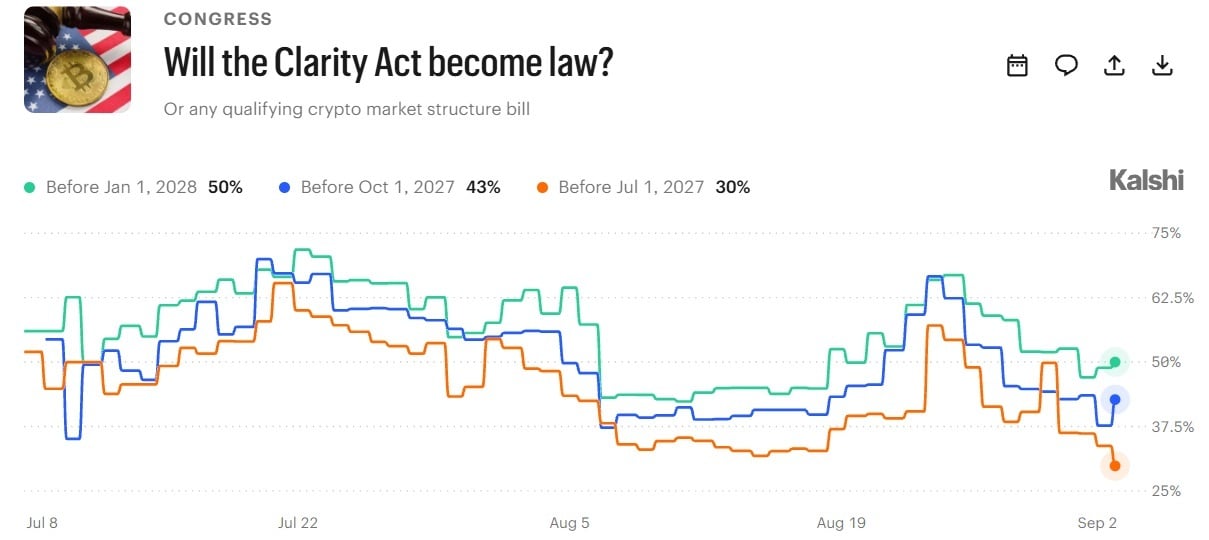
Kalshi’s longer-term contracts showed stronger probabilities, but they measure a broader outcome and cannot be compared directly with Polymarket’s 2026 contract. Kalshi gave the CLARITY Act, or another qualifying crypto market structure bill, a 30% chance of becoming law before July 1, 2027, and a 50% probability before Jan. 1, 2028. Volume totaled approximately $6.85 million.
Kalshi traders assigned a qualifying crypto market structure bill a 30% chance of passage before July 1, 2027, and a 50% chance before Jan. 1, 2028. Source: Kalshi, Sept. 2, 2026.
The latest figures show that traders distinguish between an imminent Senate vote and completed enactment. By Aug. 31, the market had already separated procedural progress from final passage, with traders assigning strong odds to a Senate vote but much weaker probabilities to the bill becoming law during 2026. Polymarket’s latest 15% reading rose from 13% but remained heavily weighted against enactment.
Sept. 15 Cloture Motion Becomes the Immediate Test
The next measurable step would be a procedural vote on the bill, which senators could hold as soon as Sept. 15. The official Senate schedule states that the cloture motion on proceeding to H.R. 3633 will ripen at 2:15 p.m. Cloture generally requires 60 votes, placing the bill’s future on its ability to retain bipartisan support.
The proposal has already demonstrated support across party lines at earlier stages. The Senate Banking Committee advanced H.R. 3633 by a 15-9 vote on May 14, moving it toward floor consideration. Democratic Senators Ruben Gallego and Angela Alsobrooks joined Republicans in supporting advancement, although committee approval did not establish sufficient support for cloture or final passage.
Senate negotiators subsequently released revised legislation combining work from the Banking and Agriculture committees. The updated CLARITY Act framework addresses SEC and CFTC jurisdiction, consumer protection, illicit finance, decentralized finance, intermediary oversight, disclosure requirements, and specified network tokens.
The revised language creates another timing consideration reflected in the low 2026 odds. Senate approval of provisions differing from the House-passed measure could require further action before the bill reaches the president. The Polymarket contract pays out only if H.R. 3633 completes every remaining step by the end of 2026.
Hill’s Regulatory Push Confronts the Legislative Clock
Hill placed CLARITY inside a wider economic program covering capital markets, housing, community financial institutions, and regulatory modernization. He stated: “Committee Republicans are working diligently to codify these reforms to make them permanent and predictable.” The prediction-market probabilities indicate that traders see the remaining congressional calendar as a significant obstacle to that objective.
The lawmaker did not deliver an extensive digital asset argument in the Sept. 2 statement, but he previously explained why he considers CLARITY essential. During a July field hearing marking one year since House passage, Hill compared stablecoin legislation without a crypto market framework to an incomplete communications system while the CLARITY Act remained unfinished in the Senate.
Hill stated:
“We need CLARITY in place because of a key point I always make: if you have GENIUS and dollar-backed stablecoin, which President Trump signed into law last July, but you do not have a market structure bill, you have passed authorization to have a cellphone but no cell network.”
The bill could affect centralized exchanges, decentralized platforms, brokers, dealers, token issuers, and customers. Centralized and decentralized cryptocurrency exchange structures raise different custody, compliance, and consumer-protection considerations that the proposed framework seeks to address.
If senators take up the cloture motion on Sept. 15, the vote would provide the next direct test of the market’s skepticism. Clearing the procedural threshold could improve expectations for Senate consideration, while failure would strengthen the 85% probability currently assigned to H.R. 3633 not becoming law during 2026.
Could this sudden uptick in STORJ’s price signal a larger trend? In just 15 minutes, STORJ surged by 7.12%, climbing from $0.0281 to a current price of $0.0301. This quick movement showcases the dynamic nature of the cryptocurrency market, drawing attention from traders keen on capitalizing on momentum. The trading volume during this period reached $882,793.71, indicating active participation.
The Story So Far
The broader cryptocurrency market is exhibiting mixed signals, with various assets experiencing fluctuations. STORJ’s price spike comes despite a 24-hour decline of 6.52%, which indicates a potential rebound or corrective movement. Over the last hour, STORJ also saw a modest increase of 2.38%. The sudden rise within such a short timeframe suggests traders might be responding to short-term sentiment shifts, possibly driven by speculative trading rather than fundamental changes.
Market Snapshot
In the last 24 hours, STORJ hit a low of $0.0281 and a high of $0.038, demonstrating significant volatility. The price movement is notable, particularly as it approaches the recent high, prompting traders to monitor key levels. Current market conditions reflect a cautious optimism among traders, with many looking for further signals that could influence future price action.
Historical Context
The recent price action may be linked to broader trends in the derivatives market, including open interest and funding rates. With traders looking for opportunities, the quick surge could have been fueled by short-covering or a reaction to broader market sentiment. However, without confirmed catalysts, the reasons behind this move remain speculative and warrant careful observation.
The Road Ahead
What Traders Are Watching Next. Traders are closely watching STORJ’s next moves, especially as it approaches key resistance levels around $0.038. Support is seen near $0.0281, and a break below this could signal further downside. The current trading environment remains volatile, influenced by sentiment shifts and potential market reactions.