Lighter [$LIT] surged by another 13% in the last 24 hours, its third consecutive green day. The altcoin made a new local high of $4.67, with trading volume surging after the perpetual DEX was built into Robinhood Wallet.
The perpetual DEX is slowly but steadily closing on the gap that exists between it and Hyperliquid [$HYPE].
$LIT outpaces $HYPE and $ETH
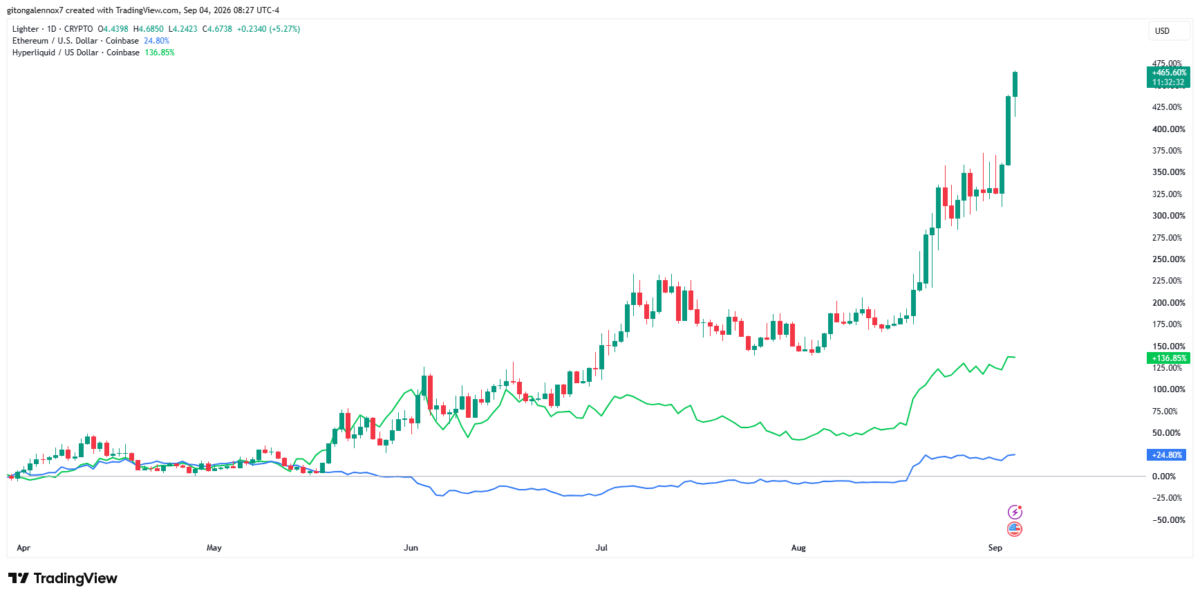
Lighter has performed better than both Hyperliquid and Ethereum [$ETH]. On the charts at press time, Lighter was up 465%, followed by $HYPE with 136% and $ETH a distant third with 24% returns.
Over the past five months, the altcoin has outperformed both $HYPE and $ETH combined.
Source: $LIT x $HYPE X $ETH on TradingView
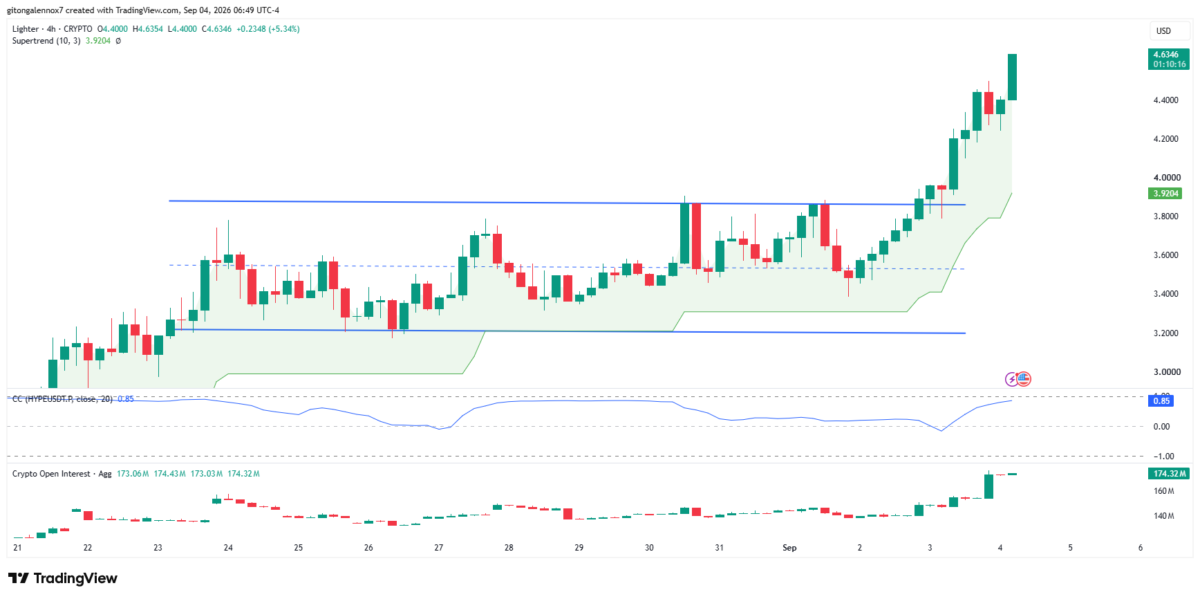
The correlation coefficient of Lighter with $HYPE was 0.85, reinforcing the growing DEX adoption. Similarly, $HYPE has been surging, but its gains have been smaller compared to those of Lighter.
Over the past two weeks, bulls have been consistently buying $LIT, as seen in the Open Interest (OI). Since the start of September, the OI has risen from $138 million to about $180 million.
At the time of writing, the price action was yet to outline key levels. However, it has stayed above the Supertrend since 10th April on the daily chart. The sideways channel is the most recent area of interest, with the same trading between $3.20 and $3.85.
Source: $LIT/USD on TradingView
At press time, the market cap of Lighter was roughly $1.09 billion, while that of $HYPE was $21.92 billion. In fact, the altcoin is 21 times smaller than $HYPE by capitalization, but that gap may be slowly but steadily reducing.
And yet, despite this gap being wide, Lighter is helping cement the DEX sector as a major crypto narrative.
Robinhood effect spreads to the Lighter ecosystem
The Robinhood effect has fueled the altcoin’s recent gains. The integration of Lighter into Robinhood Wallet has increased network activity, resulting in more fees.
The protocol’s fees rose from $124K to $195K in the last 24 hours alone, as per DefiLlama. These fees buy back $LIT, creating demand and reducing the token supply available in the market.
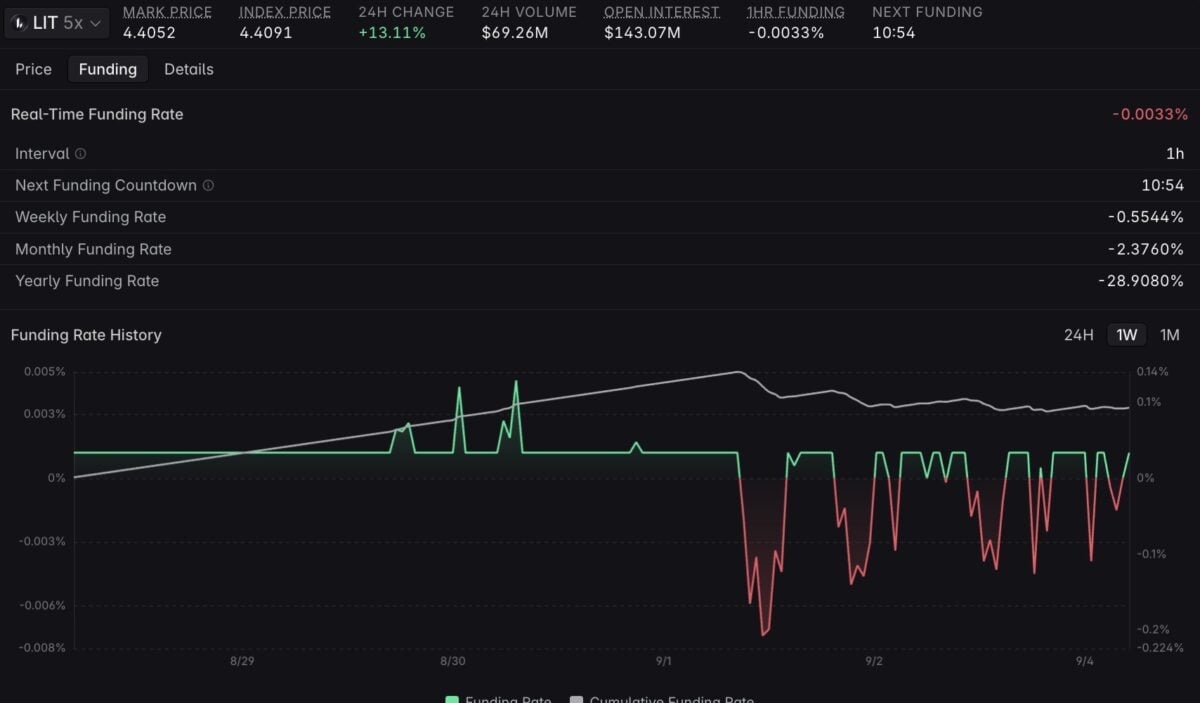
For the recent surge, short liquidations amplified the gains. This was evident as it sustained a negative Funding Rate during its breakout.
Source: Hyperliquid
However, that is not all there is.
According to Etherscan, the Transfer Count rose from 1,914 on 29th August to 6,196. This was equivalent to tripling its network activity in six days.
Here, it’s worth noting though that the data did not guarantee that the altcoin’s gains will hold.
Final Summary
$LIT surged by 13%, making a new peak of $4.67 as it outpaced $HYPE and $ETH in the last five months.
The Robinhood effect has been driving Lighter’s network activity lately.
The industry’s funnel also narrows sharply beyond its earliest stages. Of 3,957 blockchain companies tracked by Tracxn, 1,323 have received equity funding, but only 167 have reached Series A or later. Fifty have reached Series B, 14 Series C and just four Series D or beyond.
Singapore dominates
Geographically, Southeast Asia’s crypto investment market basically starts and ends with Singapore.
The city-state accounts for 82.5% of the regions’s $6.2 billion cumulative blockchain funding and is home to 2,285 if the companies tracked, Tracxn said. Jakarta, Indonesia is the next largest funding hub, which accounts for just 3%.
Exits are also somewhat uneven. Tracxn counted 43 acquisitions but only four IPOs across the sector, including SBI Group’s acquisition of Singapore-based CoinHako and Bybit’s purchase of NOBI this year.
Southeast Asia has neverthless produced six blockchain unicorns, including Sygnum, Bitkub, Sky Mavis and Amber Group.
The numbers suggest the regions’s blockchain investment market has enjoyed a recovery year in 2026, but not be recreating the funding boom of 2022. Capital is clustering around financial services and mature businesses, rather than speculative early-state ventures.
The $XRP Ledger had fewer active accounts in the second quarter than it did a year earlier, but the accounts still trading on its main exchange were moving almost three times as much $XRP.
Order-book trading averaged 3.57 million $XRP a day during the quarter, up 79% from a year earlier. At the same time, the number of accounts initiating those trades fell to about 1,100 a day from more than 1,860.
That worked out to roughly 3,200 $XRP traded per account each day, against about 1,070 a year earlier, Evernorth, the $XRP treasury company preparing to list on Nasdaq, shared in a quarterly report with CoinDesk.
An account is not necessarily one person. A trading firm can use several, while an individual can do the same. The data therefore cannot show whether institutions are replacing retail traders — but indicates $XRP is being traded by a smaller group of active accounts.
The number of assets $XRP changed hands against on the order book fell to about 319 a day from 480, down 18% on the year and the lowest in the six quarters the report covers.
$XRP trading is concentrating into fewer accounts. (Shaurya Malwa/CoinDesk)
The order book also took a larger share of activity on the network’s decentralized exchange, or DEX, where users trade directly through the ledger rather than through a centralized exchange such as Coinbase or Binance. It accounted for 81% of DEX trading in the quarter, up from 54% a year earlier.
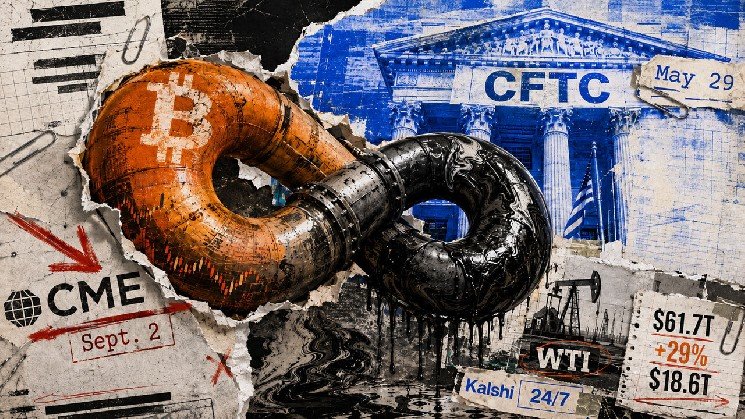
The Commodity Futures Trading Commission (CFTC) asked a federal court on Sept. 2 to dismiss CME’s challenge to Kalshi’s Bitcoin perpetual contract.
The lawsuit turns on whether a contract without a fixed expiration belongs in the US futures regime. Before the court reaches that question, the regulator says CME must first show an injury the court can fix.
The Commodity Futures Trading Commission says CME is free to list a comparable digital commodity product, so the exchange cannot blame the regulator for competitive harm caused by its choice to stay out.
That threshold argument turns a dispute over one Bitcoin contract into a test of how perpetual-style futures can spread through regulated US markets.
Bloomberg reported discussions about Coinbase seeking a regulated route to selected contracts linked to prices on Hyperliquid. Kalshi is reportedly preparing to seek approval for a West Texas Intermediate crude-oil version.
Together, the examples trace a contract structure popularized in offshore crypto markets as it enters the American regulatory perimeter one venue and asset class at a time.
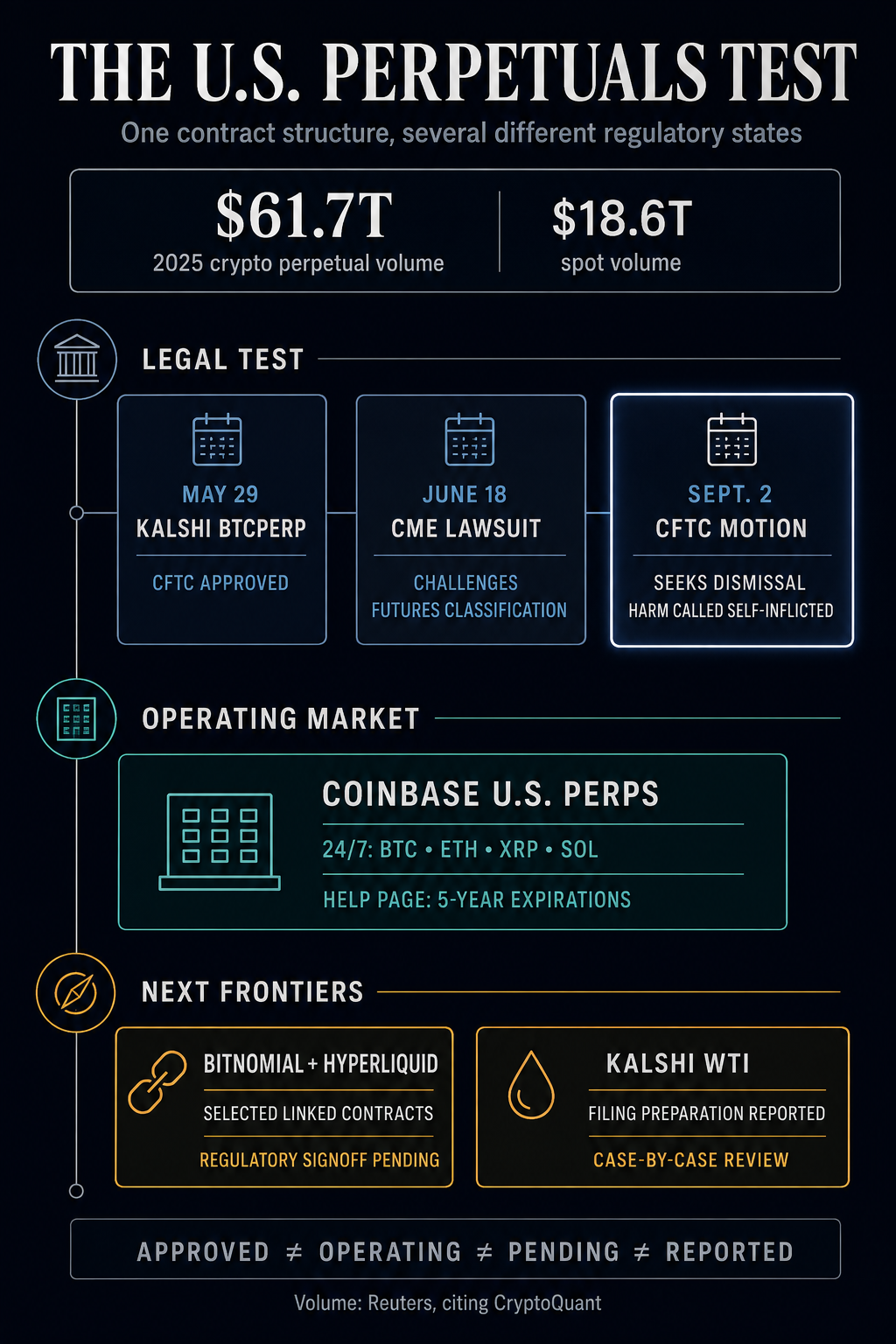
CryptoQuant data shows that global crypto perpetual-futures volume reached about $61.7 trillion in 2025, up 29% from the previous year, while spot trading totaled $18.6 trillion over the same period.
The CME case could shape how much of that activity US exchanges can pursue through the CFTC’s futures framework.
The CFTC says CME can compete in Bitcoin perpetuals
CME sued the CFTC on June 18, seeking to overturn the agency’s May 29 approval of KalshiEX’s Bitcoin perpetual contracts and the accompanying policy statement. CME argued that a contract without a fixed expiration is a swap rather than a future under the Commodity Exchange Act.
The CFTC’s motion said the relief CME seeks would fail to remedy the exchange’s claimed competitive injury.
The agency added that CME may list similarly structured digital commodity perpetuals, characterizing any disadvantage from CME declining that opportunity as self-inflicted.
A judicial decision treating Kalshi’s product as a swap would not necessarily remove competing exposure from the market because another venue might offer it under that classification. In the agency’s view, a win for CME on that point would still fail to redress the alleged injury.
The current schedule gives CME until Oct. 2 to oppose the dismissal motion. A ruling on standing could leave the deeper line between futures and swaps unresolved.
The May 29 CFTC policy defined designated contract markets as those that could list similarly structured perpetuals tied to Bitcoin and digital commodities with deep, active, and continuous spot markets. Products outside that group were directed toward case-by-case review under Regulation 40.3.
The result is a faster path for qualifying digital commodity products and a separate review track for other assets. That distinction will matter as venues look from crypto toward energy and other established futures markets.
The timeline shows Kalshi, CME, and CFTC milestones for US crypto perpetuals, alongside Coinbase’s operating market and pending Bitnomial, Hyperliquid, and Kalshi products.
Coinbase’s derivatives market page markets US perpetual-style futures with 24/7 trading and contract families tied to Bitcoin, Ethereum, XRP, and Solana.
The name “perpetual” covers different contract mechanics in the emerging US market. Coinbase’s official help material describes the covered contracts as having five-year expirations, so they offer long-dated, continuously traded exposure, while a literal expiry-free contract requires different terms.
A June CFTC staff letter granted conditional relief for requests from Coinbase Derivatives and Bitnomial to remove expiration dates from existing digital commodity perpetual-style contracts that expired on June 30.
Regulated US perpetual-style crypto futures have moved from policy concept to operating category, even as the exact expiration mechanics vary by contract. CME’s suit challenges the agency approach behind that change as rival venues adapt one of crypto’s largest trading formats.
Hyperliquid would test an on-chain bridge
Hyperliquid and Payward are reportedly discussing a structure for registered US users. Payward subsidiary Bitnomial, a regulated derivatives venue, would offer selected contracts tied to token prices on Hyperliquid.
Payward completed its acquisition of Bitnomial in August, adding its US derivatives exchange and clearing infrastructure.
President Donald Trump supplied a political signal on Aug. 19, saying that his administration was working on a US route for Hyperliquid during a White House technology event.
A signed-off structure would test a bridge between a registered domestic venue and token prices formed in an on-chain market. Surveillance, market integrity, and the precise relationship between the venues would turn on the approved design.
Polymarket’s international site shows live leveraged crypto perpetual markets, while Polymarket US is a separate platform. The international product demonstrates how quickly crypto-native venues are expanding the format, supplying global context.
Oil brings the model into traditional futures
In June, the CFTC requested public comment on 24/7 futures trading and perpetual contracts for storable, physically delivered energy commodities, including crude oil. That consultation placed the structure under active review in a longstanding futures market.
Kalshi is reportedly preparing a CFTC filing for a perpetual contract tied to WTI crude oil, potentially as soon as the following week.
A WTI proposal would follow the CFTC’s case-by-case route. Its review would also confront the practical differences between a cash-referenced crypto contract and a market built around a physical commodity with established delivery infrastructure.
Perpetuals are being considered for a traditional commodity market where CME is an incumbent, placing the new structure closer to the core of established derivatives competition.
A quick CFTC victory on standing would preserve the agency’s framework without a ruling on the futures-versus-swaps question. Other exchanges could read that result as support for proposing similar contracts, subject to the applicable listing or review process.
Continued litigation on the merits would put the statutory classification question before the court. A decision on whether a no-expiry contract can qualify as a future would create a clearer legal boundary, while the period before a ruling could complicate product planning.
Regulatory sign-off for selected Bitnomial contracts linked to Hyperliquid prices would test the on-chain bridge. Acceptance of a WTI perpetual would show the structure crossing into a traditional commodity.
The CFTC is now defending its approach in court while exchanges probe its limits, with perpetual-style products entering the regulated US market.
The next phase will depend on whether CME has standing, how a court classifies the Kalshi contract, which venues can meet the CFTC’s conditions, and whether regulators allow the model to extend from digital commodities to on-chain prices and physical markets.
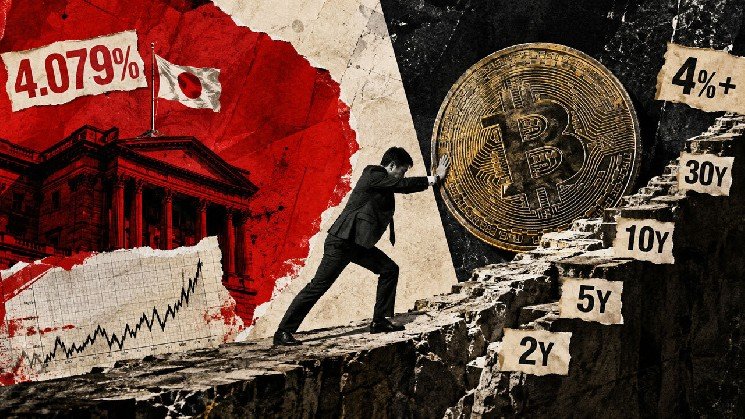
Japan’s 30-year government-bond auction cleared at a 4.079% average yield on Sept. 3, underscoring a tougher backdrop for future capital raised by Metaplanet to buy Bitcoin. The long bond is a market signal; the nearer test for the company is the price of shorter-tenor debt and refinancing.
The average yield rose 14.2 basis points from 3.937% at the previous 30-year auction on Aug. 6. Japan’s Sept. 1 10-year auction averaged 2.995%, placing the 4% threshold at the long end rather than across the entire curve. The Bank of Japan, meanwhile, maintains an operating guideline of around 1% for the uncollateralized overnight call rate.
Metaplanet’s existing fixed obligations retain their contractual cash flows. Its ¥8 billion 20th-series ordinary bond is zero-coupon and matures on April 23, 2027, while its inaugural BitBonds carry fixed coupons. The shift in Japanese yields instead raises the benchmark for future issuance and refinancing.
That leaves a narrower version of Metaplanet’s funding advantage intact. The bilateral zero-coupon bond protects near-term cash flow, but repeating such favorable terms at the scale required for sustained Bitcoin purchases remains uncertain.
Metaplanet BitBonds face a shorter-tenor funding test
Metaplanet’s inaugural 21st through 24th-series BitBonds total ¥200 million, pay fixed coupons ranging from roughly 4.0% to 4.3%, and mature in about three years. Recent government auctions cleared at average yields of 1.708% for two-year debt and 2.163% for five-year debt.
A straight-line interpolation between those official results produces an estimated three-year sovereign benchmark of 1.8597%. The estimate is an analytical tenor comparison rather than a traded three-year quote or a cash-flow duration calculation.
Against it, the inaugural BitBonds pay an estimated premium of about 214 to 244 basis points. Future coupons would rise if the sovereign benchmark increased while Metaplanet’s credit spread stayed constant. A wider credit spread would add further pressure.
The bond terms explain why investors may require that premium. The BitBonds are unrated, unsecured and unguaranteed senior obligations. They carry transfer restrictions, and secondary-market liquidity is unassured. Metaplanet has said later series may differ in maturity and interest rate according to market conditions and investor demand.
Existing instruments face a different equation. Higher rates can affect their market value, while the stated coupon and principal cash flows remain fixed. The company’s 20th-series ordinary bond funded Bitcoin purchases before all expected cash arrived from its 27th-series stock acquisition rights. Part of the warrant proceeds was designated to repay the bond, allowing Metaplanet to bring forward funding without an annual coupon bill.
Metaplanet’s funding channels carry different costs
Metaplanet was already drawing on several channels at midyear. At June 30, it reported 43,000 $BTC, $414 million drawn from a $500 million Bitcoin-collateralized credit facility, ¥67.486 billion of short-term borrowings, ¥8 billion of bonds due within one year and ¥1.805 billion of first-half interest expense.
Second-quarter Bitcoin purchases used proceeds from the 20th-series bond, the credit facility, the 27th-series rights and Bitcoin-income revenue. This mix kept purchases moving while mNAV remained below 1.0x for most of the half and the company made no discretionary common-share allotments during the quarter. The funding inventory therefore separates into two parts: fixed structures protect current economics, while each new round of capital faces prevailing market terms.
Scale turns a coupon into a constraint
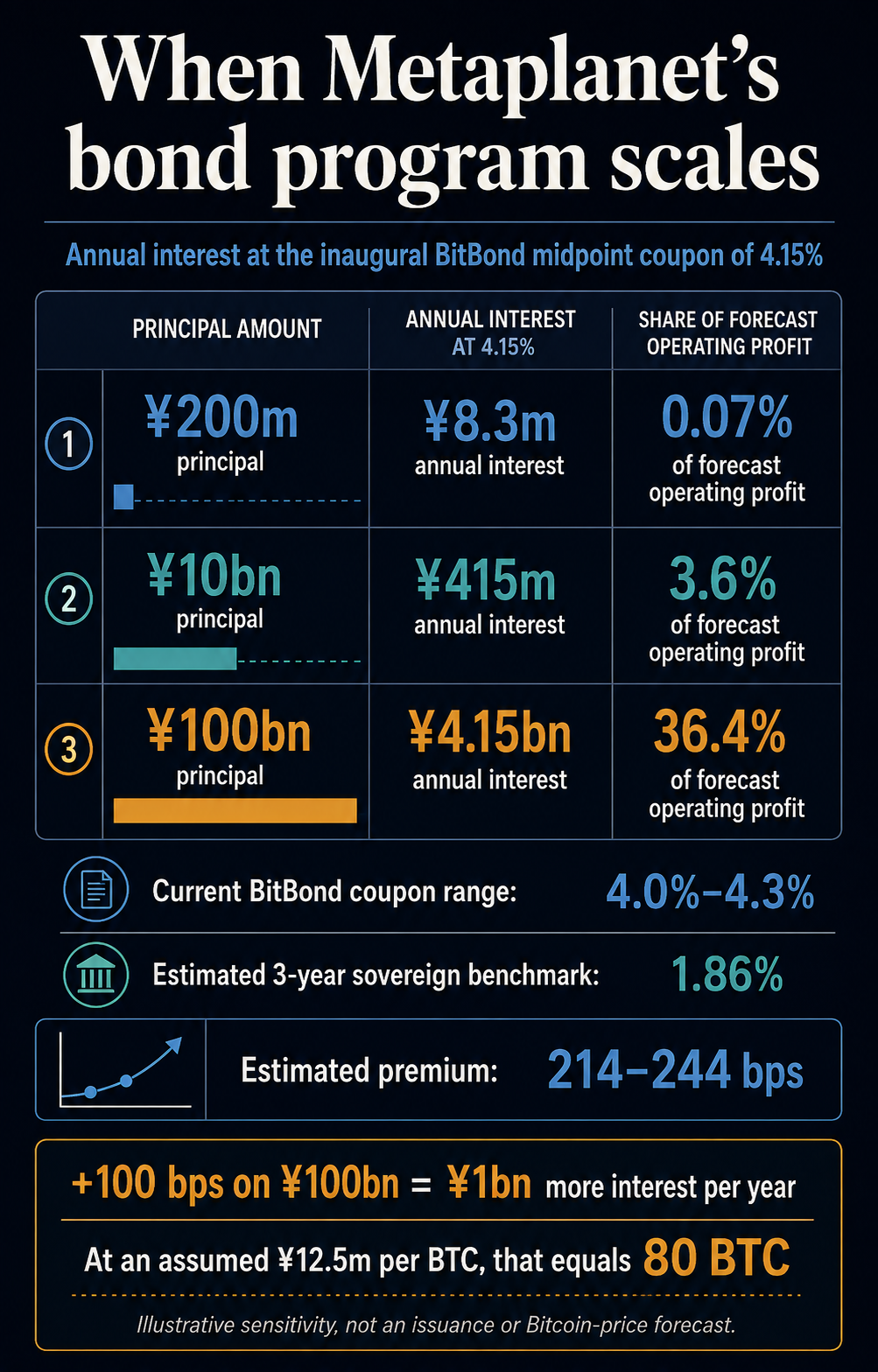
The inaugural BitBond issue is too small to transform Metaplanet’s economics. At 4.15%, the midpoint of its coupon range, annual interest on ¥200 million is about ¥8.3 million, equivalent to roughly 0.07% of the company’s ¥11.4 billion full-year operating-profit forecast.
The same rate applied to larger illustrative programs produces a different result:
The ¥10 billion and ¥100 billion rows are sensitivities rather than issuance forecasts. They show why the ability to expand the program at acceptable rates matters more than the first tranche’s small coupon bill.
A one-percentage-point increase on an illustrative ¥100 billion program would add ¥1 billion to annual interest. At an assumed Bitcoin purchase price of ¥12.5 million, that amount equals 80 $BTC a year when the additional interest comes entirely from cash otherwise available for accumulation.
Metaplanet could instead meet the expense through operating cash flow or another financing source. The 80 $BTC figure applies only to the stated price and cash-use assumptions. Its purpose is to translate a rate move into the company’s capacity to add Bitcoin for each share outstanding.
The balance-sheet effect grows faster than the headline drama. A 4.079% 30-year sovereign yield changes little about a ¥200 million BitBond issue. A large future debt program near the current coupon range would consume a meaningful portion of forecast operating profit before any additional rise in the benchmark or credit spread.
Equity access depends on Metaplanet’s valuation
The 27th-series rights generally may be exercised only when company-notified mNAV is at least 1.01x. No rights were exercised in August. At Aug. 31, 947,300 rights representing 94.73 million potential shares remained, equal to about 7.0% of the company’s 1.345 billion issued shares.
That leaves a material but conditional dilution overhang. If the mNAV threshold prevents exercise, warrant-funded Bitcoin purchases may stall and the proceeds intended partly for repaying the zero-coupon bond arrive more slowly. If the threshold is satisfied and exercises resume, Metaplanet gains funding while existing holders absorb more shares.
The company also held authority to repurchase as many as 150 million shares for up to ¥75 billion through Oct. 28. It bought zero shares in August and zero cumulatively under that authorization through Aug. 31, leaving buybacks absent from the period’s offset to potential dilution.
For the first half, Metaplanet’s issuer-defined measure of Bitcoin holdings per 1,000 fully diluted shares increased 9.6% to 0.0263554 $BTC. The reported funding mix was accretive over that period. Future accretion becomes harder as debt principal expands, coupons rise or more rights convert into shares.
Japan’s Sept. 3 auction therefore tests Metaplanet’s funding advantage at the margin. The zero-coupon bridge preserves the clearest benefit on existing terms, and the BitBond program demonstrates access to fixed-rate yen debt at a meaningful premium over a comparable sovereign tenor. The next funding round’s price and scale will determine how much of that advantage continues to reach Bitcoin per share.
From time to time, a crypto project needs to address contract security and transparency.
MemeToro’s Stage 7 progress has been supported by three independent smart contract audits, while MemeToro has presented its AI agent architecture as open source.
These details matter because buyers need to know how a crypto project handles its code, launch rules, and token distribution before focusing only on price.
MemeToro Presale News: What Three Audits Tell Buyers
MemeToro presale news highlights three independent smart contract audits as an important technical milestone. A smart contract is code that runs rules on a blockchain. An audit checks that code for security problems, unexpected behavior, and other weaknesses before users depend on it.
Three audits do not make a project risk-free, but they give users more information than an unaudited contract. For a presale project, this can be especially useful because buyers are sending funds to blockchain contracts and need to understand how those contracts are designed.
The key points are during Stage 7, after launch, and as the platform gains users and trading activity.
Three independent audits have approved MemeToro’s deployment frameworks.
The project operates on BNB Chain. Public smart contracts are intended to enforce launch rules. The audit work supports, but does not guarantee, future security.
For people following MemeToro Presale News, the main value of the audits is greater visibility into the technical side of the project. A recent project update also identifies Coinsult, BlockSAFU, and SolidProof as part of its reported three-audit security stack.
How Open-Source AI Supports the Stage 7 Story
Another major part of MemeToro Presale News is the project’s open-source AI agent. MemeToro describes an AI agent that monitors social media, online communities, and global news for emerging trends. It can then generate a memecoin concept, visuals, branding, marketing content, and token details before a launch.
The open-source approach matters because users can inspect the architecture and understand more about how the system is intended to work. MemeToro also says its launch process removes private allocation tiers and insider advantages. Instead, public smart contracts enforce the published rules for launches.
The AI proposes a launch, while smart contracts enforce the conditions. That separation can make the process easier to understand than a system where important launch decisions remain hidden.
That distinction is useful for everyday buyers. Security reviews mainly answer technical questions, while an open-source AI model answers questions about visibility and process.
Neither one answers the larger market question of whether users will adopt the platform or whether $MT will gain lasting demand after launch. Those outcomes depend on delivery, liquidity, trading activity, and wider crypto conditions.
What the Audits and AI Validation Do Not Prove
MemeToro Presale News does not mean audits or open-source code remove investment risk. An audit is a review at a specific point in time. New code, integrations, market conditions, or user behavior can create different risks later.
Open-source architecture can improve visibility, but it cannot guarantee that AI-generated memecoins will perform well. Meme markets are highly volatile, and technical quality cannot predict demand.
Users evaluating Stage 7 should therefore look at several areas together:
Audit findings and whether identified issues were addressed.
Public contract behavior and launch rules.
AI agent documentation and actual product delivery.
Tokenomics and distribution.
Liquidity and exchange plans after launch.
MemeToro’s tokenomics list 1.2 billion total $MT, with 71% for the public sale and 10% for CEX reserves. It also describes up to 35% APR staking and a 24-month vesting period for marketing and partnership allocations.
These details add useful context, but they should be assessed alongside security and market risks.
Citigroup has significantly postponed its expectation regarding Federal Reserve interest rate cuts following strong employment data from the US.
The bank announced that it expects the Fed to make its next 25 basis point interest rate cut in June 2027. According to Citigroup’s new forecast, the Fed is expected to implement three separate 25 basis point interest rate cuts in June, September, and December 2027. Citi previously predicted rate cuts in October and December 2026, and January 2027.
Strong US employment data influenced the forecast revision. In August, non-farm employment increased by 162,000 people, exceeding market expectations, while the unemployment rate remained stable at 4.1 percent.
Citigroup, which has long been known for its relatively dovish views on the Fed, stated that recent data may lead policymakers to assess the employment market as generally stable and shift the focus of monetary policy to the inflation outlook.
In a note they published, Citi economists Andrew Hollenhorst and Veronica Clark pointed out that the unemployment rate remained unchanged and the labor force participation rate had recovered significantly.
Following strong employment data, market expectations for the Fed have also changed. According to Fed funds futures, the probability of the Fed raising interest rates at its September 15-16 meeting has risen from 52 percent before the employment report to 61 percent.
Investors are expected to watch the consumer price index (CPI) and producer price index (PPI) data to be released next week for new signals regarding the Federal Reserve’s future interest rate policy.