Zcash price [$ZEC] has returned above $800 as holders consider changes that could impact the network’s speed and issuance.
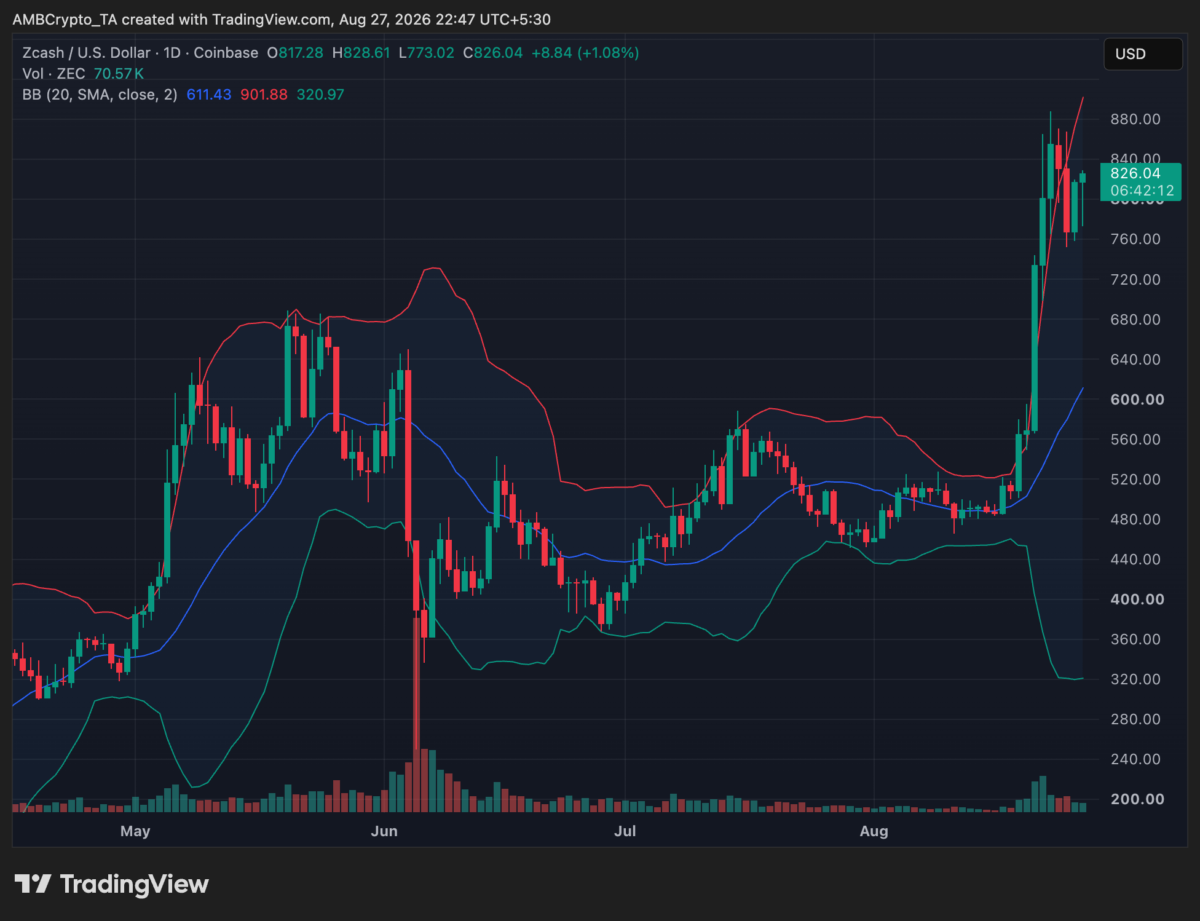
$ZEC traded near $826 at the time of writing after falling briefly to the $773 level. The recovery comes during a time when it’s seeing a sharp weekly rally, even as the price remains below its recent peak near $890.
Zcash coinholders weigh five NU7 questions
The NU7 coinholder poll asks eligible $ZEC holders to vote on five questions concerning Zcash’s next major network upgrade.
One of the proposals is asking for the current four-year halving cycle to be replaced with a smoother reduction in new issuance. Supporters of this proposal believe that this would give miners and users greater certainty instead of cutting rewards suddenly at fixed intervals.
Coinholders are also considering whether part of the network’s transaction fees should return to future block rewards. Other questions cover retiring the old Sprout transaction system and allowing NU7 to proceed if some planned features face delays.
Another proposal would reduce Zcash’s block time from 75 seconds to 25 seconds, which means users would wait less time for transactions to appear on the network.
Cypherpunk Technologies has published its recommended positions on all five questions. The Zcash-focused treasury company strongly supports faster blocks, citing test results that it believes show the network can handle the change.
The poll is also advisory, and its result will only show what participating coinholders prefer, but it does not guarantee that every supported proposal will enter NU7.
$ZEC recovers after falling below $800
$ZEC’s return above $800 follows a positive move from around $500 within several trading sessions.
The rally briefly took it towards $890 before sellers stepped in, and then it dropped below $800, reaching $773 during the latest session. But buyers pushed it back to around $826.
Source: TradingView
That leaves $850–$880 as the next area to overcome, as a move beyond the recent high could bring $900 into view.
The first support sits around $780, and if that level fails, the price could return to $750, an area where buyers previously responded.
There was a lot of trading activity during the initial surge, but it has since reduced. That does not end the rally, but it suggests the latest rebound has led to less activity compared to the move that took its price to $800.
Final Summary
Zcash holders are voting on faster blocks, issuance changes and other NU7 questions.
$ZEC recovered from a fall to $773 to around $826, leaving $850–$880 as its next test.
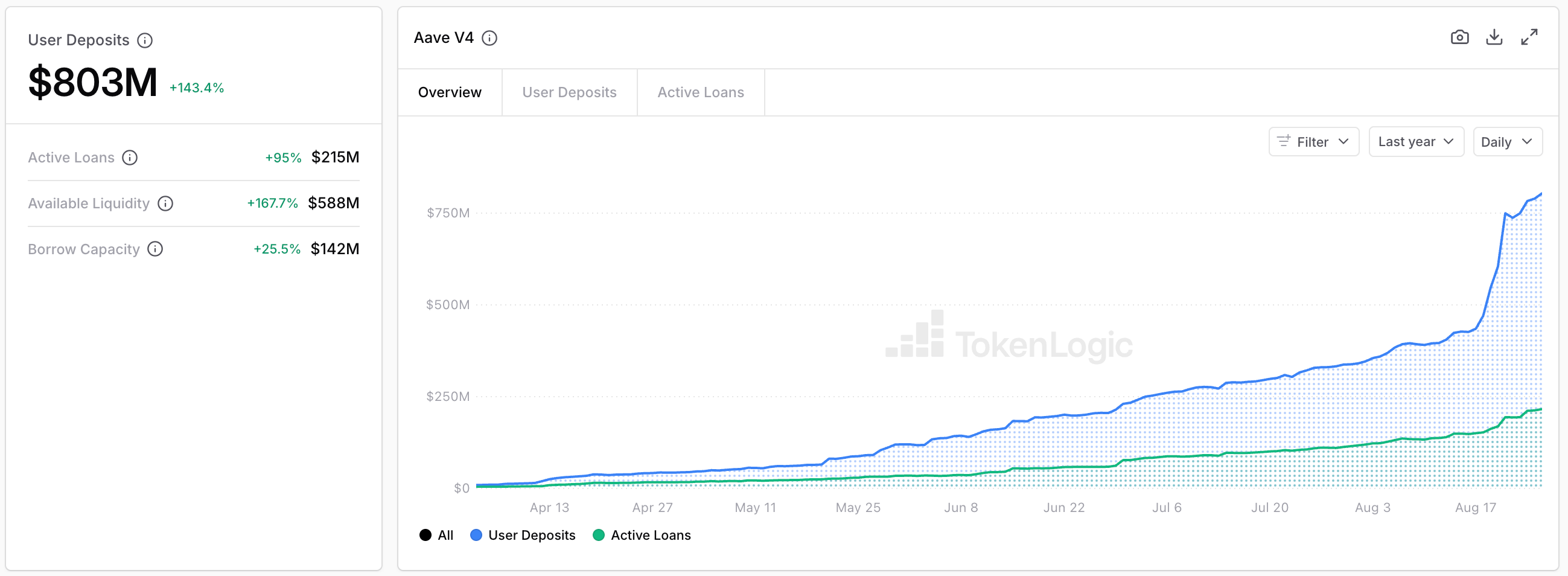
Aave’s live onchain dashboard listed V4 user deposits at $806 million. Deposits jumped by 30% over seven days and reached a new all-time high above $800 million.
The latest reading extends a steep August climb. Aave announced that V4 deposits crossed $500 million on Aug. 19 and $600 million on Aug. 21, before moving above $800 million six days later. A separate announcement said Ethereum V4 deposits alone crossed $500 million on Aug. 25. EtherFi Cash accounted for V4’s second-largest current market.
The market is supporting borrowing as well as deposits. V4 had $216 million in active loans on the dashboard. Aave separately measured $62 million of active loans in the EtherFi market, where weETH collateral backed WETH borrowing at 92% utilization.
The current market mix includes V4 deployments on Ethereum, Optimism and Avalanche. Ethereum Core held $378 million, followed by EtherFi Cash on Optimism at $257 million, Ethereum Global Dollar at $75 million and Ethereum Prime at $63 million. Avalanche Core and Ethereum Plus accounted for another $18 million and $15 million, respectively.
The deposit mix was led by weETH at $97 million and USDG at $90 million. WETH and USDC each accounted for $81 million, followed by liquidETH at $77 million, liquidUSD at $58 million and WBTC at $54 million.
V3 Retains a Far Larger Base
Aave’s equivalent V3 dashboard showed $31 billion in user deposits, far above V4’s $806 million. Ethereum Core alone held $25 billion on V3.
The versions organize liquidity differently. Aave’s documentation says V4 replaces V3’s market-per-pool design with a hub-and-spoke system: hubs consolidate liquidity and accounting, while spokes apply separate borrowing rules and risk limits to particular markets.
On Aug. 27, TokenLogic said the EtherFi Cash market had been live for two weeks and was moving toward a $500 million lending-capacity target.
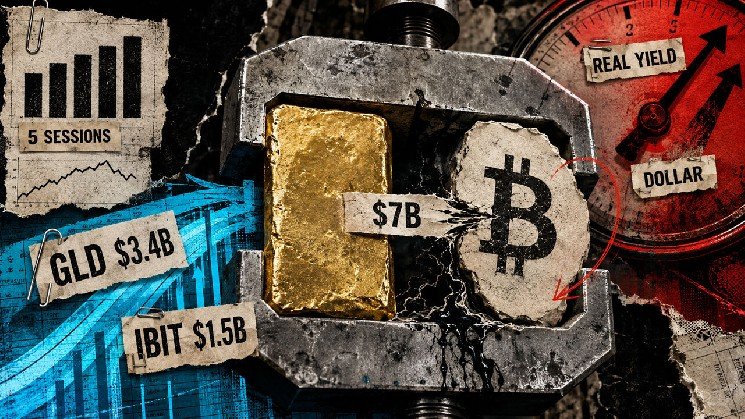
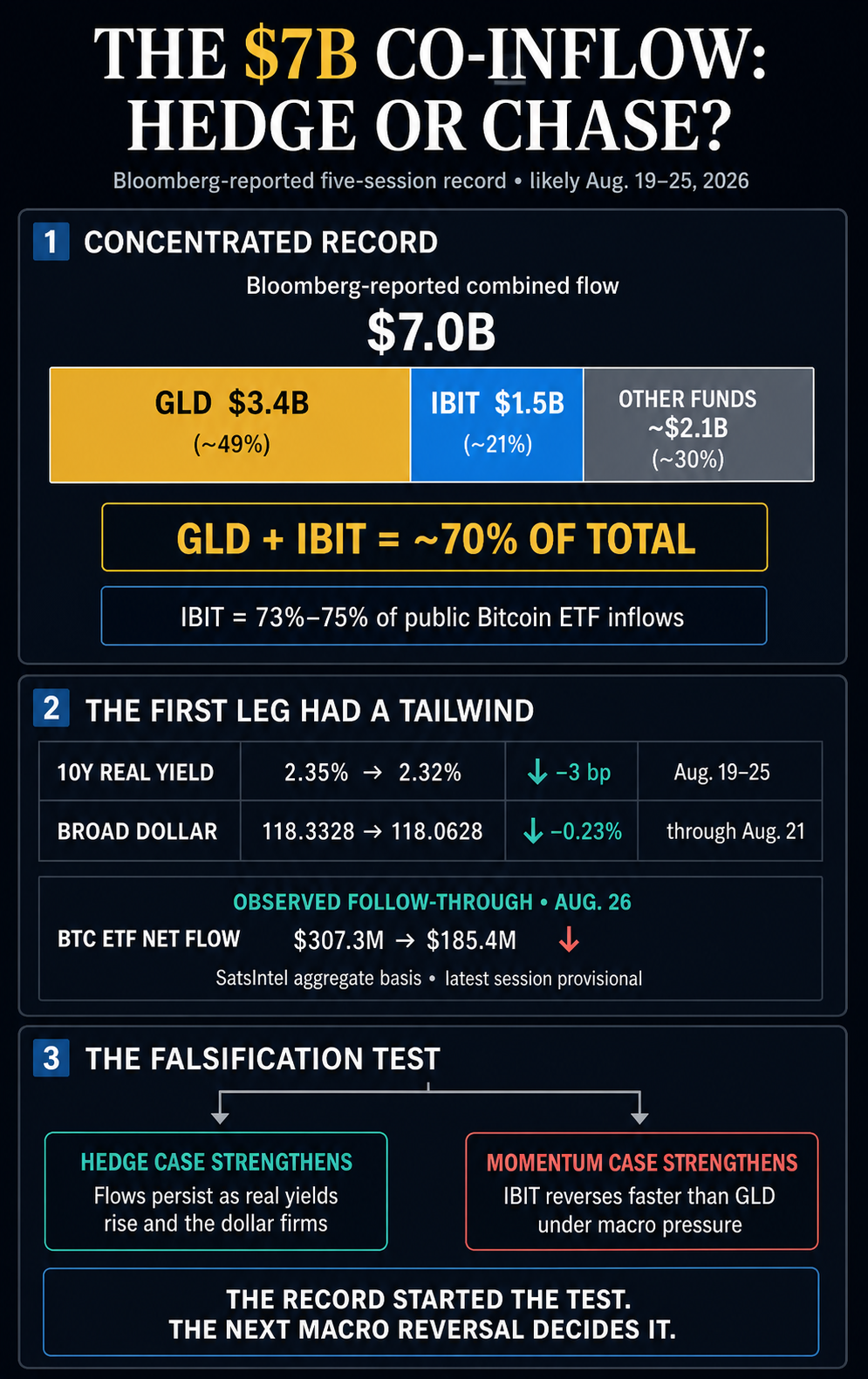
Gold and Bitcoin exchange-traded funds (ETFs) drew roughly $7 billion over five US trading sessions, a record combined haul that puts both assets at the center of a renewed investor push for protection against currency weakness and mounting fiscal pressure.
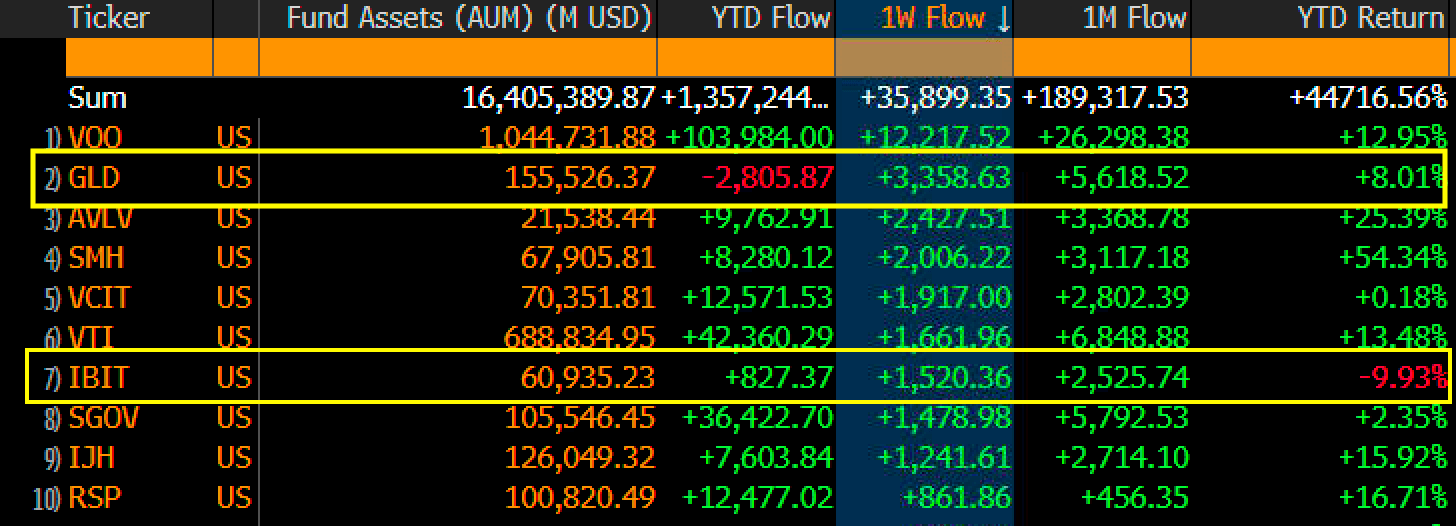
About $3.4 billion of this capital went into SPDR Gold Shares (GLD) while BlackRock’s iShares Bitcoin Trust (IBIT) attracted roughly $1.5 billion. GLD manages more than $150 billion in assets, while IBIT holds around $60 billion, making each the dominant institutional access point in its respective market.
Together, the two funds accounted for about 70% of the combined “debasement trade” inflow, showing how strongly the move was concentrated in the largest vehicles.
Bloomberg Intelligence analyst Eric Balchunas said the five-day total was easily a record for the pair, with both GLD and IBIT ranking among the 10 biggest US ETFs by weekly inflows. He also noted that IBIT’s year-to-date flows had returned to positive territory after recovering from an earlier deficit.
Top 10 US ETFs by Weekly Flow (Source: Bloomberg)
The surge came as both assets climbed sharply. Bitcoin broke above $80,000, while gold traded above $4,600 an ounce, extending a move that has increasingly linked the two through the same scarcity narrative.
Fiscal pressure revives demand for hard assets
The synchronized buying accelerated as investors focused on US debt, Treasury-market strains and a softer dollar.
Treasury’s Aug. 19 decision to at least double the maximum size of liquidity-support buybacks for longer-dated securities to $4 billion per operation added to that backdrop. The change helped pull long-term yields lower initially and came with U.S. public debt already above $40 trillion.
That combination has revived the so-called debasement trade, where investors seek assets with constrained supply as protection against the possibility that persistent deficits and currency expansion erode purchasing power.
Bitwise Chief Investment Officer Matt Hougan said the attraction partly reflects how traditional portfolios remain fully denominated in fiat money.
“A 60/40 portfolio is 100% exposed to fiat currency,” Hougan said, arguing that investors are increasingly looking for a modest source of diversification as fiscal uncertainty rises.
Strive Chief Executive Matt Cole framed the same shift through scarcity, saying dollar debasement expands the pool of capital searching for limited-supply assets and that Bitcoin’s continuing monetization allows it to capture a growing share of that demand.
Bitcoin’s fixed 21 million supply makes it an obvious candidate for that trade, although it remains far more volatile than gold and has a much shorter history as a defensive asset.
Market trends are currently moving in the same direction. Charlie Morris, founder of ByteTree, pointed out that both Bitcoin and gold have positively sloping 200-day moving averages and carry ByteTrend scores of 5, the firm’s strongest bullish reading. The dollar, by contrast, carries a score of zero.
That alignment does not establish why investors are buying, but it reinforces the divergence now visible between scarce assets and the currency against which they are priced.
Wall Street sees a longer-term scarcity trade
The stronger argument for the trade is that the pressure may persist even after the latest move in yields and the dollar fades.
Bernstein said the four-decade decline in interest rates appears to have ended just as sovereign debt burdens have reached record levels, leaving governments more exposed to rising debt-servicing costs. Higher yields can then feed back into larger interest bills, wider deficits and greater borrowing needs, increasing the difficulty of stabilizing public finances.
The firm expects policymakers facing that tradeoff to ultimately favor currency debasement over prolonged fiscal restraint, which it views as the less politically disruptive path.
That would strengthen the case for assets whose supply cannot be readily expanded.
Bernstein said Bitcoin is particularly well positioned because of its fixed issuance, wider institutional and retail access, and a holder base that has historically absorbed severe drawdowns. It estimates about 60% of Bitcoin is held by investors that remained through declines of more than 50%.
BlackRock has also pushed Bitcoin further into conventional portfolio discussions. In research published this month, the asset manager said historical modeling showed that a 1% to 2% Bitcoin allocation could have improved the risk-adjusted performance of a traditional 60/40 portfolio.
Those arguments help explain why the latest ETF flows are attracting more attention than another short-term rally.
Gold already has an established role as protection against monetary and fiscal uncertainty. Bitcoin is increasingly being considered for the same scarcity allocation, but its record remains far shorter and its volatility substantially higher.
That leaves Bitcoin with a test gold does not face to the same degree.
If the dollar strengthens or real yields rise and Bitcoin ETFs continue attracting capital, the latest $7 billion co-inflow would look more like a durable shift in portfolio construction than a trade built around favorable macro conditions.
However, if Bitcoin demand fades while gold remains resilient, the two assets may have benefited from the same debasement narrative without yet earning the same status in investor portfolios.
Jurrien Timmer, Global Macro Director at Fidelity Investments, said that the US Treasury Department’s increase in long-term bond buybacks and its focus on issuing short-term Treasury bills is putting pressure on the dollar while supporting Bitcoin and gold.
Timmer pointed out that the dollar weakened last week after the US Treasury Department repurchased more long-term bonds and issued more short-term bonds in return. He argued that the strong rise in gold and Bitcoin prices during the same period reflected market expectations regarding the future of fiscal and monetary policies.
According to the renowned analyst, investors may have begun to price in a potential shift towards what is increasingly described as “fiscal dominance” in the US, and a weakening of the Federal Reserve’s independence.
Timmer made the following statements:
“It is noteworthy that the U.S. Treasury Department’s issuance of more short-term Treasury bills last week while simultaneously buying back more long-term bonds dragged the dollar down and caused both gold and Bitcoin to rise sharply. The market senses a slippery slope towards fiscal dominance and a possible loss of the Federal Reserve’s independence.”
“Increased Buybacks May Be Necessary to Keep Bond Yields Low”
According to Timmer, for the U.S. Treasury Department’s strategy to keep long-term bond yields under pressure to be successful, the bond repurchase program may need to be significantly increased beyond current levels.
However, Timmer noted that such a scenario could force the Federal Reserve to become involved, potentially meaning the central bank would participate in a kind of “Operation Maturity Restructuring” policy aimed at changing the maturity structure of the bond market.
Timmer stated that such a development could increase the risk of currency depreciation, and offered the following assessment:
“For the U.S. Treasury Department to successfully keep interest rates low, it may need to significantly increase the size of repurchases. This could require the Federal Reserve to become involved in this Operation Maturity Restructuring policy, and could lead us down a path of currency depreciation.”
Timmer: Loose Fiscal and Monetary Policy is Positive for Bitcoin
According to the Fidelity executive, the simultaneous implementation of expansionary fiscal policy and loose monetary policy creates a particularly negative picture for the dollar.
Noting that the dollar is on a significant long-term trend line, Timmer said that such a macroeconomic environment is distinctly positive for gold, and Bitcoin could similarly benefit from it.
Ripple is recommending that the $XRP Ledger community withdraw the long-running XChainBridge (XLS-38) amendment that is focused on bringing cross-chain bridging to the network.
According to the company, the technology is no longer needed for its main intended use case. Moreover, it has failed to secure sufficient developer demand.
Ripple cannot unilaterally remove the feature since it controls only one validator vote on the $XRP Ledger. The withdrawal still has to proceed via the network’s standard amendment process.
XLS-38 was created to provide a native bridging framework for the $XRP Ledger. The proposal would allow assets to move between the XRPL mainnet and connected sidechains with the help of “witness servers.”
The system was designed with custom sidechains, including private and permissioned networks as well as experimental chains. It was also originally intended to serve as the bridge connecting the $XRP Ledger to the XRPL EVM Sidechain.
The Axelar alternative
Ripple said it selected the Axelar network for the EVM Sidechain. Axelar’s network currently has more than 75 validators and supports broad interoperability with more than 50 blockchain networks.
Ripple initially decided to use Axelar for the XRPL EVM Sidechain in June 2024. At the time, the company said it would continue leaving XLS-38 available for a community vote.
Ripple now says that there is little evidence that such demand exists.
“The primary use case that motivated XLS-38’s development is fully addressed, and we believe better addressed, by the Axelar integration,” RippleX said.
The company also argued that maintaining the dormant implementation has become a liability. Removing XChainBridge would allow developers to eliminate more than 10,000 lines of code.
Ripple’s decision could be reversed. Those devs who are actually building around XLS-38 have been asked to present some compelling use cases that could convince the company to change its mind.
The Hyperliquid Policy Center (HPC) made its stance clear in a filing with the Commodity Futures Trading Commission (CFTC) on Thursday, August 27, 2026, pushing the regulator to prioritize perpetual contracts in its innovation agenda.
The HPC’s latest push drops another ping on the radar of US traders who have been shut out of a derivative market that has gone beyond $500 billion in offshore volume.
Perpetual contracts took over CFTC meeting
The statement arrives just after the CFTC held its first Innovation Advisory Committee meeting on August 20. Perpetual contracts were not a part of the main agenda.
The main agenda included digital assets, artificial intelligence, and prediction markets. However, members of the committee could not stop mentioning the topic of perpetual contracts in each of the three sessions, according to HPC.
HPC took this as proof of demand and decided to make four arguments in its statement:
that perpetuals are critical to CFTC’s innovation work
that they meet real hedging needs
that a friendlier CFTC is presently bringing these markets onshore
and that public blockchains can modernize derivative plumbing, thus rewriting the law.
Jake Chervinsky, chief executive of HPC, signed the statement, alongside senior counsel Brad Bourque. HPC submitted the statement to Commission Secretary Christopher Kirkpatrick.
HPC self-describes as an independent research and advocacy organization with ties to the Hyperliquid Foundation. HPC was founded by the Hyperliquid Foundation in February 2026.
Who spoke at the committee meeting?
In the statement, HPC mentioned the names of the members who brought up perpetuals, citing timestamps in the meeting webcast.
Tyler Winklevoss of Gemini said that US firms are being left behind as perpetual contracts make up a bulk of global digital assets trading volume. Don Wilson of DRW perceives perpetuals to be risk tools that registered funds would rather hold next to dated futures.
Brian Armstrong of Coinbase, Raghu Yarlagadda of FalconX, and Multicoin’s Tushar Jain also spoke in favor of perpetuals
Why a contract can track a price despite it expiring
A huge part of HPC’s filing centers on the mechanics of a perpetual contract. A perpetual contract has no settlement date, cannot be rolled over, nor delivered. Rather than expire, money is transferred between long and short holders by a recurring funding payment. This is done so the price can move back toward a reference price.
HPC views this as a better solution for exposures that do not end. It gave examples like: an airline consuming aviation fuel, a fund that manages portfolio risk, and an AI developer that has rising compute costs. They all have unending costs, and hedging them with dated futures will mean traders get to experience a roll cycle that includes risk with timing and transaction costs.
A kinder CFTC docket with a lawsuit to match
The statement arrives at a perfect time. It comes at a point when the CFTC has developed a friendlier vibe toward perpetuals.
In May, the CFTC approved the first US-listed perpetual futures contract, Kalshi’s BTCPERP. It further released a policy statement and staff guidance that broached continuous trading. In June, it requested comment on extending the product to storable energy commodities.
HPC and the HIP-3 deployer trade[XYZ] issued a joint response to the energy request on August 26. Then, HPC went on to file a separate response on August 24, requesting the SEC and CFTC to see qualifying equity perpetuals as security futures.
Walt Lukken of the FIA released committee figures which showed the agency was in charge of 30 designated contract markets, up from 16 in 2003 and 17 pending applications. The agency also oversees 6,700 listed contracts, up from 2,100 in 2023.
Not everyone is on board, though. CME Group took the CFTC to court in June, arguing perpetuals are swaps and not futures, and CME’s outgoing chief, Terry Duffy, has referred to the product as “a disaster waiting to happen.”
MemeToro and AlphaPepe are both attracting attention in the 2026 crypto presale market, but their strategies are different. MemeToro has reached Stage 6 at $0.00350 and is approaching $100,000 raised, while AlphaPepe has advanced to Stage 20 with more than $2.5 million raised from over 11,100 wallet holders.
MemeToro is building an AI-powered $BNB Chain launchpad with automated security scanning, while AlphaPepe focuses on a broader ecosystem featuring rewards, rankings, referrals, and planned exchange access.
Comparing their tokenomics and utility helps explain why both projects have gained attention among investors searching for the best crypto presale opportunities.
MemeToro Focuses Token Utility on AI Launch Infrastructure
MemeToro’s $MT token is connected to an ecosystem designed around AI-assisted memecoin creation and launch infrastructure. The project is currently in Stage 6, with the token priced at $0.00350 and fundraising nearing $100,000.
Its defining feature is the AI-powered launchpad on $BNB Chain. The platform uses an AI agent to help identify trends and develop memecoin concepts, while its automated security scanner is designed to detect developer backdoors and honeypot-style mechanisms before deployment.
This gives MemeToro a clear utility narrative within the AI crypto presale category. Rather than relying solely on community hype, the project is building a product around the process of creating and evaluating new meme tokens.
For investors comparing a crypto presale with established meme assets, that infrastructure focus is an important distinction. The $MT narrative is tied directly to the platform’s future ecosystem.
Here’s a video to watch if you prefer visuals over reading to discover everything about the MemeToro ecosystem.
AlphaPepe Brings a Larger Presale Ecosystem
AlphaPepe has already progressed considerably further through its fundraising cycle. The project has surpassed $2.5 million raised and has attracted more than 11,100 unique wallet holders.
Its Stage 20 presale is priced between $0.02789 and $0.02817, while a 48-hour Bonus Drop gives buyers an opportunity to unlock additional ALPE tokens.
AlphaPepe’s ecosystem includes several features designed around user engagement and participation. Its broader model includes rewards, rankings, referrals, marketplace activity, and planned exchange partnerships.
Project updates also highlight upcoming trading partnerships with CEXs including Azbit and BiFinance. That gives AlphaPepe a strong listing and community-growth narrative alongside its presale.
For readers following crypto presale news, the difference is straightforward. AlphaPepe emphasizes ecosystem engagement and market expansion, while MemeToro emphasizes AI-powered token creation and security infrastructure.
Comparing the Two Presales for 2026
The best way to compare the projects is to look at what each is attempting to build. MemeToro is positioning itself around AI and launch infrastructure, while AlphaPepe is building an ecosystem around community activity, rewards, rankings, referrals, and exchange access.
Their current progress also differs considerably:
MemeToro: Stage 6 at $0.00350
AlphaPepe: Stage 20 at $0.02789–$0.02817
MemeToro: approaching $100,000 raised
AlphaPepe: more than $2.5 million raised
MemeToro: AI launchpad and security scanner
AlphaPepe: rewards, rankings, referrals and CEX roadmap
That makes the comparison useful for investors researching the latest crypto presale market. MemeToro offers exposure to an AI-powered $BNB Chain launchpad, while AlphaPepe offers a broader community and rewards ecosystem.
Both also fit into the expanding memecoin presale category, but their product narratives are distinct. MemeToro’s strongest differentiator is AI-driven infrastructure, while AlphaPepe’s strength is its established presale momentum and engagement-focused ecosystem.
Missed bitcoin’s $BTC$79,672.47 initial climb to $80,000 and looking for a smart way in? Industry experts favor a defined-risk strategy known as call spreads for the next leg higher.
The strategy is popular with traders looking to profit from an expected price rise while capping potential losses. It involves buying the right to purchase $BTC at a given price, such as $80,000, and simultaneously selling the right for someone else to buy it at a higher price, say $90,000, capping both the upside and downside.
The maximum profit is the difference between the two strike prices minus what the call spread buyer paid for the spread. The maximum loss is limited to the initial premium.
“Call spreads remain an appealing mechanism for upside exposure into September,” said Jean-David Pequignot, the chief commercial officer at Deribit, the world’s largest crypto options exchange by volume and open interest.
“Long call spreads allow traders to buy the cheaper wing of a skew leading toward downside puts, capturing potential post-expiry upside while maintaining defined risk ahead of Fed and inflation catalysts,” he told CoinDesk.
He added that put options, which are bets that protect against $BTC price losses, remain relatively expensive.
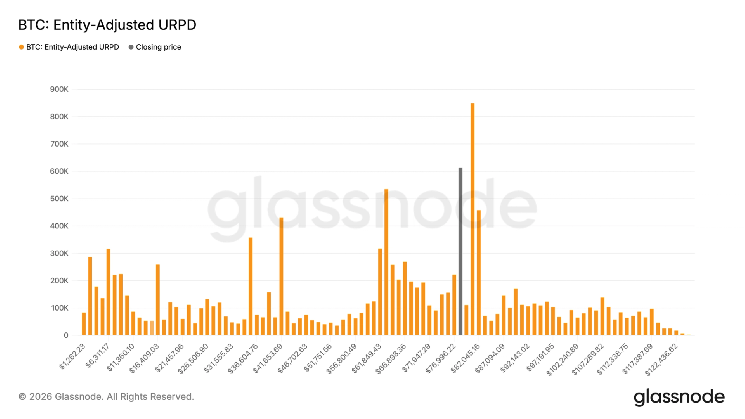
Bitcoin faces a significant resistance wall between $80,000 and $82,000, the largest concentration of supply across any comparable price range.
According to Glassnode’s Realized Price Distribution (URPD), nearly 8% of bitcoin’s supply was acquired within this band. The metric shows where the existing supply last moved, assigning each entity’s total balance to its average purchase-price bucket.
Around 5% of bitcoin’s supply is concentrated at $80,000, the largest cluster at any individual price level, while $82,000 represents the fourth largest. The $78,000 level contains the second-largest cluster, accounting for approximately 3.7% of supply.
These concentrations matter because investors who acquired bitcoin around these levels may sell as the price returns to their cost basis, creating overhead resistance. While, the average cost basis of deposits into the U.S. bitcoin spot ETFs is also around $80,000 to $82,000 adding to the potential sell-pressure.
BTC: Average Cost Basis of US Spot ETF Deposits (Glassnode)
A similar dynamic developed between $60,000 and $63,000, where more than 6% of supply is concentrated. That area became a strong support zone after bitcoin traded within the range for much of 2026 and only briefly fell below $60,000 during the summer but reclaimed that price level quickly.
The 50-week moving average, which tracks bitcoin’s average closing price over the previous 50 weeks, currently sits at $81,081. Bitcoin has remained below it since November 2025. The previous two major recoveries above this trend line, in May 2020 and March 2023, were followed by sustained bull runs.
Recent rapid advancements in quantum computing technology have brought the quantum threat back to the forefront of security concerns for cryptocurrencies, particularly Bitcoin.
The possibility that sufficiently powerful quantum computers could break the current cryptographic systems of cryptocurrencies raises concerns about the long-term security of digital assets.
Therefore, transitioning to quantum-resistant technologies and preparing existing networks against quantum attacks is becoming increasingly important in the crypto sector.
First Quantum Secure Transaction Completed!
At this point, StarkWare announced that it had completed the first transaction designed to provide protection against security threats arising from quantum computing on the Bitcoin mainnet.
The company announced that the quantum-resistant transaction took place on the Bitcoin mainnet using the Quantum Safe Bitcoin (QSB) method and was verified by miners.
The statement explains that quantum-resistant Bitcoin, or QSB technology, uses a hash-based cryptographic system resistant to quantum algorithms, instead of traditional elliptic curve cryptography.
What Does QSB Technology Do?
A significant portion of Bitcoin’s current security architecture relies on elliptic curve-based cryptographic methods such as ECDSA and Schnorr. It is thought that a sufficiently powerful quantum computer could overcome these mathematical problems via the Shor algorithm, making it possible to derive the private key from the public key. This could potentially make Bitcoin addresses that have previously published their public keys vulnerable to quantum attacks.
Therefore, it was stated that the most important feature of QSB technology is that it can be implemented immediately within Bitcoin’s existing scripting standards without changing the consensus algorithm or requiring a soft fork.
It was also noted that QSB uses an additional protection mechanism to prevent the public key from being revealed before the transaction is confirmed by the Bitcoin network.
The Cost of the Procedure is High!
One of QSB’s most significant disadvantages, it was noted, is its high computational cost compared to existing Bitcoin transactions.
In research published in April 2026, StarkWare researcher Avihu Levy predicted a GPU cost of approximately $75 to $150 to create the process. However, following actual testing on the mainnet, the cost was reported to be around $150–$200, or several hundred dollars. It was also noted that the calculation process took hours.
Therefore, QSB is currently considered more of an experimental method for protecting high-value Bitcoin assets against quantum threats, rather than an economical alternative for daily Bitcoin transfers.