DWF Maas and Falcon Digital, two firms tied to market maker DWF Labs, sued custodian BitGo for $141 million in London’s High Court, alleging it sold locked-up tokens early in breach of a private OTC deal.
The firms say BitGo got the tokens at a discount on a pledge not to sell before vesting, then moved them to exchanges early.
Both parties have ties to Trump-backed World Liberty Financial.
Two companies tied to crypto market maker DWF Labs have taken BitGo to court, alleging the custodian dumped locked-up tokens early and tanked their value, in a $141 million dispute now before London’s High Court.
DWF Maas and Falcon Digital filed the suit, the Financial Timesreported Friday, accusing BitGo of breaching the terms of a private, over-the-counter deal involving Falcon Finance (FF) and ESPORTS tokens.
According to the reporting, BitGo had received the tokens at a discount in exchange for a commitment not to sell them until lock-up and vesting periods expired, but instead moved them to exchanges roughly two months before the first unlock.
DWF argues that selling into a thin market created heavy downward pressure, eroding the value of the tokens it still held. The firms say they raised the issue with BitGo in April and May before suing when the company didn’t provide assurances.
BitGo declined to comment, per the report, and the allegations have not been tested in court.
The clash pits two institutional heavyweights against each other. BitGo is one of crypto’s largest custodians, with roughly $5 billion in assets under custody. The company went public on the NYSE this year at around a $2 billion valuation and recently acquired NYDIG’s institutional trading arm.
BitcoinBTC · USD
$83,018−2.1%
Oct 4Oct 5Oct 7Oct 9Oct 11
$86.7k$84.7k$82.7k$80.7k
24h HighHigh$83,094
24h LowLow$82,494
VolVol$564.5M
Market projectionsOdds by Myriad
→
DWF Labs, headquartered in Dubai, is a prolific market maker and investor across the token economy. A notable thread ties the warring parties together: both have links to World Liberty Financial, the Trump-family-backed crypto venture.
DWF bought $25 million of World Liberty’s WLFI token last year, and BitGo custodies the reserves behind the project’s USD1 stablecoin, a role World Liberty is now moving to take over through its own newly approved trust bank.
Daily Debrief Newsletter
Start every day with the top news stories right now, plus original features, a podcast, videos and more.
Starknet is “actively considering” becoming an independent layer-1 blockchain, with 2027 as the target to become the first fully quantum-resistant network.
StarkWare CEO Eli Ben-Sasson said an L1 would let Starknet control its own security upgrades instead of waiting for Ethereum, whose roadmap targets core post-quantum infrastructure around 2029.
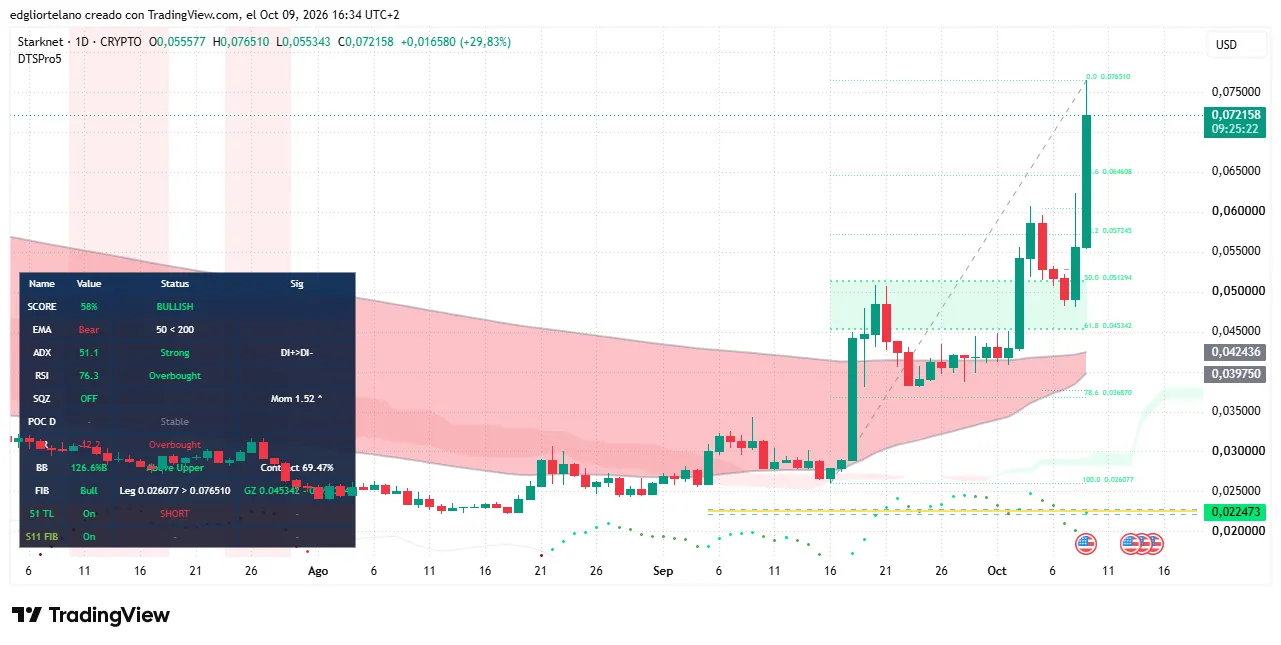
The STRK token traded near $0.073 on Friday, up about 20% in 24 hours and more than double its roughly $0.03 price in April.
Starknet, the Ethereum scaling network built by StarkWare, said it is weighing a move to become its own blockchain.
“We are actively considering becoming an L1,” the project wrote on X. “This would enable Starknet to become the first fully quantum-resistant network, with 2027 as our target.”
The STRK token traded around $0.073 on Friday, up about 20% in 24 hours. That is more than double the roughly $0.03 it fetched in April, when StarkWare cut staff to chase revenue.
An L1, or layer 1, is a base blockchain such as Bitcoin or Ethereum that validates and secures its own transactions. Starknet is a layer 2, a network that sits on top of Ethereum, bundles transactions into batches and leans on the base chain for security.
Starknet’s pitch centers on quantum computers, machines that could one day crack the elliptic-curve cryptography (the math behind the digital signatures that prove you own your coins) used by Bitcoin and Ethereum. Starknet’s own proofs rely on hash functions, which scramble data into fixed fingerprints and are considered quantum-resistant, though some elliptic-curve pieces remain that it said it would replace in a roadmap published June 30.
Starknet price data. Image: Tradingview
StarkWare CEO Eli Ben-Sasson floated the idea in a thread on X, saying the quantum threat “may be much closer than we think” and that AI’s pace in mathematics adds a second risk that calls for “bunker mode”—a phrase recently popularized by Ethereum researcher Justin Drake in his own call to action earlier this week.
Starknet becoming an L1 for post-quantum agility: good idea or bad idea?
Two giant elements we need to pay attention to: (1) The quantum threat. It may be MUCH closer than we think.
(2) AI. It’s becoming more powerful than we can process. Is anyone willing to bet how much time… pic.twitter.com/bLsxzwX2mQ
— Eli Ben-Sasson | Starknet.io (@EliBenSasson) October 8, 2026
Ben-Sasson wrote that Starknet, as an L2, relies on the security of Ethereum, which means it can only be as quantum-safe as its base layer. He said the network needs Ethereum to move “real fast,” and that becoming an L1 is among the options if it does not.
Ethereum’s own roadmap targets core post-quantum infrastructure by around 2029, per ethereum.org, after the Ethereum Foundation formed a dedicated post-quantum team in January. Drake said at the time that “timelines are accelerating.” Bitcoin has made no such commitment, according to Ben-Sasson.
Becoming an L1 would give Starknet control over its own security upgrades, so it would not have to wait for Ethereum or Bitcoin to move first, Ben-Sasson wrote. It would also mean Starknet secures itself instead of borrowing Ethereum’s protection, the arrangement that defines a layer 2. The statement does not say how existing apps and users would move over.
BitcoinBTC · USD
$83,018−2.1%
Oct 4Oct 5Oct 7Oct 9Oct 11
$86.7k$84.7k$82.7k$80.7k
24h HighHigh$83,094
24h LowLow$82,494
VolVol$564.5M
Market projectionsOdds by Myriad
→
On the other hand, it would also mean Starknet is responsible for its safety and development, which could be a hurdle considering Ethereum as a project is the second largest and most active in the crypto ecosystem after Bitcoin.
No quantum computer can break these systems today, and experts disagree on when one might. Strategy co-founder Michael Saylor told Bloomberg last year that he does not worry about it, arguing that banks and tech giants would be hit first.
Ben-Sasson said Starknet could reach quantum resistance by 2027, two years before the end-of-2029 date he cited for Ethereum.
Daily Debrief Newsletter
Start every day with the top news stories right now, plus original features, a podcast, videos and more.
Bitcoin rebounded 1.38% to $82,837 on Friday after dipping to $80,427 on Thursday, while total crypto market cap rose 2% to $2.8 trillion and the Fear & Greed Index fell to a neutral 56.
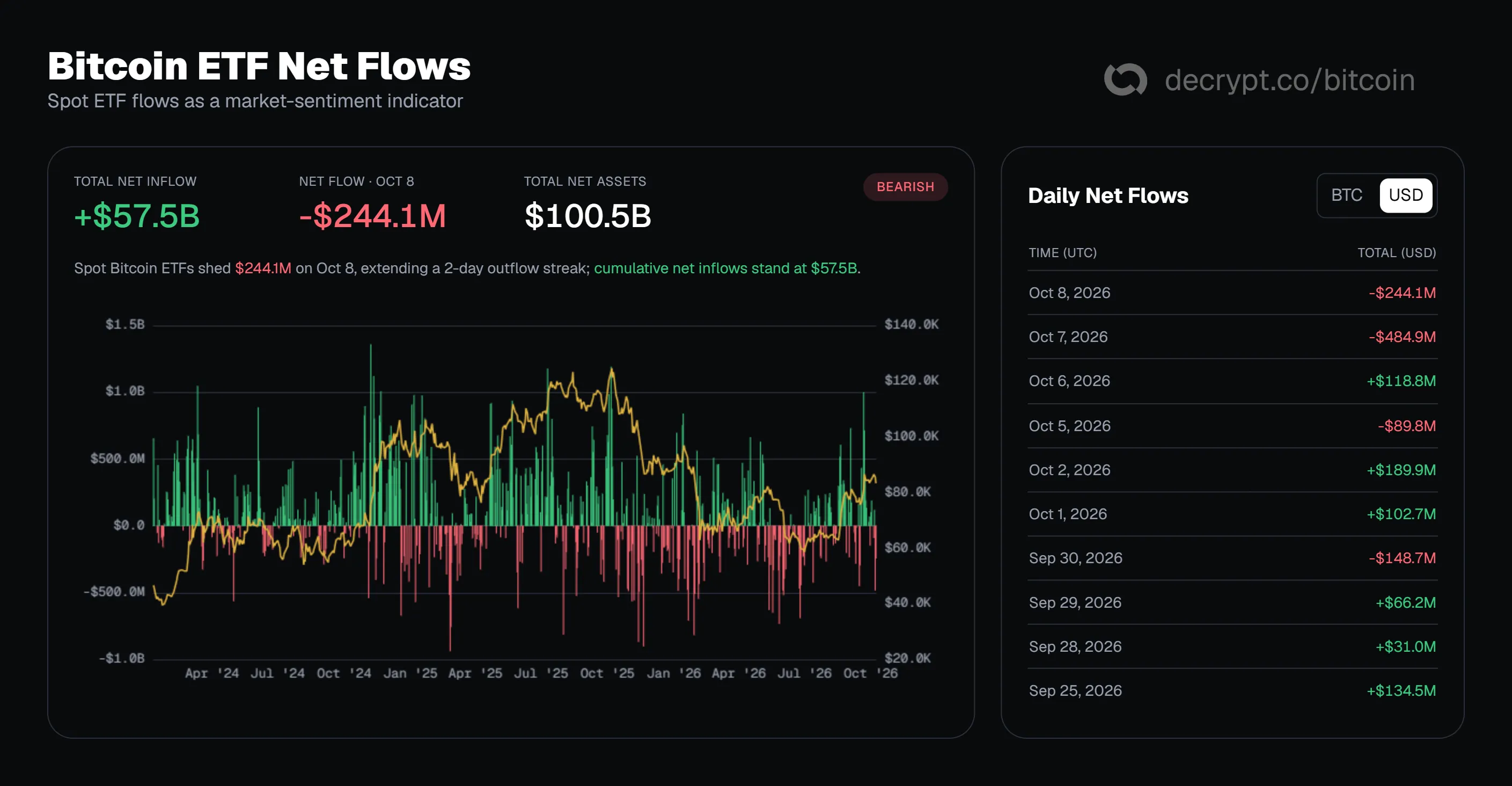
Bitcoin ETFs shed $484.9 million on Wednesday and $244 million on Thursday as the 10-year Treasury yield hit 5.32%, and Fed minutes point to another hike by year-end.
Myriad traders give a 67% chance Bitcoin trades at or below $80,000 before October ends.
The crypto markets are breathing today, with the total capitalization up 2.1% to $2.89 trillion on Friday. The bounce recovers only part of the damage, since the market stood above $3 trillion a week ago, when Bitcoin was pressing against its yearly high.
Despite the recovery, traders are still nervous. The Fear & Greed Index dropped to 56, a neutral reading, down from the 71 that put sentiment firmly in “greed” territory on October 2.
Wall Street is also nervous. Bitcoin ETFs alone shed $484.9 million on Wednesday, their worst day since June 25, and a further $244 million on Thursday, according to Decrypt’s ETF tracker.
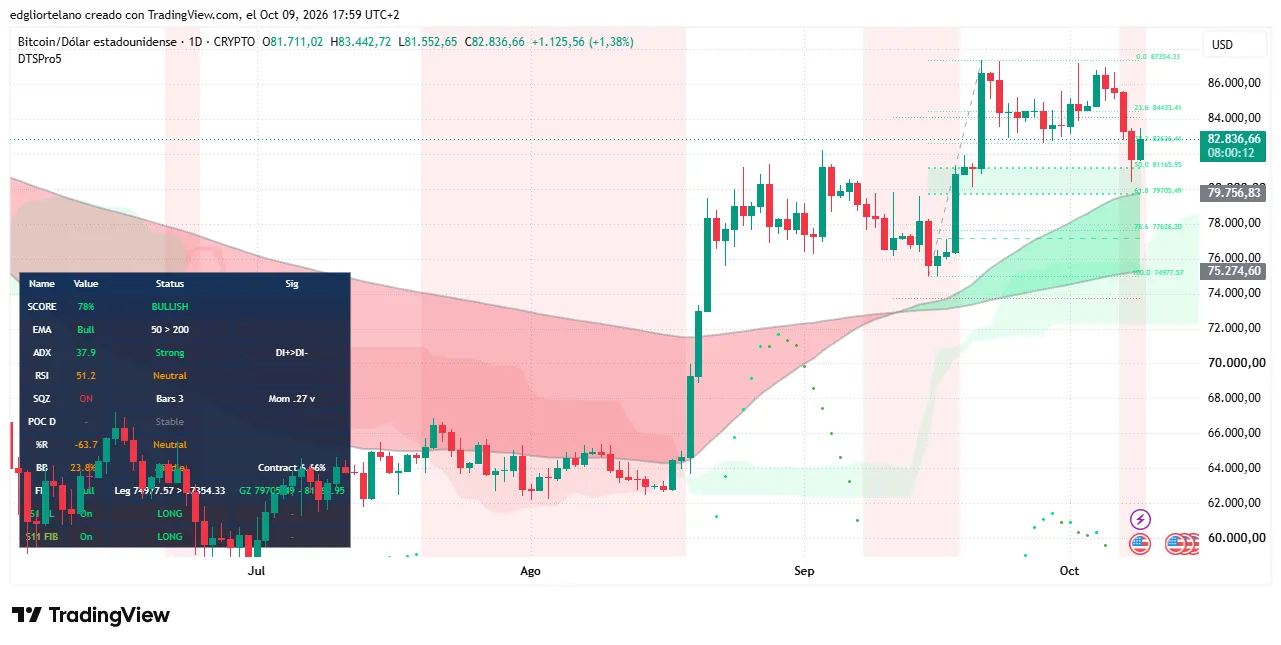
Bitcoin trades around $82,837 on Friday, up 1.38% on the day, after dipping to $80,427 on Thursday, its lowest level since early September.
The daily candle opened at $81,711 and has ranged between $81,553 and $83,443. On the four-hour chart, price still trades below the 50-period exponential moving average, so the short-term trend has not turned.
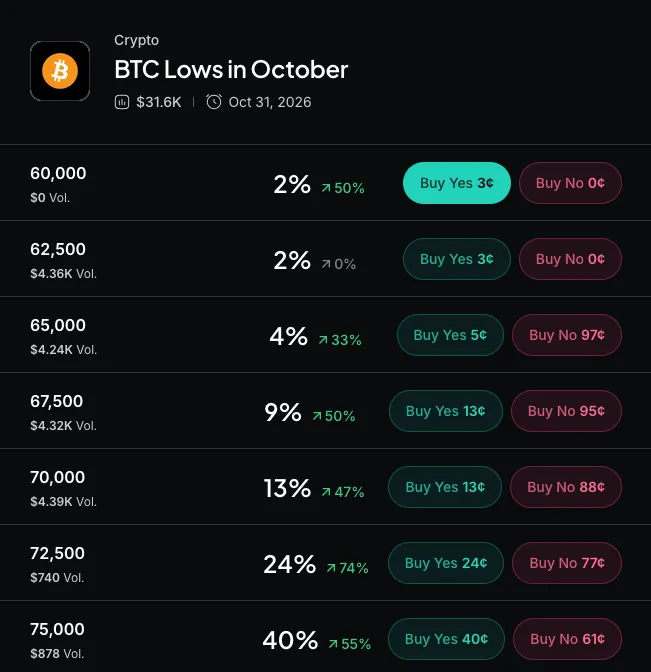
Myriad, a prediction market owned by Decrypt‘s parent company Dastan, gives a 67% chance that Bitcoin trades at or below $80,000 at some point in October, with 40% odds for $77,500 and 24% for $75,000.
Bitcoin price data. Image: Tradingview
A separate weekly market put 49% odds on Bitcoin finishing the week above $87,500 so traders expect a month of price compression with some space for further downside.
The Average Directional Index, or ADX, which measures trend strength regardless of direction, reads 37.9 on the daily chart, well above the 25 level that confirms a real trend. The directional lines show buyers (DI+) above sellers (DI-), so the trend is still bullish even after the pullback.
The Relative Strength Index, or RSI, gauges buying pressure on a scale of 0 to 100, and its 51.2 reading is neutral, just like the Fear and Greed Index. This is worth checking out, because Bitcoin appears to be cooling down after an overbought phase.
Bitwise Europe’s Luke Deans told Decrypt that the $83,000 zone combines the average ETF cost basis with the prior higher-high level, which makes it the first test for the bounce.
Reclaiming it would put the price zone at $84,433 in play, while the September high at $87,354.33 remains the ceiling bulls need a daily close above.
Daily Debrief Newsletter
Start every day with the top news stories right now, plus original features, a podcast, videos and more.
New York Attorney General Letitia James has permanently barred former Celsius CEO Alex Mashinsky from the securities, commodities and crypto industries.
The settlement secures up to $35 million, payable only if Mashinsky fails to forfeit $10 million more or does not serve his full prison sentence.
Mashinsky is serving 12 years in federal prison after pleading guilty to fraud, and has asked a court to vacate the sentence.
New York Attorney General Letitia James has permanently barred former Celsius Network CEO Alex Mashinsky from the securities, commodities and crypto industries, and secured up to $35 million from him, her officeannounced Friday.
The payments are conditional, with Mashinsky required to pay New York $25 million if he fails to forfeit a further $10 million in ill-gotten gains to the federal government under his plea agreement, and $10 million if he does not serve his full prison sentence.
We’re barring Alex Mashinsky, the former CEO of Celsius, from the financial industry after he promised New Yorkers that his company was a secure place to invest their savings, only to leave them penniless.
Mashinsky hasasked a court to vacate his 12-year sentence.
Jamessued Mashinsky in 2023, accusing him of defrauding hundreds of thousands of investors, including more than 26,000 in New York, by misleading them about the safety of the crypto lending platform, which collapsed in 2022.
Her office’s investigation found that Mashinsky repeatedly claimed Celsius was safer than a bank, while customers’ assets were used in high-risk strategies whose losses he concealed.
One New York resident mortgaged two properties to invest with Celsius, and a disabled veteran lost $36,000 that had taken him nearly a decade to save, according to the attorney general’s office.
“Alex Mashinsky promised New Yorkers that his company was a secure place to invest their hard-earned savings, only to leave them penniless when his risky investments collapsed,” James said.
Mashinsky wassentenced to 12 years in federal prison in May 2025 after pleading guilty to fraud charges. Prosecutors hadsought 20 years. He was also ordered to forfeit more than $48 million.
Celsius creditors had received more than $3.4 billion through the company’s bankruptcy as of August 2026, according to the attorney general’s office. Mashinskyforfeited all of his claims to the bankruptcy proceeds.
Daily Debrief Newsletter
Start every day with the top news stories right now, plus original features, a podcast, videos and more.
The UK has sanctioned three crypto exchanges, two payment platforms and one individual it suspects of helping Russia circumvent financial sanctions.
The targets include Xeltox Enterprises, the Canadian company the UK says owns Cryptomus, and a Kyrgyz payment firm owned by the country’s Ministry of Finance.
The 38-designation package also hit Russian oil producers Zarubezhneft and INK Capital, and 12 more shadow fleet tankers.
The UK has sanctioned three crypto exchanges and two payment platforms that it suspects Russia is using to circumvent financial sanctions, the Foreign, Commonwealth & Development Officesaid Thursday.
The targets include Xeltox Enterprises, a Vancouver-registered company designated through its ownership of Cryptomus and activities “linked to and continued via” Heleket, according to the UK’ssanctions notice. Kyrgyz firms TokenSpot and Tsunami Payments, which share an office tower in Bishkek, were also designated.
Putin’s war depends on money, oil revenues and the networks that help sustain them.
Today, the UK is imposing 38 new sanctions to disrupt those networks.
The message is simple: if you help Russia fund or equip this war, you will face the consequences. pic.twitter.com/bCMq37dKPa
— Foreign, Commonwealth & Development Office (@FCDOGovUK) October 8, 2026
So was Processing KG, the operator of payment service VexPay, whose parent company is Kyrgyzstan’s Ministry of Finance, according to the notice. Its director, Ulan Bukabaev, was sanctioned alongside it.
Two of the targets processed and facilitated transactions with the A7 network, the government said, without specifying which.
Beyond asset freezes, the four companies face internet services sanctions, which require social media platforms, internet providers and app stores to take reasonable steps to stop UK users accessing their sites and apps.
The UK describes A7 as a Kremlin-backed “illicit finance network” used to circumvent sanctions on Russia’s financial sector. The network claimed to have moved more than $90 billion last year, roughly half of Russia’s annual military spending, according to the government.
The crypto designations are part of a 38-target package that also includes Russian oil companies Zarubezhneft and INK Capital. UK sanctions now cover more than 90% of Russia’s oil production capacity, the government said.
The package adds 12 shadow fleet tankers, bringing the number sanctioned to more than 600, and 17 entities and individuals involved in supplying goods critical to Russia’s missile and drone production.
The UK, the U.S. and the EU have sanctioned a string of crypto businesses as part of their Russia sanctions packages over the past few years. In May, the UKsanctioned Justin Sun’s HTX and other crypto firms, accusing HTX of providing financial services to A7. The EUnamed HTX in its own Russia sanctions two months later.
The U.S. has sincedesignated the A7 network as a transnational criminal organization, and the EU hasmoved toward a ban on all crypto transactions with Russian entities.
A UKoperation targeting Russian sanctions evasion has also led to 128 arrests and seizures of crypto and cash.
In May, Kyrgyzstanordered 50 companies to cease activity after state agencies flagged them for sanctions risks.
Daily Debrief Newsletter
Start every day with the top news stories right now, plus original features, a podcast, videos and more.
Bitcoin has dropped 4.1% this week, after U.S. spot BTC ETFs shed $484.9 million Wednesday.
The slide comes in October, which is historically a green month for the leading cryptocurrency.
Experts warn that Bitcoin could continue to stoop, testing support levels as low as $72,000.
Bitcoin has been in the red since October started, a month historically green for the leading cryptocurrency—often referred to as “Uptober.” Experts warn not to treat October as a reliable bottom for Bitcoin, and predict there could be more bleeding ahead.
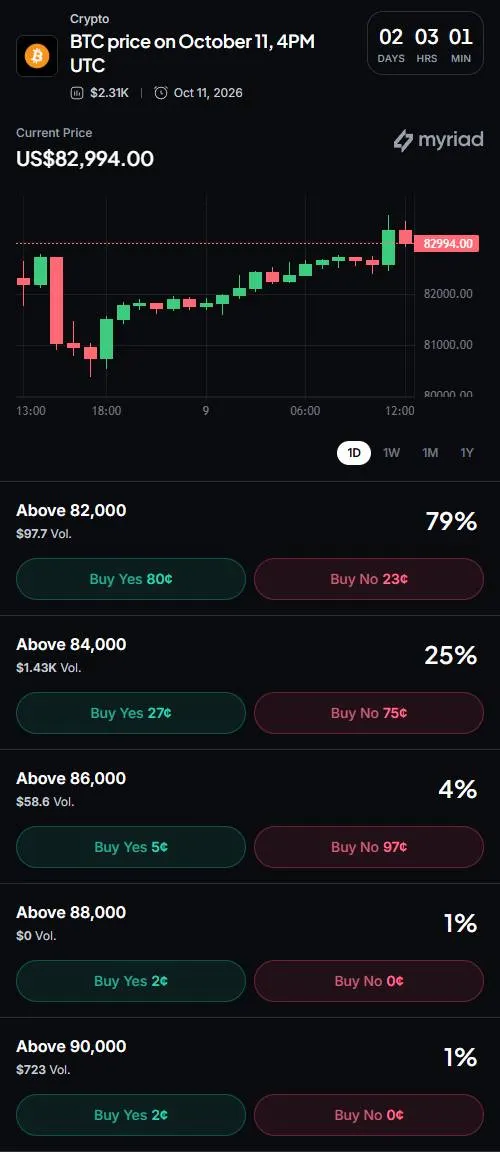
Per CoinGecko data, Bitcoin hit lows of $80,427 in the past week, and is currently trading at just under $83,000, down 4.1% over the past seven days. On Myriad, a prediction market owned by Decrypt‘s parent company Dastan, users put a 79% chance on Bitcoin ending the week above $82,000, and just a 28% chance of it topping $84,000.
“From a market-structure perspective, the $83,000 region remains an interesting level,” Luke Deans, Senior Research Associate at Bitwise Europe, told Decrypt. “This area combines the average ETF cost basis with the prior technical higher-high threshold and has been tested repeatedly over recent weeks.”
Myriad: BTC price on October 11, 4PM UTC. Click to make your prediction.
Where is support?
Bitcoin fell below $83,000 early on Thursday morning and is currently attempting to recover. Deans said the reaction to this will be “informative,” as if it struggles to recover, then lower structural support targets should be considered.
Ananda Banerjee, Founder and Principal Quantitative Researcher at analysis firm Charlie Quant Lab, told Decrypt that he sees strongest support at $77,000. This is according to on-chain metrics, he said, which show a notable cluster of the Bitcoin supply was bought at this level. Deans agrees that the average acquisition price of active investors, or the True Market Mean, is near $77,000.
BitcoinBTC · USD
$82,656−2.34%
Oct 3Oct 4Oct 6Oct 8Oct 10
$86.7k$84.7k$82.7k$80.7k
24h HighHigh$83,398
24h LowLow$81,857
VolVol$1.0B
Market projectionsOdds by Myriad
→
However, Deans also sees lower support at $74,000 with the Short-Term Holder Cost Basis, which represents the average acquisition price of newer market participants. The 200-day moving average also sits at $72,000, which he said provides an independent technical reference alongside the on-chain measures.
“Through this lens, Bitcoin could fall materially from current levels and still remain within what we would consider a constructive risk-on structure,” Deans told Decrypt. “A move into the $72,000 to $77,000 region would represent a strong retest of the broader transition zone.”
If that area is successfully defended, he said, then a range which previously acted as resistance for Bitcoin movements will be turned into support—which would be a positive signal. That said, failing to defend that zone could “impair current market structure.”
Still, Bitcoin tested a move above $87,000 at the start of the week, albeit unsuccessfully. The failure was driven “mainly by futures positioning rather than spot demand,” Bitfinex analysts told Decrypt. “Spot demand remains the missing piece,” they added, noting that U.S. spot Bitcoin ETFs took in $241.1 million in the week of September 28 to October 2, against $2.39 billion the week before. “The average ETF investor is back at breakeven for the first time since January, a level at which inflows have historically been slow,” they said.
Can-Luca Köymen, Investment Strategist at Sygnum Bank, also told Decrypt that low spot volume is stunting Bitcoin’s price action.
Bitfinex analysts believe that Bitcoin’s consolidation range is between $84,000 and its yearly open of $87,722. The analysts said that September CPI on October 14 could put an end to that range, alongside ETF flows picking up.
Bitcoin ETFs lost $484.9 million on Wednesday, the worst single-day outflow since June 25, according to Decrypt’s ETF tracker. BlackRock’s IBIT took the biggest hit at $207.7 million, with Fidelity’s FBTC next at $105.1 million. Experts believe this needs to reverse for a successful Uptober—but with the funds shedding a further $244 million Thursday, the direction of travel is still downwards.
Is Uptober cancelled?
So, is Uptober over? Most experts that Decrypt spoke to were hesitant to declare Uptober cancelled over a single week of red action. Still, they warned against basing investment decisions based on a hyped up month rather than fundamentals.
“Historical evidence supports October strength,” Jake Kennis, Senior Research Analyst at Nansen, told Decrypt. “Bitcoin has posted a median October return of roughly 14% since 2013, with 10 of the past 13 Octobers finishing positive.”
“But ultimately liquidity, positioning, macro conditions, and underlying demand are more important drivers than any specific date,” he added.
Daily Debrief Newsletter
Start every day with the top news stories right now, plus original features, a podcast, videos and more.
Ledger is investigating reported losses among Southeast Asian customers who bought devices from reseller CryptoBilis, and has asked the reseller to pause sales and shipments.
The company told anyone who bought from CryptoBilis in the past 90 days not to set up their device, and those who have to move funds to a new device with a fresh seed phrase.
Onchain investigator Specter traced more than $86 million in suspected thefts across Ethereum, Tron and Bitcoin. Ledger hasn’t confirmed the figure or the cause.
Ledger is telling some customers to hold off on setting up their hardware wallets.
The Paris-based wallet maker said Friday it is investigating reports that users in Southeast Asia who bought devices from a reseller called CryptoBilis have lost funds.
“As a precaution, and pending the results of our investigation, we have asked CryptoBilis to pause all sales and shipments of Ledger devices,” the company’s support account wrote on X.
Ledger urged anyone who bought from the reseller in the past 90 days not to set up their device if they haven’t already. Those who have should consider moving their assets to a new Ledger signer with a new seed phrase, the master backup that can regenerate a wallet’s private keys.
Ledger is investigating reports of loss of funds from users in South East Asia who purchased products from a reseller named CryptoBillis. As a precaution, and pending the results of our investigation, we have asked CryptoBilis to pause all sales and shipments of Ledger devices.…
Ledger didn’t say what caused the losses or how many customers were affected. Hardware wallets are designed to keep private keys offline, but a device compromised before it reaches the buyer, such as one shipped with a recovery phrase an attacker already knows, can leave funds exposed. No tampering has been confirmed.
The losses may be large, potentially in the tens of millions of dollars. Pseudonymous crypto investigator Specter said they traced theft addresses flagged in reports from Ledger users on X and Reddit and found inflows from hundreds of victim wallets across Ethereum, Tron, and Bitcoin.
There have been a reports on X and Reddit of wallet-draining by Ledger users.
I traced the theft addresses and identified inflows from more hundreds of victim wallets across several major blockchains, including Ethereum, TRON, and Bitcoin.
“Total losses $86M+,” Specter wrote. Arkham data shared by the investigator shows nearly $87 million at those addresses, including about $42 million in ETH, $17.6 million in BTC and $16.5 million in USDT. Ledger hasn’t confirmed the figure, and it’s unclear whether every theft is linked to the reseller.
Rival Trezor has faced its own security headaches, including customer data exposed in a shipping partner breach and a breach of its email just last month.
BitcoinBTC · USD
$82,656−2.34%
Oct 3Oct 4Oct 6Oct 8Oct 10
$86.7k$84.7k$82.7k$80.7k
24h HighHigh$83,398
24h LowLow$81,857
VolVol$1.0B
Market projectionsOdds by Myriad
→
The episode adds to a brutal stretch for crypto security. Last month, Bitget lost roughly $387 million in a hack that investigators have tied to North Korea, and blockchain tracking firms Chainalysis and Elliptic have since traced part of the haul.
A batch of 100.02 BTC mined in July 2010 moved on October 7 for the first time in 16 years, worth about $8.3 million at roughly $83,000 per Bitcoin.
The coins were split into 10 BTC and 90.02 BTC outputs sent to two new addresses, both unspent as of Thursday, and nothing onchain identifies the owner or shows a sale.
The move follows a run of dormant-wallet activity, including six wallets that shifted 553.59 BTC between August 16 and 26.
A batch of 100.02 Bitcoin mined in July 2010, from a period commonly known as the Satoshi-era, moved on Wednesday for the first time in 16 years.
At roughly $83,000 per coin, the stash was worth about $8.3 million when it left. Based on Bitbo’s highest registered price of BTC in 2010, the stash was worth around $29 when it was mined.
The transaction was confirmed at 18:52 UTC in block 970,379—one of the batches of transactions that Bitcoin’s network stamps onto its public ledger roughly every 10 minutes. It split the coins between two new addresses, an address being the string of characters that works like an account number: 10 BTC went to one and 90.02 BTC to the other.
The holder paid a fee of 1,467 satoshis—a satoshi is one hundred-millionth of a bitcoin—which came to about $1.22 for moving $8.3 million. Both destinations are modern bc1q addresses, a format that did not exist when the coins were mined. Nothing in the transaction identifies the owner, and moving coins between addresses is not the same as selling them.
Both pieces were mined within days of each other: 50.02 BTC in block 70,522 on July 26, 2010, and 50 BTC in block 70,748 on July 28. The two payouts were merged into a single transaction on July 30, 2010, landing in the address that just moved them.
Nobody knew it back then, but 2010 turned out to be a special year for Bitcoin. A Florida programmer named Laszlo Hanyecz had paid 10,000 BTC for two pizzas, a bill of about $41. Today, the stash has grown more than a millionfold since.
BitcoinBTC · USD
$83,238−4.11%
Oct 2Oct 4Oct 6Oct 7Oct 9
$86.7k$84.7k$82.7k$80.7k
24h HighHigh$83,398
24h LowLow$80,427
VolVol$1.6B
Market projectionsOdds by Myriad
→
The mining reward has been cut in half four times since, most recently to 3.125 BTC in the April 2024 halving, a scheduled event that repeats roughly every four years. A block mined today pays one-sixteenth of what those two blocks did.
The address itself has not been idle: it sent out 100 BTC twice on August 8, 2015, 100 BTC in December 2017 and 249 BTC in March 2018. Those were other coins—Bitcoin tracks money as individual chunks, a bit like bills, so an address can spend some while others sit untouched. Galaxy tracks the coins rather than the address, and says these particular coins had not moved since 2010.
We maintain a complete ledger of every single UTXO and all their historical movements (about 1.7 terabytes). This address has been somewhat active in the past, but these specific coins have not moved since 2010. We track the coins.
Coins from Bitcoin’s first years are called Satoshi-era, after the network’s pseudonymous creator, Satoshi Nakamoto, and they have been waking up in clusters. In February 2025, a 50 BTC batch valued at $0.10 per coin when mined moved after about 15 years, by then worth roughly $5 million. The holder skipped a test transaction—a small trial transfer people usually send first to make sure the destination works.
In August, 49.97 BTC first received in July 2011, when Bitcoin traded under $15, moved after about 15 years and went on to a wallet that Arkham, a blockchain analytics platform, labeled as FalconX, a prime broker serving trading firms. The label alone does not confirm a sale.
Between August 16 and 26, six wallets dormant since 2011, 2012 or 2014 moved 553.59 BTC, about $40 million. Two carried tags tied to a New York lawsuit that asks a court to declare 39,069 dormant addresses abandoned property.
As of Thursday, the 10 BTC and 90.02 BTC were still sitting in their new addresses, with nothing sent onward. So, Bitcoin holders, you can breathe: this whale is not dumping their coins—yet.
Daily Debrief Newsletter
Start every day with the top news stories right now, plus original features, a podcast, videos and more.
The NFL filed an amicus brief backing New Jersey’s bid for Supreme Court review of a Third Circuit ruling that shielded Kalshi’s sports contracts from state gambling laws.
The league said the CFTC and operators have refused its requested safeguards, including bans on easily manipulated bets and a minimum trading age of 21.
If the Court upholds the ruling, the NFL said it would push regulators and Congress for stronger protections before the 2027 season.
The NFL has picked a side in the fight over sports prediction markets, and it isn’t Kalshi’s.
In an amicus brief filed Thursday, the league urged the Supreme Court to take up New Jersey’s appeal of a Third Circuit ruling. That ruling found Kalshi’s sports event contracts are “swaps” under the CFTC’s exclusive jurisdiction, shielding them from state gambling laws.
The Sixth and Ninth Circuits have ruled the opposite way, creating a split only the high court can resolve. Kalshi and prediction market rivals such as Polymarket have long faced pushback from state regulators. (Disclosure: Decrypt‘s parent company Dastan operates Myriad, a prediction market unavailable to U.S. residents.)
The NFL in its brief sided with the Sixth and Ninth Circuits. It argued that Dodd-Frank’s definition of a swap covers instruments that hedge existing risk, not bets that create new risk, which means sports contracts belong under state gambling oversight.
The brief lays out the league’s grievances in detail. The NFL said it asked the CFTC and operators like Kalshi to ban contracts that one person could easily manipulate, that involve injuries or officiating, or whose outcomes are knowable in advance, but they declined.
It noted that 18-year-olds can trade on Kalshi while most states require sports bettors to be 21, and that the CFTC has just 543 employees nationwide, suggesting the agency is understaffed to handle the task of policing these markets. Without league-specific lists of prohibited bettors, operators’ “nominal insider-trading policies or prohibitions are paper tigers,” the brief says.
BitcoinBTC · USD
$83,246−4.11%
Oct 2Oct 4Oct 6Oct 7Oct 9
$86.7k$84.7k$82.7k$80.7k
24h HighHigh$83,398
24h LowLow$80,427
VolVol$1.6B
Market projectionsOdds by Myriad
→
NFL-related contracts accounted for $1.8 billion of the $3.3 billion traded across prediction markets on the season’s first Sunday, according to the brief. The league, represented by former U.S. Attorney General William Barr, wants a ruling before the 2027 season.
It isn’t asking for prediction markets to disappear, though. If the justices side with the Third Circuit, the NFL said it would redouble efforts to persuade the CFTC, operators, and Congress to adopt stronger integrity and consumer protections before then.
Sports gaming attorney Daniel Wallach said the brief “meaningfully increases the chances of a cert grant,” in a post on X.
It is extremely telling that the sports league which has most forcefully advocated for federal regulation is essentially saying “this ain’t it.” An important amicus brief that meaningfully increases the chances of a a cert grant. https://t.co/URCMeYoZlb
“It is extremely telling that the sports league which has most forcefully advocated for federal regulation is essentially saying ‘this ain’t it,’” he wrote on X. Wallach noted that former CFTC and SEC Chair Gary Gensler and former Sen. Christopher Dodd, D-Conn., both of whom helped pass Dodd-Frank, also filed briefs backing New Jersey.
Other leagues have taken a friendlier approach. MLB named Polymarket its exclusive prediction market sponsor in March and signed an integrity agreement with the CFTC, and the NHL became the first major league to license its trademarks to prediction markets. DraftKings and FanDuel have launched prediction markets of their own.
The stakes keep rising as prediction markets increasingly enter the mainstream. Bernstein analysts see a $10 trillion opportunity in prediction markets, while Robinhood CEO Vlad Tenev expects crypto contracts to eventually overtake sports.
Daily Debrief Newsletter
Start every day with the top news stories right now, plus original features, a podcast, videos and more.
Vitalik Buterin, Ethereum’s co-founder, thinks it is “plausible” that AI-driven advancements in math might break encryption, specifically lattice-based cryptography, within the next two years.
Lattice-based cryptography is one of several options to quantum-proof a blockchain, but Buterin is warning that it might expose the network to a closer AI risk.
It comes a day after Ethereum Foundation researcher Justin Drake also said that AI-accelerated math may break encryption before quantum computing can.
Ethereum co-founder Vitalik Buterin says it is “plausible” for artificial intelligence to break encryption within the next two years. As a result, he believes the industry needs to protect itself from AI-vulnerable cryptography, as well as quantum-vulnerable cryptography.
It comes just a day after Ethereum Foundation researcher Justin Drake called on the industry to plan for “bunker mode” by moving funds to addresses whose public keys haven’t been exposed. Drake said that it’s now reasonable to believe AI advances in math could result in encryption breaking before quantum computers become powerful enough to break encryption, commonly referred to as Q-Day.
“There is a good chance that the concrete security of lattices will take serious hits from the next two years of AI math,” Buterin said on X. “If AI will bring us 50 years of math in two years, then that 50 years of math may very plausibly include a […] level of improvement to our ability to break lattices.”
Lattice-based cryptography is an option that some crypto projects, such as Cardano, have considered in an attempt to quantum-proof themselves. That means that users could be moving funds to addresses vulnerable to AI-attacks in the short term, out of fear of avoiding a long-term quantum threat.
I don’t recommend anyone scramble to move their funds to new wallets today. But we should take the risks to cryptography from AI-accelerated math seriously, and minimize our exposure to not just quantum-vulnerable cryptography, but also potentially AI-vulnerable cryptography.…
“Potential breaks in cryptography by quantum computers were generally thought to be contained to Elliptic curve cryptography and RSA,” Isabel Foxen Duke, head of Mara Foundation and co-author of BIP-360, told Decrypt. “Breaks in cryptography by classical methods (e.g. those potentially created by AI) could affect types of cryptography that are broadly considered quantum secure (e.g. lattice-based cryptography). If we include concerns about classical breaks in the mix, we have to be even more conservative.”
As a result, Buterin believes that any lattices should significantly increase in size to improve safety. Now, the Ethereum founder thinks that hash-based cryptography is a better route for quantum-proofing, but added that, theoretically, AI-driven math could break hashes too.
“I wouldn’t treat Vitalik’s two-year scenario as a deadline. The post doesn’t demonstrate that these systems have been broken,” Ananda Banerjee, founder of analytics firm Charlie Quant Lab, told Decrypt. “I would prepare carefully rather than rush to move funds.”
Buterin isn’t proposing any drastic measures to prepare for a “plausible” doomsday scenario. He suggests keeping your funds in addresses that haven’t made transactions, as the public key will not have been exposed, which significantly decreases the chances of an attack.
The AI fears come just a month after Buterin said that AI wouldn’t doom crypto security, arguing that security defenses will keep pace. His latest comments may suggest that the industry might’ve been running in slightly the wrong direction.
Daily Debrief Newsletter
Start every day with the top news stories right now, plus original features, a podcast, videos and more.


 →
→