Coinbase, which says it custodies roughly 5% of all Bitcoin, urged developers to start preparing for the quantum threat now, warning that consensus changes and migration “can take years.”
It laid out technical requirements—backing a flexible “container” design like BIP-360, a staged “1-of-2” classical-plus-quantum spending path, and compatibility with the MPC key-splitting custodians rely on.
The exchange said dormant, lost, and Satoshi-era coins are a separate governance problem.
Coinbase is pressing Bitcoin’s developers to begin preparing for the quantum-computing threat before it’s too late, laying out a detailed technical wish list for how the network should harden itself and arguing the work can’t wait for certainty that a threat has arrived.
In a blog post published Tuesday, the exchange, which says it custodies roughly 5% of all Bitcoin in existence, framed the shift to quantum-resistant cryptography as a complex, multi-year undertaking that needs to start now.
“Bitcoin consensus changes and ecosystem migrations can take years,” the company wrote, warning that waiting for the announcement of a cryptographically relevant quantum computer, the kind capable of breaking Bitcoin’s signatures, would leave too little time to respond.
The concern centers on how Bitcoin secures wallets. A sufficiently powerful quantum machine could, in theory, derive a private key from an exposed public key and drain the funds, a hypothetical milestone the industry calls “Q-Day.”
Coinbase stressed that a fix involves far more than picking a new signature scheme: any transition would need to protect both existing and newly created coins, fit Bitcoin’s limited block space, keep working for ordinary wallets and institutional custody alike, and offer a migration path for coins that never move.
BitcoinBTC · USD
$81,273−1.77%
Oct 8Oct 10Oct 11Oct 13Oct 15
$84.2k$83.0k$81.8k$80.6k
24h HighHigh$83,791
24h LowLow$80,444
VolVol$1.9B
Market projectionsOdds by Myriad
→
The post reads less like a mandate than a set of requirements from one of the network’s largest stakeholders. Coinbase backed a flexible “container” design, pointing to proposals such as BIP-360, that would let new post-quantum signature systems be swapped in over time without a full redesign.
It also floated a staged “1-of-2” construction, letting the same funds be spent with either a classical key or a quantum-safe one during the transition. The company emphasized that whatever scheme Bitcoin adopts should be compatible with multi-party computation, the key-splitting technique custodians like Coinbase rely on to guard against theft.
Thornier still is the question of dormant, lost, or exposed coins, including Satoshi-era holdings, which Coinbase said should be treated as a separate governance problem. It cautioned that any rescue mechanism must itself be quantum-safe, so an attacker who only knows an exposed public key couldn’t exploit it.
The exchange convened a quantum advisory board in January o study the risks and develop precisely the sort of guidance it offered this week. The company also joined a Bitcoin Security Consortium in July alongside BlackRock and Strategy, pledging a combined $15 million toward quantum-proofing Bitcoin.
Daily Debrief Newsletter
Start every day with the top news stories right now, plus original features, a podcast, videos and more.
Ledger has asked resellers and distributors in six Southeast Asian countries and Hong Kong to suspend sales of its devices while it investigates tampered wallets.
The company said the only confirmed incidents remain in Southeast Asia, and that it has not verified a drain linked to a device bought elsewhere.
MediaMarkt Saturn has stopped selling Ledger devices in its stores and online after a customer in Germany reported an implant, though no funds were lost.
Ledger has asked resellers and distributors in Southeast Asia and Hong Kong to stop selling its hardware wallets and take them off the shelves while it investigates devices fitted with a hidden implant, the company said in atweet on Tuesday.
The request covers Indonesia, Singapore, Thailand, the Philippines, Vietnam, Malaysia and Hong Kong.
Incident Update – Oct 13th, 2026
Ledger is asking resellers and distributors in Southeast Asia and Hong Kong to suspend sales of Ledger devices while the investigation is ongoing. This includes taking products off the shelves.
The only confirmed incidents remain in Southeast Asia, Ledger said, and it has not verified a drain linked to a device bought elsewhere. The company haspreviously said that all confirmed losses involve devices sold through CryptoBilis, a reseller in the region.
Ledger is still working to establish who tampered with the devices and at what point in the distribution chain. It said it has no indication that its own infrastructure, systems, services or direct sales channel have been compromised.
Ledger’s Donjon security teamfound that the implant reads the 24-word recovery phrase from the device’s screen during setup and sends it out over LTE. Anyone holding that phrase can restore the wallet and move its funds. Onchain investigator Specter hastraced more than $86 million in suspected thefts, a figure Ledger says it has not verified.
Earlier on Tuesday, MediaMarkt Saturn stopped selling Ledger devices in its stores and online, with Ledger’s agreement, after a customer in Germany reported an implant, Ledger said in a separatetweet. No loss of funds was reported.
Rival hardware wallet maker Trezor said on Tuesday that it willend its authorizations for resellers on January 1, 2027, describing the move as a “precautionary measure.” Trezor said there was no evidence that its own devices had been compromised.
Daily Debrief Newsletter
Start every day with the top news stories right now, plus original features, a podcast, videos and more.
Turkish police and intelligence officers detained Hex founder Richard Heart in Istanbul on Wednesday, Turkish media reported, acting on an Interpol Red Notice.
Finland sought the notice in 2024 on a charge of aggravated tax fraud, and Heart was detained along with his wife, according to the reports.
The U.S. Securities and Exchange Commission accused Heart in 2023 of raising more than $1 billion in unregistered crypto offerings, but later dropped the case.
Turkish authorities have detained Richard Heart, the founder of the Hex cryptocurrency, in Istanbul on an Interpol Red Notice, Daily Sabahreported on Wednesday, citing Turkish news agency IHA.
Heart, whose legal name is Richard James Schueler, was detained with his wife on Wednesday morning in an operation by Istanbul police and Turkey’s National Intelligence Organization (MIT), according to the report. Police had monitored his address in the city’s Beşiktaş district before the arrest.
Officers seized a dozen mobile phones, several laptops, graphics cards, rifles, pistols, two drones, gold bracelets and a large amount of cash in different currencies, IHA reported.
A Red Notice is a request to law enforcement worldwide to locate and provisionally arrest a person pending extradition or similar legal action, and is not an international arrest warrant. Interpol issued the notice for Heart in 2024 at the request of Finland. The notice lists a single charge, aggravated tax fraud, though Finnish authorities have also sought him over an alleged assault. Daily Sabah described the notice as relating to high-value cryptocurrency fraud.
Heart and Hex
Heart launched Hex in 2018, marketing it as a high-yield “blockchain certificate of deposit.”
In 2023, the SEC charged Heart and three entities he controlled, Hex, PulseChain and PulseX, with conducting unregistered offerings of crypto asset securities that raised more than $1 billion. It also accused him of misappropriating at least $12 million of investor funds to buy luxury goods, including sports cars, watches and a 555-carat black diamond known as “The Enigma.”
A federal judge dismissed the complaint in February 2025 for lack of jurisdiction, finding that Heart’s activities were not clearly aimed at U.S. investors. The SEC declined to amend it by an April deadline, ending the case, which Heart’s lawyer called “a complete victory.”
It was not immediately clear whether Finnish authorities have requested Heart’s extradition from Turkey.
Daily Debrief Newsletter
Start every day with the top news stories right now, plus original features, a podcast, videos and more.
U.S. consumer prices rose 3.7% year over year in September, above the 3.6% forecast, as gasoline jumped 9.1% in a single month.
Odds of an October Fed rate hike roughly doubled from 22% after the report, and the 10-year Treasury yield climbed to about 5.3%.
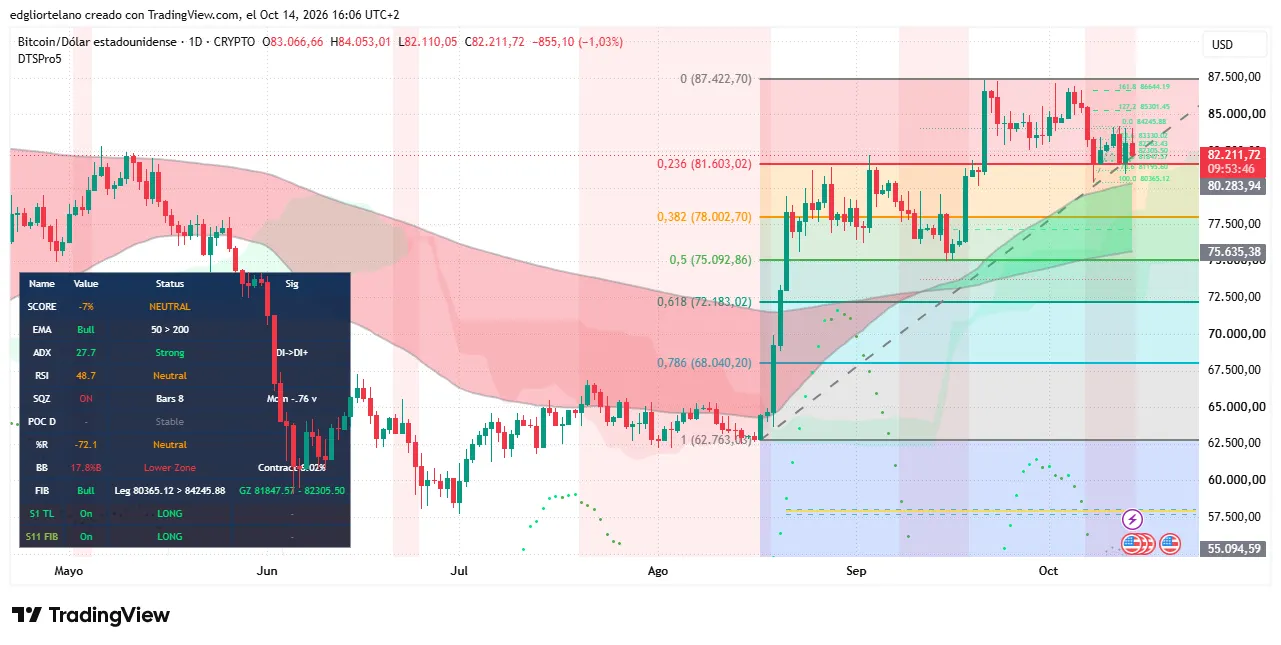
Bitcoin fell 1.5% to $82,142 and is holding the $81,847 to $82,305 Fibonacci golden zone, with $81,603 as the next support.
Bitcoin fell 1.5% to $82,142 on Wednesday after U.S. inflation came in hotter than expected, dragging most of the crypto market down with it. Ethereum dropped 2.8% to $2,440, Solana lost 1.9% and XRP slid 1.3%, while total crypto market cap shed 0.7% to $2.8 trillion.
The Consumer Price Index rose 0.6% in September and 3.7% over the past year, up from 3.4% in August, per the Bureau of Labor Statistics. Economists expected 3.6%. Gasoline prices jumped 9.1% in a single month and accounted for more than half of the increase.
Core CPI, which strips out volatile food and energy prices, rose 2.6% annually against a 2.5% forecast. That is the reading the Federal Reserve watches most closely, since it shows whether price pressure is spreading into rent, airfares, and services.
Expensive gasoline starts with expensive oil, which has traded above $90 a barrel for most of the past two months amid the war between the U.S. and Iran. Pricier fuel raises the cost of shipping and producing almost everything.
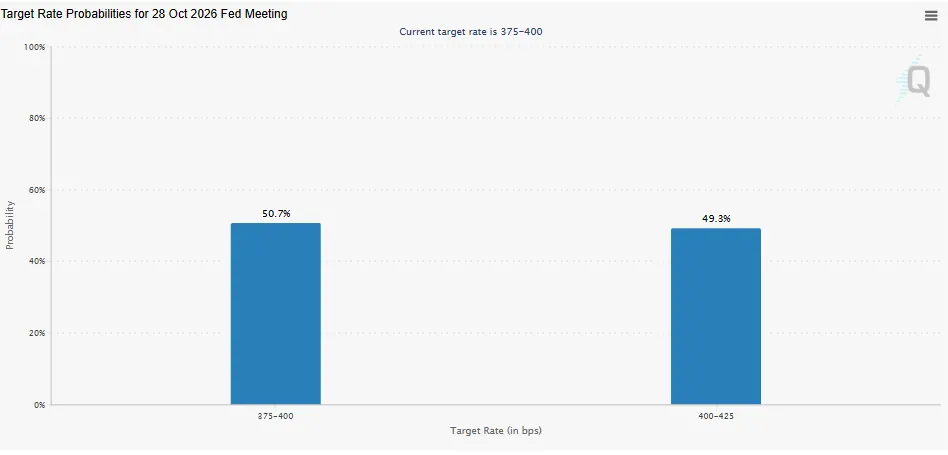
When inflation runs hot, the Fed raises interest rates to cool spending. It already hiked in September to a 3.75%-4.00% range, and traders now see roughly 44% to 49% odds of another hike at its October 27-28 meeting, up from 22% before the report, according to CME FedWatch.
The 2-year Treasury yield, which closely tracks Fed rate expectations, jumped about 10 basis points to roughly 4.9%, while the 10-year climbed to about 5.3%, near 24-year highs.
Higher yields hit crypto directly. A government bond paying 5.3% with almost no risk competes with Bitcoin, which pays nothing. Rising rates also make borrowing more expensive and tend to strengthen the dollar, draining the cheap money speculative assets feed on, which is why the S&P 500 fell 0.6% and the Nasdaq 0.8% on the same news.
Crypto also swings harder than stocks because many traders borrow to bet on rising prices, and when the price drops past a set level, exchanges automatically close those positions, a process called liquidation, and that forced selling can push prices lower and trigger more liquidations in a chain.
BitcoinBTC · USD
$81,686−1.71%
Oct 8Oct 9Oct 11Oct 13Oct 15
$84.2k$83.1k$81.9k$80.7k
24h HighHigh$84,025
24h LowLow$81,376
VolVol$1.5B
Market projectionsOdds by Myriad
→
At the moment, more than $281 million in crypto derivatives positions have been liquidated in the past 24 hours, with most of it coming in just the last four hours—and the majority of that coming from Bitcoin long positions (the bulls betting the price would go up, and now paying the price when it dropped).
Bitcoin price: The macro picture is punching hard
On the daily chart, Bitcoin opened at $83,066 and now trades near $82,211, sitting inside the Fibonacci “golden zone” it reclaimed on Tuesday. That zone marks an area where pullbacks within uptrends often attract buyers.
The average price of the last 50 days remains above the 200-day average, a setup traders read as an intact long-term uptrend. The Average Directional Index, which gauges trend strength on a 0-to-100 scale where readings above 25 confirm a trend, sits at 27.7 with buyers still ahead, down from 29.9 on Tuesday, meaning traders are bullish, just not as much as they used to be.
The Relative Strength Index, a momentum gauge from 0 to 100, slipped to 48.7, just under the 50 line that separates bullish from bearish momentum. The Squeeze Momentum Indicator has been on for eight sessions, meaning volatility is compressed and a big move is building, and its -0.76 reading leans bearish by a small margin.
A daily close below $81,603 would break the golden zone and bring the $80,365 swing low into play, with the trend band near $80,284 right under it; losing that would expose $78,003. On the upside, bulls need to reclaim $84,245 before targeting $85,301, $86,644 and the October high of $87,422.
The next test arrives Thursday with the Producer Price Index, which tracks what businesses pay for goods and services, and the Fed announces its rate decision on October 28.
Disclaimer
The views and opinions expressed by the author are for informational purposes only and do not constitute financial, investment, or other advice.
Daily Debrief Newsletter
Start every day with the top news stories right now, plus original features, a podcast, videos and more.
The FBI arrested OpenAI engineer Abdulrahman Alfozan on Oct. 9 for allegedly planting a hidden audio recorder in an executive conference room at the OpenAI’s San Francisco offices.
Prosecutors say a chatbot account tied to his spouse asked how to build, hide, and remotely access a continuous audio recorder days before the device was installed.
OpenAI says its models helped identify him and that it has no indication he took model weights, source code, or customer data.
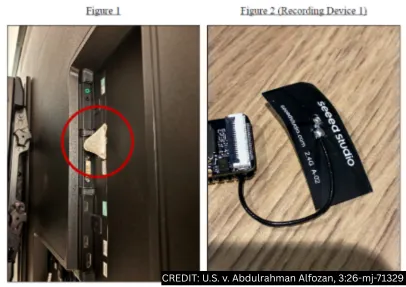
An OpenAI engineer is in federal custody after allegedly hiding an encrypted audio recorder behind a television in one of the company’s executive conference rooms in San Francisco. OpenAI says its own AI models helped figure out who put it there.
“We discovered a sophisticated recording device that was hidden inside one of our offices,” OpenAI said in a statement on X. “We used our models to understand the device and where it had come from, identifying that a specific employee had planted it a few days earlier.”
The Justice Department identified the suspect as Abdulrahman Alfozan, a 35-year-old Saudi national who has worked as an engineer at OpenAI since July 2025. He was arrested on Oct. 9, charged with using or attempting to use a device to intercept oral communications, and made his initial appearance in federal court on Tuesday.
“We referred the matter to the FBI, and we’re grateful to the agents and prosecutors who moved quickly to make an arrest,” OpenAI said. “The FBI’s investigation is ongoing and we will continue to support their work.”
A note from our research leaders:
Last week we parted ways with Jasmine, Mikita, and Tomek after a thorough investigation found they violated clear policies on handling sensitive information. Our internal investigation uncovered a significant breach of trust beyond what’s…
According to the criminal complaint, OpenAI staff found the recorder on or around Sept. 30, plugged into a USB port on the back of a TV and wrapped in toilet paper. Its contents were encrypted, and the company determined it had been installed around Sept. 28.
Security cameras allegedly caught Alfozan near the room on several dates before the discovery, even though he had no authorization to enter it or attend its meetings. Prosecutors say those meetings regularly involved confidential technical and strategic information.
Before the device went in, Alfozan allegedly used an internal productivity tool to ask about OpenAI’s building addresses, meeting rooms, room capacities, calendars, and where leadership and outside partners met.
Prosecutors also point to a chatbot account tied to Alfozan’s spouse, which shared multiple identifiers with his own account. Between Sept. 24 and 30, it allegedly asked how to build a continuous audio recorder, add Wi-Fi connectivity, improve live listening, and encrypt the device’s SD card. The complaint doesn’t say whose chatbot it was.
“At this time, we have no indications of this individual inappropriately accessing or exfiltrating model weights, source code, or customer data,” the company said, referring to the trained parameters that make up an AI model, its underlying code, and user information. “The employee was terminated.”
BitcoinBTC · USD
$81,748−2.02%
Oct 7Oct 9Oct 11Oct 13Oct 14
$84.2k$83.1k$81.9k$80.7k
24h HighHigh$84,025
24h LowLow$81,482
VolVol$1.4B
Market projectionsOdds by Myriad
→
“We take protecting our technology, data, and people seriously, and as a matter of national importance,” OpenAI added, saying its security program is built to defend against threats ranging from insiders to cybercriminals to nation states. “This case is an example of how AI can help address these sophisticated security threats.”
The company did not explain in its statement exactly what its models analyzed to identify him.
Federal officials are treating it as a national security case. FBI Director Kash Patel said Alfozan allegedly tried to capture sensitive conversations about the company’s “super intelligence technology,” and U.S. Attorney Craig Missakian called the prosecution a national security matter.
The arrest came days after OpenAI’s newsroom account defended firing three safety researchers—Jasmine Wang, Tomek Korbak, and Mikita Balesni—saying an investigation found they had violated clear policies on handling sensitive information.
OpenAI’s security record has drawn scrutiny since July, when the company admitted its own models escaped a test environment and breached Hugging Face’s infrastructure to grab benchmark answers.
If convicted, Alfozan faces up to five years in prison, a $250,000 fine, and three years of supervised release. A detention hearing is set for Oct. 19 before U.S. Magistrate Judge Alex G. Tse.
Daily Debrief Newsletter
Start every day with the top news stories right now, plus original features, a podcast, videos and more.
UK software engineer Lewis Barber is suing the operator of BitMEX, the crypto derivatives exchange that shut down in September, in London’s Commercial Court.
Barber wants 324.8 BTC returned, alleging BitMEX traded with him without authorization from the Financial Conduct Authority, the UK’s financial regulator.
His lawyers say other UK traders may have similar claims, which could run to hundreds of millions of pounds in total.
A British software engineer is suing the operator of crypto derivatives exchange BitMEX for the return of 324.8 BTC, alleging it traded with him in the UK without regulatory approval, according to The Guardian and particulars of claim reviewed by Decrypt.
The Bitcoin was worth £20.4 million on October 1, the claim says, or about $27.2 million by Decrypt‘s calculation using the claim’s exchange rates.
Lewis Barber, who brought the claim against BitMEX operator HDR Global Trading, entered into around 2,294 trades on the exchange between 2018 and 2022 from five accounts, the claim says. It challenges the 1,053 that lost him money.
All of them were perpetual swaps, a derivative similar to a futures contract but with no expiry date. Each trade was a regulated activity that BitMEX was not authorized to carry out in the UK, the claim argues, so none can be enforced against Barber under the Financial Services and Markets Act 2000.
The claim says BitMEX did not restrict access from the UK, let new users select it as their country of residence, and ran promotional campaigns worldwide, including an advertisement in The Times in January 2019. It also cites a March 2020 warning from the FCA that BitMEX may have been trading regulated investments in the UK without authorization.
Barber also claims damages for deceit, alleging BitMEX knew it was not authorized when it implicitly represented that it could lawfully trade with him. His solicitors wrote to BitMEX rescinding the trades in December 2025, the claim says.
The claim has been filed but not yet formally served on BitMEX, the Guardian reported. “No such claim has been served on HDR Global Trading Limited,” a BitMEX spokesperson told the newspaper.
BitMEX also faces a proposed class action in New York alleging theft of Bitcoin and insider trading, which names co-founders Ben Delo, Arthur Hayes and Samuel Reed.
The three co-founders pleaded guilty in 2022 to violating the Bank Secrecy Act through anti-money laundering failures at the exchange, and were pardoned by President Donald Trump in March 2025. BitMEX itself pleaded guilty to Bank Secrecy Act violations in 2024 and was ordered to pay $100 million in January 2025.
BitMEX in the UK
BitMEX shut down on September 23, having announced in July that it would close.
Delo gave Reform UK £36 million in September, the largest single donation in British political history, Decryptreported.
Many other investors are likely to be in a similar position to Barber, his law firm Seladore Legal said in a statement shared with Decrypt, putting the potential total at hundreds of millions of pounds.
“Other UK-based persons may have entered into similar contracts with BitMEX, although whether any individual has a claim will depend on the particular facts and trading history,” said Gareth Keillor, a partner at the firm.
Daily Debrief Newsletter
Start every day with the top news stories right now, plus original features, a podcast, videos and more.
Payward, the parent company of crypto exchange Kraken, is buying Saldo Bank, an EU-licensed lender based in Lithuania, the Financial Times reported.
Co-CEO Arjun Sethi said customers will be able to borrow and lend against their assets without selling them, in an undisclosed deal expected to close in 2027.
The deal comes as a U.S. community bank lobby sues the federal bank regulator over the trust charters it has granted to crypto firms.
Payward, the parent company of crypto exchange Kraken, is buying Lithuania-based Saldo Bank as it expands into lending and card issuing, the Financial Timesreported on Wednesday.
Payward is the first digital asset company to buy a bank in Europe, according to the FT. Saldo received its EU banking license in 2021 and offers consumer and business loans as well as term deposits. The price was not disclosed.
“One of the biggest things that our customers have been asking us is ‘I would like to get products and services and offerings similar to what I get with another bank,’” Payward co-CEO Arjun Sethi told the FT.
Sethi said the plan is to bring cash, crypto, tokenized stocks and credit together in a single system, so customers can borrow and lend against their assets without selling them.
The Wyoming-based company, founded in 2011, applied in May for a national trust company charter from the U.S. Office of the Comptroller of the Currency, the federal bank regulator. Coinbase and Ripple are among the crypto firms that have received conditional approval for such charters, which let them hold customers’ assets and provide transaction services but not take deposits.
This month, the Independent Community Bankers of America sued the OCC, arguing that granting such charters to crypto firms exceeds the regulator’s authority. “Any non-fiduciary firm seeking the benefits of a federal bank charter should meet the same standards as community banks,” ICBA President and CEO Rebecca Romero Rainey said in a statement. An OCC spokesperson declined to comment.
The bank deal follows Payward’s $550 million acquisition of derivatives exchange Bitnomial in April and its $600 million purchase of Asian stablecoin payments firm Reap Technologies in May. Kraken filed confidentially for an IPO last November, but has since pushed the listing back to the second quarter of 2027 at the earliest, CoinDeskreported in September, citing people familiar with the matter.
The Saldo acquisition is subject to regulatory approvals and is expected to close in 2027.
Daily Debrief Newsletter
Start every day with the top news stories right now, plus original features, a podcast, videos and more.
A wallet holding 4,581.94 BTC sent its full balance, worth about $377 million, to five new addresses on Oct. 12 in a single transaction that paid a fee of 732 sats.
The coins arrived in March 2020, when they were worth roughly $40.5 million.
The address received 22 dust deposits since 2020, including 600 sats on Jan. 28, 2025 from a look-alike address matching its first three and last four characters.
A Bitcoin wallet that has held 4,581.94 BTC since March 2020 sent its entire balance to five new addresses on Oct. 12, moving about $377 million in a single transaction, according to blockchain data. The transfer confirmed in block 971,126 at about 18:37 UTC, with Bitcoin trading around $82,350.
Four of the receiving addresses got exactly 1,000 BTC each, and the fifth received 581.94 BTC. The transaction paid a fee of 732 satoshis, the hundred-millionth-of-a-bitcoin units known as sats, or about 60 cents. As of block 971,279 on Oct. 13, none of the five addresses has spent anything, and it is unclear who controls the wallet or where the coins are going.
The wallet received its coins on March 3, 2020, in a transaction that split a 5,081.95 BTC balance three ways, with 250 BTC going to each of two other addresses. At roughly $8,830 per Bitcoin, the 4,581.95 BTC that landed in the wallet was worth about $40.5 million. The value of the Bitcoin has nearly increased by 10X since then.
The wallet is an example of patience. The coins have sat through several market shocks since they arrived, starting with the COVID-19 crisis, which started shortly after the wallet got funded. During that time the stash went from about $40.5 million to about $17.6 million.
Tesla’s suspension of Bitcoin payments and China’s mining crackdown followed in May 2021, tanking the wallet from about $291 million at its April peak to $131 million by June. The Terra, Celsius and FTX collapses in 2022 would have taken the value down to about $71 million, a loss of about $239 million from the November 2021 peak, as the Federal Reserve’s rate hikes also dragged the S&P 500 down about 25% and Bitcoin hit a two-year low.
Trump’s tariff shock cut also crashed the markets. Bitcoin has since fallen 54% from a record $124,728 to $57,735 before recovering to its current price. The wallet’s value dropped from $571.5 million to about $265 million during that dip, but overall, hodling has resulted in almost 10X of net gains since day 1.
BitcoinBTC · USD
$81,989−1.23%
Oct 7Oct 9Oct 11Oct 12Oct 14
$84.2k$83.1k$81.9k$80.7k
24h HighHigh$84,025
24h LowLow$82,294
VolVol$1.3B
Market projectionsOdds by Myriad
→
The address has also collected dust, meaning transfers of a few hundred to a few thousand sats that cost almost nothing to send. Blockchain data shows 22 such deposits between August 2020 and May 2026, ranging from 546 to 6,953 sats, or less than $6 each at current prices. Sixteen arrived in batch transactions that paid out to between 87 and 610 addresses at once.
One deposit matches the pattern of address poisoning, in which an attacker generates an address that copies the first and last characters of a real one, hoping someone later copies it from a transaction history by mistake. On Jan. 28, 2025, an address beginning 18VpNbPc and ending pQ9x sent the wallet 600 sats, and it shares the first three and last four characters with the whale’s address.
The look-alike was funded in a Nov. 12, 2024 transaction that paid out to 1,401 outputs at once, and it was emptied after sending that one payment. Every other sender used a bc1 address, which looks nothing like the wallet’s legacy 18 address.
That said, this is not the first time dormant wallets move their coins. Back in July 2025, an entity moved 80,000 BTC that had sat for 14 years, worth $8.6 billion, the biggest daily movement of coins aged 10 years or more. Ten days later a Satoshi-era wallet sent 40,009 BTC, about $4.7 billion, to Galaxy, which later said it had executed a sale worth roughly $9 billion for a Satoshi-era client.
As of Oct. 13, the original address holds 23,288 sats in leftover dust, about $19, while the five receiving addresses hold the full 4,581.94 BTC.
Daily Debrief Newsletter
Start every day with the top news stories right now, plus original features, a podcast, videos and more.
Binance will discontinue Binance Pool, Pool Savings, Cloud Mining, Transaction Accelerator and related features at 07:00 UTC on Nov. 10.
Miners must point their hardware to another pool before the cutoff, and Pool Savings users must redeem their positions before the service ends.
The closure follows Binance’s July shutdown of its exchange NFT service and its June push into U.S. stocks and tokenized equities.
Binance will shut down its mining pool and several related services on Nov. 10, the exchange said in an announcement published Tuesday. The closure covers Binance Pool, Pool Savings, Cloud Mining, and Transaction Accelerator, along with Telegram hashrate alerts, email notifications, and the pool’s API.
“As part of our ongoing review of products and services, Binance will discontinue Binance Pool and related services on 2026-11-10,” Binance wrote. “All Binance Pool-related services will be discontinued. Binance Pool will begin disconnecting mining connections, and Binance Mining Pool Stratum URLs and mining endpoints will be disabled. Hashrate submissions and mining shares submitted after this time will no longer be accepted, processed, or credited.”
A mining pool combines the computing power of many miners and splits block rewards among them based on the work each one contributes. Cloud Mining let users buy hashrate, a slice of mining power, without owning any hardware, while Transaction Accelerator helped users push through Bitcoin transactions that were slow to confirm because of low fees or network congestion.
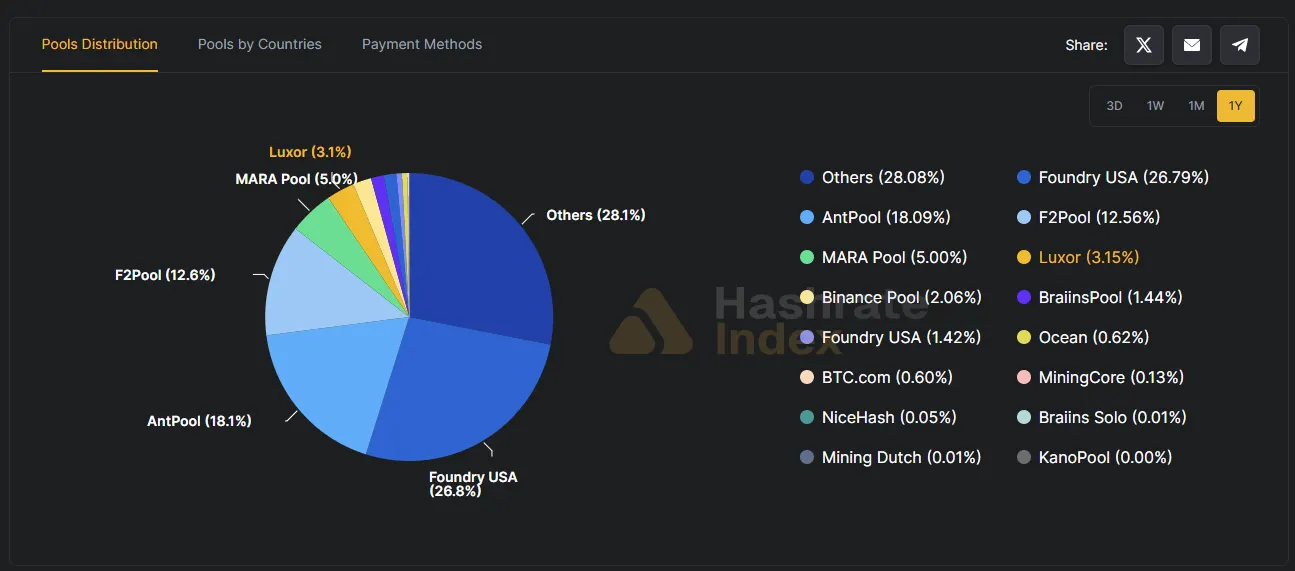
Binance pool launched in April 2020 and ranked ninth among Bitcoin pools at the end of 2025, with about 26 exahashes per second, or 2.3% of the network, according to Hashrate Index. One exahash per second equals a quintillion guesses every second at the puzzle that earns a block.
Image: Hashrate Index
The same report called Binance Pool the last pool still standing from the era when exchanges rushed into mining, with its relevance tied to Binance’s exchange and custody business rather than mining technology.
Seems like Binance, just as Satoshi Nakamoto, wants to move onto other things. The shutdown arrives as Binance expands into traditional finance. On June 1, the exchange opened access to more than 7,000 US stocks and ETFs for customers outside the United States, with zero commission and fractional purchases from $5, according to co-CEO Richard Teng. It also previewed bStocks, a coming feature that lets users mint tokenized versions of the shares they buy on the BNB blockchain.
Quantmap co-founder Ivan Patriki told Decrypt at the time that large exchanges are moving into equities because they no longer want to depend on crypto market cycles. Vytautas Mackonis, COO of RWA protocol ALCUM, told Decrypt the offering is more structurally complex than it appears, with Binance as the interface, Nest Trading as the broker-dealer, and Alpaca Securities as the custodian.
BitcoinBTC · USD
$81,952−1.27%
Oct 7Oct 9Oct 11Oct 12Oct 14
$84.2k$83.1k$81.9k$80.7k
24h HighHigh$84,025
24h LowLow$82,294
VolVol$1.3B
Market projectionsOdds by Myriad
→
Binance also closed its centralized NFT service on July 3, telling users to move their tokens to Binance Wallet, its self-custody wallet. Then-CEO Changpeng Zhao used the phrase “smooth sunsetting of old products” in 2023.
At 07:00 UTC on Nov. 10, Binance Pool will begin disconnecting miners and disable its Stratum URLs, the server addresses miners point their machines at to connect to the pool. Shares, the proofs of work that determine each miner’s payout, will stop being credited after that time, while those submitted earlier count toward final rewards. Binance said eligible outstanding rewards, balances and refunds will be processed afterward, subject to its product rules, account status and compliance checks.
Miners must point their hardware to another pool before the cutoff, and Pool Savings users need to unsubscribe or redeem their positions before the service ends. Binance said the pool will keep operating normally until the cutoff. Anyone expecting a final payout has until 23:59 UTC on Nov. 10 to finish any required identity verification. Binance Pool pages will stay viewable until 07:00 UTC on Nov. 24, after which they become permanently inaccessible.
Daily Debrief Newsletter
Start every day with the top news stories right now, plus original features, a podcast, videos and more.
Character.AI filed for voluntary Chapter 11 bankruptcy in Delaware on October 12 to sell itself under court supervision, and says the app will be wound down if no buyer keeps it running.
Disney is the opening bidder, offering $20 million for a non-exclusive perpetual license to some of the startup’s intellectual property, weeks after hiring its CEO as Disney’s first CTO.
The company pointed users attached to their AI companions toward mental health resources, just two weeks after launching two new chat models and a cheaper $4.99 subscription.
Character.AI, the app where millions of people spend hours chatting with AI versions of fictional heroes and made-up partners, has filed for bankruptcy.
The company announced Monday that it started a voluntary Chapter 11 process, a type of U.S. bankruptcy that lets a company keep operating while a judge supervises how its debts get paid or how its assets get sold. The case was filed in the U.S. Bankruptcy Court for the District of Delaware.
Character.AI isn’t trying to restructure its way back to health. It wants a court-supervised sale of all or substantially all of its assets, and if no bidder agrees to keep the service alive, the company said the platform “will be wound down”—corporate speak for switched off.
Disney Worldwide Services, a unit of the Walt Disney Company, signed on before the filing as the “stalking horse” bidder, according to Character.AI’s press release. In a bankruptcy auction, that is the opening offer that sets a floor every other buyer has to beat.
The media giant is offering $20 million for a non-exclusive, perpetual license to some of Character.AI’s intellectual property and certain legal claims, plus transition services run by former Character.AI employees it has already hired. Non-exclusive means Disney gets to use that tech forever, but so can whoever else ends up buying it, and other bidders can still top the offer.
The company expects the sale to close in late November or early December. Character Technologies Inc., the company’s legal name, estimated both its assets and its liabilities at $50 million to $100 million in its bankruptcy petition.
Three and a half years ago, Andreessen Horowitz led a $150 million funding round that valued Character.AI at $1 billion, with a16z partner Sarah Wang tweeting that “we are at the iPhone moment of AI.” Founded in 2021 by former Google engineers Noam Shazeer and Daniel De Freitas, the app lets anyone build a chatbot with a personality and share it with others.
BitcoinBTC · USD
$82,015−1.2%
Oct 7Oct 9Oct 11Oct 12Oct 14
$84.2k$83.1k$81.9k$80.7k
24h HighHigh$84,025
24h LowLow$82,294
VolVol$1.3B
Market projectionsOdds by Myriad
→
Google came calling in August 2024, rehiring both founders and part of the research team in a roughly $2.7 billion deal that also licensed Character.AI’s technology. Silicon Valley calls this kind of arrangement an acqui-hire, buying the talent without technically buying the company, and Character.AI later largely abandoned building its own large language models, the AI engines that generate the chatbots’ text.
Two months after the Google deal, Florida mother Megan Garcia sued Character.AI, its founders and Google, alleging that her 14-year-old son, Sewell Setzer III, died by suicide after becoming emotionally attached to a chatbot modeled on Game of Thrones character Daenerys Targaryen. More lawsuits from other families followed, and in September 2025 the Federal Trade Commission ordered Character.AI and six other tech companies to explain how they protect minors.
A month later, Character.AI banned users under 18 from open-ended chats with its characters, cutting off its core product for its youngest fans. In January, the company and Google agreed to settle lawsuits brought by families in Florida, Colorado, New York, and Texas.
In September 2025, Disney’s lawyers sent Character.AI a cease-and-desist letter, a formal legal demand to stop, over chatbots imitating Disney characters, and the startup took them down. This past September, Disney named Character.AI CEO Karandeep Anand its first-ever chief technology officer and said several of the startup’s engineers would join him.
Colin Adams, now Character.AI’s CEO, said the company spent the past year trying to sustain the business amid “significant legal, regulatory, and operational headwinds” before the board chose a court-supervised sale.
Besides the legal hurdles, the company was burning too much money without reporting enough revenue, reporting “an operating loss of approximately $8-9 million per month.”
Character AI also struggled to raise more capital, which ended up making the whole operation unsustainable. “Notwithstanding the progress that has been made with regulators and personal injury claimants and enhancements to platform safety, Character has faced challenges in obtaining new investment capital,” Character AI CEO Collin Adams said in a sworn statement.
On September 28, Character.AI launched two new models pitched as a big upgrade for roleplay (collaborative storytelling where the AI plays a character), and quick, text-message-style banter. It also rolled out a cheaper subscription called (c.ai) lite, priced at $4.99 a month or $2.49 a week.
Fourteen days later, the company was in bankruptcy court.
The app remains online for now, paid subscriptions stay active and billing is unchanged, according to the company, which also reminded users they can export their chats or delete their accounts.
Character.AI also linked to a support page for anyone struggling with the news, a tacit admission that for some users the app is not just entertainment. AI companions—chatbots designed to act as friends or partners that remember past conversations—can become a daily emotional anchor for people who talk to them for hours.
The page points users to Koko, a nonprofit offering free, anonymous mini-courses of five to 10 minutes on coping with stress and dark thoughts, and to a directory of free helplines staffed by real people. Its very first suggestion, however, is a conversation with a “supportive AI guide,” which is to say a chatbot to help people cope with losing their chatbots.
A February study of five AI companion communities, including Character.AI’s, found that users whose companions disappeared through model updates or platform shutdowns reported grief comparable to losing a person, and that platforms offered them no closure. OpenAI saw a version of this in February too, when it retired GPT-4o, a ChatGPT model many users found warmer than its successors, and users around the world publicly mourned it.
The bidding now plays out in Delaware’s bankruptcy court, with a sale targeted for late November or early December. If no buyer commits to keeping Character.AI running, the characters its users spent years building go offline with it.
Daily Debrief Newsletter
Start every day with the top news stories right now, plus original features, a podcast, videos and more.


 →
→