MoonPay has introduced the Open Wallet Standard (OWS), an open-source framework for AI agents to manage funds across blockchains.
Contributors include PayPal, Ethereum Foundation, Solana Foundation, Ripple, OKX, Tron, and TON Foundation, among others.
The standard addresses wallet and key management fragmentation challenges while enhancing security for AI developers.
Crypto payments infrastructure company MoonPay has launched an open-source wallet standard designed for AI agents to manage funds and execute transactions across multiple blockchains, addressing key infrastructure challenges that have limited AI-crypto integration.
The Open Wallet Standard (OWS), announced Monday, was developed with contributions from PayPal, the Ethereum Foundation, the Solana Foundation, Ripple, OKX, Tron, TON Foundation, and Base, among other companies.
“The agent economy has payment rails. It didn’t have a wallet standard. We built one, open-sourced it, and now the full stack exists,” said MoonPay co-founder and CEO Ivan Soto-Wright in a statement.
The framework aims to solve fragmentation issues in wallet and key management that have complicated financial operations for autonomous AI systems, according to MoonPay, which is an investor in Decrypt’s sister company Myriad.
OWS supports the x402 open payment protocol developed by Coinbase, along with Stripe and Tempo’s Machine Payments Protocol (MPP) for session-based micropayments. It also builds on MoonPay’s earlier collaboration with Ledger that enables hardware wallet signing for MoonPay Agents transactions.
“On-chain payments originate from wallet addresses, and every chain represents them a bit differently,” said Mysten Labs co-founder and CTO Sam Blackshear in a statement, explaining that a “unified representation” streamlines processes and enables agents to focus on high-level tasks instead of details.
According to MoonPay, OWS is designed in such a way that a wallet’s private key is never exposed to agents, the LLM context or parent applications when transacting.
The launch comes as AI agents increasingly require sophisticated financial capabilities to operate autonomously, and forms part of a “deliberate shift” at MoonPay towards AI-native infrastructure.
The contracts track major U.S. stocks and indices but do not grant ownership, functioning as synthetic exposure products.
Traders can post Bitcoin, Ethereum and yield-bearing crypto assets as collateral under a unified margin system.
The launch comes as exchanges race to offer real-world asset exposure to retail traders outside traditional brokerage systems.
OKX has launched more than 20 equity perpetual swap contracts, offering users across Asia, the CIS region, Latin America, and Türkiye exposure to trade major global stocks around the clock using crypto as collateral.
The launch includes the full “Magnificent 7”—Nvidia, Tesla, Apple, Alphabet, Microsoft, Amazon, and Meta, according to a statement shared with Decrypt.
It also covers crypto-linked firms such as Strategy, Coinbase, Robinhood, and Circle, as well as technology stocks Palantir, Intel, Micron, and SanDisk, and the S&P 500 tracker SPY.
The equity perp launch is framed as the first phase of a broader rollout, with OKX planning to expand its range of equity contracts and tokenized real-world asset exposure in the coming months.
It’s OKX’s latest push into real-world assets, as crypto exchanges increasingly compete to offer traditional market exposure to retail investors who face hurdles accessing U.S. equities through conventional brokerages in many parts of the world.
All contracts are denominated in USDT and offer up to 5x leverage, allowing traders to respond to earnings releases, macroeconomic developments, and market-moving events even when traditional equity markets are closed, the statement said.
Unlike tokenized equities that represent actual shares, equity perpetual swaps are derivatives that track price movements without granting ownership, placing them closer to synthetic exposure products already offered by other exchanges.
“I think these instruments will command a good following from momentum-driven retail investors,” Peter Chung, head of research at Presto Labs, told Decrypt. “Crypto exchanges are far more accessible venues for retail investors in many jurisdictions around the world.”
“On traditional rails, these names are often beyond their reach due to various hurdles,” he added.
Asked how the product differs from those offered at rival platforms, including Binance, an OKX spokesperson told Decrypt its offering is differentiated by its “unified trading account.”
The spokesperson said the platform allows users to stake assets and use them as collateral for equity perpetual positions, with those assets continuing to generate yield while positions remain open.
A unified trading account allows users to deploy a range of crypto assets, including Bitcoin, Ethereum, USDT, and staked holdings, as collateral across positions.
“This is one step towards bringing a broader range of real-world assets into our platform,” the spokesperson said when asked about the choice of perpetual swaps over tokenized equities representing actual shares.
“We will keep expanding our infrastructure to support exposure to global equities while allowing traders to use their crypto portfolios for this,” they said.
The rollout follows OKX’s high-profile tie-up with Intercontinental Exchange, the New York Stock Exchange’s parent company, which invested in OKX earlier this month at a $25 billion valuation.
The deal is also expected to enable OKX users to trade tokenized stocks and derivatives listed on the NYSE starting in the second half of the year.
OKX’s native token, OKB, is trading at $85, up 0.3% in the last day, and down 11.7% in the last 7 days, according to CoinGecko data.
Daily Debrief Newsletter
Start every day with the top news stories right now, plus original features, a podcast, videos and more.
Balancer Labs is winding down after a $128 million exploit left the company facing legal exposure and no sustainable revenue.
The protocol will continue under a DAO, foundation, and service-provider structure, with staff potentially moving to a new operating entity.
Experts say the shutdown reflects deeper issues with older DeFi governance and token incentive models that are losing traction.
Balancer Labs has decided to call it quits six months after its namesake protocol suffered a major security breach that founders say caused reputational damage and triggered a sell-off in the Balancer token.
The protocol, created to build and manage a DeFi platform for token swaps and liquidity pools, was hit by an exploit in November last year, after an attacker drained $128 million across six blockchains in just 30 minutes from Balancer V2’s Vault contract.
The “exploit created real and ongoing legal exposure,” co-founder Fernando Martinelli wrote in a statement on Monday, adding that Balancer Labs was left without “any sources of revenue.”
“Maintaining a corporate entity that carries the liability of past security incidents, while the protocol itself needs to move forward unburdened, is not responsible stewardship,” Martinelli added.
Balancer no longer needs a traditional company above it, and its DAO, Foundation, and service-provider structure should carry the protocol forward, with key staff set to move into a new operating arm if governance approves, he added.
The hack worked by exploiting a small pricing error in Balancer’s older V2 stable pools, where the system inconsistently rounded numbers during swap calculations, according to an analysis by blockchain security firm BlockSec.
“Beyond the immediate financial impact, the incident led to three lasting pressures: unrecovered funds, ongoing legal and operational exposure, and a significant erosion of user trust,” Brian Wong, senior audit engineer at BlockSec, told Decrypt.
Transitioning to a DAO governance model could help “isolate legal risk, reduce fixed operational overhead, and shift governance and accountability more directly to the community,” Wong added.
“I believe Balancer still has a chance to turn things around and prove to token holders who stay that there can be product market fit and sustainability,” Martinelli said.
Balancing act
The wind-down points to both the longer-running weaknesses in Balancer’s token and governance model and the pressure the November hack put on the protocol’s ability to sustain itself, observers told Decrypt.
Balancer’s decision “exposes structural failure” that points to how it has “capitulated to a broken model where emissions faded, governance weakened, value capture stayed shallow,” Dominick John, analyst at Zeus Research, told Decrypt.
While streamlining its operations could be the right call, it comes as a “late-stage patch,” he said, adding that older DeFi models built around token rewards and incentive-driven growth are being “phased out.”
The shutdown also appears to be Balancer’s way of finding “a quick way to escape legal risks” after the November 2025 hack, Ryan Yoon, senior analyst at Tiger Research, told Decrypt.
It gives Balancer a way to use the DAO transition to drop veBAL, its escrow governance model, which Yoon suggested had become part of the protocol’s broader structural problems.
The next test is whether Balancer’s smaller team can “actually fix governance,” Yoon said, by keeping governance aligned, security intact, and the treasury stable enough to carry the protocol forward, areas John said are “critical to keeping Balancer relevant.”
Daily Debrief Newsletter
Start every day with the top news stories right now, plus original features, a podcast, videos and more.
Hostplus CIO Sam Sicilia says the retirement fund is eyeing a potential launch as early as next financial year.
The fund is looking beyond Bitcoin at a wider range of digital assets, including tokenized exposure to areas like music rights.
It comes as AMP Super, the first Australian fund to back crypto, exited most of its Bitcoin futures position ahead of this year’s market decline.
Crypto is inching closer to Australia’s retirement system, with one of the country’s largest super funds now actively exploring how to offer it to members.
Australian industry superannuation fund Hostplus is exploring whether to open a path into Bitcoin and other digital assets for its members, according to a Bloombergreport.
This move would put the $105 billion (A$150 billion) retirement giant among a small group of global pension funds willing to take on crypto exposure.
“As soon as one super fund breaks ranks on crypto assets, I’d say there’s a high probability the rest follow,” Jason Titman, CEO of Australian crypto exchange Swyftx, told Decrypt. “Around a quarter of Australians want their super funds to offer digital assets, and that number is likely to increase when the market is regulated.”
The fund’s CIO, Sam Sicilia, told Bloomberg the plan is focused on Choiceplus, a self-directed window that lets members manage a slice of their own retirement savings, currently about 1% of the fund’s total book.
“There’s certainly a demand from some of our members who write in and say, ‘Why can’t I have access to cryptocurrency?’” he said.
A launch could come as early as next financial year, pending regulatory approval and internal product design work, Sicilia said.
Hostplus, which serves nearly two million members with an average age in the mid-to-late 30s, is still reviewing consumer protections and product design.
Sicilia said the fund’s view of crypto has evolved considerably since an earlier assessment roughly a decade ago, and that the current review covers not just Bitcoin but a broader universe of digital assets, including potential tokenized exposure to areas such as music rights.
Kraken Australia managing director Jonathon Miller told Decrypt the move, if implemented, is a “positive step forward for the sector.”
“We have come a long way in the last decade, and for many Australians, digital assets are increasingly viewed as a legitimate long-term investment; however, access to them, outside of SMSFs, has remained limited,” he said.
“Expanding availability through platforms like Choiceplus gives investors more flexibility in how they build and diversify their portfolios,” Miller said, adding that “more choice” and “easier access” would benefit “both consumers and the broader market”.
Still, volatility remains a key barrier as AMP Super, one of the few funds to experiment with crypto, recently cut its Bitcoin futures exposure to around 0.02% after a sharp downturn wiped out roughly $700 billion from the market earlier this year.
“We’ve had essentially no exposure during most of the recent sell-off,” AMP Super head of portfolio design Stuart Eliot toldInvestment Magazine last month.
The position dates back to May 2024, when AMP Super added Bitcoin futures via its dynamic allocation strategy.
On Myriad, a prediction market owned by Decrypt’s parent company Dastan, market sentiment leans toward upside, with users seeing a 50.7% likelihood of Bitcoin reaching $84,000 rather than falling to $55,000.
The world’s largest crypto currently sits at $70,599, up 3.6% on the day, according to CoinGecko data.
Daily Debrief Newsletter
Start every day with the top news stories right now, plus original features, a podcast, videos and more.
200 protesters marched from Anthropic to OpenAI and xAI offices in San Francisco.
Activists called on AI companies to pause development of new frontier AI models.
Organizer Michael Trazzi previously staged a multi-week hunger strike outside Google DeepMind.
Protesters took to the streets of San Francisco on Saturday, stopping outside the offices of Anthropic, OpenAI, and xAI to call for a conditional pause in the development of increasingly powerful artificial intelligence.
According to Stop the AI Race founder and documentarian Michael Trazzi, roughly 200 protesters participated in the demonstration. Participants included researchers, academics, and members of advocacy groups such as the Machine Intelligence Research Institute, PauseAI, QuitGPT, StopAI, and Evitable.
“There are a lot of people who care about this risk from advanced AI systems,” Trazzi told Decrypt. “Having everyone marching together shows people are not isolated in thinking about this by themselves. There are a lot of people who care about this.”
The march began at noon outside Anthropic’s offices, then moved to OpenAI and then to xAI. At each stop, activists and speakers from the participating organizations addressed protesters.
According to Trazzi, the protest aimed to push AI companies to agree to a coordinated pause in building more powerful AI models and create treaties with AI developers in other countries to do the same.
“If China and the U.S. agreed to stop building more dangerous models, they could focus on making the systems better for us, like medical AI,” he said. “Everyone would be better off.”
Stop the AI Race’s proposal calls for companies to stop building new frontier models and shift work toward safety, if other major labs “credibly do the same,” which Trazzi said makes protesting in front of AI labs’ offices more important.
Steady opposition
The protest is the latest in a series of efforts to disrupt AI development.
In March 2023, the Future of Life Institute published an open letter demanding a moratorium on further enhancements to the leading AI tool following the public launch of ChatGPT the year before.
Signers included xAI founder Elon Musk, Apple co-founder Steve Wozniak, and Ripple co-founder Chris Larsen. Since then, the “Pause Giant AI Experiments” open letter has garnered over 33,000 signatures.
In September, Trazzi staged a week-long hunger strike outside Google DeepMind’s London offices, while Guido Reichstadter held a parallel hunger strike outside Anthropic’s San Francisco offices.
Government officials and supporters of continued AI development argue that slowing research in the U.S. could give competitors abroad an advantage.
Last week, the Trump Administration published its AI framework to establish a national standard for laws governing AI development. The White House framed it as a commitment to “winning the AI race.”
“Even if you’re in China or any country in the world, nobody wants systems they cannot control,” Trazzi said. “Because we’re in this race between companies and countries to build the systems as fast as possible, we’re taking shortcuts and cutting corners on safety. There is a race that has no winners. What we have is a system we cannot control, and that’s why it’s called a suicide race.”
But even if AI developers agreed to pause development, verifying it may be easier said than done. Trazzi suggested one way to verify a pause would be to limit the computing power used to train new models.
“If you limit how much compute a company can use to build these systems, then you’re pretty much limiting developing new models,” he said.
Following the San Francisco protest, Trazzi said additional demonstrations could take place in other locations where major AI companies operate.
“We want to show up where the employees are,” he said. “We want to talk to them, and we want them to talk to their leadership and have things moving from inside,” adding that whistleblowers will have some amount of power because “they’re the ones building it.”
OpenAI, Anthropic, and xAI did not immediately respond to Decrypt’s requests for comment.
Daily Debrief Newsletter
Start every day with the top news stories right now, plus original features, a podcast, videos and more.
Bitcoin climbed above $71,000 today, offering bulls their first glimpse of relief since February’s collapse.
At the same time, the price move has formed the same compressive wedge pattern that preceded Bitcoin crashes in October 2025 and January 2026.
On Myriad, traders are calling it a toss up on whether Bitcoin pumps to $84K or dumps to $55K first.
After a brutal February that took Bitcoin from the mid-$90,000s all the way down to a $59,000 low, the market finally has something to feel decent about. BTC is up roughly 4.65% today, trading around $71,013 and shaking off some of the fear that dominated the last several weeks.
The problem is, in doing so, Bitcoin has drawn an all too familiar pattern on its charts—and one that suggests a price crash could be in the cards.
The broader market, meanwhile, is still anticipating hard times. Stocks sunk to four-month lows after news of a delay to potential U.S.-Iran military strikes, pushing crypto alongside equities in a mild risk-on move. WTI crude dropped sharply, and the crypto market is once again in “extreme fear” territory, based on the Crypto Fear and Greed Index.
Despite this, some Bitcoin bulls believe this is a good time to buy, considering the last time Bitcoin had a similar spike was at the beginning of the month. So who’s right? Here’s what the charts say:
Bitcoin (BTC) price: by the numbers
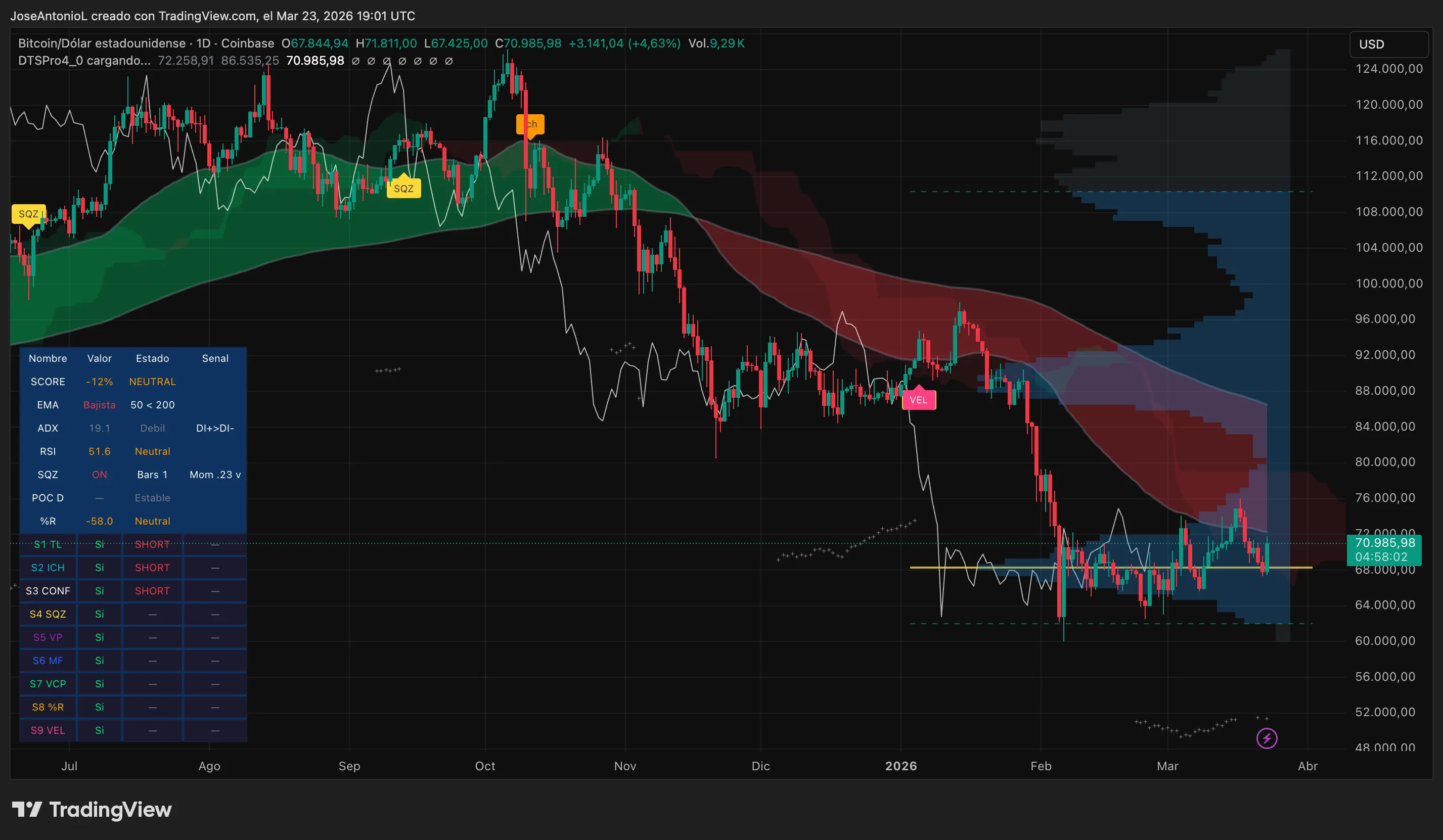
Bitcoin is, indeed, having a nice start to the week: a 4.6% spike, going from $67,844 to a daily high of $71,811, before settling around its current price of $70,985. This movement is trying to break past the resistance of the average price of Bitcoin in the last 200 days, which is a real test of trend strength.
Bitcoin price data. Image: Tradingview
Dig deeper and the picture gets more nuanced. The ADX—the Average Directional Index, which measures how strong any trend actually is—sits at 19.1. That’s below 25, the threshold traders use to confirm a trend has real legs. At 19.1, it’s a sign of a weakening trend, which means bears are struggling to maintain the broader crash’s momentum.
The exponential moving averages, or EMAs, tell a similar story. The 50-day exponential moving average is still trading below the 200-day, which traders would interpret as the clearest signal of a bearish trend. Exponential moving averages smooth out price action over time to help identify where the price of an asset finds support or resistance. When the short-term average sits below the long-term one, it usually means the prevailing direction is still down, even during bounces.
The Relative Strength Index, or RSI, at 51.5 is also neutral. It is not screaming buy or sell, which makes sense. Bitcoin is in that in-between zone where it’s too early to celebrate and too soon to panic (again).
The Squeeze Momentum Indicator is on, with momentum reading a modest 0.26. This number tracks when a market is coiling up energy before a big move—like a spring being compressed or prices stabilizing after a major trend. It’s on right now, meaning the spring is loading. But with momentum still low, we haven’t seen a direction yet.
Fool me once…
Here’s what makes this moment more than a run-of-the-mill bounce: The chart is drawing a pattern it has now drawn twice before—and both times, it ended badly.
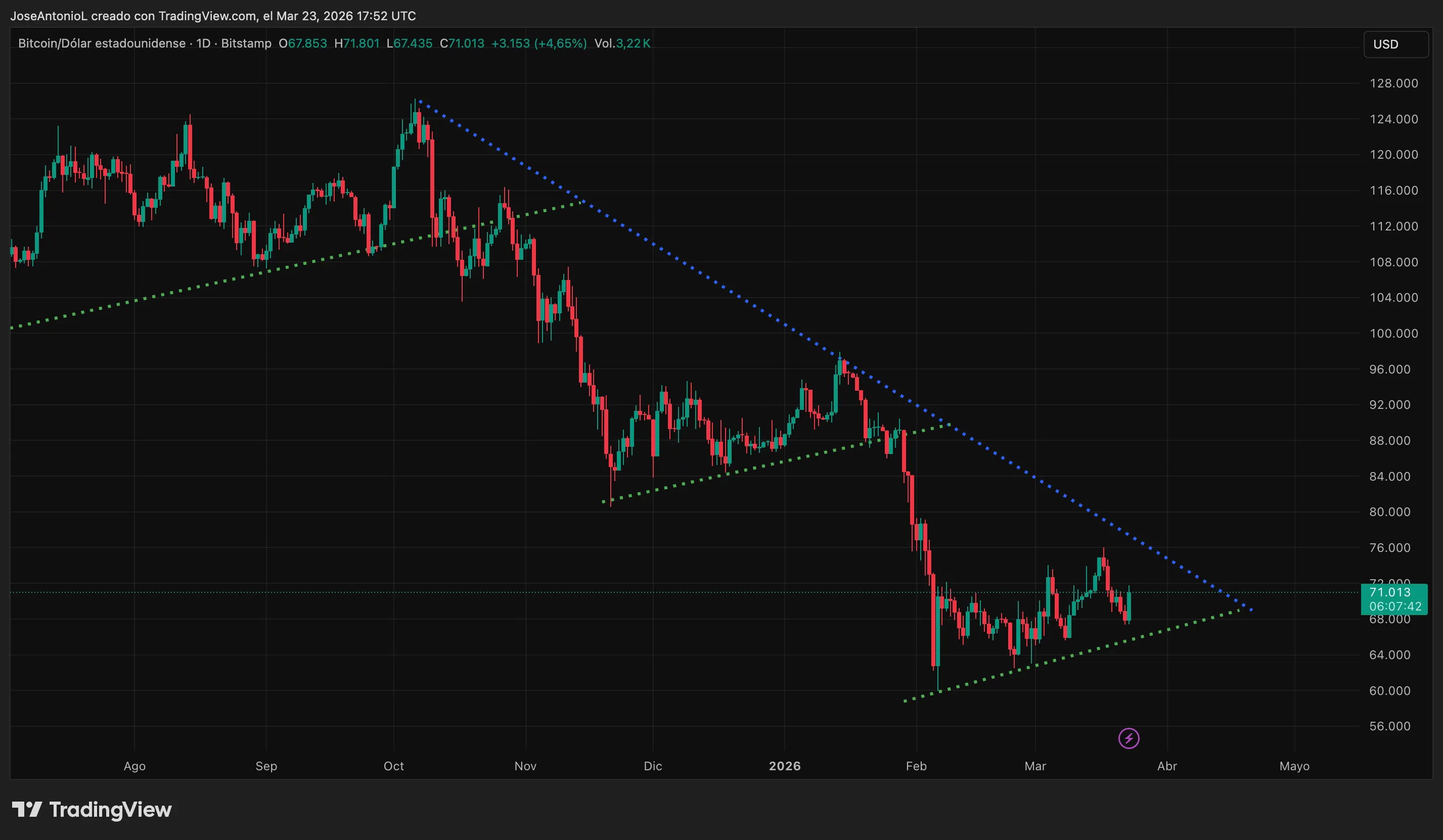
Bitcoin price data. Image: Tradingview
There’s a blue descending resistance line running from Bitcoin’s October 2025 peak, around $125,000, all the way down through the current price level. This is the roof. Bitcoin keeps trying to push up and the line keeps capping it. (That’s why it’s called a resistance.)
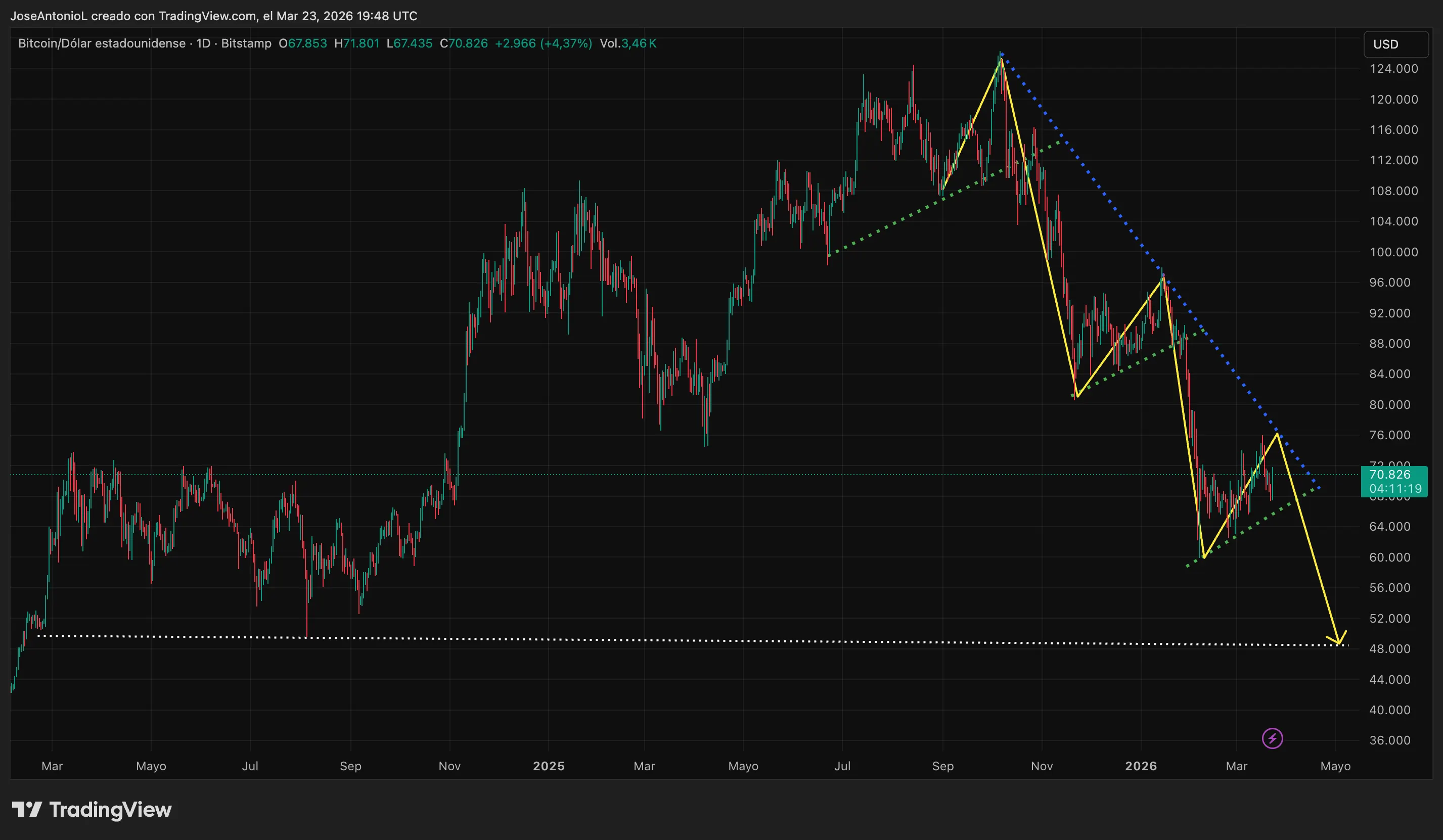
Below price action, there are three green dotted ascending lines, running parallel to each other. These are the supports. After each major crash, Bitcoin compresses: It bounces off the ascending green floor, climbs toward the blue ceiling line, and the range gets tighter and tighter until something breaks and the price crashes.
It happened after the October 2025 crash. Bitcoin recovered into that same wedge structure, touched resistance, and then broke down hard one month later.
It happened again after the January 2026 crash. Same wedge, same compression. Then the February 2026 wipeout to $59,000.
And right now Bitcoin is forming the exact same structure. The ascending support line is acting as the floor once more. The descending blue line is sitting just overhead, roughly around $70,000 depending on when it arrives. If the pattern holds, a third rejection somewhere in April or May 2026 would be on the table.
Bitcoin price data. Image: Tradingview
On Myriad, a prediction market built by Decrypt’s parent company Dastan, the question on everyone’s mind is framed plainly: “BTC next move: Pump to $84K or Dump to $55K?”
Right now, traders are placing 51.4% odds on the bullish outcome. But that’s not a ringing endorsement of Bitcoin’s health—it’s a toss up, and likely a reflection of how extreme the $55K scenario feels.
Most traders probably can’t stomach betting on a number that low, not because they’re convinced BTC is going up, but because the downside seems too painful to price in. The gap between bulls and bears is tight and follows the market sentiment.
The one thing that could change the story
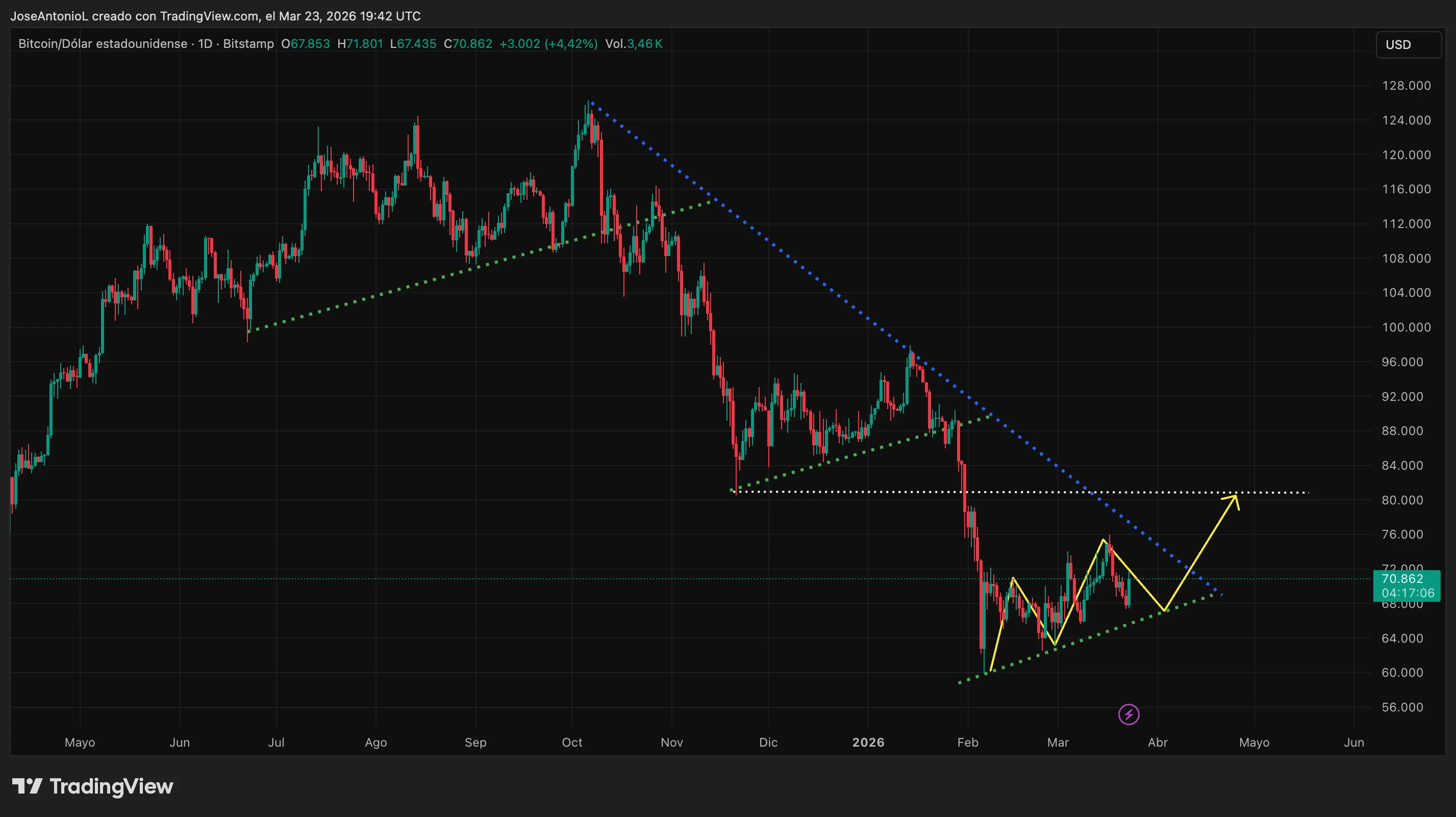
There is a scenario, though, where everything flips. If Bitcoin can break through that descending blue resistance with a strong, high-volume candle—not just touch it, but close decisively above it—followed by a series of candlesticks closing on top of the broken resistance, that would be a real signal. It would suggest the pattern has finally been broken, and that the market may have actually found a bottom around the $59,000–$64,000 range from early March.
If it respects its current support, the $80K zone becomes the next technical milestone to conquer.
That would be the kind of move that forces even skeptics to reconsider. Resistance lines that get convincingly broken tend to flip into support. (That’s just how these market dynamics work.)
But right now? The pattern is intact. Bitcoin may look nice in the short term. The immediate indicators look neutral instead of heavily bearish, the daily candle is green, and the shorts are hurting a little. None of that is reason to ignore what three data points of the same setup are telling us.
For bulls, the champagne will likely have to wait.
Disclaimer
The views and opinions expressed by the author are for informational purposes only and do not constitute financial, investment, or other advice.
Daily Debrief Newsletter
Start every day with the top news stories right now, plus original features, a podcast, videos and more.
Polymarket and Kalshi both made new moves to try and curb insider trading on their prediction market platforms.
Polymarket has introduced new integrity rules across its platform, clarifying the types of behaviors that are prohibited.
Meanwhile, Kalshi has created new policies and implemented preemptive screening to block individuals from certain markets.
Prediction markets Polymarket and Kalshi are taking steps to remove insider trading from their platforms, announcing updates to rules and tooling, respectively, on Monday as scrutiny continues to build on prediction markets and their offerings.
For Polymarket, Monday’s steps included updating integrity rules and clarifying types of insider trading conduct, like trading on insider information or illegal tips, which are prohibited behaviors on the firm’s DeFi platform and its CFTC-regulated U.S. platform.
“These rule enhancements make our expectations abundantly clear for every participant across both platforms and highlight the compliance infrastructure we have already built,” Polymarket Chief Legal Officer Neal Kumar said in a statement.
“As Polymarket continues to scale,” he added, “we will build on our foundation with clear communication to Polymarket’s users to ensure our markets do what they do best—surface truth.”
The rules, and examples of prohibited behavior—like a coach trading on a sports contract using inside knowledge about a star player’s availability, or an ensemble performer buying shares in a market about which songs will be played at an event—can be found on the site’s market integrity page, accessible via its footer.
Polymarket said it uses a “multi-layered monitoring system” to detect potential violations of its insider trading rules on its DeFi platform, or its international version. On the U.S. side, it works with partners and a real-time control desk to “identify unusual or disruptive trading activity.”
It also recently announced that it’s working with Peter Thiel’s Palantir to create “systems for surveilling sports-focused prediction markets.”
Monday’s advances from Kalshi take a more proactive approach to squashing insider trading on the platform, like in the example of a coach trading on a sporting event they are tied to.
The firm announced it has established a new policy disallowing members connected to college or professional sports—like coaches or players—from trading markets “associated with the sports they are involved with.” A Kalshi representative confirmed to Decrypt that athletes and others in the sports industry can trade in markets related to other sports that they are not involved in.
The firm is also implementing preemptive screening for both athletic parties and politicians using screening lists it has developed, which will allow it to block trades before they even occur.
“These efforts, which have been in the works for months, proactively address the CFTC’s guidance and Congressional bill proposals to prevent insider trading,” the firm wrote.
Insider trading allegations on prediction markets have drawn considerable attention and scrutiny this year, highlighted by anonymous traders winning major sums in markets related to subjects like government actions.
For example, one trader won more than $436,000 on the January ousting of Venezuelan President Nicolás Maduro, leading New York representative Ritchie Torres to draft a bill that would keep federal employees from using prediction markets when they have relevant inside information.
Two weeks prior to that, two Israelis were arrested in the country and charged with using classified information to make bets about military operations on Polymarket.
Potential violations of the insider trading rules on Polymarket can be reported to the platform via Discord or email, its updated rules say. Details on how the investigations unfold from there, or how many reports are being made are not immediately clear. Kalshi has also implemented whistleblower functionality directly into its market pages, allowing individuals to flag potential insider trading behaviors.
Representatives for Polymarket did not immediately respond to Decrypt’s request for comment.
Editor’s note: This story was updated after publication to include an additional detail confirmed by Kalshi.
Daily Debrief Newsletter
Start every day with the top news stories right now, plus original features, a podcast, videos and more.
A $90K global contest is rewarding AI influencers.
Human judges behind top virtual stars are now part of the evaluation panel.
An exploding $46B virtual influencer market fuels high-stakes talent hunt
OpenArt and Fanvue want to find the world’s best AI personality, and they’re putting $90,000 on the table to do it.
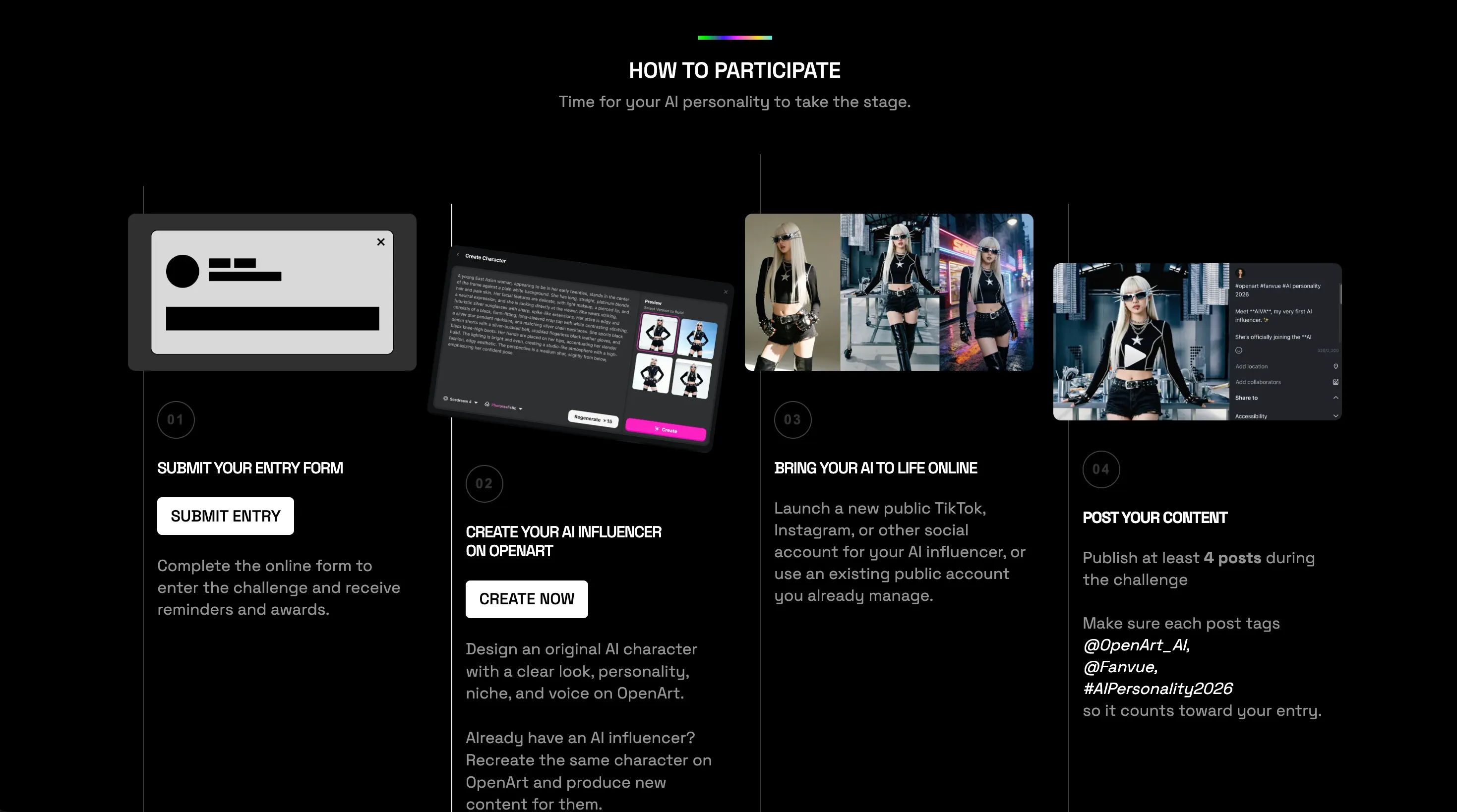
The AI Personality of the Year 2026 is a four-week global challenge, open now through April 19, where creators design and launch original AI influencers competing across five tracks: Entertainer, Lifestyle Influencer, Comedian, Fitness, and Anime/Cartoon/Fantasy.
Weekly winners pocket $200 cash and a platform shoutout, but there’s a much bigger prize waiting for the ultimate victor. The grand prize winner takes home $6,000 in cash plus $2,000 in paid promotion, priority placement on Fanvue, and enrollment in both organizers’ affiliate programs.
Track finalists take home prizes too, ranging from $5,000 cash and $1,000 in promotional exposure for the winner down to $1,000 in cash for the third-place finalist in each category. Fan-voted prizes—Most Viral Video and Audience Choice—add $1,000 each to the pool. Add it all up and the total stretches past $90,000.
To enter, you must build your character on OpenArt, launch a public TikTok or Instagram account for it, post at least four times during the challenge window, and tag @OpenArt_AI, @Fanvue, and #AIPersonality2026. That’s simple enough on paper, but likely competitive in practice, given that ElevenLabs is the founding sponsor and the ambassador lineup includes some of the most-followed AI personalities on the internet right now.
The judging panel is 100% human—which is refreshing, for a change. When Miss AI ran its beauty pageant in 2024, two of its four judges were AI-generated influencers themselves. Here, the 11-member panel includes a 13-time Emmy-winning comedy writer, a PR industry co-founder, and a marketing agency executive.
But “all human” doesn’t mean these judges are just spectators to this world. Several of them built the virtual personalities that people are already following. Diana Núñez Morales, the architect behind Aitana—the Barcelona-based AI model who earns up to €10,000 a month in brand deals and was itself a judge in the Miss AI 2024 pagant—is on the panel.
So is Cameron Wilson, creator of Shudu, widely recognized as the world’s first digital supermodel; and Christopher “Topher” Townsend, who built Solomon Ray. The people scoring your entry created some of the most successful AI personalities in existence. They’ll know exactly what they’re looking at.
The virtual influencer market was valued at roughly $6 billion in 2024 and is projected to hit nearly $46 billion by 2030. As Decrypt reported, AI companions and personas have grown so convincing that telling them apart from real humans “often feels impossible”—and that was over a year ago. They’ve only gotten more realistic since then. Today, there are countless Instagram accounts dedicated to expose influencers that go viral without disclosing their AI nature.
OpenArt’s suite covers character creation, image generation, video, and ElevenLabs-powered audio, all in one place. Tutorials on how to build and monetize AI influencers are flooding YouTube, TikTok, and creator newsletters.
Judging criteria for the competition covers quality, inspiration, brand appeal, and social clout through a points-based system. It’s not just about how photorealistic your character looks—it’s about whether the audience actually shows up.
The challenge kicked off Monday, with final winners announced in May. The virtual influencer economy now has an official talent search. The next Aitana might already be queuing up their first post.
Daily Debrief Newsletter
Start every day with the top news stories right now, plus original features, a podcast, videos and more.
Prosecutors said a March filing submitted in Sam Bankman-Fried’s name appears to have been sent from San Francisco, raising questions over its authenticity.
Bankman-Fried’s parents went public March 21 calling his prosecution political and his sentence excessive.
The clemency push comes as the fallout from FTX’s collapse continues to shape crypto policy debates.
Federal prosecutors have cast doubt on a recent court filing purportedly sent from prison by former FTX CEO Sam Bankman-Fried, telling a judge that a March 16 letter submitted in his name may not have been sent from prison but instead shipped via FedEx from the San Francisco Bay Area.
In a filing, prosecutors said the letter appeared inconsistent with Bureau of Prisons rules, which prohibit inmates from using private carriers. The envelope labeled the facility incorrectly, FedEx tracking data pointed to pickup in Palo Alto or Menlo Park, and the document bore a typed “/s/” signature rather than a handwritten one, discrepancies the government said give it “reason to doubt” the letter was actually sent by Bankman-Fried.
The letter asked for a one-month extension to April 16 to respond to a government brief. It cited an expected transfer from FCI Terminal Island and warned he could spend weeks without access to legal materials, counsel or the courts while in transit through Bureau of Prisons facilities.
The court wrangling comes as Bankman-Fried’s family ramps up a public campaign to recast his case and press for clemency. In a March 21 CNNinterview, his parents, Joseph Bankman and Barbara Fried, argued that his prosecution was politically motivated and his 25-year sentence excessive.
“I think we have a really serious problem with prosecution being used for political ambition,” Fried said, adding that she believed the Biden administration had tried to “destroy crypto.”
Bankman rejected comparisons between his son and Bernie Madoff, saying that “Sam built billion dollar businesses in a new field and was a pioneer for doing so.”
They also challenged the core allegations, portraying FTX’s failure as a liquidity crisis rather than fraud. Fried said “all of the money was turned over” and argued customers were ultimately repaid with interest, while Bankman said transfers to Alameda Research reflected borrowing within the platform.
Bankman-Fried fired his lawyers in early February and is currently representing himself. However, separate filings from March 16 also show tensions around his family’s involvement in Bankman-Fried’s legal strategy.
A letter submitted in his name but written by his mother, a Stanford Law professor, sought an extension of time in the case. U.S. District Judge Lewis Kaplan rejected the filing, writing that she “lacks standing” to seek relief because she is not counsel of record and has not appeared in the case, and noted the letter did not indicate it had been served on prosecutors.
Kaplan also said court staff had received a voicemail from someone identifying herself as Fried, adding that the court does not accept telephone calls from litigants or their family members. While declining her request, the judge extended the deadline on his own to March 23, allowing Bankman-Fried’s attorneys to seek relief properly if needed.
The collapse of FTX
FTX’s collapse in November 2022 remains one of the largest failures in the history of digital assets. The exchange, once valued at $32 billion, imploded after a surge in withdrawal requests exposed a shortfall tied to the use of customer funds by its affiliated trading firm, Alameda.
Prosecutors said roughly $8 billion in customer money was missing at the time of the bankruptcy, and a jury later convicted Bankman-Fried on seven counts including fraud, conspiracy and money laundering. Bankman-Fried remains in federal custody serving a 25-year sentence.
Whether customers were “made whole” has become central to Bankman-Fried’s post-conviction arguments. While the bankruptcy estate has recovered enough to repay many claims based on 2022 valuations, critics say that understates losses because crypto prices later rebounded sharply, meaning customers would have held far more valuable assets had their funds not been frozen.
In early 2024, the FTX estate sold off its 8% stake in Anthropic, which it invested $500 million in in 2021, for $1.3 billion across two sales. Today it would be worth over $30 billion.
Other cases have raised hopes of a pardon among Bankman-Fried’s supporters. President Donald Trump’s 2025 pardon of Binance founder Changpeng “CZ” Zhao signaled a more crypto-friendly posture in Washington and a willingness to revisit prior enforcement.
Since his X account became active again in September last year, Bankman-Fried has increasingly tailored his public messaging to themes aligned with Trump and his allies, criticizing Biden-era crypto policy and raising claims of prosecutorial overreach as he pursues relief.
However, Congress has not been receptive to the push. Senator Bernie Moreno (R-Ohio) called Bankman-Fried a “piece of shit” earlier this month, according to Politico, adding that, “The guy shouldn’t be pardoned. The guy should go to jail for a long, long time.”
Trump indicated in February he currently has no plans to offer a pardon.
Daily Debrief Newsletter
Start every day with the top news stories right now, plus original features, a podcast, videos and more.
Sen. Elizabeth Warren urged Beast Industries to move cautiously as the firm created by MrBeast considers crypto for Step, a teen-focused mobile banking app.
Before the company was acquired by Beast Industries, the senator argued that it pressured kids into asking their parents for permission to invest in crypto.
Earlier this year, Beast Industries signaled an interest in DeFi after receiving a $200 million investment from Ethereum treasury firm BitMine.
Senator Elizabeth Warren (D-MA) requested information Monday regarding Beast Industries’ recent acquisition of Step, urging the company created by YouTube star MrBeast to move cautiously as it weighs crypto for the mobile banking app designed for young investors.
In a letter sent to Beast Industries CEO Jeff Housenbold and MrBeast—whose real name is Jimmy Donaldson—the crypto critic argued that the firm’s history “raises concerns about its ability to manage a financial technology company, particularly one targeting children and teens.”
The 12-page letter focuses on Step’s previous involvement in crypto. In 2022, the app announced that it had become the first platform in the U.S. to allow teens, with the consent of a parent or legal guardian, to purchase digital assets like Bitcoin. The company later advertised that it was expanding access to more than 50 digital assets, including NFTs.
The senator argued that the Step promoted “risky investments” on social media, while providing users with resources that allegedly encouraged kids to pressure their parents into allowing crypto investments through Step, including a script that was posted to YouTube.
Although Step backed away from crypto in 2024, Warren noted that Beast Industries has signaled its acquisition of Step could unlock opportunities with crypto and decentralized finance. Not long before, Beast Industries filed a trademark for “MrBeast Financial,” with language that mentioned crypto-based services for trading and payments using DeFi.
In a statement, a spokesperson for Beast Industries said that it appreciates Warren’s outreach, and the company plans on engaging with her as Step evolved under MrBeast. Warren’s letter put forth 11 different questions for the company to answer, which include procedures for accommodating users who lose funds due to fraud, scams, and cybersecurity failures.
“Our primary motivation behind this deal is to improve the financial future of the next generation,” they added. “We’re examining all existing offerings and marketing approaches to ensure that Step’s future is developed thoughtfully and deliberately, meets our very high quality standards, and is in compliance with applicable laws and regulatory requirements.”
With over 500 million across social media, Warren wrote that MrBeast’s fans are loyal and likely to place their “funds, savings, and financial futures” in the YouTube star’s hands.
Prior to acquiring Step, Beast Industries disclosed a $200 million from Ethereum treasury firm BitMine, which is chaired by Fundstrat co-founder Tom Lee. (Disclosure: Lee is an investor in DASTAN, the parent company of an editorially independent Decrypt.)
Warren’s scrutiny of Beast Industries centered on Step, but the company was also thrust into the conversation around prediction markets earlier this year after Kalshi said that it had taken an enforcement action against a video editor, who was then fired. Kalshi found that the employee in question had abused knowledge of MrBeast’s videos to conduct near-perfect trading.
Daily Debrief Newsletter
Start every day with the top news stories right now, plus original features, a podcast, videos and more.