
Tag: Business – Decrypt

  • What Happens to Bitcoin if Bank of America’s ‘Three Conditions’ for Fed Rate Hikes Hit?

    What Happens to Bitcoin if Bank of America’s ‘Three Conditions’ for Fed Rate Hikes Hit?

    In brief

    • While Bank of America economists still view rate cuts as the most likely path, they outlined how surging energy costs could force the Federal Reserve to hike.
    • Beyond oil, rising shipping costs for fertilizer and aluminum threaten to spark broader price pressures in the U.S. economy, they noted.
    • Experts warned that a surprise rate hike would initially pressure crypto and stocks, but the digital asset could later thrive as currency debasement hedge like gold.

    U.S. President Donald Trump is putting intense pressure on the Federal Reserve to lower its benchmark interest rate. But as his war in Iran presses toward its fourth week, Bank of America economists raised the prospect of a policy move on Friday that’s in the opposite direction.

    Although the group still views cuts as more likely than hikes, it outlined conditions under which the U.S. central bank would likely determine that tighter monetary policy is appropriate, amid surging energy costs and no end in sight to the conflict rattling the Middle East.

    The economists wrote in a note that the likelihood of a hike would increase if Fed Chair Jerome Powell’s tenure at the central bank’s helm runs longer than expected, the unemployment rate remains below 4.5%, and price pressures from higher energy costs spread to other parts of the economy.

    The assessment came as Bitcoin changed hands below $70,000, according to CoinGecko. Earlier this week, the digital asset touched a 45-day high of $75,600, after dropping as low as $63,000 on the day that the U.S.-Israel war with Iran broke out.

    So-called risk assets, including stocks and crypto, would likely face short-term pressure in the unlikely event that the Fed raises interest rates following a series of cuts last year, James Butterfill, head of research at crypto asset manager CoinShares, told Decrypt.

    Since Powell said on Wednesday that it was “too soon to know” how the war would affect the economy, Butterfill noted that exchange-traded funds tied to crypto have posted consecutive days of outflows, a potential preview of what a rate hike could bring.

    “The initial reaction to Bitcoin would not be great,” he said. “But I think it would actually turn around and do quite well as people realize we could easily be in a stagflation environment.”

    In some ways, a combination of high inflation, stagnant economic growth, and high unemployment would mirror the currency debasement and financial security concerns that led BlackRock CEO Larry Fink to highlight crypto and gold as “assets of fear” in October.

    The sentiment was echoed by Gerry O’Shea, head of global markets insights at crypto asset manager Hashdex, who argued that macroeconomic headwinds for Bitcoin are unlikely to slow the pace of its adoption among institutional investors allocating on behalf of clients.

    “You have a lot of investment advisors who have been doing their due diligence,” he said. “Given their mandate, they’re seeing this as an opportunity to get their clients exposure.”

    ‘Uncomfortably high’

    On Friday, West Texas Intermediate oil edged down to $109 per barrel, Trading Economics data showed. Since the conflict in Iran upended global energy markets, via restrictions on key corridors like the Strait of Hormuz, the U.S. benchmark has jumped as high as $116 per barrel.

    Bank of America economists wrote that rate hike conditions would most likely be met “if the Iran shock is sustained but moderate,” describing $80 to $100 per barrel as a “sweet spot.”

    On Myriad, a prediction market owned by Decrypt parent company DASTAN, traders foresaw a 67% chance on Friday that Brent crude, the international benchmark, would pump to $120 per barrel before dumping to $55 per barrel. What’s more, they penciled in an 11% chance of the U.S. reaching a ceasefire with Iran by the end of this month.

    The bank’s economists are among those still forecasting two 25-basis-point cuts this year, yet traders are currently holding their breath until mid-2027, per CME FedWatch.

    “We are still a long way off from Fed rate hikes,” Zach Pandl, head of research at crypto asset manager Grayscale, told Decrypt. “Unless the increase in oil prices starts to feed into longer-term inflation expectations, Fed officials will likely consider it transitory.”

    Indeed, the Fed’s framework typically “looks through” volatile food and energy costs, while focusing on so-called core goods and services. Bank of America economists noted that input costs for these sectors could rise as a result of higher energy prices, but they also raised the prospect of a broader supply disruption, with shipping costs for fertilizer and aluminum also surging.

    They added that “core inflation is already uncomfortably high,” with the Fed’s preferred inflation gauge showing a 2.8% increase in January compared to a year earlier. That measure has run above the Fed’s 2% target for nearly five years.

    Bitcoin has tumbled far from its all-time highs of $126,000 last year, leading Pandl to attribute the digital asset’s recent outperformance compared to gold and stocks to recovering sentiment and broader industry trends. 

    “Bitcoin has traded remarkably well since the start of the war with Iran,” he said. “We think this reflects oversold conditions and continued positive fundamental news related to stablecoins and tokenization.”

    Powell’s term as chair is slated to end in May. But on Wednesday, he indicated that he would continue to serve in his current capacity until his successor, former Fed governor Kevin Warsh, is confirmed by the U.S. Senate. 

    Bank of America economists noted that Powell “isn’t nearly as dovish” as Warsh is likely to be, bolstering the possibility of a hike. “This is important because we view June as the earliest meeting at which the Fed can start to hike rates,” they added.

    Daily Debrief Newsletter

    Start every day with the top news stories right now, plus original features, a podcast, videos and more.


  • Gemini Faces Class-Action Suit Over Prediction Market Pivot, Plummeting Stock Price

    Gemini Faces Class-Action Suit Over Prediction Market Pivot, Plummeting Stock Price

    In brief

    • Gemini is being sued by shareholders for allegedly misleading investors and hiding its pivot to prediction markets.
    • Founders Tyler and Cameron Winklevoss are accused of overstating the viability of Gemini’s crypto business.
    • The lawsuit links these claims to the company’s sharp stock decline.

    Crypto exchange Gemini is facing a class action lawsuit from shareholders who claim the company illegally failed to disclose its pivot into prediction markets—and overstated the viability of its struggling core business.

    The federal suit, filed this week in the Southern District of New York, alleges Gemini and its founders, Tyler and Cameron Winklevoss, materially misled investors in the build-up to taking the company public last fall.

    Gemini “overstated the viability of its core business as a crypto platform” and “overstated its commitment to and/or the viability of growing its business through expanding its international operations,” the lawsuit claims.

    The shareholders further argue that Gemini withheld information that would have shown the company was poised for “an expensive and disruptive restructuring.” Indeed, in February, the exchange laid off over a quarter of its staff and fully exited Europe and Australia, saying that it planned to lean on AI to boost company efficiency.

    That same day, the Winklevoss twins announced the company planned to make its new prediction market platform “front-and-center” for users. Plans for this significant pivot were also improperly concealed when Gemini went public months prior in September, the shareholders allege.

    Gemini did not immediately respond to Decrypt’s request for comment on the case.

    Since Gemini went public six months ago, the company’s stock (Nasdaq: GEMI) has lost nearly 85% of its value. In the same period, Bitcoin has shed some 40% of its price. Gemini shareholders insist the damage to Gemini’s stock has much to do with the company’s alleged failure to disclose the state of its businesses and its future plans.

    “As a result of defendants’ wrongful acts and omissions, and the precipitous decline in the market value of the company’s securities, Plaintiff and other class members have suffered significant losses and damages,” the complaint reads.

    On Thursday, Gemini shares rose nearly 7% in after-hours trading after the company reported more stable revenue streams in 2025, and signaled success from its cost-cutting efforts—though it also reported a $582.8 million net loss for 2025.

    Gemini’s stock is down 5.8% on the day Friday, as of this writing, to $5.66.

    Daily Debrief Newsletter

    Start every day with the top news stories right now, plus original features, a podcast, videos and more.

  • Morgan Stanley Prepares Bitcoin ETF for NYSE Arca Launch, Picking MSBT Ticker

    Morgan Stanley Prepares Bitcoin ETF for NYSE Arca Launch, Picking MSBT Ticker

    In brief

    • Morgan Stanley amended its Bitcoin ETF S-1, adding Fidelity as custodian and the NYSE Arca ticker MSBT.
    • The fund will offer a fee waiver on the first $5 billion invested for six months.
    • The Solana ETF filing remains unchanged since January, suggesting the Bitcoin fund could list first.

    Investment banking giant Morgan Stanley has updated its Bitcoin ETF application, adding Fidelity as a custodian and disclosing that the fund will be listed on the NYSE Arca under the MSBT ticker when it launches.

    The Morgan Stanley Bitcoin Trust will offer investors a fee waiver on the first $5 billion invested for six months, the firm said Wednesday in an amendment to its S-1 SEC form.

    The firm first registered its Bitcoin fund alongside a Morgan Stanley Solana Trust in January. Based on SEC filings, it appears that the BTC fund could get listed before its SOL counterpart. The Solana filing hasn’t been updated since its initial S-1 was filed.

    At the time, the bank described both as passive investment vehicles that would seek to track the performance of the relevant cryptocurrency’s price. The initial filings did not yet name custodians, crypto counterparties, or specify fee structures—which is typical for S-1 filings, which are usually amended leading up to a fund’s listing.

    Earlier this month, Morgan Stanley said that The Bank of New York Mellon and Coinbase Custody Trust Company would custody the fund’s assets, with Fidelity now joining the list of custodians.

    The updated application comes as Morgan Stanley has been signaling a broader crypto push.

    In February, the bank’s newly appointed digital assets strategy head, Amy Oldenburg, said the firm plans to build proprietary Bitcoin custody and trading services in-house, with yield and lending services also under exploration.

    “We really need to build this out internally. We can’t just primarily rent the technology to do this,” she said at a Bitcoin conference in Las Vegas.

    Morgan Stanley, which oversees nearly $9 trillion in client assets, confirmed last September that it would offer Bitcoin, Ethereum, and Solana trading via its E*Trade app.

    The bank also filed to add an Ethereum ETF to its planned crypto lineup in January, one day after the Bitcoin and Solana registrations. That filing has also yet to be updated since it was first filed.

    Daily Debrief Newsletter

    Start every day with the top news stories right now, plus original features, a podcast, videos and more.
  • First Working Quantum Battery Proves Bigger Really Does Mean Faster

    First Working Quantum Battery Proves Bigger Really Does Mean Faster

    In brief

    • Australian scientists built the first working quantum battery prototype.
    • Quantum batteries charge faster as they scale, defying classical limits.
    • The breakthrough could power future quantum computers, but not yet consumer devices.

    Your phone takes an hour to charge. Your EV takes all night. That trade-off—more capacity means more waiting—is so embedded in how batteries work that nobody really questions it anymore. A team of Australian scientists just built something that breaks that rule entirely.

    Researchers at CSIRO, Australia’s national science agency, together with teams from RMIT University and the University of Melbourne, have unveiled the world’s first working quantum battery prototype.

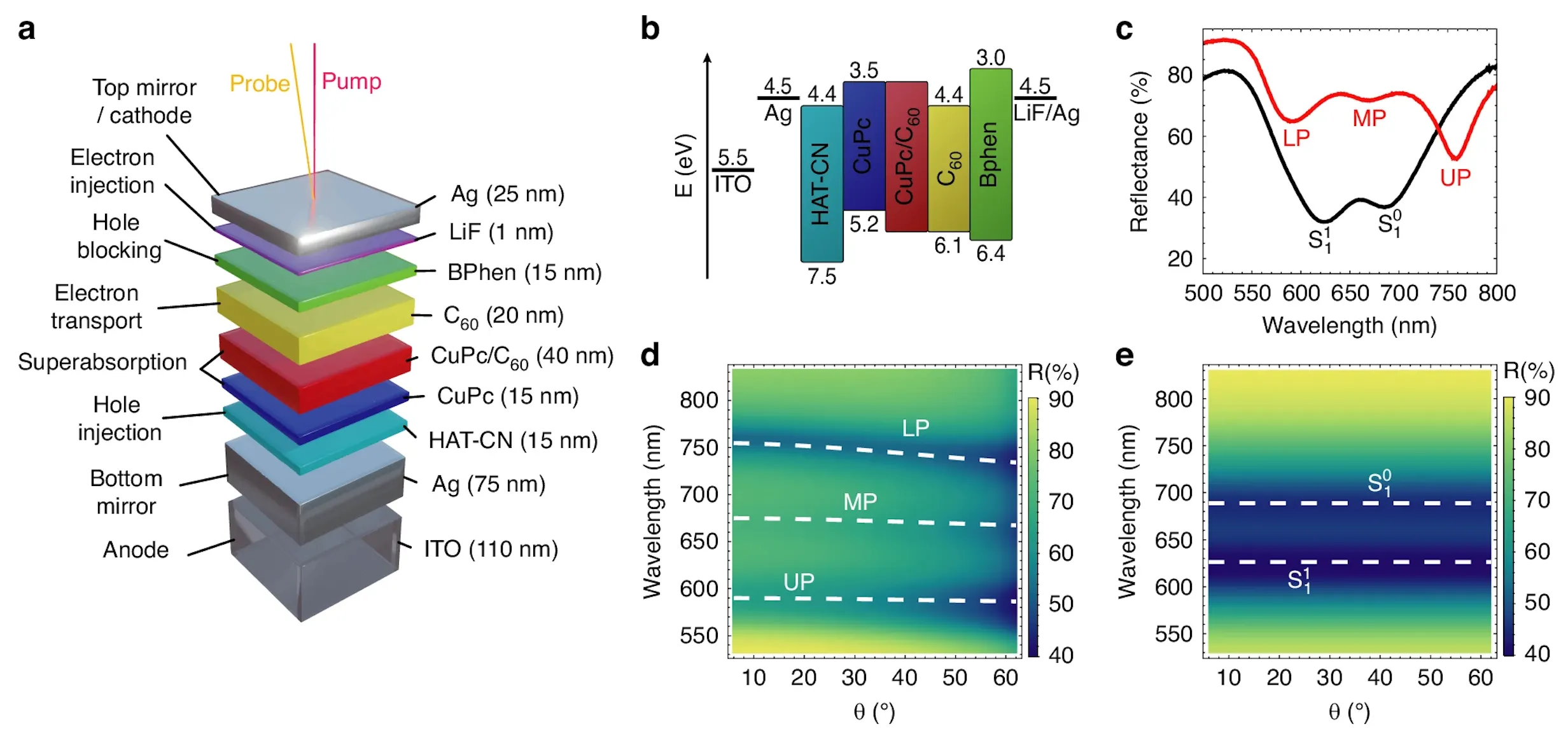
    This is an actual physical device that charges, stores energy, and discharges it—using the rules of quantum physics instead of chemistry. Their findings were published Wednesday in Nature Light: Science & Applications.

    The prototype is a tiny, layered wafer of organic materials like a nanoscopic sandwich that gets charged wirelessly by a laser pulse. That pulse lasts femtoseconds. One femtosecond is a quadrillionth of a second. The device charges in that window, then holds its energy for nanoseconds—about six orders of magnitude longer than it took to fill up.

    That gap sounds unimpressive until you scale it. “If we can charge a battery in one minute, it would stay charged for a couple of years,” lead researcher James Quach explained. The physics already work. The challenge now is extending how long the stored energy can last in a real-world device.

    The genuinely strange part isn’t the speed but the scaling behavior.

    Conventional batteries get slower to charge as they grow. More capacity means more time, but quantum batteries do the opposite. The more molecules packed into the device, the faster each one charges—because at the quantum level, they don’t act individually. They behave collectively, sharing the incoming energy in a single coordinated burst the researchers call “superabsorption.”

    Technically speaking researchers say that the charging time drops as 1/√N, where N is the number of molecules. Double the battery, cut the charging time by nearly half, and so on.

    “Our findings confirm a fundamental quantum effect that’s completely counterintuitive: quantum batteries charge faster as they get larger,” Quach told Melbourne University. “Today’s batteries don’t function like that.”

    This property had been predicted mathematically since 2013, and a partial version was demonstrated in 2022. What’s new here is the complete cycle: The team figured out how to pull the stored energy back out as an electrical current, which no previous quantum battery experiment had managed. The device also runs at room temperature—a practical advantage over competing superconducting approaches from China and Spain that require cryogenic cooling.

    The immediate application isn’t your EV or something like that. The prototype’s total capacity is measured in billionths of electron-volts—enough to power nothing in the real world yet. But quantum computers are a different story. Those systems are already advancing faster than most expected, and they have a specific energy problem: Their delicate quantum states demand power delivered coherently, without the noise that conventional electronics introduce. A quantum battery charges and discharges using the same quantum language those processors speak.

    “Quantum batteries could provide energy coherently, with the minimum energy cost to the quantum computers,” Professor Andrew White, who leads the quantum technology lab at the University of Queensland and was not involved in the research, told The News Digital.

    CSIRO is already seeking development partners, including EV manufacturers and deep-tech investors, to push the research forward. The theory had a decade head start on the hardware. The hardware just caught up.

    Daily Debrief Newsletter

    Start every day with the top news stories right now, plus original features, a podcast, videos and more.

  • XRP Treasury Firm Evernorth Inches Closer to Public Listing With $685 Million Stash

    XRP Treasury Firm Evernorth Inches Closer to Public Listing With $685 Million Stash

    In brief

    • Evernorth Holdings filed a new S-4 registration statement with the SEC about its intentions to go public.
    • The firm aims to become the biggest XRP treasury firm, and is expected to launch with $685 million in XRP tokens.
    • It originally raised more than $1 billion to build its XRP treasury.

    Evernorth Holdings, a firm with intentions of becoming the largest publicly traded XRP treasury, expects to launch with at least 473 million XRP valued around $685 million, according to its S-4 registration statement filed with the SEC on Wednesday. 

    The firm, which got a sizable XRP contribution from Ripple—the payments firm that’s built around the crypto asset—raised more than $1 billion to accumulate the token. 

    “We believe global finance is entering a new era with digital assets playing a larger role in how capital is held, managed, and deployed,” said Evernorth founder and CEO Asheesh Birla, in a statement. Our focus is on combining public-market discipline with XRP blockchain-based financial infrastructure to help shape a more transparent, efficient, and connected global financial system.” 

    Initially announced in October, the firm’s planned public listing will come via a business combination between Evernorth and Armada Acquisition Corp. II, a special purpose acquisition company (SPAC) that is sponsored by Arrington Capital and trades on the Nasdaq as XRPN. 

    Its XRP holdings, worth around $324 million less than the $1 billion it raised, were acquired via a variety of agreements, the S-4 filing notes.

    The biggest chunk, around 211 million XRP, is being contributed by the sponsor, Arrington Capital, pursuant to an advanced funding subscription agreement. Nearly 127 million XRP is expected to be contributed by Ripple upon the completion of the business combination, while around 84 million further XRP tokens were purchased at an average price of $2.53 using $214 million in advanced funding. 

    The value from its purchased lot has now almost been cut in half, and is valued around $122 million as XRP recently changed hands at $1.45. 

    Nevertheless, the firm notes that it believes the public company will provide “an attractive entry valuation” to investors seeking exposure to XRP. 

    “The SPAC Board believes that [Evernorth] provides an attractive entry valuation (calculated as a multiple to NAV) to XRP,” the filing reads.

    While its filing is still subject to SEC review, and the business completion subject to shareholder approval, the firm intends to actively manage its eventual XRP treasury. 

    Its four key business pillars include accumulating XRP, actively managing the asset, earning yield by using it in decentralized finance (DeFi), and exploring international expansion opportunities with a beginning focus on Japan and South Korea.

    “Our core strategy begins with our efforts to acquire, hold, and actively manage a treasury focused on XRP,” it wrote in the S-4. 

    XRP is down around 0.4% in the last 24 hours, recently sitting 60% off its July all-time high of $3.65. Earlier this week, the token leapfrogged BNB to become the fourth most valuable crypto asset by market cap. 

    A representative for Evernorth did not immediately respond to Decrypt’s request for comment.

    Daily Debrief Newsletter

    Start every day with the top news stories right now, plus original features, a podcast, videos and more.
  • BlackRock Staked Ethereum Fund Tops $250 Million in Its First Week

    BlackRock Staked Ethereum Fund Tops $250 Million in Its First Week

    In brief

    • BlackRock’s ETHB has reached $254 million in AUM, with $146 million flowing in since its March 12 debut.
    • The fund stakes 70–95% of its ETH and passes 82% of staking rewards to investors through monthly payments.
    • ETHB enters a market where Grayscale and REX-Osprey already offer staked Ethereum products.

    BlackRock’s iShares Staked Ethereum Trust has reached $254 million worth of assets under management after launching a week ago. That means investors have bought $146 million worth of shares since the fund debuted, on top of more than $100 million seeded in the fund.

    BlackRock launched the iShares Staked Ethereum Trust (ETHB) on Nasdaq on March 12, with the seed capital coming from BlackRock Financial Management, an affiliate of iShares. The new fund stakes between 70–95% of its ETH holdings and passes 82% of resulting rewards to investors through monthly payments, with the remaining 18% split among the trust, custodians, and staking service providers.

    The fund’s validators include Figment, Galaxy Blockchain Infrastructure, and Attestant. ETHB charges a 0.25% sponsor fee, discounted to 0.12% for its first year on up to $2.5 billion in assets. It entered a market where Grayscale and REX-Osprey had already launched competing staked Ethereum products.

    Ethereum did have a bullish rally above $2,300 earlier this week, but but has since fallen alongside Bitcoin and the rest of the market. At the time of writing, ETH was changing hands for $2,126 after having dropped 4% in the past day.

    The Grayscale Ethereum Staking ETF added staking in October 2025 and renamed the fund to reflect its new staking activity in January. The fund saw mixed results its first week as a staking ETF, seeing a net outflow of $32.5 million. But Grayscale had the misfortune of adding staking to its ETF the same week that a Bitcoin flash crash triggered a $19 billion leverage wipeout last October, dragging down the rest of the crypto market.

    Meanwhile, the Grayscale Ethereum Staking Mini ETF was formed in April 2024, although it didn’t initially launch with staking. That wasn’t added until October 6, 2025, the same week the ETHE fund added staking.

    The BlackRock offering is different from both the Grayscale ETH funds because it was conceived and launched with staking, rather than adding the feature later.

    Daily Debrief Newsletter

    Start every day with the top news stories right now, plus original features, a podcast, videos and more.

  • ETF Giant Challenges Tether and Paxos With Framework for Tokenized Gold

    ETF Giant Challenges Tether and Paxos With Framework for Tokenized Gold

    In brief

    • The World Gold Council, which helped establish the first gold-backed ETF in the U.S., is working on a service to standardize tokenized gold.
    • The nonprofit association views the process of managing gold reserves as a barrier to entry for issuers interested in establishing gold-backed tokens.
    • So far, the market for tokenized gold has coalesced around crypto-native firms that have established their own custody arrangements and issuance pipelines.

    Cryptocurrencies like Bitcoin offer individuals complete control over their funds, but the same can’t be said for assets locked in vaults, according to the World Gold Council.

    On Thursday, the trade association formed and funded by the world’s leading gold mining companies proposed a framework for addressing complexities tied to tokenized gold, with the aim of establishing standards for digital assets backed by the precious metal.

    In a white paper co-authored by Boston Consulting Group, the nonprofit established the concept of “Gold as a Service,” a platform designed to allow companies creating gold-backed tokens to tap into a shared network for managing physical reserves.

    The service seeks to bolster confidence in tokenized gold through features like continuous audits, while establishing a level of fungibility across products. As of now, companies like Paxos and Tether, which have dominated the market for gold-backed tokens for years, have established their own custody arrangements and issuance pipelines from the ground up.

    In an interview with Decrypt, the World Gold Council’s Global Head of Market Structure and Innovation, Mike Oswin, compared the council’s latest initiative to Intel’s iconic stickers. Commonly found on Windows-based laptops, they enable consumers to see that the chipmaker’s processors were embedded in a product at a glance, he noted.

    “If you see that little symbol, you know that it’s Intel inside,” he said. “You’re getting the best processor, so you know you’re walking out with what you need.”

    For the World Gold Council, tokenization also represents an ability to extend its influence into an emerging market after establishing SPDR Gold Shares in 2004. The first U.S.-listed exchange-traded fund to be backed by physical gold currently has a market cap of $126 billion.

    Meanwhile, Tether Gold and PAX Gold have grown to a combined market cap of $4.9 billion since they both debuted five years ago, according to CoinGecko

    Paxos parks reserves for its gold-backed token in London, using vaults that are managed by security services provider Brink’s. Similarly, Tether houses tons of gold for its token in a Swiss-based vault, which once operated as a Cold War-era nuclear bunker.

    Research conducted by the World Gold Council has indicated that investors who self-custody their digital assets often prefer holding onto the precious metal themselves, Oswin added. That’s partly because of the bespoke custody arrangements that need to be created.

    “At the end of the day, [gold] is a physical asset that comes in different sizes, shapes, forms, locations,” he said. “It’s always been an inhibitor to these kinds of initiatives.” 

    Unlike stablecoins, which are often backed by cash and U.S. Treasuries, gold doesn’t generate income when it’s tucked away behind closed doors. Rather, there are costs associated with safeguarding the precious metal that don’t exist for other types of real-world assets.

    Oswin said the council’s service could address that barrier to entry for other firms, which is in line with the World Gold Council’s goal of promoting the precious metal broadly.

    “Instead of a handful of successful products, this will potentially lead to hundreds of products that can now come to market,” he said. “The business case stands up much better because of the way they can access the physical gold in a simplified, more cost-effective way.”

    Daily Debrief Newsletter

    Start every day with the top news stories right now, plus original features, a podcast, videos and more.

  • Why Bitcoin Is Falling Despite $1.1 Billion in ETF Inflows

    Why Bitcoin Is Falling Despite $1.1 Billion in ETF Inflows

    In brief

    • Bitcoin fell about 4%–5% even as U.S. spot ETFs recorded over $1.1 billion in inflows across seven days.
    • Rising oil prices and sticky inflation have pushed traders to scale back expectations for rate cuts.
    • Key support around $70,000 is now in focus as macro conditions continue to drive short-term moves.

    Bitcoin continues to struggle to maintain a foothold at elevated prices even as institutional investors continue pouring money into the asset, hinting at a growing disconnect between short-term macro pressures and longer-term demand.

    U.S.-listed spot Bitcoin ETFs recorded roughly $1.16 billion in inflows over seven consecutive sessions through Tuesday.

    Wednesday saw its first daily outflow of around $129 million, according to CoinGlass data, as prices declined about 4% following a shift in interest-rate expectations.

    It’s worth noting that ETF flow data is reported after the market’s daily close and doesn’t capture intraday positioning.

    Still, the trend over seven consecutive days confirms institutional conviction remains “firm beneath the surface,” Rachael Lucas, a crypto analyst at BTC Markets, told Decrypt in an emailed statement.

    “What distinguishes this pullback from prior corrections is the continued flow of institutional money into U.S.-listed Bitcoin ETFs,” Lucas said. “That sustained demand points to a maturing investor base treating Bitcoin as a longer-term portfolio allocation rather than a purely speculative trade.”

    The world’s largest crypto was down 4.2% to $71,235 late Wednesday after topping out near $75,600 earlier in the week, CoinGecko data shows. It remains up about 3.5% over the past month.

    The pullback came as traders reassessed the outlook for monetary policy.

    The Federal Reserve held its benchmark rate at 3.5% to 3.75% while signalling inflation would remain elevated, lifting its 2026 forecast to around 2.7%.

    Chair Jerome Powell said policymakers expect “some progress” on inflation, though “not as much as we had hoped,” reinforcing a higher-for-longer stance.

    Markets were already on edge in the lead-up to the decision from the Federal Open Markets Committee. A hotter-than-expected producer price index reading and a surge in oil prices have complicated the outlook for rate cuts.

    Brent crude futures rose above $110 a barrel late Wednesday amid escalating attacks on Middle Eastern energy infrastructure, including Iranian strikes on a Qatari facility tied to global liquefied natural gas exports.

    The combination has led traders to scale back expectations for near-term easing, weighing on both equities and crypto alike. The S&P 500 fell 1.36% on Wednesday, while the Nasdaq dropped 1.46%.

    Key support for Bitcoin around $70,000 is now in focus with further downside risk if incoming data, including jobless claims and manufacturing surveys, reinforces inflation concerns.

    Thursday’s readings are forecast by economists to show a modest rise in jobless claims from 213,000 to 215,000, while the Philadelphia Fed manufacturing index is expected to ease to 8.4 from 16.3, signalling slower but still positive regional factory activity.

    Daily Debrief Newsletter

    Start every day with the top news stories right now, plus original features, a podcast, videos and more.
  • OpenClaw Developers Lured in GitHub Phishing Campaign Targeting Crypto Wallets

    OpenClaw Developers Lured in GitHub Phishing Campaign Targeting Crypto Wallets

    In brief

    • Attackers used fake GitHub accounts to tag developers, claiming they had won $5,000 in $CLAW tokens and directing them to a cloned OpenClaw site.
    • OX Security said the phishing page used heavily obfuscated JavaScript and a separate C2 server to drain connected wallets and hide activity.
    • The accounts were created last week and deleted within hours of launch, with no confirmed victims so far.

    OpenClaw’s viral rise has drawn an ugly new side effect: crypto scammers are now using the AI agent project’s name to target developers in a phishing campaign aimed at draining their wallets. 

    Security platform OX Security published a report on Wednesday detailing an active phishing campaign targeting OpenClaw in which threat actors create fake GitHub accounts, open issue threads in attacker-controlled repositories, and tag dozens of developers. 

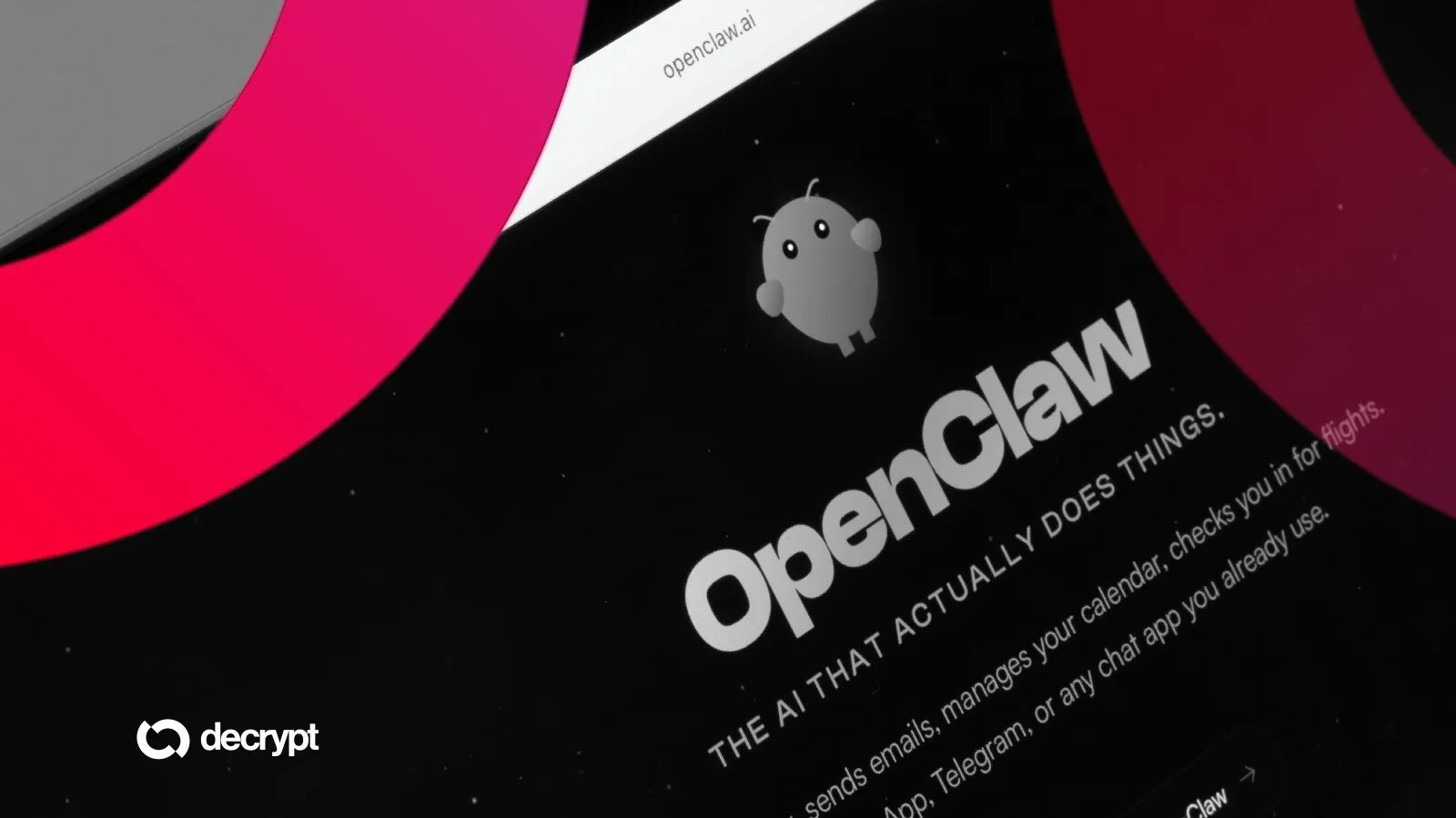
    The scammer posts GitHub issues telling developers, “Appreciate your contributions on GitHub. We analyzed profiles and chose developers to get OpenClaw allocation,” and claims they have won $5,000 worth of $CLAW tokens, directing them to a fake website that closely resembles openclaw.ai. The site includes an added “Connect your wallet” button designed to trigger wallet theft.

    OX Security research team lead and a co-author of the report, Moshe Siman Tov Bustan, told Decrypt they uncovered evidence the scam attempt bears resemblance to a campaign that “spread on GitHub, relating to Solana.”

    “[We’re still] analyzing the behavior and the relation of these campaigns,” Bustan added.

    The phishing campaign surfaced weeks after OpenAI CEO Sam Altman announced OpenClaw creator Peter Steinberger would lead its push into personal AI agents, with OpenClaw transitioning to a foundation-run open-source project. 

    That mainstream profile and the framework’s association with one of the most prominent names in AI make its developer community an increasingly attractive target.

    OX Security said it had previously assessed the attackers may be using GitHub’s star feature to identify users who have starred OpenClaw-related repositories, making the lure appear more targeted and credible.

    The platform’s analysis found the wallet-stealing code buried inside a heavily obfuscated JavaScript file called “eleven.js.”

    “According to who that was targeted and the user’s reports on GitHub,” the campaign targeted only users who “starred the OpenClaw GitHub repository,” Bustan said. “During our analysis, we found only one address belonging to the threat actor, which hadn’t sent or received any funds yet.”

    After deobfuscating the malware, researchers identified a built-in “nuke” function that wipes all wallet-stealing data from the browser’s local storage to frustrate forensic analysis. 

    The malware tracks user actions via commands such as PromptTx, Approved, and Declined, relaying encoded data, including wallet addresses, transaction values, and names, back to a C2 server.

    Researchers identified one crypto wallet address they believe belongs to the threat actor, 0x6981E9EA7023a8407E4B08ad97f186A5CBDaFCf5, used to receive stolen funds. 

    The accounts were created last week and deleted within hours of launch, with no confirmed victims so far, according to OX Security.

    Decrypt has reached out to Peter Steinberger for comment.

    OpenClaw’s crypto magnet problem

    OpenClaw, a self-hosted AI agent framework that lets users run persistent bots connected to messaging apps, email, calendars, and shell commands, hit 323,000 GitHub stars following its acquisition by OpenAI last month. 

    That visibility quickly attracted bad actors, with OpenClaw creator Peter Steinberger saying crypto spam flooded OpenClaw’s Discord almost “every half hour,” forcing bans and ultimately a blanket prohibition after what he described to Decrypt as “nonstop coin promotion.”

    Unlike chat-based AI tools, OpenClaw agents persist, wake on a schedule, store memory locally, and execute multi-step tasks autonomously.

    OX Security recommends blocking token-claw[.]xyz and watery-compost[.]today across all environments, avoiding connecting crypto wallets to newly surfaced or unverified sites, and treating any GitHub issue promoting token giveaways or airdrops as suspicious, particularly from unknown accounts. 

    Users who recently connected a wallet should revoke approvals immediately, the platform warned. 

    Editor’s note: Adds comment from OX Security’s Bustan

    Daily Debrief Newsletter

    Start every day with the top news stories right now, plus original features, a podcast, videos and more.

  • You Can Now Trade Official S&P 500 Perpetual Futures via Hyperliquid

    You Can Now Trade Official S&P 500 Perpetual Futures via Hyperliquid

    In brief

    • S&P Dow Jones Indices licensed the S&P 500 to Trade[XYZ], enabling round-the-clock speculation on the largest publicly traded companies in the U.S.
    • The development comes as the CFTC develops a regulatory framework for perpetual futures in the U.S., which could be unveiled soon.
    • Perpetual futures tied to indices and exchange-traded funds are becoming increasingly popular on Hyperliquid, yet commodities and crypto still lead.

    Hyperliquid traders have gained access to perpetual futures that track the S&P 500 under a licensing agreement between S&P Dow Jones Indices and Trade[XYZ], enabling round-the-clock speculation on the largest publicly traded companies in the U.S.

    For the first time, investors outside the U.S. will be able to gain leveraged exposure to the stock index using an officially licensed product that’s also digitally native, the index provider said in a Wednesday announcement.

    In recent months, Trade[XYZ] has broadened access to markets based on real-world assets like gold and oil on Hyperliquid. The startup offers contracts that are settled in Circle’s USDC stablecoin and accessible through the decentralized exchange.

    “We developed XYZ with a vision of bringing the world’s most important markets on-chain,” Collins Belton, chief operating officer and general counsel at Trade[XYZ]’s parent company, said in a statement. “The S&P 500 is a natural starting point.”

    Perpetual futures tied to indices and exchange-traded funds are becoming increasingly popular on Hyperliquid, following an upgrade last year that allows firms like Trade[XYZ] to create markets independently. On Sunday, perpetual futures tied to those products commanded 5.5% of Hyperliquid’s trading volumes at $215 million, according to a Dune dashboard.

    Although that was far less than crypto (76%) and commodities (17%), the new licensing agreement shows that companies forming the bedrock of traditional finance are taking a closer look at the proliferation on-chain of perpetual futures.

    Hyperliquid’s native token changed hands around $43 on Wednesday, a 7% increase over the past day. Its price has tumbled 27% from an all-time high of $59 in September. Still, HYPE has soared 225% over the past year.

    Earlier this month, CFTC Chair Mike Selig indicated alongside SEC Chair Paul Atkins that his agency plans to establish a regulatory framework for perpetual futures in the U.S. soon. At the time, he argued the prior administration drove associated activity offshore.

    Perpetual futures allow a trader to speculate on an asset indefinitely, and their prices are anchored to their underlying asset through periodic payments, known as a funding rate. Over time, they have become the dominant form of derivatives across global crypto markets.

    Daily Debrief Newsletter

    Start every day with the top news stories right now, plus original features, a podcast, videos and more.