Tag: Business – Decrypt

  • Wikipedia Bans AI-Generated Text in Articles Under New Editing Policy

    Wikipedia Bans AI-Generated Text in Articles Under New Editing Policy

    In brief

    • Wikipedia now prohibits editors from using large language models to generate or rewrite article content.
    • The policy still allows limited AI-assisted copyediting if editors review the changes and no new content is introduced.
    • The rule reflects growing concerns about hallucinations, fabricated sources, and accuracy in AI-generated text.

    Wikipedia editors have moved to restrict how artificial intelligence can be used on the platform, in a recent policy update banning the use of large language models to write or rewrite articles.

    The new guideline reflects growing concern within the Wikipedia community that AI-generated text can conflict with the platform’s standards, particularly around verifiability and reliable sourcing.

    “Text generated by large language models often violates several of Wikipedia’s core content policies,” the policy update reads. “For this reason, the use of LLMs to generate or rewrite article content is prohibited, save for the exceptions given below.”

    The policy still allows limited use of AI tools, including suggesting basic copy edits to an editor’s own writing, provided the system does not introduce new information. However, editors are advised to review those suggestions carefully.

    While the new policy does not mention penalties for using AI-generated content, according to Wikipedia’s guidelines around disclosure, repeating misuse forms a “pattern of disruptive editing,” and may lead to a block or ban. Wikipedia does give editors a path to reinstate their accounts following an appeal process.

    “Blocks can be reversed with the agreement of the blocking admin, an override by other admins in the case that the block was clearly unjustifiable, or (in very rare cases) on appeal to the Arbitration Committee,” Wikipedia said.

    “The Wikimedia Foundation does not determine editorial policies and guidelines on Wikipedia; volunteer editors do,” a Wikimedia Foundation spokesperson told Decrypt. “Wikipedia’s strength has been and always will be its human-centered, volunteer-driven model.”

    According to Emily M. Bender, a professor of linguistics at the University of Washington, some uses of language models in editing tools may be reasonable, but drawing a clear boundary between editing and generating text can be difficult.

    “So one of the things that you can do with a language model is build a very good spell checker, for example,” Bender told Decrypt. “I think it’s reasonable to say it’s fine to run a spell checker over edits. And if you are doing the next level up, a grammar checker, that can also be fine.”

    Bender said the challenge comes when systems move beyond correcting grammar and begin altering or generating content, noting that large language models lack the kind of accountability that human contributors bring to collaborative knowledge projects.

    “Using large language models to produce synthetic text, it is a fundamental property of these systems that there is no accountability, no connection to what someone believes or stands behind,” she said. “When we speak, we speak based on what we believe and what we are accountable for, not based on some objective notion of truth. And that’s not there for large language models.”

    Bender said widespread use of AI-generated edits could also affect the site’s reputation.

    “If people are instead taking shortcuts and making something that looks like a Wikipedia edit or article and putting it there, then that degrades the overall value and reputation of the site,” she said.

    Joseph Reagle, associate professor of communication studies at Northeastern University, who studies Wikipedia’s culture and governance, said the community’s response reflects longstanding concerns about accuracy and sourcing.

    “Wikipedia is wary of AI generated prose,” Reagle told Decrypt. “They take the accurate characterizations of what reliable sources state about a topic seriously. AI has had serious limitations on that front, such as ‘hallucinated’ claims and fabricated sources.”

    Reagle said Wikipedia’s core policies also shape how editors view AI tools, noting that many large language models have been trained on Wikipedia content. In October, the Wikimedia Foundation said human visits to Wikipedia fell about 8% year over year as search engines and chatbots increasingly provide answers directly on their platforms, rather than sending users to the site.

    In January, the Wikimedia Foundation announced agreements with AI companies, including Microsoft, Google, Amazon, and Meta, allowing them to use Wikipedia material through its Enterprise product, a commercial service designed for large-scale reuse of its content.

    “While the use of Wikipedia content is permitted by Wikipedia’s licenses, there’s still some antipathy among Wikipedians about services that appropriate the content of communities and then place unwanted demands on those communities to deal with the consequent glut of AI slop,” Reagle said.

    Despite the prohibition on using LLMs, Wikipedia does permit AI tools to translate articles from other language editions into English, provided editors verify the original text. The policy also warns editors not to rely on writing style alone to identify AI-generated content and instead focus on whether the material complies with Wikipedia’s core policies and the contributor’s editing history.

    “Some editors may have similar writing styles to LLMs,” the update says. “More evidence than just stylistic or linguistic signs is needed to justify sanctions, and it is best to consider the text’s compliance with core content policies and recent edits by the editor in question.”

    Editor’s note: This article was updated after publication to include comment from the Wikipedia Foundation.

    Daily Debrief Newsletter

    Start every day with the top news stories right now, plus original features, a podcast, videos and more.

  • Retail Investors Growing Exposed to Bitcoin Giant Strategy’s STRC Over MSTR, Says CEO

    Retail Investors Growing Exposed to Bitcoin Giant Strategy’s STRC Over MSTR, Says CEO

    In brief

    • Strategy CEO Phong Le signaled that Strategy’s common stock is taking a backseat relative to its flagship preferred share among retail investors.
    • Benchmark-StoneX’s Mark Palmer said that makes sense, describing STRC as an investment that dovetails with individuals’ accustomed thinking.
    • On a notional basis, the value of common stock held by retail investors still outweighs allocations among individuals to the dividend-paying product.

    Strategy CEO Phong Le signaled on Thursday that retail investors are becoming increasingly interested in the Bitcoin-buying firm’s flagship preferred share relative to its common stock, highlighting who is exposed to the company’s shift in fundraising efforts.

    Although individuals currently hold approximately 40% of the company’s ordinary shares, Lee noted in a post on X that they presently make up around 80% of those invested in STRC. Strategy started pitching the shares alongside its $2.5 billion debut last year.

    At a market cap of $5 billion, Lee suggested that STRC’s popularity among retail investors indicates that they “prefer low-volatility, high-yield digital credit.” The assessment comes as Strategy’s common stock (MSTR) price has plunged 56% over the past six months to $134.

    Not long after STRC debuted in July, Strategy Executive Chairman and co-founder Michael Saylor said the product that currently pays 11.5% in dividends annually could be interesting for a “whole new class of people.” Those remarks focused on investors like retirees, yet the product has also started showing up on its Bitcoin-buying peers’ balance sheets.

    Platforms common among retail investors have expanded access to STRC, which trades on the Nasdaq, including Robinhood, Kraken, and Webull. At 80% of STRC’s market cap, Lee indicated that retail investors hold $4 billion worth of the dividend-paying product.

    On a notional basis, that’s still less than the value of common shares that Lee said retail investors hold. A 40% slice of Strategy’s $46.3 billion market cap is currently $18.5 billion.

    The notion that Strategy’s common stock is losing preference among retail investors makes sense when viewed through a risk-adjusted lens, according to Mark Palmer, an equity research analyst at investment banking firm Benchmark-StoneX.

    “The company’s common stock offers theoretically unbounded upside, but it is essentially a leveraged, non-yielding Bitcoin proxy and therefore better suited for sophisticated, risk-tolerant investors,” he told Decrypt. “STRC offers a predictable return through its high-yield, low-volatility, and significant Bitcoin overcollateralization that limits downside, and as such it maps better to how most retail investors are accustomed to thinking about income-generating assets.”

    Analysts at Benchmark, who have penciled in a year-end price target of $705 for Strategy, are among the Bitcoin-buying firm’s most bullish on Wall Street. Analysts at TD Cowen, for example, pared their price target to $500 from $440 earlier this year.

    The investment bank’s managing director of equity research, Lance Vitzana, recently told Decrypt that STRC’s uptick in issuance followed Strategy’s annual conference in Las Vegas last month. He noted that STRC was marketed aggressively during the two-day confab.

    So far this month, Strategy has raised more than $1.5 billion via the dividend-paying product, which is engineered to trade at near its $100 par value. That represents around 33% of the product’s market cap, including its multi-billion-dollar public offering.

    When the preferred share trades above that threshold, Strategy issues more shares to grow its Bitcoin stockpile. If the product lingers below, then the firm has indicated that it will hike the dividend in an effort to increase demand and lift STRC back towards its target.

    Even though institutional investors are allocating to STRC, Palmer said that group is unlikely to displace demand from individuals. That’s because institutions tend to prefer the relative liquidity of Strategy’s common equity and asymmetric risk-reward profile, he said.

    “In that sense, STRC is carving out a distinct investor base rather than competing directly with Strategy’s common stock,” Palmer added. “Importantly, this dynamic strengthens Strategy’s ability to raise capital for bitcoin accumulation, as STRC effectively expands the company’s addressable investor base.”

    Daily Debrief Newsletter

    Start every day with the top news stories right now, plus original features, a podcast, videos and more.

  • XRP Falls to 2-Week Low as Ripple Deploys AI to Boost Ledger Security

    XRP Falls to 2-Week Low as Ripple Deploys AI to Boost Ledger Security

    Ripple has unveiled a comprehensive AI-powered security overhaul for the XRP Ledger, deploying automated testing tools and establishing a dedicated red team that it said has already uncovered more than 10 bugs in the blockchain’s codebase.

    The company outlined its new strategy on Thursday, detailing how AI tools will be integrated across the XRP Ledger development lifecycle, including adversarial code scanning on every pull request and automated stress testing.

    The AI-assisted red team focuses on analyzing how features interact in real-world scenarios, particularly at boundaries where legacy code meets new functionality.

    Ripple said the next XRP Ledger software release will be dedicated entirely to bug fixes and improvements without introducing new features, signaling a shift toward prioritizing security over rapid feature deployment. The company also plans to require multiple independent security audits for significant protocol changes and is expanding its bug bounty program.

    “XRPL has proven its reliability over more than a decade of operation. Our responsibility now is to ensure the ledger continues to meet the demands of global payments, tokenized assets, and institutional-grade financial infrastructure,” the blog post reads. “We will evolve XRPL by systematically strengthening the foundation it is built on.”

    XRP was recently trading at $1.34, down 5% on the day amid a broader crypto market dip on Thursday. Stock prices are also tumbling amid uncertainty around the Iran conflict.

    At that price, XRP is at its lowest price in more than two weeks, per data from CoinGecko. XRP set a new all-time high price of $3.65 last July, but has fallen 63% since.

    Daily Debrief Newsletter

    Start every day with the top news stories right now, plus original features, a podcast, videos and more.
  • Australia Lays Groundwork for Tokenized Asset Markets After RBA Project

    Australia Lays Groundwork for Tokenized Asset Markets After RBA Project

    In brief

    • The RBA said tokenization is now a question of how, not if, as it outlined the next steps after its Project Acacia research program.
    • Regulators, including the RBA, ASIC, and AUSTRAC, are now coordinating on legal and regulatory frameworks for tokenised assets and settlement systems.
    • BTC Markets told Decrypt the move toward a longer-term sandbox and regulatory coordination could unlock institutional participation in tokenized markets.

    Australia’s central bank is moving toward building the legal and market infrastructure needed for tokenized asset markets, as regulators begin coordinating on rules that could allow the products to trade at scale within the financial system.

    In a speech on Tuesday, Reserve Bank of Australia Assistant Governor Brad Jones said the question was no longer whether tokenization had a future in Australia’s financial system, but how it would be implemented, following the conclusion of the bank’s Project Acacia research program into tokenized assets and money.

    The RBA said it would work with other regulators and industry on a new digital market infrastructure sandbox to test tokenized assets, tokenized money, and settlement systems in a longer-term environment designed to support commercialization, rather than short-term pilot programs.

    The central bank also confirmed it is coordinating with other agencies on the legal and regulatory framework for tokenized markets, including how tokenized assets are classified, how settlement finality works, and how new platforms would be licensed and supervised.

    The push on tokenized markets comes as lawmakers move to bring crypto platforms and tokenized custody services under Australia’s financial-services regime, requiring firms that hold client tokens to obtain licenses and meet asset-safeguarding rules.

    Industry participants say that regulatory coordination is the key step needed to move tokenized assets from pilot programs into real markets.

    “Project Acacia represents a turning point,” Paul Stonham, chief commercial officer at Australian crypto exchange BTC Markets and a member of the project’s advisory group, told Decrypt.

     “The RBA’s decision to move from exploratory pilots to a longer-term, stage-gated sandbox environment signals genuine institutional commitment to making tokenized finance work in Australia, not just studying it.”

    Stonham said the most significant development was the coordination now underway between the RBA, the Australian Securities and Investments Commission, and AUSTRAC to address legal and regulatory uncertainty that has limited institutional participation.

    He said regulated digital asset exchanges are likely to play a central role in tokenized markets, arguing that tokenized assets will need to trade on transparent, centrally managed order books operated by licensed platforms to attract larger players.

    The RBA said tokenization could improve efficiency and reduce risk in wholesale markets, particularly if tokenized assets and money can be settled on synchronized systems, and estimated the economic benefit to Australia could reach about $24 billion (US$16.6 billion) per year.

    The bank also said further work would focus on settlement infrastructure, tokenized bank deposits, stablecoins, and the potential role of a wholesale central bank digital currency.

    Daily Debrief Newsletter

    Start every day with the top news stories right now, plus original features, a podcast, videos and more.
  • Google Sets 2029 Deadline to Deal With Quantum Threat—Is It a Problem for Bitcoin?

    Google Sets 2029 Deadline to Deal With Quantum Threat—Is It a Problem for Bitcoin?

    In brief

    • Google publicly set a 2029 deadline to transition its systems to post-quantum cryptography.
    • Bitcoin faces long-term cryptographic risk as quantum breakthroughs compress security timelines.
    • Crypto must coordinate a slow, decentralized migration to quantum-resistant standards under external pressure.

    Google is done treating quantum computing as a future problem. On Tuesday, the company published a formal timeline for transitioning its entire infrastructure to post-quantum cryptography (PQC) by 2029—calling the move urgent and saying quantum frontiers “may be closer than they appear.”

    “As a pioneer in both quantum and PQC, it’s our responsibility to lead by example and share an ambitious timeline,” the blog reads. “Quantum computers will pose a significant threat to current cryptographic standards, and specifically to encryption and digital signature.”

    The announcement, signed by Google VP of Security Engineering Heather Adkins and Senior Cryptography Engineer Sophie Schmieg, describes the 2029 target as a response to rapid advances in quantum hardware, error correction, and factoring resource estimates.

    In plain English: The machines that could theoretically crack today’s encryption are getting real, faster than expected.

    Google’s warning rests on two distinct threats. The first is already happening. So-called “harvest now, decrypt later” attacks allow bad actors to steal encrypted data today and sit on it, confident they’ll be able to unlock it once quantum computers are powerful enough. That threat is present-tense. The second is future-facing: digital signatures, the cryptographic foundation of authentication across the internet, will need to be replaced before a cryptographically relevant quantum computer—a CRQC—arrives.

    To lead by example, Google announced that Android 17 will integrate post-quantum digital signature protection using ML-DSA, an algorithm recently standardized by the U.S. National Institute of Standards and Technology (NIST). The company is also pushing PQC across Google Cloud and internal communications systems.

    The 2029 deadline is not arbitrary. IBM has its own roadmap targeting fault-tolerant quantum systems by the same year. As both companies race toward that threshold, 2025 marked a turning point in the field—when error correction breakthroughs, new processor architectures, and a Caltech result trapping over 6,000 atomic qubits at once shifted the conversation from “if” to “when.”

    What does it mean for Bitcoin?

    Bitcoin runs on elliptic curve cryptography (or ECDSA signatures), the same class of math that quantum computers—running what’s known as Shor’s algorithm—could eventually reverse-engineer. That means: Given your public key, a sufficiently powerful quantum machine could derive your private key.

    Normal computers would take centuries to crack something like this. Quantum computers may take that problem and turn it into something solvable in practical time.

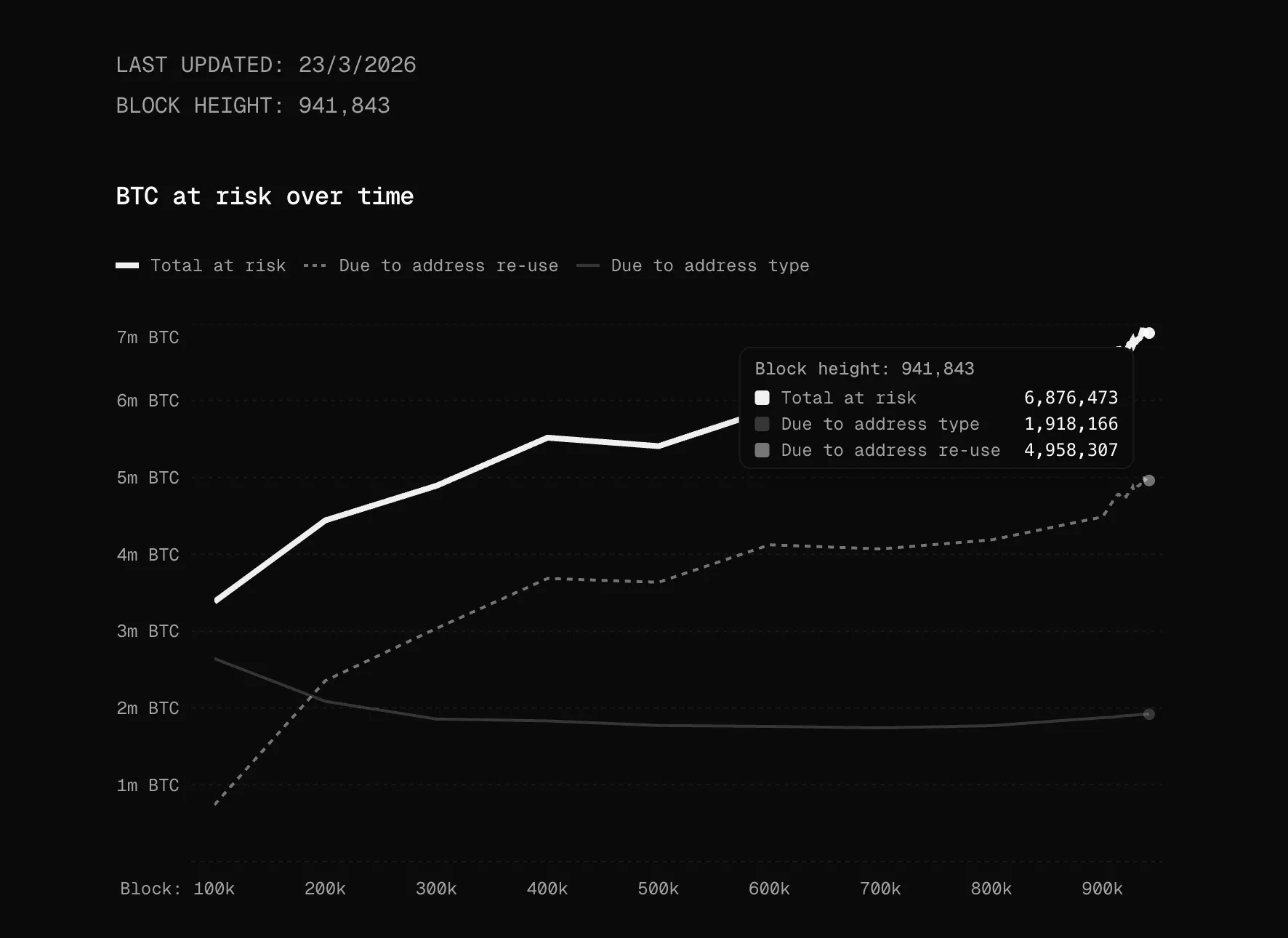
    The exposure is larger than most people realize. According to Project Eleven, a cybersecurity and crypto-focused startup working on protecting crypto from future quantum computer attacks, over 6.8 million Bitcoin—over $470 billion worth—sits in addresses that are vulnerable to quantum attacks, including coins from Bitcoin’s earliest days. A separate estimate from Ark Invest and Unchained puts roughly 35% of the total Bitcoin supply in address types theoretically vulnerable to a future quantum attack.

    Source: Project eleven

    Google’s researchers recently found that cracking RSA encryption may require 20 times fewer quantum resources than previously estimated—a finding that compressed the security timeline for everything that relies on similar mathematical structures, Bitcoin included. Earlier estimates put the qubit count needed to crack Bitcoin at around 20 million. Researchers at Iceberg Quantum now suggest the number could fall to roughly 100,000.

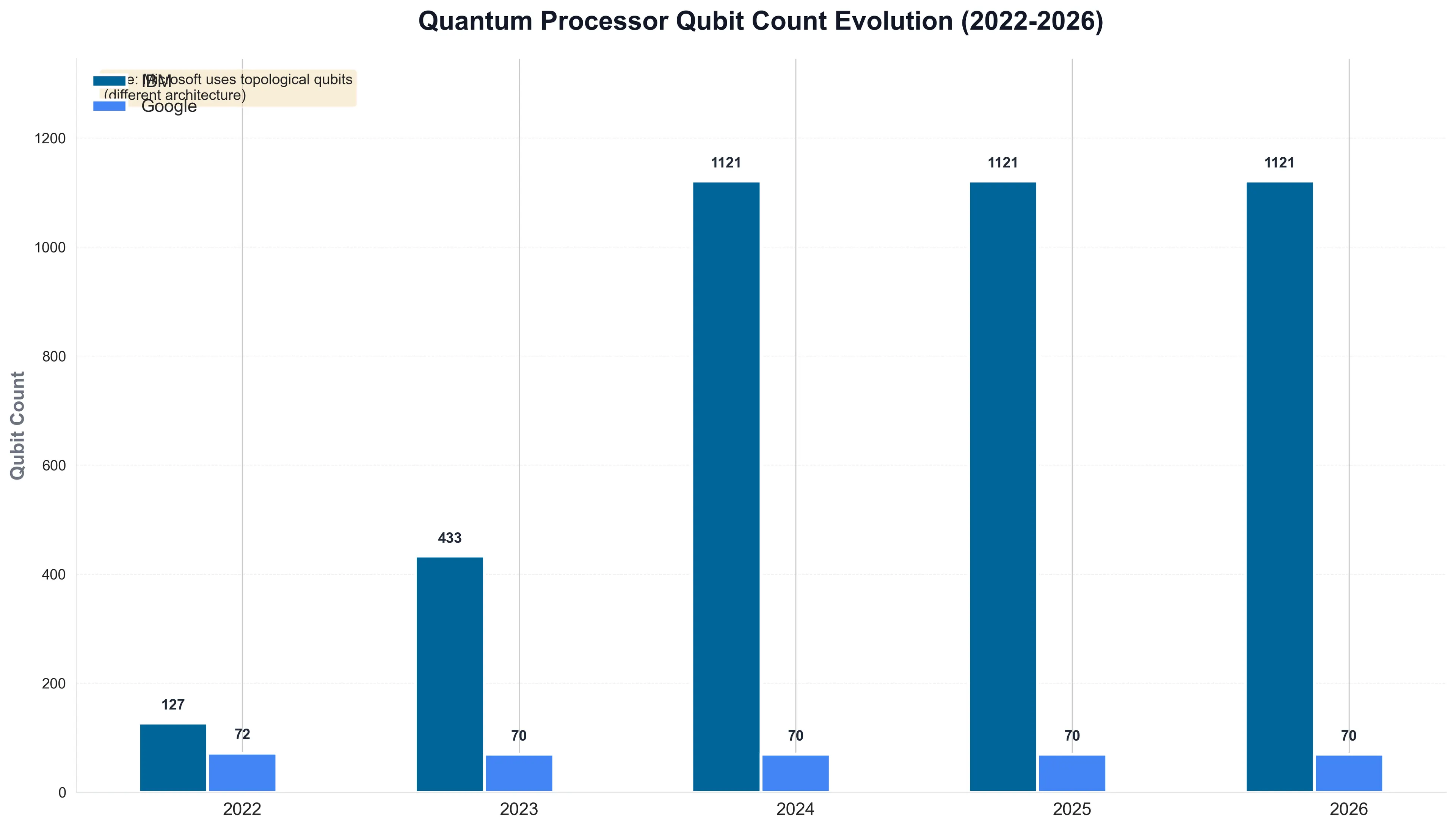
    Quantum computers have achieved almost a 10x growth in power in the last five years.

    Source: Programming-Helper.com

    So, should we all panic and sell our coins? Not really—but we should pay attention.

    First of all, Google isn’t saying quantum computers will break cryptography by 2029. It’s simply saying it plans to be ready before they do.

    Also, Bitcoin developers are not asleep at the wheel. BIP 360, a proposal introducing a quantum-resistant address format called Pay-to-Merkle-Root, was recently merged into Bitcoin’s formal improvement repository. It doesn’t activate anything—but it starts the clock on a serious overhaul.

    Jameson Lopp, co-founder of Bitcoin custody firm Casa, believes that even if quantum computers remain years away from posing a real threat, upgrading Bitcoin’s protocol and migrating billions in user funds could take five to 10 years on its own.

    “Right now, we’re several orders of magnitude away from having a cryptographically relevant quantum computer, at least as far as we know,” Loop told Decrypt earlier this year. “If innovation in quantum computing continues at a similar, fairly linear rate, it’s going to take many years—probably over a decade, maybe even several decades—before we get to that point.”

    Bitcoin’s decentralized governance means no single team can flip a switch. Miners, wallet developers, exchanges, and millions of individual users would all need to move simultaneously.

    Google can set a 2029 deadline because it controls its own infrastructure. Bitcoin cannot. And that asymmetry is exactly what makes Google’s announcement matter for crypto—not as a death sentence, but as a hard deadline the network didn’t set for itself and can’t afford to ignore.

    Daily Debrief Newsletter

    Start every day with the top news stories right now, plus original features, a podcast, videos and more.
  • Google Shrinks AI Memory With No Accuracy Loss—But There’s a Catch

    Google Shrinks AI Memory With No Accuracy Loss—But There’s a Catch

    In brief

    • Google said its TurboQuant algorithm can cut a major AI memory bottleneck by at least sixfold with no accuracy loss during inference.
    • Memory stocks including Micron, Western Digital and Seagate fell after the paper circulated.
    • The method compresses inference memory, not model weights, and has only been tested in research benchmarks.

    Google Research published TurboQuant on Wednesday, a compression algorithm that shrinks a major inference-memory bottleneck by at least 6x while maintaining zero loss in accuracy.

    The paper is slated for presentation at ICLR 2026, and the reaction online was immediate.

    Cloudflare CEO Matthew Prince called it Google’s DeepSeek moment. Memory stock prices, including Micron, Western Digital, and Seagate, fell on the same day.

    So is it real?

    Quantization efficiency is a big achievement by itself. But “zero accuracy loss” needs context.

    TurboQuant targets the KV cache—the chunk of GPU memory that stores everything a language model needs to remember during a conversation.

    As context windows grow toward millions of tokens, those caches balloon into hundreds of gigabytes per session. That’s the actual bottleneck. Not compute power but raw memory.

    Traditional compression methods try to shrink those caches by rounding numbers down—from 32-bit floats to 16, to 8 to 4-bit integers, for example. To better understand it, think of shrinking an image from 4K, to full HD, to 720p and so. It’s easy to tell it’s the same image overall, but there’s more detail in 4K resolution.

    The catch: they have to store extra “quantization constants” alongside the compressed data to keep the model from going stupid. Those constants add 1 to 2 bits per value, partially eroding the gains.

    TurboQuant claims it eliminates that overhead entirely.

    It does this via two sub-algorithms. PolarQuant separates magnitude from direction in vectors, and QJL (Quantized Johnson-Lindenstrauss) takes the tiny residual error left over and reduces it to a single sign bit, positive or negative, with zero stored constants.

    The result, Google says, is a mathematically unbiased estimator for the attention calculations that drive transformer models.

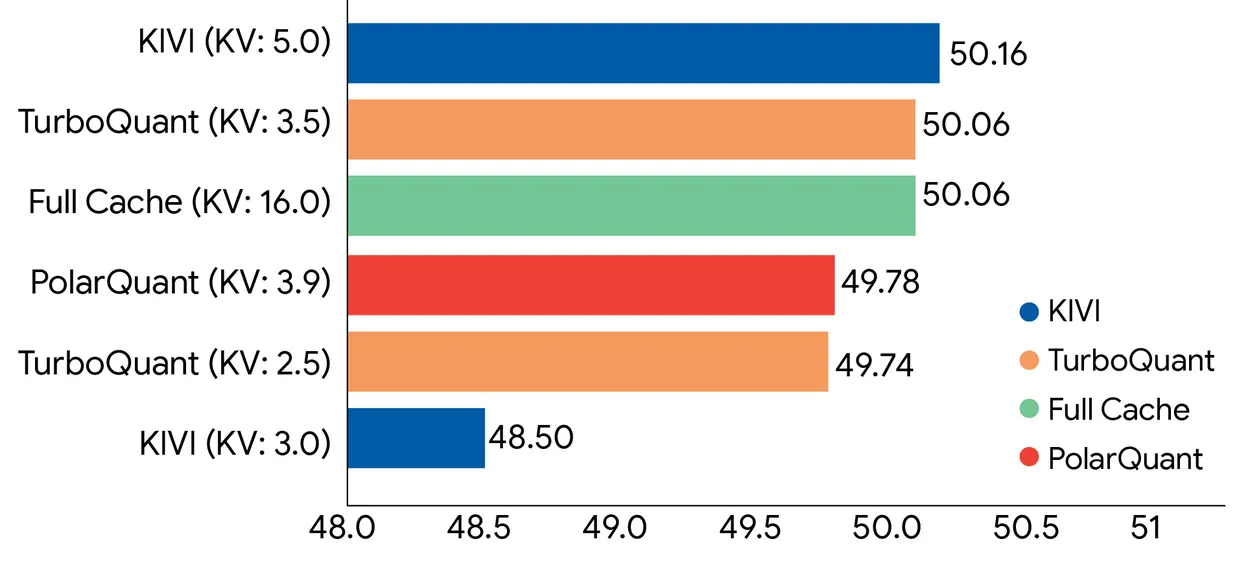
    In benchmarks using Gemma and Mistral, TurboQuant matched full-precision performance under 4x compression, including perfect retrieval accuracy on needle-in-haystack tasks up to 104,000 tokens.

    For context on why those benchmarks matter, expanding a model’s usable context without quality loss has been one of the hardest problems in LLM deployment.

    Now, the fine print.

    “Zero accuracy loss” applies to KV cache compression during inference—not to the model’s weights. Compressing weights is a completely different, harder problem. TurboQuant doesn’t touch those.

    What it compresses is the temporary memory storing mid-session attention computations, which is more forgiving because that data can theoretically be reconstructed.

    There’s also the gap between a clean benchmark and a production system serving billions of requests. TurboQuant was tested on open-source models—Gemma, Mistral, Llama—not Google’s own Gemini stack at scale.

    Unlike DeepSeek’s efficiency gains, which required deep architectural decisions baked in from the start, TurboQuant requires no retraining or fine-tuning and claims negligible runtime overhead. In theory, it drops straight into existing inference pipelines.

    That’s the part that spooked the memory hardware sector—because if it works in production, every major AI lab runs leaner on the same GPUs they already own.

    The paper goes to ICLR 2026. Until it ships in production, the “zero loss” headline stays in the lab.

    Daily Debrief Newsletter

    Start every day with the top news stories right now, plus original features, a podcast, videos and more.

  • Visa Becomes First Major Payments Company to Join Canton Network as Super Validator

    Visa Becomes First Major Payments Company to Join Canton Network as Super Validator

    In brief

    • Visa announced it will join Canton Network as the first major global payments company to serve as a Super Validator.
    • The company will be one of 40 Super Validators helping banks and financial institutions bring payment flows on-chain.
    • Canton Network is designed to address privacy concerns that have kept many banks from adopting public blockchains.

    Visa announced Wednesday that it will join Canton Network as the first major global payments company to serve as a Super Validator, helping extend privacy-preserving blockchain infrastructure to banks and financial institutions worldwide.

    The payments giant will be one of 40 Super Validators on the layer-1 Canton network, applying “the same trusted and reliable standards it uses to operate critical payment systems today,” it said in an announcement.

    As a Super Validator with voting powers to shape Canton’s network decisions, Visa will help institutions experiment with and scale stablecoin payments, settlement, and treasury use cases without changing how they manage risk, compliance, and operations.

    “Many banks see the lack of privacy as a dealbreaker for moving meaningful activity on-chain,” said Rubail Birwadker, Visa’s global head of growth products and strategic partnerships, in a statement. “By operating as a Super Validator on Canton Network, we’re bringing Visa-grade trust, governance and operational rigor that define Visa’s global network to privacy‑preserving blockchain infrastructure, so regulated financial institutions can bring payments on-chain without having to rethink how they operate.”

    Canton’s configurable privacy model allows institutions to adopt blockchain without compromising confidentiality—addressing concerns that banks can’t run payroll if salaries are public and trading firms can’t reveal positions without hurting price discovery.

    The move builds on Visa’s expanding digital asset work, including stablecoin settlement that has reached an annualized run rate of $4.6 billion globally and stablecoin-linked card programs spanning more than 130 programs across more than 50 countries.

    Canton has seen significant uptake from major financial players, with Franklin Templeton expanding its tokenized fund platform Benji to the network and JPMorgan bringing over its JPM Coin for institutional client payments. In December, the Depository Trust & Clearing Company—which processes quadrillions of dollars’ worth of transactions annually—said it would issue tokenized securities on Canton.

    Since launching in November, Canton’s native CC token has rapidly become one of the most valuable cryptocurrencies on the market. It’s up more than 3% over the last day to a recent price of $0.145 and a market cap above $5.5 billion, making it the 21st biggest coin by that metric per data from CoinGecko.

    Daily Debrief Newsletter

    Start every day with the top news stories right now, plus original features, a podcast, videos and more.
  • Franklin Templeton, Ondo Finance Bring 24/7 Tokenized ETF Trading to Crypto Users

    Franklin Templeton, Ondo Finance Bring 24/7 Tokenized ETF Trading to Crypto Users

    In brief

    • Franklin Templeton and Ondo Finance are teaming up to tokenize five of the financial giant’s ETFs.
    • Offerings include Franklin Templeton’s responsibly sourced gold ETF and its high-yield corporate ETF.
    • The tokenized ETFs will be offered via Ondo’s Global Markets platform, which is unavailable to U.S. users.

    Global asset manager Franklin Templeton and real-world asset tokenization firm Ondo Finance are teaming up to offer tokenized versions of five Franklin Templeton exchange-traded funds (ETFs) as part of a new initiative, the firms announced on Wednesday. 

    The funds—which include Franklin Templeton’s high-yield corporate ETF, its focused growth ETF, and its responsibly sourced gold ETF—will allow those without traditional brokerage accounts to gain access and trade them around the clock. 

    “This initial set of ETFs was selected by Ondo, based on demand they’ve recognized in their ecosystem,” Franklin Templeton Head of Innovation Sandy Kaul told Decrypt. “We believe it’s important to anchor this space in high-quality, well-understood investment strategies, and Franklin Templeton will continue to take a thoughtful approach to bringing institutional-grade products on-chain.”

    “We’ll evaluate future opportunities based on investor appetite, usability, and where we can deliver the most value,” she added. 

    The firms will also work together on educational programs designed to showcase how traditional investments will fit in alongside “emerging financial ecosystems.” 

    “Success is less about a single metric and more about expanding access while maintaining the standards and outcomes investors expect from Franklin Templeton,” Kaul added. “We’re focused on how these products are actually used: helping investors access diversified strategies, engage more consistently with long-term investing, and integrate traditional investments into their financial lives on-chain.”

    The new tokenized ETF offerings will use Ondo’s tokenized securities platform, Ondo Global Markets, which has established more than $620 million in total value locked (TVL) since its launch last fall. 

    However, access to the products is not intended for U.S. users, who are ineligible to make trades on Ondo’s Global Markets platform.

    Ondo rolled out access to more than 100 tokenized U.S. equities on the Ethereum blockchain in September as interest around tokenized equities and products rose. 

    Franklin Templeton also has a long history with tokenized assets, debuting its Franklin On-Chain U.S. Government Money Fund on the Stellar network in 2021 before expanding the offering to Ethereum in 2024. It has also since expanded to Polygon, Aptos, Avalanche, Arbitrum, Solana, and Base.

    The pair’s latest tokenization initiative comes a day after the New York Stock Exchange announced it will collaborate with the BlackRock-backed Securitize for the tokenization of securities. Also, last week, Nasdaq earned SEC approval to test tokenized versions of some securities in a pilot program.

    Editor’s note: This story was updated after publication to add in comments from Franklin Templeton, replacing quotes from the press release.

    Daily Debrief Newsletter

    Start every day with the top news stories right now, plus original features, a podcast, videos and more.

  • Cipher Digital Stock Pops as Firm Bolsters Shift From Bitcoin Mining With 15-Year Data Center Deal

    Cipher Digital Stock Pops as Firm Bolsters Shift From Bitcoin Mining With 15-Year Data Center Deal

    In brief

    • Cipher Digital signed a 15-year lease agreement with an “investment-grade hyperscale tenant” for a new data center development.
    • The company closed a $200 million revolving credit facility with an additional $50 million accordion option, maturing in March 2030.
    • The firm rebranded from Cipher Mining in February, with the latest moves furthering its pivot away from Bitcoin mining.

    Cipher Digital, a publicly traded developer and operator of industrial-scale data centers for high-performance computing workloads, announced Wednesday that it has signed a 15-year lease for its third data center campus, furthering its recent pivot from Bitcoin miner to powering the growing demand for AI power and other computing needs.

    The company will develop and deliver a new HPC data center at one of its existing sites under the agreement, according to a press release. Investors appear to like the news, with Cipher’s stock (CIFR) rising more than 8% since the opening bell Wednesday to recently trade at $16.14 per share.

    “This agreement for our third large AI campus reinforces Cipher’s position as a trusted partner to develop high-quality HPC data center infrastructure for the world’s leading companies,” said Cipher CEO Tyler Page, in a statement.

    Cipher also announced the closing of a revolving credit facility providing up to $200 million of committed capacity, with an additional accordion option of up to $50 million. The facility, which was undrawn at close, has a scheduled maturity of March 2030 and bears interest at the Secured Overnight Financing Rate (SOFR) plus 1.25% to 1.75%, with step-down pricing based on the company’s total debt to market capitalization ratio.

    “This transaction marks Cipher’s first syndicated revolving credit facility and represents a major step in the evolution of our capital structure,” said Cipher CFO Greg Mumford, in a statement. “We believe this facility highlights the continued strength and maturation of our business, as well as the growing confidence in our long-term strategy from premier financial institutions.”

    Morgan Stanley serves as administrative agent, lead arranger, and lead bookrunner, with Banco Santander, Goldman Sachs, JPMorgan Chase, Sumitomo Mitsui Banking Corporation, and Wells Fargo also joining in the syndicate.

    The company rebranded from Cipher Mining in February, saying that it was expanding beyond its original Bitcoin mining focus to serve broader high-performance computing demand. Cipher Digital also sold off an interest in three joint mining sites in February, along with mining rigs housed at one of its sites.

    “While Bitcoin mining played a foundational role in building Cipher’s power origination expertise and large-scale development capabilities, the company’s identity has evolved to focus on enabling next-generation compute at industrial scale,” it said last month, adding that it would “maintain optimized exposure to the Bitcoin mining industry in a capital-light manner.”

    Cipher is one of several Bitcoin mining firms that have made either full or partial moves away from their original core business towards powering AI and other high-performance computing needs, including Core Scientific, Cango, and Bitfarms (now Keel Infrastructure).

    Daily Debrief Newsletter

    Start every day with the top news stories right now, plus original features, a podcast, videos and more.

  • UK Imposes Moratorium on Political Donations in Cryptocurrency

    UK Imposes Moratorium on Political Donations in Cryptocurrency

    In brief

    • The UK government has imposed an immediate moratorium on all crypto donations to political parties, following the Rycroft review into foreign electoral interference.
    • Parties have 30 days to return crypto donations once legislation passes, with criminal penalties thereafter.
    • Overseas donations from British expats will also be capped at £100,000 annually.

    UK Prime Minister Keir Starmer has announced an immediate moratorium on cryptocurrency donations to UK political parties following an independent review into countering foreign financial influence in British politics, according to the Press Association.

    The ban, triggered by the government-commissioned Rycroft review, covers donations of any size, and will be applied retrospectively to all cryptocurrency donations received from today. Parties will have 30 days to return any crypto received once legislation is passed, after which criminal penalties apply. The review also recommended that overseas donations from UK citizens living abroad and still on the electoral register be capped at £100,000 per year.

    The rules are being written into the Representation of the People Bill currently going through Parliament.

    To date, the only major political party in the country to accept donations in crypto is Reform UK. Reports indicate that the party received the UK’s first-ever crypto donation in October 2025, though no declaration has been made to the Electoral Commission.

    Reform UK leader Nigel Farage has positioned himself as a “champion” for cryptocurrency, calling for lower capital gains taxes on crypto and for the establishment of a national Bitcoin reserve.

    Members of Reform UK reportedly walked out of Parliament during the announcement of the ban, during which Starmer aimed a pointed barb at Farage, suggesting that there is “only one party leader who has shown he will say anything, no matter how divisive, if he is paid to do so.”

    Philip Rycroft, the former senior civil servant who authored the review, stopped short of calling for a permanent ban on crypto donations. In the review, he wrote that a moratorium “should not be seen as a prelude to an outright and permanent ban,” but as an “interlude” to allow the regulatory environment to catch up with cryptoassets, and gather together the expertise to allow for the “safe use of cryptoassets in the political process.”

    Daily Debrief Newsletter

    Start every day with the top news stories right now, plus original features, a podcast, videos and more.