
Tag: Business – Decrypt

  • Anthropic’s ‘Most Capable’ AI Model Claude Mythos Leaks, Deemed Major Cybersecurity Threat

    Anthropic’s ‘Most Capable’ AI Model Claude Mythos Leaks, Deemed Major Cybersecurity Threat

    In brief

    • A leaked draft post revealed Anthropic’s most powerful AI model, Claude Mythos.
    • The model also appears to introduce a new tier above Opus, internally referred to as “Capybara.”
    • Cybersecurity stocks declined after reports suggested the system could accelerate AI-driven cyberattacks.

    Claude creator Anthropic is developing a new AI model called Claude Mythos, described internally as the company’s most capable model to date, with draft materials about the system being leaked online this week.

    The existence of the model was first reported by Fortune on Thursday after unpublished files tied to Anthropic’s blog were discovered in a publicly accessible data cache. An Anthropic spokesperson confirmed the existence of the model to the publication.

    “We’re developing a general purpose model with meaningful advances in reasoning, coding, and cybersecurity,” an Anthropic spokesperson told Fortune. “Given the strength of its capabilities, we’re being deliberate about how we release it. As is standard practice across the industry, we’re working with a small group of early access customers to test the model. We consider this model a step change and the most capable we’ve built to date.”

    In an archived development page reviewed by Decrypt, Anthropic called Mythos “the most powerful AI model we’ve ever developed.”

    “Mythos is a new name for a new tier of model: larger and more intelligent than our Opus models—which were, until now, our most powerful,” Anthropic wrote. “We chose the name to evoke the deep connective tissues that link together knowledge and ideas.”

    According to Anthropic, Mythos scored “dramatically higher” than Claude Opus 4.6 on tests of software coding, academic reasoning, and cybersecurity.

    The leak of Mythos appears to have originated from draft materials stored in an unsecured content management system. According to Fortune, Anthropic restricted public access to the data store after being notified that the files were searchable online. The company attributed the exposure to human error in the configuration of its CMS tools.

    However, Anthropic’s documents labeled Mythos as version one of the new model, and described version two internally as “Capybara,” which the company also positioned above its current top-tier Opus models.

    The draft materials also highlighted concerns about the system’s potential cybersecurity implications.

    “Although Mythos is currently far ahead of any other AI model in cyber capabilities, it presages an upcoming wave of models that can exploit vulnerabilities in ways that far outpace the efforts of defenders,” the company wrote.

    Because of those risks, the company said it plans to release the model cautiously, beginning with a limited early-access rollout aimed at organizations working on cybersecurity defense.

    Anthropic did not immediately respond to Decrypt’s request for comment.

    While Anthropic took down the blog post, news of the leak quickly spilled into financial markets.

    Shares of several cybersecurity firms dropped after the reports surfaced, including Palo Alto Networks (PANW), which fell about 7%, and CrowdStrike (CRWD), which dropped roughly 6.4%. Meanwhile, Zscaler (ZS) declined around 5.8%, and Fortinet (FTNT) slipped about 4% during Friday trading, according to Yahoo Finance.

    The selloff reaction echoes a similar market response to the reveal of a new Anthropic product. In February, Anthropic unveiled Claude Cowork, an AI system designed to automate complex workplace tasks—including contract review and compliance—which triggered a broad sell-off across software and professional-services companies.

    That sell-off erased roughly $285 billion in market value as investors reassessed the long-term impact of AI agents on enterprise software businesses.

    “The market’s response was a signal, not that AI agents will immediately replace these businesses, but that investors are finally pricing in the structural risk that foundation model providers can now compete directly with the software layer,” Nexatech Ventures founder Scott Dylan told Decrypt at the time. “That’s a polite way of saying if Anthropic can build a legal workflow tool in-house, what’s stopping them from doing the same for finance, procurement, or HR?”

    Daily Debrief Newsletter

    Start every day with the top news stories right now, plus original features, a podcast, videos and more.


  • Gavin Newsom Bans California Public Officials From Prediction Market Insider Trading

    Gavin Newsom Bans California Public Officials From Prediction Market Insider Trading

    In brief

    • California public officials are banned via executive order from using inside information to make money on prediction markets.
    • The ban extends to state officials and appointees using information to help others from profiting, as well.
    • The order follows continued scrutiny from Democratic lawmakers that have claimed Trump insiders are profiting from proximity.

    California is joining the crackdown on prediction market insider trading. 

    Democratic Governor Gavin Newsom signed an executive order, effective immediately, that prohibits public officials and decision-makers in the state from using inside information to profit via prediction markets. 

    “Public service should not be a get-rich-quick scheme,” said Newsom in a statement. 

    “At a time when Trump’s Washington is riddled with ethical failures and insider profiteering, California is drawing a bright line: If you serve the public as a political appointee, you serve the public—period,” he said, adding that his state wouldn’t “tolerate this kind of corruption.” 

    The move also prohibits appointees and officials from using inside information to help others—like children, spouses, and business partners—to profit from inside information. 

    Newsom’s executive order comes amid increasing scrutiny surrounding insider trading and prediction markets, particularly from Democrats. Earlier this month Democratic lawmakers introduced the BETS OFF Act, a federal bill that would ban prediction markets focused on war and other specific topics.

    Those types of markets, the lawmakers claim, have been profited on by those close to the Trump administration. Newsom, too, highlighted concerns that those in President Trump’s “orbit are exploiting confidential information for their own personal gain.”

    “We shouldn’t live in a country where government officials or well-connected people can make money off of secret information that is supposed to be used in the public interest,” Rep. Greg Casar (D-TX) said at the time of the BETS Off Act’s introduction.

    Both highlighted the events surrounding the January capture of Venezuelan leader Nicolas Maduro, where the suspicious timing of a user’s trades—just hours before intervention—led to more than $430,000 in profits on Polymarket and allegations of insider trading.

    Insider trading issues have been apparent elsewhere ,as well. Two Israelis were arrested for making trades on Polymarket using inside information they had about military secrets. Plus, a video editor for MrBeast was fined and suspended by Kalshi—and later fired from his job at Beast Industries—for using inside information to trade markets about what the YouTube personality would say in videos.

    The platforms are aware of the implications, especially as legislation and executive orders start to pile up. This week, the two major startups took steps to address issues related to insider trading, with Polymarket improving rules on market integrity while Kalshi implemented preemptive screening to ensure that politicians can’t make trades on associated markets.

    Daily Debrief Newsletter

    Start every day with the top news stories right now, plus original features, a podcast, videos and more.
  • Strategy, BitMine and Robinhood Shares Hit Monthly Lows as Bitcoin Sinks Further

    Strategy, BitMine and Robinhood Shares Hit Monthly Lows as Bitcoin Sinks Further

    Major crypto-related stocks fell sharply Friday, with some hitting their lowest prices in at least a month as markets reacted to continued uncertainty around the Iran war, and Bitcoin fell to its lowest price since March 2.

    Bitcoin was recently trading at $65,804, down more than 4% on the day. It fell as low as $65,720 earlier Friday, which is the lowest price registered since March 2, the first business day after the United States and Israel began bombing Iran, as markets reacted to the surprise weekend assault.

    Other major cryptocurrencies are similarly feeling the pain, with Ethereum down about 4% to $1,980, Solana falling 5% to under $83, and BNB dipping 3% to $608. Over $500 million worth of crypto positions have been liquidated in the last 24 hours, per data from CoinGlass, with nearly 90% of the carnage coming from long positions.

    Strategy, the largest corporate holder of Bitcoin with approximately $50 billion in holdings, saw its stock (MSTR) fall more than 5% on the day as of this writing, recently trading below $126. It fell below $124 earlier Friday, marking its lowest price in more than a month.

    The top Ethereum treasury firm, BitMine Immersion Technologies (BMNR), similarly hit a monthly low of $18.42 earlier Friday, and was recently trading just above that level at a more than 4% daily dip. (Disclosure: BitMine Chairman Tom Lee is an investor in Decrypt‘s parent company, Dastan.)

    Crypto and stocks trading platform Robinhood (HOOD) also fell to a monthly low earlier Friday, trading just above $66. HOOD is now down more than 11% over the last month, with its six-month plunge now topping 50% as of this writing.

    Stock market indices are broadly down again Friday, with the Nasdaq falling 1.5% as of this writing, with the S&P 500 and Dow both down just over 1% each. U.S. President Trump said Thursday after markets close that he would pause a planned assault on Iranian energy sites, but Israel then said it would “escalate” attacks on Iran following missile strikes against it.

    Bitcoin traders have flipped increasingly bearish on the coin in the last couple days, with users on Myriad—a prediction market platform operated by Decrypt‘s parent company, Dastan—currently penciling in a 64% chance that Bitcoin’s next stop is $55,000 rather than $84,000. That sentiment was flipped as recently as early Thursday morning.

    Daily Debrief Newsletter

    Start every day with the top news stories right now, plus original features, a podcast, videos and more.

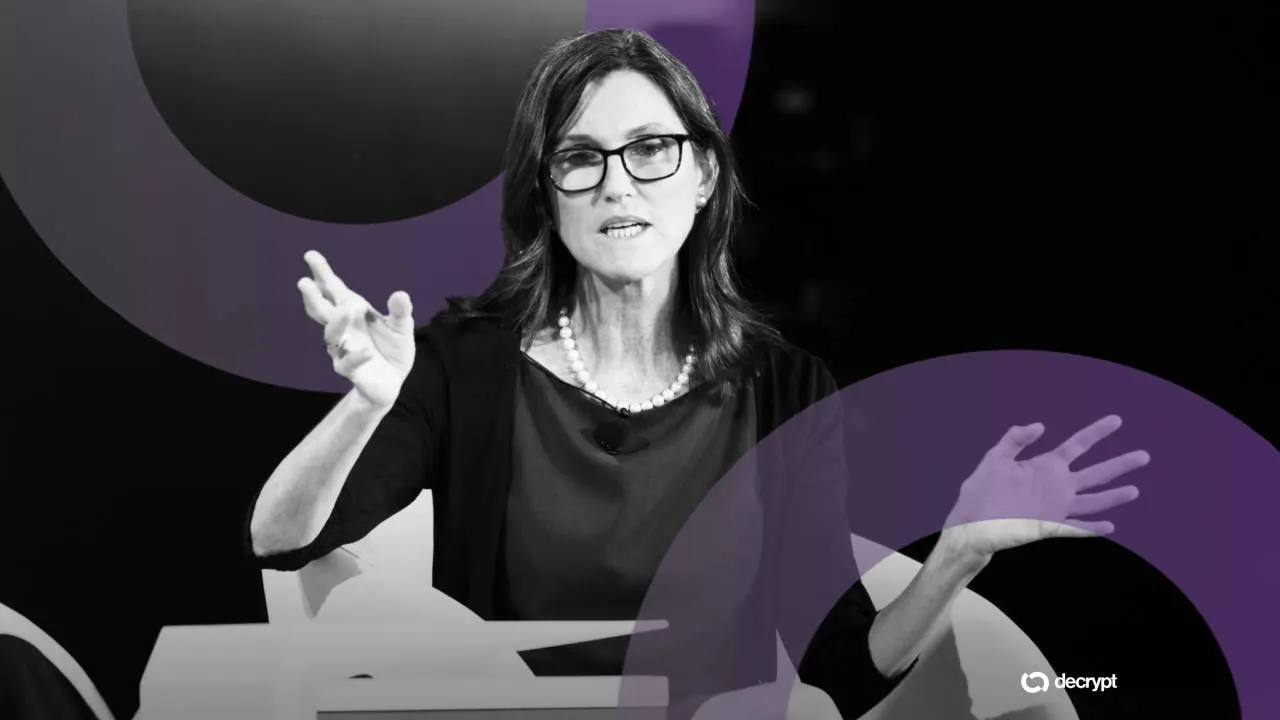
  • Cathie Wood’s Ark Invest Dumps Meta, Nvidia and Bitcoin ETF Shares in Major Tech Sell-Off

    Cathie Wood’s Ark Invest Dumps Meta, Nvidia and Bitcoin ETF Shares in Major Tech Sell-Off

    In brief

    • Ark Invest parted with nearly $41 million in META and $26 million in NVDA shares on Thursday.
    • Cathie Wood’s firm also dumped around $11 million worth of shares in its Bitcoin ETF.
    • The sales come amid a sustained market downturn as uncertainty in Iran shakes stocks and crypto.

    Ark Invest, the investment firm of notable tech investor Cathie Wood, shed millions of dollars’ worth of shares of major tech stocks on Thursday, significantly trimming positions in Nvidia and Meta while also diminishing its exposure to Bitcoin via its own Bitcoin ETF. 

    The firm’s Thursday activity saw it part with nearly $41 million worth of Meta (META) and more than $26 million in Nvidia (NVDA), both of which have fallen further since the opening bell on Friday, dropping 2.98% and 1.55%, respectively. 

    The prominent tech stocks have fared much worse over the last month, with META dropping more than 17% over that time to change hands around $531. The bulk of those losses—around 10%—have come in the last week as the social media platform lost a pair of social media addiction lawsuits that said it failed to protect young users. 

    Nvidia has held up better, but still dipped around 5% in the last month as uncertainty surrounds the conflict in Iran. The firm was also hit with a class action lawsuit over alleged crypto mining revenue gaps

    The actively managed ARK ETFs also saw considerable decreases in other popular tech stocks, like Google parent Alphabet (GOOG) and Advanced Micro Devices (AMD), which it sold around $2.5 million and $7.5 million worth of, respectively. The pair have not been spared in Friday trading, dropping 1% and 2.27% since trading began.

    Beyond the tech stocks, Ark Invest also divested from some crypto exposure on Thursday. The firm shed around $11 million worth of shares in its spot Bitcoin ETF (ARKB) and about $6.5 million in shares of crypto exchange Bullish. It also dumped nearly $5 million worth of Bitcoin proponent Jack Dorsey’s firm, Block (XYZ), which has a number of Bitcoin-centric products.

    Bitcoin, the leading cryptocurrency, has now fallen around 4.8% in the last 24 hours to change hands around $66,020, briefly touching its lowest price since March 2 below $66,000. Meanwhile, Bullish has fallen nearly 3.5% in the last 24 hours, and is now down nearly 44% in the last six months of trading as the entire crypto market slides. 

    Wood has been outspokenly optimistic about the future of Bitcoin, providing ambitious price forecasts—like $1.2 million per coin by 2030. But after Thursday’s sales, the firm only holds around $100 million in ARKB, enough to make it the 35th largest holding among actively managed ARK ETFs out of 96 total positions, according to data from Cathie’s Ark

    Earlier this year, Wood said that she was not concerned about a bubble in AI, instead pointing to precious metals and the run in gold as the real bubble. As of Friday, gold was down around 20% from its yearly high, recently changing hands around $4,483 per ounce.

    Daily Debrief Newsletter

    Start every day with the top news stories right now, plus original features, a podcast, videos and more.

  • Binance Australia Hit With $6.9M Fine After Investors Lose Millions on Derivatives

    Binance Australia Hit With $6.9M Fine After Investors Lose Millions on Derivatives

    In brief

    • A federal court ordered Binance Australia Derivatives to pay a $6.9 million USD penalty for allowing misclassified users to access high-risk products.
    • A total of 524 retail investors were incorrectly classified as wholesale clients between July 2022 and April 2023, resulting in about $6 million in trading losses
    • Binance admitted allowing clients unlimited attempts at a multiple-choice quiz to qualify as sophisticated investors.

    Australia’s Federal Court has ordered Oztures Trading Pty Ltd, trading as Binance Australia Derivatives, to pay an AUD $10 million (about $6.9 million USD) penalty after the exchange admitted to exposing 524 retail investors to high-risk crypto derivative products without required consumer protections.

    The misclassification occurred between July 2022 and April 2023, with Binance admitting to failures in client onboarding that allowed retail clients to make unlimited attempts at a multiple-choice quiz until they achieved a passing score to qualify as sophisticated investors, according to ASIC’s announcement.

    The misclassified client group incurred AUD $8.66 million (about $6 million) in trading losses and paid AUD $3.89 million ($2.67 million) in fees. Of the 524 misclassified clients, 460 were incorrectly classified as meeting the Sophisticated Investor Test, 33 as meeting the Individual Wealth Test, 26 as professional investors, 4 as Related Body Corporate, and 1 as meeting the Large Business Test.

    In one example, Binance assessed an individual as a professional investor based solely on their claim to be an “exempt public authority,” without adequate verification.

    “Binance failed to set up basic compliance checks and incorrectly approved hundreds of applications for complex, wholesale investor products,” ASIC Chair Joe Longo said, in a statement. “Binance’s shortcomings left more than 85% of their Australian customer base exposed to high-risk products they should have never been able to access, and without important consumer protections or rights, costing retail investors millions.”

    Justice Moshinsky also ordered Binance to contribute to ASIC’s costs, with the penalty coming on top of approximately AUD $13.1 million in compensation already paid to affected clients in 2023.

    “The issue was self-identified, reported to ASIC, and fully remediated in 2023, with approximately AUD 13 million compensated to affected users. Oztures ceased its derivatives business and voluntarily gave back its AFSL in 2023,” a Binance spokesperson told Decrypt. “Binance Australia is committed to offering users in Australia innovative, compliant, and trusted products, while helping advance the responsible growth of the country’s blockchain and digital asset ecosystem.”

    Editor’s note: This story was updated to include comment from Binance.

    Daily Debrief Newsletter

    Start every day with the top news stories right now, plus original features, a podcast, videos and more.

  • Bitcoin Dips Under $67K as Geopolitical Uncertainty, Treasury Yields Spook Traders

    Bitcoin Dips Under $67K as Geopolitical Uncertainty, Treasury Yields Spook Traders

    In brief

    • Bitcoin dropped under $67,000 as Middle East tensions and rising yields pressured risk assets.
    • Over $1.33 billion was liquidated this week, with heavy leveraged positions stacked between $70,000 to $75,000.
    • Experts expect choppy near-term action with potential relief rally contingent on easing macro pressures.

    Bitcoin and the broader crypto market continue to stack losses this week as March comes to a close, with experts anticipating rangebound price action and increased volatility in the near term.

    The leading crypto dropped to lows of $66,400 Friday, Bitcoin’s lowest level since March 9. It is currently trading at $66,633, down 3.9% in the past 24 hours and 5.6% on the week, according to CoinGecko data.

    Bitcoin’s drop this week is primarily driven by macroeconomic risk-off conditions resulting from the geopolitics, involving the Middle East war, Andri Fauzan Adziima, research lead at cryptocurrency exchange Bitrue, told Decrypt.

    The ripple effects of this war have raised oil prices, leading to fears of sticky inflation. Though Bitcoin continues to outperform gold and the U.S. stock market since the war began on February 28, it dropped over 6% from over $75,000 to below $70,000 as the U.S. Federal Reserve kept the interest rates steady last week.

    “Like all other macro assets, Bitcoin is trading to geopolitical headlines,” Thahbib Rahman, research analyst at crypto research platform Block Scholes, told Decrypt. “Trump’s uncertain tone yesterday around the likelihood of a ceasefire coincided with Bitcoin falling to $67,000.”

    In addition to geopolitical pressure, 10-year U.S. Treasury yields rose for four consecutive weeks in response to the confusing mixed messages around the U.S.-Iran war.

    The U.S. dollar index rose 0.57% this week to 100.148, continuing to weigh down on risk assets, including Bitcoin.

    Despite Bitcoin’s relatively tiny range, extending from $72,000 to $66,200, over $1.33 billion has been liquidated this week, CoinGlass data show. That reflects “heavy leveraged positions stacked above current levels, especially $70,000 to $72,000, and up to $73,000 to $75,000, with thinner liquidity on the downside, Adziima said.

    Users of Myriad, a prediction market owned by Decrypt’s parent company Dastan, turned bearish on Bitcoin’s outlook, putting a 56% chance on its next move taking it to $55,000, up 10% on the day.

    Experts continue to expect heightened volatility and a potential choppy price action in the near term, with a potential relief rally in the mid-term, contingent on easing macro and geopolitical pressures.

    “Thin weekend volume raises odds of a quick liquidity sweep lower toward $67,000 to $68,000 support first,” Adziima explained.

    From a macro perspective, Myriad users assign a 66% chance that oil’s next move could see it rally to $120, underscoring the uncertain geopolitical landscape.

    Daily Debrief Newsletter

    Start every day with the top news stories right now, plus original features, a podcast, videos and more.

  • Morning Minute: Fannie Mae Accepts Crypto for Mortgages

    Morning Minute: Fannie Mae Accepts Crypto for Mortgages

    Morning Minute is a daily newsletter written by Tyler Warner. The analysis and opinions expressed are his own and do not necessarily reflect those of Decrypt. And check out our new daily news show covering all of the top stories in 5 minutes or less, downloadable on Apple Pod or Spotify.

    GM!

    Today’s top news:

    • Crypto majors fall hard overnight on escalating war+oil concerns; BTC -4% at $66.6k
    • Fannie Mae to accept crypto collateral for mortgages w/ help from Coinbase
    • Mara sold $1.1B in Bitcoin as it pivots to AI, still holds $2.75B worth
    • Tether selects KPMG for its first official audit
    • Strategy CEO reveals that retail investors prefer STRC over MSTR

    🌎 Bitcoin Falls Ahead of Iran War “Final Blow”

    BTC fell below $67,000 overnight after Axios reported the Pentagon is actively preparing plans for a “final blow” in Iran, including ground forces and a massive bombing campaign.

    Trump posted on Truth Social that he’s extending the military pause to 10 days, citing ongoing diplomatic talks that are “going very well,” which led to a brief rebound in prices before the deeper selloff overnight.

    Now the week closes with three convergent events in a 24-hour window: a $15B options expiry on Deribit Friday morning at 8am UTC, PCE inflation data, and the expiration of Trump’s original diplomatic window.

    It’s going to be a rocky Friday.

    Key Details:

    • Bitcoin dipped to $67K Friday morning, with ETH sub-$2k; Oil +3% to $97
    • Trump posted on Truth Social extending the strike pause to 10 days, citing an Iranian government request and talks “going very well”
    • $15B in BTC options expire Friday at 8am UTC on Deribit, along with PCE data

    🏠 Fannie Mae Just Accepted Crypto as Mortgage Collateral

    The $12 trillion US residential mortgage market just formally recognized Bitcoin as a legitimate asset.

    Coinbase and Better Home & Finance launched the first Fannie Mae-conforming mortgage that lets borrowers pledge BTC or USDC as down payment collateral instead of selling.

    The primary mortgage is a standard conforming loan with all of Fannie Mae’s usual protections. Where crypto comes in is via a separate, overcollateralized loan that covers the down payment. And it has no margin calls and no forced selling on price drops.

    Here’s an example of how it works: On a $500,000 home requiring a $100,000 down payment, the buyer can pledge $250,000 in BTC to Coinbase Prime custody, receive a $100,000 loan against that collateral, use it as the down payment on a conventional $400,000 Fannie Mae mortgage. Note that the interest rates are 0.5% to 1% higher than standard.

    The Bitcoin stays intact (no sale, no taxable event) and is returned once the loan is repaid or refinanced.

    Liquidation triggers only on a 60-day payment delinquency, same as any mortgage.

    Key Details:

    • Coinbase and Better launched the first Fannie Mae-conforming crypto-backed mortgage; borrowers pledge BTC or USDC as collateral for a separate down payment loan without selling their assets
    • The structure: two loans: a standard Fannie Mae primary mortgage plus a separate overcollateralized crypto-backed loan to fund the down payment; Fannie buys the primary loan just like any conforming mortgage
    • No margin calls: if BTC drops, mortgage terms are unchanged; liquidation only triggers on 60-day payment delinquency, same as conventional mortgages
    • Rates run 0.5-1.5% higher than a standard 30-year; cold wallets excluded; collateral must be held on a US-regulated exchange (Coinbase)
    • Better CEO Vishal Garg estimates the company missed “$40 billion more of consumer demand over the past few years” without this product; 41% of American families lack the cash for a down payment despite holding other assets

    ⛏️ MARA Sold $1.1B in Bitcoin

    Bitcoin miner turned AI infrastructure player MARA sold 15,133 BTC between March 4 and March 25 for approximately $1.1B.

    The company used those proceeds to buy back roughly $1B of its own convertible notes at a 9% discount, capturing approximately $88 million in value in the process.

    The concerns here from Bitcoin enthusiasts are twofold:

    • Mara has another $2.75B in Bitcoin (38,689 BTC), still the second-largest public corporate Bitcoin holder behind Strategy’s 762,099 BTC.
    • Many other miners have also pivoted to AI data centers and infra strategies over the last year – and they may become sellers as well

    Key Details:

    • MARA sold 15,133 BTC between March 4 and March 25 for ~$1.1B; proceeds used to retire ~$1B in convertible notes
    • BTC holdings drop from 53,822 to ~38,689 BTC; MARA remains the second-largest public corporate holder behind Strategy
    • MARA stock jumped 10% in premarket Thursday

    🔒 Crypto Got Its Green Light, Privacy Developers Did Not

    Coin Center says crypto privacy tool developers are in a “very bad state” despite the most pro-crypto administration in US history.

    The DOJ continues to actively prosecute Tornado Cash developer Roman Storm and the Samourai Wallet developers as unlicensed money transmitters, despite the Trump administration dropping enforcement actions against exchanges and rolling back Biden-era crypto policy across the board.

    The House version of the Clarity Act included explicit developer protections that would have prevented exactly this. The Senate let them die.

    If the Clarity Act passes without those developer shields, the message to anyone building privacy infrastructure in the US is clear: proceed at your own risk.

    Key Details:

    • Coin Center says crypto privacy developers are in a “very bad state” despite the most pro-crypto administration in US history
    • DOJ continues prosecuting Tornado Cash developer Roman Storm and Samourai Wallet developers as unlicensed money transmitters — cases that predate Trump but have not been dropped
    • Coin Center’s argument: treating software publication as financial crime creates chilling uncertainty for US open-source development and drives builders offshore

    ₿ Retail Is Choosing STRC Over MSTR

    Strategy’s CEO revealed Thursday that retail investors own 80% of STRC versus 40% of MSTR common stock.

    At a $5B market cap, that’s $4 billion of retail capital in the 11.5% annual dividend product engineered to trade near its $100 par value. Strategy has raised $1.5B via STRC just this month.

    The product is available on Robinhood, Kraken, and Webull, common platforms for retail investors. Benchmark-StoneX analyst Mark Palmer said this makes sense from a risk-adjusted lens because Institutions tend to prefer MSTR’s liquidity and asymmetric upside, while retail investors are accustomed to thinking about yield.

    STRC fits that mental model. And notably, the product is starting to show up on other Bitcoin treasury firms’ balance sheets as a reserve asset – so it’s not just a consumer product.

    Key Details:

      • Strategy CEO revealed 80% of STRC is owned by retail vs. 40% of MSTR; at $5B market cap, retail holds ~$4B in the dividend product
      • MSTR is down 56% over the past six months to $134; STRC holds near $100 par and pays 11.5% annually (~$0.9583/share monthly)
      • Strategy has raised $1.5B+ via STRC this month alone – its fastest issuance pace since the product’s $2.5B public debut last July

    🌎 Macro Crypto and Markets

    • Crypto majors are red again as war, energy concerns escalate; BTC -4% at $66.6k; ETH -4% at $1,990; SOL -5% at $83; HYPE -2% at $38.40
    • M (+4%), STABLE (+4%) and CC (+4%) led top movers
    • Oil +3% at $97; Gold -1% at $4,410
    • David Sacks stepped down as White House AI and crypto czar after hitting the 130-day limit for special government employees; he will stay involved as co-chair of the Science Council alongside Zuckerberg, Huang, and Andreessen
    • Tether named KPMG as the auditor for its first-ever full independent audit of USDT’s $184B in reserves; the company also engaged PwC to prep its internal systems for the processOKX said it won’t rush a US IPO, with CMO Haider Rafique telling the Digital Asset Summit “we will go public when we have confidence that we can give back shareholder value”

    Corporate Treasuries & ETFs

    Meme Coin Tracker

    • Meme majors were mostly red; DOGE -2%, SHIB -3%, PEPE -4%, TRUMP -4%, PENGU -5%, SPX -4%, FARTCOIN -3%
    • Either (+72%), Hachi (+50%) and Wojak (+20%) led top movers

    💰 Token, Airdrop & Protocol Tracker

    • X Money hired Benji Taylor as its new crypto-savvy design lead, former CPO at Aave Labs and design head at Coinbase’s Base
    • Ripple is rolling out AI-assisted red team security testing across the XRP Ledger

    🚚 What is happening in NFTs?

    • NFT leaders were mostly red; Punks -1% at 29 ETH, Pudgy -1% at 4.1 ETH, BAYC even at 5.25 ETH; Hypurr’s even at 409 HYPE
    • Pixel Pups (+35%) led notable movers

    Daily Debrief Newsletter

    Start every day with the top news stories right now, plus original features, a podcast, videos and more.

  • First Sora, Now Sexy Chat? OpenAI Cancels Erotic ChatGPT Mode

    First Sora, Now Sexy Chat? OpenAI Cancels Erotic ChatGPT Mode

    In brief

    • OpenAI has reportedly halted plans to release an adult mode in ChatGPT.
    • The move follows earlier promises to allow verified adults access to more content features.
    • The reported move comes the same week that OpenAI canceled its Sora text-to-video generator.

    OpenAI has shelved plans to launch its previously announced erotic chatbot, according to a report, apparently backing away from a controversial expansion of ChatGPT that would have allowed adult users to generate sexual content.

    The reversal, first reported by the Financial Times on Thursday, follows internal concerns about the societal impact of sexualized artificial intelligence. In January, members of OpenAI’s Expert Council on Well-Being and AI reportedly warned that erotic chat features could foster unhealthy emotional dependency among users, and risk turning the chatbot into what one member described as a “sexy suicide coach.”

    OpenAI declined Decrypt’s request to comment on the status of the erotic mode, and the firm has yet to post about its fate.

    The decision to cancel what was reportedly to be called “Citron mode” comes two days after OpenAI canceled its Sora text-to-video model, as the company moves to focus development on a unified AI platform rather than a collection of specialized tools.

    The move marks a departure from the direction outlined by CEO Sam Altman as recently as October. At the time, Altman said OpenAI planned to allow verified adults to access romantic and erotic content once a robust age-verification system was in place.

    Altman described the idea as part of a broader effort to treat adult users with greater autonomy while maintaining safeguards for minors. By December, however, the timeline was pushed to 2026 as the company continued to refine its age-estimation technology.

    While OpenAI may be getting out of the adult chatbot business before it ever really got into it, AI models do not necessarily need an “erotic mode” for users to form connections with them.

    When OpenAI deprecated GPT-4o last summer, users flooded social media with calls to restore the model after saying they had formed personal and emotional relationships with the chatbot, reflecting a broader debate around erotic chatbots and how people interact with AI.

    In June, research published by researchers at Waseda University in Tokyo said 75% of participants reported turning to AI systems for emotional advice.

    At the same time, AI developers are facing growing scrutiny as lawsuits test whether conversational AI systems are responsible for reinforcing delusional beliefs or harmful behavior among vulnerable users.

    Daily Debrief Newsletter

    Start every day with the top news stories right now, plus original features, a podcast, videos and more.

  • Trump Policy Has Crypto Privacy Developers in a ‘Very Bad State’, Says Coin Center

    Trump Policy Has Crypto Privacy Developers in a ‘Very Bad State’, Says Coin Center

    For over a year now, the White House has made strong efforts to court the crypto industry, rolling out permissive regulations that have turbocharged the sector’s integration with the U.S. economy.  

    But there’s one issue that still keeps some crypto industry leaders up at night, despite the Donald Trump administration’s many promises on the subject: protections for software developers. 

    Last year, the Trump Justice Department made multiple commitments to stop prosecuting the developers of crypto privacy software—the types of tools used to keep crypto transactions anonymous. And yet, months later, federal prosecutors sent two Bitcoin developers to prison for creating such software—and took another Ethereum developer to trial for creating similar tools. 

    The Ethereum developer, Roman Storm, was convicted on one charge and acquitted on two others. But earlier this month, the Trump DOJ filed to try him on those two charges again. 

    Those developments had crypto privacy advocates in a grim enough mood. But on Wednesday, a federal judge in Texas handed down a decision that some feel could bode even more poorly. The judge dismissed a lawsuit against the DOJ brought by a software developer, Michael Lewellen, who said he feared being prosecuted by the U.S. government for creating his own privacy tool. The judge ruled that because the Trump DOJ has said it doesn’t plan to prosecute crypto developers, the man had no standing to claim “a credible threat of prosecution.”

    The ruling has Peter Van Valkenburgh, executive director of the crypto advocacy group Coin Center, very worried. By making statements in support of software developers, but still going after some of them anyway, the Trump DOJ appears to have now stuck policy leaders like him between a rock and a hard place.

    “They can effectively go after developers when they want to go after them, and then claim to be pro-developer when they want to claim to be pro-developer,” Van Valkenburgh, who leads Washington’s longest running crypto policy think tank, told Decrypt. Coin Center was financially supporting Lewellen’s lawsuit.

    In yesterday’s ruling, Judge Reed O’Connor determined that the “core conduct” of the crypto developers thus far prosecuted by the Trump DOJ was money laundering—whereas, in yesterday’s case, plaintiff Michael Lewellen asserted he planned to run a proper, upstanding business. Because Lewellen had no intention to launder money, he should not fear an impending prosecution, O’Connor decided. 

    That particular conclusion particularly irked Van Valkenburgh, who maintains crypto developers—including those targeted by the Trump DOJ—should not be responsible for policing who ends up using their software. 

    “Michael wants to build good tools that can be used for privacy,” he said. “It is very plausible that those tools will be used for money laundering, and that then somebody will come and prosecute him.”

    Prosecutions against the developers of crypto privacy tools didn’t start under Trump. They trace back to the Joe Biden administration, which was roundly criticized by industry leaders for numerous crypto-skeptical policies. But while the current White House has taken a far friendlier tack towards digital assets, and even—theoretically—software developers, Van Valkenburgh worries the DOJ’s apparent lack of consistency on the issue might have put his priorities in a worse spot. 

    “Short term, pragmatically, maybe developers are a little safer now,” he said. “But that very same deprioritization is now making it harder for someone like Michael Llewellyn to get binding legal clarity.”

    “That’s a very bad state of the world right now,” Van Valkenburgh said.

    Daily Debrief Newsletter

    Start every day with the top news stories right now, plus original features, a podcast, videos and more.

  • Venture Firm Founder Offers Bounty to Help Recover $42 Million in Stolen Bitcoin, Crypto

    Venture Firm Founder Offers Bounty to Help Recover $42 Million in Stolen Bitcoin, Crypto

    In brief

    • Bo Shen, founder of Fenbushi Capital, is offering a 10-20% bounty to those who can help him recover a portion of $42 million that was stolen from him in 2022.
    • The theft was allegedly due to a compromised seed phrase, leading to the loss of around $38 million in stablecoins in addition to Bitcoin and Ethereum.
    • The venture founder believes new on-chain tooling and AI can help crack the case.

    Bo Shen, the founder of crypto venture firm Fenbushi, is offering a bounty of 10-20% to any individuals able to help him recover a portion of the $42 million in Bitcoin, Ethereum, and stablecoins stolen from his personal wallet in 2022. 

    The malicious actor made off with crypto assets now valued around $42 million, highlighted by $38 million in Circle’s dollar-backed stablecoin USDC, but also 1,607 Ethereum, nearly $720,000 in Tether’s stablecoin USDT, and 4.13 Bitcoin. 

    “Three years have passed. The investigation has never stopped,” said Shen in a post on X. “Our team has continued to gather critical evidence and leads. The flow of the stolen assets is becoming increasingly clear,” he added while making a public bounty offer. 

    “Any individual or organization that makes a substantive contribution to asset recovery—regardless of identity, background, or method—will receive 10%–20% of the total recovered amount, based on the level of contribution,” he added.

    About $1.2 million of the funds have been frozen to date thanks to help from notable on-chain analyst Taylor Monahan and pseudonymous sleuth ZachXBT. 

    Now, though, Shen thinks the advances in on-chain tooling and artificial intelligence (AI) can help do even more in the case. 

    “This is not just about recovering assets,” he said. “It is about opening a real case to the community, inviting collaboration, and seeing how far the tools of the AI era can push what was once impossible.” 

    The theft from Shen’s personal wallet took place in November 2022, allegedly as a result of a compromise of his seed phrase, the 12 or 24 word phrase that unlocks a wallet’s private key,  according to analysis by blockchain security firm SlowMist.

    Shortly after the theft, it was reported to local law enforcement, according to Shen, with the FBI and lawyers also involved. 

    Established in 2015, Shen’s Fenbushi Capital says it has more than $1.6 billion in assets under management. Its portfolio includes major crypto firms like exchange Bybit and stablecoin issuer Circle, alongside holdings of Ethereum and Zcash

    Daily Debrief Newsletter

    Start every day with the top news stories right now, plus original features, a podcast, videos and more.