
Tag: Business – Decrypt

  • Senator Questions SEC Over Treatment of Trump-Linked Crypto Businesses

    Senator Questions SEC Over Treatment of Trump-Linked Crypto Businesses

    In brief

    • Senator Richard Blumenthal asked the SEC whether allies of President Donald Trump in crypto received favorable treatment.
    • His inquiry focuses on the SEC’s dismissal of fraud charges against Tron founder Justin Sun.
    • The letter comes as the SEC has closed or dropped multiple crypto cases and Trump has issued pardons to industry figures.

    Senator Richard Blumenthal (D-CT) is pressing the U.S. Securities and Exchange Commission for answers about whether individuals and companies tied to President Donald Trump’s cryptocurrency ventures received preferential treatment from regulators.

    In a letter to SEC Chairman Paul Atkins on Monday, Blumenthal requested records and communications related to enforcement decisions involving cryptocurrency firms, including companies linked to Tron founder Justin Sun, after the agency dismissed fraud charges against Sun and several of his companies earlier this month in a settlement that included a $10 million civil penalty.

    Bluenthal’s letter also questioned the departure of Margaret Ryan, who had served only six months as director of the SEC’s Division of Enforcement before leaving the agency.

    “Ms. Ryan’s abrupt departure from the agency raises questions in light of her short tenure and reports that senior leadership intervened to prohibit the Division of Enforcement from pursuing cases against certain cryptocurrency companies,” Blumenthal wrote. “Indeed, on March 5, 2026, approximately 11 days before Ms. Ryan stepped down from her position, the SEC dismissed fraud charges against Mr. Sun and several of his companies after he agreed to pay a $10 million fine.”

    In March 2023, the SEC charged Sun and his companies with securities violations. Charges were also filed against several influencers, Jake Paul, Lindsay Lohan, Aliaune “Akon” Thiam, and adult film star Michelle “Kendra Lust” Mason, for not disclosing they were paid to promote Tron-related cryptocurrency tokens.

    “Facing federal prosecution, Mr. Sun began to buy into President Trump’s cryptocurrency ventures, first by purchasing millions of dollars worth of the President’s memecoin, $TRUMP, which made Sun its largest holder and entitled him to a private dinner with the President,” Blumenthal wrote. “Mr. Sun and his firms then went on to become an early investor in the Trump family’s larger cryptocurrency venture, World Liberty Financial (WLFI), providing tens of millions in support to WLFI’s governance token and its stablecoin, USD1.”

    Blumenthal’s letter comes after the SEC ended multiple high-profile cases originally brought during the Joe Biden administration. The agency closed its lawsuit against Coinbase in February 2025, moved to dismiss its case against Binance and founder Changpeng “CZ” Zhao in May 2025, and ended appeals in its long-running dispute with Ripple over XRP in August 2025. At the same time, Trump has granted clemency to several prominent figures in the cryptocurrency industry, including CZ and BitMEX founder Arthur Hayes.

    Blumenthal asked the SEC to provide the requested records to the Senate Permanent Subcommittee on Investigations by April 13, and to include any documents related to Zhao’s case as well. The senator is also seeking records of contacts between the chairman’s office and members of the Trump or Witkoff families regarding cryptocurrency businesses.

    Blumenthal’s request adds further criticism from Democratic lawmakers over the SEC’s approach to crypto enforcement since Trump returned to office.

    In January, House Democrats, including Representatives Maxine Waters, Brad Sherman, and Sean Casten, warned that the agency’s retreat from enforcement actions raised concerns about political influence over regulatory decisions. This was followed in February, when Democratic lawmakers criticized Atkins for easing enforcement against Binance and Justin Sun, accusing the SEC of enabling reputational damage and undermining market integrity.

    “People are losing trust,” Rep. Stephen Lynch (D-MA) told Atkins during a hearing before the House Financial Services Committee. “This is not good for crypto, it’s certainly not good for consumers. The reputational damage the SEC is suffering right now.”

    The office of Senator Blumenthal did not immediately respond to Decrypt‘s request for comment.

    Daily Debrief Newsletter

    Start every day with the top news stories right now, plus original features, a podcast, videos and more.


  • Senators Reveal ‘Mined in America’ Bill to Boost Bitcoin Mining, Support Trump’s Reserve

    Senators Reveal ‘Mined in America’ Bill to Boost Bitcoin Mining, Support Trump’s Reserve

    In brief

    • U.S. Sens. Bill Cassidy (R-LA) and Cynthia Lummis (R-WY) introduced legislation on Monday to support Bitcoin miners.
    • The U.S. Commerce Department would be able to certify that entities are “Mined in America,” giving them access to government support.
    • The initiative is aimed at bolstering demand from manufacturing jobs, while stemming the industry’s exposure to companies linked to foreign adversaries.

    U.S. Sens. Bill Cassidy (R-LA) and Cynthia Lummis (R-WY) introduced legislation on Monday to support Bitcoin miners, arguing that the industry needs government help to prevent foreign adversaries from gaining outsized influence over the digital asset’s network.

    The Mined in America Act is aimed at empowering the government to support Bitcoin miners through federal programs, while also enshrining U.S. President Donald Trump’s executive order to establish a Strategic Bitcoin Reserve into law, according to a press release.

    “The Mined in America Act brings this industry home through forward-thinking initiatives to secure our financial future,” Lummis said in a statement. “President Trump pledged to make the United States the digital asset capital of the world—and we’re not backing down.”

    The legislation would create a voluntary certification program where mining entities facilities can become certified as “Mined in America” under the Commerce Department. As part of that certification, those entities commit to phasing out “mining equipment manufactured by companies tied to foreign adversaries” like Russia and China.

    Projects certified as “Mined in America” gain the ability to tap existing federal energy and rural programs amid the shift, the press release states. What’s more, the government would be committed to helping U.S. manufacturers develop crypto mining equipment onshore.

    The Mined in America Act was crafted with support of the Satoshi Action Fund, and in a statement, CEO and co-founder Dennis Porter described the industry’s reliance on hardware from China as a “liability.” Those machines total 97% of Bitcoin’s so-called hash rate, he said.

    In some ways, the legislation mirrors the Chips and Science Act. Enacted in 2022, the legislation set aside federal funding for domestic chip-manufacturing. At the time, supply chains snarled by the global pandemic raised questions about the country’s exposure to regions like Taiwan, where the world’s most advanced chips are fabricated.

    The bill lands as Bitcoin miners increasingly pivot toward artificial intelligence, with profitability pressured by the digital asset’s latest fall from all-time highs. Cassidy signaled that Bitcoin mining has the potential to buoy blue-collar job creation, at a time when data center buildouts are accelerating as a result of the AI boom.

    “Digital asset mining is a big part of our economy. We should be doing it here in America,” he said. “This bill will secure supply chains, back U.S. manufacturing, and support this industry.”

    Trump’s promise to create a Strategic Bitcoin Reserve was among his biggest overtures to digital asset investors on the campaign trail. However, the U.S. government has yet to unveil an allocation that’s only allowed to stem from budget-neutral strategies.

    In October, Lummis advocated for $14.4 billion in Bitcoin seized from the alleged head of a global crypto scam network to be diverted to the reserve. At the time, the seizure represented the DOJ’s largest haul in the cryptosphere.

    Not long before, Eric and Donald Trump Jr. unveiled a Bitcoin mining venture dubbed American Bitcoin. Earlier this month, the company indicated in an SEC filing that its fleet “primarily comprises Bitmain S21 series and MicroBt M5X and M6X series machines.”

    Those machines are primarily manufactured in China.

    Daily Debrief Newsletter

    Start every day with the top news stories right now, plus original features, a podcast, videos and more.
  • Microsoft Made GPT and Claude Work Together—And the Result Beats Every AI Research Tool Out There

    Microsoft Made GPT and Claude Work Together—And the Result Beats Every AI Research Tool Out There

    In brief

    • Microsoft released two different modes that pair GPT and Claude to increase the quality of AI research.
    • Critique makes the models collaborate, whereas Council makes them work in parallel while a third judge finds the discrepancies.
    • This two-model workflow fixes hallucinations, weak citations, and other problems associated with mono-model AI research.

    Deep research AI has been one of the hottest arms races in tech this year. Google announced its research agent for Gemini in December 2024, OpenAI released its own research agent in February 2025, xAI followed suit, Perplexity doubled down, and Anthropic’s Claude built a loyal following among professionals who need detailed, cited answers, introducing its agent in April of last year.

    Every company has been trying to convince you that their single AI model is the smartest researcher in the room. Microsoft just said: Why pick one?

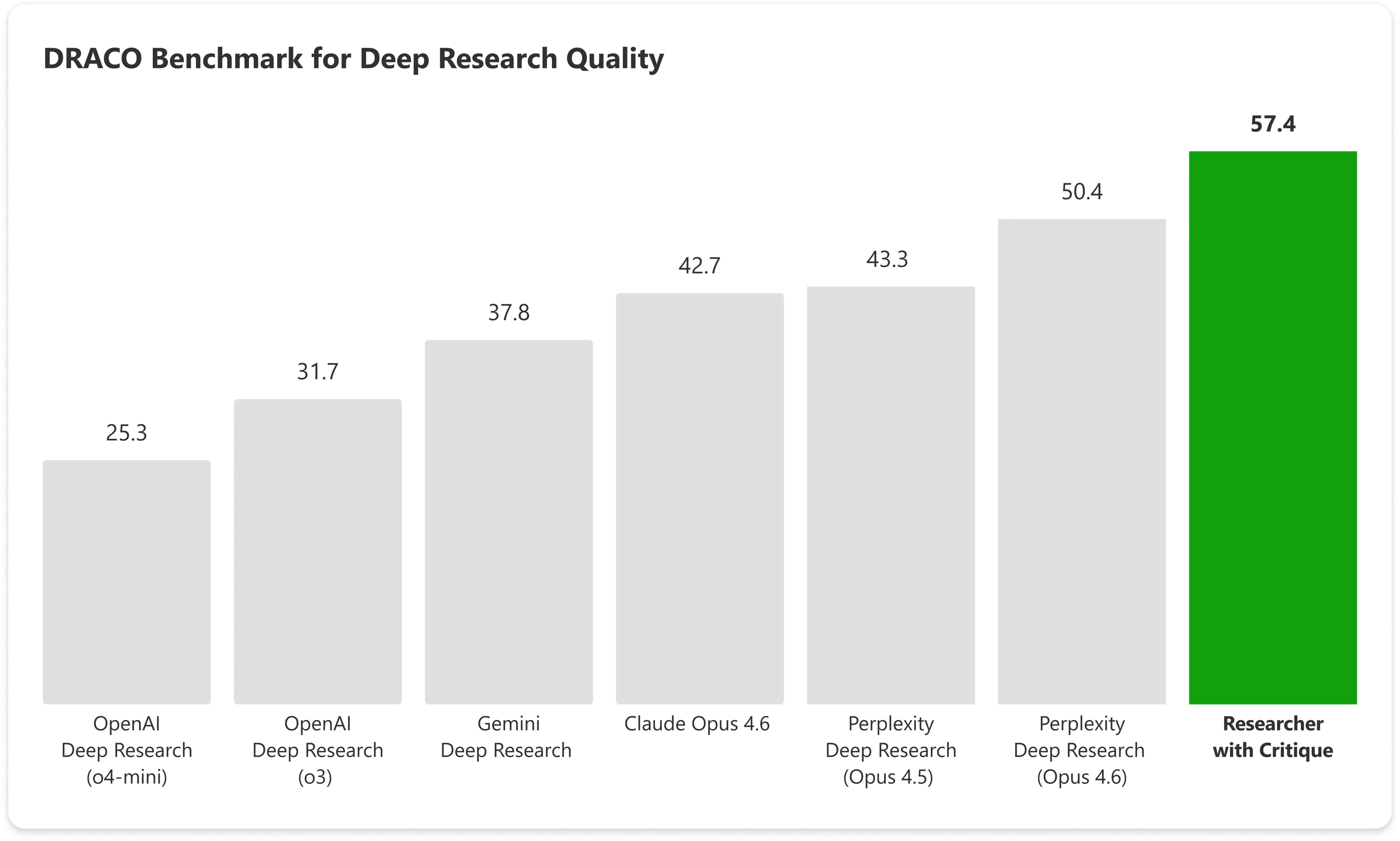
    The company announced two new features on Monday for Copilot’s Researcher tool—called Critique and Council—that put OpenAI’s GPT and Anthropic’s Claude to work on the same research task in sequence. The result, according to Microsoft’s testing against an industry benchmark, scores higher than every system included in that test, including models from the top AI companies.

    “Critique is a new multi model deep research system designed for complex research tasks. It separates generation from evaluation and utilizes a combination of models from Frontier labs, including Anthropic and OpenAI,” Microsoft explains. “One model leads the generation phase, planning the task, iterating through retrieval, and producing an initial draft, while a second model focuses on review and refinement, acting as an expert reviewer before the final report is produced.”

    Here’s the basic problem Critique is designed to fix: Every AI research tool today works the same way. You ask a question, one model plans a search, scours sources, writes a report, and hands it back to you. That single model is doing everything with no one checking its work.

    This can end up with some hallucinations slipping in, some errors in citations, fake or inaccurate claims, etc.

    Critique breaks that workflow in two. GPT handles the first phase—it plans the research, pulls sources, and writes an initial draft. Then Claude steps in as a strict editor, reviewing the report for factual accuracy, citation quality, and whether the answer actually addressed what was asked. Only after that review does the final report reach the user. Microsoft says the roles can eventually run in the opposite direction too, with Claude drafting and GPT critiquing, though for now GPT goes first.

    On the DRACO benchmark—a standardized test covering 100 complex research tasks across 10 domains including medicine, law, and technology—Copilot with Critique scored 57.4. points with Anthropic’s Claude Opus 4.6 by itself hitting 42.7. Microsoft’s combined system beats the next best result by nearly 14%.

    Image: Microsoft

    The biggest gains showed up in breadth of analysis and presentation quality, with factual accuracy also posting a significant improvement.

    The second feature, Council, takes a different approach to the same problem. Instead of having one model review the other’s work, Council runs GPT and Claude simultaneously and puts their full reports side by side. A third “judge” model then reads both and writes a summary explaining where the two AIs agreed, where they diverged, and what unique angles each one caught that the other missed. Comparing AI research tools manually has been something users have had to do themselves until now.

    In Critique, the models essentially collaborate with each other while in Council the models compete against each other.

    Critique is the default experience in Researcher whereas Council requires you to select “Model Council” from the picker to activate the side-by-side mode. Both features are currently available to users enrolled in Microsoft’s Frontier program, the early-access channel for Copilot’s newest capabilities. A Microsoft 365 Copilot license ($30/user/month) is required, but users also need to be enrolled in Frontier to access them.

    Image: Microsoft

    OpenAI and Microsoft have a multibillion-dollar partnership, but Microsoft’s bet is that no single model stays on top for long, and that the real value is in the orchestration layer that routes tasks to whichever combination works best.

    Daily Debrief Newsletter

    Start every day with the top news stories right now, plus original features, a podcast, videos and more.

  • Chainlink Labs, Anchorage Digital Back New Crypto Super PAC Ahead of Midterms

    Chainlink Labs, Anchorage Digital Back New Crypto Super PAC Ahead of Midterms

    In brief

    • The Blockchain Leadership Fund launched Monday with Anchorage Digital and Chainlink Labs as founding contributors.
    • BLF is structured as a hybrid PAC, allowing both direct candidate contributions and independent expenditures.
    • The new PAC enters a field already dominated by Fairshake, which has amassed $116 million for the 2026 midterms.

    The Blockchain Leadership Fund, a new political action committee focused on digital asset policy, launched Monday.

    The new PAC adds another player to a crypto lobbying landscape already flush with cash heading into the 2026 midterms.

    The Blockchain Leadership Fund, a hybrid PAC formed by members of The Digital Chamber, announced its launch in a press release, with Anchorage Digital and Chainlink Labs as founding contributors. Structured as a hybrid PAC, BLF can make both direct candidate contributions and independent expenditures—and says it will engage across federal, state, and local races.

    “Crypto policy is being written right now and the companies that show up and engage will help define the rules of the road; the ones that don’t will inherit them,” an Anchorage Digital spokesperson said in the release.

    The launch comes as the crypto industry’s political infrastructure has grown dramatically since Fairshake, the sector’s dominant super PAC, registered with the FEC in March 2023.

    Backed primarily by Coinbase, Andreessen Horowitz, and Ripple, Fairshake raised nearly $300 million during the 2024 election cycle and backed winning candidates in at least 90% of the congressional races where it spent $1 million or more.

    By January 2025, the PAC had already amassed $116 million for the 2026 midterm election cycle. As of last month, crypto industry political action groups had already spent some $288 million on the midterms, according to independent journalist Molly White.

    BLF’s connection to The Digital Chamber is notable. The group has been lobbying for stablecoin rewards, and in 2024 was vocal in urging Democratic presidential nominee Kamala Harris to pick a crypto-friendly running mate.

    “The viewpoint is now: ‘Your position on crypto matters not just until November 5. Your position matters long-term,” Cody Carbone, then the lobbying group’s president (now CEO), told Decrypt in November 2024. He added that by signaling its staying power into 2026, he thought Fairshake was trying to dispel the notion that crypto’s political moment had already passed.

    It remains to be seen whether the Blockchain Leadership Fund will operate as a complement to Fairshake or carve out its own lane. The BLF didn’t immediately respond to a request for comment from Decrypt on the matter.

    Daily Debrief Newsletter

    Start every day with the top news stories right now, plus original features, a podcast, videos and more.
  • Bitcoin Flashes ‘Warning Sign’ With Nearly Half of BTC Supply Sitting at a Loss: Report

    Bitcoin Flashes ‘Warning Sign’ With Nearly Half of BTC Supply Sitting at a Loss: Report

    In brief

    • About 47% of Bitcoin is sitting at a loss, according to data gathered from CEX.io Research.
    • The mark includes more than 30% of the Bitcoin held by long-term holders, the highest mark since 2023.
    • Bitcoin is roughly even on the day, but has fallen more than 47% from its all-time high.

    Holders of around 9.4 million Bitcoin, or approximately 47% of the total circulating supply, are sitting on unrealized or paper losses, according to a new report from CEX.io Research

    That includes more than 30% of the Bitcoin held by long-term holders, or $304 billion worth of the largest crypto asset, which is now underwater—the highest share since 2023, according to the report. 

    “Long-term holders are now selling at their deepest losses in three years, and the speed of the reversal indicates a sharp deterioration in confidence,” the report reads.

    “The broader context makes this more concerning,” analysts added. “Bitcoin’s price has been drifting slightly higher over recent weeks, but the share of long-term holders sitting in profit has been quietly shrinking at the same time.” 

    Bitcoin is roughly flat in the last 24 hours, recently changing hands around $66,567, but it has fallen around 6% in the last week of trading as the potential for escalation in the conflict in Iran has grown. 

    The shift in conditions has led Bitcoin to a shaky place, according to CEX.io. The firm’s Bitcoin Impact Index, which measures Bitcoin holders and their stress levels as it relates to selling, has flashed to “high impact.” In other words, there is significant stress across Bitcoin holders and institutional capital. 

    “This kind of divergence between price action and on-chain conviction has historically been a warning sign,” the report says. “For instance, similar moves occurred in mid-2018 and mid-2022 before price drops by over 25%.”

    Another 25% drop would push Bitcoin below $50,000 for the first time since February 2024. As of this writing, Bitcoin is currently about 47% off its all-time high of $126,080 set in October.

    The CEX.io research suggests that the new setup resembles the period of late January, which preceded the steep drop in Bitcoin prices from the mid-$90,000s to low $60,000s in early February. 

    “The difference this time is that holders are not yet rushing Bitcoin to exchanges to sell. That kept February’s worst moments from becoming even worse, and it is doing the same now,” it said, adding that if it continues to hold, prices could stabilize rather than fall further. 

    The cautious analysis is similar to that recently shared by VanEck, which indicated an “unusually strong demand” for downside protection on Bitcoin. Earlier this year, CryptoQuant suggested that BTC’s real bear market bottom price would be closer to $55,000, while Standard Chartered said it would hit $50,000 before rebounding towards $100,000.

    Daily Debrief Newsletter

    Start every day with the top news stories right now, plus original features, a podcast, videos and more.

  • Jack Dorsey’s Square Automatically Enables Bitcoin Payments for Millions of Sellers

    Jack Dorsey’s Square Automatically Enables Bitcoin Payments for Millions of Sellers

    In brief

    • Square has automatically enabled Bitcoin payments as the default setting for eligible U.S. sellers.
    • The shift affects 4 million merchants who can now accept Bitcoin with zero fees.
    • Sellers receive USD by default through background conversion, though they can opt out or adjust settings.

    Block’s Square payments platform has begun automatically enabling Bitcoin payments for eligible U.S. sellers, shifting from an opt-in to an opt-out model in a move that could significantly expand mainstream Bitcoin payment adoption.

    The change, which co-founder and CEO Jack Dorsey—an outspoken Bitcoin maximalist—confirmed began rolling out on Monday, affects an estimated 4 million merchants.

    “Starting today, eligible U.S. Square sellers will begin having Bitcoin payments automatically enabled. Sellers who accept Bitcoin will receive USD as default,” said Miles Suter, Block’s Bitcoin product lead. He added that the ability will roll out to all sellers in the coming month.

    Under the new system, merchants who accept Bitcoin payments will receive USD as their default settlement currency, with the conversion handled automatically in the background. The feature comes with zero fees for accepting Bitcoin payments.

    Merchants retain control over the feature and can opt out or adjust settings if they prefer not to accept Bitcoin payments. The automatic enablement represents a strategic shift in how payment processors approach cryptocurrency integration, moving from requiring merchants to actively choose Bitcoin acceptance to making it a default option.

    Block first launched the Bitcoin payments feature for all sellers last November, after testing and then gradually rolling out the functionality. Previously, Square users would have to optionally enable the feature, ahead of the shift announced Monday.

    Dorsey has led Block towards a number of Bitcoin initiatives beyond Square payments terminals, including buying and selling BTC in Cash App, launching a Bitcoin hardware wallet, and developing a modular Bitcoin mining system. Despite Dorsey’s own personal Bitcoin fandom, Cash App is enabling stablecoin support—though he’s grumbled about the move.

    Block recently laid off over 4,000 people—representing about 40% of its staff—in a move to maximize efficiency and further embrace AI tools. Block’s stock (XYZ) is up more than 1% on the day to $56.76, as of this writing, down about 11% over the last month.

    Daily Debrief Newsletter

    Start every day with the top news stories right now, plus original features, a podcast, videos and more.

  • Ethereum Foundation Stakes More ETH, Boosting Total to $50 Million

    Ethereum Foundation Stakes More ETH, Boosting Total to $50 Million

    In brief

    • The Ethereum Foundation staked more than $46 million worth of ETH on Monday.
    • The move is the organization’s second staking action, with nearly $50 million staked in total.
    • The initiative is part of its new treasury plan designed to “enhance financial sustainability.”

    The Ethereum Foundation staked another 22,517 ETH, or $46.2 million worth, as part of its previously announced staking initiative, according to on-chain data curated by blockchain analytics firm Arkham Intelligence. 

    The latest batch was staked in 11 distinct transactions, with 2,047 ETH or around $4.2 million worth staked each time. In total, the firm has now staked 24,623 ETH, valued around $50 million, since it began proactively implementing staking as part of a revamped treasury strategy unveiled last June

    As part of that newly established strategy, the organization promised to more frequently utilize staking and DeFi protocols to “enhance financial sustainability and to support a key application category that is delivering on the promise of permissionless secure access to base civilizational infrastructure.” 

    Staking refers to the act of locking up tokens to help validate Ethereum’s proof-of-stake network, and provides back ETH token rewards in the form of yield to those who do so. Approximately $78 billion worth of ETH is currently staked in the network.

    The Ethereum Foundation intends to ultimately stake around 70,000 ETH, or $142 million worth of the second largest crypto asset, with all the rewards flowing back to the Foundation. Based on data from Arkham, the Foundation holds around 147,000 ETH at present time, with a portfolio valued at more than $364 million in total. 

    The organization’s on-chain activity comes amid its funding of the Ethereum Economic Zone (EEZ), a new framework designed to better align infrastructure and stakeholders within the Ethereum ecosystem. 

    Proposed by Gnosis and Zisk, the “economic zone” aims to address barriers and limitations currently present for Ethereum’s layer-2 scaling networks. For example, under the EEZ framework, layer-2s can operate in shared environments, avoiding duplicative work while removing some of the isolation that layer-2 networks may have from Ethereum mainnet. 

    The EEZ’s introduction comes shortly after Ethereum co-founder Vitalik Buterin pressed the importance of a “new path” for the layer-2 network roadmap, asking for scaling networks to act less like “extensions” of Ethereum mainnet. 

    Buterin has not yet publicly commented on the Ethereum Economic Zone, but he did re-post the introductory announcement from the EEZ on X—a potential sign of endorsement. 

    A representative for the Ethereum Foundation did not immediately respond to Decrypt’s request for comment.

    Daily Debrief Newsletter

    Start every day with the top news stories right now, plus original features, a podcast, videos and more.

  • Bluesky Users Revolt Against AI Tool Attie, Blocking It More Than ICE and White House Accounts

    Bluesky Users Revolt Against AI Tool Attie, Blocking It More Than ICE and White House Accounts

    In brief

    • Bluesky’s new AI feed-building app, Attie, has already been blocked more than 125,000 times since launch.
    • The total places the account ahead of ICE and the White House, second only to Vice President JD Vance in total user blocks.
    • Users responding to the announcement raised concerns about automation, AI training, and the platform’s direction.

    A new AI tool launched on Bluesky over the weekend has quickly become one of the most-blocked accounts on the platform, representing a strong anti-AI vibe on the rising social network rival to Elon Musk’s X.

    The account for Attie, an experimental feed-building app, has been blocked 125,000 times since it was publicly announced on Saturday, according to data from analytics website ClearSky.

    That total places the account second only to U.S. Vice President JD Vance among the platform’s most-blocked profiles. Attie has been blocked by users more than the accounts for the White House and Immigration and Customs Enforcement (ICE), both of which have been blocked by more than 100,000 users.

    Attie was created by The Atmosphere, a development team led by former CEO Jay Graber, and built using Bluesky’s AT Protocol, the decentralized infrastructure that powers the network and lets developers build interoperable social apps.

    At its core, Attie lets users type in a simple description of the type of posts or topics they want in their personalized feed. Using AI, the tool automatically searches for relevant posts across Bluesky and assembles a custom feed that matches the user’s request.

    While the launch was framed as a way to make the Bluesky experience better, it drew nearly immediate pushback from some users.

    “It would be kinda neat if Attie became the most-blocked account,” wrote author Dani Finn.

    “Attie is almost as unpopular as ICE and JD Vance—and it’s only been about 27 hours,” writer and artist Dan Lansdowne wrote late Sunday.

    Other users framed the feature as a shift away from what originally attracted them to the platform.

    “You guys do realize that most of your user base came here because they wanted to get away from Twitter’s AI right?” illustrator Marco Alfaro commented. “So basically, you guys are turning the only advantage Bluesky had over X, and why most people migrated here. This definitely won’t backfire.”

    Others criticized the company’s priorities as the platform grows.

    “This always happens when companies start to get bigger, they start to shift more into what they think the market wants rather than fixing issues that still exist on the main platform,” tech YouTuber Sam Thibault wrote.

    Unlike Bluesky, X does not make its analytics publicly available, making it unclear how many times an account has been blocked by users.

    The surge in blocks reflects Bluesky’s culture, where users often rely on blocking and shared blocklists to filter accounts they don’t want to see. The practice has become a common form of user-driven moderation on the platform. When U.S. Vice President JD Vance joined Bluesky last summer, his account quickly became the most-blocked on the site, still holding that record at 180,684 according to ClearSky.

    “We understand that some of our users have genuine concerns about how LLMs work and the impact they are having on our society,” Graber, now Bluesky’s chief innovation officer, told Decrypt in a statement. “We take those concerns seriously.”

    Editor’s note: This story was updated to include comment from Bluesky.

    Daily Debrief Newsletter

    Start every day with the top news stories right now, plus original features, a podcast, videos and more.

  • Coinbase, Robinhood and Figure Stocks Are 60% Off Their Peaks—Bernstein Says Buy the Dip

    Coinbase, Robinhood and Figure Stocks Are 60% Off Their Peaks—Bernstein Says Buy the Dip

    In brief

    • Bernstein lowered its price targets on Coinbase to $330, Robinhood to $130, and Figure to $67, while keeping Outperform ratings on all three.
    • Coinbase spot volumes are tracking roughly 30% below Q4 2025 levels, with Bernstein cutting its 2026 EPS estimate by 44%.
    • Robinhood’s prediction markets revenue is projected to surge 286% in 2026, partly offsetting weakness in crypto trading.

    Bernstein analysts cut price targets Monday on Coinbase, Robinhood, and blockchain lending firm Figure Technology Solutions, citing geopolitical headwinds and weak crypto sentiment.

    But the analysts maintained “Outperform” ratings on all three companies, despite the reductions.

    “In our view, these businesses offer exposure to trillion dollar markets with years of growth ahead—prediction markets, stablecoins, tokenized real world assets, crypto derivatives, and further beta on crypto recovery from the bottom,” they wrote. “We believe, we will see a bottom in crypto stocks into weak Q1 earnings.”

    The stocks are trading roughly 60% below their 2025 peaks, according to the note, written by analyst Gautam Chhugani. Bernstein lowered its price target on Coinbase (COIN) to $330 from $440, on Robinhood (HOOD) to $130 from $160, and on Figure (FIGR) to $67 from $72.

    Coinbase, currently trading around $160, faces the most direct crypto exposure of the three. Spot volumes are tracking roughly 30% below Q4 2025 levels, and Bernstein cut its 2026 earnings per share estimate by 44% to $5.97. Still, the firm projects a 26% revenue compound annual growth rate through 2027, citing the firm’s stablecoin revenue.

    The San Francisco-based exchange receives roughly half of Circle’s USDC income, and has been rapidly scaling its derivatives business following its acquisition of Deribit.

    Robinhood and Figure will have an easier time rebounding because of their more limited exposure to crypto prices, Bernstein analysts argued.

    “We see stronger resilience particularly in HOOD and FIGR given revenues unlinked to crypto recovery—Figure is a pure blockchain tokenization business. Crypto is mere ~20% of HOOD revenues,” they wrote.

    The analysts expect prediction markets to emerge as a meaningful revenue driver for Robinhood in 2026, projecting roughly $586 million in contributions—a 286% jump year-over-year—supported by its Kalshi distribution deal and proprietary exchange Rothera, a joint venture with Susquehanna.

    Figure, a pure-play blockchain tokenization platform, crossed $1 billion in monthly loan origination volume in March, Bernstein noted, and is expanding beyond its core home equity line of credit business into auto loans, small business lending, and tokenized equities. The company went public in September at a $5.3 billion valuation.

    Robinhood (HOOD) recently traded around $64, down about 3% on the day, while FIGR is down less than 1% to under $31 per share.

    Daily Debrief Newsletter

    Start every day with the top news stories right now, plus original features, a podcast, videos and more.

  • NYSE Parent Company Finalizes Polymarket Investment, Totaling $1.6 Billion

    NYSE Parent Company Finalizes Polymarket Investment, Totaling $1.6 Billion

    In brief

    • ICE has invested another $600 million into Polymarket, fulfilling its commitment made in October.
    • Rival Kalshi recently raised $1 billion at a $22 billion valuation, outpacing Polymarket’s current valuation.
    • Prediction markets face mounting regulatory pressure, with lawmakers moving to ban insider trading on the platforms.

    New York Stock Exchange parent company Intercontinental Exchange has completed its investment into prominent prediction market platform Polymarket, with the final total landing at $1.6 billion.

    ICE said the new funding is part of an equity capital fundraising by Polymarket, and that the firm intends to purchase up to $40 million worth of Polymarket securities from existing holders.

    The NYSE parent company made a commitment of up to $2 billion to Polymarket in October 2025 that valued the company at $9 billion. Back then, the company made a $1 billion initial investment. The additional $600 million and the plan to purchase securities from existing investors mean that the firm’s obligations to Polymarket have now been fulfilled.

    Polymarket has been locked in a heated competition with rival platform Kalshi, even when it comes to fundraising.

    Kalshi just raised $1 billion earlier this month in a round led by Coatue Management, at a $22 billion valuation—double its $11 billion valuation from a December round backed by Paradigm, Andreessen Horowitz, Ark Invest, and Sequoia.

    Kalshi has been on a rapid fundraising tear since winning a CFTC court battle in May 2025. That cleared the way for its election contracts to be offered and the company to scale from a $2 billion valuation in June 2025 to its current $22 billion in under a year.

    Polymarket recently put together a 3-day Washington D.C. pop-up experience, the Situation Room, which was billed as the world’s first brick-and-mortar destination for monitoring global prediction markets. It got mixed reviews from journalists in attendance—tech outlet Wired called it “a disaster,” due to the screens being off on opening night thanks to technical difficulties.

    The investment comes as prediction markets face growing regulatory scrutiny in Washington and in multiple states.

    Massachusetts Rep. Seth Moulton banned his staff from trading on platforms like Polymarket and Kalshi this week, citing concerns about insider trading. The additional funding for Polymarket arrives a few weeks after bipartisan lawmakers introduced the PREDICT Act to extend similar restrictions to members of Congress, senior officials, and their families.

    Separately, senators have proposed bans on sports contracts and war-related markets, following controversy over profitable bets tied to U.S. strikes on Iran and the capture of Venezuela’s Nicolás Maduro. Also on Friday, California Governor Gavin Newsom signed an executive order to ban state officials and governor appointees from betting on prediction markets using insider info.

    Daily Debrief Newsletter

    Start every day with the top news stories right now, plus original features, a podcast, videos and more.