Tag: Al Jazeera

  • Is Russia stalking satellites which help Ukraine from space?

    Is Russia stalking satellites which help Ukraine from space?

    A Russian military satellite has manoeuvred to within metres of a US-registered radar satellite believed to provide intelligence to Ukraine, according to space-tracking data reported by The War Zone, a US defence news site.

    Cosmos 2612 may have passed ICEYE-X36, a satellite owned by the US arm of the Finnish company ICEYE.

    Recommended Stories

    list of 4 itemsend of list

    LeoLabs, a US space-tracking company, put the closest approach at about 500 metres, according to Breaking Defence.

    ICEYE has supplied radar imagery to Ukraine since 2022, Defence News reported.

    So is Russia stalking satellites which help Ukraine from space? Al Jazeera spoke to analysts to find out:

    What has happened?

    A Russian satellite has deliberately positioned itself close to a Western one, after months of manoeuvring.

    Cosmos 2612 is one of six satellites the Russian military launched in April, The War Zone reported.

    In May, four of them moved close to an ICEYE satellite.

    ICEYE-X36 is a commercial satellite, owned by a private company rather than a government, but ICEYE sells radar imagery to militaries and supplies data to the US and its allies.

    ICEYE’s chief executive, Rafal Modrzewski, told the Reuters news agency the company then moved its own satellite, which appeared to prompt further Russian manoeuvres.

    Then, between Thursday and Friday last week, Cosmos 2612 closed in from more than 320km (200 miles) from ICEYE-X36 to about 4.8km (3 miles), the space-tracking company LeoLabs told the news site Axios.

    Over the weekend, it moved between positions ahead of and behind the ICEYE satellite, at times coming within roughly 500 metres, LeoLabs said in a report on Monday, adding that the estimate was uncertain and, by Monday, it had begun to move away.

    A Ukrainian official told Axios that Ukraine’s military works with ICEYE and uses its capabilities, but said it was unclear whether ICEYE-X36 itself supports Ukraine.

    Has Russia done this before, and what is the purpose?

    In the past, Russia has mainly carried out such manoeuvres against Western military satellites, rather than commercially owned ones, Mark Hilborne, a senior lecturer in the defence studies department at King’s College London, told Al Jazeera.

    In early 2020, two Russian satellites moved close to USA 245, a US spy satellite.

    In September 2025, German Defence Minister Boris Pistorius said two Russian Luch-Olymp satellites were tracking two Intelsat satellites used by the German military.

    Dr Marco Langbroek, a lecturer in optical space situational awareness at TU Delft Faculty of Aerospace Engineering, said: “At geostationary altitude, we have seen two Russian satellites (LUCH/OLYMP-K 1 & 2) repeatedly approach western communication satellites to distances of a few tens of kilometres in the past few years, likely with the intention to eavesdrop on communications and data transfers. And we have seen the Russians practising very close approaches in Low Earth Orbit – similar to what they now did to ICEYE-X36 – with their own satellites as test targets.”

    However, this incident is different, because “approaching another satellite this close without the cooperation of the owner or operator of the other satellite, is widely considered ‘not done’ as it is dangerous, with a risk of collision or interference.

    “It is equivalent to placing your car on the freeway within 10 cm of another driving car: highly unsafe.”

    Langbroek said it is not known what the purpose of the Russian manoeuvre was, however, “it could be a dry run for a future attack, it could be provocation or scare tactics to ruffle the feathers of Ukraine and its allies, and/or a test to see how the satellite operators react to a threat like this.”

    This sort of manoeuvre, therefore, falls into the pattern of “hybrid warfare” – “the same kind of provocations and inciting reactions like what Russia does when they fly a drone into Polish airspace or zoom a NATO warship at low elevation in the Baltic Sea”.

    How common are these incidents?

    Close approaches have happened for years, but not like this.

    Hilborne said this is “the first time that a country has done such a manoeuvre … against the commercial satellite without any consent”.

    It was also “incredibly close”, he said, with some reports putting the distance at less than 30 metres.

    Far more common is interference that does not require going near a satellite at all. This is mostly done through jamming, which drowns out a satellite’s signals, often from the ground.

    Western military officials told Reuters that Russian interference with Western space systems has increased significantly since its full-scale invasion of Ukraine in 2022.

    What is the significance of this?

    For Hilborne, the choice of target “is starting to indicate that Russia does not distinguish between commercial and military satellites as potential targets”.

    That matters because militaries, including Ukraine’s, increasingly rely on commercial satellites for communications and imagery.

    Moscow has warned about this.

    In October 2022, a senior Russian foreign ministry official told the United Nations that “quasi-civilian infrastructure may be a legitimate target for a retaliatory strike”.

    Juliana Suess, a space security researcher at the German Institute for International and Security Affairs (SWP) in Berlin, said Russia may be calculating that reactions will be less severe if it shadows a commercial satellite rather than a sovereign one, especially one not belonging to the US.

    But ownership is not that simple.

    ICEYE-X36 is owned by ICEYE’s US subsidiary and registered as a US satellite, Hilborne noted, adding, “this creates a complex problem”.

    The distance matters too. A gap of less than 5km may sound far, Suess said, but “it’s essentially a hop and a skip in space”.

    “It’s incredibly close and could potentially enable Russia to conduct nefarious activity, including intercepting data from the satellite or disrupting its service – temporarily via signal jamming, for example,” she added.

    “A kinetic attack would also be possible but seems less likely at this point in time, in part because this would be an unprecedented measure taken against a satellite”, she explained.

    Is Russia just sending a message, or escalating?

    Probably both.

    “It is sending a message that these platforms could be held under threat,” Hilborne said, adding that it also represents an escalation, suggesting Russia might be willing to attack, since any satellite could be used as a weapon simply by crashing it into another.

    Suess added: “I think regardless of whether we see further manoeuvring or consequences, the political goal of intimidation should not be underestimated”.

    “The manoeuvre is also a message that space assets cannot be considered wholly safe or removed from the war in Ukraine”, she said.

    She pointed to November 2021, when Russia destroyed one of its own satellites with a missile, an event referred to in the European Union’s 2023 space strategy.

    “We have long known what Russia is capable of in terms of disrupting or even destroying space assets. This manoeuvre is also a reminder of those previously demonstrated capabilities,” she said.

    Moscow calls such spacecraft “inspector satellites”, and in 2020 described such manoeuvres as common practice “by many countries”, Radio Free Europe/Radio Liberty reported.

    Hilborne described the approach as “another example of activity that sits below the threshold of conflict”.

    An outright attack on ICEYE-X36 looks unlikely for now, Hilborne said.

    “With the current balance in the conflict, and this being an American-registered satellite, it would seem unlikely that Russia would actually attack the satellite, as the response would be unpredictable”, he said.

    An attack could also create a large amount of space debris, which would be a problem for everyone, he added, warning that “it’s hard to second-guess where Russia draws the line”.

    How has Ukraine fought to keep its eyes in space?

    Ukraine’s access to satellites has come under pressure before, at times from its own allies.

    In March 2025, as Washington paused intelligence sharing with Kyiv, the US National Geospatial-Intelligence Agency “temporarily suspended” Ukraine’s access to the main portal for US government-purchased commercial imagery.

    If ICEYE-X36 were disrupted, Ukraine would not necessarily go blind, Suess said, because the ICEYE constellation has more than one satellite, and sovereign radar satellites, such as Germany’s, could also provide data.

    But speed is the issue. According to ICEYE, the expanded access agreed this year meant faster access, Suess explained.

    “The question is whether a similarly fast transfer of data could be enabled with a new provider, whether commercial or sovereign in nature,” she said.

    Now, Ukraine faces another squeeze. Last week, the order to limit Starshield – the military-grade version of SpaceX’s Starlink service – for Ukraine came from inside the White House, two US officials and a Western official told Reuters.

    On Saturday, US Secretary of State Marco Rubio said Starshield is currently unavailable to Ukraine, but that Kyiv’s request to use it for attacks deep inside Russia is “under discussion”.

  • Egypt’s Hassan and Zico suspended over FIFA World Cup refereeing criticism

    Egypt’s Hassan and Zico suspended over FIFA World Cup refereeing criticism

    FIFA punishes Egypt’s head coach, forward and team manager for their comments after their World Cup loss to Argentina.

    Egypt’s head coach Hossam Hassan and forward Mostafa Zico have paid the price for criticising the referee after their World Cup knockout loss to Argentina, with FIFA suspending the duo for three and five matches, respectively.

    FIFA’s Disciplinary Committee handed down the sanctions, the Egyptian Football Association (EFA) said in a statement on Monday.

    Recommended Stories

    list of 4 itemsend of list

    Hossam’s twin brother, Ibrahim, who is the national team’s manager, was also given a three-match suspension.

    The EFA said it had submitted a request to the committee, seeking “the detailed reasons and justifications for the decisions”. The national football body is planning to appeal after assessing the legal aspects of the punishment.

    The suspensions could rule Hossam and Ibrahim Hassan out of Egypt’s upcoming matches against Malawi in the next rounds of Africa Cup of Nations qualifying in November, as well as the first match of the March international window.

    Zico will be unavailable until June.

    Egypt were knocked out in the round of 16 by Argentina, who came from 2-0 down to win the tense encounter in Atlanta, United States, on July 6.

    The Pharaohs were left furious after a number of controversial calls went against them, including a disallowed goal early in the second half, and a member of their coaching staff was red-carded in the aftermath of the winning goal.

    Hassan claimed his side was “cheated” out of a place in the quarterfinals after Argentina’s stunning late comeback.

    “I do not want to put it nicely and talk about hard luck. We have been cheated unfairly today; we have suffered injustice,” Hassan said in an explosive post-match news conference.

    Egypt had a Zico goal ruled out when they were leading 1-0 as the video assistant referee (VAR) intervened to spot a foul on Lisandro Martinez much earlier in the move.

    Zico then put Egypt on the brink of a place in the last eight for the first time by doubling their lead.

    However, the defending champions hit back as Cristian Romero reduced the arrears before Lionel Messi, who had a first-half penalty saved, smashed in the equaliser with his eighth goal of the tournament.

    The controversy did not end there, though, as in the build-up to Argentina’s winner scored by Enzo Fernandez, Egypt believe they should have instead been awarded a penalty for a pull by Alexis Mac Allister on Hamdy Fathy.

    “We haven’t seen respect or fair play. There has not been respect or fair play,” Hassan said.

    “A penalty was ruled out; it was not even checked by VAR. A second goal was remarkably disallowed. There has not even been a VAR check when we have all seen the image of the [shirt] being pulled back.”

    Zico had a goal ruled out for a foul in the build-up, before Egypt’s players appealed for a penalty near the end when the score was 2-2.

    However, FIFA refereeing chief Pierluigi Collina defended the officiating in the match, saying such allegations could provoke threats against referees and their families.

  • Alberta voters reject separation from Canada, early results show

    Alberta voters reject separation from Canada, early results show

    With around 1.8 million votes counted, about 76 percent supported remaining in Canada.

    Alberta residents have voted to remain ⁠part of Canada in the province’s first-ever referendum on separation, in a much-needed win for Prime Minister Mark Carney as he ‌attempts to unify the country amid an ongoing trade war with the United States.

    With around 1.8 million votes counted, about 76 percent supported remaining in Canada, compared with 24 percent who backed beginning a process that could lead to separation, preliminary results showed on Tuesday.

    Recommended Stories

    list of 3 itemsend of list

    The vote was not a direct referendum on independence but would have set oil-rich Alberta on a path towards a future vote on separation from Canada.

    Carney welcomed the result and said Albertans had made a “clear choice” in favour of unity.

    “They chose unity, to build together, and to take care of each other,” he said in a statement on X.

    Jeffrey Rath, a top leader of the secessionist Alberta Prosperity Project, told reporters his push for an independent Alberta will “absolutely” continue, despite the result from Monday’s vote.

    “We’ve learned a lot of lessons from this fight,” he said.

    Alberta Premier Danielle Smith, a conservative, said she voted against independence but called the referendum to settle an issue that has divided the province.

    She has said a win for the federalists would close the secession question.

    Alberta has the world’s fourth-largest proven oil reserves, and much of the secessionist momentum has been driven by anger over oil industry management.

    Smith has blamed Carney’s predecessor Justin Trudeau for igniting the secessionist fire, accusing him of trying to crush oil production to advance his pro-climate agenda.

    Alberta’s independence push has also drawn sustained interest from the allies of US President Donald Trump, including Treasury Secretary Scott Bessent, who called Alberta Washington’s “natural partner”. Elon Musk, the world’s richest person and eminent Trump supporter, also posted on X that Alberta “should separate”.

    Carney, who grew up in Alberta, has worked to improve relations between the province and Ottawa since taking office last year. He has partnered with Smith on advancing a new pipeline to export more Alberta bitumen overseas, a project considered a nonstarter during Trudeau’s tenure.

  • Trump’s approval ratings plummet: what that means for the US midterms

    Trump’s approval ratings plummet: what that means for the US midterms

    United States President Donald Trump’s approval ratings have fallen to a record low, a sign that Americans angry about rising living costs amid the deeply unpopular US-Israel war on Iran could punish his party at the upcoming midterm elections.

    Most Americans are unhappy with Trump’s performance, according to a Reuters/Ipsos poll published on Monday, with more people saying they plan to vote for Democrats on November 3.

    Recommended Stories

    list of 4 itemsend of list

    Sitting US presidents have traditionally seen a dip in approval ratings around the midterms, and that has often coincided with their parties losing seats in Congress.

    With Trump’s ratings lower than any of his predecessors, experts say Democrats could reach their goal of flipping both the US House of Representatives and the Senate in the congressional vote.

    All 435 districts in the House and 33 of the 100 Senate seats are up for election.

    Republicans currently hold a slim majority of 218-214 seats in the House, and are also leading in the Senate, with a 53-47 majority. However, Democrats are campaigning hard to seize majorities in both houses, a scenario that could prove a major headache for Trump.

    Here’s what the latest polls might mean for these elections:

    epa13312272 People shout during a No Kings rally in New York, New York, USA, 17 October 2026. The nationwide day of action aims to encourage nonpartisan voter turnout and early voting ahead of the November midterm elections. EPA/OLGA FEDOROVA
    People shout during a No Kings rally in New York on October 17, 2026. The nationwide day of action aims to encourage nonpartisan voter turnout and early voting before the November midterm elections [Olga Fedorova/EPA]

    What do the latest polls show?

    About 31 percent of Americans polled by Reuters/Ipsos said they were happy with Trump’s performance – the lowest-ever figure during Trump’s two terms as president. Two weeks earlier, the number stood at 32 percent.

    When asked which party they would vote for if the midterms were held today, 47 percent chose Democrats, while 35 percent opted for Republicans. That represents a 12-point advantage for the Democrats, the widest ever in the current cycle, and is up from the seven-point lead two weeks ago.

    The slide in support for Republicans came from the growing number of women choosing Democrats – about half of those polled. More voters – 40 percent – also said Democrats were better at managing the economy, compared with 33 percent who selected Republicans.

    The polls, which canvassed 1,679 adults, are a generic ballot providing an overview of voter sentiment, but not a state-by-state breakdown, meaning the results could still be surprising.

    What is the history of presidential polling ahead of the midterms?

    The president and party in charge of the White House usually face some backlash in the midterms.

    Supporters of the non-presidential party are often more motivated to vote in the midterms than their counterparts, according to the University of Virginia’s Center for Politics.

    The think tank also found that in 12 of the past 20 midterm elections since 1946, the sitting president’s approval ratings worsened between July and November, the months just before the elections. Only in seven instances did approval ratings improve, while in one case, during the 2006 elections under President George W Bush, the president’s approval ratings stayed the same.

    What has that pattern meant for midterm results?

    With a dip in presidential ratings being the norm, a more favourable view of the sitting president still often correlates with the governing party losing fewer seats in the midterms, according to researchers.

    When presidential approval ratings are much lower, the party in power often loses more seats.

    In the 20 midterm elections held since 1946, the governing party lost seats in the House of Representatives in 18 instances, although a well-liked president often cushioned the effect, according to data from The American Presidency Project run by the University of California (UC), Santa Barbara.

    For example, Americans’ favourable view of President George Bush – 75 percent in the 1990 midterms – saw Republicans lose only eight seats across the two houses.

    But research aggregating the UC Santa Barbara data found that when presidents have approval ratings below 50 percent, their party was likely to have a bad election.

    In 1994, for example, when President Bill Clinton’s first midterm approval rating stood at 46 percent, Democrats lost 52 seats in Congress.

    But when Clinton’s approval rose to 66 percent by the next midterms in 1998, Democrats lost only five seats.

    What does that mean for Trump?

    Researchers say Trump’s plummeting ratings amid the US-Israel war on Iran are highly likely to affect Republicans negatively.

    With Trump’s generally low ratings – the lowest of any president in US history, according to UC Santa Barbara’s aggregate – researchers say the odds that Republicans will keep their thin majority in Congress are very small.

    The question, however, remains just how badly the party could be hurt by Trump’s policies.

    Republicans might have some hope yet. According to the Center for Politics, presidential approval in the past five midterms has generally been slightly higher in exit polls than in pre-election polling, because those later surveys include people who have actually voted.

    That means the midterm results ultimately hinge on how well parties convince supporters to actually cast their ballots.

    How many seats could the Democrats take?

    According to NBC News, which conducts its own polling and provides state-by-state breakdowns, Senate Democrats are likely to win North Carolina and Maine from the Republicans. NBC also sees Alaska, Iowa and Texas as states that could go either way.

    In the House of Representatives, NBC predicts “possible flips” from Republican to Democrat in 15 districts. It rates four districts currently held by Republicans and three held by Democrats as “toss-up”.

    If the Democrats were to win all of those close contests without losing any of their current seats, they would gain a total of 22 seats in the House of Representatives and five in the Senate.

  • Rashida Tlaib demands arrest of Israeli soldier tied to Hind Rajab killing

    Rashida Tlaib demands arrest of Israeli soldier tied to Hind Rajab killing

    US lawmaker says that government must arrest Israeli commander allegedly responsible for attack while he is in the US.

    United States Representative Rashida Tlaib has called for her government to arrest the commander of an Israeli military unit believed to be responsible for the killing of five-year-old Palestinian girl Hind Rajab in Gaza.

    In a social media post on Monday, Tlaib pointed to reports that Israeli soldier Sean Glass was present in the US. She emphasised that the US had a legal responsibility to probe his involvement in Rajab’s death.

    Recommended Stories

    list of 3 itemsend of list

    “As a party to the Genocide Convention and the Geneva Conventions, our government is obligated to arrest and investigate him for these war crimes and acts of genocide,” she wrote.

    As part of her post, Tlaib shared a report from the Hind Rajab Foundation (HRF), which tracks Israeli soldiers suspected of war crimes in Gaza.

    The group said it has filed an emergency request for the US Department of Justice to arrest Glass.

    “Sean Glass commanded the ‘Vampire Empire’ Company implicated in the killing of five-year-old Hind Rajab, members of her family, and the medics sent to rescue them. HRF’s investigation places him and his troops in the direct vicinity of Hind’s vehicle during the killing,” the group said in a statement.

    “Today, Glass walks free in the United States. HRF demands that the US authorities arrest him and bring him to justice.”

    The five-year-old’s killing on January 29, 2024, triggered global outrage and became a symbol of Israel’s targeting of Palestinian civilians and children during its genocidal war on Gaza.

    Rajab and her family were attempting to leave Gaza City when their vehicle came under Israeli fire.

    Her family was killed in the gunfire. Rajab called emergency services, appealing to rescuers, “I’m so scared. Please come!”

    Recordings of her telephone call made international news. But both Rajab and the rescue team that tried to reach her were ultimately killed by Israeli forces.

    The car Rajab was in was riddled with 335 bullet holes, which Israeli authorities initially blamed on a firefight with Palestinian fighters.

    An investigation by the group Forensic Architecture found no evidence of an exchange of fire and concluded that only Israeli forces had been present in the area at the time of the incident.

    Israel has opened a probe into the killings, but such investigations are seen by Palestinians as a means of dodging accountability and buying time until outrage over an incident dissipates.

    Experts at the United Nations and other human rights watchdogs have declared Israel’s assault on Gaza to be a genocide. At least 74,000 Palestinians have been killed, including at least 21,000 children.

    The US has continued to bolster Israel with diplomatic, military and economic assistance despite evidence of routine war crimes by Israeli forces in Gaza and elsewhere.

    It has also denounced the International Criminal Court (ICC) for seeking the arrest of Israeli Prime Minister Benjamin Netanyahu and former Defence Minister Yoav Gallant on charges of war crimes.

  • Trump approval hits record-low 31 percent, polls show Republican struggles

    Trump approval hits record-low 31 percent, polls show Republican struggles

    A Reuters/Ipsos poll reveals Democrats are leading by 12 points in generic US congressional ballot surveys against Republicans.

    United States President Donald Trump’s approval rating has fallen to 31 percent – another record low in his political career, according to a new Reuters/Ipsos poll.

    The same poll found Trump’s Republican Party also at a major disadvantage: when respondents were asked whether they would rather vote for a generic, unnamed Democrat or Republican, Democrats led by 12 points.

    Recommended Stories

    list of 3 itemsend of list

    The percentage of Americans who disapprove of Trump has grown steadily in recent months, especially since the February 28 launch of the US-Israel war on Iran, which has driven up petrol and diesel prices and had knock-on effects across the economy.

    Several recent polls have documented the growing problems facing Trump and his party ahead of midterm elections, set for November 3, which could determine control of the House and Senate.

    An NBC poll released Sunday found 71 percent of Americans said the country was on the “wrong track” and 55 percent would vote for the Democratic Party if an election were held that day.

    A Washington Post/ABC/Ipsos poll, also released on Monday, found Trump had a record-low approval rating of 33 percent, with 7 out of 10 saying petrol or gasoline was becoming unaffordable.

  • Mahmoud Khalil takes deportation fight to the US Supreme Court

    Mahmoud Khalil takes deportation fight to the US Supreme Court

    Lawyers for the former student leader seek to overturn an appeals court decision that would allow for his removal.

    Pro-Palestine activist Mahmoud Khalil has petitioned the United States Supreme Court to review a court ruling that could pave the way for his re-arrest and deportation.

    On Monday, Khalil’s lawyers filed an emergency application to the high court, seeking an immediate stay of a decision from Philadelphia’s 3rd Circuit Court of Appeals.

    Recommended Stories

    list of 4 itemsend of list

    That court had ruled that federal law should have prohibited lower courts from ordering Khalil’s release from immigration detention in June 2025.

    Instead, the appeals court said that Khalil’s detention should have been weighed first in an immigration court — a system overseen by the executive branch of the US government — and not in district court, which is part of the judicial branch.

    In March 2025, Khalil became the first student protester known to be targeted for his pro-Palestinian views under the second administration of President Donald Trump.

    A permanent US resident and former Columbia University graduate student, Khalil was arrested inside the student housing complex where he lived with his wife, a US citizen.

    The push to deport Khalil has become a flashpoint in the debate over free speech on US campuses.

    His petition to the Supreme Court could result in a major legal showdown that determines whether federal courts can intervene when noncitizens face retaliatory detention for speech protected under the First Amendment of the US Constitution.

    Khalil’s lawyers have asked the Supreme Court to rule that noncitizens do indeed have the right to sue if immigration officials detain them as a reprisal for exercising free speech.

    “If the Trump administration can punish someone for their pro-Palestine speech, this or any future administration can punish anyone for any speech,” Khalil said during a news conference on Monday.

    Trump campaigned for re-election in 2024 in part on a pledge to crack down on the pro-Palestinian student protest movement, which had erupted in 2023.

    Columbia University in New York became an epicentre for such activism. Khalil, who was born in a Palestinian refugee camp in Syria, had served as a spokesperson for the protest groups.

    The Trump administration, however, has characterised pro-Palestinian activism as a threat to US foreign policy interests. It has argued it has the legal right to deport noncitizens who engage in such protests as a result.

    After his arrest, Khalil was quickly moved to immigration detention centres in New Jersey, then Louisiana, where he remained in custody for more than three months.

    Khalil faces deportation to Algeria or Syria if the 3rd Circuit Court’s decision holds.

    In May, the 3rd Circuit narrowly voted six-to-five against reconsidering his case, but its decision will not go into effect until Khalil has exhausted his appeals.

    He has fought his deportation both in the immigration court system and in the federal district court system, where he has filed a habeas corpus case. Both cases remain ongoing.

    In April, the Board of Immigration Appeals denied his appeal in the immigration court system and issued a final order of removal in his case.

    On Monday, faculty and staff at Columbia University held a silent vigil outside one of the school’s gates to protest what they described as “abducted students”, taken by Immigration and Customs Enforcement (ICE).

    Placards with portraits of Khalil and fellow student protester Mohsen Mahdawi, among others, were hoisted into the air. Demonstrators called for solidarity with the students facing deportation and pushed for Columbia University to reopen its gates to the public after their closure during the protest movement.

  • Hegseth meets Netanyahu on unannounced Israel visit

    Hegseth meets Netanyahu on unannounced Israel visit

    Hegseth has travelled to Israel to meet Netanyahu before a closely contested election, Axios reported, citing sources.

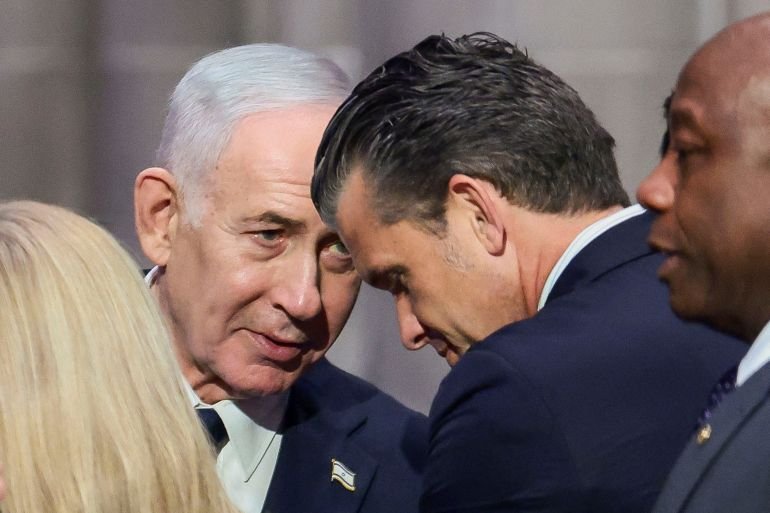
    United States Defense Secretary Pete Hegseth has met Israeli Prime Minister Benjamin Netanyahu during an undisclosed visit to Israel, according to Axios.

    The meeting between the hawkish ally of US President Donald Trump and the veteran Israeli premier facing a knife-edge election occurred on Monday, Axios reported, citing two sources with knowledge of the matter.

    Recommended Stories

    list of 3 itemsend of list

    A spokesman for the US Department of Defense told Al Jazeera it “declines to comment” on the report.

    Hegseth wrote on a social media post that he had visited US service members in the Central Command area of responsibility, which covers the Middle East, North Africa, and parts of Asia.

    Israel’s Army Radio reported his meeting with Netanyahu took place at an air force base in Israel’s southern desert.

    Trump endorsement

    The reports of the visit come a day after President Trump took to his social media platform Truth Social to endorse Netanyahu in next week’s parliamentary election, the first vote since the Hamas-led October 7 attacks in 2023 and Israel’s genocidal campaign in Gaza.

    (FILES) US President Donald Trump (R) and Israeli Prime Minister Benjamin Netanyahu shake hands as they arrive to speak to journalists during a joint press conference at Trump’s Mar-a-Lago residence in Palm Beach, Florida, on December 29, 2025.
    US President Donald Trump (R) and Israeli Prime Minister Benjamin Netanyahu shake hands [File: AFP]

    Trump praised the prime minister for being an ally of the US in its war on Iran. He added that Netanyahu had his “Complete and Total Endorsement”.

    “BIBI NETANYAHU WILL NEVER LET YOU DOWN!” Trump wrote.

    Netanyahu’s religious-nationalist coalition is projected to lose its governing majority, although the opposition may also struggle to form a government, opinion polls suggest.

    US Vice President JD Vance, however, declined to endorse Netanyahu in an interview earlier on Monday, saying he was not getting involved in Israeli elections.

    “I endorse American candidates, and that’s where I’m focused on is the midterms,” Vance, who travelled to Budapest and endorsed Viktor Orban in Hungarian elections earlier this year, said in an interview with digital media outlet 2WAY.

    “I’m not anti-endorsing him, but I’m not pro-endorsing him; I’m not getting involved in Israeli elections,” Vance said.

  • One killed in US shooting near mosque in Columbus, Ohio

    One killed in US shooting near mosque in Columbus, Ohio

    Local authorities say the mosque was not the target of the attack.

    At least one person has been killed in a shooting near a mosque in Columbus, Ohio in the United States, according to police.

    The US Bureau of Alcohol, Tobacco, Firearms and Explosives in Columbus, Ohio initially said its agents were “responding to a reported shooting incident at a mosque in the 2200 block of Albert Ave”.

    However, local police later said the shooting took place near the mosque, but the facility was not targeted.

    “We want to make it clear this was not an attack on the mosque,” said Sergeant James Fuqua, according to the Associated Press.

    He said the shooting stemmed from a dispute at an apartment building at the same location as the mosque.

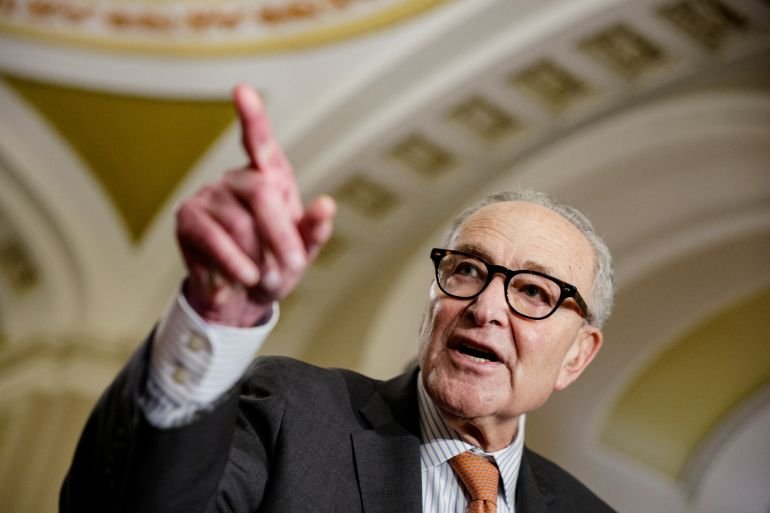
  • Chuck Schumer urges FCC to block AI robocalls before elections

    Chuck Schumer urges FCC to block AI robocalls before elections

    Chuck Schumer urges FCC to reject petition allowing AI robocalls ahead of key November midterm elections.

    United States Senate Democratic leader Chuck Schumer of New York has urged the Federal Communications Commission (FCC) not to approve a petition by the conservative group Club for Growth to allow AI-generated robocalls ahead of the November midterm elections.

    “Under this change, campaigns could use their opponents’ voice to send out a message that is, at best, disingenuous and, at worst, a blatant lie,” Schumer said on Monday.

    Recommended Stories

    list of 4 itemsend of list

    The petition was originally filed on August 31, and the public comment period began on September 4 and expires on Monday.

    Earlier this month, Anna Gomez, the Democratic member of the FCC, urged her colleagues not to allow consideration of the petition brought by the national conservative fiscal policy organisation.

    Her concerns echoed Schumer’s. “[If] the FCC allows a dark money group to flood Americans’ phones with AI-generated robocalls they never agreed to receive, it would bring chaos so close to Election Day,” commissioner Gomez told the Reuters news agency at the time.

    There is precedent for the concerns being raised. In the 2024 presidential election, ahead of the New Hampshire primary, voters received an AI-generated version in the voice of President Joe Biden, the then Democratic incumbent, telling them not to vote. The FCC said that a political consultant working with longshot primary challenger Dean Phillips was responsible.

    At the state level, Louisiana, Tennessee and Vermont passed laws this year requiring disclosures for AI-generated campaign phone calls. While robocalls have been used in political campaigns for years, FCC rules prohibit such calls to cellphones without prior consent, but the restrictions do not apply to landlines.

    Club for Growth’s president, David McIntosh, in a statement earlier this month, said that the group is asking for “the FCC to treat First Amendment-protected political speech the same way it already treats wireless calls about package deliveries, bank accounts, and doctor’s appointments”.

    “There is no one at the FCC that has expressed any interest in moving to an order on this or any of the petitions, and there are zero plans to do so. The FCC seeks comment on petitions that come in as a matter of normal procedure,” a spokesperson for the FCC told Al Jazeera.