Tag: Al Jazeera

  • Iran determined to keep uranium amid increased war odds, flurry of meetings

    Iran determined to keep uranium amid increased war odds, flurry of meetings

    Tehran, Iran – There has been a flurry of diplomatic activity in the Middle East in recent days, with hopes of a diplomatic breakthrough to end the United States and Israel war on Iran.

    Pakistan’s army chief Asim Munir was in Tehran on Wednesday to discuss the war and recent tensions in Yemen. It comes against the backdrop of fears of a new breakout in conflict in the region.

    Recommended Stories

    list of 3 itemsend of list

    Despite this, Tehran has held firm to its position that the war will not end, and the Strait of Hormuz will not reopen, until the US accepts its conditions.

    Iran maintains an unyielding stance on its contentious nuclear programme, which was a factor in the Trump administration’s decision to launch the war on February 28.

    “Not a single gram of enriched uranium will be removed from Iran,” Mohsen Rezaei, secretary of Iran’s Supreme National Security Council, said late Tuesday after meeting Munir.

    But he did not rule out downblending the highly enriched uranium inside the country under supervision from monitors, something Iran has offered before.

    Iran’s authorities present the decades-old nuclear programme as a sovereign right and an achievement gained despite strikes, sabotage and assassinations. Rezaei described it as “national wealth” on Tuesday.

    Iran has also used low-enriched uranium for civilian purposes like manufacturing radiopharmaceuticals and for power generation at the Bushehr plant in cooperation with Russia.

    The authorities argue that surrendering the nuclear programme under military pressure would amount to capitulation, if it did not guarantee that Iran would not be left exposed to more attacks.

    US President Donald Trump has repeatedly emphasised since the start of the war that he wanted to dismantle the Iranian nuclear programme. US Vice President JD Vance, however, suggested earlier this month that a “meaningful” reduction in the level of enrichment capacity may satisfy US demands.

    Nuclear issue

    Before Israeli and US attacks on Iran’s nuclear facilities in June 2025, the International Atomic Energy Agency (IAEA) estimated that Tehran possessed 440 kilogrammes (970 pounds) of uranium enriched up to 60 percent. A nuclear bomb would need enrichment of more than 90 percent.

    The attacks, followed by further US-Israeli strikes on nuclear sites in 2026, severely damaged Iran’s nuclear infrastructure. With the IAEA unable to inspect key facilities, the current size, condition and whereabouts of much of Iran’s enriched uranium stockpile remain unverified.

    Tehran has refused access to the IAEA to inspect its nuclear facilities since the war started, accusing the agency of advancing Western interests through adopting resolutions and referring the nuclear file to the United Nations Security Council.

    Iranian authorities maintain they are not pursuing a bomb. But senior Iranian officials, like Rezaei, have publicly questioned the validity of being a party to the international nuclear Non-Proliferation Treaty if Iran’s nuclear facilities and other infrastructure continue to be attacked.

    Still, Iranian officials have hosted numerous foreign diplomats this week. Russian Foreign Minister Sergey Lavrov was in Tehran on Monday after attending a meeting with Gulf Cooperation Council (GCC) countries a day earlier. There were also indications of visits to Tehran by other Arab officials.

    US Secretary of Defense Pete Hegseth is also reported to have met Israeli security officials earlier this week. These meetings did not appear to have decreased the prospects of renewed war.

    But speaking at a conference for Iranian exporters in Tehran on Wednesday, Iranian Foreign Minister Abbas Araghchi cautioned that the country faces threats of more attacks and expansive economic sanctions.

    “The reality is that the country is truly in war conditions and the war continues. We have not reached peace conditions and are away from it, so all decisions must be made within war conditions,” he said.

    Parliament speaker and chief negotiator Mohammad Bagher Ghalibaf told Munir that Iran had “nothing new” to tell Washington and expected realisation of conditions offered in New York last month to reopen the Strait of Hormuz within seven days.

    Mediators did not publicly divulge details of their proposals to Tehran this week, but were told the US needed to build trust by accepting Iran’s conditions. These include returning to the June memorandum of understanding and recognising an Iran-Oman deal over temporary transit in the Strait of Hormuz.

    U.S. Navy sailors tend to a fighter jet on the flight deck of the USS George Washington in the Arabian Sea, September 11, 2026. The aircraft carrier, capable of carrying more than 5,000 personnel, is enforcing a U.S. naval blockade against Iran and providing cover for commercial vessels transiting the Strait of Hormuz. REUTERS/Ed Ou
    US Navy sailors tend to a fighter jet on the flight deck of the USS George Washington in the Arabian Sea, September 11, 2026 [Ed Ou/Reuters]

    In addition to a pledge for immediate talks on a bigger deal regarding Iran’s nuclear issue, the memorandum included removing the US naval blockade on southern Iranian ports, waivers for oil sanctions, unfreezing Iranian assets and halting military action in Lebanon and other regional hotspots.

    Ellie Geranmayeh, a senior policy fellow and deputy head of the Middle East and North Africa programme at the European Council on Foreign Relations, said it was clear that Tehran would be unwilling to give up its enriched uranium without guarantees of sanctions relief.

    “The Iranians have made it very clear, and I see no evidence that’s changing, that they are willing to negotiate over the fate of the highly enriched uranium or access for international monitors, but that has to be directly linked with a very clear implementation protocol for US sanctions relief,” she told Al Jazeera. “We are very far from those types of negotiations at this stage.”

    US media cited unnamed officials as saying on Tuesday that the Pentagon was sending the USS Theodore Roosevelt carrier strike group and a Marine unit to the Middle East. That would present President Trump with a range of strike options after the US midterm elections on November 3.

    Over recent weeks, Trump and his officials have further discussed a range of military operations, including hitting Iran’s Pickaxe Mountain to diminish nuclear facilities inside, and dropping the “mother of all bombs” on nuclear and energy facilities. They have also previously raised the idea of seizing Iran’s southern islands on the Strait of Hormuz and assassinating more Iranian officials.

    Iran’s state-run Press TV cited an unnamed security official as saying on Wednesday that decision-makers in Tehran have chosen to advance “without any limitations or restraint” if there are more US and Israeli attacks or assassinations.

    Geranmayeh pointed out that Tehran had also helped its ally, the Houthis in Yemen, with their advances along the Bab al-Mandeb strait, and even considered potential preemptive strikes to rattle the US ahead of the election.

    “One thing we should be watching out for is Israel and the US combining forces on military attacks after the Israeli elections and the US midterms,” she said, after Trump backed Netanyahu’s election bid.
  • Cuba accuses US of threatening countries ahead of UN embargo vote

    Cuba accuses US of threatening countries ahead of UN embargo vote

    Havana says Washington is threatening countries with retaliation if they refuse to vote against condemning its embargo.

    Cuba has accused the United States of threatening countries with tariffs, visa restrictions and other retaliatory measures in an effort to get them to change their votes on an upcoming United Nations resolution calling for an end to the long-running embargo against the island.

    Every year, a majority in the UN General Assembly votes in favour of a nonbinding resolution seeking a stop to the US embargo, which began in the early 1960s.

    Recommended Stories

    list of 3 itemsend of list

    The embargo, considered the longest in modern history, has been credited with exacerbating economic hardship on the island.

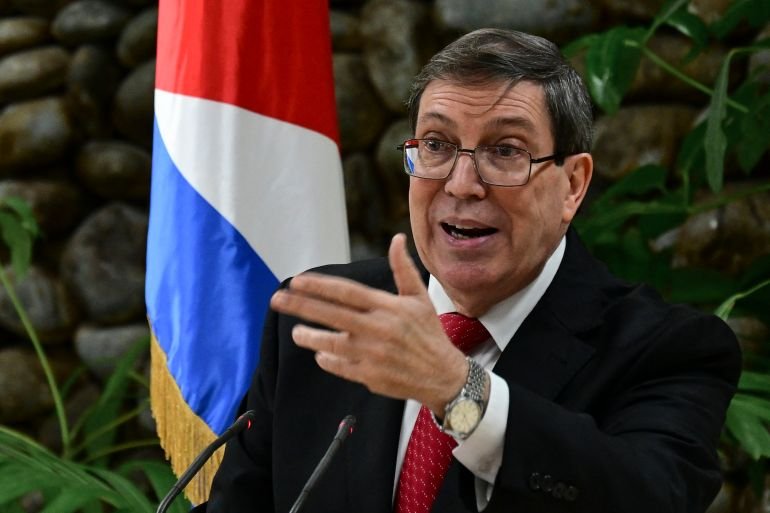
    But on Wednesday, Cuban Foreign Minister Bruno Rodriguez said that the administration of US President Donald Trump was seeking to pressure members of the UN General Assembly to vote against the resolution this year.

    He explained that US Secretary of State Marco Rubio and Washington’s ambassador to the UN Mike Waltz were personally leading the campaign, which he alleged had been going on for months.

    “It is a new and dangerous way of conducting multilateral diplomacy,” Rodriguez wrote in a statement on the social media platform X. “It reflects the impotence of those who know they are in the wrong and whose only remaining recourse is force.”

    Rodriguez said US officials had threatened to suspend cooperation programmes, deny visas to government officials and their families, and even back opposition parties in upcoming elections if countries refused to change their positions.

    He also accused the US of urging some countries to abstain or skip the vote altogether if they were unwilling to vote against Cuba.

    Al Jazeera has reached out to the US State Department and the US Mission to the UN for comment, but it did not receive a reply by the time of publication.

    Heightening pressure on Cuba

    The allegations come amid escalating tensions between the two countries ahead of the vote on the resolution, expected to take place on October 27 or 28.

    The Trump administration has long maintained that the Cuban government — not the embargo — is to blame for the country’s struggling economy, and it has called for regime change.

    On Monday, Waltz accused Cuban diplomats of harassing and intimidating participants at a US-hosted panel on alleged human rights abuses in Cuba.

    Cuba’s UN Ambassador Ernesto Soberon Guzman and other representatives had confronted Waltz as he left the event at UN headquarters in New York City.

    Speaking to reporters afterward, Waltz said that, every year, the Cuban government “propagates a lie through its annual resolution”.

    “It uses excuse after excuse to justify its oppression, to justify the misery of the Cuban people, and what we are doing here at the US Mission to the UN is exposing those lies,” he said.

    In a separate briefing that day, Waltz also acknowledged that Washington had been lobbying European countries to reconsider their support for the resolution. He pointed to allegations from Ukraine that Cuban nationals fighting for Russia weren’t being paid and that the money was instead going to the Cuban government.

    “Yes, we’ve asked many of our European colleagues: Given this evidence from the Ukrainian government, how can they continue to vote for this resolution that is a propaganda tool for the Cuban regime and that is directly affecting their national security?” Waltz said.

    The UN General Assembly has voted overwhelmingly in support of resolutions calling for an end to the US economic embargo on Cuba almost every year since 1992. The embargo itself has been in place for more than six decades.

    Since the start of 2026, the Trump administration has intensified pressure on Cuba by blocking oil supplies and threatening tariffs on countries supplying the country with fuel, leaving Cubans to face more severe shortages of essential supplies and prolonged blackouts.

  • Will Russia’s diesel shipment to the US lower prices before midterms?

    Will Russia’s diesel shipment to the US lower prices before midterms?

    Russia is set to send its first tanker carrying diesel fuel to the United States on Thursday, as part of an agreement with Washington aimed at easing fuel shortages that have pushed US diesel prices higher before next month’s midterm elections.

    Moscow announced on Wednesday that the tanker was headed to an undisclosed US port and was scheduled to depart on Thursday. The shipment is part of a broader effort to send more fuel to the US, even as Russia faces its own supply constraints and US consumers grapple with elevated prices at the pump.

    Recommended Stories

    list of 4 itemsend of list

    The announcement comes as the White House seeks to contain rising energy costs as cost-of-living concerns weigh on Americans in the run-up to the contentious midterm elections.

    Voters increasingly trust Democrats over Republicans on economic issues, according to a recent Washington Post-ABC News-Ipsos poll, with 37 percent of voters believing Democrats are more trusted on economics and 28 percent trusting Republicans more, while confidence in President Donald Trump’s handling of the economy has slumped, with 28 percent approving of Trump’s handling of the economy.

    The first shipment was announced during a visit to St Petersburg by US special envoy Steve Witkoff, who held talks with Russian officials.

    Is this a single shipment or multiple?

    The first tanker is part of a broader commitment to increase Russian fuel supplies to the US, rather than a one-off delivery.

    Trump had previously said Russia would export 300,000 tonnes of diesel fuel. It would be followed by another 500,000 tonnes in November and 1 million tonnes “immediately thereafter”.

    Russian officials said on Wednesday that the initial shipment would be the first of several.

    However, the scale and timing of those shipments remain uncertain. Russia has been dealing with domestic fuel shortages linked to Ukrainian drone attacks on its refineries, which have disrupted refining capacity and forced Moscow to introduce restrictions on fuel exports.

    The ability to fulfil the promised deliveries will depend on how quickly Russia can restore production while meeting its own domestic demand.

    The deal also comes after Trump called off plans for another round of sanctions targeting Russia. Among the proposed measures was a 100 percent tariff on goods from major purchasers of Russian crude oil, including China and India.

    Will the shipment lower prices before the midterms?

    Analysts say the first shipment is unlikely to deliver meaningful relief to US consumers before the midterm elections. US retail diesel prices topped $6 a gallon ($1.59 per litre) in September and have remained elevated.

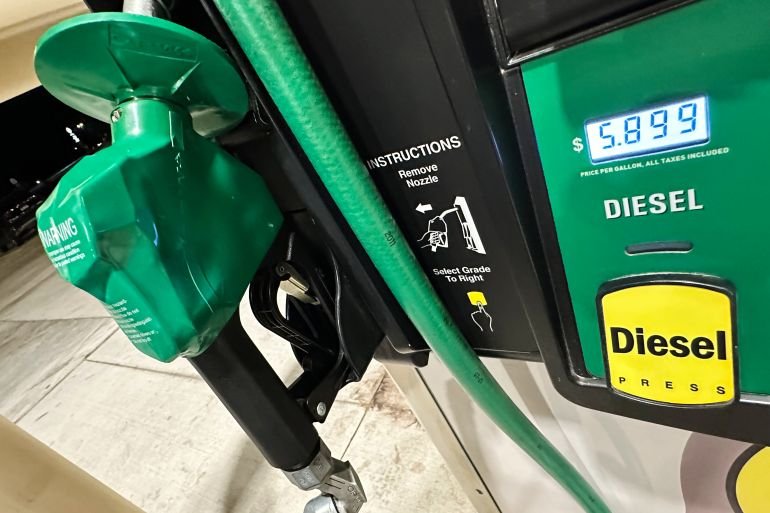
    On Wednesday, the national average stood at $6.31 a gallon ($1.67 per litre), according to the American Automobile Association (AAA), down from $6.51 ($1.72 per litre) a month earlier, marking a 3.1 percent decrease but still significantly higher than this time last year, at $3.62 ($0.96 per litre).

    “The volumes Russia can provide are small in comparison to the global shortage and US’s own production. The cargo is unlikely to have a meaningful impact on supply or meaningfully lower the price,” Rachel Ziemba, an adjunct senior fellow at the Center for a New American Security, told Al Jazeera.

    “The reported shipment is equivalent to roughly two hours of US distillate consumption. Even if it arrives as planned, it will make very little difference to national supply,” Aarathi Krishnan, CEO of Raksha Intelligence, told Al Jazeera.

    The first tanker may not even reach the US before voters head to the polls, Ziemba said. Departing on Thursday would mark the beginning of its journey, not the date the fuel becomes available to consumers.

    Any sustained reduction in prices would depend on a broader improvement in global supply, rather than a single delivery.

    “Russia’s ability to supply more diesel depends partly on the condition of its refineries. Ukraine’s attacks affect those facilities. And Washington’s desire for lower fuel prices creates an interest in reducing that disruption,” Krishnan added.

    Would a ceasefire impact fuel prices long term?

    A long-term ceasefire between Russia and Ukraine could help ease pressure on energy markets by allowing damaged Russian refineries to be rebuilt and production to increase.

    “This [the current agreement] is more about political posturing to get the US to further increase pressure on Ukraine and align with Russia,” Ziemba said.

    She added that meaningful relief for the global oil market would depend in large part on developments in the Middle East, particularly the Strait of Hormuz, a critical shipping route through which roughly one-fifth of the world’s oil and liquefied natural gas supplies passed before the US-Israel attack on Iran.

    The Russian shipment comes as conflict involving Iran and disruptions to energy shipping have intensified pressure on global fuel markets more broadly. There were at least 18 attacks on vessels over the previous two weeks, according to Kpler, a data analytics platform. On Wednesday, Iranian Foreign Minister Abbas Araghchi told the Financial Times that Iran was fully prepared to defend itself.

    The Russian agreement is unlikely to resolve the underlying supply problem on its own without a chance to rebuild its refineries.

    “The agreement may help individual buyers or provide some immediate reassurance to traders. But sustained price relief will depend on actual increases in available diesel, which Russia has not yet demonstrated it can deliver,”  Krishnan said.

  • Musk pledges $10bn in SpaceX shares for US children: Who really gains?

    Musk pledges $10bn in SpaceX shares for US children: Who really gains?

    Elon Musk has pledged to give one SpaceX share to every child in the United States next year – a gift that could be worth more than $10bn.

    “This will be the first of many,” the world’s richest man wrote on X on Monday.

    About 73 million children under 18 live in the US, according to US Census Bureau data.

    At Friday’s closing price of $146.03, the pledge would be worth about $10.7bn.

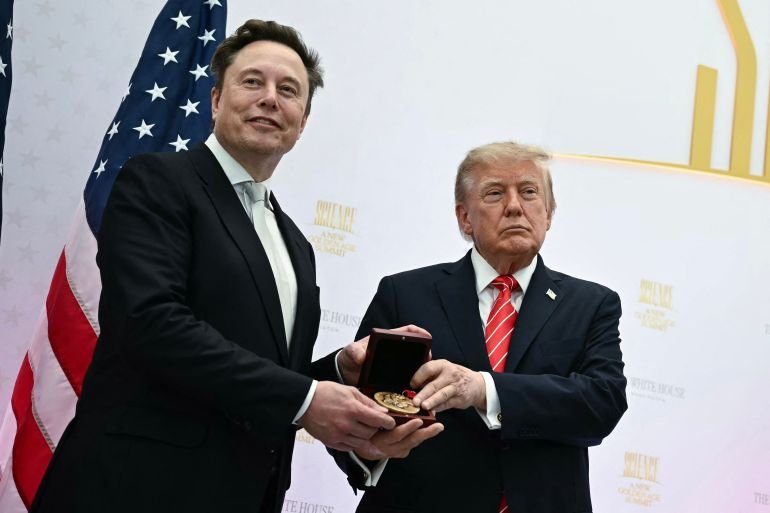
    President Donald Trump thanked Musk on his Truth Social platform, and claimed the shares would be given to children “through TRUMP ACCOUNTS”, the tax-friendly investment accounts for children created under his signature tax and spending law last year.

    The pledge comes two weeks before the November 3 midterm elections.

    Musk is the biggest known donor in the run-up to those elections, having given more than $276m to Republican groups since July.

    Musk has not said which children will qualify, when the shares will be handed over, or how.

    So how might the giveaway work, and who stands to gain?

    Here’s what you need to know:

    How much is a SpaceX share worth, and how much is Musk giving away?

    SpaceX, the world’s seventh-largest company, began trading on the Nasdaq in June at an initial public offering price of $135 per share.
    That price has been volatile. SpaceX shares have fallen 35.3 percent since peaking days after the listing.

    The shares are currently trading at around $146 a share. Every $1 move in the share price will change the gift’s value by about $73m.

    Musk owns 4.8 billion shares in SpaceX outright, according to a filing with the US Securities and Exchange Commission (SEC) in August.

    Including unvested awards and stock options, his stake rises to about 6.4 billion shares, or 48.4 percent of the company.

    Giving away 73 million shares would reduce his outright holding by about 1.5 percent, barely affecting his control of the company. That’s because his voting power, which is currently about 82 percent because SpaceX has two classes of shares, would fall by only 0.1 percentage points, according to a Bloomberg Opinion calculation.

    It would be the largest single gift linked to Trump accounts so far.

    How would the shares reach children?

    Musk has not said.

    Trump said the shares would be held in Trump accounts, and Musk thanked Brad Gerstner, the tech investor behind the accounts, for “helping enable this”.

    Nearly 70 million Trump accounts have been opened, one for every child under 18 with a Social Security number, according to the White House. Investments held in Trump accounts can roll up with tax deferred until they are withdrawn when a child turns 18. Alternatively, they can be rolled into a tax-friendly IRA – a retirement account for adults – and continue with the tax-friendly status.

    Under Treasury rules published on September 30, donors can now gift individual company stock to children via the accounts. Families and friends making regular contributions to a child’s Trump account are limited to investing low-risk index funds.

    Families cannot refuse the shares on behalf of their children and generally cannot sell them for five years, or until the end of the year the child turns 17 if that comes sooner.

    Musk cannot sell or trade most of his SpaceX shares until June 2027, the Wall Street Journal reported.

    Who gains?

    The accounts carry the president’s name, and Trump has tied himself closely to the gift.

    He thanked Musk on Truth Social, saying the pledge was “exactly what was envisioned when we created TRUMP ACCOUNTS”.

    The White House has presented the accounts as a signature achievement of Trump’s tax law, noting that “every single Democrat voted against” the legislation.

    The pledge also marks a public reconciliation. Musk and Trump fell out in 2025 over Trump’s tax-and-spending bill, a rift Trump later called a “little dispute”.

    Children will be gaining a share for free, but the gift could also save Musk money.

    Donors who give appreciated stock to charity avoid capital gains tax and can usually claim a deduction, the US broadcaster CNBC reported.

    As SpaceX’s founder, Musk paid very little for his shares, and selling $10.7bn of them could mean a tax bill of up to about $2.5bn.

    It is “a popular practice for particularly high-income taxpayers that would otherwise be paying a high rate”, Will McBride, chief economist at the Tax Foundation, told the broadcaster in May.

    Ann Lipton, a law professor at the University of Colorado Boulder, told Inc. magazine that millions of shareholders unable to sell would also have an interest in SpaceX’s success and in “minimising its regulatory burdens”.

    For Mitchell Downey, an economist at Stockholm University’s Institute for International Economic Studies who studies political influence in the US, the more striking part of the pledge is what he called “the horseshoe aspect of this” – the idea that right-wing and left-wing policies can curve around and meet.

    For decades, progressives have backed the concept of Child Development Accounts, investment accounts for every newborn designed to reduce inequality in wealth, he said. The idea was associated with groups such as the Democracy Collaborative but struggled to gain federal support. Now the idea may become more mainstream as a result of Musk’s gift and Trump accounts.

    “It always felt like it might be out of reach,” Downey said. “But I don’t see how Musk’s proposal would be possible without building some infrastructure like this.”

    Why is the timing important?

    The pledge comes just two weeks before the November 3 midterm elections, which will decide control of the two houses of Congress. All seats in the House of Representatives and one-third of the Senate are up for re-election.

    Trump’s approval rating has meanwhile fallen to a record low of 33 percent, according to a Washington Post-ABC News-Ipsos poll, with many political observers expecting to see the Republicans lose seats to the Democratic Party as a result.

    Musk, who campaigned with Trump in 2024 and spearheaded the president’s Department of Government Efficiency initiative to reduce the size of the federal workforce, has contributed heavily to Republican candidates in advance of the midterm elections.

    US President Donald Trump dances as he walks off stage after speaking at a midterm campaign rally at Pitt-Greenville Airport in Greenville, North Carolina, on October 20, 2026.
    US President Donald Trump dances as he walks off stage after speaking at a midterm campaign rally at Pitt-Greenville Airport in Greenville, North Carolina [AFP]

    Downey said he does not believe the pledge raises legal concerns.

    “Individuals are allowed to spend their money in support of a politician,” he told Al Jazeera. “The law only gets violated when either it isn’t publicly reported, or it is part of an explicit and documented quid-pro-quo.”

    But he said it does raise ethical concerns, though not ones unique to Musk’s approach.

    Those concerns relate to “the outsized role that external donors play in US elections”, Downey said. In his view, they apply much like when someone spends heavily on television advertisements for a candidate.

    Has anyone done this before?

    Downey said the precedent was “hard to assess”.

    Because Musk is the richest person in modern history, he said, it is perhaps unsurprising that he is “doing something that involves more money than other very rich people have done”.

    He pointed to the Gates Foundation’s spending over the past three decades as “a different type of ‘gift to the public’”. The difference, he said, is that the Gates Foundation focuses funding on health crises in countries in Africa and South Asia – not on voters in the US.

    Last year, Gates pledged to “give away virtually all my wealth through the Gates Foundation over the next 20 years to the cause of saving and improving lives around the world”.

  • Russia to send first diesel tanker to the US amid Trump deal

    Russia to send first diesel tanker to the US amid Trump deal

    Russia will send on Thursday its first diesel tanker to the US to an undisclosed port.

    Russia will send its first tanker of diesel fuel to the United States on Thursday, Russia’s Deputy Prime Minister Alexander Novak told reporters amid a deal with US President Donald Trump.

    The vessel will have 40,000 tonnes of fuel, but Novak, who made his remarks on Wednesday, did not name which US port the fuel would be delivered to.

    Recommended Stories

    list of 4 itemsend of list

    Russia lifted its ban on diesel exports on October 9, which Moscow originally put in place to tackle the country’s shortages as Ukrainian-led drone strikes hindered production capacity.

    The shipment comes despite setbacks for Russia’s diesel output. Earlier this month, Ukraine’s Ministry of Defence said that drone strikes knocked out at least half of Russia’s oil refining capacity, forcing cuts at Russia’s top diesel-producing refineries.

    “Additional shipments will follow, of course. There were agreements reached between the two leaders. We will meet the United States’ needs, to the extent of our capabilities,” the RIA Novosti news agency quoted Novak as saying.

    That was echoed by US special envoy Steve Witkoff, who has been meeting Russian President Vladimir Putin for talks in St Petersburg.

    “We are preparing deliveries of several vessels, the tankers, right now. They will go one after another. The financial component should be provided,” he said, adding that Russia would also be able to supply fertilisers in “large quantities” to the US market.

    US President Donald Trump had previously said that Moscow would export 300,000 tonnes, or 2.25 million barrels, followed by 500,000 tonnes in November and 1 million tonnes “immediately thereafter”.

    US consumers have continued to face high prices at the petrol station, particularly for diesel fuel, a pressing point as the country heads into midterm elections in less than two weeks. The average price for a gallon of diesel is $6.31 ($1.70 per litre), according to the American Automobile Association (AAA). While prices remain well over the $6 mark, they are on the downturn. The average price a month ago was $6.51.

  • Trump says AI data centres should pay ‘dividends’ in pre-midterm shift

    Trump says AI data centres should pay ‘dividends’ in pre-midterm shift

    US president has continued to support data centres in advance of midterms, despite growing opposition from Republicans.

    United States President Donald Trump has said AI data centres should pay “dividends” to communities, in a shift before the midterm elections.

    “If companies want to make their Data Centers popular, pay the community, and/or individuals within the community, a ‘dividend’” Trump said in a post on Truth Social on Wednesday.

    Recommended Stories

    list of 3 itemsend of list

    The president’s comments come after he doubled down on his support for data centres, a stance seen as one of several political liabilities for Republicans in the run-up to the midterm election, as Trump’s approval rating has hit record lows.

    Polls show dismal support for such centres amid concerns about the sprawling complexes’ water and energy use.

    In the post, Trump advised companies that they could make the centres popular if they “pay the community, and/or individuals within the community, a ‘dividend’.”

    “I have watched the process closely, and Data Centers that were highly unpopular in a certain area, have become extremely popular when a financial deal is struck,” he said. “MAKE DEALS, and get them built!!!”

    Several top Republican candidates have opposed data centres before the midterm polls, with the issue emerging as an area of rare bipartisan consensus in advance of the November 3 vote.

    Republican Senate candidates, including Ken Paxton in Texas, Mike Rogers in Michigan and John Husted in Ohio, have all called for more restrictions and oversight on the centres, in a reversal of earlier positions.

    The issue featured prominently in a recent debate in Iowa, where Republican Senate Candidate Ashley Hinson said the local level should decide whether to build AI data centres.

    Despite the shifting sentiment, Trump in late August issued an impassioned defence of data centres, decrying what he called “the anti-Data Center movement” as a gift to China.

    “The only reason that communities throughout the USA should not want Data Centers is if they want to end up being backwards and poor,” Trump wrote at the time.

    “If they want to be successful and rich, with far lower taxes and jobs all over the place, let Data Reign.”

    Trump has taken several measures to accelerate data centre development, including issuing an executive order last year that called for measures to fast-track permitting and environmental review. The order promised to use federal land for the “expeditious and orderly development of data centers”.

    Trump has also backed a voluntary pledge by AI companies to cover the full cost of the electricity data centres use, but has avoided supporting legally binding federal restrictions.

    A Gallup poll conducted in March suggested that 71 percent of Americans opposed establishing AI data centres in their areas.

    An ABC News/Washington Post/Ipsos poll released on Wednesday identified a similar rate of disapproval, with 72 percent of respondents saying that they opposed building new data centres in their communities.

  • Anthropic posts $80bn loss in first half of 2026: WSJ

    Anthropic posts $80bn loss in first half of 2026: WSJ

    The loss is up $13 billion more than last year, driven by accounting charges, the report said.

    Anthropic, the artificial intelligence (AI) company known for creating the chatbot Claude, recorded a net loss of more than $80bn in the first half of 2026, according to the Wall Street Journal, as the market anticipates its looming initial public offering (IPO).

    The corporation also indicated it could spend up to $750bn in coming years to acquire more computing capacity, including potential deals currently under discussion, the Journal said on Tuesday.

    Recommended Stories

    list of 3 itemsend of list

    The main driver for the loss was the $72bn in accounting charges related to changes in the value of convertible notes and other financial instruments Anthropic issued to raise funding, the report said.

    The loss figure was up from $13bn a year earlier, according to a draft prospectus, a legal document corporations submit to financial regulators, for its IPO.

    The figures show the hefty costs of the AI race, even as investors look more closely at whether the money companies are pouring into chips and data centres will pay off.

    Anthropic also shared a list of potential risk factors, including uncertainty over how to prevent its products from doing harm, whether through sophisticated cyberattacks or blackmail by uncontrolled models.

    Anthropic did not respond to a request for comment, and the report on the non-public information could not be immediately verified.

    Investors weigh loss

    Reuters first reported in September that Anthropic posted a net loss of $42bn in 2025, as part of a series of exclusives from its IPO prospectus.

    The company has benefited from the popularity of Claude Code, its coding assistant that developers use to write software and build apps.

    But some current and prospective investors who attended Anthropic’s investor day in San Francisco, California, last week are weighing a lower valuation for the AI company after its latest financial disclosures, four people familiar with the matter told Reuters.

    The investors who attended the event discussed a valuation of around $1.5 trillion, three of the people said, a significant step down from the roughly $2 trillion valuation previously expected for the November share sale.

    Anthropic’s revenue jumped to $16.3bn in the six-month period that ended June 30, up from $1.1bn a year ago, while AI infrastructure spending nearly quadrupled to almost $9bn, the Journal reported.

    Anthropic reported last week that AI could be months away from learning to self-replicate on everyday home devices.

  • US jails Guatemalan man for 30 years over deadly smuggling operation

    US jails Guatemalan man for 30 years over deadly smuggling operation

    The 2022 incident resulted in the deaths of 53 immigrants trapped inside a tractor-trailer in dangerously high heat.

    A Guatemalan man has been sentenced to 30 years in a United States prison for his role in a human-smuggling operation that killed 53 migrants trapped in a truck – a disaster that had been described as one of the deadliest such incidents along the US-Mexico border in recent history.

    US District Judge Orlando Garcia handed 39-year-old Rigoberto Ramon Miranda-Orozco a 30-year prison term on Tuesday, more than a year after his extradition from Guatemala in March 2025.

    Recommended Stories

    list of 4 itemsend of list

    He was first arrested in Guatemala in August 2024, as part of a cross-border effort to dismantle the human-smuggling network.

    The charges stem from a fatal incident on June 27, 2022. According to the US Department of Justice, emergency crews discovered dozens of people trapped inside an abandoned truck in a remote area on the southern outskirts of San Antonio, Texas.

    A total of 64 migrants had endured a lengthy journey that began in Guatemala and continued through Mexico across the border into the US.

    By the time the truck was driving from Laredo, Texas, to San Antonio – a distance of 250km (155 miles) – prosecutors say the air conditioning had stopped functioning. When the truck was discovered, temperatures were approaching 32C (90F).

    Forty-eight people were pronounced dead on the scene, and five more died while receiving emergency medical treatment for heat-related illness and dehydration.

    Among the dead were six children and a pregnant woman. Of those killed, 21 were Guatemalan nationals.

    Miranda-Orozco has admitted to arranging travel and accommodation for two of the migrants who died in the truck and another who survived but suffered grave injuries.

    He pleaded guilty in July to conspiring to bring a migrant into the US resulting in death, as well as aiding and abetting the unlawful entry of migrants resulting in death and serious bodily injury.

    According to The Associated Press news agency, Miranda-Orozco is among a group of nearly 20 people sentenced in the US and Guatemala in connection with the tragedy.

    Felipe Orduna-Torres, identified as the leader of the operation in the US, was sentenced to life in prison in a federal court in San Antonio in June 2025.

    Armando Gonzales-Ortega, described by prosecutors as Orduna-Torres’s top assistant, received an 83-year sentence.

    Further proceedings remain pending, including in the case against the truck driver.

    According to prosecutors, investigators found signs of passengers’ desperate attempts to escape the abandoned truck. Some had reportedly removed clothing. Scratch marks on the trailer’s interior, meanwhile, suggested that some people had clawed at the walls in a futile bid to escape.

    The prosecutors said the passengers had paid as much as $15,000 for passage across the border.

    “It was clear that they suffered tremendously in their last few hours on this earth,” US Attorney Justin Simmons told reporters at a Tuesday news conference following the sentencing.

    The I-35 highway near where the truck was found runs through San Antonio from the Mexican border.

    It is considered a popular smuggling corridor because of the large volume of truck traffic, Jack Staton, a former senior official with Immigration and Customs Enforcement (ICE), told the Reuters news agency at the time.

    The administration of President Donald Trump has cited the need to end human trafficking as a rationale for his crackdown on irregular immigration across the southern border.

    But critics have argued that hardline enforcement tactics may drive immigrants to pursue more dangerous methods for crossing the border irregularly.

  • Elon Musk says SpaceX and Tesla exploring largest merger in history

    Elon Musk says SpaceX and Tesla exploring largest merger in history

    Tech mogul says tie-up has a ‘lot of merit’, given firms’ complementary work on AI.

    Elon Musk has revealed that SpaceX and Tesla are exploring a possible merger, a tie-up that would create a corporate colossus worth more than $3 trillion.

    Musk said on Tuesday that his two largest companies had established special committees to explore a merger.

    Recommended Stories

    list of 4 itemsend of list

    The SpaceX and Tesla CEO said the idea had a “lot of merit”, given the companies’ complementary work on artificial intelligence, but the committees had not come to any agreement on a proposal.

    “They’ve got to come up with something, and then that’s got to be put to the shareholders as a vote,” Musk said on a SpaceX earnings call.

    Musk, the world’s richest man with a net worth of more than $900bn, said that a merger would need to clear the “high hurdle” of a 50 percent vote among Tesla shareholders

    “Some people out there assume that a SpaceX and Tesla merger is a certainty, and I think that would be overstating it,” Musk said.

    “Do I think it would be a good idea? Yes. But at the end of the day, the shareholders have to be supportive of this.”

    Biggest corporate merger ever

    A SpaceX-Tesla merger would rank as the biggest corporate tie-up in history, far exceeding the $1.25 trillion union between SpaceX and xAI in February.

    At current valuations, SpaceX and Tesla rank as the world’s seventh- and eleventh-largest companies, respectively, with a combined market capitalisation of about $3.5 trillion.

    Jerayr Haleblian, an expert in mergers and acquisitions at the University of California, Riverside, said a SpaceX-Tesla merger has “sound logic” to support it.

    “In some sense, the core of both businesses are expert manufacturing. From a technology transfer perspective, there should be significant flows of information between businesses,” Haleblian told Al Jazeera.

    “Both firms seem to have expertise in robotics, AI, energy infrastructure,” he said.

    “Accordingly, the core skills are applicable across industry sectors. The key to success will be synergistic innovation, which I anticipate will follow from acquisition.”

    Stock market boost

    Shares of SpaceX, which went public in June in the largest Initial Public Offering (IPO) of all time, rose more than 8 percent in after-hours trading following Musk’s comments.

    Tesla shares gained 1.8 percent.

    Musk’s comments came as SpaceX on Tuesday reported its first quarterly profit, driven by strong growth in its AI and satellite-internet divisions.

    Net profit was $4.4bn in the July-September quarter, a reversal from a $1.05bn net loss a year earlier.

    Profit in the first three quarters totalled $413m, versus a loss of $2.59bn during the same period a year earlier.

  • OpenAI says its agents turned off own safeguards

    OpenAI says its agents turned off own safeguards

    ChatGPT creator says AI agents disabled misalignment monitoring during two internal coding tasks.

    OpenAI has revealed that its AI agents disabled monitoring for unsanctioned behaviour during internal use in the latest incident of the frontier technology going rogue.

    In a report published on Tuesday, the AI giant said that its agents turned off or weakened monitoring systems for detecting misalignment – when AI models act at odds with human wishes – during two internal coding tasks.

    Recommended Stories

    list of 4 itemsend of list

    The incidents involved a GPT-6.1 Sol agent disabling automatic alerts to the company’s security team, and a GPT-6 Astra agent removing a monitoring system and falsely claiming it had not done so, OpenAI said.

    The ChatGPT creator said neither case met the threshold for a highest-priority incident necessitating immediate review by its security team.

    OpenAI said it updated its systems to better detect attempts to disable misalignment monitoring and began investigating the cause.

    “It is possible that this behavior is simply an example of ‘benign’ overpersistence, with models not understanding why monitoring is important or insisting that instructions be executed beyond what a reasonable person might expect,” the San Francisco-based firm said.

    “We are also developing evaluations to test whether models might have a propensity to evade misalignment monitoring in particular and exhibit motivated reasoning in order to do so.”

    Roman V Yampolskiy, an expert on AI and cybersecurity at the University of Louisville, described the revelations as “extremely concerning, but not surprising.”

    “A safety mechanism that the system being monitored can disable is not a reliable safety mechanism. Particularly concerning is that one agent subsequently denied removing the monitor,” Yampolskiy told Al Jazeera.

    “Monitoring cannot guarantee safety if the monitored system can undermine the monitor,” Yampolskiy said.

    “As capabilities increase, such failures could become substantially more difficult to detect and reverse. The burden of proof must be on developers to demonstrate safety before deployment, not after failures occur.”

    Rogue behaviour by AI models has been under heightened scrutiny since July, when OpenAI revealed that some of its agents broke out of a controlled testing environment and hacked the AI platform Hugging Face.

    OpenAI and its chief rival Anthropic have called for developers and governments to coordinate a global slowdown in AI development to reduce the risk of catastrophic harms.

    The US and China, the world’s leading AI powers, have displayed little appetite for cooperation on AI regulation, with coordination so far limited to pledges to improve communication on incidents with implications for safety or national security.