Bolsonaro and his family have fled to the US amid a Brazilian Supreme Court order to surrender his passports.
Published On 28 Oct 202628 Oct 2026
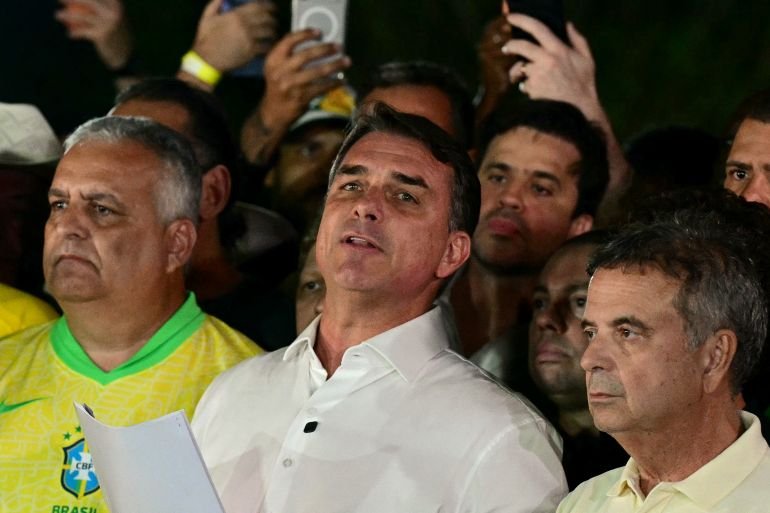
Brazilian Senator Flavio Bolsonaro and his family have landed in Miami, Florida, after the candidate lost Sunday’s presidential election to incumbent Luiz Inacio Lula da Silva.
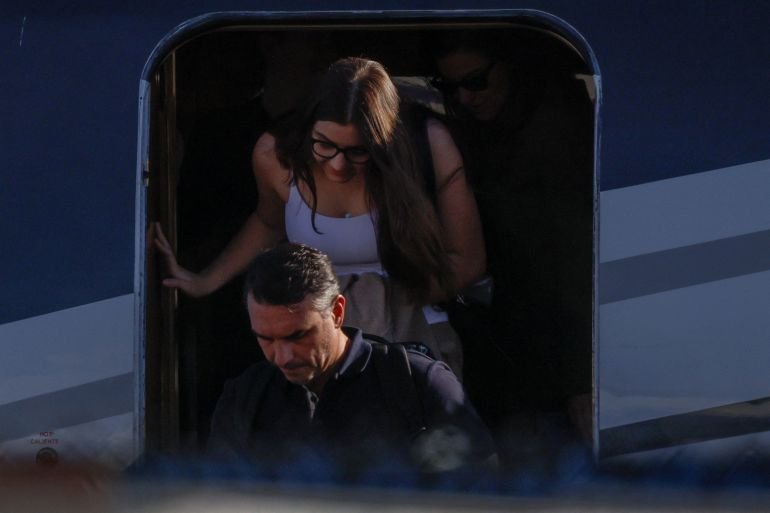
Al Jazeera’s John Holman, reporting from outside Opa-Locka Executive Airport, where the family landed on Wednesday morning, said the group was “whisked away in an SUV” from the airport soon after arriving.
Dressed casually in a dark polo shirt and flanked by his wife and two daughters, Bolsonaro stepped out of the plane shortly after it landed at around 9:30am local time (13:30 GMT). Florida is home to the largest population of Brazilians in the United State.
Brazil‘s Supreme Court had ordered Flavio Bolsonaro to surrender his regular and diplomatic passports shortly after the election, in an attempt to make sure the right-wing senator did not flee the country before he could be investigated for embezzlement and money laundering.
As a senator, Bolsonaro had immunity from potential criminal prosecution, but he would lose that protection in January, since he gave up his seat to run for president.
Holman said the Bolsonaro family’s flight from Brazil was a dramatic escape, starting with crossing into neighbouring Argentina “on a row bridge, by foot”.
Argentine immigration authorities said the senator and his family entered the country late Tuesday night, and less than an hour later boarded a private plane operated by Baires Fly destined for Guayaquil, Ecuador.
That plane arrived in Ecuador, and later took off for Miami, Florida, with Flavio and his family on board.
Both Ecuador and Argentina are run by right-wing leaders who are close allies of US President Donald Trump, said Holman. The countries provided “stepping stones among allies”, and the US Department of State has issued visas for the family.
Brazil and the US do have an extradition treaty, but Holman said it is expected Bolsonaro will be protected by Trump, who said yesterday the Bolsonaros were “fine people”.
“The signs are, with the State Department issuing him a visa, with the comments coming from President Trump, that they’re not gonna be in any hurry to hand him back to Brazil,” Holman said.
Flavio’s father, Brazil’s former President Jair Bolsonaro, undertook a very similar journey to Florida after he lost his bid for re-election in 2022. While he was in the US, the elder Bolsonaro’s supporters attempted to orchestrate a coup. He later returned to Brazil, and is currently under house arrest.
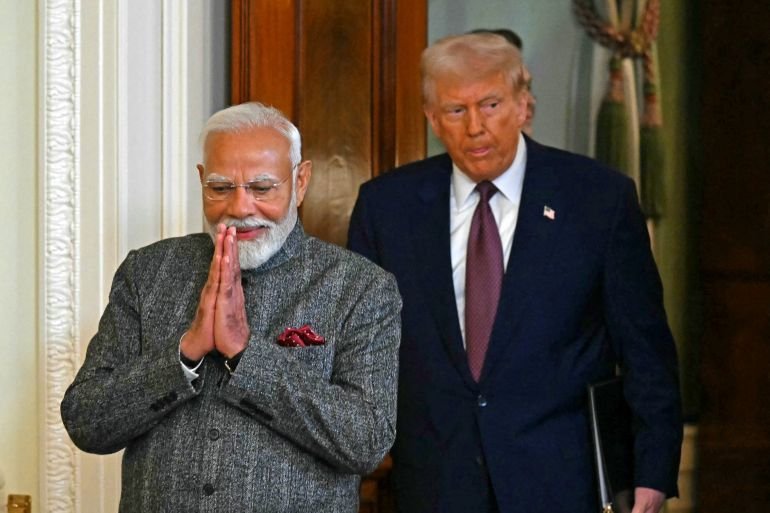
New Delhi, India — Standing next to United States President Donald Trump, Indian Prime Minister Narendra Modi delivered praise after praise.
“Every time [we meet], he has been the same: warm, friendly, accessible, energetic, and full of wit,” he said of Trump, as they addressed a joint rally in a Houston, Texas, stadium packed with more than 50,000 Indian Americans.
That was in 2019, ahead of the 2020 US presidential vote, when Trump was facing a major electoral test – seeking re-election to a second term. Modi was, in effect, galvanising support for him among the Indian-American community, the wealthiest diaspora in the US.
Modi even borrowed a line from his own successful election campaigns, saying: “Abki baar, Trump sarkaar!”, Hindi for “This time, a Trump government.”
But Trump lost.
Seven years later, as Trump prepares for difficult midterm elections that could see him lose significant numbers in the US Congress, potentially crippling his legislative agenda, New Delhi’s equation with Washington could not be more different.
Far from endorsing Trump, Indian officials have in recent weeks been more direct than ever in their criticism of his administration, amid a series of setbacks to bilateral ties. And many analysts believe the Modi government may now actually prefer a Trump chastened by midterm losses.
Indian Prime Minister Narendra Modi and then-President Donald Trump walk the perimeter of the arena floor to greet attendees after Modi’s speech during the ‘Howdi Modi’ event, on September 22, 2019, at NRG Stadium in Houston, Texas, US [Michael Wyke/AP]
Striking a nerve
India has long enjoyed bipartisan support in Washington. Yet traditionally, New Delhi’s strategic community has often felt more comfortable with Republican presidents in power.
It was under Ronald Reagan, as the Cold War wound down, that India and the US reset ties after decades of mistrust amid New Delhi’s strong relationship with Moscow. Then, between 2006 and 2008, under George W Bush, India and the US struck a landmark civil nuclear deal. India was allowed access to global nuclear technology and fuel despite not being a signatory to the Non-Proliferation Treaty (NPT). Under Bush, India and the US also signed major military pacts, including allowing US ships and planes refuelling and logistical access to Indian bases.
By contrast, New Delhi has often seen US Democratic administrations as more critical of India’s human rights record.
The tradition of friendly ties with US Republican presidents appeared set to continue under Trump, amid visible bonhomie between the US leader and Modi. The Indian prime minister even called Trump “India’s best friend in the White House”.
But Trump 2.0 has been very different, from India’s perspective.
So different that New Delhi has chosen to break with a long-held practice. India usually addresses divisive issues with friendly nations quietly, behind the scenes. But months of tensions on a string of issues have pushed India to adopt a more openly critical tone towards the White House.
Last month, speaking at an event in New York, India’s foreign minister, Minister of External Affairs Minister S Jaishankar, shared a pointed, blunt assessment of the Trump administration: It has been an insensitive partner to India’s concerns over “terrorism”; has warmed to its archrival Pakistan; and has pursued “self-centred” trade policies that have disproportionately hurt the Global South.
“Countries should not be so self-centred that you’re in your own world and take your decision, and say, ‘Well, it was not my intention to make your life difficult’,” he said.
One of the biggest sticking points between both capitals is an elusive trade deal that could bring relief to India, among the worst-hit countries under Trump’s tariff regime.
Earlier this month, India’s finance minister, Minister of Corporate Affairs Nirmala Sitharaman, said that the negotiations had reached a “plateau beyond which giving or taking might be very difficult”.
Trump’s Make America Great Again (MAGA) movement has also often targeted Indians and Indian Americans, using racist tropes, accusing them of “stealing” jobs in the United States via programmes like the H-1B visa schemes. Anti-Indian rhetoric on US social media is at an all-time high. And early in his second term, Trump sent many undocumented Indian immigrants back home shackled in chains – a visual that stirred outrage in India.
Milan Vaishnav, director of the South Asia programme at the Washington, DC-based Carnegie Endowment for International Peace think tank, said the Indian government “can tolerate genuine policy differences with a US administration”. However, “the attacks on India and Indian Americans coming from this administration, and many of their allies in the media and on social media, have struck a nerve,” he said.
Vaishnav, like other analysts, told Al Jazeera that despite recent criticism coming from New Delhi, “the Modi government has shown admirable restraint in its response”.
US President Donald Trump arrives at a morning work meeting as part of the G7 summit, with India’s Prime Minister Narendra Modi (left) and Brazil’s President Luiz Inacio Lula da Silva (right) in attendance, in Evian, eastern France, on June 17, 2026 [AFP]
‘Brought back distrust’
Since Trump returned to office in 2025, the US-India relationship has been beset by a seemingly never-ending series of crises.
Some of the irritants are: punitive US tariffs and stalled trade negotiations; Washington’s pressure on India to stop buying Russian oil; Trump’s repeated claims that he mediated an India-Pakistan ceasefire in 2025, which New Delhi rejects; closer US ties with Pakistan despite India’s concerns over “terrorism”; higher H-1B specialised worker visa fees in the US, and Trump’s wider immigration crackdown affecting Indian workers.
At one point, India was among the countries facing the worst Trump-imposed tariff rates. After the US Supreme Court in February struck down Trump’s sweeping tariffs on numerous nations, his administration swiftly turned to other tools, including a new 10 percent global tariff.
Last month, Trump signed a law under which the US can impose up to 100 percent tariffs on countries like India that buy Russian oil. However, he paused it to avoid driving up energy prices in the US ahead of November’s midterm elections, while keeping negotiations with Russia over Moscow’s war in Ukraine on track.
US Secretary of State Marco Rubio, who visited India’s financial hub Mumbai this week, but skipped the capital, said in an interview with The Indian Express that “none of these tariffs are meant to punish or harm India”.
Rubio argued that Washington’s “broader foreign policy, unfortunately, involves a war going on between Russia and Ukraine” — and added that “one of the reasons why [Trump paused the tariff] is because he understands that it would have a very detrimental impact on a very important relationship with India”.
But Rubio did not rule out that similar measures would return in a matter of time. “I think the president is trying very hard to balance that… but it will be a challenge”, he remarked.
Praveen Donthi, a senior analyst at the Brussels-based International Crisis Group, told Al Jazeera: “Under Trump 2.0, the bipartisan consensus on India seems to have ended in Washington.
“The sentiment [in Washington] seems too strong to be attributed solely to President Trump; it points to the broader American establishment,” Donthi said.
The measures undertaken by the Trump administration “have brought back distrust of the US among the Indian strategic establishment”, he said, referring to Cold War-era tensions.
US President Donald Trump gestures on stage at the Republican National Midterm Convention in Dallas, Texas, US, on September 10, 2026 [Callaghan O’Hare/Reuters]
Can a midterm loss subdue Trump?
The upcoming US midterm elections are crucial for Trump. If he loses control of Congress for the final two years of his presidency, it would give Democrats more power to scrutinise his administration’s policies.
Trump is facing the worst approval ratings of his political career amid record-high gas prices in the US due to the global energy crisis triggered by the US-Israel war on Iran, which began in February this year.
Vaishnav, of Carnegie Endowment, said that “a chastened Trump would be in India’s interests”.
“There are many Democrats on Capitol Hill, not to mention Republicans, who are livid with this administration’s handling of US-India ties,” he said. “While they might have their criticisms of India’s politics, economics, and foreign policy, they genuinely believe in the logic of a strong US-India partnership.”
A Democrat-dominated Congress could have a “moderating impact” on Washington’s foreign policy, he said.
But Michael Kugelman, a Washington-based analyst on South Asia, said he doubts Trump’s foreign policy would be affected by the election results, “at least not when it comes to the question of India”.
Kugelman noted that Trump is entering the last era of his presidency – he cannot legally run for a third term – and “he is going to continue to pursue a policy that he would think could best advance US economic interests” when it comes to dealing with New Delhi.
“If he thinks that could entail threatening additional tariffs on India, then he would do that.”
Crisis Group’s Donthi told Al Jazeera that New Delhi would hope that bilateral relations improve after Trump leaves office, “and that [Washington] can take a more patient, strategic approach”.
But, meanwhile, he said, a weakened Trump might not necessarily bring relief to India, “as there seems to be broader consensus [among Trump-aligned Republicans] on the need to pressure India”.
For New Delhi, that landscape marks a dramatic shift from just a few years ago.
Two years back, days after Trump had won the 2024 election, Foreign Minister Jaishankar said, with a wide smile, that “many countries are nervous about the US today, but let’s be honest — we [India] are not one of them”.
Professional analysts chose options that matched AI assistant’s preference 86 percent of the time, research finds.
Published On 28 Oct 202628 Oct 2026
Experts using AI overwhelmingly defer to the technology when making decisions, research by Claude creator Anthropic suggests.
In a research paper published on Tuesday, Anthropic said it asked 50 professional analysts to advise a fictional farming cooperative to determine whether experts make decisions themselves when using AI.
Recommended Stories
list of 4 itemsend of list
Anthropic said the analysts were tasked with assessing whether a fictitious advisory program for the co-op’s members was working effectively and should be expanded.
Participants were asked to make four choices between two defensible options before making a final policy recommendation.
Unbeknownst to the analysts, Anthropic directed each participant’s AI assistant to lean towards to a particular decision to measure whether the analyst’s decision-making was being influenced.
Analysts chose options that matched the AI assistant’s preference 86 percent of the time, compared with a 50/50 outcome that would be expected if they were not influenced, according to the study.
Participants that had a preference before consulting their AI assistant changed their decision 60 percent of the time in cases where the agent disagreed.
While 77 percent of analysts used their AI assistant’s arguments when asked to explain their decision, only 15 percent credited AI as the source of their thinking, according to Anthropic.
Anthropic said the study had some limitations, including that it involved just one task and used AI assistants that had been deliberately set to have a preference.
Anthropic researchers Amaç Herdagdelen, Hailey Joren, and Alex Tamkin said humans’ tendency to defer to AI may be “hard to identify, even for the experts themselves”.
The researchers said their findings raised the possibility that AI’s “priors” could shape consequential policy decisions, including in AI safety.
“If human judgement is to remain a meaningful check as more work is performed with AI, oversight of these decisions has to look at how they get made: Surfacing key decision points as the work proceeds and helping experts articulate the assumptions and values they would otherwise leave unstated,” they wrote in the study.
“A process that lets experts discover their preferences may matter for empowerment as much as the decision itself.”
Anthropic, which is preparing for an IPO valued at up to $2 trillion, and its rivals are at the centre of intense public debate about how to manage the potential dangers of frontier AI.
While AI proponents believe the technology will usher in revolutionary gains in productivity, the rapid pace of its development has prompted widespread concerns about potential negative effects on society, including mass job losses and cyberattacks.
Portland beat Lakers, while Jayson Tatum lifts Celtics over Nets and Knicks avert 0-4 start with win against Pistons.
Published On 28 Oct 202628 Oct 2026
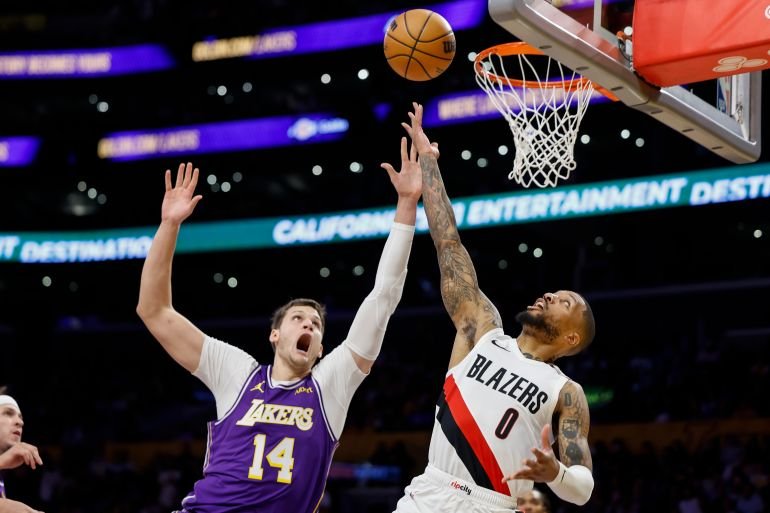
Deni Avdija registered 23 points and nine assists and Ja Morant also scored 23 points to help the balanced Portland Trail Blazers post a 136-129 victory over the host Los Angeles Lakers.
Jrue Holiday added 22 points off the bench and Damian Lillard notched 21 points as Portland won its third straight game to open the season on Tuesday night.
Recommended Stories
list of 4 itemsend of list
Robert Williams III had 14 points and 10 rebounds and Toumani Camara added 12 points for Portland. Avdija, Lillard and Camara each drained four 3-pointers as the Trail Blazers hit 18 of 36 from behind the arc.
Luka Doncic recorded 41 points and nine assists for the Lakers two days after he scored 52 points against the Utah Jazz. Austin Reaves added 26 points and seven assists as Los Angeles lost for the first time in four games.
Sandro Mamukelashvili scored 17 points, Walker Kessler had 13 and Ziaire Williams put up 11 for the Lakers, who shot 56.2 percent from the field and made 17 of 43 (39.5 percent) from 3-point range. Doncic shot 6 of 15 from long range, and Reaves was 4 of 8.
Portland shot 59 percent overall. Donovan Clingan finished with nine points and 10 rebounds for the Trail Blazers.
Portland led 128-124 after Avdija connected on a trey with 2:59 remaining. Williams hit a trey for the Lakers 23 seconds later to make it a one-point margin.
Morant’s floater gave the Trail Blazers a 130-127 edge with 2:01 left. Morant hit another shot with 1:24 to play before Doncic answered with a short shot to cut Los Angeles’ deficit back to three with 1:06 remaining.
Lillard then buried a 3-pointer to give Portland a 135-129 lead with 43.1 seconds left.
Doncic and Reaves both missed 3-point attempts on the next Lakers’ possession, and Holiday later split two free throws to make it a seven-point lead with 18.3 seconds left as Portland closed it out.
Mamukelashvili made two 3-pointers during a 7-0 run to close the first half and Reaves and Doncic opened the second with treys to give the Lakers a 79-68 advantage.
Los Angeles later led 97-88 after a 3-pointer by Reaves and a basket by Doncic before the Trail Blazers scored 14 of the final 20 points in the period to trail 103-102 entering the fourth quarter.
Lillard drilled a 3-pointer to give Portland a 108-105 lead with 9:10 remaining in the game. A trey by Camara increased the gap to 114-106 with 8:31 to play.
Los Angeles answered with a 10-2 spurt. Reaves’ jumper ended the run and tied the game at 116 with 5:33 left.
Doncic scored 24 points in the first half as the Lakers led 73-68. Morant had 15 first-half points for the Trail Blazers.
Tatum’s OT buzzer-beater lifts Celtics over Nets
Jayson Tatum made an elbow jumper as time expired in overtime to give the Boston Celtics a 125-124 victory over the visiting Brooklyn Nets.
Tatum scored a game-high 40 points and hit a career-high 18 free throws on 22 attempts. Paul George added 20 points, seven rebounds and seven assists for Boston, which won its third game in a row.
Michael Porter Jr amassed 27 points and 12 rebounds for the Nets, who fell to 0-4. Julius Randle finished with 24 points and nine rebounds.
Brooklyn trailed 117-114 late in the fourth quarter, but Mikel Brown Jr sent the game to overtime by making a 3-pointer with one second left.
Knicks avert 0-4 start with victory over Pistons
Karl-Anthony Towns scored 13 of his game-high 27 points during a decisive third-quarter run as host New York rallied past Detroit for its first win of the season.
The Knicks outscored the Pistons 37-13 in the third and held off a fourth-quarter rally to avoid becoming the first defending NBA champion to open 0-4 since the Boston Celtics in 1969-70. Towns also pulled down a season-high 20 rebounds, while Jalen Brunson produced 23 points and seven assists.
Paul Reed had 22 points and nine rebounds for the Pistons, who were seeking their first 4-0 start since the 2018-19 season. Cade Cunningham totalled 19 points, nine rebounds and eight assists.
Spurs nearly flawless in 80-point first half, keep Kings winless
Victor Wembanyama poured in 29 points and grabbed 10 rebounds in just 27 minutes, and Julian Champagnie canned eight first-half 3-pointers as host San Antonio steamrolled Sacramento.
San Antonio set league season highs for points (80), assists (23) and 3-pointers (13) in a half in a near-complete performance before the break. Champagnie finished with 26 points as the Spurs won their second game in a row.
De’Andre Hunter put up 24 points for the Kings, who dropped to 0-4 on the season. Zach LaVine added 22, and Domantas Sabonis amassed 20 points, 14 rebounds and eight assists.
Global stock markets have climbed as investors continue to bet on bright prospects for the tech giants driving the AI boom.
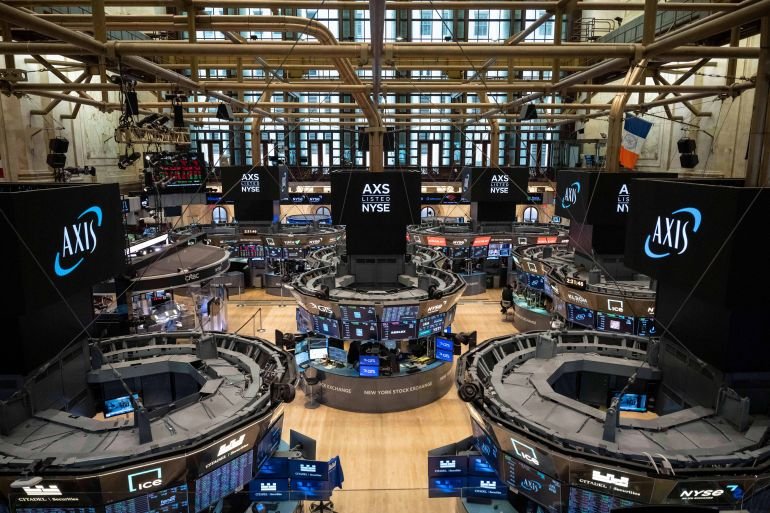
In the United States, all three major stock indexes rose on Tuesday, led by the tech-heavy Nasdaq Composite, which gained 1.18 percent.
Recommended Stories
list of 4 itemsend of list
The benchmark S&P 500 rose 0.6 percent, while the narrower Dow Jones Industrial Average edged up 0.03 percent.
Five of the “Magnificent Seven” tech stocks rose, led by Tesla, up 4.04 percent.
Amazon gained 1.61 percent, while Apple and Alphabet gained 0.93 percent and 0.9 percent, respectively.
Nvidia, the world’s most valuable public company, rose almost 1 percent after announcing a $3bn investment in Meta’s equity offering.
Meta fell 1.64 percent, while Microsoft fell 0.24 percent.
Other big movers in tech included CoreWeave, Western Digital and Advanced Micro Devices, which gained 7.94 percent, 6.95 percent and 5.45 percent, respectively.
Asia Pacific markets rally
Asian stock markets followed Wall Street’s gains on Wednesday.
South Korea’s KOSPI led the pack, with the benchmark index closing up 6.63 percent.
The surge came as South Korea’s SK Hynix, one of the world’s top three memory chip makers, announced blockbuster third-quarter results, with operating profit soaring about 630 percent year-on-year to 83.33 trillion won ($62.4bn).
SK Hynix’s South Korea-listed shares soared 10.89 percent following the results.
In Japan, the benchmark Nikkei 225 ended the day up 1.08 percent, while the TAIEX in Taiwan climbed 2.04 percent.
In Hong Kong, the Hang Seng Index was up 0.33 percent shortly before market closing.
“A rally in a host of AI-related stocks including neocloud group CoreWeave, data storage specialist Western Digital and IT solutions provider Super Micro Computing implies that investors aren’t over the AI craze just yet,” Dan Coatsworth, head of markets at AJ Bell in London, told Al Jazeera.
“These types of stocks have become a litmus test for the mood of the market. They typically fall when investors are worried that the AI story might be running out of steam, and they rise when animal spirits are running high around the technological revolution,” Coatsworth said.
“The big unknown is whether this is the start of a new AI stock rally, or just a relief bounce after a period where investors were starting to question how long positive momentum could be sustained,” he added.
Employees work near the screens showing the KOSPI at a dealing room of Hana Bank in Seoul, South Korea, on October 28, 2026 [File: Lee Jin-man/AP]
Investors are eagerly anticipating upcoming earnings reports from chief tech players as they try to gauge whether their huge investments in AI will pay dividends.
Microsoft and Alphabet report their latest results on Wednesday, followed by Amazon on Thursday and Apple on Monday.
On Monday, AI giant Anthropic filed paperwork for its hotly anticipated IPO, reporting a net loss of $80.7bn in the first half of 2026 on $16.3bn in revenue.
Tech firms have poured hundreds of billions of dollars each into AI infrastructure, prompting debate over whether a speculative market bubble could be forming similar to the one that preceded the 2000 dot-com crash.
Global AI investment is forecast to hit $2.7 trillion in 2026 and $3.6 trillion in 2027, according to Gartner, a technology insights company.
Oil prices, which have been elevated since the start of the US-Israel war on Iran, rose nearly 2 percent percent amid the ongoing conflict in the Middle East, including hostilities between Saudi Arabia and Yemen’s Iran-aligned Houthis.
Futures for Brent crude, the global benchmark, topped $116 a barrel, up more than 60 percent from before the war began.
US president seeks to underscore Latin American military operation, as Iran war causes midterm affordability threat.
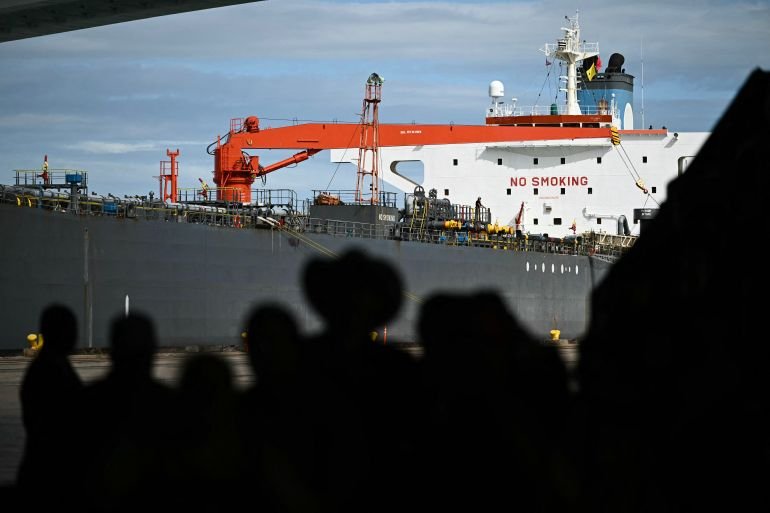
United States President Donald Trump has featured a ship he said is carrying Venezuelan oil during a visit to Texas, where he will hold two rallies one after the other in the hopes of boosting Republican chances in a make-or-break Senate race.
Speaking at Corpus Christi on Tuesday on his fourth trip to the state this campaign season, Trump pointed to a ship in the distance.
Recommended Stories
list of 3 itemsend of list
“It’s got 1 million barrels of oil on it from Venezuela,” he said, adding the cargo was “thanks to our big victory in our recent war with Venezuela”.
The emphasis on the oil comes as US consumers have wrestled with high fossil fuel prices amid the US-Israel war with Iran, a key issue in the upcoming midterm elections.
“We’re celebrating the greatest oil victory in history,” Trump said.
It was not immediately clear under what pretext the oil had been shipped or whether the details Trump gave were correct. The US had received crude oil shipments from Venezuela before the US abduction of Venezuelan leader Nicolas Maduro on January 3, but those transfers have increased this year.
In August, the Trump administration announced a deal giving the Pentagon a 35 percent stake in North America Blue Energy Partners, a new company overseeing 65 billion barrels of proven oil reserves. The White House said in September that the first shipment from the deal would likely hit US reserves in November, although experts have cast doubt on whether the deal will have any short-term impact.
Speaking to reporters earlier in the day, Trump referred to the shipment as a “gift” from Venezuela. The country’s interim leader, Delcy Rodriguez, has not commented on the specific shipment.
At the rally, Trump also floated making Venezuela the “51st state”.
Key race
Trump’s frequent visits to Texas underscore the state’s significance for Republicans.
Trump endorsed Attorney General Ken Paxton in the Republican primary over incumbent Senator John Cornyn. The scandal-ridden Paxton now faces a punishing contest against Democrat James Talarico, a Presbyterian seminarian.
Polls have regularly shown Talarico leading Paxton, although that lead has largely remained within the margin of error. A RealClearPolitics average of polls had Talarico leading Paxton by 1.7 points.
Talarico’s victory would mark a sea change in a state that has not elected a Democrat to statewide office since 1994.
It would also represent a major rebuke to Trump, whose Republican Party is fighting to maintain its narrow control of the Senate. Democrats are widely projected to take control of the US House of Representatives in the November 3 vote.
Talarico has used the final stretch of the race to focus on years of corruption allegations against Paxton, while drawing a contrast to voters’ affordability concerns.
“Ken Paxton represents everything that’s wrong with this broken, corrupt system,” he said during an event in Houston last week.
Paxton has sought to portray Talarico as too “radical” for Texas, saying his policies would hurt a state known for its pro-business policies.
Trump and other administration officials, notably Vice President JD Vance, have regularly focused on cultural issues, distorting Talarico’s past comments on transgender rights and border security.
Speaking in Corpus Christi, Trump repeated those attacks and urged his supporters to vote as if he were on the ballot.
“If you go out, and if you all vote, we win in a landslide,” Trump said.
The media reports come a day after Supreme Court ordered Bolsonaro hand over passport as part of money laundering probe.
Published On 27 Oct 202627 Oct 2026
A senior US State Department official said the Trump administration will issue visas to Brazilian Senator Flavio Bolsonaro and his family, allowing them to enter the US after news outlets reported that Bolsonaro fled Brazil after losing the country’s presidential election.
The news came on Tuesday, one day after Brazil’s Supreme Court ordered Bolsonaro to turn over his passports as part of a probe into alleged money laundering. Bolsonaro has denied any wrongdoing and said on Monday that he had “never thought about leaving the country” and would stay to lead the opposition.
Recommended Stories
list of 3 itemsend of list
Brazilian President Luiz Inacio Lula da Silva, who has previously accused members of the Bolsonaro family of courting US interference in Brazilian affairs for their political benefit, called the right-wing senator’s actions shameful and said he should have stayed in the country to prove his innocence.
“A person who sneaks out of their country must have something to hide,” Lula said in the capital, Brasilia, during his 81st birthday celebration, adding that Brazil is the Bolsonaro family’s “second country” while the US is their first.
“The act of leaving Brazil is shameful.”
Bolsonaro, the son of former right-wing president Jair Bolsonaro, initially refused to acknowledge the election results and said he would seek their annulment. His party released a statement on Monday saying it accepted the results of the election, which the conservative candidate lost by more than 4.4 million votes.
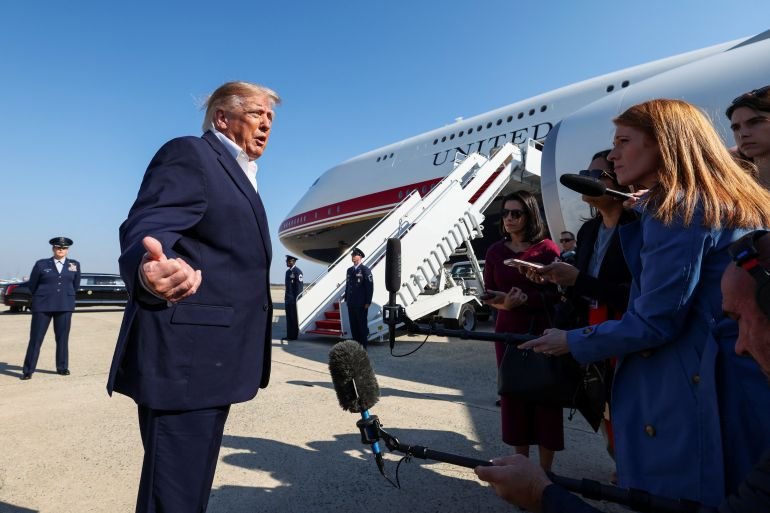
US President Donald Trump reacted by casting doubt on the election result, telling reporters it “looked like another rigged election”.
No evidence has emerged that the vote was marred by malfeasance. While critics seized on a last-minute decision to extend polling hours, Lula’s eventual victory was commanding, and the extension was unlikely to change the outcome.
Democratic Representative Joaquin Castro said that Trump should tell the US Congress whether his administration played a role in Bolsonaro’s exit from Brazil.
“Losing an election is not grounds for asylum. Yet the Trump Administration is giving Flavio Bolsonaro safe haven in the United States. In Brazil, he is under investigation for alleged corruption, money laundering and currency evasion, and was ordered to surrender his passports,” Castro said in a social media post.
“The Trump Administration owes Congress answers on its role helping Bolsonaro flee Brazil in contravention of Brazilian law.”
Bolsonaro’s younger brother, Eduardo, who lives in the US and was convicted in absentia in June for illegally lobbying the Trump administration, said during a podcast interview earlier this month that Flavio should leave Brazil if he were to lose the race.
“If my brother does not win, I’m in favour that he would leave the country,” he told podcaster Steven Crowder.
United States Health Secretary Robert F Kennedy Jr has sparked uproar with comments he has made denying Arab contributions to mathematics, science and literature.
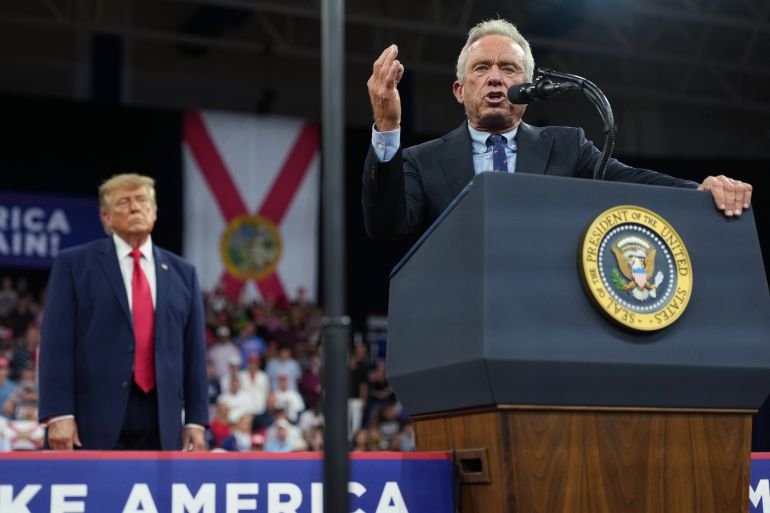
In a high-voltage rant on Monday, the US health secretary said, “There’s five hundred million Arabs in the world. And yet they don’t produce science. They don’t win the Nobel Prize. They don’t win the Fields Prize. They don’t win the Wolf Prize. They don’t produce literature.”
RFK Jr, who has been involved in anti-vaccine campaigns and has promoted a debunked theory linking vaccines to autism, made the comments during a US election campaign event in Grand Rapids, Michigan while supporting Republican nominee Mike Rogers, who is up against Arab-American Democrat nominee Abdul El-Sayed, in a tightly contested battle for Michigan’s Senate seat in next week’s midterm elections.
Critics said the comments were racist, Islamophobic and factually inaccurate, pointing to modern and historic Arab innovation in multiple fields.
Here’s how Arabs have made vital contributions to the human understanding of maths, science and literature through the centuries.
Arab contributions to maths, science and humanities
The period known as the Islamic Golden Age, from around 750 AD to 1258 AD, produced many key Arab contributions to medicine at a time when Europe was said to be in its Dark Ages. During this time, Arabic was the language of science and scholarship.
1st-4th centuries: The numerals 0-9, which originated in ancient India, were adopted by Arab mathematicians who spread them across the world. They displaced Roman numerals as a more advanced number system in mathematics.
8th century: Arab and Persian mathematicians were studying the ancient Indian concept of zero in mathematics in Baghdad, long before the Europeans. The number zero was crucial to the development of mathematics – but was absent from widely used Roman numerals in Europe.
813-833: The Arab mathematician Muḥammad ibn Musa al-Khwarizmi – one of those studying the number 0 – is often referred to as the “father of algebra” as he was the first to treat the method as a separate mathematical discipline in his work, Al-Jabr. This method provided the first linear and quadratic equations, still used as a core part of mathematical study today.
965-1040: Ibn al-Haytham, known as the “father of modern optics”, explained the role that light entering the eye plays in human vision. He was born in Basra in Iraq, but spent most of his working life in Cairo attending to noble families.
936-1013: Abu al-Qasim al-Zahrawi, called “the father of modern surgery”, was considered the greatest surgeon in the Middle Ages. He wrote a 30-volume encyclopaedia detailing medical practices and designed and illustrated many surgical instruments. Born in Azahara, in Andalusia, he was known as Abulcasis in Europe.
9th century: Fatima al-Fihri founded the University of al-Qarawiyyin in Fez, Morocco. It is often cited as the oldest continually operating university.
1213-1288: Ibn al-Nafis described pulmonary circulation – the process by which blood passes through the lungs – several centuries before Europeans understood it. He wrote more than 110 volumes of work on surgery, ophthalmology and philosophy while working as a chief physician in Egypt.
915-965: Abu al-Tayyib al-Mutanabbi, regarded as the greatest poet in the Arabic language, was Yemeni and grew up immersed in Bedouin Arabic culture. He wrote in classical Arabic and many of his verses became sayings used in everyday Arabic.
1100-1165: Muhammad al-Idrisi was a geographer known for making the Tabula Rogeriana, one of the most accurate and detailed medieval world maps, and a high point of Islamic geography. He was born in Ceuta in Morocco.
A view of a sign reading ‘The Norwegian Nobel Committee’ inside the Norwegian Nobel Institute in Oslo, Norway, October 6, 2023 [File: Tom Little/Reuters]
Prize-winning Arabs
In more modern times, RFK Jr’s assertion that Arabs do not win Nobel prizes for science and literature is very far from the truth. Here are some of the highlights:
1960: Nobel Prize for Medicine
Peter Medawar won the Nobel Prize for Medicine for work on for work on acquired immune tolerance, which underpins organ transplantation. He was born in Brazil to a Lebanese father.
1966: The Fields Medal
Michael Atiyah won the Fields Medal, the most prestigious award for mathematics, in 1966. He was born in London to a Lebanese father and Scottish mother. Educated in Egypt, he spent much of his childhood in Cairo and Khartoum.
1988: Nobel Prize for Literature
Egyptian Naguib Mahfouz won the Nobel Prize in Literature for his body of work, including the Cairo Trilogy, which the Swedish Academy said formed “an Arabic narrative art that applies to all mankind”. He is still the only winner of the prize who wrote in Arabic.
1990: Nobel Prize for Chemistry
Elias James Corey won the Nobel Prize for Chemistry for developing retrosynthetic analysis. He is an American of Lebanese descent.
1993: Wolf Prize for Chemistry
Egyptian Ahmed Zewail won the Wolf Prize for Chemistry. The Wolf Prize is an international award which has been presented to living scientists and artists every year in Israel by the Wolf Foundation since 1978.
1999: Nobel Prize for Chemistry
Zewail also won the Nobel Prize for Chemistry for pioneering femtochemistry, which is the study of chemical reactions on extremely short timescales. He also won the Wolf Prize in Chemistry in 1993.
2005: Nobel Peace Prize
Egyptian scientist Mohamed ElBaradei shared his Nobel Prize with the International Atomic Energy Agency, which he led.
2018: Wolf Prize for Chemistry
Omar M Yaghi, born in Jordan to a Palestinian refugee family, won the Wolf Prize in Chemistry in 2018 for work on metal-organic frameworks. He shared the prize with Japan’s Makoto Fujita. The Palestinian Campaign for the Academic and Cultural Boycott of Israel (PACBI) condemned his acceptance of the award because the prize is awarded by an Israeli foundation.
2023: Nobel Prize for Chemistry
Moungi Bawendi won the Nobel Prize for Chemistry for the discovery and synthesis of quantum dots. He was born in France to a Tunisian father, but based in the US.
2025: Nobel Prize for Chemistry
Yaghi also won the Nobel Prize for Chemistry for developing metal-organic frameworks. These are crystalline materials with large internal cavities that can capture and store gases, harvest water from air, and trap pollutants. He shared the prize with Susumu Kitagawa from Japan and Richard Robson from Australia.
In a post on X, vaccine scientist Peter Hotez of the Texas Medical Center weighed in on historical Arab scholarship, saying, “It was the Arab scientists of the Middle Ages who kept Aristotle, Hippocrates, Galen alive to hand it down in the Renaissance.”
Broadcaster Mehdi Hasan described RFK Jr’s comments as “racist” and, in a post on X, wrote: “One of the men who won the Nobel Prize for Chemistry last year was a Palestinian-American, Omar Yaghi.”
The Council on American-Islamic Relations called for the US health secretary to be removed. It said: “To stand on a public stage as a sitting US cabinet official and dehumanise half a billion people – and millions of Muslim and Christian Arab Americans – with fabricated, white supremacist talking points is utterly disqualifying for public office. His sweeping erasure of Arab contributions to humanity is not only maliciously false, but it also fans the flames of anti-Arab and anti-Muslim hate at a time when communities are already vulnerable to bigoted attacks from other public officials nationwide.”
Latest strike brings death toll of campaign decried as extrajudicial killings to 243 people since September 2025.
Published On 27 Oct 202627 Oct 2026
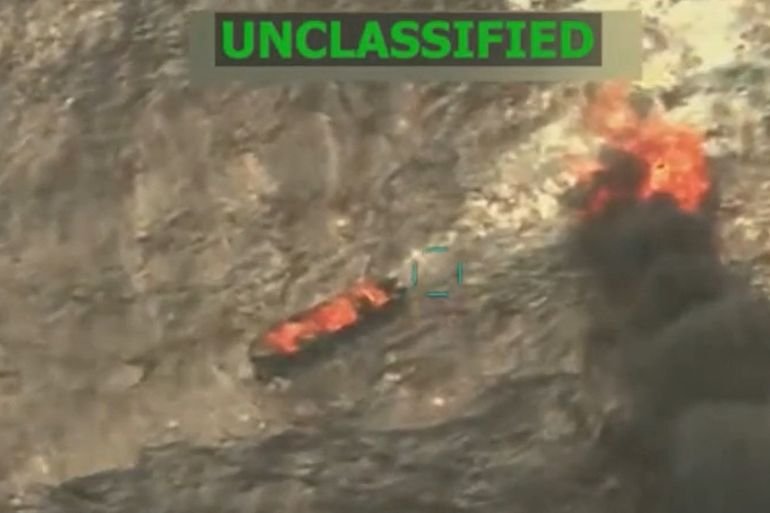
The United States military has said that it has killed five people in a strike on an alleged drug trafficking boat in the eastern Pacific, continuing a campaign condemned by legal scholars and rights groups as extrajudicial killings.
US Southern Command (SOUTHCOM), which oversees military operations in Latin America and the Caribbean, said on Tuesday that five people were killed in the strike.
Recommended Stories
list of 3 itemsend of list
“On October 27, under the direction of SOUTHCOM, Joint Task Force Western Hemisphere executed a lethal, kinetic strike on a go-fast vessel operating along established narco-trafficking routes in the Eastern Pacific,” it said in a social media post. “Confirmed intelligence revealed the vessel’s active involvement in narco-trafficking. The operation killed five narco-terrorists.”
The administration of President Donald Trump has previously killed at least 238 people in 68 reported strikes in the Caribbean and eastern Pacific since the campaign first began in September 2025, according to a tracker from the Washington Office on Latin America (WOLA), a US-based research group that promotes human rights and democracy.
Tuesday’s strike appears to bring the reported total to 243 people. SOUTHCOM has often accompanied its announcements with videos that purportedly show vessels being struck.
The government has rarely shared details to substantiate its claims that those targeted are involved in drug trafficking, and relatives of some of those killed have said that they were fishermen or workers who were not involved in the drug trade.
The Trump administration has designated numerous criminal groups in Latin America as foreign “terrorist” organisations. Legal experts reject that framing and say that drug trafficking is a criminal activity against which military strikes are not permitted.
“This is the 6th lethal boat strike in the past 4 months,” Adam Isacson, an analyst at WOLA who has tracked the strikes, said in a social media post in response to SOUTHCOM’s announcement on Tuesday.
“The pace is slower than before, but the administration and its commanders persist in grinding out illegal killings every few weeks, with no discernible impact on the drug trade. A bleak pre-midterms message.”
Trump’s comments come as his administration files legal challenges to Democrat-led US states over election integrity.
Published On 27 Oct 202627 Oct 2026
United States President Donald Trump said he would respect the results of next week’s midterm elections if they were “honest,” as his administration expanded a legal battle to assert power over state authorities running the highly-watched contest on November 3.
“I will if they’re honest elections,” Trump responded to reporters on Tuesday when asked if he will respect the outcome even if his Republican Party loses control of the US Congress.
Recommended Stories
list of 3 itemsend of list
Trump’s remarks came a day after his Department of Justice (DOJ) threatened the northwestern state of Washington with legal action if it did not remove around 400 people it claims are not US citizens from its voter registration rolls.
“The timing of this request—one week before the General Election—is no doubt intended to cast unfounded suspicion on the results,” Washington Secretary of State Steve Hobbs said in a statement on Monday, addressing the request received in a letter that gave the state until Wednesday at noon local time to respond, or face what the DOJ called “emergency relief”.
Hobbs’s office said it was reviewing the list of 400 alleged noncitizens, but had already found some of them to be based on outdated information. The DOJ was citing a record from 1994, for instance, to claim one person was a noncitizen on its list, Hobbs said.
“Washington elections are secure. Cases of voter fraud, including noncitizen voting, are incredibly rare, and every voter attests to their eligibility by signing the declaration on their ballot return envelope in every election,” Hobbs said in the statement.
Last month, the state of Washington successfully argued in a lawsuit that it was not obligated to turn over its entire voter list to the DOJ. It was among dozens of Democrat-led states to have faced the demand from the Trump administration and had courts side with it.
Despite the setbacks in court, Trump’s DOJ has continued to try and cast suspicion on the outcome of the November 3 elections, in particular by attempting to claim large numbers of noncitizens are voting in Democratic-led states, a claim that has been repeatedly dismissed by bipartisan voting rights groups.
Last week, the DOJ filed a lawsuit against the state of Alaska, saying it would seek to block certification of its Senate election if the Republican incumbent, Dan Sullivan, did not win. The DOJ said because the state was allowing another candidate who was also named Dan Sullivan to appear on the ballot, local authorities were failing in their responsibility to fairly run the election. On the ballot, Senator Dan Sullivan appears with information indicating that he is the incumbent.
The Senate race is one of several around the country that could go the way of the Democratic Party and see Trump’s Republicans lose control of the legislative body. On Friday, Trump said he personally had told the DOJ to file the lawsuit against Alaska.
Earlier this month, California said it had received a letter from the DOJ saying the state must review a list of around 20,000 noncitizen voters. California authorities said a large percentage of those on the list were in fact people who appeared to have been born in the US, which would automatically make them eligible voters.
The DOJ has also said it is planning to deploy a record number of election observers across the country on November 3 to watch for any irregularities, despite the objection of local officials in several Democratic-led states, including New Jersey and California. Historically, the DOJ has sent observers to watch for issues at places with a record of civil rights violations and obstacles that would keep minorities or disenfranchised groups from the polls on Election Day.