Tag: Al Jazeera

  • WNBA Finals: Valkyries beat Dream to reach the brink of their first title

    WNBA Finals: Valkyries beat Dream to reach the brink of their first title

    Kiah Stokes and Veronica Burton shine for Golden State as Angel Reese’s Atlanta team was stifled by a strong defence.

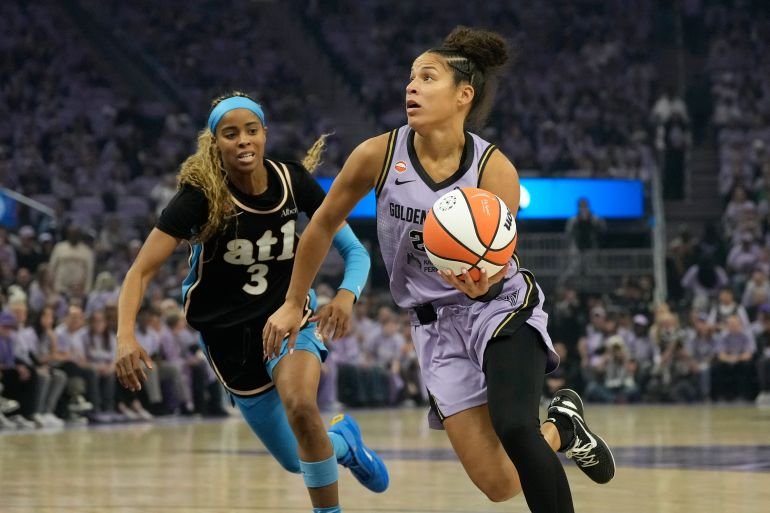
    Kiah Stokes and Veronica Burton each scored 13 points to help secure Golden State’s 64-55 victory over Atlanta, putting the Valkyries on the brink of winning the Women’s NBA Finals.

    Tiffany Hayes and reserve Cecilia Zandalasini each added 12 points for the Valkyries while Stokes and Burton each pulled down a team-best eight rebounds in Game 5 on Monday.

    Golden State seized a 3-2 lead over the Dream in the best-of-seven championship series, which continues on Thursday in Atlanta.

    “We’re not done yet. We’ve got one more,” Stokes said. “We need two hoops, 94 feet and each other and that’s all we need.”

    The Valkyries, in only their second WNBA campaign, kept Dream star Angel Reese to seven points on 2-of-8 shooting, although she grabbed a game-high 15 rebounds.

    Atlanta Dream forward Angel Reese, middle, shoots against Golden State Valkyries forward Kayla Thornton, left, forward Cecilia Zandalasini (24) and guard Veronica Burton (22) during the first half of Game 5 of the WNBA basketball finals, Monday, Oct. 26, 2026, in San Francisco. (AP Photo/Jeff Chiu)
    Atlanta Dream’s star forward Angel Reese was held back in Game 5 by GSV’s strong defence [Jeff Chiu/AP]

    Golden State dominated defensively, keeping Atlanta to a season-low in points on 19-of-65 (29 percent) shooting from the floor.

    “That has just been our staple all season. We really rely on our defence,” Stokes said.

    “They are tough. We have to make sure we’re all doing our part. It’s a team for a reason.”

    Stokes had a game-high four blocked shots and has had at least three blocks in every finals game.

    Rhyne Howard led Atlanta with 20 points while Jordin Canada added 12.

    The Valkyries have been a hit with spectators in the home arena of the NBA Golden State Warriors.

    “You all are amazing,” Stokes screamed to a cheering crowd moments after the triumph. “We couldn’t do this without you all.”

  • Melania or the pope: Who brokered Russia-Ukraine ceasefire in Oleshky?

    Melania or the pope: Who brokered Russia-Ukraine ceasefire in Oleshky?

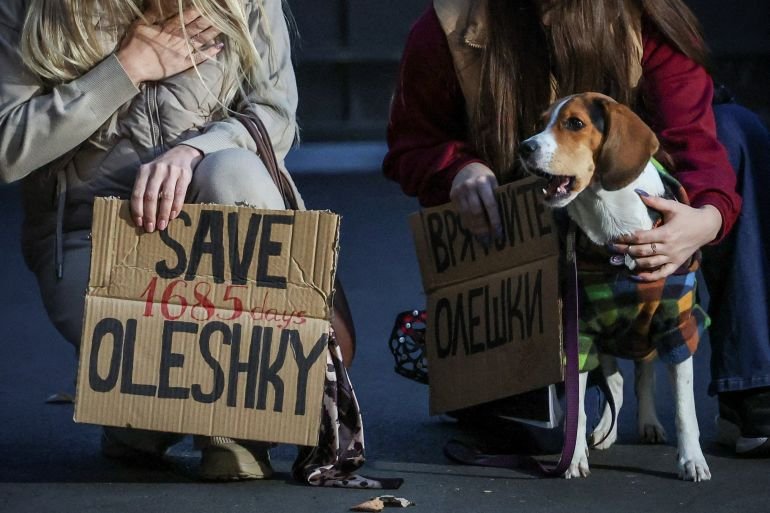
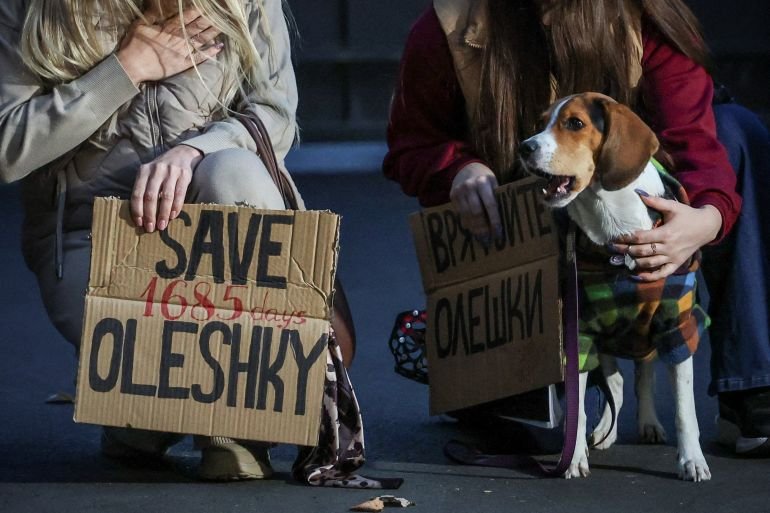
    A critical localised ceasefire in Ukraine that promises to help more than 1,000 civilians has set off an unlikely contest over who brokered the truce.

    The White House insists that United States’ First Lady Melania Trump mediated the ceasefire in Oleshky between Russia and Ukraine, after weeks of increasingly alarming reports from the town warning of a growing humanitarian crisis.

    Recommended Stories

    list of 3 itemsend of list

    But the Vatican has offered its own narrative, suggesting that the pope was responsible for helping the pause in fighting through phone calls with Russian President Vladimir Putin and Ukrainian President Volodymyr Zelenskyy.

    Here’s what we know about the Oleshky ceasefire, and why the diverging versions of what led to the truce matter:

    What’s the ceasefire about?

    Russia took the southern Ukrainian town of Oleshky in the Kherson region in the early days of the invasion in February 2022 and has retained control over it since.

    But the town has suffered from extensive war damage and was later hit by flooding after the destruction of the nearby Kakhovka Dam in 2023.

    According to residents and officials, those who remain in the town, which the US estimates at 1,700-2,000 residents, have reported severe shortages of food, medicine, and other supplies.

    Then, on October 23, a brief ceasefire was announced. Ukrainian and Russian officials have said the pause in fighting over Oleshky will allow the delivery of humanitarian assistance and the evacuation of those who want to leave the Russian-occupied town.

    They’ve added that humanitarian corridors would be established to allow for aid deliveries.

    Both sides have said this ceasefire, which is scheduled to end on Sunday, is not a comprehensive end to hostilities. Multiple diplomatic efforts to end the war have so far failed.

    Still, the Kremlin said on Monday that the truce might set a precedent for similar localised ceasefires in the future.

    On Telegram, Russia’s Ministry of Defence announced that it had stopped shelling in the direction of Ukraine’s city of Kherson from 4am Moscow time (01:00 GMT) on Tuesday, to prepare for the effort in Oleshky.

    “As head of the Ukrainian negotiating team, I confirm that the Ukrainian side is honouring its commitments,” Dmytro Lubinets, the parliamentary commissioner for human rights, said in a Facebook post confirming Russia’s timing of its halt.

    What have Melania and the White House said?

    Announcing the ceasefire on Friday, US First Lady Melania Trump said the situation in the town was “dire”, and it was on the “brink of disaster”.

    “The people of Oleshky have limited electricity, live amid mined roads, and endure regular military attacks. It was abundantly clear that without my intervention, the possibility to bring humanitarian aid into the city and to evacuate the elderly would be impossible,” she said in a statement issued by the White House.

    It added that Melania and her representatives had worked closely with Russian and Ukrainian leadership to define the terms of the ceasefire.

    “Non-military, civilian leaders from both countries will work together to visit Oleshky residents in their homes and determine the level of assistance they require. Residents who wish to evacuate will receive coordinated support and transportation to their preferred destination. I anticipate some will want to go to Russia, and some to Ukraine,” said Melania.

    Ukrainian human rights ombudsman Dmytro Lubinets also publicly thanked the first lady and her team for helping coordinate the talks. Russian officials confirmed the agreement.

    What is the Vatican saying?

    The morning after the White House announcement, the Vatican published a front-page article in its official newspaper, L’Osservatore Romano. The headline: Humanitarian truce for Oleshky.

    The article underscored that the ceasefire was secured after Pope Leo spoke to Russian and Ukrainian leaders, urging them to agree to the pause in fighting to help save trapped civilians.

    Pope Leo spoke to Russian President Vladimir Putin via phone call on October 16 and expressed his “deep concern about the grave humanitarian situation in the city of Oleshky”, adding that he had called for a ceasefire to allow for food and medical assistance.

    The pontiff made the phone call while he was in hospital recovering from surgery to remove a cancerous tumour in his lung.

    Three days later, on October 19, Pope Leo also spoke with Ukrainian President Volodymyr Zelenskyy about the situation in Oleshky.

    The pope’s special envoy, Cardinal Matteo Zuppi, had pressed Russian authorities on conditions in Oleshky during a visit to Moscow in late September.

    Hasn’t Trump tussled with the pope before?

    US President Donald Trump and Pope Leo have had a strained relationship.

    Pope Leo, the first US pope in history, has criticised Trump’s decision to launch the Iran war, saying it violated Catholic moral principles of a “just war”.

    In April, responding to Leo’s critiques, Trump said the pope was “weak on crime, weak on nuclear weapons”, and that he would not have been elected pope if Trump wasn’t president – claiming, without evidence, that his presidency had helped Leo into the position.

    “Leo should get his act together as Pope, use Common Sense, stop catering to the Radical Left, and focus on being a Great Pope, not a Politician. It’s hurting him very badly and, more importantly, it’s hurting the Catholic Church!” Trump wrote on Truth Social at the time.

    Does this matter for the US midterm election?

    Among Catholics, Trump’s popularity is low. Refusing to even mention the pope’s role in the Oleshky ceasefire is unlikely to help him.

    The midterms, scheduled for next week, often reflect a sitting president’s performance as voters decide whether Trump’s Republicans can retain control of Congress.

    A Pew Research Centre study conducted between September 28 and October 4 suggested that Trump’s approval rating among Catholics has fallen from 47 percent at the start of his second term in January 2025 to just 30 percent in October 2026. As many as 20 percent of US adults identify themselves as Catholic.

    Among white Catholics, Trump’s popularity has fallen from 59 to 39 percent, while among Hispanic Catholics it has crashed from 31 to 18 percent.
  • Hegseth heads to Manila to shore up US ties with Asia-Pacific partners

    Hegseth heads to Manila to shore up US ties with Asia-Pacific partners

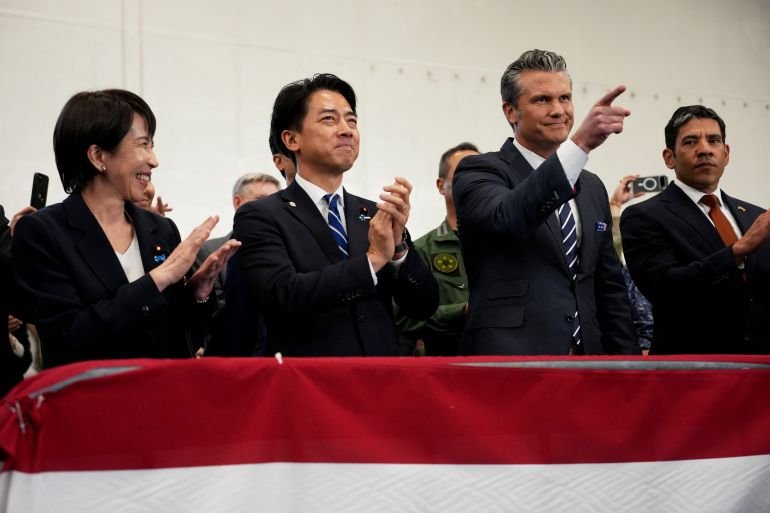
    US Secretary of Defense Pete Hegseth will attend a Southeast Asian defence meeting this week alongside his counterparts from India, South Korea and Japan as Washington looks to solidify ties with the region after a year overshadowed by the fallout from the US-Israel war on Iran.

    The meeting will bring together defence officials from the 11-member Association of Southeast Asian Nations (ASEAN) plus eight of the bloc’s dialogue partners.

    Australia, New Zealand, Russia and China are also expected to send representatives to the talks, which run from Wednesday to Thursday in the Philippines.

    Known as the ASEAN Defense Ministers’ Meeting-Plus (ADMM-Plus), the meeting will be held alongside a parallel ASEAN members-only event for Brunei, Cambodia, Indonesia, Laos, Malaysia, Myanmar, the Philippines, Singapore, Thailand, Timor-Leste, and Vietnam.

    India is among the dialogue partners that will host bilateral meetings on the sidelines of ADMM-Plus to “review the ongoing defence ties and explore ways to further strengthen strategic partnerships”, according to state media.

    William Yang, senior analyst for Northeast Asia at the International Crisis Group, told Al Jazeera that the focus will be on regional security concerns like Myanmar’s ongoing civil war and maritime disputes between ASEAN states and neighbouring China.

    “The South China Sea dispute is going to be front and centre because the Philippines is the chair of this year’s summit,” he told Al Jazeera, adding that he expects Manila to push for ASEAN to finalise a code of conduct with China to outline how to approach maritime disputes and handle conflicts in the globally important waterway.

    The Philippines, China, Vietnam, Malaysia, Brunei, and Taiwan all have overlapping territorial claims to the South China Sea, although Beijing claims most of it as domestic waters.

    These disputes often leave Beijing at odds with its neighbours, and particularly Manila, as both sides claim the uninhabited Scarborough Shoal and parts of the Spratly Islands.

    Tensions escalated sharply this month with at least “eight close encounters” in the South China Sea and nearby Luzon Strait, according to the US Naval Institute.

    The spat turned into a war of words when Chinese Ambassador to the Philippines Jing Quan said Beijing could “easily win” a war with the Philippines, prompting a Philippine senator to call for his expulsion.

    Beijing has yet to confirm whether Chinese Defence Minister Dong Jun will attend ADMM-Plus in person, but he could still make a last-minute appearance. The Chinese defence chief attended ADMM-Plus 2024 and 2025, according to Bonnie Glaser, managing director of the German Marshall Fund’s Indo-Pacific Program, and Hegseth’s presence could factor into Beijing’s calculations.

    China and the US have spent the past year thawing their relationship. A face-to-face meeting between Hegseth and Dong could also lay the groundwork for two meetings between US President Donald Trump and Chinese President Xi Jinping scheduled for later this year, following two previous meetings between Trump and Xi this year.

    “It is certainly possible that he will attend again this year,” Glaser told Al Jazeera by email. “I would not be surprised if Dong meets with Secretary Hegseth, especially since China has repeatedly said that it attaches importance to strengthening crisis communications and preventing crises between the US and Chinese militaries.”

    Analysts, however, say that the bulk of Hegseth’s work at ASEAN will be reassuring the bloc and its dialogue partners that the US remains committed to the region amid its months-long conflict with Iran.

    The US has raised eyebrows in Asia over the past year by moving some of its military assets from South Korea and Japan to the Middle East, while Trump has also sent mixed signals on his views on Taiwan, another potential flashpoint for the region.

    Trump has reportedly delayed a major arms package to Taiwan, an unofficial US ally, ahead of an upcoming meeting with Xi at the Asia-Pacific Economic Cooperation (APEC) summit in November, before the Group of 20 (G20) Leaders’ Summit in December.

    “What Hegseth says and does will be interesting,” said Ja Ian Chong, a political scientist at the National University of Singapore, because of recent comments by US defence official Elbridge Colby suggesting that Washington would focus less on empty gestures and more on substance in the Asia-Pacific region.

    “How Hegseth keeps to these lines while trying to keep a US advantage will be interesting, since these are not easy calibrations to make,” Chong said.

  • Russia halts strikes on Ukraine’s Kherson as Oleshky ceasefire takes effect

    Russia halts strikes on Ukraine’s Kherson as Oleshky ceasefire takes effect

    The localised ceasefire, secured by US First Lady Melania Trump, will allow evacuations and aid deliveries to Oleshky.

    Russia has suspended strikes on the Ukrainian province of Kherson as a localised ceasefire takes effect ahead of a humanitarian mission led by the United States’ First Lady Melania Trump.

    The pause in fighting started at 01:00 GMT on Tuesday, according to the Russian Ministry of Defence, to allow for an aid mission into the Russian-occupied town of Oleshky in southern Kherson later this week.

    Recommended Stories

    list of 3 itemsend of list

    The mission will enable aid deliveries and allow evacuations from the front-line town, which is suffering acute shortages of food, medicine and other basic supplies.

    The agreement was announced on October ‌23 and brokered by the US first lady, with the additional involvement of Pope Leo XIV, as Washington seeks to revive peace talks between Moscow and Kyiv after more than four and a half years of fighting.

    Up to 2,000 people remain in Oleshky. They have been unable to leave because of explosive mines and drone attacks in the area, according to the United Nations.

    In this undated image from video provided by the Ukrainian 34th Separate Marine Brigade "Borysfen" on Sept. 30, 2026, destroyed cars are seen on a highway from the Russian-occupied city of Oleshky in the Kherson region of Ukraine.
    Destroyed cars are seen on a highway from the Russian-occupied city of Oleshky in the Kherson region of Ukraine [File: Ukrainian 34th Separate Marine Brigade ‘Borysfen’ via AP]

    Matthias Schmale, the UN’s resident and humanitarian coordinator in Ukraine, told Al Jazeera that civilians were trapped in the town “without a guaranteed safe exit route”.

    The assessment was based on interviews UN human rights monitors conducted with residents who had managed to get out “at great risk”, he said, as well as on information from credible civil society organisations.

    “We hope that the announced ceasefire focused on Oleshky will bring the much-needed relief to their situation and allow both humanitarian aid to reach them as well as enable those who want to leave to do so safely,” he said.

    The town, which had a pre-war population of 24,000 people, lies on the eastern bank of the Dnipro River in the partially occupied Kherson region, opposite Kherson city, which is held by Ukrainian forces. Russian troops seized Oleshky during the first ⁠days of their February 2022 invasion and have controlled it ever since.

    Oleshky has suffered extensive war damage and was hit hard by flooding after the destruction of the nearby Kakhovka Dam in 2023.

    The localised ceasefire is due to last through Saturday, or longer, amid deep mistrust between Russia and Ukraine that has thwarted previous attempts at ceasefires.

    Negotiators involved in the aid mission said doctors, medicines, food supplies and water would be taken to Oleshky before evacuation corridors are opened.

  • AI makes discoveries in mathematics, computer science, physics, OpenAI says

    AI makes discoveries in mathematics, computer science, physics, OpenAI says

    OpenAI has announced that its AI models have made several scientific discoveries in mathematics, computer science and physics.

    The AI giant said on Monday that the three new discoveries concerned the fields of harmonic analysis, complexity theory and quantum field theory.

    Recommended Stories

    list of 4 itemsend of list

    Among the discoveries, AI models proved the local smoothing conjecture, one of the central propositions of harmonic analysis, in every spatial dimension for the first time, according to OpenAI.

    Researchers in harmonic analysis, a branch of mathematics that studies how complex signals and functions can be broken down into elementary waves, had previously only proved the theory in three dimensions.

    ‘Historic development’

    Alex Iosevich, a professor of mathematics at the University of Rochester who specialises in harmonic analysis, said OpenAI appeared to have “cracked” the conjecture in a “historic development”.

    “The conjecture was formulated by my PhD adviser, Chris Sogge, so it is near and dear to my heart, and the news was a shock at first,” Iosevich told Al Jazeera.

    “Now I am filled with joy and optimism, because the scientific enterprise as a whole is going to make giant leaps as a result of the AI revolution, and we have the chance to be a part of this historic development.”

    Iosevich said he expected the field of theoretical mathematics to “change drastically” due to AI.

    “I feel a twinge of sadness as a result,” Iosevich said.

    “Many theoretical mathematicians I know feel the same way, but I firmly believe that these feelings will soon give way to the realisation that there is so much we can now accomplish.”

    “Problems in pure mathematics did not arise in a vacuum,” he added. “Many of them came out of concrete physical considerations, and these connections can now be explored rapidly and decisively.”

    According to OpenAI’s announcement, its models also disproved the Exponential Time Hypothesis, which relates to the time it takes to solve complex computational problems, and provided “mathematically rigorous” proof of quantum chromodynamics, which studies the interaction of quarks and gluons.

    Ryan Williams, an expert in computational complexity theory at MIT, said a confirmed refutation of the Exponential Time Hypothesis would be a major development.

    “The ETH has been widely believed true since the late 1990s and a great deal of theoretical computer science was built on it being true,” Williams told Al Jazeera.

    “We are working to verify and examine their proof and determine if it holds up,” Williams said.

    “Their proof proposes a mysterious new method to more efficiently solve a variety of fundamental problems that have a wide range of potential applications.”

    Williams said that while the development would not have real-world applications in the short-term, it could potentially lead to many “future real-world benefits for society”.

    “It is hard to predict what will be possible next, because it’s a shocking development,” he said.

    The ChatGPT creator said it had reached out to scientists outside the company to turn its “raw research data into scientific understanding”.

    The San Francisco-based company said it decided on several different methods for releasing the findings based on consultations with three expert groups chosen to act as “shepherds”.

    While the groups collaborating on the mathematics and computer science problems opted to make the AI-produced data public immediately, the physics group decided to defer the release in order to write up their own interpretation of the findings, OpenAI said.

    “All of these approaches involve tradeoffs,” OpenAI said.

    “On the one hand, the collaborations empower experts to foster unpacking the results and contextualizing them in the broader academic community,” the $852bn start-up said.

    “On the other hand, choosing initial shepherds necessarily shapes who gets involved first and creates asymmetry of information. We welcome feedback on how to broaden participation and make this process more useful.”

    OpenAI’s announcement is the latest in a series of claimed scientific breakthroughs credited to AI.

    Last month, Claude creator Anthropic announced the discovery of a new enzyme said to resemble CRISPR, the groundbreaking gene editing mechanism used in treating conditions such as cancer and sickle cell disease.

    Anthropic’s announcement drew mixed reactions among scientists.

    While some researchers hailed the finding as an exciting development, others suggested that the AI company had exaggerated its significance.

  • US court rules against Trump administration in California voting case

    US court rules against Trump administration in California voting case

    A United States appeals court has ruled against the administration of President Donald Trump in its bid to block the state of California from counting certain mail-in ballots this election cycle.

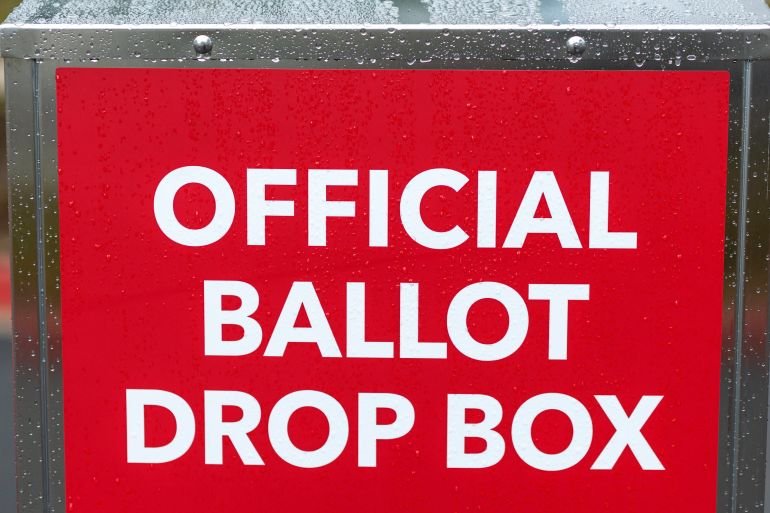
    In a decision on Monday, the 9th US Circuit Court of Appeals denied a request from the government to sequester roughly 20,000 mailed ballots ahead of the November 3 midterm election.

    Recommended Stories

    list of 3 itemsend of list

    The Trump administration had asserted that the ballots were sent to people who are “likely” non-citizens.

    But it has not publicly revealed how it created its list or determined that the voters identified upon it were ineligible due to their citizenship status.

    In a two-to-one decision, the appeals court said the Trump administration had not given lower courts enough time to review the case. It therefore declined to stop California’s ballot tabulation.

    The court’s majority also underscored that election administration was the state’s responsibility under the US Constitution.

    The Trump administration was asking “the federal court to dictate to a state legislature a matter squarely within the state’s traditional domain”, Judge Gabriel Sanchez wrote in his opinion.

    Sanchez also warned that granting the Trump administration’s petition would be “inviting disorder and confusion for voters and election officials alike”.

    The Trump administration filed its lawsuit against California on October 15, less than three weeks before the midterm vote on November 3.

    California is a Democrat-led state, and Trump, a Republican leader, has repeatedly made unfounded claims that the state is prone to “cheating” in its elections.

    The case is currently being weighed in a lower court, with a hearing scheduled for Tuesday.

    But the Trump administration sought an expedited decision from the appeals court, pointing to the looming election date.

    The midterm elections are critical to determine which political party holds power in Congress.

    Currently, the Republican Party maintains slim majorities in both the House of Representatives and the Senate, but experts project the Democratic Party is on track to make significant gains, flipping one or both chambers.

    In the lead-up to the midterms, Trump has raised the prospect of non-citizen voting as a threat to election integrity.

    But experts say such voting is rare. California officials have likewise cast doubt on the administration’s claims of 20,000 ballots going to “likely non-citizens”, and they framed the administration’s lawsuit as an effort to interfere in the voting process.

    “At best, this litigation is a reckless political stunt,” lawyers for California Secretary of State Shirley Weber said in a court filing on October 20. “At worst, it threatens to disenfranchise thousands of Californians this election.”

    Trump’s Department of Justice has sued 30 states and Washington, DC, for complete access to voter rolls that include sensitive personal data.

    It has argued that releasing such information is necessary to prevent alleged voter fraud.

    But the department has lost 26 of those cases thus far, with opponents successfully arguing that such manoeuvres could scare away voters and interfere with state election administration.

    The Trump administration has yet to win any of the 30 cases.

    Despite claims to the contrary by Trump and his allies, cases of illegal voting, including by non-citizens, are few and far between. Non-citizens are barred from participating in federal elections in all 50 states in the US.

    In July, an investigation by the news service Reuters found only 129 cases of noncitizens being charged by federal authorities with illegal voting since 1996.

    Many of those cases involved mistakes, like administrative errors or individuals being uncertain of voting rules, rather than fraudulent intent.

    Voting rights advocates have also pointed to flaws in how the Trump administration has identified potential non-citizen voting, signalling some eligible voters may be disenfranchised as part of its efforts.

    Immigration agents under Trump have been assigned to ferret out non-citizen voters, in some cases knocking on doors to inquire about the citizenship status of the residents inside.

    Last week, the administration charged 28 immigrants in California with illegally voting.

    But reporting from the Los Angeles Times found that some of the accused reacted to the charges with confusion and maintained that they never registered to vote.

    Trump has a history of promoting false claims of election fraud in order to justify greater federal influence over the voting process.

    In 2020, he lost his bid for re-election to Democrat Joe Biden, but he denied his defeat, instead blaming vote “rigging”. That claim prompted some of Trump’s supporters to storm the US Capitol on January 6, 2023, in an apparent effort to halt the election certification.

  • Former FBI director James Comey hit with third set of charges under Trump

    Former FBI director James Comey hit with third set of charges under Trump

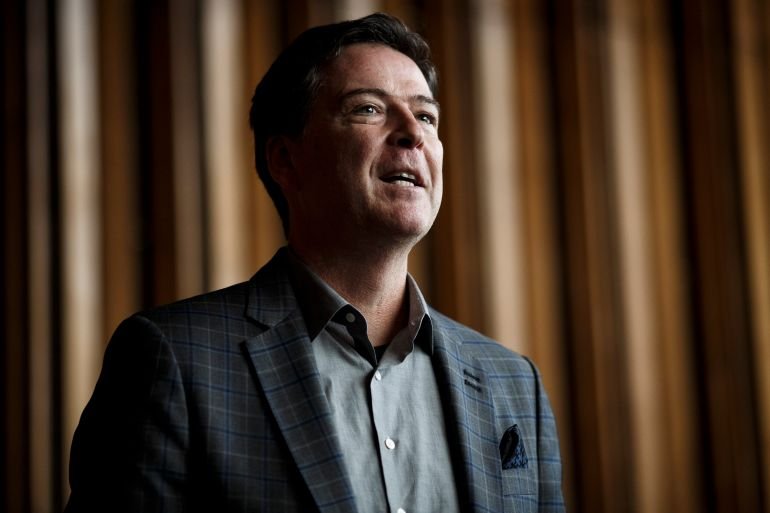
    James Comey, the former director of the Federal Bureau of Investigation (FBI), is facing a third set of criminal charges under the administration of United States President Donald Trump.

    On Monday, sealed documents came to light showing that the Trump administration has accused Comey of two counts related to the unlawful dissemination of “information related to national defence”.

    Recommended Stories

    list of 3 itemsend of list

    Comey, a high-profile Trump critic, has not been indicted in the case. He has denied any wrongdoing.

    But it is the third time the Trump administration has sought to level criminal charges against the former FBI director since the president returned to office in January 2025.

    In an October court filing, prosecutors accuse Comey of ordering his FBI colleagues to leak information to the news media.

    “The defendant [Comey] through one or more co-conspirators directed Individual #1 to disclose national defence information to a reporter for a national news publication,” the court filing reads.

    In a video published on the online platform Substack, Comey once again denounced the Trump administration’s attempts to prosecute him as a campaign of political retribution.

    “Well, now they’re back again. It would almost be funny if it weren’t such an appalling abuse of the Department of Justice, one that we cannot become numb to,” Comey said.

    “Nothing’s changed with me. I’m still innocent, and I’m still not afraid of these people, and I still believe in the independent federal judiciary.”

    Comey also noted that Trump is only midway through his second term, and he hinted that he expects more criminal charges to come his way.

    “The next couple years are going to be hard for all of us,” Comey added. “It’s really important that we stand straight and keep the faith in America.”

    The latest charges pertain to a New York Times article from October 5, 2016, which describes how the email platform Yahoo was ordered to scan traffic on its site for a specific computer signature allegedly tied to a “terrorist” organisation.

    Prosecutors have accused Comey of directing sensitive information to be disclosed to the reporter on that story, Charlie Savage.

    In a statement released to news media, Comey’s defence lawyer Pat Fitzgerald framed the charges as feeble, claiming that the government had already investigated the matter twice before.

    “Both times the Government determined that no charges should be brought against anyone,” the statement said.

    Fitzgerald pointed out that government prosecutors had not sought an indictment, which involves presenting charges to a grand jury that must then choose whether to approve the criminal charges.

    Instead, they are seeking to charge Comey through a process called a “criminal information”, which allows prosecutors to bypass a grand jury.

    “Ten years after the article was published, the Government filed an ‘Information’ against Mr Comey that was not approved by a judge nor issued by a grand jury,” Fitzgerald said. “It purports to charge Mr Comey with crimes that he did not commit.”

    Federal Judge Trevor McFadden, from the US District Court in Washington, DC, is overseeing the case. He is a Trump appointee.

    Trump has long sought the prosecution of Comey, whom he fired from the role of FBI director in 2017, during his first term as president.

    Comey had been FBI head since 2013. But his dismissal came as the FBI investigated the possibility of collusion between Russia and Trump’s 2016 presidential campaign, a probe that Trump has repeatedly denounced as a “hoax”.

    Following Trump’s second inauguration in 2025, his administration has sought the prosecution of several of the president’s critics, including Comey.

    In September 2025, Trump appeared to request that then-Attorney General Pam Bondi look into Comey and other perceived political adversaries.

    “Nothing is being done. What about Comey, Adam ‘Shifty’ Schiff, Leticia???” Trump wrote to Bondi in a social media post, referencing the former FBI director, a Democratic senator and New York Attorney General Letitia James. “They’re all guilty as hell, but nothing is going to be done.”

    Trump concluded his post by telling Bondi not to “delay any longer” before pursuing the three critics.

    “JUSTICE MUST BE SERVED, NOW,” he wrote.

    Five days later, on September 25 of that year, Comey was indicted on charges of lying to Congress and obstructing a legislative proceeding.

    The case was ultimately dismissed on the basis that the prosecutor in charge, Lindsey Halligan, was unlawfully appointed.

    A second indictment came on April 28. In that case, the Trump administration accused Comey of threatening the president by posting a photo on social media of seashells, arranged to form the message “86 47”.

    Forty-seven is a reference to Trump, the 47th president, and “86” is a rhyming word for “nix”, common in the service industry as code for throwing out a dish or customer.

    The Trump administration, however, has argued that “86” implies violence. That case is ongoing.

    Earlier on Monday, before the third set of charges was revealed, a federal judge in a separate case ruled that Comey’s daughter, former assistant US attorney Maurene Comey, had been unlawfully fired last year under Trump’s second term.

    The younger Comey has maintained her termination was retaliation against her father. The court determined she was entitled to “retroactive reinstatement” and backpay.

    James Comey has denied all accusations of criminal wrongdoing, and his legal team has sought to have the latest set of charges dismissed.

  • US court rules daughter of Trump critic James Comey was illegally fired

    US court rules daughter of Trump critic James Comey was illegally fired

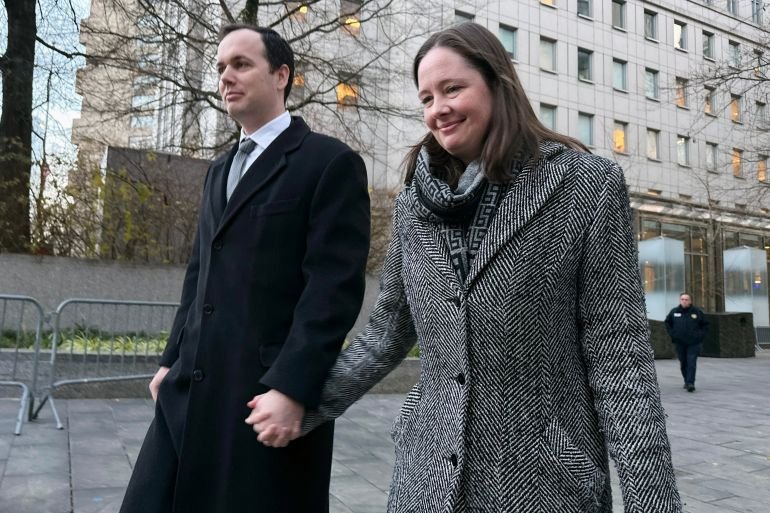
    A United States judge has ruled that former federal prosecutor Maurene Comey was illegally fired by the administration of President Donald Trump.

    US District Judge Jesse Furman said on Monday that the Trump administration had overstepped the boundaries of executive authority when it fired so-called “inferior officers” without cause.

    Recommended Stories

    list of 3 itemsend of list

    He rejected the administration’s position that the president had the power to undertake such firings, regardless of the protections implemented by Congress.

    “To accept defendants’ argument would be to unsettle the very equilibrium established by this nation’s constitutional system,” Furman wrote.

    He also dismissed the idea that federal prosecutors like Comey are an extension of the president’s “conclusive and preclusive” powers.

    “Defendants invented a new and expansive theory of executive power,” Furman wrote of the Trump administration. “They have also utilised that theory to remove other Executive Branch employees who have long held protections from removal.”

    The ruling is a setback for the Trump administration, which has sought to fire federal employees seen as out of step with the president’s priorities.

    Critics have also accused Trump of seeking retribution against perceived enemies. Comey is the daughter of former government official James Comey, who led the Federal Bureau of Investigation (FBI) from 2013 to 2017.

    He was fired during Trump’s first term and has since become one of the Republican leader’s most visible critics.

    Maurene Comey’s legal team had argued that her position was terminated because of Trump’s antipathy towards her father.

    In Monday’s decision, Furman granted her request for back pay from the date of her firing on July 16, 2025, through December. He also said she is entitled to “retroactive reinstatement” for that time period.

    Maurene Comey had served as an assistant US attorney for the Department of Justice since 2015, based in Manhattan.

    She had brought cases against such high-profile figures as convicted sex offender Jeffrey Epstein, his associate Ghislaine Maxwell and music mogul Sean “Diddy” Combs.

    In her lawsuit, Comey alleged that her firing had violated federal laws prohibiting the termination of civil servants for political reasons.

    She also pointed to the separation of powers under the US Constitution, which allows Congress to pass regulations governing federal employees, so long as they do not interfere with the president’s authority.

    The Department of Justice, under Trump, has countered that the president has wide latitude to fire federal employees without cause.

    In response to Monday’s ruling, the administration has said it “disagrees with this decision and will appeal in due course”.

    Since returning to office for a second term, Trump has sought to reduce the size of the federal government and remove prosecutors and investigators involved in cases he disagrees with.

    He has also pushed the Justice Department to prosecute several of his critics, including James Comey.

    In a social media post on September 20, 2025, Trump called on then-Attorney General Pam Bondi to pursue charges against James Comey and several others.

    “There is a GREAT CASE, and many lawyers, and legal pundits, say so,” Trump wrote.

    “We can’t delay any longer, it’s killing our reputation and credibility. They impeached me twice, and indicted me (5 times!), OVER NOTHING. JUSTICE MUST BE SERVED, NOW!!!”

    James Comey was fired when the FBI was investigating potential links between Trump’s 2016 presidential campaign and Russia. That investigation was a frequent subject of Trump’s anger.

    Shortly after the September 2025 post, the Department of Justice charged Comey with lying to Congress. A judge dismissed the case in November after finding the prosecutor who brought the charges, Lindsey Halligan, had been unlawfully appointed.

    In April, James Comey was charged again in a separate case accusing him of threatening Trump by sharing an image of seashells on social media.

    The seashells were arranged to form the numbers “86 47”. The term “86” is used in the restaurant industry in the US to refer to throwing someone out of a bar, but the Trump administration argued that it is a threat associated with organised crime.

    The “47”, it added, was a reference to Trump, the 47th president.

    The ex-FBI chief has denounced the case as an example of political persecution under Trump.

  • ‘Deflections’: Abdul El-Sayed responds to Trump’s anti-Muslim attacks

    ‘Deflections’: Abdul El-Sayed responds to Trump’s anti-Muslim attacks

    The Democratic candidate for the US Senate has been the subject of Islamophobic attacks from Trump.

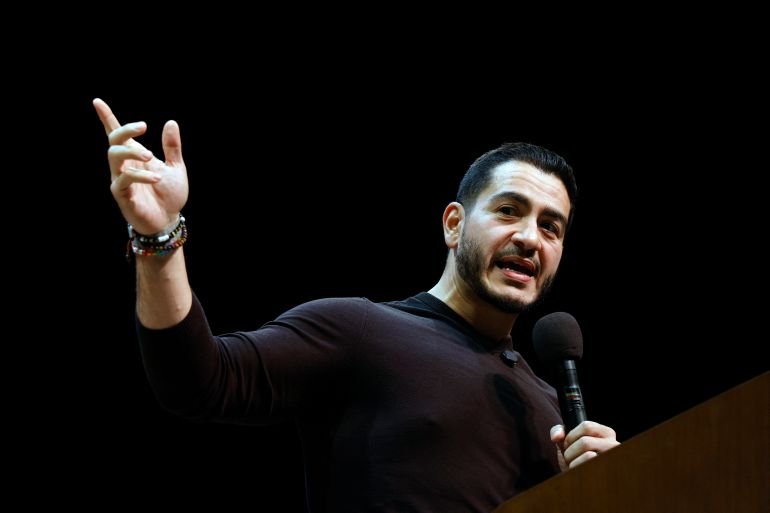
    Detroit, Michigan – Democratic Senate candidate Abdul El-Sayed has dismissed United States President Donald Trump’s anti-Muslim attacks against him, saying that they are an attempt to move the attention away from the president’s own record.

    At a news conference in Detroit on Monday, El-Sayed said Trump is trying to distract from issues that matter to Americans – including petrol prices and the war on Iran – by accusing the Democratic candidate of being a “jihadist”.

    Recommended Stories

    list of 3 itemsend of list

    El-Sayed called the attacks “deflections and deceptions based on no evidence”.

    “They have nothing to say about solving the problems in your life. They’re not talking about you,” the Democratic candidate said of Republicans.

    “They’re not talking about your gas or your groceries … They’re not talking about clean air or clean water. They’re not talking about any of the things that the government is actually supposed to solve. Why? Because Donald Trump has created those problems.”

    At a rally in Michigan on Sunday, Trump unleashed repeated baseless claims against El-Sayed, accusing the Democrat of wanting to impose “Sharia law” on the country.

    “He would be the only senator that will have to go through a metal detector before he’s allowed to go into the Senate,” Trump said. “I want him to have a metal detector.”

    El-Sayed laughed off the suggestion that he may personally be a physical threat to Congress. “He knows I got those Wolverine claws,” he said, a reference to the sports teams of his alma mater, the University of Michigan.

    The progressive Democrat and former public health official is locked in a close race with former Republican Congressman Mike Rogers, a contest that could decide the Senate majority for the next two years.

    Rogers has made unfounded allegations linking El-Sayed to the Muslim Brotherhood, Hamas and Hezbollah a central point of his campaign.

    On Monday, El-Sayed said most Americans reject such attacks.

    “There are always a few small people who want to make America small like that. You see them; they’re very loud, and they bark,” El-Sayed said.

    “The vast majority of folks in this state believe in a big America. They’re open-minded. They’re big-hearted. And the story of America is those who believe in big America, overcoming the deception, the distraction, the sad attempts of the small-minded to make us small.”

    He added that “Michiganders are a lot bigger than that”.

    El-Sayed also addressed Trump’s statements mocking his name and misrepresenting it as “Mohamed”.

    “My name and my faith are not the reason you can’t afford your gas – not the reason you can’t afford your groceries, not the reason you can’t pay your rent, your mortgage, not the reason you can’t see a doctor,” he said.

  • Trump faces private citizens lawsuit over limiting White House media access

    Trump faces private citizens lawsuit over limiting White House media access

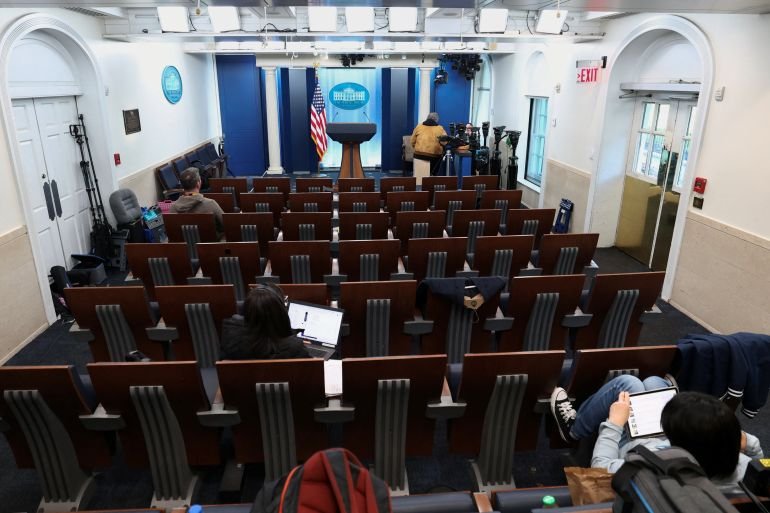
    The plaintiffs argue they are losing access to vital information media outlets covering Trump used to provide.

    A group of private citizens has sued the administration of United States President Donald Trump over its restrictions on news outlets covering the White House.

    “All of the Plaintiffs rely on the White House press corps for independent reporting about the president and his administration, and all of them use that reporting in a variety of ways in their scholarship, teaching, journalism, or advocacy,” says the lawsuit, filed on Monday in a federal court in New York.

    Recommended Stories

    list of 3 itemsend of list

    The lawsuit is the first lodged not by the news outlets being banned, but by those who consume the news and rely on it for their work.

    The plaintiffs include a human rights advocate, a media watchdog, a university history professor, a high school teacher, a legal journalist and a student journalist.

    Each argues they need unbiased, diverse media reporting from the White House to do their work.

    “I’m gravely concerned that the Trump administration’s restrictions on White House reporters are cutting off access to crucial information,” Peter Schmidt-Nowara, a high school social studies teacher in New York City, said in a statement.

    “I joined this lawsuit because my students deserve to know what’s happening in their government and to hear from a free and independent press.”

    Trump already faces several legal challenges to his practice of banning journalists from outlets he dislikes from accessing the White House.

    Last month, he banned journalists from CNN, MS NOW, and Politico from attending news conferences at the White House. A federal judge later ruled the order was unconstitutional, a violation of the First Amendment, which protects freedom of the press, and ordered access be restored. However, the Trump administration continues to fight the ruling.

    Last week, Trump dismissed reporting that he planned to evict journalists from the White House press briefing room and restore a swimming pool that was housed there starting in 1933. But he said he is still considering moving the press out of the briefing room.

    “I am thinking about moving the Press, and putting them in a different location, but I will use that location for very badly needed space,” Trump said in a social media post.

    Kenneth Roth, a senior fellow at Yale University and former executive director of Human Rights Watch, said the restrictions on press access were familiar postmarks in countries whose leaders have become authoritarian.

    “Worldwide, I have seen how governmental leaders’ efforts to penalise independent journalists are a prelude to the rise of autocracy,” he said in a statement.